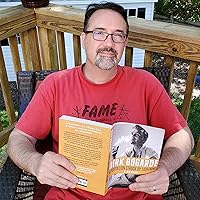
In 1970 Dirk Bogarde retired from acting and turned towards a quieter, more contemplative, more settled way of life. He both dreaded and yearned for a change from the preceding 20 years of "continual motion." Bogarde sought "a place of my own" and found it in a dilapidated farmhouse in the south of France. He writes eloquently of the dual struggle he faced--first dealing with years of neglect to the house and the land; second, with the awful fear that he had made a frightful error. Finally, we share his success in creating a real home, a sanctuary of simplicity and quiet ease where he intends to stay for good. "Bogarde's rare talent for giving resonance to both the small and large moments of life makes this a singularly rich and satisfying memoir." (Publisher's Source)
Dirk Jules Gaspard Ulric Niven van den Bogaerde was born of mixed Flemish, Dutch and Scottish ancestry, and baptised on 30 October 1921 at St. Mary's Church, Kilburn. His father, Ulric van den Bogaerde (born in Perry Barr, Birmingham; 1892–1972), was the art editor of The Times and his mother, Margaret Niven (1898–1980), was a former actress. He attended University College School, the former Allan Glen's School in Glasgow (a time he described in his autobiography as unhappy, although others have disputed his account) and later studied at the Chelsea College of Art and Design. He began his acting career on stage in 1939, shortly before the start of World War II.
Bogarde served in World War II, being commissioned into the Queen's Royal Regiment in 1943. He reached the rank of captain and served in both the European and Pacific theatres, principally as an intelligence officer. Taylor Downing's book "Spies in the Sky" tells of his work with a specialist unit interpreting aerial photo-reconnaissance information, before moving to Normandy with Canadian forces. Bogarde claimed to have been one of the first Allied officers in April 1945 to reach the Bergen-Belsen concentration camp in Germany, an experience that had the most profound effect on him and about which he found it difficult to speak for many years afterward. As John Carey has summed up with regard to John Coldstream's authorised biography however, "it is virtually impossible that he (Bogarde) saw Belsen or any other camp. Things he overheard or read seem to have entered his imagination and been mistaken for lived experience." Coldstream's analysis seems to conclude that this was indeed the case. Nonetheless, the horror and revulsion at the cruelty and inhumanity that he claimed to have witnessed still left him with a deep-seated hostility towards Germany; in the late-1980s he wrote that he would disembark from a lift rather than ride with a German of his generation. Nevertheless, three of his more memorable film roles were as Germans, one of them as a former SS officer in 'The Night Porter'.
Bogarde's London West End theatre-acting debut was in 1939, with the stage name 'Derek Bogaerde', in J. B. Priestley's play Cornelius. After the war his agent renamed him 'Dirk Bogarde' and his good looks helped him begin a career as a film actor, contracted to The Rank Organisation under the wing of the prolific independent film producer Betty Box, who produced most of his early films and was instrumental in creating his matinée idol image.
During the 1950s, Bogarde came to prominence playing a hoodlum who shoots and kills a police constable in The Blue Lamp (1950) co-starring Jack Warner and Bernard Lee; a handsome artist who comes to rescue of Jean Simmons during the World's Fair in Paris in So Long at the Fair, a film noir thriller; an accidental murderer who befriends a young boy played by Jon Whiteley in Hunted (aka The Stranger in Between) (1952); in Appointment in London (1953) as a young wing commander in Bomber Command who, against orders, opts to fly his 90th mission with his men in a major air offensive against the Germans; an unjustly imprisoned man who regains hope in clearing his name when he learns his sweetheart, Mai Zetterling, is still alive in Desperate Moment (1953); Doctor in the House (1954), as a medical student, in a film that made Bogarde one of the most popular British stars of the 1950s, and co-starring Kenneth More, Donald Sinden and James Robertson Justice as their crabby mentor; The Sleeping Tiger (1954), playing a neurotic criminal with co-star Alexis Smith, and Bogarde's first film for American expatriate director Joseph Losey; Doctor at Sea (1955), co-starring Brigitte Bardot in one of her first film roles.
Bogarde continued acting until 1990. 'Daddy Nostalgie' was his final film.
I love the way DB has Special Themes he wants to pursue and weaves them in and out and often they will merge as life often does."What's this chapter doing here ?" I'd query, but I'd soon find out. He was very averse to doing a Hollywood Style "My Life"; which is why he often fails to give even the name of the film he is working on, although he took his acting very seriously.
The main themes in this book are: * his decision to leave England and live in France and the long and interrupted process of it; *to give up his acting career which had since moved from English films to European directors and a differing attitude to films; *to care for his ageing parents, discovering more about them and the World of their Marriage ; *his fascinating analysis of his approach to acting which has no need of an audience compared to his mother's vital need of one; *his development of his writing skills due to an unexpected friendship which climaxes in the publishing of the first book in this autobiographical series. *his view of the changing face of the Movie Industry.
These are often bumpy journeys and filled with an array of interesting characters and events - puzzling, infuriating, sad, inspiring, intimate, absorbing, amusing and enlightening. It is not the usual "Star Tells All" book which can be absorbing at best but it is in many ways a secluded life, a full life, a GREAT read !!!
Yes he is a talented writer with Something to say and a Talent for saying it...despite a slow start in acquiring the abilities to take on the job because he did miserably at school as he just wasn't interested. But events led him to LOVE books ; and though he had appalling punctuation, using his own method of DOTS, (as Emil Dickinson had her dashes!) and was an Orfull speller, he wrote often to a woman in the USA who had lived in the house he then called his own. She sometimes corrected his letters and gave him advice about writing. When he left the house for one in France he decided to write about his childhood for her.
All of which had many consequences.
He was requested by the directors of Chatto and Windus to write about his life after they had heard him speaking very passionately on a TV interview about the Film Industry and admired his Gift of the gab. They of course had no idea about his lack of formal skills but they recognised a Grand Spirit, which was the essential ingredient.
I was never really aware of DB as an actor until I was older and realised that he was a natural, like Peter Finch...seemingly effortless. I found myself watching every film he was in when I got the chance knowing I would be rewarded with a talent. He still had more to offer and still does, acquiring fans although his pen has been laid to rest.
I have found my answer to the: "If you could hop on a time machine, where and when would you go?" Well, James Baldwin and Dirk sipped champagne during Bogarde's 50th birthday lunch in France. So there. Oh, Bogarde!
"An Orderly Man" is the third of Dirk Bogarde's eight volumes of autobiography. I read the first book, "A Postillion Struck By Lightning," recently, and went directly into this one, skipping the second book, something I correctly assumed that I would come to regret, but which couldn't be helped.
The book covers Bogarde's life from 1970 to 1981 and has four main story lines: 1) Bogarde's purchase, renovation, and on-going improvements to a farmhouse in the south of France which proved to be both a peaceful haven and a money-pit, 2) the decline and deaths of his parents, 3) the films he made during the period with such giants as Visconti, Resnais, and Fassbinder, and 4) the start of his new career as a writer.
Bogarde was quite a gifted writer for someone who had been trained in an entirely different field. His light touch and eye for detail make his books delightful to read.
Nearing the end of Dirks Autobiographies, he tells of his life in France and how he began his writing career in the pigionnier of his beloved house, high in the hills near Grasse in Provence. Eloquent, evocotive and endearing, another triumph. He makes you feel as though you know him as an old friend, he takes you into his world and makes you feel privileged and pleased that you discovered his wonderful books. He gave me so much pleasure, a wonderful man, he is missed.
The third volume of Dirk Bogarde’s series of autobiographies covers the early 1970s to the early 1980s, what might be termed his “arthouse years” as an actor, the period in which he made Luchino Visconti’s “Death In Venice”, Liliana Cavani’s “The Night Porter”, Alain Resnais’ “Providence” and Rainer Werner Fassbinder’s “Despair”, but prepare to be (slightly) disappointed if you’re expecting any kind of “acting diary.”
By this time, Bogarde is pretty disenchanted with cinema, and though he tells us *just* enough to satiate the appetites of film buffs, his thoughts are mostly elsewhere; with the purchase and renovation of a French farmhouse, the declining health of his parents, his two “needlewomen” mentors, and (in a circular touch) the beginnings of his entirely unexpected (and very successful) career as a writer, brought about when a publisher catches an extended TV interview between Bogarde and Russell Harty, senses he could be a born (if reluctant) raconteur, and suggests he might have an autobiography in him…
As ever, Bogarde is engaging company, and a genuinely excellent writer, who weaves the characters and events of his life together so deftly that you actually look forward to catching up with his friends and family between diversions into the worlds of cinema and publishing, especially the more tortuous aspects of publicising his films and books on the interview circuit.
Even though this volume is less intensely “personal” than the first two, it’s still a more than worthwhile addition to the series, and highly recommended for fans, though obviously those initial volumes should be the first stop for newcomers.
In his third volume of autobiography (and the only one I've read), Bogarde covers his move to France (where he buys an old farmhouse which comes with a lot of unforeseen problems), the birth of his writing career (quite a tale in itself), and the films he made in the 1970s.
Film-wise, he writes at length about 'Death in Venice', 'The Night Porter', 'Providence' and 'Despair' and more briefly about 'The Serpent', 'Permission to Kill' and 'A Bridge Too Far', which he obviously has a lower opinion of. What he has to say about 'The Night Porter' I found especially interesting, so I watched the movie, but unfortunately didn't like it at all. Although it's well-made, I couldn't help wondering why the hell anyone would want to make such a film.
I recently read the autobiographies of a couple of other actors (Basil Rathbone and Joseph Cotten) and I have to say that Bogarde's writing is way better. This is partly a matter of style, but it's also due to the fact that he's not afraid to go deep, avoids sentimentality and seems to care little about portraying himself in a favourable light.
An actor in his prime: Dirk Bogarde writes fluidly about the vicissitudes of the business, from Death In Venice and Rainer Werner Fassbinder to the tiring treadmill of promotions and commercial death in “critic’s films”. As he says, this is not a Hollywood biog, there’s little sex or scandal (though he has the source material) and celeb anecdotes are few and far between - though prime cuts when they do arrive, such as Judy Garland’s advice on being adored. Bogarde writes crisply and without self-pity in a way that’s long out of fashion - reserved yet self-critical. A pity he doesn’t open up more on his private life (tales of the renovation of his auberge in the French backwoods substitute for anything about him and Forwood) but that’s his way and perhaps the better for it. A study in control and camouflage disguised as memoir.
This volume focuses on the latter part of Dirk's film career, working with Visconti, Cavani and Resnais, and his time spent living in Provence. Like the first two volumes of Dirk's memoirs, this is a great read, especially of you're a fan of his film work. On to Volume 4...
Absorbing autobiography by a very great actor. I found it easy to read - told with honesty and keen intelligence. Bogarde was very insightful and generously shared his thoughts and reflections. Wonderful book.
This is the third of Bogarde's autobiographical works. I am reading these in random order as I stumble upon each book in second-hand book stores. Yet there is a continuity in Bogarde's writing that seems to make it easy to piece together. Each work is a standalone wonder of personal stories that are somehow vividly interesting. I "discovered" Bogarde after reading Thomas Mann's Death in Venice and then watching the movie of the book. I also "discovered" Mahler. After watching the movie, I have become more aware of the name of Dirk Bogarde and this has sent me on a mission to read all of his works (15 I believe). An Orderly Man is of interest because it covers the period of Bogarde's portrayal of Gustave Aschenbach. The work brings to life Visconti and other famous Art House directors and screen writers and presents in sharp relief the life of an English actor of the period working on the Continent versus the excesses of fame and fortune in Hollywood. Bogarde's humility shines through and it is difficult not to admire the "underdog" and his trials and tribulations. Mind you, living in Provence and existing by acting and writing are hardly the banal stuff of most people's lot. Yet the stories are fascinating, Bogarde makes a wonderful success of writing about writing (and acting) and finishing each of his books so far leaves me calmly contented and eager for the next book.
The third in Dirk Bogarde's series of seven autobiographical works. Most of this one is about his move to France and trials with that. There's the usual account of what films he was doing during the period written about and his thoughts on first becoming a published author. The series is worth a read for anyone who likes autobiography, of which these books are an excellent example. Bogarde did not utilise any ghost writer and he could write very well, as this and other books attest. He also wrote some fictional works, which I will probably track down in due course. I enjoy his writing.
Backcloth is next up when I get through another historical work.
I really enjoyed all of Dirk Bogarde's books. I read them a long time ago, so forget the details, but a good idea to start with the first one, "A Postillion Struck by Lightning" This series is autobiographical. I love France and he spent a many years living there. Thoroughly entertaining.
Others in this series are (in order): 2/ Snakes and Ladders 3/ An Orderley Man 4/Backcloth 5/A Short Walk from Harrods 6/Cleared for Take Off
slightly prissy (of course!), it reads a bit patchy, and he has a melodramatic habit of ending sections with something "significant". reads as sincere, and makes one yearn to enjoy the anecdotes over a bottle on his patio in the south of france.
In this third volume of his autobiography, Dirk becomes the un-Peter Mayle in his new house near Nice, and slowly shifts from actor to author. Not quite as outstanding as volume two, but more touching.