Carla, una norteamericana distanciada de su padre mexicano, decide ir a la capital del país azteca para “encontrarse a sí misma”. Se instala en casa de un antiguo ligue que sigue las huellas de sus héroes William S. Burroughs y Jack Kerouac por los bares de la ciudad. Harry se toma con buen humor la reaparición de Carla en su vida hasta que se da cuenta de que ésta, que se pasa los días empapándose de la ciudad, explorando la casa de Frida Kahlo y aprendiendo español, no tiene intención de largarse.
Cuando la relación de mutua tolerancia entre Harry y Carla llega a su inevitable fin, ella reniega de su mundo de anglófonos expatriados y se busca su propio grupo de amigos: el guapo Óscar, un camello con ínfulas de DJ, y el carismático Memo, un mujeriego pseudointelectual de izquierdas.
Los evocadores dibujos en blanco y negro de Jessica Abel hacen cobrar vida a la ciudad de México de ayer y de hoy, desplegando la oscura historia de Carla frente a los legados de Burroughs y Kahlo. Un relato sobre el deseo juvenil de vivir una vida auténtica y las consecuencias de confiar en las respuestas sencillas, La perdida –arraigada en las especificidades de la vida en México y universal a la vez– es una historia sobre encontrarse a uno mismo al perderse.
Author and coach Jessica Abel is the author of Growing Gills, Out on the Wire, La Perdida, and two textbooks about making comics, Drawing Words & Writing Pictures and Mastering Comics. Abel’s latest work of fiction is the Eisner-nominated Trish Trash: Rollergirl of Mars.
È la storia di una ragazza che parte per trovare se stessa e finisce quasi per perdersi. Ma il finale è rassicurante.
Cerca di immergersi in un mondo che non conosce (Città del Messico): anche se di padre messicano, non comprende la lingua né ha mai visto prima il paese. Si impegna per penetrare nella società e nella cultura locale, per diventarne parte, e non limitarsi a conoscerla. Ma sbaglia approccio - oppure si tratta di un mondo che proprio non le appartiene, non è il suo.
Quindi, senso di estraneità unito a un forte desiderio di accettazione (soprattutto di essere accettata).
Però la storia è troppo arzigogolata, il lungo finale mi sembra in qualche modo scollegato.
Ma non è questo il suo limite maggiore. Il vero problema è che tutto è molto spiegato, didascalico, nessuna sottrazione, neppure le banalità vengono risparmiate. Vignette piccole con disegni carichi e pieni di particolari. Faticoso da leggere, da seguire. Anche per via dei refusi.
When I first started to read La Perdida I really enjoyed it because I was excited to read a graphic novel about a young Mexican-American woman. I also enjoyed the author/artist Jessica Abel's sparsely drawn images of Mexico City landmarks (and Pilsen in Chicago).
Unfortunately, as the story progressed I started to become uncomfortable with the authors negative portrayal of Mexico City/Chilango youth culture. Raw honesty I appreciate, but the author painted a seedy world where you can't trust anyone even yourself. In the end it's just another cautionary tale, with witty dialogue and a cool Mexico City setting. The author doesn't truly explore Mexico City/chilango culture or the bi-culture identity of U.S. born Latinos it just uses them as a background.
Oh, and I learned later this book is not a memoir it's a work of fiction (i.e. Abel is not Latina). Maybe it would have been more relevant if it was based on real events and experiences.
I don't even recall how I stumbled across Jessica Abel's La Perdida—probably in doing research on Love & Rockets—but I'm glad I found it. While far from perfect, the first three-fifths of the graphic novel or so are wonderful, and while it kind of devolves into a melodramatic plot that unfortunately reeks of stereotypes of Mexico, overall it is still strongly characterized and well-drawn.
Carla, the protagonist may be a post-college naïve-as-hell gringita prone to willful ignorance and drunken outbursts, unable or unwilling to accept her own position of privilege vis-á-vis her Mexican friends and neighbors, but her earnest desire to learn something about Mexico as to learn about her own Mexican-roots (her father is Mexican) along with her foibles makes her all the more believable, and makes her downward spiral understandable, as she gets involved with some asshole dudes, who spout Marxism and machismo in the same rants, littering truthful indictments in their anti-American diatribes (while wanting some of the cache that comes along with hanging and sleeping with an American girl), while also serving to psychologically break Carla down through her confusion and self-loathing.
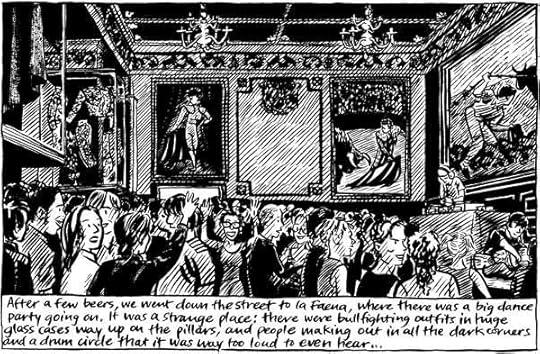
All of this works and the art reinforces that. Abel uses a clean black and white “cartoony” style, but there is energy and movement in how the panels depict the heated arguments and frenetic partying. She also draws fantastic representations of various sites in Mexico City. She mostly uses a straight-forward six-panel per page layout, which means when she does break into larger panels it effectively displays the importance, breadth or majesty of what is being depicted. The only time her artwork fails is not because of the drawing itself, but because later, when most of the action takes place in Carla's little apartment where she obsessively follows a kidnapping story in the newspapers, it starts to feel static and repetitive. While I think it does serve to demonstrate Carla's relative isolation during this time, Abel might have done more with the text and narration to make it more engaging.
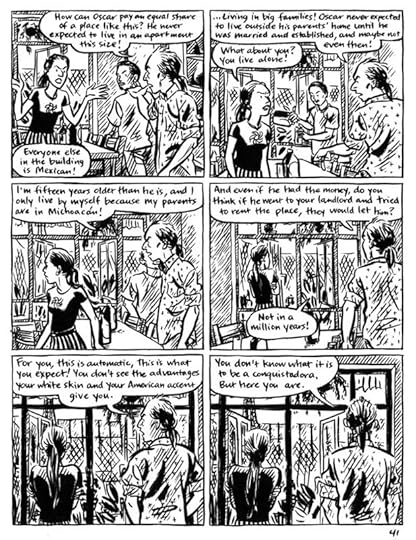
If La Perdida was only about Carla's search and confusion regarding her Mexican-American identity, if it spent more time exploring how she allowed her desire to befriend “real Mexicans” to obfuscate the fact the men she ended up hanging around were just no good, that regardless of her intentions her own desire to party—doing bumps of coke and selling nickel bags of pot—was as misguided as the attitudes of the other American expats who kept themselves separate from the Mexican community surrounding them (and that Carla harshly criticized) it would have been a fine book by itself. It is admirable how Abel has Carla struggle with her privilege. She does a good job describing the social dynamics between various groups of expats, and between those expats and locals and different groups of locals. But there is only a hint of that parallel world once Carla gets caught up in seedy underbelly that unfortunately is the dominate narrative regarding Mexico in general and Mexico City in particular. As such, La Perdida does some work in reinforcing the very stereotypes that I think Abel was trying to avoid. In the end, Carla mentions that there was so much going on that she ended up closed off to because of her own conceptions of immersing herself in Mexico, but those mentions don't do enough to save the conclusion of the novel.
I can't give this four stars, but three seems too low. It is was very engaging and I tore through it and I'd recommend it, but it just doesn't go deep enough for my tastes.
I divide this book into two parts, even though it's not formally divided as such. There's such stylistic difference between them, it almost seems like there should be a formal divide. The first part of the book is a coming of age post-college, finding oneself while traveling, open-ended exposition. There's not much plot, just a lot of wondering around and talking to people. This isn't necessarily a bad thing -- I really enjoy those types of stories if they're done right. But what stopped me first from getting into this was that I couldn't relate to Carla, the protagonist, and in fact, didn't like her all that much. As we find out later, this is part of the point. If she were completely likable then she couldn't have had the moment of breakthrough at the end.
The second, much shorter part (though that could be because the first part dragged) is the action, the plot, where we see that that the first part, where nothing much seemed to be happening, actually did have a point, and that is to serve as the set up and background to the eventual plot. I did end up enjoying this part of the book, but I wish that the beginning was more condensed, or that Carla was easier to like.
I was more a yawning spectator of her trip rather than being along for the ride.
Although it's not a memoir, La Perdida is based on the author's personal experience and is memoir-esque. On the surface, it sounds interesting: a half-Mexican woman goes to Mexico to get more in touch with her cultural heritage. It was pretty well regarded.
IT IS AWFUL, YOU GUYS.
I wanted to give it up halfway through the second issue because I was so bored. I just didn't care about anything! All the characters were annoying, and nothing fucking happened. Each issue seemed to be nothing more than the main character pissing off some new friend she makes, and since the story is from her perspective, it almost seems like you're supposed to feel sorry for the fact that she runs into so many assholes, but maaaaaybe she's the real problem here. She's so concerned with having an "authentic" experience that she can't accept the fact that she is not authentic, and it is not only impossible but insulting to step into another culture and pretend you're one of them.
There were small moments here and there where I saw the story I thought it was going to be, but they were few and far between. I thought it would be an interesting discussion of culture clashes and finding your cultural identity and appreciating your heritage and all that business, but instead it was just a boring-as-shit series of occurrences that don't provoke any emotional reactions. And the last couple issues were such a bizarre place to take the story. I have no idea what the hell she was trying to say with all that. Mexico is violent and dangerous? That is the ultimate point of this story, what? If I were one to throw things across the room, I would have done so.
This is the worst graphic novel I have ever read, hands down.
I have to say, I was extremely lukewarm to this book. It seems like the kind of thing I would like, but overall I didn't see what all the hype was about. The entire plot rests on the main character being annoying, stupid, and so desperate to please her 'real Mexican' friends that she throws common sense out the window. By the end, you just want her to stop white guilt whining about how HARD it is to be privileged and to stop trying to win the favor of people who she can never win over. The ending is tense and page turning, but I kinda figured out that was where we were going about halfway through.
And the art is good, but it is nothing to write home about. If you've never thought about issues of privilege, race, and culture this could be an eye opener. If you have, it is actually really boring to listen to Carlas pretentious whining. She doesn't do anything with her guilt and issues besides drink with scumbag lowlifes while the reader is forced to constantly roll their eyes.
Nunca había leído un libro de ficción que repitiera tanto las palabras: capitalista, burgués, elitista, imperialista, comunista, fascista, política y colonizador
This book is part of my 2016 resolution to read all the books on my shelf that have not been read to this date.
I DID NOT enjoy this book at all. It took me 10 pages to know that Carla was the most naive Mexican-american in the world. This book portrays the Mexican culture as one of low-life people who are selfish and do not care for anything in the world besides themselves. While I do agree that Gringos are treated it different in Latin cultures, I have to disagree in the way Carla was treated... She didn't exactly deserve it, but come on? I do not want to go into details but -ugh!!- I seriously dislike her and 99.9% of her actions. There's no real story, the characters are all assholes, except for one good friend Carla had, and threw away defending her asshole friends. I am not the type of person that reads any book regardless of how bad they are... I put them aside and take another one. I finished this book because I didn't want to write that it was crap until I knew for sure that it was crap indeed.
The dust jacket is the only reason this book should get a single star, its beautifully done and with a grat color pallette. Besides that, this is the perfect book to take to a campmfire if you are out of wood or fuel. Terrible story, full of cliches, awful black and white drawings. Maybe if it had been done in full color it could have been eye catchy, but its not. It does not seem to start that bad , but as you continue it only gets worse. The depction of mexico city at the beginning is quite fair, but as it goes on, it uses the same resources every simplistic and bad story taken part in Mexico´s capital uses, partucularly kidnapping (there are so many bad kidnaping stories taken place in mexico city, it could be a genre by itself). I dont understand how the author became such a refential point within women graphic novel creators, with such a lousy book.
Este tebeo da una visión tenebrosa de México a través de los personajes con los que se relaciona su protagonista. Un entorno que encuadra la crisis de su protagonista, atrapada en una búsqueda personal que termina sacando a la luz su inmadurez, una pésima gestión de "amistades" y sus consecuencias. Su personalidad variable, con uno de los extremos situados en una estupidez que puede hacerse cargante, es el mayor logro de Abel además de cómo transforma paulatinamente una historia costumbrista en un thriller claustrofóbico. El dibujo recuerda mucho al de Dupuis y Berberian o Craig Thompson, un poco menos suelto, más recargado. Pero Abel sabe aligerar los fondos o cambiar la luz con la tinta cuando llega el momento de enfatizar los clímax. Y aunque ha tardado en atraparme, me he leído las últimas 150 páginas de una sentada.
This is more like a 3.5 for me, but I'm rounding up.
In some ways, I think the format of the graphic novel is somewhat limiting to the subject matter, since it involves issues of race and identity, and what it means to be of mixed ethnicity--which is some rather complicated stuff to convey with simple line drawings, dialog and occasional narrative.
The main character, Carla, has grown up in the U.S., always speaking English and only English, but moves to Mexico City and gets caught up in trying to live an 'authentic Mexican' life there. Unfortunately, her means of doing this is to fall in with the first group who will have her. And while several members of this new cluster of friends rail against tourists, whites, capitalism, and the United States, they seem to connect to Carla exactly because that is what she represents--and because they think she may provide them some advantage from her ties to the United States and the world of privilege. But they are fooling themselves just as much as Carla is fooling herself about her ability to become Mexican--or even half-Mexican--by rejecting some of the more obvious connections to the world of the expats.
So characters like Memo attempt to impress Carla by inviting her along on 'authentic' excursions which he admits to his friends are only meant to impress gullible American women. And Oscar, who becomes Carla's boyfriend, seems to be perpetually bugging her for money (which she doesn't have) or to connect him to Americans who can further his DJ career--a career he never really pursues in any meaningful way. Carla believes she is finding herself, but is mostly just drifting. Her story could be like that of many people in their early to mid-20s, running around to parties, not having any real direction, and making plenty of bad choices--she just chooses to do it in a city that is foreign to her.
I was somewhat disappointed with what occurred in the final act--it seemed a bit too easy to go that direction, especially when, up to that point the entire story had been more about relationships and connections between people. Although looking back I realize that Abel was leading up to that kind of conclusion, I think I had been blinding myself to it, in the hopes of a more 'down to earth' end to the story.
Still, there is plenty of good material here, and it's easy to identify with much of it, and the misguided decisions Carla and those around her make. For instance, it's very telling when, near the end of the story, Carla realizes she never even bothered to look up the village where her father's family came from, or made any effort to track down any of her blood relatives. There were ways for her to connect with (half) her roots, but she left those paths unexplored.
as a graphic novel, i think "La Perdida" is a total success, the way the awesome illustrations tell the story and are supported by the text. i picked it up and started reading and couldn't put it down. brilliant!
unfortunately, the story lacked the depth and analysis about certain issues (class privilege, racism, tokenism..) that would have made it great. the clueless main character annoyed the shit out of me by making horrible choices and basically just being a total idiot. the story offers great potential to explore the main character's identity as a bi-racial/Latina woman from the U.S. living in Mexico & learning Spanish for the first time in her life. however, her identity was barely mentioned, later ridiculed, and eventually denied completely. infuriating!
one thing i appreciated was how honest the main character was about her flaws & bad choices. i felt like the whole time i was reading the book, she & i together were looking back on her story, thinking together "oh, god, that was SOOOooooo fucking stupid!" i was hoping/expecting that by the end of the book, everything would magically come together and there would be some sort of intelligent point to it all, especially after the terrible, embarrassing kidnapping/murder plot twist (why?! what the fuck?!). sadly, though, by the end of the book i still didn't get the impression that she had learned anything. after all of that! aaagh!
More than anything a coming of age graphic novel where the young person is not only the narrator but their identity and that of a county lurching into the 21st century. The narrative trips over itself a few times and the dialogue can feel a little set-upy instead of natural. But make no mistake. La Perdida is a huge-friggin achievement, amazingly drawn, so sure of its setting in Mexico City and place in time (late 90s) that it feels as much a diary or historical document. Or just a conversation with a magnificent storyteller who probably lived it.
Were it slows up is a passing annoyance compared to what Jessica Abel has done here. Bravo. I was to see more.
I really love the concept of this book, and I thoroughly enjoyed the first 1/3 of the book, which was 50% in Spanish. It was disappointing when it switched to 100% English. I wish the author would have stuck with the 50% English/50% Spanish model, which made the book really unique.
I also enjoyed the story at the beginning, but it drastically switched gears in the last half of the book, and turned into a depressing chronicle of drug abuse and dysfunctional relationships. This book really wasn't enjoyable for me after the switch to English, but I really enjoyed the beginning of the book, so I'm giving it two stars.
Great texture about life in Mexico City for a young American expat circa the dawn of email, reinforced by detailed and fluid drawing that's reminiscent of early Craig Thompson. What begins as a slice of life narrative turns increasingly macabre, largely without losing its balance. Although some of the emotional outbursts felt forced and a few plot pivots were predictable, I suspect this story of self-delusion disguised as a search for authenticity will stay with me for a while. 3.5 stars.
Expats, socialist revolutionaries, drugs, bad choices, kidnappings. And surprise surprise, an unhappy ending. At first I wanted to imagine that this is what my college roommates life was like in Colombia, but in the end, I hated the narrator, there were no other likeable characters, and they were drawn pretty unattractively too. Also it was hella long. Bleck.
Za mna dost ukecany a divny komiks. Hladanie identity som videla znazornene inac a ovela lepsim sposobom. Prilis vela textu ma odvadzalo od toho grafickeho, ktory byva v komiksoch platformou na vyjadrenie emocii a aj roznych situacii. Tu boli ob-rozpravane a to mi liezlo na nervy. Ani pribeh ma nejako extra nezaujal, stred som preskocila a vobec mi to nechybalo...
I feel like this book had a real chance to say something about Mexico, privilege, worldviews, living abroad post-college, Americans abroad in general, blah blah etc. etc. I mean I guess this book is almost 20 years old at this point, and ~conversations~ were ~different~ back then, because we didn't have Twitter poking us 24/7 and telling us to be #woke. Maybe. I don't know. I was living under a rock in 2002. (I live under a smaller rock now (and I quit Twitter, so what do I know, anyway?))
But this book didn't say those things. And while that's disappointing, I also felt excited about this book because (as far as I know) it wasn't a memoir!!!! So many graphic novels I read are memoirs, which is nice and fine but over time it can start to feel a touch formulaic. This was (again, as far as I know) just a crazy story about how sometimes you make one decision (or two decisions, or even ten decisions, but still) and the next thing you know your life is is a gargantuan (and, in the case of this book, scary) mess.
I feel like this book could have taken place anywhere, though. OK, not anywhere. But maybe not Mexico.
I hope the next book I read that takes place in a different country uses the fact that it takes place in that country to do something a little ~more~ than what this did. But I also hope to read more non-memoir graphic novels in the future.
Me gustó la historia al principio porque luego se desvió de lo que pensé iba a tratar. Carla es una chica que desea encontrar sus raíces, desea encontrarse a ella misma y viaja desde Estados Unidos a México. En un principio se va a vivir con su ex-novio Harry, Hijo de un hombre importante y que vive en este país por razones que no logro entender del todo, no siento que desprecie como tal a los mexicanos pero no le interesa conocer el país, ni sus costumbres, ni a las personas que allí viven. Carla empieza a conocer todo un nuevo mundo que la hará pelearse con todo lo que conocía, para ella es una manera de acercarse a una cultura que es en parte suya pero que nunca lo ha sido. A medida que iba leyendo me sentía incomodo por las situaciones que se planteaban porque pueden que sean reales pero no creo que sea la regla general.
No me parece que Carla sea un personaje desesperante y por el contrario creo que representa esos momentos en los que estamos en la búsqueda de un sentido y en los que nos gusta probar aquello que nos es desconocido y por ende terminamos peor que como empezamos.
La Perdida by Jessica Abel A Review by: Ryan Caplinger
La Perdida by Jessica Abel, is a graphic novel about a half-Mexican and half-American girl named Carla who moved to Mexico to learn about the culture. Carla moved in with her ex-boyfriend, Harry. She tries to fit in, but she looks American and many of the Mexicans don’t like Americans, so she gets ridiculed all the time. Abel shows this when she states that “I was trying to predict exactly how Memo would manage to make me feel like a traitor for hanging out at the international terminal, welcoming the tourists” (109). When Carla begins to hang around Memo and Oscar more, she gets in a fight with Harry and is forced to move out. She is then influenced by them and starts doing bad things. I don’t want to give anything away but she is forced to play a part in something very dangerous and illegal. Sounds like a great read, right? Wrong. I would rate this novel a two out of five stars. The first few pages were very interesting. It had a good hook because it was talking about how she got banished so it interested me to see how she got there. But after that, the beginning of La Perdida was extremely boring. It introduces the characters, but you don’t learn much about any of them other than Carla. Also, nothing important happens. In the middle, it got better with a little more action when Carla went to parties. I feel like the middle of the book was all over the place. Also, the main conflict wasn’t developed until the very end. I thought the end of the book made it a lot better because there was a lot of drama and suspense. I kept wanting to read more because it was so interesting. If it wasn’t for the last 40 or so pages, this book would be a generous one star. I couldn’t connect to anything in this book. Carla was a complete outsider and she didn’t fit in. She did many bad things like doing drugs. This is shown when Abel says, “I was still flying, and the drive home was worse than the drive up” (97). Carla did cocaine and she is driving home and she is being affected by the side effects of it. She is having a hangover and she has a headache. You can see in the picture that she is not feeling good because her eyes look weird. Personally, I can’t even think about doing that kind of stuff. It is so dumb and dangerous. In my opinion, Abel didn’t structure the book very well. I feel like she could have done better with the conflict. There were two conflicts in this graphic novel. There was a small conflict and a main conflict. The small conflict was very minor and barely affected the book. The main conflict wasn’t introduced until the end of the book, but I thought it was written pretty well and taught the lesson of the story. I just thought the timing ruined it. Although Abel did bad things in her writing, there is one aspect of the novel that I really liked. The drawings were extremely helpful to the plot. For example, Abel states, “You guys! Someone will see” (81)! The text didn’t explain anything about what was going on, but you could see in the picture that Oscar and Carla were doing drugs. Also, the drawings are very good with great detail so you can see the emotions of the characters. I do not recommend La Perdida because I thought that the plot was all over the place and random. It only talks about the bad things in Mexico and not many of the good things. Another thing I didn’t like was, in my opinion, the conflict could have been developed better. It wasn’t even introduced until the last 40 pages of the book Also, the beginning of the story was very boring and the middle of the story wasn’t much better. Another thing is, in my opinion, this book was too dramatic. If you are looking into reading this book, know that you have to be mature enough to handle nudity and bad words. If you enjoy graphic novels with a lot of drama, then you may want to read this book. If you decide to read La Perdida, you can’t say I didn’t warn you.
genuinely if you can think of any negative personality trait this main character embodied it. stupid, check. privileged, check. annoying, check. irresponsible, check. shitty friend, check. the only reason i was not rooting for anyone else because every other character (that she willingly surrounded herself with, btw!) was a raging misogynist and/or violent criminal. when she started her monologue about “losing her innocence” i started “losing my mind”
Jessica Abel’s sizeable fictional travelogue La Perdida is the annotated postcard of the protagonist Carla’s visit to Mexico to find herself. As she navigates relationships and challenges, from disagreements with her wealthy ex-boyfriend expatriate, Harry to the difficulties of learning an unfamiliar culture, she also journeys through delusion, self-discovery and accountability.
While Carla is not always likeable, Abel’s skillfully expressive bold-line drawings and revealing dialogue keep the reader engaged, cursing Carla’s drunken temper, cringing at her embarrassment, and holding breath when she gets into trouble. Carla’s naiveté is sometimes beyond belief. Her choice of friends and lovers who take her for granted and her inability to suss out the violent and dangerous nature of some characters is frustrating, but they suit her deep self-doubt, fear of being an outsider, and desire to encounter her illusory conception of authentic Mexico.
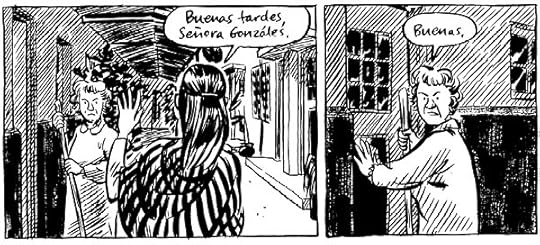
La Perdida is notable for its commitment to honesty. Abel writes the first chapter in Spanish with subtitles, then shifts to all-English dialogue, mimicking Carla’s transition from monolingual tourist to functionally bilingual expat. Abel includes a glossary of Mexican slang, organizations and landmarks. Details in her drawings illustrate Mexico City’s ambience. Nearly every character demonstrates a level of depth, complete with both charming and unpleasant traits. Characters, like the despicable Memo and unlikable Harry, raise political issues like communism, capitalism, globalization, class and the cultural effects of tourism. While these debates, like many real-life discussions, rarely transcend the realm of beer-induced arguments, they function as invaluable character exposition. Abel realistically and expertly depicts her protagonist as a real, fallible person struggling through the excitement and loneliness of mapping the unfamiliar territory of herself.
I was not a big fan of this one. This was an assigned reading for a literature course I was taking and I just found myself frustrated while reading. Maybe, in my late twenties, I can’t relate with our main character Carla who travels to Mexico City to find a part of herself she feels is missing. She ends up staying with her trust fund “friend with benefits” until he eventually kicks her out.
Carla is young, naive, and desperate to find a place in the city. But she makes poor decisions, allows her so-called “friends” to belittle her, and ruins relationships with the people who might have actually been kind to her. I had so much disdain for her that it was difficult to fully engage in caring about the horrible things that happen to her towards the end of the graphic novel.
The character development left something to be desired. The only one who experiences some sort of change is Carla, but I’m not sure she really learned much of anything. At the end, she is so downtrodden. I don’t need a happy ending, but I wasn’t sure what she gained through it all. The frenemies and enemies are basic. We don’t learn anything about them or their motivations. Even the likeable characters are one note.
Was it worth reading? I don’t know. The theme of my college course was cultural identity and immigrants/generations feeling torn between their home/heritage and their place in the US. So while it fit this theme, I didn’t feel the overall message of this graphic novel went anywhere with it. Mexico City, being shown through the eyes of a bland character, dissolves into stereotypes and only one/two of the Mexican characters aren’t total jerks.
I just felt as empty as Carla does at the end of the reading.
Jessica Abel’s _La Perdida_ tells the story of Carla, an anglo-mexican U.S. citizen, who in an aimless sojourn in Mexico city falls into various situations and encounters a variety of people, all of which challenge her custom-made American identity. After a brief period of successfully (or so she thinks) acculturating to not only her local community (which include Marxist revolutionaries, drug dealers, and ESL students) but to Mexican society at large, an international incident occurs which ultimately destabilizes everything she has ever known about herself, as well as shatters her newfound identity as a Mexican pseudo-revolutionary.
. . . The translation of the title of the comic, roughly, means “The Lost Woman.” To find out in what ways the title resonates with the story and vise-versa and how Jessica Abel deftly uses the medium of comic art to tell the story (consider the half-page panel on page 16, which depicts Carla looking up at a blooming jacaranda tree---which she has never seen before---when she first tours Mexico city and upon viewing it, she feels that the “answer” to what she’s looking for in Mexico is provided by that tree, a promising oracle of what she thinks is to come) by juxtaposing past and present, all with the aim of telling Carla’s journey of discovery and the tragic steps she takes. As such, the beautiful and inspired rendering of Carla’s story will haunt you for days.
This fantastic graphic novel follows the adventures of a young woman named Carla who embarks on a somewhat misguided journey to Mexico in search of her roots. While she is half Mexican, Carla quickly discovers that her class and cultural background make it impossible for her to ever truly be accepted and fit in with her Mexican friends. Despite this, Carla rejects her ex-pat friends and falls in with Memo, a communist pseudo-intellectual, and his attractive but dim friend Oscar. Carla's innocence and longing to belong sometimes make you cringe as you're reading. Memo is a jerk and cuts down Carla at every turn, but she puts up with it because of what I can only describe as her liberal white guilt. She's continually caught between cultures -- she rejects her white friends, but simply can't be accepted by her Mexican friends, or at least not by Memo and his "revolutionary" friends. As it turns out, her wish to belong ends up causing her to overlook more than just Memo's insults, and she finds herself in very real danger. The events in this book, particularly in the second half, could have failed miserably in the hands of a lesser writer, but Abel does an excellent job of setting things up so that they feel believable. She also manages to keep Carla very real without making her unsympathetic. The artwork is dense and well-suited to the subject, and this is a very rewarding book.
Okay, so this comic has had a lot of attention and it really is very well done. Jessica Abel really captures the nuances of travel - you want to have an authentic experience but as a foreigner, you can never truly experience a country like someone native; while you may be welcomed in a country, you will not necessarily ever seen as anything more than a tourist; the fellowship of other travelers can be both comforting and dis-assimilating at the same time; and yet there is something totally thrilling about being out and about in the world. She paints a vivid picture of the political complexities and the blase acceptance of criminal activity in Mexico City. Her artwork is fantastic and really enhances the story.
So, why only 3 stars? Well, I couldn't rate this book any higher because I really, really disliked the main character, Carla. I mean, she's the pits! Carla is self-centered, easily influenced, manipulative, antagonistic, and an all-around douchebag. The majority of her conversations with others are arguments that she initiated. She's gross.
This might, at first glance, be mistaken for autobiography. It feels very natural. A young woman, Carla, travels to Mexico City to, well, find herself, as the saying goes. She stays with an old boyfriend, who is tolerant at first, until he realizes that she has no intention of leaving. Her relationships with the ex-boyfriend, Harry, and her new friends in Mexico City slowly play out over the course of this book. Some of Carla's choices turn out to not be very smart, and it's the playing out of the resulting drama, and her self-realization of how she got to where she is, that makes for compelling reading. The setting and characters are fully realized. Jessica Abel is particularly good at capturing facial expressions. This is an excellent book, well worth reading.