

What do you think?

Travis McGee #6
Bright Orange for the Shroud
Another bestseller starring Travis McGee, a real American hero--and maybe thestar of a new movie franchise!
Audio Cassette
First published January 1, 1965
About the author
John D. MacDonald
590 books1,469 followersJohn D. MacDonald was born in Sharon, Pennsylvania, and educated at the Universities of Pennsylvania, Syracuse and Harvard, where he took an MBA in 1939. During WW2, he rose to the rank of Colonel, and while serving in the Army and in the Far East, sent a short story to his wife for sale, successfully. He served in the Office of Strategic Services (O.S.S.) in the China-Burma-India Theater of Operations. After the war, he decided to try writing for a year, to see if he could make a living. Over 500 short stories and 70 novels resulted, including 21 Travis McGee novels.
Following complications of an earlier heart bypass operation, MacDonald slipped into a coma on December 10 and died at age 70, on December 28, 1986, in St. Mary's Hospital in Milwaukee, Wisconsin. He was survived by his wife Dorothy (1911-1989) and a son, Maynard.
In the years since his death MacDonald has been praised by authors as diverse as Stephen King, Spider Robinson, Jimmy Buffett, Kingsley Amis and Kurt Vonnegut, Jr.. Thirty-three years after his passing the Travis McGee novels are still in print.
Following complications of an earlier heart bypass operation, MacDonald slipped into a coma on December 10 and died at age 70, on December 28, 1986, in St. Mary's Hospital in Milwaukee, Wisconsin. He was survived by his wife Dorothy (1911-1989) and a son, Maynard.
In the years since his death MacDonald has been praised by authors as diverse as Stephen King, Spider Robinson, Jimmy Buffett, Kingsley Amis and Kurt Vonnegut, Jr.. Thirty-three years after his passing the Travis McGee novels are still in print.
Ratings & Reviews
Friends & Following
Create a free account to discover what your friends think of this book!
Community Reviews
Displaying 1 - 30 of 292 reviews

July 8, 2018
"A tall, frail, sallow-looking fellow in a wrinkled tan suit too large for him stared up at me with an anxious little smile that came and went—a mendicant smile, like dogs wear in the countries where they kick dogs."
The man McGee is talking about is Arthur Wilkinson, or rather the shell that’s left after becoming entangled with Wilma Ferners in Bright Orange for the Shroud. Though it is Boone “Boo” Waxwell who understandably gets mentioned most whenever this entry in the legendary Travis McGee series is spoken of or written about, Wilma is nearly his predatory equal. MacDonald the writer knew that for every Waxwell in the world, there also exists a female counterpart; in this case the sexy but amoral Wilma Ferners. MacDonald paints each in their charming, venomous tones to perfection. The real literary achievement here, upon any serious reflection, is how MacDonald was able to make the small and beautiful, outwardly sweet yet inwardly predatory and sadistic Wilma so memorable. While McGee has more than one face to face encounter with Waxwell, we basically only get to “see” Wilma in flashbacks; but they are painted so vividly that when McGee concludes halfway through the narrative that she’s no longer among the living, the reader simply doesn't care. Not after what she almost did to the Alabama Tiger, and to Arthur Wilkinson. Arthur has been taken for every penny, mercilessly cleaned out. This includes his manhood, and his dignity. Wilma and Boone were simply part of a slick con.
McGee enlists the aid of Chookie in this one, who will be familiar to any true fan of this great series. MacDonald paints her as a real flesh and blood woman with faults, but also a heart. She is, in fact, one of the great recurring characters in this series, memorable in the overall mythology of Travis McGee as the tarnished white knight grew older, and the entries became more resonating. The particulars of Bright Orange are unimportant, just another instance of McGee running a con, to get back money that was taken in a con. But this one is unique in that it has one of the most dangerous and memorable villains in crime fiction, and because it is also salvage work — McGee is attempting to salvage Arthur himself, including his manhood. Chook works toward that end and becomes involved with Arthur, but when you’ve been stripped of everything, it is a long and rough road back.
Waxwell is physically dangerous, with a quick and instinctive predilection for danger and violence. But he can also exude a fascination that while it repulses, also attracts:
"Bogart, Mitchum, Gable, Flynn—the same flavor was there, a seedy, indolent brutality, a wisdom of the flesh. Women, sensing exactly what he was, and knowing how casually they would be used, would yet accept him, saying yes on a basis so primitive they could neither identify nor resist it."
Waxwell is predatory in every manner possible, and has a yen for Vivian, the neglected wife of an ineffectual and alcoholic lawyer involved in the original scam. MacDonald poignantly paints her so that the reader feels a sense of doom closing in on a fine woman:
"A man going sour puts an attractive wife in a strange bind. Still tied to him by what remains of her security, and by all the weight of the sentimentalities and warmths remembered, she is aware of her own vulnerability and, more importantly, aware of how other men might be appraising that vulnerability, hoping to use it."
"Houses where love is dead or dying acquire a transient look. Somewhere there are people who, though they don't know it yet, are going to move in."
In painting Vivian with such nuance, MacDonald is setting up one of the most horrific scenes in crime fiction, which I’ll get back to in a bit. Boone uses everyone, including a plump fifteen-year old deep in the remote area of Florida he calls home. She keeps coming back for more, unable to break the hold Waxwell has on her despite being smart enough to know he’s ruining her. It is a desperation you feel from almost everyone throughout the narrative of Bright Orange for the Shroud — Arthur, Vivian Crane and the alcoholic husband she still loves, even Chook; her involvement with Arthur on the Busted Flush brings to the surface problems she’s been unwilling to face.
There is Stebber and others that McGee must make his way through in an effort to get the money back — if he can find it, and if he can stay alive while doing so. Chook makes an observation about McGee’s similarity to Waxwell which angers McGee at first, because the very thought of that potential, were McGee to have taken a different path in life, is vile:
"Maybe he is you, gone bad. Maybe that's what he smelled. Maybe that's why you can handle him."
When trying to smoke Wilma out doesn’t work, McGee realizes Waxwell had murdered her:
"I had a sudden and vivid image of that small, delicate, pampered face, watery under the black slow run of water, of fine silver hair strung into the current flow, of shadowy pits, half seen, where sherry eyes had been."
The reader doesn’t care, because in essence she had it coming. So does Waxwell:
"After exposure to Boone Waxwell, the look of Chook and Arthur on the early afternoon beach had the flavor of great innocence."
McGee’s plan to enlist Vivian’s help in distracting Boone away from Marcos so that he can search for Arthur’s money is pre-empted when Waxwell strikes first, unexpectedly. A miscalculation by McGee gets him shot in the head, leaving him dazed and paralyzed on one side as he is forced to lay helplessly by a window and listen to the sounds of Waxwell, smug and toying as he rapes Vivian Watts Crane. The scene is one of the most brutal in the series. Yet it needs to be pointed out that the brutality is all in the mind of the reader. McGee can only hear the sounds, the voices, for most of it. He can hear Vivian’s desperation — lonely and neglected, hating her physical and involuntary response to an act of violence, and a man she truly despises. It is a brilliant piece of writing, using the device of McGee’s helplessness, his ability to only hear what’s happening, while avoiding completely any gore or painfully graphic details. It makes the scene all the more powerful and harrowing, because through McGee’s helplessness, we feel Vivian Crane’s.
"From the mortgaged house came the finishing cry of the tennis player, a tearing hypersonic howl like a gun-shot coyote. Her eyes were a very dark blue, and with sun-coin on the tawny forearm, she had closed her eyes and shuddered at the thought of any Waxwell touch."
With Arthur just beginning to feel like a man again, but still incredibly fearful — rightfully so — of Waxwell, it takes an attack of conscience by Wilkinson to finally come back and help McGee. Rather than go to the police, McGee has Arthur take him to a hospital, where he makes up a story about the bullet wound. Not fit to be released, still partially paralyzed and with bone fragments in his skull, McGee goes back for Vivian. It is a sticking point for many readers. Yes, it does make things work out later, so it was a plot choice, and yes, it did expose Vivian to further abuse by Waxwell. But, with a bullet shattering part of his skull, McGee is in no condition to be making rational decisions. And even were we to assume he was, there is something hugely important being overlooked, and it is this:
Earlier in the narrative, Vivian has a conversation with McGee which reveals just how close to the edge she really is. In that conversation, she shudders at the thought of Waxwell ever getting hold of her, because he makes “her skin crawl” and as she tells McGee: “He makes me feel naked and sick.” — “It’s like nightmares where you’re a kid. I think that if Boone Waxwell ever…got me, I might walk around afterwards and look just the same, but my heart would be dead as a stone forever.” By the time we’ve reached this point in the narrative, we have such a nuanced portrait of Vivian, a fine woman sliding toward oblivion because of a husband gone sour, we have reason to believe her, and so does McGee. With what McGee overheard, Vivian is already gone. Proof of that is what McGee finds when he does return — what she has done after Waxwell leaves, in regard to her passed out husband, and herself:
"It's what they so often do in the night. Maybe some forlorn fading desire to keep the darkness back. But if they could turn on all the lights in the world, it wouldn't help them."
It is terribly sad, yet somehow inevitable, as Chandler noted the conclusion should be to a great crime mystery. It affords McGee an opportunity to set up Waxwell, however, while at the same time the reader gets to hear the terrible regret and compassion for Vivian that McGee has in his head, as he tidies up the scene:
"They'll pretty you up for burying. But not in orange. That's a color to be alive in. To smile in. They won't bury you in it."
But even when this one seems over, it isn’t, because on the water, Boone Waxwell pays one last call. The end is brutal and fitting, in one of the most memorable books in the series. This one definitely isn’t for the snowflakes, and it isn’t even for McGee, as it sours him a bit in the immediate present. That is borne out when he is propositioned by the beautiful Debra at the end, who is simply another version of Wilma:
"Sweet," I said, "you are a penny from heaven. And you probably know lots and lots of tricks. But every one would remind me that you are a pro, from Wilma's old stable of club fighters. Call me a sentimentalist. The bloom is too far off the rose sweetie. I'd probably keep leaving money on the bureau. You better peddle it. Thanks but no thanks."
And seconds later we get this:
"The lips curled back and her face went so tight, I saw what a pretty and delicate little skull she'd make, picked clean, as Wilma now was, in the dark bottom of Chevalier Bay."
This is one of the best and most resonating entries in the series, despite the violence and the harrowing rape scene, and despite it being at the earlier end of the Travis McGee canon. Bright Orange for the Shroud is highly recommended. Brutal, sad, but resonating. A great writer at what seemed like his peak, until near the end of the series, when he raised the bar even higher.
The man McGee is talking about is Arthur Wilkinson, or rather the shell that’s left after becoming entangled with Wilma Ferners in Bright Orange for the Shroud. Though it is Boone “Boo” Waxwell who understandably gets mentioned most whenever this entry in the legendary Travis McGee series is spoken of or written about, Wilma is nearly his predatory equal. MacDonald the writer knew that for every Waxwell in the world, there also exists a female counterpart; in this case the sexy but amoral Wilma Ferners. MacDonald paints each in their charming, venomous tones to perfection. The real literary achievement here, upon any serious reflection, is how MacDonald was able to make the small and beautiful, outwardly sweet yet inwardly predatory and sadistic Wilma so memorable. While McGee has more than one face to face encounter with Waxwell, we basically only get to “see” Wilma in flashbacks; but they are painted so vividly that when McGee concludes halfway through the narrative that she’s no longer among the living, the reader simply doesn't care. Not after what she almost did to the Alabama Tiger, and to Arthur Wilkinson. Arthur has been taken for every penny, mercilessly cleaned out. This includes his manhood, and his dignity. Wilma and Boone were simply part of a slick con.
McGee enlists the aid of Chookie in this one, who will be familiar to any true fan of this great series. MacDonald paints her as a real flesh and blood woman with faults, but also a heart. She is, in fact, one of the great recurring characters in this series, memorable in the overall mythology of Travis McGee as the tarnished white knight grew older, and the entries became more resonating. The particulars of Bright Orange are unimportant, just another instance of McGee running a con, to get back money that was taken in a con. But this one is unique in that it has one of the most dangerous and memorable villains in crime fiction, and because it is also salvage work — McGee is attempting to salvage Arthur himself, including his manhood. Chook works toward that end and becomes involved with Arthur, but when you’ve been stripped of everything, it is a long and rough road back.
Waxwell is physically dangerous, with a quick and instinctive predilection for danger and violence. But he can also exude a fascination that while it repulses, also attracts:
"Bogart, Mitchum, Gable, Flynn—the same flavor was there, a seedy, indolent brutality, a wisdom of the flesh. Women, sensing exactly what he was, and knowing how casually they would be used, would yet accept him, saying yes on a basis so primitive they could neither identify nor resist it."
Waxwell is predatory in every manner possible, and has a yen for Vivian, the neglected wife of an ineffectual and alcoholic lawyer involved in the original scam. MacDonald poignantly paints her so that the reader feels a sense of doom closing in on a fine woman:
"A man going sour puts an attractive wife in a strange bind. Still tied to him by what remains of her security, and by all the weight of the sentimentalities and warmths remembered, she is aware of her own vulnerability and, more importantly, aware of how other men might be appraising that vulnerability, hoping to use it."
"Houses where love is dead or dying acquire a transient look. Somewhere there are people who, though they don't know it yet, are going to move in."
In painting Vivian with such nuance, MacDonald is setting up one of the most horrific scenes in crime fiction, which I’ll get back to in a bit. Boone uses everyone, including a plump fifteen-year old deep in the remote area of Florida he calls home. She keeps coming back for more, unable to break the hold Waxwell has on her despite being smart enough to know he’s ruining her. It is a desperation you feel from almost everyone throughout the narrative of Bright Orange for the Shroud — Arthur, Vivian Crane and the alcoholic husband she still loves, even Chook; her involvement with Arthur on the Busted Flush brings to the surface problems she’s been unwilling to face.
There is Stebber and others that McGee must make his way through in an effort to get the money back — if he can find it, and if he can stay alive while doing so. Chook makes an observation about McGee’s similarity to Waxwell which angers McGee at first, because the very thought of that potential, were McGee to have taken a different path in life, is vile:
"Maybe he is you, gone bad. Maybe that's what he smelled. Maybe that's why you can handle him."
When trying to smoke Wilma out doesn’t work, McGee realizes Waxwell had murdered her:
"I had a sudden and vivid image of that small, delicate, pampered face, watery under the black slow run of water, of fine silver hair strung into the current flow, of shadowy pits, half seen, where sherry eyes had been."
The reader doesn’t care, because in essence she had it coming. So does Waxwell:
"After exposure to Boone Waxwell, the look of Chook and Arthur on the early afternoon beach had the flavor of great innocence."
McGee’s plan to enlist Vivian’s help in distracting Boone away from Marcos so that he can search for Arthur’s money is pre-empted when Waxwell strikes first, unexpectedly. A miscalculation by McGee gets him shot in the head, leaving him dazed and paralyzed on one side as he is forced to lay helplessly by a window and listen to the sounds of Waxwell, smug and toying as he rapes Vivian Watts Crane. The scene is one of the most brutal in the series. Yet it needs to be pointed out that the brutality is all in the mind of the reader. McGee can only hear the sounds, the voices, for most of it. He can hear Vivian’s desperation — lonely and neglected, hating her physical and involuntary response to an act of violence, and a man she truly despises. It is a brilliant piece of writing, using the device of McGee’s helplessness, his ability to only hear what’s happening, while avoiding completely any gore or painfully graphic details. It makes the scene all the more powerful and harrowing, because through McGee’s helplessness, we feel Vivian Crane’s.
"From the mortgaged house came the finishing cry of the tennis player, a tearing hypersonic howl like a gun-shot coyote. Her eyes were a very dark blue, and with sun-coin on the tawny forearm, she had closed her eyes and shuddered at the thought of any Waxwell touch."
With Arthur just beginning to feel like a man again, but still incredibly fearful — rightfully so — of Waxwell, it takes an attack of conscience by Wilkinson to finally come back and help McGee. Rather than go to the police, McGee has Arthur take him to a hospital, where he makes up a story about the bullet wound. Not fit to be released, still partially paralyzed and with bone fragments in his skull, McGee goes back for Vivian. It is a sticking point for many readers. Yes, it does make things work out later, so it was a plot choice, and yes, it did expose Vivian to further abuse by Waxwell. But, with a bullet shattering part of his skull, McGee is in no condition to be making rational decisions. And even were we to assume he was, there is something hugely important being overlooked, and it is this:
Earlier in the narrative, Vivian has a conversation with McGee which reveals just how close to the edge she really is. In that conversation, she shudders at the thought of Waxwell ever getting hold of her, because he makes “her skin crawl” and as she tells McGee: “He makes me feel naked and sick.” — “It’s like nightmares where you’re a kid. I think that if Boone Waxwell ever…got me, I might walk around afterwards and look just the same, but my heart would be dead as a stone forever.” By the time we’ve reached this point in the narrative, we have such a nuanced portrait of Vivian, a fine woman sliding toward oblivion because of a husband gone sour, we have reason to believe her, and so does McGee. With what McGee overheard, Vivian is already gone. Proof of that is what McGee finds when he does return — what she has done after Waxwell leaves, in regard to her passed out husband, and herself:
"It's what they so often do in the night. Maybe some forlorn fading desire to keep the darkness back. But if they could turn on all the lights in the world, it wouldn't help them."
It is terribly sad, yet somehow inevitable, as Chandler noted the conclusion should be to a great crime mystery. It affords McGee an opportunity to set up Waxwell, however, while at the same time the reader gets to hear the terrible regret and compassion for Vivian that McGee has in his head, as he tidies up the scene:
"They'll pretty you up for burying. But not in orange. That's a color to be alive in. To smile in. They won't bury you in it."
But even when this one seems over, it isn’t, because on the water, Boone Waxwell pays one last call. The end is brutal and fitting, in one of the most memorable books in the series. This one definitely isn’t for the snowflakes, and it isn’t even for McGee, as it sours him a bit in the immediate present. That is borne out when he is propositioned by the beautiful Debra at the end, who is simply another version of Wilma:
"Sweet," I said, "you are a penny from heaven. And you probably know lots and lots of tricks. But every one would remind me that you are a pro, from Wilma's old stable of club fighters. Call me a sentimentalist. The bloom is too far off the rose sweetie. I'd probably keep leaving money on the bureau. You better peddle it. Thanks but no thanks."
And seconds later we get this:
"The lips curled back and her face went so tight, I saw what a pretty and delicate little skull she'd make, picked clean, as Wilma now was, in the dark bottom of Chevalier Bay."
This is one of the best and most resonating entries in the series, despite the violence and the harrowing rape scene, and despite it being at the earlier end of the Travis McGee canon. Bright Orange for the Shroud is highly recommended. Brutal, sad, but resonating. A great writer at what seemed like his peak, until near the end of the series, when he raised the bar even higher.

June 17, 2017
If you have been reading Spillane's Mike Hammer and Westlake's Parker, turning to MacDonald's Travis McGee is a bit like going from Van Halen to Jimmy Buffett. McGee is a guy who lives on a houseboat ("The Busted Flush") on the Gulf Coast waterways of Florida. He putters about and fishes and only works when he needs a stake. These novels have a relaxed pace that takes some getting used to.Reading these Travis McGee books is more like listening to a guy on a boat on a lazy afternoon spin his yarn. He meanders as he talks to tell you about the type of characters the people he's talking about are. He talks about the fishing off Marcos Island and Naples. He bemoans the fact that modern American cities are designed for cars not people, not even Ybor City which is being converted into some fake New Orleans.
In "Bright Orange For The Shroud," McGee is planning a lazy summer, getting by on the few bucks he has, when Arthur Wilkinson stumbles onto his boat. Arthur used to have a nearby boat where there was always an endless party and he had a cushy inheritance. Had is the operative word before little Wilma Ferner got a hold of him, married him, twisted him around and around her finger till his balls were practically in a jar on her nightstand. Wilma had a lush body and a husky voice. She was always on, always putting on her act, and all the gals were wary of her. And, he had his money before she introduced him to a bunch of land option swindlers who milked every last cent out of him and left him as nothing but a rotting husk of a man. That's when Wilma had disappeared.
This novel keeps the Florida boating feel throughout. It is a more complete work than "Nightmare in Pink." Worth a read just to journey onto the houseboat and listen to the waves lap at the sides of the boat.
In "Bright Orange For The Shroud," McGee is planning a lazy summer, getting by on the few bucks he has, when Arthur Wilkinson stumbles onto his boat. Arthur used to have a nearby boat where there was always an endless party and he had a cushy inheritance. Had is the operative word before little Wilma Ferner got a hold of him, married him, twisted him around and around her finger till his balls were practically in a jar on her nightstand. Wilma had a lush body and a husky voice. She was always on, always putting on her act, and all the gals were wary of her. And, he had his money before she introduced him to a bunch of land option swindlers who milked every last cent out of him and left him as nothing but a rotting husk of a man. That's when Wilma had disappeared.
This novel keeps the Florida boating feel throughout. It is a more complete work than "Nightmare in Pink." Worth a read just to journey onto the houseboat and listen to the waves lap at the sides of the boat.

June 17, 2013
Splice the main brace aft and toe the keel line as the crow flies and the bilge pumps.
I have no idea what that means but I’m sure John D. MacDonald does. He loves his nautical terms and uses them liberally throughout this novel. You see, Travis McGee, salvage and recovery expert, lives aboard a house boat and as his need arises, sails the boat to get where he needs to go. In this case, it’s to help an acquaintance who’s been beaten and sucked dry by a group of con artists.
I’ve recently read a Carl Hiaasen novel and in his books when all the Florida-based bad stuff happens, it’s usually done with a nod and a wink; here the bad guys are as malicious and nasty as a cranky one-eyed gator that hasn’t eaten in a month*.
This novel was more palatable than the last one I read, The Girl in the Plain Brown Wrapper. The cringe worthy, cave man sexism (McGee as sex machine) and condescending interactions with minorities (McGee as, Abe Lincoln, brother to all mankind) are kept to a minimum.
Here it’s Travis McGee, recent graduate of the Rich Little School of Mimicry and Travis McGee crafty manipulator of school officials. In one offensive plot development, Trav claims to be someone from the “state board” in order to boondoggle a school employee so he can draw a fifteen year old trailer park Lolita out of school in order to pump her for information. Sleazy, Mr. McGee.
Border line jail bait hijinks aside, this is a decent entry into the Travis McGee series. It’s got a first-rate slime ball villain in Boone Waxwell, the anachronisms are at a minimum and the story line is engaging. MacDonald is a good writer and it is easy to see how he has gotten props from authors like Stephen King, Kurt Vonnegut and Carl Hiaasen.
* I have no idea what this means either.
I have no idea what that means but I’m sure John D. MacDonald does. He loves his nautical terms and uses them liberally throughout this novel. You see, Travis McGee, salvage and recovery expert, lives aboard a house boat and as his need arises, sails the boat to get where he needs to go. In this case, it’s to help an acquaintance who’s been beaten and sucked dry by a group of con artists.
I’ve recently read a Carl Hiaasen novel and in his books when all the Florida-based bad stuff happens, it’s usually done with a nod and a wink; here the bad guys are as malicious and nasty as a cranky one-eyed gator that hasn’t eaten in a month*.
This novel was more palatable than the last one I read, The Girl in the Plain Brown Wrapper. The cringe worthy, cave man sexism (McGee as sex machine) and condescending interactions with minorities (McGee as, Abe Lincoln, brother to all mankind) are kept to a minimum.
Here it’s Travis McGee, recent graduate of the Rich Little School of Mimicry and Travis McGee crafty manipulator of school officials. In one offensive plot development, Trav claims to be someone from the “state board” in order to boondoggle a school employee so he can draw a fifteen year old trailer park Lolita out of school in order to pump her for information. Sleazy, Mr. McGee.
Border line jail bait hijinks aside, this is a decent entry into the Travis McGee series. It’s got a first-rate slime ball villain in Boone Waxwell, the anachronisms are at a minimum and the story line is engaging. MacDonald is a good writer and it is easy to see how he has gotten props from authors like Stephen King, Kurt Vonnegut and Carl Hiaasen.
* I have no idea what this means either.

March 7, 2019
A terrific McGee adventure, 5-stars. Must read.
Beautiful prose throughout, flowing descriptions of people and places, super action sequences with real peril, and truly incredible descriptions of Florida and the Everglades.
The ending is superb. Just as good as The Deep Blue Good-by, perhaps even better.
As usual with my reviews, please first read the publisher’s blurb/summary of the book. Thank you.
The Alabama Tiger's Flush Deck Wheeler Yacht

Full size image here
46%
Great fist fight scene between Boo Waxwell and McGee. Terrific stuff.
69%
Bluebeard, mentioned by McGee while plotting with Chookie
The tale tells the story of a wealthy violent man in the habit of murdering his wives and the attempts of one wife to avoid the fate of her predecessors. ... The notoriety of the tale is such that Merriam-Webster gives the word "Bluebeard" the definition of "a man who marries and kills one wife after another," and the verb "bluebearding" has even appeared as a way to describe the crime of either killing a series of women, or seducing and abandoning a series of women.
https://en.wikipedia.org/wiki/Bluebeard

Full size image here
Notes and Quotes:
Keep in mind these observations were written in about 1964 ...
After they have strangled the king with boiling Wine, it is therapeutic to get a little tipsy on a more palatable brand.
-
A friend is someone to whom you can say any jackass thing that enters your mind. With acquaintances, you are forever aware of their slightly unreal image of you, and to keep them content, you edit yourself to fit.
-
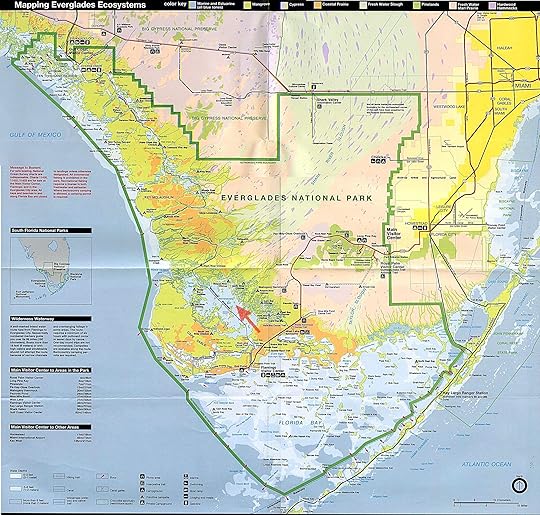
TOOK the Flush up to Flamingo, through Whitewater Bay, and out the mouth of the Shark River into the Gulf of Mexico. The Gulf was flat calm, so I took her about six miles out, figured the course to take me just outside Cape Romano, ... cruised up the flank of the Everglades, past the misted shoreline of the Ten Thousand Mangrove Islands. It is dark strange country, one of the few places left which man has not been able to mess up.
(Arrow at Whitewater Bay. Ten Thousand Islands at upper left)
Full size image here
Now, of course, having failed in every attempt to subdue the Glades by frontal attack, we are slowly killing it off by tapping the River of Grass. In the questionable name of progress, the state in its vast wisdom lets every two-bit developer divert the flow into the draglined canals that give him "waterfront" lots to sell. As far north as Corkscrew Swamp, virgin stands of ancient bald cypress are dying. All the area north of Copeland had been logged out, and will never come back. As the Glades dry, the big fires come with increasing frequency. The ecology is changing with egret colonies dwindling, mullet getting scarce, mangrove dying of new diseases born of dryness.
-
There were some rowdy teenagers at one of the counter sections, and I sat as far from them as possible. I like them fme in smaller units. But when they socialize, showing off for each other, they sadden me. The boys punch and shove, and repeat each comment in their raw uncertain baritone over and over until fmally they have milked the last giggle from their soft little girls with their big, spreading, TV butts. And they keep making their quick cool appraisals of the environment to make certain they have a properly disapproving audience of squares.
-
School Bonita
Full size image here
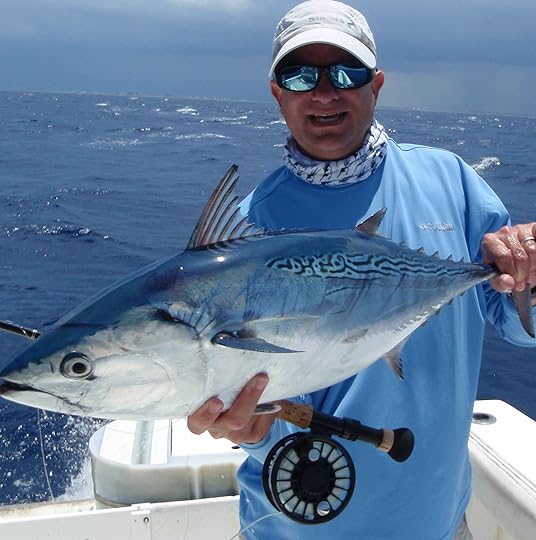
School bonita run all of a size, and allowing for the magnification of the water, and my momentary glimpse of them, they had to be upwards of six pounds. All they would do would be tear up my light spinning gear on the chance of boating something inedible. They are the great underrated game fish of the Gulf coast. On light gear, a six pound bonita is the equal of a twenty pound king mackerel. There is one thing they all do. Work them, with great effort, close to the boat, and they give you one goggle-eyed stare, turn and go off in a run every bit as swift and muscular as the first one. And they will keep doing that until, on light tackle, they die in the water. It seems a poor reward for that much heart in any living thing, particularly when the meat is too black, bloody, oily and strong to make edible. Bonefish quit. Barracuda dog it. Tarpon are docile once they begin to show their belly in the slow rolls of exhaustion. But the only way you can catch a live bonita is to use gear hefty enough to horse him home before he can kill himself.
-
The villian:
McGee called out, "Boone Waxwell!"
In a few moments I heard some thumping around inside, saw a vague face through a dingy window. Then the door opened and a man came out onto the porch. He wore dirty khaki pants. He was barefoot, bare to the waist. Glossy black curly hair, dense black mat of hair on his chest. Blue eyes. Sallow face. Tattoo as Arthur had described it. But Arthur's description hadn't caught the essence of the man. Perhaps because Arthur wouldn't know what to call it. Waxwell had good wads of muscle on his shoulders. His waist had thickened and was beginning to soften. In posture, expression, impact, he had that stud look, that curiously theatrical blend of brutality and irony. Bogart, Mitchum, Gable, Flynn-the same flavor was there, a seedy, indolent brutality, a wisdom of the flesh. Women, sensing exactly what he was, and knowing how casually they would be used, would yet accept him, saying yes on a basis so primitive they could neither identify it nor resist it.
Bonus. From the 1970 "Darker Than Amber" movie starring Rod Taylor, pictures of the producers' ideas of McGee's "The Busted Flush":

Full size image here

Full size image here

Full size image here
And finally, two great blogs about John D. MacDonald, McGee and the rumoured-never-written novel where McGee dies"...
The Birth of Travis McGee (fascinating)
http://thetrapofsolidgold.blogspot.co...
"Black Border for McGee" (rumours surrounding a final book, never published)
http://thetrapofsolidgold.blogspot.co...
.
Beautiful prose throughout, flowing descriptions of people and places, super action sequences with real peril, and truly incredible descriptions of Florida and the Everglades.
The ending is superb. Just as good as The Deep Blue Good-by, perhaps even better.
As usual with my reviews, please first read the publisher’s blurb/summary of the book. Thank you.
The Alabama Tiger's Flush Deck Wheeler Yacht
Full size image here
46%
Great fist fight scene between Boo Waxwell and McGee. Terrific stuff.
69%
Bluebeard, mentioned by McGee while plotting with Chookie
The tale tells the story of a wealthy violent man in the habit of murdering his wives and the attempts of one wife to avoid the fate of her predecessors. ... The notoriety of the tale is such that Merriam-Webster gives the word "Bluebeard" the definition of "a man who marries and kills one wife after another," and the verb "bluebearding" has even appeared as a way to describe the crime of either killing a series of women, or seducing and abandoning a series of women.
https://en.wikipedia.org/wiki/Bluebeard
Full size image here
Notes and Quotes:
Keep in mind these observations were written in about 1964 ...
After they have strangled the king with boiling Wine, it is therapeutic to get a little tipsy on a more palatable brand.
-
A friend is someone to whom you can say any jackass thing that enters your mind. With acquaintances, you are forever aware of their slightly unreal image of you, and to keep them content, you edit yourself to fit.
-
TOOK the Flush up to Flamingo, through Whitewater Bay, and out the mouth of the Shark River into the Gulf of Mexico. The Gulf was flat calm, so I took her about six miles out, figured the course to take me just outside Cape Romano, ... cruised up the flank of the Everglades, past the misted shoreline of the Ten Thousand Mangrove Islands. It is dark strange country, one of the few places left which man has not been able to mess up.
(Arrow at Whitewater Bay. Ten Thousand Islands at upper left)
Full size image here
Now, of course, having failed in every attempt to subdue the Glades by frontal attack, we are slowly killing it off by tapping the River of Grass. In the questionable name of progress, the state in its vast wisdom lets every two-bit developer divert the flow into the draglined canals that give him "waterfront" lots to sell. As far north as Corkscrew Swamp, virgin stands of ancient bald cypress are dying. All the area north of Copeland had been logged out, and will never come back. As the Glades dry, the big fires come with increasing frequency. The ecology is changing with egret colonies dwindling, mullet getting scarce, mangrove dying of new diseases born of dryness.
-
There were some rowdy teenagers at one of the counter sections, and I sat as far from them as possible. I like them fme in smaller units. But when they socialize, showing off for each other, they sadden me. The boys punch and shove, and repeat each comment in their raw uncertain baritone over and over until fmally they have milked the last giggle from their soft little girls with their big, spreading, TV butts. And they keep making their quick cool appraisals of the environment to make certain they have a properly disapproving audience of squares.
-
School Bonita
Full size image here
School bonita run all of a size, and allowing for the magnification of the water, and my momentary glimpse of them, they had to be upwards of six pounds. All they would do would be tear up my light spinning gear on the chance of boating something inedible. They are the great underrated game fish of the Gulf coast. On light gear, a six pound bonita is the equal of a twenty pound king mackerel. There is one thing they all do. Work them, with great effort, close to the boat, and they give you one goggle-eyed stare, turn and go off in a run every bit as swift and muscular as the first one. And they will keep doing that until, on light tackle, they die in the water. It seems a poor reward for that much heart in any living thing, particularly when the meat is too black, bloody, oily and strong to make edible. Bonefish quit. Barracuda dog it. Tarpon are docile once they begin to show their belly in the slow rolls of exhaustion. But the only way you can catch a live bonita is to use gear hefty enough to horse him home before he can kill himself.
-
The villian:
McGee called out, "Boone Waxwell!"
In a few moments I heard some thumping around inside, saw a vague face through a dingy window. Then the door opened and a man came out onto the porch. He wore dirty khaki pants. He was barefoot, bare to the waist. Glossy black curly hair, dense black mat of hair on his chest. Blue eyes. Sallow face. Tattoo as Arthur had described it. But Arthur's description hadn't caught the essence of the man. Perhaps because Arthur wouldn't know what to call it. Waxwell had good wads of muscle on his shoulders. His waist had thickened and was beginning to soften. In posture, expression, impact, he had that stud look, that curiously theatrical blend of brutality and irony. Bogart, Mitchum, Gable, Flynn-the same flavor was there, a seedy, indolent brutality, a wisdom of the flesh. Women, sensing exactly what he was, and knowing how casually they would be used, would yet accept him, saying yes on a basis so primitive they could neither identify it nor resist it.
Bonus. From the 1970 "Darker Than Amber" movie starring Rod Taylor, pictures of the producers' ideas of McGee's "The Busted Flush":
Full size image here
Full size image here
Full size image here
And finally, two great blogs about John D. MacDonald, McGee and the rumoured-never-written novel where McGee dies"...
The Birth of Travis McGee (fascinating)
http://thetrapofsolidgold.blogspot.co...
"Black Border for McGee" (rumours surrounding a final book, never published)
http://thetrapofsolidgold.blogspot.co...
.

November 15, 2017
The sixth book in the Travis McGee series involves Travis once again helping an old friend, this time to recover a quarter million dollars that has been taken from him as well as the man’s dignity. Just when McGee is planning on having himself a “slob summer” meaning lots of partying and over-indulgence, his old friend Arthur Wilkinson visits him on board his houseboat, the “Busted Flush”. Arthur is so skinny and feeble-looking that McGee hardly recognizes him but he, somewhat reluctantly, agrees to help. Turns out Arthur has been the victim of an elaborate con game involving a fake marriage, and land development deals. With the assistance of Arthur’s old girlfriend, Chookie McCall (a bit character from the very first novel, The Deep Blue Good-Bye) the trio plans an elaborate reverse con on the con artists.
This novel is generally regarded as one of the better Travis McGee entries, and rightly so. It’s a lot leaner than its predecessor and has very few departures from the main plot line. The setting remains in Florida throughout and the waterways and docks of the Glades almost become a character in and of themselves. And just to put a cherry on top of the whole thing, the main bad guy, a land “developer” named Boone “Boo” Waxwell should be counted among the best villains in literature.
I had actually read this book many years ago, when I had thought to expand my reading choices from my typical science fiction and fantasy. But I think I was too inexperienced a reader at that time to appreciate the style of these sorts of novels and I thought it rather boring. Strange to think that now because reading it again nearly 30 years later, even though somewhat dated, I found it anything but boring. If you plan to sample a single Travis McGee novel rather than read the entire series as I’m doing, then you could certainly do worse than this one.
This novel is generally regarded as one of the better Travis McGee entries, and rightly so. It’s a lot leaner than its predecessor and has very few departures from the main plot line. The setting remains in Florida throughout and the waterways and docks of the Glades almost become a character in and of themselves. And just to put a cherry on top of the whole thing, the main bad guy, a land “developer” named Boone “Boo” Waxwell should be counted among the best villains in literature.
I had actually read this book many years ago, when I had thought to expand my reading choices from my typical science fiction and fantasy. But I think I was too inexperienced a reader at that time to appreciate the style of these sorts of novels and I thought it rather boring. Strange to think that now because reading it again nearly 30 years later, even though somewhat dated, I found it anything but boring. If you plan to sample a single Travis McGee novel rather than read the entire series as I’m doing, then you could certainly do worse than this one.

October 18, 2023
As usual, John D. MacDonald fishes out the literary hero of my youth from some small core of dead synapses located in my middle-aged mind. With Bright Orange for the Shroud, Travis McGee once again reminds me that emotional maturity, a rational perspective, and a sympathetic attitude are all qualities of a decent human being.
The Travis McGee novels are all off-center from the typical crime/mystery/detective novels. McGee is a salvage expert. His baseline mode of operation involves the recovery of things lost for a payment of half their value. He is guided by a duty to the moral good even if law and order need to be discarded to achieve it. But most of all, McGee will typically end up recovering the dignity of the person that has experienced the loss. The money becomes secondary to McGee as his connection and sympathy with the victim grows.
Bright Orange for the Shroud is all the above, but it’s also probably better than most McGee novels. With this being the sixth McGee novel, MacDonald must have felt comfortable with McGee the man and felt that he could take his readers deeper into his attitudes and philosophies. Therefore, MacDonald provides some truly insightful passages. MacDonald illuminates McGee’s psyche as he encounters and experiences the human predators that plague the swamps, cities, and towns of 1960s Florida.
My one complaint has to do with the ending. It relies on a coincidence of a virtually impossible nature. It’s rather unfortunate. Any number of more probable endings would have made this particular Travis McGee novel into a perfect example of its own kind.
The Travis McGee novels are all off-center from the typical crime/mystery/detective novels. McGee is a salvage expert. His baseline mode of operation involves the recovery of things lost for a payment of half their value. He is guided by a duty to the moral good even if law and order need to be discarded to achieve it. But most of all, McGee will typically end up recovering the dignity of the person that has experienced the loss. The money becomes secondary to McGee as his connection and sympathy with the victim grows.
Bright Orange for the Shroud is all the above, but it’s also probably better than most McGee novels. With this being the sixth McGee novel, MacDonald must have felt comfortable with McGee the man and felt that he could take his readers deeper into his attitudes and philosophies. Therefore, MacDonald provides some truly insightful passages. MacDonald illuminates McGee’s psyche as he encounters and experiences the human predators that plague the swamps, cities, and towns of 1960s Florida.
My one complaint has to do with the ending. It relies on a coincidence of a virtually impossible nature. It’s rather unfortunate. Any number of more probable endings would have made this particular Travis McGee novel into a perfect example of its own kind.

October 17, 2013
10/2013
Finally, in the sixth book of the series, I get my wish: Travis McGee sleeps with no women (After some space, I'll appreciate it more when he does connect with a lady). And he has a female friend who helps him: Chook McCall, who appeared in the first book. Further proof that Travis is not sexist. This was good, and interesting, but it got dark near the end, with violence and some very disturbing rape.
Finally, in the sixth book of the series, I get my wish: Travis McGee sleeps with no women (After some space, I'll appreciate it more when he does connect with a lady). And he has a female friend who helps him: Chook McCall, who appeared in the first book. Further proof that Travis is not sexist. This was good, and interesting, but it got dark near the end, with violence and some very disturbing rape.

July 2, 2008
When I first read the Travis McGee books during my high school years in the ‘80s, I thought they were pretty bad-ass crime stories, but that the early ones from the ‘60s were a little dated. Re-reading the McGee books now makes me realize that they are VERY dated in a lot of ways, but that MacDonald was way ahead of the curve on some issues. And they’re still bad-ass crime stories.
McGee is a self-described boat bum in Fort Lauderdale with a unique racket. Calling himself a salvage consultant, he makes deals with people who have been ripped off or conned out of money or valuables by means that make legal recovery difficult or impossible. For half the value, McGee will go out and try to get it back. Part detective and part con man, McGee is prone to brooding over the nature of his work and humanity in general, but he deals with his occasional bouts of depression with long cruises on his houseboat, usually with a beautiful woman along for company.
At the start of this story, McGee is in one of his funks and planning a lazy summer of boating, booze and babes to combat this latest case of the blues when an old acquaintance named Arthur Wilkinson shows up looking homeless and starved. Arthur had a good-sized inheritance when he hung around McGee’s beach friends, but he had married an evil little shrew named Wilma. It turned out that Wilma had been the scout for a group of con men working a real estate scheme and with her help, Arthur has been taken for all he had.
McGee originally tries to pawn Arthur off on Chookie, a dancer that Arthur had dated before hooking up with Wilma. But when Chookie demands that McGee help Arthur recover his money and his self-esteem, they start running their own scam on the people that fleeced Arthur. But they’ll have to be very careful around Boone Waxwell, a cunning and brutal good ole boy with a taste for abusing women.
The good parts of a McGee story are all here. The plan to scam the money with action set against McGee’s musings about the state of the world is pretty typical of these stories. MacDonald was ahead of his time on issues like environmentalism and over-development of Florida. He also predicted how the computerization and regulation of personal information would eventually make it very hard for people to maintain their personal privacy, and McGee chafes against the modern world. And Boone Waxwell is a very creepy and effective villain.
But the dated and almost laughable parts of these books are McGee’s attitude towards women. While not seeing them as disposable pleasures, McGee did have a patronizing chauvinisism regarding the ladies that would probably get him kicked in the testicles today. There’s some really cringe inducing passages about dealing with the little woman here, and the female characters fit right into McGee's view of them.
Also, there’s a really nasty rape scene where McGee knows it’s going on, but doesn’t immediately try to stop it. There are circumstances preventing his direct involvement, but when he has a chance, he doesn’t call for help for the woman, and then coldly uses the aftermath to his advantage and doesn’t show much remorse about it. McGee could be a bastard at times, but usually felt horrible about it afterwards so this may just be a flaw in the plot rather than a character issue, but it’s pretty ugly.
McGee is a self-described boat bum in Fort Lauderdale with a unique racket. Calling himself a salvage consultant, he makes deals with people who have been ripped off or conned out of money or valuables by means that make legal recovery difficult or impossible. For half the value, McGee will go out and try to get it back. Part detective and part con man, McGee is prone to brooding over the nature of his work and humanity in general, but he deals with his occasional bouts of depression with long cruises on his houseboat, usually with a beautiful woman along for company.
At the start of this story, McGee is in one of his funks and planning a lazy summer of boating, booze and babes to combat this latest case of the blues when an old acquaintance named Arthur Wilkinson shows up looking homeless and starved. Arthur had a good-sized inheritance when he hung around McGee’s beach friends, but he had married an evil little shrew named Wilma. It turned out that Wilma had been the scout for a group of con men working a real estate scheme and with her help, Arthur has been taken for all he had.
McGee originally tries to pawn Arthur off on Chookie, a dancer that Arthur had dated before hooking up with Wilma. But when Chookie demands that McGee help Arthur recover his money and his self-esteem, they start running their own scam on the people that fleeced Arthur. But they’ll have to be very careful around Boone Waxwell, a cunning and brutal good ole boy with a taste for abusing women.
The good parts of a McGee story are all here. The plan to scam the money with action set against McGee’s musings about the state of the world is pretty typical of these stories. MacDonald was ahead of his time on issues like environmentalism and over-development of Florida. He also predicted how the computerization and regulation of personal information would eventually make it very hard for people to maintain their personal privacy, and McGee chafes against the modern world. And Boone Waxwell is a very creepy and effective villain.
But the dated and almost laughable parts of these books are McGee’s attitude towards women. While not seeing them as disposable pleasures, McGee did have a patronizing chauvinisism regarding the ladies that would probably get him kicked in the testicles today. There’s some really cringe inducing passages about dealing with the little woman here, and the female characters fit right into McGee's view of them.
Also, there’s a really nasty rape scene where McGee knows it’s going on, but doesn’t immediately try to stop it. There are circumstances preventing his direct involvement, but when he has a chance, he doesn’t call for help for the woman, and then coldly uses the aftermath to his advantage and doesn’t show much remorse about it. McGee could be a bastard at times, but usually felt horrible about it afterwards so this may just be a flaw in the plot rather than a character issue, but it’s pretty ugly.

September 12, 2017
"the most dangerous animal in the world is not the professional killer. It is the amateur."
- John D. MacDonald, Bright Orange for the Shroud

This is the first Travis Mcee novel I've read where I didnt' feel the need to reserve a star because his writing about women & sex was so aweful. Just to be clear, the writing about women still left something to be desired. Every Travis McGee novel makes me imagine Burt Reynolds spanking some bikini wearing eye candy in some movie about cars, boats, or horses. I'm not saying Travis McGee = Burt Reynolds. No. I'm just trying convey the essense of the male/female in these novels. They are certainly not provincial, but they haven't yet made it to modern. But, briefly, in this novel, there was an almost mature, subtle, untangling of sex that was both real and (dare I say it?) beautiful. It is surprising to say that a writer that specializes in Florida pulp can still surprise me. I guess that is why I keep coming back to John D. MacDonald (I think this might now be my 10th JDMac novel). In 1965 he wrote perhaps one of the best, most honest, couple paragraphs about sex I've read (most sex writing sends me running for the hills).
Here is just a taste, a flirt with what I'm talking about:
"I was awake for a little while in the first gray of the false dawn, and heard the lovers. It was a sound so faint it was not actually a sound, more a rhythm sensed. It is a bed rhythm, strangely akin to a heartbeat, though softer. Whum-fa, whum-fa, whum-fa. As eternal, clinical, inevitable as the slow gallop of the heart itself. And as basic to the race, reaching from percale back to the pallet of dried grasses in the cave corner. A sound clean and true, a nastiness only to all those unfortunates who carry through their narrow days their own little hidden pools of nastiness, ready to spill it upon anything so real it frightens them. Heard even in its most shoddy context, as through the papery walls of a convention motel, this life-beat could be diminished not to evil but to a kind of pathos, because then it was an attempt at affirmation between strangers, a way to try to stop all the clocks, a way to try to say: I live.
The billions upon billions of lives which have come and gone, and that small fraction now walking the world, came of this life-pulse, and to deny it dignity would be to diminish the blood and need and purpose of the race, make us all bawdy clowns, thrusting and bumping away in a ludicrous heat, shamed by our own instinct.
Way to go John D.
- John D. MacDonald, Bright Orange for the Shroud
This is the first Travis Mcee novel I've read where I didnt' feel the need to reserve a star because his writing about women & sex was so aweful. Just to be clear, the writing about women still left something to be desired. Every Travis McGee novel makes me imagine Burt Reynolds spanking some bikini wearing eye candy in some movie about cars, boats, or horses. I'm not saying Travis McGee = Burt Reynolds. No. I'm just trying convey the essense of the male/female in these novels. They are certainly not provincial, but they haven't yet made it to modern. But, briefly, in this novel, there was an almost mature, subtle, untangling of sex that was both real and (dare I say it?) beautiful. It is surprising to say that a writer that specializes in Florida pulp can still surprise me. I guess that is why I keep coming back to John D. MacDonald (I think this might now be my 10th JDMac novel). In 1965 he wrote perhaps one of the best, most honest, couple paragraphs about sex I've read (most sex writing sends me running for the hills).
Here is just a taste, a flirt with what I'm talking about:
"I was awake for a little while in the first gray of the false dawn, and heard the lovers. It was a sound so faint it was not actually a sound, more a rhythm sensed. It is a bed rhythm, strangely akin to a heartbeat, though softer. Whum-fa, whum-fa, whum-fa. As eternal, clinical, inevitable as the slow gallop of the heart itself. And as basic to the race, reaching from percale back to the pallet of dried grasses in the cave corner. A sound clean and true, a nastiness only to all those unfortunates who carry through their narrow days their own little hidden pools of nastiness, ready to spill it upon anything so real it frightens them. Heard even in its most shoddy context, as through the papery walls of a convention motel, this life-beat could be diminished not to evil but to a kind of pathos, because then it was an attempt at affirmation between strangers, a way to try to stop all the clocks, a way to try to say: I live.
The billions upon billions of lives which have come and gone, and that small fraction now walking the world, came of this life-pulse, and to deny it dignity would be to diminish the blood and need and purpose of the race, make us all bawdy clowns, thrusting and bumping away in a ludicrous heat, shamed by our own instinct.
Way to go John D.

November 10, 2011
My third read of the Travis McGee series and I'm paying particular attention to how Travis relates to women.
My interest is due to a nice conversation I had a few months ago as to whether Travis treated women well, took advantage of them and/or was a misogynist. Hey, or anything in between.
Bright Orange... was a non-stop read from beginning to end and in my mind, the touchstone of the entire series. The quintessential Travis McGee with all the elements found in the best of the series.
The only thing missing is Meyer who has been mentioned in series 1-5, but has not played a significant role in the story yet.
Was this JDM as good the third time around as it was the first and second? For me, a big yes. Probably even more so although if you ask me to explain why, I can't answer. Ok, one answer might be that I'm reading more carefully with more thought.
Amazing to me that more than 50 years later, the series is being talked about like it was just reviewed in the NYT and is on the bestseller list.
Last read, about seven years ago, gave it four stars. Today, five stars and if I could give more...you bet I would. Nobody loves Travis more than I do.
My interest is due to a nice conversation I had a few months ago as to whether Travis treated women well, took advantage of them and/or was a misogynist. Hey, or anything in between.
Bright Orange... was a non-stop read from beginning to end and in my mind, the touchstone of the entire series. The quintessential Travis McGee with all the elements found in the best of the series.
The only thing missing is Meyer who has been mentioned in series 1-5, but has not played a significant role in the story yet.
Was this JDM as good the third time around as it was the first and second? For me, a big yes. Probably even more so although if you ask me to explain why, I can't answer. Ok, one answer might be that I'm reading more carefully with more thought.
Amazing to me that more than 50 years later, the series is being talked about like it was just reviewed in the NYT and is on the bestseller list.
Last read, about seven years ago, gave it four stars. Today, five stars and if I could give more...you bet I would. Nobody loves Travis more than I do.

October 12, 2024
Trav agrees once again to help out an old acquaintance Arthur in his sixth adventure of the series, and this time, all the action resides in the Sunshine state. Arthur just stumbled onto Trav's boat one day, emaciated and worn down. It seems Arthur married something of a black widow and left the scene one day before showing back up a year or so later looking for help. While not filthy rich, Arthur had been living on his investments (1/4 million or so), and his new wife, along with some 'pals', fleeced him for all of it. Classic Florida land scheme to boot! Not sure if he can get any of the money back, Trav agrees to help anyway...
Unlike most of the books in this series, Trav does not spend time 'educating' women about a healthy sex life, and Bright Orange possesses a nastier feel than the previous installments, primarily due to dirty scheme to fleece Arthur and one low life who was part of it. Lots of philosophical musings as you might expect with a McGee novel, and this time, largely centered on the 'development' of Florida. I found these musings a bit ironic given that the Mouse was rapidly buying up lots of property in Central Florida about the same time when this was published; love to here MacDonald's take on Disney! Overall, less action packed than some other of the series, but grittier for sure. 3.5 scheming stars!!
Unlike most of the books in this series, Trav does not spend time 'educating' women about a healthy sex life, and Bright Orange possesses a nastier feel than the previous installments, primarily due to dirty scheme to fleece Arthur and one low life who was part of it. Lots of philosophical musings as you might expect with a McGee novel, and this time, largely centered on the 'development' of Florida. I found these musings a bit ironic given that the Mouse was rapidly buying up lots of property in Central Florida about the same time when this was published; love to here MacDonald's take on Disney! Overall, less action packed than some other of the series, but grittier for sure. 3.5 scheming stars!!

October 1, 2017
MID-20TH CENTURY NORTH AMERICAN CRIME
1965
I've read the first 12 in the McGee series and am reading them again before proceeding with #13-#21. Is it just me, or is MacDonald on the inconsistent side as a writer? I don't much care for most of his stand-alone books.
HOOK -1 star: "Another season was ending. The mid-May sun had a tropic sting..." Yea, a weather report opening that pales in comparison, for example, with the opener of 'Darker than Amber' (McGee #7): "We were about to give up and call it a night when somebody dropped the girl off the bridge." So which is the great hook, the one that pulls you in instantly?
PACE - 1 star: The middle third of this book was about impossible to get through a 2nd time. (It took me 4 days to plow through.) It was messy the first time through, boring AND messy AND senseless on the 2nd read. MacDonald has a reason, I'll give him that: the climax is sensational, but oh it's tough getting there.
CAST - 4 stars: The fabulous and groovy Chook returns (she opens the first McGee novel, "The Deep Blue Goodbye" with a sexyhot practice/dance performance: she and McGee have remained friends. (My bet is, in the final novel of the series, Travis settles down with Chook). She's all girl, muscular, gorgeous and just might be McGee's other half in many ways as she's open for adventure, big and tough like McGee, they seem to be soulmates. Arthur Wilkinson appears, an old friend of McGee's, and he's at the end of his rope, the victim of a scam. As Chook nurses Arthur back to health, McGee takes a good long look at how the land development scam had worked against Arthur. There are assorted villains (G. Harrison Gisik is sick, "frail and old and quiet"; Crane Watts is a local attorney, "good-looking, friendly...and unremarkable"; Viv Watts is his wife, "dark, sturdy, pretty...an athlete..."; Boone Maxwell is "rough and hard and loud...and from a local swamp" and more), but the story spins on Chook, Travis, Arthur and Boone. 4 stars for this element, mainly for Chook.
CRIME - 2 - A land development scam. Boringly detailed. And senseless because we are lead to believe McGee is going to do a reverse scam, but doesn't at all. I'm not sure what he actually does do as the plot sort of winds away with the Florida breezes. But MacDonald really ramps up the action during the last 50 pages or so: rape, torture, murder, missing money. A way too tough and street smart 15-year-old girl makes for a sad and uncomfortable story here. And even McGee winds up in a hospital after a gunshot that runs between his skull and skin and he is given up for dead and thrown in a car trunk. Nothing really original here though. And a horrific, extended rape scene toward the end of this novel is unnecessary. It borders on torture-porn, not my thing at all.
ATMOSPHERE - 4: "So we cruised up the flank of the Everglades, past the misted shoreline of the Ten Thousand Mangrove Islands. It is dark strange country, one of the few places left which man has not been able to mess up." (If only that were still true 55 years later: developers will build sky-high condos on anything....I know, as I live in a high rise...on a swamp but with lovely canals hopefully draining the swamp water elsewhere...but if you're thinking of moving to Florida, keep in mind those little lizards can climb like Spiderman.) MacDonald gets Florida so right, the mosquitos, the sweat, the endless and beautiful turquoise beaches, the tropical growth that if not maintained it'd push half the population out out in a year or so. Maybe that'd be a good thing. The author spends much time detailing McGee's "Busted Flush" and I learned a lot about boats. Good grief, boats take a lot of upkeep! Nice job with atmosphere...to cover a pointless and boring middle half I suppose.
SUMMARY - 2.4. This one is all atmosphere and cast with perhaps McGee/McDonald's weakest story. If you're not gonna read the entire series, I'd say skip this one, unless you love Florida and boats. Oh, and McGee doesn't bed any ladies. But what he does do, on the last page? He "slapped a wrench on a nut, put my back into it..." before the gal can tempt him to bed.
ORIGINAL REVIEW:
At the end of this sixth entry, McGee turns away a woman who shows up, with luggage, at his boat. McGee then turns to his boat for, as MacDonald tells us, "solace". MacDonald goes on to write, " I [McGee] went below, slapped a wrench on a nut, put my back into it...". And earlier, McGee says, "I felt as if each grunt of effort was tearing the innermost lining of my throat." I'd not noticed these kinds of insinuations previously but I found them surprisingly offbeat and funny. Another reviewer here on goodreads points out that in this book, McGee has no "female encounters" which to me enhances the above remarks. Macdonald doesn't take his writing too seriously, he just has a good time, and that's part of the appeal of his work. The plot here is on the messy side, but still, a boat party visit with Travis is guaranteed to lighten up one's day. Or evening perhaps.
1965
I've read the first 12 in the McGee series and am reading them again before proceeding with #13-#21. Is it just me, or is MacDonald on the inconsistent side as a writer? I don't much care for most of his stand-alone books.
HOOK -1 star: "Another season was ending. The mid-May sun had a tropic sting..." Yea, a weather report opening that pales in comparison, for example, with the opener of 'Darker than Amber' (McGee #7): "We were about to give up and call it a night when somebody dropped the girl off the bridge." So which is the great hook, the one that pulls you in instantly?
PACE - 1 star: The middle third of this book was about impossible to get through a 2nd time. (It took me 4 days to plow through.) It was messy the first time through, boring AND messy AND senseless on the 2nd read. MacDonald has a reason, I'll give him that: the climax is sensational, but oh it's tough getting there.
CAST - 4 stars: The fabulous and groovy Chook returns (she opens the first McGee novel, "The Deep Blue Goodbye" with a sexyhot practice/dance performance: she and McGee have remained friends. (My bet is, in the final novel of the series, Travis settles down with Chook). She's all girl, muscular, gorgeous and just might be McGee's other half in many ways as she's open for adventure, big and tough like McGee, they seem to be soulmates. Arthur Wilkinson appears, an old friend of McGee's, and he's at the end of his rope, the victim of a scam. As Chook nurses Arthur back to health, McGee takes a good long look at how the land development scam had worked against Arthur. There are assorted villains (G. Harrison Gisik is sick, "frail and old and quiet"; Crane Watts is a local attorney, "good-looking, friendly...and unremarkable"; Viv Watts is his wife, "dark, sturdy, pretty...an athlete..."; Boone Maxwell is "rough and hard and loud...and from a local swamp" and more), but the story spins on Chook, Travis, Arthur and Boone. 4 stars for this element, mainly for Chook.
CRIME - 2 - A land development scam. Boringly detailed. And senseless because we are lead to believe McGee is going to do a reverse scam, but doesn't at all. I'm not sure what he actually does do as the plot sort of winds away with the Florida breezes. But MacDonald really ramps up the action during the last 50 pages or so: rape, torture, murder, missing money. A way too tough and street smart 15-year-old girl makes for a sad and uncomfortable story here. And even McGee winds up in a hospital after a gunshot that runs between his skull and skin and he is given up for dead and thrown in a car trunk. Nothing really original here though. And a horrific, extended rape scene toward the end of this novel is unnecessary. It borders on torture-porn, not my thing at all.
ATMOSPHERE - 4: "So we cruised up the flank of the Everglades, past the misted shoreline of the Ten Thousand Mangrove Islands. It is dark strange country, one of the few places left which man has not been able to mess up." (If only that were still true 55 years later: developers will build sky-high condos on anything....I know, as I live in a high rise...on a swamp but with lovely canals hopefully draining the swamp water elsewhere...but if you're thinking of moving to Florida, keep in mind those little lizards can climb like Spiderman.) MacDonald gets Florida so right, the mosquitos, the sweat, the endless and beautiful turquoise beaches, the tropical growth that if not maintained it'd push half the population out out in a year or so. Maybe that'd be a good thing. The author spends much time detailing McGee's "Busted Flush" and I learned a lot about boats. Good grief, boats take a lot of upkeep! Nice job with atmosphere...to cover a pointless and boring middle half I suppose.
SUMMARY - 2.4. This one is all atmosphere and cast with perhaps McGee/McDonald's weakest story. If you're not gonna read the entire series, I'd say skip this one, unless you love Florida and boats. Oh, and McGee doesn't bed any ladies. But what he does do, on the last page? He "slapped a wrench on a nut, put my back into it..." before the gal can tempt him to bed.
ORIGINAL REVIEW:
At the end of this sixth entry, McGee turns away a woman who shows up, with luggage, at his boat. McGee then turns to his boat for, as MacDonald tells us, "solace". MacDonald goes on to write, " I [McGee] went below, slapped a wrench on a nut, put my back into it...". And earlier, McGee says, "I felt as if each grunt of effort was tearing the innermost lining of my throat." I'd not noticed these kinds of insinuations previously but I found them surprisingly offbeat and funny. Another reviewer here on goodreads points out that in this book, McGee has no "female encounters" which to me enhances the above remarks. Macdonald doesn't take his writing too seriously, he just has a good time, and that's part of the appeal of his work. The plot here is on the messy side, but still, a boat party visit with Travis is guaranteed to lighten up one's day. Or evening perhaps.
January 27, 2016
My favorite McGee so far. Snappy, fast-paced, and maddening setup that had me itching for him to get after this particular "salvage project," and once he did, there was just a certain economy to the plotting that kept this one perfectly paced throughout.
There's always a moment, after McGee's begun digging around and located a few of the dishonest parties, when he suddenly becomes known and gets onto the radar of the most dangerous person in that particular book. It's always slightly horrifying, having read a few of these, because you know he's going to be prowling around and thinking he's still out in front of everyone, but the positions will have shifted just enough that something is going to come flying around a corner or sneaking up behind him and it's one of the things that makes these books so spectacular. There's a tension that builds when you know and respect (even if they are deplorable) and fear the main antagonist, and McGee always seems to get matched up against the most dangerous of characters. This one did not disappoint.
I'm just sad I've only got 15 more of these to read for the first time. There's just a richness of characterization, dialogue, and plotting to JDM's work that truly does set it apart for me.
There's always a moment, after McGee's begun digging around and located a few of the dishonest parties, when he suddenly becomes known and gets onto the radar of the most dangerous person in that particular book. It's always slightly horrifying, having read a few of these, because you know he's going to be prowling around and thinking he's still out in front of everyone, but the positions will have shifted just enough that something is going to come flying around a corner or sneaking up behind him and it's one of the things that makes these books so spectacular. There's a tension that builds when you know and respect (even if they are deplorable) and fear the main antagonist, and McGee always seems to get matched up against the most dangerous of characters. This one did not disappoint.
I'm just sad I've only got 15 more of these to read for the first time. There's just a richness of characterization, dialogue, and plotting to JDM's work that truly does set it apart for me.

January 6, 2017
This is my favorite Travis McGee so far...and after all the talk of whether McGee is a Mysogonist or not (I am in the camp that believes he is not), I have to wonder if it is because McGee sees no female action in this edition?
Whatever the reason I found this a page-turner and devoured it in short time.
McGee is trying to not do any work after being so injured on the last job. But an old friend shows up looking like death warmed over, and McGee is sucked into helping him recover both his money and his sense of self.
Whatever the reason I found this a page-turner and devoured it in short time.
McGee is trying to not do any work after being so injured on the last job. But an old friend shows up looking like death warmed over, and McGee is sucked into helping him recover both his money and his sense of self.

July 8, 2019
A great Travis McGee story, with MacDonald's amazingly vivid prose on full display. I also found this more chilling than the average McGee, with a truly sadistic anatoganist. However, some of the old fashioned attitudes, particularly towards women, as well as behavioral and psychological underpinnings make this feel more dated than other McGee stories I've read and somewhat detracted from my enjoyment.

June 8, 2026
Powerful pulp. The strongest Travis McGee entry I've read, filled with surprising insights about relationships and power dynamics. For a book written in 1965, it feels surprisingly modern - down to the unnecessary double ending.
3.5
3.5

February 11, 2020
Kicks into high gear about a third of the way in once McGee actually starts investigating, and for the last half of the book I was locked into page-turning mode. The long ending sequence was riveting, even if it has a lot of similarities to the ending of the first book in the series (The Deep Blue Good-by). For first time readers it probably doesn't play this way, but for me (having read all of these McGee books at least a few time over the years) the beginning was way too slow. The first chapter, the hook, is not as compelling as most of the others in the series, and then MacDonald embarks on a leisurely re-introduction of Travis McGee with a bunch of recap on his who, what, where, and why, which is completely unnecessary if you'd read the first five books. It took me a couple of times of picking this one up and putting it back down before I got passed the slow opening and let the book take me away.
Basic plot is that an acquaintance has been conned out of all of his money by a group of professional grifters and McGee sets about trying to recover what he can: the basic McGee salvage operation. The con here is a scammy real estate transaction and MacDonald spends a lot of time showing how such a scam would work.
McGee is competent at everything so it's not an easy task creating a villain for him to spar with, but MacDonald completely delivers with Boo Maxwell, who is physical, smart, nasty, and one of the creepiest talkers. McGee is just flawed enough to make mistakes that put him in grave danger and that really drives the back half of the book.
The lead-up to the ending sequence has an incredibly dark series of scenes where Maxwell shoots McGee and leaves him for dead. Only McGee survives and while he's trying to escape he overhears Maxwell raping Viv. Later, he goes back and finds Viv has committed suicide. MacDonald's description of this scene and what is in McGee's head as he changes the crime scene to look like a murder is an extraordinary end to one of the bleakest scene sequences in the McGee series.
MacDonald also provides one interesting and surprising bit of McGee self-awareness about why he prefers damsels in distress rather than strong women. As readers we can surmise, but it is still surprising to have McGee reveal that "Maybe she was a little too much . . . All that robust, glowing, powerful vitality might actually have given me a subconscious block, a hidden suspicion that I might, in the long run, be unable to cope . . . "
Boaters will enjoy this one, as there is a lot of time spent on the Busted Flush cruising around the everglades.
Basic plot is that an acquaintance has been conned out of all of his money by a group of professional grifters and McGee sets about trying to recover what he can: the basic McGee salvage operation. The con here is a scammy real estate transaction and MacDonald spends a lot of time showing how such a scam would work.
McGee is competent at everything so it's not an easy task creating a villain for him to spar with, but MacDonald completely delivers with Boo Maxwell, who is physical, smart, nasty, and one of the creepiest talkers. McGee is just flawed enough to make mistakes that put him in grave danger and that really drives the back half of the book.
The lead-up to the ending sequence has an incredibly dark series of scenes where Maxwell shoots McGee and leaves him for dead. Only McGee survives and while he's trying to escape he overhears Maxwell raping Viv. Later, he goes back and finds Viv has committed suicide. MacDonald's description of this scene and what is in McGee's head as he changes the crime scene to look like a murder is an extraordinary end to one of the bleakest scene sequences in the McGee series.
MacDonald also provides one interesting and surprising bit of McGee self-awareness about why he prefers damsels in distress rather than strong women. As readers we can surmise, but it is still surprising to have McGee reveal that "Maybe she was a little too much . . . All that robust, glowing, powerful vitality might actually have given me a subconscious block, a hidden suspicion that I might, in the long run, be unable to cope . . . "
Boaters will enjoy this one, as there is a lot of time spent on the Busted Flush cruising around the everglades.

November 11, 2012
Bright Orange for the Shroud is the 6th book in the Travis McGee mystery series by John D. MacDonald. It surprised me to realize that it's been 4 years since I last delved into McGee's world.
McGee is a beach bum who lives on his houseboat in Florida and to make ends meet takes cases to help people in need. In this story he is planning to take the summer off, having earned enough money from previous cases, that he can take the boat and just relax and vegetate for the summer. His plans are upset by the sudden appearance of an acquaintance, Arthur Wilkinson. Arthur is at wit's end and doesn't know who can help him, but McGee. He married a few months back and it turns out that it was part of a scam to bilk him of his inheritance. Arthur is beaten both physically, mentally and spiritually by this encounter. With the assistance of Chooke, a dancer who had previously dated Arthur, McGee agrees to try and help. While Chooke works to build up Arthur's spirit again, they set off to try and get Arthur's money back.
That's the basic story, but it has an edgy darkness to it. Arthur is a decent guy, who has had his spirit broken by his 'wife', a malicious, wicked gold digger and his body broken by a swamp dweller, Boone Waxwell, who partners with the 'wife', Wilma. Other people were involved in the scam but Boone becomes the focus and he is someone you don't ever want to meet.
McGee plan to recover the money is not without danger and the story begins to get under your skin, in a creepy, dangerous way. I'm trying to remember the other McGee stories I've read so far, but I think that so far, this one might have been the darkest, or at the very least, right up there.
The story is a page turner, the characters, McGee, Chooke and Arthur are all well crafted and they are people who you don't want anything bad to happen to. Excellent story and I look forward to the 7th installment. (4 stars)
McGee is a beach bum who lives on his houseboat in Florida and to make ends meet takes cases to help people in need. In this story he is planning to take the summer off, having earned enough money from previous cases, that he can take the boat and just relax and vegetate for the summer. His plans are upset by the sudden appearance of an acquaintance, Arthur Wilkinson. Arthur is at wit's end and doesn't know who can help him, but McGee. He married a few months back and it turns out that it was part of a scam to bilk him of his inheritance. Arthur is beaten both physically, mentally and spiritually by this encounter. With the assistance of Chooke, a dancer who had previously dated Arthur, McGee agrees to try and help. While Chooke works to build up Arthur's spirit again, they set off to try and get Arthur's money back.
That's the basic story, but it has an edgy darkness to it. Arthur is a decent guy, who has had his spirit broken by his 'wife', a malicious, wicked gold digger and his body broken by a swamp dweller, Boone Waxwell, who partners with the 'wife', Wilma. Other people were involved in the scam but Boone becomes the focus and he is someone you don't ever want to meet.
McGee plan to recover the money is not without danger and the story begins to get under your skin, in a creepy, dangerous way. I'm trying to remember the other McGee stories I've read so far, but I think that so far, this one might have been the darkest, or at the very least, right up there.
The story is a page turner, the characters, McGee, Chooke and Arthur are all well crafted and they are people who you don't want anything bad to happen to. Excellent story and I look forward to the 7th installment. (4 stars)

October 1, 2023
If you’ve ever been on a drive towards a destination that you have been anticipating eagerly and encountered some unexpected roads en route, then you’ll understand my reaction to this novel.
There’s some easy, smooth blacktop where the trip seems effortless. But then, suddenly, the road becomes a rutted, rock strewn dirt path that makes you begin to wonder if the destination is really worth it. Keep going and the pavement returns, and you relax. Nevertheless, MacDonald isn’t through with you just yet and will be challenging your comfort and commitment yet again.
There are some sixties era values and huge helpings of sexism scattered among the pages, but the reader should accept that It comes with the era and setting of this book. Nevertheless, there are some scenes of sexual abuse and even rape that can be disturbing. Nothing graphic, just enough implied to convey the callous evil of the bad guy, a degenerate called Boone “Boo” Waxwell.
The plot is good enough but nothing to confuse or challenge you. The characters fit well with the ambience of the story and the outstanding sense of place. However, I just had difficulty connecting with Travis McGee this time, whereas in past novels, I have found him more enjoyable and clever. If you’re a fan, you will definitely want to include this one. New to this series? Perhaps begin with another. I confess that none of them has really rocked me, but they have been consistently 3-3.5 rated books for me. I guess I remain consistent with this one as well.
There’s some easy, smooth blacktop where the trip seems effortless. But then, suddenly, the road becomes a rutted, rock strewn dirt path that makes you begin to wonder if the destination is really worth it. Keep going and the pavement returns, and you relax. Nevertheless, MacDonald isn’t through with you just yet and will be challenging your comfort and commitment yet again.
There are some sixties era values and huge helpings of sexism scattered among the pages, but the reader should accept that It comes with the era and setting of this book. Nevertheless, there are some scenes of sexual abuse and even rape that can be disturbing. Nothing graphic, just enough implied to convey the callous evil of the bad guy, a degenerate called Boone “Boo” Waxwell.
The plot is good enough but nothing to confuse or challenge you. The characters fit well with the ambience of the story and the outstanding sense of place. However, I just had difficulty connecting with Travis McGee this time, whereas in past novels, I have found him more enjoyable and clever. If you’re a fan, you will definitely want to include this one. New to this series? Perhaps begin with another. I confess that none of them has really rocked me, but they have been consistently 3-3.5 rated books for me. I guess I remain consistent with this one as well.
March 9, 2026
Wilma Ferner is a piece of work. While most of the men and women who find themselves in her orbit sense a falsehood and danger in her and stay well clear, one classic paragon of victimhood named Arthur Wilkinson fell into her trap, married her, and then entered a land scheme in Florida at her behest that depleted his hefty bank account.
Now eight months later as this tale begins, Arthur has found himself starving, beaten, desperate, sick, and falling down on the doorstep (or gangplank, if you will) of Travis McGee's houseboat asking his help to recover what he had lost.
Of note in "Bright Orange for the Shroud" (1965), among the crew of rotten business schemers there's an Everglades-living swamp hillbilly named Boone Waxwell. This Waxwell character presents as a truly frightening, evil, clever monster who makes a perfect villain foil for our 60's-era swinging knight errant Trav McGee. It's a McGee story, so we know he's going to win in the end, but what might it cost him along the way?
This tale takes some dark turns and, like prior episodes in the McGee detective series, has a horror-thriller-style final third that will keep me sleepless for a while.
Verdict: "Bright Orange" starts with a revenge heist narrative that is just great. We're rooting for Trav and his two accomplices in an effort to steal back what was wrongly stolen from a hapless victim, and Trav's noir-detective-inspired processing of information and planning make it a wickedly fun vengeance and horror tale.
Jeff's Rating: 4 / 5 (Very Good)
movie rating if made into a movie: R
Now eight months later as this tale begins, Arthur has found himself starving, beaten, desperate, sick, and falling down on the doorstep (or gangplank, if you will) of Travis McGee's houseboat asking his help to recover what he had lost.
Of note in "Bright Orange for the Shroud" (1965), among the crew of rotten business schemers there's an Everglades-living swamp hillbilly named Boone Waxwell. This Waxwell character presents as a truly frightening, evil, clever monster who makes a perfect villain foil for our 60's-era swinging knight errant Trav McGee. It's a McGee story, so we know he's going to win in the end, but what might it cost him along the way?
This tale takes some dark turns and, like prior episodes in the McGee detective series, has a horror-thriller-style final third that will keep me sleepless for a while.
Verdict: "Bright Orange" starts with a revenge heist narrative that is just great. We're rooting for Trav and his two accomplices in an effort to steal back what was wrongly stolen from a hapless victim, and Trav's noir-detective-inspired processing of information and planning make it a wickedly fun vengeance and horror tale.
Jeff's Rating: 4 / 5 (Very Good)
movie rating if made into a movie: R

January 25, 2010
This is my favorite thus-far in my historically ordered re-reading of the McGee novels. It is the first that was just wonderful beginning to end.
An old casual friend of McGee shows up half dead. He's been badly treated, having been taken in by the long con. He's been abused and made broke. McGee is cajoled into taking the case with his standard deal -- Something has been taken from you and there is no legal way to get it back. He risks expenses which come off the top of any recovery and the balance is split 50/50.
This particular romp gets us to know Chook even better, has McGee in an array of unlikely adventures across Florida and had a particularly spectacular villain. These first novels don't strongly introduce my favorite character but for McGee himself, Meyer. He not only appears in this novel, but shares some of his characteristic wisdom.
I feel like MacDonald has slipped into his groove and expect that the juicy, lovable part of the series is about to commence.
For people who want to sample the series, this would be a good place to start. Knowing what comes before isn't particularly important, and this novel is still early enough that you get a sense of young McGee. If you like this one, you might go back and start at the beginning.
An old casual friend of McGee shows up half dead. He's been badly treated, having been taken in by the long con. He's been abused and made broke. McGee is cajoled into taking the case with his standard deal -- Something has been taken from you and there is no legal way to get it back. He risks expenses which come off the top of any recovery and the balance is split 50/50.
This particular romp gets us to know Chook even better, has McGee in an array of unlikely adventures across Florida and had a particularly spectacular villain. These first novels don't strongly introduce my favorite character but for McGee himself, Meyer. He not only appears in this novel, but shares some of his characteristic wisdom.
I feel like MacDonald has slipped into his groove and expect that the juicy, lovable part of the series is about to commence.
For people who want to sample the series, this would be a good place to start. Knowing what comes before isn't particularly important, and this novel is still early enough that you get a sense of young McGee. If you like this one, you might go back and start at the beginning.

July 21, 2015
Maybe 3.5 stars. As I am beginning to expect with this series, this isn't really a mystery. Travis McGee is a 1960s version of the gang in the TV show "Leverage", only he works mostly alone and without all the cool gadgets. In this entry of the series, McGee doesn't get a romantic interest but that is OK as it is taken up by the client and a dancer friend of McGee's.
If you like suspense/thrillers and don't mind a high body count, this McGee novel might appeal. It was less dated than some of the previous books in the series and had less snide social-commentary. For me, the first of those was a plus but the second a minus...
If you like suspense/thrillers and don't mind a high body count, this McGee novel might appeal. It was less dated than some of the previous books in the series and had less snide social-commentary. For me, the first of those was a plus but the second a minus...

August 26, 2013
This title is a real winner in the Travis McGee mystery series. One of the things I like is Travis kept his curmudgeonly moralizing to a minimum. The story takes several unexpected twists, and Travis gets tough when he needs to get he and his friends out of a tense jam. I'll look forward to reading my next Travis McGee.

April 29, 2015
Another excellent book in the Travis McGee series by John D. MacDonald. He helps some friends recover some money from a ruthless man who shoots McGee at the end in the head and almost kills him. I don't see how McGee walks away from this one.

September 11, 2014
Never thought I'd read a Travis McGee book where Travis McGee didn't get any ass. But there it is.

April 24, 2022
"I'd take you any ways seems safe, take you way up Lostman's River and stuff you under the red mangrove roots for crab food [...]."
Una bonita forma de solucionar un "problemilla": convertirlo en comida para cangrejos.
Fanatismo por cualquier mención de cangrejos a parte, este libro deja un poco que desear. Lo he encontrado un tanto estático y lento, como que no llegaba a suceder nunca nada, a diferencia de otras entregas de trepidante acción en las que se ve envuelto McGee. Para darle más peso a este argumento, me parecía que aún estaba en la introducción de la trama (el cliente le explica el caso a McGee y se prepara para hacer lo suyo) y llevaba la mitad de la novela.
-------Spoiler----------
Una historia un tanto rara donde (y se que es simplificarlo mucho) los malos terminan ayudando a McGee y solo uno es malo malo. Todo se tuerce y va a mal, como suele suceder. La trama se resuelve en su clímax gracias a un árbol en el que el malo malo, que casi se carga a todo el mundo y que está a punto de escapar, se empala al zambullirse en el agua. Un desenlace que junto con una trama estática deja un regusto agridulce en la boca.
Una bonita forma de solucionar un "problemilla": convertirlo en comida para cangrejos.
Fanatismo por cualquier mención de cangrejos a parte, este libro deja un poco que desear. Lo he encontrado un tanto estático y lento, como que no llegaba a suceder nunca nada, a diferencia de otras entregas de trepidante acción en las que se ve envuelto McGee. Para darle más peso a este argumento, me parecía que aún estaba en la introducción de la trama (el cliente le explica el caso a McGee y se prepara para hacer lo suyo) y llevaba la mitad de la novela.
-------Spoiler----------
Una historia un tanto rara donde (y se que es simplificarlo mucho) los malos terminan ayudando a McGee y solo uno es malo malo. Todo se tuerce y va a mal, como suele suceder. La trama se resuelve en su clímax gracias a un árbol en el que el malo malo, que casi se carga a todo el mundo y que está a punto de escapar, se empala al zambullirse en el agua. Un desenlace que junto con una trama estática deja un regusto agridulce en la boca.

August 21, 2026
I give up. The McGee books just don’t work for me and, overall, I don’t enjoy MacDonald’s writing. Good on ya if they do.

April 21, 2022
This is definitely not my favorite of these books. It's eminently readable, as are all of the MacDonald books I've read. He knows how to tell a story, especially a McGee story. There are two things that bother me.
One: the indestructible hero trope. After what should have been a completely incapacitating injury, McGee is essentially unaffected after getting some sleep. He doesn't even go to a hospital...that would interfere with everything else he has going on, I guess.
Two: a morality issue. McGee is witness to a truly horrific act during the course of trying to resolve the issues in this book. He does absolutely nothing about it. Yes, there would have been fallout if he'd tried. Yes, it could have ended very badly. But it could not have ended any worse than his inactivity allowed it to. I'm bothered that he acted this way. It felt out of character for him as it was happening, based solely on my knowledge of him in other books. To make matters worse, he essentially gives the whole thing the cold shoulder afterwards.
This won't keep me from reading more of these stories, but it did cost this book 2 stars in Tim's opinion™.
One: the indestructible hero trope. After what should have been a completely incapacitating injury, McGee is essentially unaffected after getting some sleep. He doesn't even go to a hospital...that would interfere with everything else he has going on, I guess.
Two: a morality issue. McGee is witness to a truly horrific act during the course of trying to resolve the issues in this book. He does absolutely nothing about it. Yes, there would have been fallout if he'd tried. Yes, it could have ended very badly. But it could not have ended any worse than his inactivity allowed it to. I'm bothered that he acted this way. It felt out of character for him as it was happening, based solely on my knowledge of him in other books. To make matters worse, he essentially gives the whole thing the cold shoulder afterwards.
This won't keep me from reading more of these stories, but it did cost this book 2 stars in Tim's opinion™.

March 13, 2017
My favorite McGee since the Deep Blue Goodbye. The series remains a bit dated but I'm able to place myself into the period of writing easy enough. I don't know why I always picture Chevy Chase as Fletch when McGee is doing his "in disguise" business. The crime and recover efforts were fun and believable enough. Top notch villains (not fun). A very enjoyable McGee entry.




July 10, 2024
The first several chapters felt dragged down by Travis' caring for a friend and his constant waxing on about the human condition. Travis has always done so but he seemed to do so at length for the first third. Picks up nicely and improves to be on par with past stories.
Displaying 1 - 30 of 292 reviews