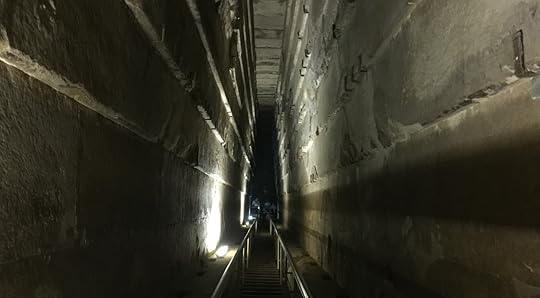
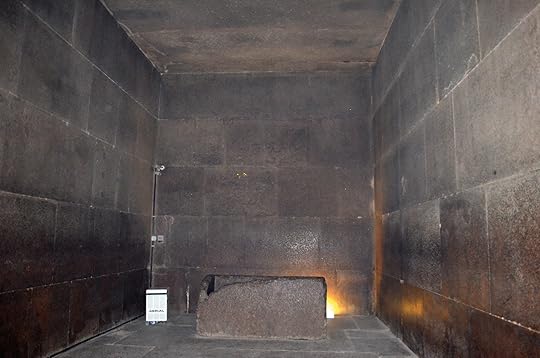
Did a highly advanced civilization exist in prehistory? Is the Giza Pyramid a remnant of their technology? Then, what was the power source that fueled such a civilization? The technology of harmonic resonance, claims renowned master craftsman and engineer Christopher Dunn. In a brilliant piece of reverse engineering based on twenty years of research, Dunn reveals that the Great Pyramid of Giza was actually a large acoustical device! By its size and dimensions, this crystal edifice created a harmonic resonance with the Earth and converted Earth's vibrational energies to microwave radiation. The author shows how the pyramid's numerous chambers and passageways were positioned with the deliberate precision to maximize its acoustical qualities. This may be the same technology discovered by Nikola Tesla and the solution to our own clean energy needs.
I got to go to Egypt in 2006. I had already read this book, but being inside the Great Pyramid made this book real for me. When you are in Egypt, and you see all the tombs and temples and ceremonial centers you see the Egyptians "wrote" on everything. In places like Dendra (it means "house of bread") they even carved/painted the ceilings! You can see writing all over the tombs in the valley of the Kings. But look inside the Great Pyramid, which is supposed to be a tomb. It is the grandest structure there incomparable to a place like King Tut's tomb. Yet, once you are walking inside, notice what is not there. What you realize is that there are zero carvings, paintings, or marks of any kind! What kind of tomb is this anyhow? No scenes of the king's life or accomplishments, not a single cartouche, no texts to instruct the king on what to do in the after life! This book scientifically and carefully explores what The Great Pyramid could be instead, and it is fascinating and carefully pieced together! You will especially like how precise they made things! How many of their items look as if made by machines or some kind of specialized tools that mainstream Egyptologists won't acknowledge! This will take your mind on a fantastic voyage!
One of the best books available - on what many people believe - to be the true function regarding the Great Pyramid of Giza. Christopher Dunn has been a mechanical engineer for more than 40 years. He presents a serious, open-minded, and very strong hypothesis to support his power plant theory.
The tomb theory is picked apart throughout the book, however, many will be surprised to know that out of all the pyramids in Egypt (100-odd), not one original body has been discovered to support the orthodox tomb theory. The Great Pyramid remains the largest, most precisely built, and accurately aligned building in the world today, with a lot more to offer than what meets the eye.
The pyramid is estimated to have been built from 4,800 to 73,000 years ago - (anybody interested in the Sumerian tablets will know this will be during the time of the mysterious 'Annunaki' before they left around 200 BC).
Dunn presents many interesting facts surrounding the Great Pyramid. However, some of them are extremely perplexing to say the least. The Great Pyramid is in alignment with the constellation Orion. Also, the weight of the pyramid is a perfect integer of the weight of the Earth! Furthermore, the pyramid is placed directly in the centre of the Earth's land mass. All of these are either coincidental, or an indication that the Egyptians (or whoever built the pyramids) knew a lot more about the layout of the Earth and the Galaxy than what we give them credit for.
Dunn's hypothesis is that the Great Pyramid at one point utilized the natural energy of the earth in the form of seismic vibration. The Antechamber mitigated these frequencies before passing through to the King's Chamber. Once in the King's Chamber the vibration flows through the granite and reacts with the quartz. The Queen's Chamber below produced the gaseous medium in the form of hydrogen to allow the energy to be converted and utilized in the form of microwave radiation.
Dunn backs up his hypothesis extremely well. And if this is the truth, then there will be no contradictions, inconsistencies or any kind of deviation that will throw it in doubt. So far the results are: Dunn's hypothesis 1; Tomb theory 0.
Somehow I tried to refrain myself from boring you with the technical nuances and minute details of this theory, but amazed as I am just like millions of readers, could not stop myself from highlighting the aspects that I liked in the book. The author writes with simplicity yet with authority, and it is a pleasure to appreciate the logical reasonings..The pictures and diagrams in the book are excellent in explaining the many concepts described in the rather short and succinct book of 250 pages..reading the book is like solving some physics puzzles hard coded in solid granite blocks many centuries ago..by an ancient race nobody knows.
Christian Dunn starts off with a scientist’s observation of the Great Pyramid - the tallest manmade structure till very recent times, a huge structure of 481 ft high, each base measuring 756 ft; the four sides aligned to the four compass points with optician’s precision, & built with approximately 2.3 millions of both limestone and granite blocks weighing between 2.5 to 70 tonnes, ferried from far away Aswan quarries some 800km away. Apart from the exact flat alignment of the passages and other features, the pyramid sits at the centre of the earth’s land mass, the perimeter to base ratio coming astoundingly close to 2pi; and also this ratio exactly corresponding to ratio of earth’s perimeter to height of the northern hemisphere.
All this tells a story of advanced civilization who were aware of detailed features of the earth and astronomy, and also were capable of building such mammoth structures with mathematical precision.
But the usual suspects are the pre-historic barbarians in the Bronze Age, only primitive copper and stone tools in hand, not yet credited with the invention of wheel, let alone advanced machines and cranes!
Yet, when Dunn examines – in agreement with English archaeologist Flinders Petrie- the machining details of extremely hard igneous rocks such as granite and diorite blocks, he explains the proof of advanced tools used such as lathe machines on sarcophagi lids; cutting concave and convex spherical radii; hollowing out the insides of granite coffers using mechanized tubular drills; and ultrasonic drilling in quartz crystals.
The question therefore aroused by many, including Hancock and Dunn, is what is the real purpose of this great structure that was built thousands of years back? Was it to demonstrate or show-off their technological advancement to a future race , or was it built by some megalomaniac king as a mortuary temple ? Cenotaph, Tomb or Monument? All these presumptions fall flat when Dunn highlights the precise mathematical, ultra-precise engineering perfection that are quite redundant for these purposes, but chosen by the master-architects and pyramid-planners.
Dunn proposes that the pyramid structure was a power house of an ancient civilization to produce wireless electricity, and goes on to investigate each of the unique features and find a perfect fit to his theory.
Quite elegantly so, Dunn explains his theory based on simple principles of physics- and how the pyramid was designed as a microwave-amplifier coupled-resonator power plant, using the natural rhythm of the earth to activate it.
In summary:
The input waveguide or the northern shaft, takes in the microwave energy from the atmosphere, and the output energy is directed outwards from the pyramid from the other waveguide ( southern shaft) with particle acceleration taking place in the granite resonant quartzite chamber called as King’s Chamber.
The fuel is hydrogen gas produced in a reaction chamber called as Queen’s chamber; fed with dilute hydrochloric acid, and hydrated zinc chloride solution - through two angular shafts and connected to a subterranean chamber through vertical shafts. The proof of the vertical shafts came to light by the German scientist Gantenbrink’s upuaut snake-robot.
The ascending chamber plugged with granite-blocks acting as feedback mechanism, the grand gallery equipped with 27 banks of Helmholtz resonators, and the ante-chamber with portcullis forming a granite acoustic filter..all these help in stepping up the coupled vibrations of the pyramid upto a certain sonic frequency, causing the overhanging granite blocks in the King’s chamber to resonate at the earth’s fundamental frequency. This resonance causes creation of an electromagnetic field from the quartile igneous rocks in the chamber due to piezo-electric effect.
The interaction of the electromagnetic resonance and the hydrogen gas results in a highly concentrated microwave energy at the wavelength of hydrogen atoms; due to maser effect of ion-acceleration of hydrogen atoms.
Impressive isn’t it? Production of environmentally clean wireless energy, that Tesla could not produce.
To understand how the maser functionality of the pyramid might have worked to convert hydrogen and earth’s mechanical energy to usable electrical energy output, it can be compared to a three stage microwave amplifier. The signal input in the form of hydrogen microwave energy of a wavelength 8.4 inches, that is constantly bombarding the earth from the atmosphere, is made to pass through the northern shaft fashioned as a rectangular shaft of 8.4 inch in width and 4.8 inch in height : the perfect criteria for a waveguide. Perhaps the entire northern and southern shafts were in-lined with gold for efficient transfer of energy input and output.
The power input of the 3-stage microwave amplifier, arrives as the acoustic energy and hydrogen gas through the grand gallery and the acoustic filter. Sound or the acoustic energy is focused onto the King’s chamber to force oscillations of the granite structure at its resonant frequency. The acoustic energy is transferred into high frequency radio waves by piezoelectric effect. The hydrogen in the King’s chamber is excited (the electrons excited to a higher orbit) and de-excited continuously, resulting in excess photonic energy. The Granite box in the chamber refracts the incoming radiation inside the box, and after causing hydrogen to emit excess energy, is again focused out towards the southern shaft which collects the focused, collimated, coherent, monochromatic beam via a horn antenna and guided out of the pyramid to the sky.
To assist in the free vibration of the King's chamber at its harmonic frequency that is 438Hz, it is designed on a corrugated floor block like an egg carton. There are 43 granite beams in five rows on top of the King's Chamber, and it seems these beams were tuned to a specific resonating frequency of 438Hz by scooping out material from their top sides, resulting an uneven fourth side in contrast to other three perfect aligned sides. The sound reinforcement in the grand gallery is assisted by the 45 degree- angular ratchet-like reflecting ceiling surface. The antechamber forming an acoustic filter could have been achieved by adjusting the heights of baffles by semi-circular cams, in order to filter out non-harmonics to enter the King’s chamber from the Grand gallery. The grand gallery – with its continuously narrowing width towards the antechamber – is lined with 27 pairs of notches: theorized to hold together a wooden ladder supporting hollowed out spheres having small openings of 1/5th to 1/10th the sphere’s radius – thus acting as Helmholtz resonators along with some type of tuning fork mechanisms, samples of which –lying in Cairo Museum- have baffled modern machinists on what types of tools did the ancients use to achieve perfect hollowing out of spherical balls of rock. At the end of the ascending passage, the author theorize the presence of granite plugs as a means to monitor the acoustic energy from the descending passage. Coming to the chemical chamber known as Queen’s chamber, the two angular shafts are throttled into smaller 5-inch “lefts” while joining into the chamber, in order to prevent the gas to push-back along the narrow shafts. Finally, the copper electrodes pairs found on the Gantenbrink’s door are theorized by the author as a arrangement to monitor the liquid level inside the shafts – the circuit is closed when the liquid is able to make a short-circuit contact between the two protruding electrodes & the circuit is open - when the liquid level has receded down from the height of the electrodes.
There may be some holes in the theory : absence of gold plating in the so called waveguides, using limestone and not granite for the chemical carrying shafts into Queen’s chamber, and availability of zinc and hydrochloric acids as raw materials… but these are not enough to completely brush aside the theory put forward.. and in the absence of the feasibility to go back and interview the builders, at least till the time another theory explains all the features of the great pyramid - why it is so huge and precise; presence of exuviae; violent disturbances in the King’s chamber; resonating chambers with giant monolith granites; the presence of quartz in vast quantities; the notches along the grand gallery – we will accept the theory.
However, from this stage, Dunn takes us into a fascinating world of speculations: Devoid of any solid proofs, he pans out the possibilities for such an technologically advanced ancient civilization.. was the energy being utilized to maneuver spacecrafts, or was the power emanating from the pyramid redirected back to the earth by mirroring relay satellites.. was the civilization eventually destroyed itself by advanced nuclear warfare, descriptions of which appear in religious texts like Mahabharata as “ bhahmastra” ..
And, nicely ending the brief book, he wonders, if our own civilization will eventually fall into the same trapping of another nuclear war and annihilation… till the planet gives rise to the next civilization tens of thousands years later, and until the time they achieve a contemporary technological skills to correctly interpret the remnants of our current race..buried, time ravaged and destroyed by their early generations, in far corners of the world, till the correct interpretation dawns on them ? Or will they regard those “proofs” as absurd, imaginary or religious figments.. just like we consider the fingerprints of the ancient civilizations and our religious texts..just because we can not fathom how these scenarios could be feasible?
It is always intriguing to read something out of the ordinary. Like Charles Hapgoods wonderful book 'Maps of the Ancient Sea Kings', this book also really tingles your imagination. It brings some really hard evidence to the table for an alternative interpretation of the 'function' of the pyramids of the Giza complex. Like Robert Bauval before him, he might eventually be proven right, which would really change the way we should think about ourselves and our 'recent' history. Added to the data from Charles Hapgood and Rose and Rand Flem-Ath, it becomes nearly inescapable to truly consider that a really advanced human culture was present in our recent history that was destroyed by one or several cataclysmic events. A culture whose remains still mark our planet, waiting to be rediscovered. And even if eventually proven untrue it makes for some fascinating reading, and makes loose an Indiana Jones spirit.
For those skeptical of the popular belief that the Great Pyramids of Giza are colossal tombstones, you'll be let down by Christopher Dunn's left-field theory: Dunn proposes that the Great Pyramid of Giza was at one time an active seismic power plant. He fails to prove this thesis. Not only is there a conspicuous lack of incontestable supporting evidence in the text, but the presentation of the argument is scattered and arbitrary. The cover of the book- an almost comical artist's rendering of the book's thesis- is simply not sufficient to convince. Furthermore, any reader who has been exposed to scientific theory and proofs in a university classroom is likely be turned off by the notion that a modern engineer without a rigorous methodology could so easily solve the "mysteries" of ancient Egypt, disproving generations of researchers before him. Dunn's entire proposition rests on his scrutiny of minute traces of tangible evidence and, on the backs of conspiracy theories, on the 'support' of other random non-archaeologists/Egyptologists. As to the questions that arise from his radical proposals, he's quick to address those, too. Though, he is predictably unable to answer even the most basic questions concerning the phenomenal ancient Egyptian power industry. His single response to obvious queries is a preachy commentary on how the ancient Egyptians, owning super-modern chemistry facilities, were as susceptible to mass-self-annihilation as we are today with our weapons of warfare. To me, "All the evidence supporting my theory must have been vaporized in a cataclysmic explosion," is not a convincing way to close out the argument. Until more legitimate evidence is unearthed, I can't help but feel this book should be shelved in the 'Humor' section of the library - rather than as 'Non-Fiction'.
This entire review has been hidden because of spoilers.
✿●✿●✿●✿ I became very intrigued by this title when it popped up on my “you might also enjoy this” suggestion in an email. When I researched the reviews on Goodreads and Amazon, I became more than intrigued. A little internet research and voilà! How lucky I was to find it on archive.org!
The author asserts that the Great Pyramid was never intended to be a tomb: There are no pharaonic inscriptions, no logical burial chambers, no funerary residue. He continues to state that the pyramids were actually power plants utilized to capture natural energy from the Earth. He goes on to state the ancient Egyptians were much more advanced that most Egyptologists, archeologists, and governments are willing to admit and reveal – the ancients knew how to harness magnetic power, et cetera and use it to their great advantage.
Christopher Dunn further states that the ancients had power tools, as evidenced in circular saw marks, et al on certain hard rocks, et cetera.
The chapter on the feats of Edward Leedskalnin, who built the Coral Castle in Homestead, Florida is interesting. I had heard about this previously, and Dunn lays out the mystery of how Leedskalnin was able to move tons of limestone by himself. Although how he did it is still a mystery, Dunn presents his plausible theories. Leedskalnin intimated that he “knew how the ancient Egyptians moved” tons of stone.
While this book took me a few days to read (there are photographs and mechanical drawings), I found it a very interesting and plausible work. I always believe that all the generations before us were not ignorant; they had brains and used them, they possessed knowledge that unfortunately became “lost” over the centuries (see information about the great library at Alexandria) – and I can see why academics and certain scientific fields would have us to believe the ancients were knuckle-draggers and we are so much more advanced and intelligent. Ha! I do not believe that for a second. ✿▬✿●✿▬✿ ⚪️Internet Archive.
For reader living in Europe - the most annoying thing in whole book is using non-metrical measure systems by author. Book is full of technical details and measurements and it is very difficult to follow and imagine stupid units like cubic feet , inches etc. Otherwise very solid work, reminds me about how little we know about the past.
First of all: I generally don't even read these kind of fringe pseudohistory books, but a friend of mine nagged me into reading this one (he claimed it would be an eye-opener).
I expected a lot of crap, and false information. I was not disappointed.
I see that the man knows science, and I applaud his attempt of trying to explain something from the past, yet he doesn't know a lot about the time period in question.
First of all, the claim that no mummies were ever found in the pyramids is false. While very few complete mummies have been found in tombs, mummy parts and/or skeletal parts have been found in a lot of pyramids. Since the book was written, the mummy of queen Seshestet was actually found in a pyramid in Saqqara, and 8 complete mummies were found in the pyramid of Amenhotep II. Moreover, we have ancient texts explicitly stating the funerary use of pyramids. It's just a common misconception that the bodies were buried in the pyramids. THey were buried in chambers beneath the pyramids.
His lack of knowledge in Egyptian history becomes apprent when he describes the Serapeum as being prehistoric, while it has actually been built in the 19th dynasty (meaning it dates from the Egyptian New Kingdom)
Also, why have we not found any traces of electricity-powered technology in Egypt? (hint: because they didn't have it).
All in all, I'm certain that mr. Dunn knows his engineering stuff (which is admirable enough), but he shouldn't waste energy trying to explain things that are already sufficiently explained. And he should restrict himself to his specialty field, instead of using false data to write a book on a subject he's not very well-versed in (history of Ancient Egypt)
Very interesting and credible enough theory on how the pyramid of Khufu actually once operates as, basically, a giant engine, amplifying micro waves to be used as a power source. The author easily shows there is ample circumstantial evidence that Egyptians used power tools to fashion the pyramids and puts forward a reasonable theory, if fantastic, that explains many of the awkward quirks of the great pyramid, as well as others.
The only problem I have with the book is that the author displays many of the qualities of techies turned authors, simply not being able to stick to the main subject when trying to write for a non-technical audience. I'm really not interested in his personal musings. And when Dunn starts to talk about Cayce and Atlantis... well. He shouldn't have.
The book's already nearly 15 years old. What's been missing is a follow up, building an actual replica. A proof of concept should be easily doable, well, if there's any sense to Dunn's theory.
Although parts of the book are a bit far fetched, some very intriguing thought is put into the technological conjectures proposed. I would forward that there may be an alternate application for the configuration of the pyramids with the advent of LED technology and our understanding of how electrons emit light energy when an initiating electrical charge is applied. Could we have a beacon, rather than a power source?
The author isn't a historian nor an archaeologist nor, god forbid, an Egyptologist: he's a craftsman that worked for an aerospace manufacturing company. So he has the right background to recognize toolmarks, as well as to know and research through many contacts in the industry what would truly be needed to make the buildings and artifacts that the Egyptian civilization left behind, whether those buildings and artifacts were truly made by them or not.
If your conception of the megalithic complexes built in the land we now know as Egypt, and the people that lived around them, stayed at the level that is taught to children, that a bunch of pre-bronze age people banged diorite balls against stones in the 7-8 level of hardness and somehow organized themselves to create marvels such as the Giza pyramids, then the hypothesis that this book puts forward, that the Great Pyramid was a power plant, sounds completely ludicrous. In the past one would have to be a very adventurous person to visit some of the sites where the most magnificent and puzzling ancient structures remain. These days, many of those explorers upload very detailed videos to YouTube, for example, and you can see by yourself that the official story of some of those sites doesn't make sense. In Egypt alone there are perfectly polished and carved structures with perfect symmetry that couldn't have been made with the tools that the official narrative assures they were. In fact, the toolmarks in some of the structures or pieces evidence that saws and drills that worked at a very high rate per revolution (higher in fact than our current technology in some cases) tell you that they used powered machines to do the work. If the toolmarks tell a story that the narrative doesn't support, the narrative ought to be changed, no matter now much it screws with the preconception that civilizations progress through different ages neatly (stone age to bronze age to iron age). As I've mentioned in other reviews, there has been a disturbing trend in academia of believing that everything progresses neatly in every subject (geology, climate, history, archaeology, etc.), which would conveniently leave us as the current pinnacle of perfection or optimization. I won't get into how that ties into politics.
The official narrative tends to explain the puzzling features in some complexes (such as the strange passages and rooms inside the Great Pyramid) as the architects changing their plans mid construction (and somehow ending up with a gigantic building in which all the pieces fit correctly as if designed like that from the beginning). When it comes to how they built them or transported the stones (sometimes across hundreds of miles of desert, or up and down mountains as in some cases in South America), the solution usually comes down to effort and lots and lots of workers. However, that explanation doesn't fly in sites like the Serapeum of Saqqara, an underground complex where enormous blocks of very hard stone were somehow transported from far away through corridors with very little room to maneuver and then lowered into "crypts". Those blocks then were cut into gigantic boxes of sorts with extreme precision.
Puzzlingly, the official narrative says that those boxes were made to hold the mummies of bovine animals, because they were sacred. Everything is a tomb or an altar or a cult of some sort to these people. However, no such remains were ever found inside those boxes, even in those that were closed and with the lid on, a lid that weighs dozens of tons. Grave robbing is the usual justification, even in the case of not a single original mummy having been found in around 50 pyramids that were supposed to be tombs, including, again, in those like the Great Pyramid that had been closed off for thousands of years; it was opened on the order of Caliph Abdullah al Mamun after the muslims invaded Egypt.
Regarding the Great Pyramid, the photos and videos of the inside show a clear contrast with complexes documented by dynastic Egyptians as having been built by them: there's not a single hieroglyphic inside.
Note: according to the official narrative, everything old in the previous pictures was supposed to have been made by a pre-bronze age people. In addition, the King's Chamber, in the second picture, looks as if it had been subjected to very high temperatures, and the Queen's Chamber, in the third picture, as if it had been corroded through chemical means. Both tie into the author's tesis.
In essence, according to the author of this book I'm supposed to be writing about, the pyramids were engineered as what we in modern terms would consider Wardenclyffe or Tesla towers: structures that interact with the natural vibrations of the planet to produce electromagnetic energy. Nikola Tesla was working on it and because he couldn't finish it (couldn't get more money from the investors), he went bankrupt, and from there it was a mostly straight path into getting depressed and holed up in a hotel room for the rest of his life. The investors, most notoriously J. P. Morgan, didn't see much profit in Tesla's plan for wireless, free energy for everybody. If Tesla had succeeded, we would be living in a different world: the entire planet's reliance on fossil fuels would have stopped, and wouldn't have grown through the 20th century and into the 21st to such a degree. Goodbye to our constant preoccupation with what happens in the Middle East and with the barbarous ideologies that reign there, goodbye to dismantling countries so "we" can take over their currency and their fossil fuel infrastructure, goodbye to the growth of world conquering political systems that need their citizens to rely on the "elite" for continuous sustenance.
Regarding the construction of the Great Pyramid and other complexes we know as Egyptian, they very well might have been made by some other people that inhabited the area. However, the puzzling Dendera Light relief suggests they might have been benefiting from a power plant of some sort maybe without fully understanding it:
That would also explain why there is no soot from the torches that they would have to have used in many buildings just to work inside of them.
When the author leaves behind the detailed realm of machining and engineering and hypothesizes about what, beyond powering tools, could that energy have been used for, is where he loses me quite a bit. Yes, I know that the most ancient Indian traditions involve flying cities and terrifying weapons of mass destruction that in modern times we quickly recognize as bombs, and that there were Indian corpses from deep antiquity found with levels of radioactivity dozens of times above the average, but I would need some solid proof to believe that whoever built the Great Pyramid was powering spaceships.
I was reading something online about the Earth's "hum" when I came across this fascinating article by engineer and "pyramidiot" Robert Bauval . In it he explains that the Great Pyramid was constructed in such a way that it might have translated this frequency into something suitable for human listening; in other words, the pyramid may have been designed to "sing," making it the world's first multimedia monolith. I was so amazed at this revelation that I fired the e-mail off to my good friend, Rev. José M. Tirado, who shares my fascination with both ancient wonders and contrarians. Within minutes his reply indicated that I needed to read a book called The Giza Power Plant.
Although certain that the local library would not have a copy of this oddball book, I was taken aback when the online catalog pointed me right to it and indicated that it was available to request and check out locally. I placed my request, and once the book arrived at the library, I figured out why they were able to get a copy. It turns out that author Christopher Dunn lives in Danville, IL, which is about 45 miles from here, and so the public library owned a copy. My attitude toward coincidences is that they all are meaningful, and so the proximity of the author cemented my desire to read this book.
Dunn begins with a pretty interesting question, one rooted in his decades of experience in manufacturing: why is the Great Pyramid of Cheops so precise in its construction? He explains at some length that the precision found in the measurements of the pyramid, including the surveying and alignment of the base, with variances of less than a hundredth of an inch over a length of hundreds of feet, is beyond the level of precision expected of contemporary construction. As an aerospace machinist with over 30 years of practical experience, Dunn cannot simply brush aside this question; he makes it clear that for the folks like him, those responsible for translating the ideas of engineers into physical artifacts, the standard theory about the purposes and construction of the Great Pyramid just don't hold water.
He also asserts that there is abundant evidence of the use of machine tools at Giza and he shows quite a few images that seem to support his contention. Thin parallel grooves in shaped stone look like the marks left by a power drill. Intersecting curved surfaces in stone bowls indicate the use of lathe-like machine tools, and not easily blunted copper implements and scouring compounds. Dunn marshals some pretty intriguing evidence in his chapter on the use of machine tools in ancient Egypt and discusses the positive responses he's gotten from machinists, engineers, and others involved in hands-on manufacturing. This chapter was probably the most compelling in the book, because it does seem to me, a total layman, that he's on to something.
However, while his ideas on machine tooling in ancient Egypt are pretty intriguing, I found his overall hypothesis--that the Great Pyramid was a vast machine intended to produce power through resonance with Earth's "hum"--a lot less convincing, though no less fascinating. In brief, he asserts that the pyramid was a power plant that converted the Earth's hum into a source of clean, renewable energy. He doesn't just make this up out of whole cloth either; on the contrary, he provides a lot of circumstantial evidence that, if nothing else, does seem to indicate the inadequacy of the current explanation of the pyramid as a tomb. The granite-lined "King's Chamber" with its overlying vaults and entry-way is seen as a sort of "sound box" whose abundant quartz crystals resonate and amplify the humming earth below. The "Queen's Chamber" was a reaction chamber providing a source of hydrogen as a medium for the accumulated energy; Dunn notes the presence of various salt encrustations and a foul smell in this chamber that would be consistent with the presence of acid-base reactions. He even explains the mysterious shafts running up through the pyramid at an angle (a design feature inexplicable to modern manufacturers, since constructing the shafts on the horizontal would have been much, much easier); one shaft acted as wave guide to collect microwaves from space, focused them through granite lens that has been mistaken for a sarcophagus, and sent them out the other shaft as high-powered output.
It's a fascinating idea but it is not without its problems, obviously. Where are machine tools used in the construction, for example? I've seen museum cases filled top to bottom with Bronze Age implements but not one ancient Egyptian Black and Decker power drill. Where is evidence of the power usage (apart from the hypothetical power tools)? How was the power transmitted? (On one page, Dunn shows a bizarre "eye of Horus"-like satellite reflecting the beamed power back down to Earth, but thankfully doesn't really try to explain that.) Why did the human race completely lose its collective memory of this level of advancement?
This was a very interesting book which was incredibly well written (particularly since its writer is from Danville; in his defense, he is English by birth) and very fun to read. Dunn is an articulate voice for the seldom heard perspectives of those "on the ground" in the worlds of machining and manufacturing, and he raises some valuable and not easily dismissed questions about our knowledge of the ancient past.
This entire review has been hidden because of spoilers.
This is the author I have been looking for. Christopher Dunn comes across as a man of very reputable and learned background. He is NOT an archeologist, which is one point in his favor. He brings a very succinct and encompassing light to the mysteries of the Cheops pyramid. He has brought together the elements of advanced "Pythagorean" geometry, geomancy, harmonics, and his specialty tools and machines. He is really on to something here. It just feels right.
I found most of what he writes in this book to be possible, though sometimes his conjecture is not substantiated, leaving me thinking that either he is surfing near the edge of his expertise and has not sought out someone in another field who can back it up or he just wants to float an idea. But in the context of a book based on a string of scientific principles, those occasional forays into speculation were a bit of a letdown.
Overall, though, the book is very stimulating and caused me to wonder how much longer the human race will wander this world in ignorance. Our express purpose is to awaken to our true Self. The ancient Egyptians were well aware of this and perhaps the pyramids were devices of enlightenment. Powerhouses for the soul.
This book was absolutely fascinating. I started reading it thinking that it would be completely outlandish, and was so enthralled I finished it in just 2 days. The painstaking detail he went through to prove how the Giza Pyramid could be used as a microwave power generator turned me into a believer, but with some exceptions. And these are what kept me from rating it 5 stars. 1. If the pyramids were built as power stations, as opposed to burial chambers or some other function, then other pyramids would have layouts similar to the Giza pyramid. The author doesn't tell us, and mine own Google/Wikipedia research tells me that pyramids have all different layouts. 2. If the Kings Chamber sarcophagus is actually a quartz microwave resonator/amplifier, it seems that this could be tested on a small scale, but is never mentioned by the author. Without those 2 elements resolved, I remain skeptical.
Stumbled a bit upon this one. Never had any interest in the esoteric archeology field, however most of this book is more an analysis on the construction of the pyramids from an expert engineering / stone mason point of view. Up to now the explanation of how the pyramids were constructed was left to archeologists who, of course, have no idea about technology and engineering.
Dunn comes up with a lot of prove why the construction of the pyramids is not even possible with our technology we have today, and is completely impossible with the means of the ancient egyptians. All of these lead to interesting questions.
What I like is that Dunn only analysis and does not try to find any "ancient aliens" kind of explanations. Well worth the read, it's bit dry (i.e. engineering language) but opens up a complete field of very interesting, unanswered questions.
Unlike many of the pyramid theories, Christopher Dunn presents an unusual but important discovery. Written from an engineer's perspective, his impeccable attention to all details of the Great Pyramid has proven to me his ability to reverse engineer what is obviously a sophisticated machine deriving its power from the harmonics between the earth and the stars to which it is finely tuned. His revolutionary theory is the first to address the synergy of components in the pyramid, which most people would not recognize as being related. His conclusions demonstrate the Great Pyramid as an enormous energy producing machine, akin to microwaves, which help to support my theory (Alpha to Omega - Journey to the End of Time) as to what type of machine and just how powerful it really was. Great work!
I was researching something else at the library and came across this gem. This is some great fringe reading. I don't know if I really believe the guy but I love reading about fringe archeology. If this guy didn't set up his theory around the pyramid being a power plant, we'd have a viable alternative energy source idea. Think about it, a large scale tuning fork stuck in one of the most seismically active areas on the planet.
Very interesting information about the possible technologies in ancient times. The book looks at what we have, and the author works backwards into figuring out what they would have needed in order to machine the stones and build the pyramids.
Some of the things they did were just crazy. No way it was a bunch of primative fools with chisles and hammers.
For reader living in Europe - the most annoying thing in whole book is using non-metrical measure systems by author. Book is full of technical details and measurements and it is very difficult to follow and imagine stupid units like cubic feet , inches etc. Otherwise very solid work, reminds me about how little we know about the past.
Interesting. Not sure I agree with his theory of Pyramids use, but that he questions traditional Egyptologists/Historians is to be applauded. I agree that current mainstream theories are in error.
First of all, this book provided for some very surreal synchronistic moments. But just on content alone, it was a fascinating read. It took a very logical, mechanical, and engineering approach which was refreshing. Some unique and crazy ideas. The Great Pyramid, a machine, love it!
Very interesting stuff. Very detailed and raised some excellent questions and hypothesis. Got a bit technical in places (which I guess is necessary for credibility), but I had to re-read several sections to get it. If you are into this stuff, it's a must read.
Brilliant! This book does an excellent job of rationally and scientifically debunking a lot of the 'theory' regarding the pyramids, without making any rash assertions of its own.
This was a fascinating book I'd long wanted to read after seeing the author speak on the History Channel's 'Ancient Aliens' programme. The first half of the book focuses on alternative explanations for how the ancient Egyptians could have built the Great Pyramid. It begins with an in-depth discussion of why traditional archaeological explanations are physically impossible. It then highlights all the descriptions in the ancient texts, as well as texts from other global cultures on the subject of their own megalithic monuments, which state that the bricks were levitated into place. The author speculates on ideas of magnetism and anti-gravity, which to the casual reader might sound like something out of a sci-fi novel, but in fact these things were proved achievable through the work of Nikola Tesla at the start of the 20th century. It's only due to financial competition that we don't live in a world like he envisioned, today. Thus Christopher Dunn suggests that perhaps ancient civilisation knew about these things, too. When asked where lies the evidence of this, now, he explains that all the old metal tools would have corroded over the last 5,000 years; all that would survive is stone. The author is not a quack. He is an experienced engineer and supports his findings with extensive evidence, research and diagrams. I was immediately engaged and at least persuaded to believe in the possibility of advanced ancient technology. I am also now a believer that the pyramids were definitely not built as tombs. A quick consideration of the fact that the only original 'entrance' to the Great Pyramid hovers far above the ground tells me the Egyptians never intended for people to go inside.
Where the book loses ground is first in the way it suddenly begins extrapolating wildly, toward the end. Another point is that he often repeats himself to the point of it being irritating. He could have explained his points far more succinctly. Nevertheless, this is an eye-opening book and one I hope gains ground in the years to come. Unfortunately, modern sciences tend to shun anyone who disputes their set creed, rather than truly pursuing knowledge (despite the word 'science' meaning 'knowledge'!) and anyone who dares upset the status quo gets vilified. It is my desire to see the field of anthropology and archaeology adapt, one day, to accept the possibility that our ancestors were not as primitive as popular culture likes to think. This does NOT mean I necessarily believe they were aliens; it means I think humans have always been more intelligent than we give our race credit for.