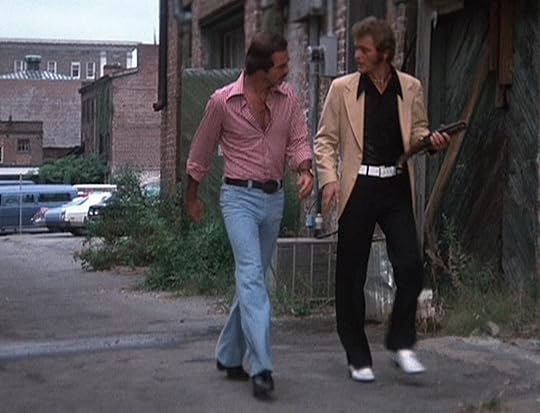
When ruthless land developers arrange to have Tush Bannon killed, they know he has a wife and three kids—but they don't know that he has a friend named Travis McGee.
John D. MacDonald was born in Sharon, Pennsylvania, and educated at the Universities of Pennsylvania, Syracuse and Harvard, where he took an MBA in 1939. During WW2, he rose to the rank of Colonel, and while serving in the Army and in the Far East, sent a short story to his wife for sale, successfully. He served in the Office of Strategic Services (O.S.S.) in the China-Burma-India Theater of Operations. After the war, he decided to try writing for a year, to see if he could make a living. Over 500 short stories and 70 novels resulted, including 21 Travis McGee novels.
Following complications of an earlier heart bypass operation, MacDonald slipped into a coma on December 10 and died at age 70, on December 28, 1986, in St. Mary's Hospital in Milwaukee, Wisconsin. He was survived by his wife Dorothy (1911-1989) and a son, Maynard.
In the years since his death MacDonald has been praised by authors as diverse as Stephen King, Spider Robinson, Jimmy Buffett, Kingsley Amis and Kurt Vonnegut, Jr.. Thirty-three years after his passing the Travis McGee novels are still in print.
Pretend for a moment that it's 1968 and you're a shady, amoral, would-be land developer in some scraggly-ass county in the Middle of Nowhere, Florida. Assume further that you own a couple of hundred acres of land near a waterway and that a big company is looking to acquire the land to build a major plant.
Assume further that there's a guy who owns a small marina on ten acres of land between you and the waterway that is critical to the plans of the big company. You make the marina operator an offer for his land, but he turns it down. He's working on his own version of the American Dream, which centers on developing his marina and a small motel.
Fortunately, you're well-connected with the local banker and politicians while the marina owner is a relative newcomer. So you pull some strings and get your pals to put pressure on the guy. Before he knows it, his loans are coming due; his business has dried up and his dream has turned to crap.
But the stubborn clown still won't sell and then one afternoon he turns up dead. It could have been an accident; the sheriff rules it a suicide, and who the hell really knows? The good thing about it, though, is that the guy's wife is really up against it now, giving you the chance to grab the land for virtually nothing while leaving her saddled with the huge remaining mortgage. Clearly, this is your lucky day.
Or maybe not. Because just when things are coming up roses, you slap yourself upside the head and say, "OMG; I really hope that damned marina guy wasn't one of Travis McGee's best friends!"
Sadly for you (and for a lot of your pals), it turns out that he was and you are about to find yourself in a huge stinking pile of steaming stuff.
McGee discovers what has happened and immediately sets out to more than even the score. As readers of the series know, McGee is a "salvage" expert who recovers things that have been taken from people who are left with no legal recourse. Normally, McGee's finder's fee is fifty percent of whatever he recovers, but this time it's personal and he's acting on behalf of his friend's widow.
As usual, there will be a psychologically damaged female who can only be saved by McGee's tender attention; as usual, there will be a dangerous sociopath lurking in the background ready to strike, and as usual, McGee will spend a fair amount of time ruminating on the state of his own life and of the world around him.
This is one of the better books in the series, mainly because of the very clever scheme that McGee creates with the help of his friend, Meyer. It's also not quite as cringe-inducing when it comes to McGee's treatment of women. This book, too, is certainly dated in that regard, but it's better than a number of others. All in all, a fun way to spend a rainy afternoon.
Travis McGee is a Florida boat bum who finances his extended vacations by trying to get back money that has been conned or stolen from people who can’t use legal means to try and recover it. His old buddy ‘Tush’ (1968 Winner For Worst Nickname) Bannon owns a small marina and hotel, but his land stands in the way of some crooked developers, and they’re using their influence with local politicians to squeeze him out. Tush refuses to sell and turns up dead on what is ruled a very messy suicide. An angry McGee decides to get revenge by swindling the developers with a complicated stock scheme, and this will also allow him to get a nest egg for Tush’s family in the process.
I’ve written before about the good, the bad and the ugly of the Travis McGee series in other reviews like One Fearful Yellow Eye, and this one is a pretty typical example of the series. The good is that MacDonald was a better than average writer, and he delivered offbeat crime stories with McGee being a kind of combination private detective and con man. The bad is that McGee can sometimes be a narcissistic bore, but at least he usually realizes that he’s essentially an overgrown child who is avoiding responsibility by opting out of the typical ‘60s lifestyle.
The ugly is the horribly dated depictions of women. Granted, this was written in 1968, but for a guy who could look ahead and write about issues like the destruction of Florida’s natural environment for greed and the loss of personal privacy in modern life long before these were issues with the general public, MacDonald wrote the females in the books with such a jaw dropping amount of sexism that at times it almost reads like a parody.
Even worse is that in this one, it seems like he really tried to incorporate some strong female characters, but then he undermines it all by having Tush’s wife fall apart after his death, leaving McGee and others to step in and take care of everything for the little woman. And this book also features a girlfriend for McGee with the James Bondian-style name of Puss Killian. As usual with the ladies in McGee’s life, Puss is measured by her looks, her hearty appetite, and her willingness to help Travis without any womanly emotions getting in the way. Oh, and of course, she’s a wildcat in the sack.
As always after checking out one of these books, I’m left liking the plot and the McGee character, but am left shaking my head in amazement at the way the females are written.
Just like Louis and Billy Ray from the 1983 John Landis film starring Dan Akroyd and Eddie Murphy and also reminiscent of the 1973 George Roy Hill film The Sting starring Robert Redford and Paul Newman, Travis McGee and his friend Meyer turn the tables on some Florida good ole boy businessmen when Travis’ old football buddy gets sideways in some shady Florida land deals.
First published in 1968, and set in Travis’ home state turf, this also made me think of the 1976 Burt Reynolds film Gator with Jerry Reed as the bad guy. Reed’s portrayal of backwoods tough guy Bama McCall fits in with some of the slick action MacDonald describes.
Like all of the Travis McGee books, this one the ninth in the series, the title includes a color (for product recognition and book sales). And like all the rest, this features John D. MacDonald’s excellent writing and adventurous imagination. This one, describing a revenge and some woman troubles (McGee???) stands above the rest as a truly great book.
MacDonald has always got it in him to create a book better than an intelligent adventure novel and here he does. Pale Gray for Guilt is not only fun and exciting, and filled with the author’s inimitable social and cultural observations, but this also hits all the right notes in all the right places. This would make an excellent introduction to his work for a first time reader.
A truly fine Travis McGee novel. McGee runs a complex real estate and stock market con on the men responsible for his friend's death. In fact, it's incredibly ambitious, straining credulity that he and his accomplices believe they can pull it off so readily. Yet my biggest issue is simply Travis McGee burnout. As always, MacDonald's writing is wonderful, the prose at times sublime. And McGee's pithy social and cultural observations are timeless gems. Yet there's something deeply irritating in MacDonald's portrayal of the relationships among McGee and his friends and lovers - too cutesy and familiar. I get my fill of it real quick. I don't know if I'm giving up McGee for good, but I certainly need to pace myself with these.
Travis McGee lives aboard the Busted Flush, a large power boat that allows him to have a comfortable place to sleep when he isn’t out doing something in his “salvage recovery” business or acting as an informal private investigator. Here’s how McGee describes it. "“It’s a tricky, complex, indifferent society, Puss. It’s a loophole world. And there are a lot of clever animals who know how to reach through the loopholes and pick the pockets of the unsuspecting. Carefully done, the guy who has been plucked clean has no way of getting it back. There are a thousand perfectly legal acts that can be immoral, or amoral, acts. Then the law officers have no basis of action. Attorneys can’t help. The pigeon might just as well have dropped his wallet into a river full of crocodiles. He knows right where it is. And all he can do is stand on the muddy shore and wring his hands. So I’m the salvage expert."
The lifestyle has its attractions and MacDonald honed his character over several successful decades. One of GR’s resident experts in McGee, James Thane, notes that these books are far from “correct” in their treatment of women and that MacDonald finds Travis McGee useful when he wants to get “preachy.”
Still, McGee isn’t blind to his own faults. "In the service of my gift, I have had to forgo much that makes a man in full. I know now that this sacrifice has left me blind to certain things. I can see what others cannot see, but sometimes I miss what is apparent to the dimmest simpleton." In Pale Gray, we find McGee in possession of a new runabout. "Even with the investment in the playtoy, I still had a comforting wad of currency back in the cache aboard the Busted Flush at Slip F-18, Bahia Mar." Life is seemingly good. But, McGee should know better than to get too comfortable: "Cold beer, good music and a place to go. That’s the way They do you. That’s the way They set you up for it. There ought to be a warning bell on the happy-meter, so that every time it creeps high enough, you get that dang-dang alert. Duck, boy. That glow makes you too visible. One of Them is out there in the boonies, adjusting the windage, getting you lined up in the cross hairs of the scope. When it happens so often, wouldn’t you think I’d be more ready for it?"
He takes his little boat upriver to visit a guy he’s called a friend from way back when. He finds hard times have come to stay and the friend, Tush, isn’t asking for help. This doesn’t sit well with McGee who worries. "The thing is, he isn’t a devious guy. And he’s caught in the middle in a very devious situation, with large money hanging on it, and old Tush may try to bull his way through, and he could get hurt twice as bad.”"
It’s only a matter of time before “the powers that be” have declared the friend a suicide, but McGee doesn’t believe it. His code of friendship demands that he not let it rest.
MaGee has some female companionship that wants “in.” "I never knew Tush. I never met Janine. But I have a very hard nose, dear, and I don’t scare, and I want to share.” And that in addition to his friend and boating companion Meyer. Who is usually much more presentable and cautionary than McGee. "“Success hasn’t spoiled me, Meyer. Have you noticed?” “All I notice are your criminal instincts, my dear Travis, and how rash you are with your queen, which lets me whip you at chess, and how right now you are too tightened up over this Tush business. You are too close to this one. Be careful. I don’t want to lose you. Some terrible people might take over Slip F-18. Nondrinkers, going around saying shush.”" “I’ll give it some thought.” “You do that.”"
There are a goodly number of entertaining descriptions along the following lines: "Ingledine’s Funeral Home was on a lateral street, and was a small version of Mount Vernon, set between a Savings and Loan branch and a used car lot."
This book is very much of The Sixties, sometimes annoyingly so with its cute nicknames and comments about contemporary pop culture rubbing against McGee’s sensibilities. It has an environmental sub-text without explicitly drawing conclusions from that plot element.
The time-warp gets annoying and the plotting is adequate but the facets of the “con game” made me hang on to the finish line. "The secret of the big con is to move the victim, bit by bit, into increasingly implausible situations. At last, in the act of plucking him clean, you have him performing such a damned-fool act he will never understand how he came to do it, why he didn’t see through it. He was blinded by the conviction he couldn’t possibly lose a dime. And when he learned he’d been conned, he couldn’t take it to the law." 3.0
Travis McGee, if you are unfamiliar with his world, lives on a houseboat, The Busted Flush, in the Bahai Marina in Florida. It is an endless string of parties in a world unlike that of the 9 to 5 Joe. McGee doesn't necessarily work in the general sense, but does collect salvage for people who have been wronged and for who the laws and the system will never make whole. These are not hardboiled detective novels, but somehow they are imbued with the spirit of the lone avenger who all on his own is out to unmask the bad guys. These books contain the most amazingly spot-on characterization as well as capturing so much of a certain time and place.
This particular McGee features the shock of watching a friend ruined and murdered all because he wouldn't give up his tiny piece of land to a cutthroat developer. While McGee can't bring his friend back from the dead, he can make this animal bleed and so, with the help of Meyer and a tall redhead, he sets up an elaborate sting. This could have simply been titled The Sting. A throughly enjoyable adventure brilliantly conceived. Great stuff, indeed.
Okay, I've been avoiding the mystery writer John. D. MacDonald (not to be confused with mystery writers Ross MacDonald and Philip Macdonald) because of the eye-poppingly sexist crap on his jacket blurbs, wherein naked women and dead people appear to be the only folks populating his world.
But this jacket blurb wasn't like that, so I read it.
Holy crap, do I love John D. MacDonald!
You know what kind of women populate his novels? The kind who can show a cheesy, sexist 1960s ass-grabber exactly how it feels to be reduced to a thing. The kind who fight with husbands they love, lose their tempers with kids they're fundamentally good to, skip out on Travis McGee just when the loving gets good---have agendas and decisions and doubts and lives all their own, independent from the men, because even in 1968 they are, in fact, human beings.
And MacDonald makes a point of proving that.
Granted, MacDonald's version of a 1968 hallucinogenic love-in is remarkably inept. And there are a couple of times when he out-right lies to the reader. (McGee tears what up as he walks back to Meyer?)
But this book is structured fabulously and written great, capturing a textured, thoughtful view on MacDonald's own time and place.
I went back to my second-hand bookstore yesterday and bought the rest of his books.
As usual with my reviews, please first read the publisher’s blurb/summary of the book. Thank you.
A book of the long con, orchestrated by Travis and Meyer. Complex, sad, workmanlike. There's little joy in this con of multiple revenge, but there are some fine characters, and too many losses. McGee's final request of Meyer at the end: I told him that we were going to take his little cruiser because it could take more sea than a houseboat, and we were going to take the Munequita in tow, and we were going to go as far down the Exuma Cays as the range of his boat would allow, and then we were going a lot further down in the Little Doll. I told him I was sick unto death of miniwomen, miniclothes, miniloves, minideaths and my own damned minilife. I wanted empty cays, gaudy reefs, hot sun, swift fish, and maybe some talk when it was time for talking. Full size image here
36% Again here, my favourite character in noir, the Philosopher-Detective.
MacDonald paints an image of the flow of time and human life. Wonderful:
Not a spoiler, just a long, poignant passage - And here we are, book #9, and we find what we always secretly knew: McGee is monogamous. A huff of wind came and flipped the point of my collar against my throat. It ruffled the canvas laced to the sundeck rail. The collar was the tickle of the brisk red hair of Puss, and the canvas sound was her chuckle, and without warning I had such an aching longing for her it was like long knives in my bowels, and my eyes stung. - McGee's pal Meyer, a philosopher economist retired Meyer in his white swim trunks reminds me a little bit of a man who is all dressed to go to a masquerade as a dancing bear. All that is left to do is put on the bear head and the collar. - I haven't owned a car since 1992 ! I love London! People hate their cars. Daddy doesn't come proudly home with the new one any more, and the family doesn't come racing out, yelling WOW, and the neighbors don't come over to admire it. They all look alike, for one thing. So you have to wedge a piece of bright trash atop the aerial to find your own. They may be named after predators, or primitive emotions, or astronomical objects, but in essence they are a big shiny sink down which the money swirls-in insurance, car payments, tags, tolls, tires, repairs. They give you a chance to sit in helpless rage, beating on the steering wheel in a blare of horns while, a mile away, your flight leaves the airport. They give you a good chance of dying quick, and a better chance of months of agony of torn flesh, smashed guts and splintered bones. Take it to your kindly dealer, and the service people look right through you until you grab one by the arm, and then he says: Come back a week from Tuesday. Make an appointment. Their billions of tons of excreted pollutants wither the leaves on the trees and sicken the livestock. We hate our cars, Detroit. - Puss Killian, beautiful, and far more important to the series than she seems. She called me back from my edge of sleep by gently thumbing my left eye open and saying, "Are you there? Listen, for making all these days and nights so full, the lady thanks you. Thanks for letting me come along for more than just the ride, McGee. Thanks for helping me cram three bushels of living into a one peck basket. Are you there?" "You are O so welcome, lady." - McGee contemplates an old friend .... Long ago and far away I could see Tush Bannon under the needle spray in the long shower room that smelled of old socks, soap and disinfectant, rubbing up a suds on that barrel chest and bawling, off-key, ". ._ and this is my storrrreeee, as you can plainly see. Never let a sailor put his hand above your kneeeeeeee."
Bonus. From the 1970 "Darker Than Amber" movie starring Rod Taylor, pictures of the producers' ideas of McGee's "The Busted Flush":
I really wanted to love this as much as I love the color gray, but it was truly on the boring side. So many details about real estate, so very long before there was real action (this is not atypical of this series). John D. MacDonald may be my favorite writer, but his Travis McGee books sometimes seem like a lot of filler. Depends. A few of them are amazing.
Tush Bannon, an old football buddy of Travis McGee, has been murdered and made to look like a suicide. Indeed, the man had been in financial difficulty as he tried to put together a nice marina/motel on the coast of the Florida Straits, but he just isn’t the type to take his own life, especially considering a lovely wife and a couple of kids left behind. McGee soon discovers that the marina/motel property happened to be the last hold-out in a large real estate deal and the fact that Tush wouldn’t sell was likely the real reason behind his murder.
McGee’s pal Meyer, joins him in conducting a complex parallel con on a couple of bad guy real estate moguls and eventually uncovers the real murderer. I always love a good con, especially one that uses the stock market to dupe supposed masters of the trade. But that’s not all that this book offers. One of the most important female characters in McGee’s life, Puss Killian, plays a major role here and near the end of the book, adds significantly to McGee’s emotional scars.
This novel sees Travis McGee in an avenging angel role, perhaps more so than usual. He seeks justice for Tush’s murder but also needs to ensure Tush’s wife and kids are financially taken care of for their futures. He risks a lot for no expected reward.
This is the 9th book in a series of 21. I am rapidly coming to the half way point and am already lamenting the day when I will have no more new Travis McGee books to read.
This is one of my favorite Travis McGee novels. I’ve read it at least 5 times. It might be my second favorite.
A warning for the Ladies, circa 2012: Travis McGee is like a big T-Rex from the Cretaceous Period—excuse me, I mean like a big macho man from the Sixties. You won’t like the way he thinks about women. But us guys just love the way Travis CHOMPS on the Bad Guys. Chomp, Chomp, ROAR!
A warning for the Gentlemen: MacDonald wrote at least twice as many non-McGee novels as McGee novels; I bought and tried to read 10-15 of them, but with the exception of THE GIRL, THE GOLD WATCH, AND EVERYTHING none of them worked for me, and I couldn’t finish them. And I almost gave up on GOLD WATCH (glad I didn’t; it’s Sweet!)
PALE GRAY is a tale of revenge, Southern style.
“What are you?” she asked.
I stood up and put my hands on her upper arms, near the shoulders and plucked her up off the sawhorse and held her. Maybe I was smiling at her. I wouldn’t know.
“And,” I heard myself say, “Tush killed himself but not with that damned engine block. He killed himself with something he said, or something he did, and he didn’t know he was killing himself. Maybe he didn’t listen very good, or catch on soon enough. I listen very good. I catch on. And when I add up this tab and name the price, I’m going to look at some nice gray skin, honey. Gray and pale, oily and guilty as hell, and some eyes shifting around looking for some way out of it. But every damned door will be nailed shut.”
I came out of it and realized she was making little hiccupy sobs and looking down and to the side, and her cheeks were wet, and she was saying, “Please, please.”
I love courtroom drama. The bad old boys think killing Tush will get them the land they need for a huge land development deal. I love the parts where Travis brings in a Southern Judge as an advocate for his position, and elegantly pisses off all the power players who had counted on a Sure Thing.
If you are going to kill a dinosaur’s friend, don’t kill the friend of a T-Rex!
John MacDonald was more than just a mystery writer. If you read mysteries just for the puzzle, you may not like this one. MacDonald writes of time, place, human nature and offers observations of same in addition to there being a mystery. In this one there is a clear message that most of our regrets concern things we didn't do rather than things we did. As a result this is primarily a story of revenge.
Travis McGee, dashing beach bum and salvage expert, helps out the widow of murdered friend. His attitudes toward women are a bit creaky, he's fond of overexplaining his world philosophy, and this time I out couldn't follow all the financial workings to his con job. But I still enjoy reading his capers from time to time, as I did with this title.
It's a salty tale, as most Travis McGee novels are; jaded souls wading in to make right of a bad situation, given meager means and fleeting opportunities. McGee manages well, and if you like jaded antiheroes, McGee's your man.
This time, he takes up for an old friend who's met with a mysterious and unjust fate, one of those fates that might just as easily pass as a tragic story local Florida neighbors remind themselves of, and sadly shake their heads.
This is set in (mostly) pre-developed coastal Florida, just as development greed is setting in, throughout real-life Florida. This was an issue dear to MacDonald's heart.
However there's no moral drum-beating tale to be told here other than times change, and sometimes hapless victims find themselves in the way of commercial progress while clinging to what's dear to them.
Villains are often people who simply begin by making bad decisions, but spend a lifetime burying the clues, and the witnesses.
John D. MacDonald frames 60's and 70's coastal Florida like no one else I've read. I highly recommended this novel, and almost all in the Travis McGee series.
This entire review has been hidden because of spoilers.
The villains in PALE GRAY FOR GUILT are more pathetic than the easily fooled Germans in World War 2 thrillers. Wherever Travis McGee lands there are a bunch of bad ass people available and willing to help him. Some of the financial fraud committed by McGee and his economist friend Meyer to get even with the bad guys are preposterous (like when McGee walks into one of the villain's offices and pitches an equity investment idea and they actually accept it!). McGee's girlfriend Puss Killian is irritating as hell (somehow she reminded me of one of THE DEVILS REJECTS (whom I like!) and not in a good way).
But despite all these major shortcomings, I intend to check out more Travis McGee novels. A private investigator (salvage consultant!) who lives on a boat and likes to have a good time (Cold beer, good music and a place to go!) even as he helps wounded people settle their scores is too good a premise to cast aside after one average novel.
This one started out extremely slowly, but ended as the strongest yet. It is the first in which Meyer plays an active role. Travis and Meyer undertake a major long con to settle a score and thus the plot is more entertaining and complex than is usual. The poetic descriptions of human nature and Florida in the sixties are firmly in place and make the reader feel at home in a McGee novel.
2018: This is the one that gives Meyer's first name! Ludwig!
I found this 9th entry in the Travis McGee series to be above average -- it had the social commentary that I like so much without the sometimes disturbing 1960s view of women & sex. Don't get me wrong, there are women and sex! But some of the earlier books in the series had a bit too much of a masculine 50s/60s attitude about women which bothered me and I found that happily missing in this one.
As I have mentioned in some of my other reviews of the McGee books, Travis McGee is clearly the forerunner of the TV show Leverage; his job is to help out the guy who has been 'done wrong' by the rich & powerful. Usually the deal is for McGee to "recover" what was taken for a 50% cut but this time what was taken was his college buddy Tush Bannon's life. Perhaps the con he arranges with the help of his friend Meyer to punish the men who were trying to snatch Bannon's property is illegal or immoral but the reader is rooting for McGee to succeed all the way.
ok, sometimes these books are a little hard to review. You need to keep in mind they were written in the 60s, and some of the outlooks regarding women are considered a little pre-historic by todays standards. But if you truly read the whole book, you will also see how dang STRONG these women are! And really, if a woman wants to have sex with someone who she isnt in a committed loving relationship with, isnt that okay? Seriously, a guy in a two-way, respectful tryst isn't taking advantage of anyone, no matter how convenient or short it may be.
This time Travis's love interest is named Puss. Now this may sound very James Bond like, but it doesnt necessarily equal mysoginistic!
Not that this was a perfect book. The horrible felons were a little bit too easily played. Travis conveniently knew a few too random people who were tailor made to get him out of whatever hole he was currently in. But sometimes you will forgive that, when a story ends the way it SHOULD. 3.5 stars
John D. MacDonald was on the top of his game with this the 9th in the Travis McGee series. One of the best in the 21 book series. Part of what makes this so good is that it has hardly any social commentary (the usual MacDonald pontificating with McGee as his mouthpiece) and it also does not feature the usual McGee patching the wounded girl-bird back together. What we have here is McGee out for revenge after one of his oldest and best friends is driven to bankruptcy and then murdered. McGee and Meyer execute several cons worthy of The Sting and then MacDonald again delivers a long intense climactic sequence that was his hallmark. The denouement tags both McGee and Meyer in a surprising way. Really enjoyed reading this again. Has all the best of MacDonald's writing and none of the worst.
"There are a lot of things in this life I wish I'd done, and a pretty gamey collection of things I wish I hadn't done - but the things you don't do leave the remorses around a little longer somehow."
Una nueva historia de McGee, en la que se demuestra la lealtad que presta a sus amigos. Una nueva etapa vengativa de este pintoresco personaje, que no descansará hasta hacer pagar a todos los culpables de las desgracias de sus allegados. Una historia un tanto más lenta y tranquila de lo habitual.
You have to love John D. MacDonald. Every time I think that I have him figured out, he throws me a curve ball. As always, a good read that keeps you guessing.
Motel and marina owner Tush Bannon is killed when he refuses to sell out his small property to a bunch of greedy speculators. Unfortunately for the bad guys, Tush Bannon is a dear and longtime friend of Travis McGee. The ninth novel in this iconic series sees McGee, with invaluable assistance from best friend Meyer, set up a sting operation to bankrupt the two main villains. The nephew of one of them turns out to be the actual murderer and he gets turned into shark-food in the penultimate chapter. As with other novels in the series, McGee frequently rails against the corporate corruption and environmental damage which is slowly destroying the Sunshine State. Very prescient for a novel published in 1968.
COUNTDOWN: Mid-2oth Century North American Crime BOOK 208 (out of 250) "Mostly I'm called Trav. Short for Travis. And we stock milk, because there is very little damn else you can put on cornflakes." Hook=2 stars: The opening pages discuss the operation of McGee's new toy: a boat named 'Munequita' (Little Doll). It takes a while for the central plot to kick in. Pace=2: At times, the pace of this story feels uneven, perhaps a bit padded at 103,000 words. Plot=2: Underhanded, perhaps illegal land transactions are central to the plot and I stumbled on a few legal issues. But basically, the owners of massive amounts of land want ten acres from a man who refuses to sell, definitely not an original plot line. Place=3: The Atlantic Ocean plus many rivers and canals of Florida play a part here, and it's interesting to read about which boats can or can't visit which canal or marina. And here in Florida, there is water everywhere and I'd never thought about how a person might have several boats to access various water locations. Characters=3: McGee is in love! With a big red-head who lands on his boat and may or may not just stay. This is the 9th McGee I've read, but the first to mention that four letter word: l-o-v-e. The background of McGee's love interest is slowly revealed, and McGee is, of course, his own man. But after closing the book, no one in particular stood out, except McGee and the red-head. Summary: A book blurb here by Donald Westlake says, "Travis McGee is the last of the great knights-errant; honorable, sensual, skillful, and tough." That might be true, but McGee feels to me out of his element dealing with land sales: after all, he lives on a boat. "Pale Gray for Guilt", imo, is a weak outing for this series. The average rating for the above factors is 2.4, or 2 stars here on goodreads.
This is perhaps the 6th or 7th MacDonald book featuring Travis McGee I've read/reviewed. I don't read them in the specific order they are numbered, or in the year published sequence. I just impulsively pick them up and go for it as it doesn't seem to matter much. He doesn't use dates within the stories, and I can believe that as MacDonald labored at his typewriter with his astonishing output, he may well have written many of them to "insert" from a sequence standpoint "between" already published stories. Doubtless there are MacDonald Scholars out there who are fully informed on this and can explicate.
This one is one of the better ones - right up there with "The Scarlet Ruse (#14)" - as this time McGee avenges the suspicious suicide of a long-time friend from his college football days with an elaborate financial scam of his own against those he feels are the perpetrators, along with the obligatory trouble requiring "dangerous physical action" in which he finds himself, and the even more obligatory romantic tumble which MacDonald so-often uses to riff on his thoughts about relationships and sex.
I need to say something about the latter, because you will certainly find many allusions if not direct references to it in both my MacDonald reviews and those of many others. I don't read much if any literature with any specificity on the sexual act, so I am probably over-stating the case in terms of MacDonald. But I am going to make a statement to parallel an analogy of I've made for another favorite author - Patrick O'Brian of the Aubrey/Maturin series. "He is Jane Austen for men." There, now I've said it, and I await the slings and arrows. But what I mean is that O'Brian's writing - in spite of the epic descriptions of physical combat in the Napoleonic Era naval engagements - is really mostly about the relationships between Jack and Stephen (and their other shipmates), and almost as importantly with their wives on shore - from whom they are separated when at sea for years at a time. But the writing is all about the conversations and ongoing relationships. And that with the women is without specific sexual content.
MacDonald is different case. He is writing in the '60s at the time of the advent and success of Playboy Magazine. He is critical of the commercial sexualization of women by Hugh Hefner.
And yet, his scenes of McGee with his girlfriends are "energetic," to say the least - at least from my reading perspective and experience. Can I call it "bodice-rippers for men?" a la my O'Brian analogy?
MacDonald is trying to make the sexual relationships of his hero with his girlfriends a natural and beautiful thing. And this isn't a bad thing in itself. But they seem dated and awkward - but what am I comparing it to? I don't know. I suspect that my unease is more related to my own personal filters and the fact that I was kid in the time period in which MacDonald was writing in the present.
You will find this ever-present in the McGee series - or at least it's been there in everyone I've read. Nor surprise, really - just evidence of the formula. (The worst one was the almost unreadable "One Fearful Yellow Eye (#8)".)
But all that said, "Pale Gray" is the 2nd best McGee I've read. The quandry, characterizations, plot line and solutions are elegant. And even while "Scarlet Ruse" remains number one, and I've covered my thoughts on MacDonald's signature "off-book musing on world affairs" in my "Ruse" review, I will close with a quote from "Pale Gray" in which he has McGee muse on the loss while flying back to Florida from his friend's funeral in Milwaukee:
Death (Musings on the flight back to Florida from a funeral in Milwaukee)
"Tush was gone, and too many others were gone, and I sought chill comfort in an analogy of death that has been with me for years. It doesn’t explain or justify. It just seems to remind me how things are.
Picture a very swift torrent, a river rushing down between rocky walls. There is a long, shallow bar of sand and gravel that runs right down the middle of the river. It is underwater. You are born and you have to stand on that narrow, submerged bar, where everyone stands. The ones born before you, the ones older than you, are upriver from you. The younger ones stand braced on the bar downriver. And the whole long bar is slowly moving down that river of time, washing away at the upstream end and building up downstream.
Your time, the time of all your contemporaries, schoolmates, your loves and your adversaries, is that part of the shifting bar on which you stand. And it is crowded at first. You can see the way it thins out, upstream from you. The old ones are washed away and their bodies go swiftly by, like logs in the current. Downstream where the younger ones stand thick, you can see them flounder, lose footing, wash away. Always there is more room where you stand, but always the swift water grows deeper, and you feel the shift of the sand on the gravel under your feet as the river wears it away. Someone looking for a safer place can nudge you off balance, and you are gone. Someone who has stood beside you for a long time gives a forlorn cry and you reach to catch their hand, but the fingertips slide away and they are gone. There are the sounds in the rocky gorge, the roar of the water, the shifting, gritty sound of sand and gravel underfoot, the forlorn cries of despair as the nearby ones, and the ones upstream, are taken by the current. Some old ones who stand on a good place, well braced, understanding currents and balance, last a long time. A Churchill, fat cigar atilt, sourly amused at his own endurance and, in the end, indifferent to rivers and the rage of waters. Far downstream from you are the thin, startled cries of the ones who never got planted, never got set, never quite understood the message of the torrent.
Tush was gone, and our part of the bar was emptier, and the jet raced from the sunset behind us to the night ahead…."
Angered when he finds that his old pal Tush Bannon is the apparent victim in a real estate scheme, McGee investigates and in Jack Reacher fashion brings justice.
#42 from macdonald for me...just finished The Girl in the Plain Brown Wrapper...don't know if that is #8...this one is #9 and I've read 8 or 9 travis mcgee stories now. i have not found any spoiler type thingies from one story to another...although there is some merit to the idea of reading these in line...trace the evolution if any of our hero mcgee.
1 jun 15 finished. good story. there's a curious quote before story begins, title page, perhaps no one can be really a good appreciating pagan who has not once been a bad puritan. --bourne
what to say about this one? this one and i think the last, too...thought it curious, the amount of time the "bad man" has on stage. much of the story is travis and for awhile, puss, unraveling the mystery of the death of tush. puss leaves after a time and travis teams up with meyer...just when i thought the meyer on the list below would only be a mention, meyer is needed, puss is gone, and the game is afoot. anyway, an entertaining story. good read.
story begins the next to the last time i saw tush bannon alive was the very same day i had that new little boat running the way i wanted it to run, after about six weeks of futzing around with it.
so on the test run i demonstrated one of our contemporary maladies: you can't just go out and ride around in car, boat, or airplane--you have to have a final destination.
then you feel purposeful.
time place scene setting * bahia mar fort lauderdale, the munequita (little doll), and in this story the reader learns how travis acquired this smaller boat, from an estate sale of a texan named kayd * boynton inlet into lake worth * shawana river...bannon's boatel * tush & janine's motel on the shawana river * story opens in october...moves through time back and forth...forth through christmas, back to a time when tush bannon was alive * beach marine * the busted flush, travis' barge-like houseboat * a number of bars, lounges * to-co groves, frostproof, florida, home of connie alverez, friend of janine * sunnydale * a number of cars from one place to another * old shawana river hotel, dining room * ingledine's funeral home * a bank, offices within the bank, bank president's office * broward beach * motel dune-away & the annex * miss agnes, travis 30s model rolls royce, converted to a truck...other stories she is painted blue, named after a teacher of travis' from gradeschool * time moves forward...through the end of the year, beginning of the new year...to the last day of january...to valentine's day and the story ends not too long after that date * gary santo's offices, miami, santo enterprises, n.e. 26th terrace *the out-island room, sultana hotel, miami beach * lafrance's real estate office, a converted store on central street...in that town...what was it? sunnydale i think * sands key...islamorada
major characters * travis mcgee, our hero, 1st person narrator * brantley b. "tush" bannon, football-playing-days friend of travis * janine bannon, tush's wife, previously janine sorrensen * puss killian, who is travis' partner in this one * preston lafrance, mover/shaker, money man...one of several moving on tush & janine property * d.j. carbee...swamp rat, owns a big chunk of land others want, making offers on * connie alvarez, friend of janine, owns a grove, husband deceased * freddie hazzard, nephew of preston lafrance, sheriff's deputy, and one of the villians in the story * gary santo, miami, mover-shaker, one of the villains herein * meyer, receives a mention, travis' economist friend...and then he plays a larger role midway into the story
minor characters, characters w/no name, setting characters...and this story, maybe more so than others, has a number of theortetical characters...nameless sometimes faceless folk who people the world * irv deibert, friend of travis * johnny dow, another * pigmy figures...seen from afar * wynne & bertram & those people * quarterback...wingback (past, football story) * defensive center, same * happy smiling five commissioners * dealer, service people (car) * three kids of tush & janine...jimmy is one two-year-old, johnny another 4 1/2, joey at 6 * phil hill...famous? "making better time than phil hill" * mick coseen, friend of travis...cinema-photographer * barni baker, pan-am stewardess friend of mick coseen * nervous little men * the man said 995 * passengers * harold the bartender on top of miami international airport terminal * two men customers * a still-faced girl...with tush at airport, is a representative of a mover/shaker, gary santos, and her name is mary smith, elizabeth * county bureau of services * a couple of sheriff's deputies * little group of meyer's irregulars and partisans * the alabama tiger...neighbor of travis' at bahia mar...don't see much of him, ever...but he has an on-going houseboat party * little ole peggy...this is one of the hypothetical people, wife of * marilee...one of barni's and puss's female friends * phone man...at the motel of tush/janine * janine's folk in milwaukee, wisconsin * sheriff hadley "bunny" burgoon * kip schroeder, football days friend of tush and travis * his wife, alice...they are in new jersey * bald bartender * bernie cohn, sports, wbro * a delivery man * a past case, old man with stamps * an agent insured * the old man's wife died, he remarried...the stamp man * hotel beachboy * a cop friend of travis...a fence * maria...at to-co groves * rufus wallington, retired judge...helps janine/travis/connie/puss * mr whitt sanders, president of shawana river national bank and trust company * his receptionist * a waitress...janie * mr farris, junior...and his father run the ingledine funeral home * a waxy pink and white old man (corpse) * two old women sat on a couch * county medical examiner * mr. lee, attorney for the bank * county clerk, assessor * his driver, the judge's * mexicans * a couple of governors ago * contractors, engineers, inspectors, state employees * hefty salvation army lassies * steve besseker, a young attorney hired by tush to discover/help...but he was driven away by the movers/shakers * linda, his wife...2 kids...her father has the buick agency * p.k. hazzard, county commissioner, brother-in-law of preston lafrance * hero, stud-pumpkin, hangs out at bahia mar, the ladies are all a-twitter over him...or, some of the ladies are, not all, how thoughtless and inconsiderate of me * tom windhorn, sheriff's deputy * willie, another deputy, i think, you'd think i'd take better notes, alas * g. ludweg meyer, ph.d. executive vice president of barker, epstein and wilks, inc management engineering services...one of meyer's persona * gary santo, mary smith, colonel dud burns, mrs halda von kroeder...gary and team meet with travis * a lackey with a face like a romanian werewolf * a waiter * a nasal woman at a random number travis calls * regulars, junebug...at bahia mar and she is in at least one other story...styles...one of the regulars * king-sized beach bunny...in contest with junebug, dancing till one or the other drops * rufus wellington's elderly secretary * desk personal, communications clerk * miss mary...apparently in corrections...name used for what is implied to be womens' correction facility * walker and englert and terry...sheriff's deputies * five of the kids from the blossom group in jacksonville...kinda like the rainbow people of today, druggies...roger and arlene's friends * harry, hotel manager, to do with the envelope of money, ticket in three pieces, part of the con * charlie...one of janine's boys says he will ride on the tractor with charlie * two girls in beach togs...hero's conquests * marguarita...connie's friend...help with kids * a nameless woman that freddie killed..."he" ran into the bush * an old couple freddie tied up, took their car * mr d.c. spartan, one of santo's lawyers * mrs roger denn, arlene or "arlie"...two renters of a houseboat at tush & janine's place on the river...arlene provides evidence against travis, retracts...both are space cadets, drug users, tuning "in" and tuning "out"...use words like "square" and "love", pretty much like the folk of today who have things backasswards
real people, famous, fictional famous, so forth so on *mickey mouse *howard johnson *brubeck doing cole porter *desmond, joe morello *christ *mr hertz, mr avis, mr national *buddha *god *george van eps, guitar *modern jazz quartet on blues...at carnegie hall *heffner *santa claus *sancho panza *frank lloyd wright *lincoln-douglas *disney's seven dwarfs *king tut *lothario *phil hill? some sort of race car driver perhaps? *jayne mansfield *daddy, mommy, rudolph *bob & ray? (bob newhart? ray? not sure) *churchill *john meynard keyes...meyer's boat is called the j.m.k. *poo bear *will rogers *cinderella *lord jesus god almighty *daks (gray pants) *herter's (two-point woodsman's shoes) *eskimo *julian bream, classical guitar *porky & pogo *louise nevelson (art forms) *joe heller...not sure if the catch-22 author is meant, but i believe so *snoopy the dog *sir hillary (mount everest)