Jump to ratings and reviews
Rate this book

The Problems of Mathematics

Rate this book
We are living in the Golden Age of mathematics, with more research being done than ever before. Yet many people view mathematics as a static, completed subject. This book for general readers aims to open the door to the rapid modern growth of mathematics and its power and beauty. It surveys
many areas of current research in non-technical terms, describing what the problems are, where they come from, how they get solved, what mathematicians are like, what you can do with the answers when you get them, and how solving them or failing to solve them changes peoples' views of mathematics
and the way it is advancing. Topics include Fermat's Last Theorem, the Riemann hypothesis, the Poincare Conjecture, prime numbers, non-Euclidean geometry, infinity, the four-color problem, probability, catastrophe theory, chaos, fractals, algorithms, and undecidable propositions. A final chapter
discusses the relations between mathematics and its applications. Each topic is developed within a historical framework, and a number of recent breakthroughs are presented for the first time in layman's terms.

268 pages, Hardcover

First published January 1, 1987

29 people are currently reading
816 people want to read

About the author

Ian Stewart

270 books758 followers
Ian Nicholas Stewart is an Emeritus Professor and Digital Media Fellow in the Mathematics Department at Warwick University, with special responsibility for public awareness of mathematics and science. He is best known for his popular science writing on mathematical themes.
--from the author's website

Librarian Note: There is more than one author in the GoodReads database with this name. See other authors with similar names.

Ratings & Reviews

What do you think?
Rate this book

Friends & Following

Create a free account to discover what your friends think of this book!

Community Reviews

5 stars
85 (28%)
4 stars
114 (38%)
3 stars
83 (27%)
2 stars
16 (5%)
1 star
2 (<1%)
Displaying 1 - 8 of 8 reviews
Profile Image for Simon Mcleish.
Author 2 books142 followers
May 14, 2012
Originally published on my blog here in August 1999.

Ian Stewart has written several versions of a survey of the current state of mathematics, dating back as far as 1975 with Concepts of Modern Mathematics. The more snappily titled From Here to Infinity, published in 1998, is the latest version of his 1987 book, The Problems of Mathematics. As mathematics progresses, the important and interesting areas change rapidly, as new breakthroughs come and new applications and connections spark renewed interest in hitherto obscure areas. Thus a considerable revision has been made with each new incarnation.

The original book has had a considerable influence on my own life. It helped confirm my desire, as an A-level student, to study mathematics at university. From Here to Infinity is as inspiring as this suggests, and made me want to return to some of the books I have not opened for years.

Stewart tends to focus on those areas which are of interest to him personally, and his enthusiasm helps to make his account more accessible. There is one part of the book which reads as though it was included because he felt he had to rather than because he wanted to, and that is the section on Fermat's Last Theorem. However, his writing is never opaque, and should be comprehensible to the (more or less) general reader. He gives a picture of the mindset behind modern mathematics, something very difficult to obtain in the English and American school systems, where little more recent in date than 1900 is taught even under the "new maths" banner. The change between school and undergraduate mathematics is marked, and at a very fundamental level, as proof rather than correct calculation becomes the important skill.
Profile Image for Robin Hall.
107 reviews
August 21, 2017
I have finally finished this book!!
not really a glowing review is it? actually some chapters are really interesting, Sadly i found them to be the latter ones which means there is a lot of technical stuff to get through before his clear and thought provoking chapter on algorithms. I am glad I persuaded but it's not a book is recommended to the non scientist.
now I'm going to look for something really trashy....
Profile Image for Remo.
2,553 reviews181 followers
November 6, 2021
Como todo lo de Ian Stewart, interesantísimo libro que hace un breve repaso divulgativo por varias cuestiones avanzadas de las matemáticas. Lo que cuenta la descripción del libro de que los matemáticos han resuelto la cuadratura del círculo que parecía imposible es bookbait, por cierto.
El autor escribe muy bien, hace los conceptos muy comprensibles y nos invita a un viaje que no queremos que acabe. Fantástica lectura.
Profile Image for Daniel Lomax.
72 reviews7 followers
February 23, 2014
I think mathematics shares a common problem with politics: they're both potentially very interesting, but generally presented in a very boring way by very boring people. Everybody's a William Hague or a John Kerry, when what the field needs is something like a George Orwell or a Christopher Hitchens. The book under review is an effort to be just that - a warts n all attempt to bring the world of mathematics to drooling schmucks like you and me, in a way that might engage (or re-engage) us. Don't let the title mislead you (as it did me) - the focus isn't specifically on infinity but on a multitude of diverse fields of mathematical research and reasoning. The author is quite good at demonstrating how these seemingly disparate issues bear on each other, but what he's not so good at is explaining complicated stuff to lesser mortals. I'll give you an example, borrowed from Google Books because Goodreads makes superscript arduous:


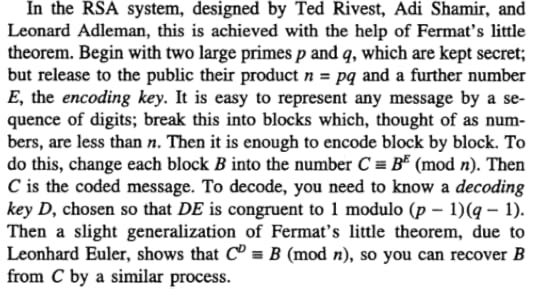
This is Stewart's (p18) explanation of how Fermat's Little Theorem comes to bear on data encryption. If you got through that paragraph and properly understood it you're better at this stuff than I am - but then you probably didn't need to be told, five pages earlier, what "prime number" means. So as the book progressed I was starting to wonder exactly who this book is supposed to be aimed at, and how well- or ill-informed they are expected to already be.

At other times he'll be explaining some complicated bit of maths - say, the foundations of non-Euclidean geometry or something - and half way through he'll omit a major step of reasoning, saying it's too big to put in the book. This is more a problem with the concept of Popular Mathematics books than with Stewart himself - proofs often are colossal - but with a link missing, the whole chain of reasoning is rendered redundant and impossible to follow, so why write it at all? Sometimes he doesn't, and sticks to explaining the history of the thinkers rather than of the ideas themselves, but this too can descend into tedious name-dropping. For instance, p165:

"Until that point the Bieberbach Conjecture was known to be true for the first six coefficients in the power series. This was proved by Bieberbach himself for the first coefficient, by Karl Löwner in 1923 for the third, by P.R. Garabedian and M. Schiffer in 1955 for the fourth, by R.N. Pederson and M.Ozawa in 1968 for the sixth, and by Pederson and Schiffer in 1972 for the fifth."


Exciting! Enlightening!

For all this, Stewart does have a good sense of humour and a knack for a sharp turn of phrase. When he writes about the shorter, more elegant proofs of magicians like Euclid and Cantor it's a genuinely interesting read, and don't miss his chapter on increasing your chances of winning the lottery. I don't doubt that Ian Stewart can write - maybe has written - an interesting and accessible introduction to mathematics, but this ain't really it.
Profile Image for Héctor.
54 reviews303 followers
April 8, 2007
FILOSOFÍA EVAPORADA

Cuando aún no se había encontrado una utilidad a los números complejos, la gente pensaba en ellos como si se tratara de un problema filosófico. Esto significaba que había que revestirlos de algún significado profundo y trascendente (...) Para los filósofos no hay nada mejor que una idea oscura y misteriosa que realmente a nadie le preocupa y tampoco nadie puede comprobar. La razón de esta preferencia es que tienen mucho espacio para lanzar argumentaciones inteligentes. Sin embargo, cuando algo llega a ser realmente útil, la mayoría de la gente deja de hablar de filosofía y, en vez de eso, pone manos a la obra. Ya no les importa cuál puede ser la esencia filosófica profunda del nuevo artilugio; desean sencillamente aprovecharlo para producir en profusión tantos resultados como sea posible en un tiempo mínimo (...) Esto es exactamente lo que les pasó a los números complejos entre 1825 y 1850. Los matemáticos descubrieron el análisis de variable compleja, es decir, cómo hacer cálculo infinitesimal con números complejos. Además, esto resultó ser un instrumento tan potente que habría sido tremendamente embarazoso si algún filósofo con ingenio, pero imprudente, hubiera demostrado que los números complejos en realidad no existen. Las preguntas filosóficas pueden ser a veces simplemente excusas para no avanzar en la tarea de desarrollar una idea difícil. De la noche a la mañana el concepto de número complejo se convirtió en algo tan práctico que ningún matemático que estuviera en su sano juicio podía ignorarlo. De esta manera la pregunta se fue convirtiendo poco a poco en "¿Qué se puede hacer con los números complejos?", y la pregunta filosófica... se evaporó (...) Existen otros casos de este tipo en matemáticas, pero quizá ninguno que haya sido más claro que éste. A medida que el tiempo pasa, la visión cultural del mundo cambia. Lo que una generación considera un problema o una solución, no tiene la misma interpretación para la gente de otra generación. Hoy en día, cuando los números "reales" no se consideran menos abstractos que muchos otros conjuntos de números, incluido el de los números complejos, es difícil de entender la manera tan diferente en que veían todo esto nuestros antepasados. Estaría bien que tuviéramos esto presente cuando reflexionamos acerca del desarrollo de las matemáticas. Contemplar la historia únicamente desde el punto de vista de la generación actual es exponerse a la distorsión y a las falsas interpretaciones.

IAN STEWART, De aquí al infinito. Ed. Crítica, 1998.
Displaying 1 - 8 of 8 reviews

Can't find what you're looking for?

Get help and learn more about the design.