A detailed guide to 41 of the most widespread wild foods in North America, covering how to find and identify them, which parts are used, when and how to harvest them, and how to prepare them for the table. The cultural and natural history of the plants are also discussed. There is no overlap between the plants covered in this book and The Forager's Harvest.
After reading The Omnivore's Dilemma, I found myself looking at the ground next to the sidewalk when taking my son for walks. I wondered what wild lettuce looked like, was that mushroom growing in my yard edible (the squirrels seemed to think so), and could I eat the red berries on the tree in front of my house? One morning, I noticed a weed on my lawn that I found attractive and thought might make nice ground cover. After several frustrating failed Internet searches, I finally identified my plant...it was Purslane. Further research revealed Purslane to be a veritable superfood (it was Ghandi's favorite), though regrettably not the best choice for ground cover.
I decided to do some further research was in order. After all, I had tasty food growing right in my own yard (I cooked up some Dandelion greens too). Thus, with the promise of free culinary delights, I reserved this book from the library at the beginning of summer and I haven't been able to return it since. Aside from being very entertaining, and often humorous, this book is loaded with information the budding forager can enjoy. The author includes excellent descriptions of his favorite wild foods, multiple photographs at various stages of development, timetables for harvesting, preparation methods, descriptions and photos of plants that have been mistaken for the desired plant, and so on.
The only frustrating thing about this book are the numerous plants that the author has enticed me to seek, but I have not yet found. However, these plants are fewer than the plants I have learned to identify: Amaranth, Wood Sorrel, Wild Carrot, Wild Lettuce, Chicory, and Salsify. I also learned how to prepare Acorns (who knew?) and I am looking forward to making Acorn flour shortly.
Most importantly, I have a greater appreciation for what food sources nature has to offer, but I never knew existed. Who knows, I might decide to plant a "wild" garden next year instead of paying for seeds! I would recommend this book to anyone looking for some new ingredients to play with and anyone who enjoys spending time outdoors. This is an excellent resource and a joy to read.
If you're at all interested in learning about edible wild plants, Samuel Thayer's books are great. I'm a complete beginner but I feel confident harvesting local wild plants using these books as a reference.
This is fantastic! Thayer is an enjoyable writer, and he goes into excellent detail about each plant. Many pictures show how the plant grows, what its different parts look like, and what to eat. I just wish he covered more!!
What a fun book! I heard author Samuel Thayer speak on Wisconsin Public Radio and he was an enthusiastic, engaging speaker. Those qualities carry over to his writing, as well. I couldn't help wonder what his poor mother thought when her son was wandering outside eating leaves off trees and plants from wild areas, but his years of foraging have paid off with a wealth of useful, edible knowledge that he has generously shared with anyone who reads his book.
Sam Thayer just made my imaginary list of three people I would choose to have dinner with. The living list being Sam, Neil Gaiman, and probably Tom Stoppard (hmmm ... no women on this list, may have to rethink). Sam Thayer is really good! He's really good at writing, at storytelling, at researching, at identifying plants, obvs. He's clear-eyed, he doesn't take for granted as truth that which is floated, speciously, as true. The chapter where he dissects, theorizes, and dismantles the legend surrounding Chris Mccandless's death is fascinating. He begins the book with a "Claimer" rather than a "disclaimer" that other publishing houses use to essentially negate everything you're about to read and also take no responsibility, financially or otherwise, for your widow and children if you do it wrong. Sam is refuting that practice and for good reason. He's passionate about plants, confident in his abilities, backs up his statements with first-hand knowledge, research, and facts. He praises others' efforts and research where warranted while tactfully tackling the ocean of misinformation and misinformers out there. Plus, he's funny and probably insanely healthy. Even if you don't see yourself attempting foraging someday, just reading through the chapter headers is a truly enjoyable read - part biography, part history, part botany, part humor, and lots else besides!
This will be a timeless classic that foragers, naturalists, environmental stewards & interconnected human beings will refer back to again & again.
I use this guide as a gateway to deepening my connection to my locale, wherever I may be traveling to in my bus across Turtle Island—plants cross arbitrary human borders!!—this guide has been especially applicable to the central states to the southeast but even found some preparations were applicable in southern Idaho!
Samuel stories & introduction to each species touches the crucial conversation (you can find him speaking more to this topic on Herbal Radio Podcast by Mountain Rose Herbs!) of being in direct relationship with plants & what it means to give the plants feet to
What led me to this book was curiosity about how people foraged in earlier times, along with an interest in post-apocalyptic stories. That eventually turned into a real interest in learning practical survival skills, just in case I ever find myself needing them.
I learned that Nature's Garden is a sequel to The Forager's Harvest, but it is designed to stand on its own and doesn’t require readers to be familiar with the earlier book. It is not a traditional field guide meant to be carried on hikes or flipped through while out foraging in the woods. Instead, the author wants readers to take a different approach: choose a featured plant, study its detailed account, and then go looking for it in the wild. The combination of detailed descriptions, extensive color photographs, and comparisons to similar-looking species—including some poisonous look-alikes—makes it easier to identify plants accurately at different stages of growth.
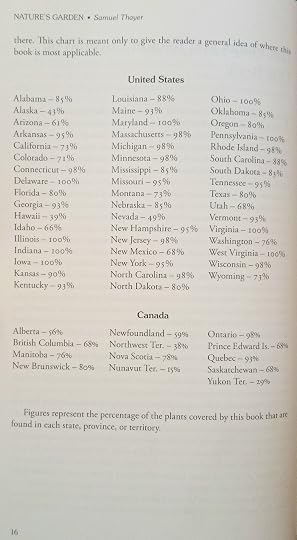
The plants featured in the book cover a wide range of edible resources, including nuts, greens, shoots, roots, tubers, teas, fruits, berries, seeds, and flowers, and those that appear in a variety of environments. While the book is not meant to be a complete regional guide, it clearly reflects the author’s extensive experience in the American Midwest. As a result, species more common to the Far North, the West, or the Deep South are less represented. To help readers get a better sense of its scope, the author includes a helpful chart showing where the book’s coverage is most applicable, as shown in the photo I took below.
One of my favorite sections is the chapter on dandelions. It goes into detail about the plant’s habitat, as well as how to harvest and prepare it. I also appreciated that the author doesn’t hesitate to point readers toward outside sources if they want to explore a plant in greater depth or continue researching related topics. This thoughtful addition encourages continued learning beyond the pages of the book.
I picked this up like 4 hours ago just to look through to see if I could recognize plants I already know about. And I guess at some point I went to the beginning and started reading from the first page to the last! I don't think I've ever lost track of time so fast before!! Wow! This was so fun and entertaining!! I'm a huge Samuel Thayer fan! And I absolutely love how informative and fun his books are! I really appreciate that he is teaching from personal experience!! I am beyond less intimidated to try salsify now. I can't wait to try dandelion noodles! I've never even considered that a possibility before! Wild carrots or what I've only known them as (queen Ann's lace) are one of my favorite flowers! Truly, I have never been happier than I was reading this and feeling like I'm looking at these plants and wondering what unknown possibilities lie within these gems! My only regret is that I only just now found this book! Can't wait to dive into his other one I got today! And you can bet I will be getting his new one on June 1st!!
See my review for The Forager's Harvest, as this book is very similar; it just features different plants. Definitely a must-read for a beginner forager. Key plants featured in this book include dandelion, a range of wild berries such as strawberries and huckleberries, 50 pages on acorns alone plus other nuts, and American lotus. The introduction has a very interesting section on poisonous plant myths and how to stay safe while foraging. It also includes an essay on how the author spent one month eating wild food and what it takes to actually get the calories and nutrition you need while living entirely off the land. While for most of us, foraging is merely a casual hobby and a nice supplement to what we get at the grocery store, I learned a lot from that section and it made me appreciate the effort that goes into foraging even more.
In the spring of 2020, I realized if society collapsed, I had no survival skills. And, as I walked a nature trail every day, I realized I didn’t know the names of the plants around me. What started as anxious catastrophizing and general curiosity led me to wild food literature and Samuel Thayer.
My time outdoors has completely transformed. I now know not only the names of many plants I see on a daily basis, but I have an idea of how to prepare them. I’m even gaining the courage to nibble a few things I’ve positively identified! But more than actual sustenance, Thayer’s books have led me to develop a stronger, more joyful connection with the plant world. And as an added bonus, I find Thayer’s writing style so accessible, enjoyable, and soothing that I read his guides cover to cover. Highly recommend!
Sam is an evangelist, energetic, and funny. Before focusing on the plants, he writes a lot about his philosophy and questions he's fielded over the years. I learned about Into The Wild and other ideas (than eating the wrong wild food) of the fellow's demise. In the plant chapters, Sam's approach of getting to know a plant really well (before eating it) is so nice. I enjoyed his chapters on each plant. Field guides are great, but more is even better.
As with so much poetry, I really have no idea how to rate this book.
Although Forager's Harvest was good, so many of the plants listed didn't grow near me. That wasn't the case with Nature's Garden. Foraging will never be a big part of my life, however I will be trying lots of new additions to my menu. This book is easy and fun reading. Plant descriptions and photographs are excellent. One result is my munching my way through my garden as I pull the weeds. Too many people cut wild plants down without really seeing them. Books like this could open their eyes to the wonders and beauties surrounding them.
Similar to Thayer's 'Foragers Harvest' with different plants. 100% of described plats are found in Ohio which was important to me. This is a very practical book that may be the best first book for folks interested in local terroir, and foraging. I am looking forward to applying what I learned, beginning with milkweed, nannyberry, and acorns. If you don't have a knowledgeable and experienced friend who can accompany you as you beging your foraging experiences, I doubt you can do any better than starting with this book.
Samuel Thayer has been foraging for food since childhood, and since then has taught foraging classes and workshops, written several books on the topic, and continues to share his knowledge with others around the country. Nature’s Garden is a comprehensive look at some edible plants that are commonly found throughout North America. Thayer includes pictures as well as detailed descriptions of the plants, how and when to collect them (and what parts), and how they can be used/prepared. Readers who are already familiar with wild plants will recognize many of the species Thayer includes (though, they may not have realized they were edible!). This book is well-organized and informative. And Thayer’s writing, while instructive, can also be humorous. Check out the “Claimer” that prefaces the body of the work:
“Since we live in a society rife with frivolous lawsuits, most wild food books published today contain statements whereby the publishers disclaim liability for use of the information contained in their books. Older wild food books do not contain these disclaimers; they begin to appear in the 1970s. By now disclaimers are standard, and virtually all wild food guides printed within the last eight years commence with them. Although it is doubtful that such disclaimers actually provide any significant legal protection, it is hard to blame publishers for including them. Most disclaimers, particularly the early ones, simply state the very reasonable fact that the author and publisher are not responsible for mistakes made by the readers. Indeed, this is true whether it is expressed in a disclaimer or not.
“However, in recent years some of these disclaimers have become ridiculous. The Falcon Guide North American Mushrooms (Miller and Miller, 2006) contains the wordage, “Neither the authors nor the publishers in any way endorse consumption or other uses of wild plants that are mentioned in this book.” This raises the question of why, then, they would include the information to begin with? Lone Pine’s Edible and Medicinal Plants of the Rockies (Kershaw, 2000) warns, “This guide is not meant to be a ‘how-to’ reference guide for consuming wild plants. We do not recommend experimentation by readers.” Really? After reading the sections on “gathering tips” and preparation information, I never would have guessed that. This disclaimer seems two-faced and disingenuous. Why else would anyone busy this book? It is clearly conceived, designed, and marketed with the foraging crowd in mind.
“It is one thing to disclaim responsibility for the actions of the inevitable idiot who reads the book and then does something stupid, but many publishers today are going way beyond this. In Van Wyk (2005) we read that “neither the author nor the publisher makes any expressed or implied representation as to the accuracy of the information contained in this book.” I find this statement deeply disturbing. How can a reader trust a reference with such a caveat? Indeed, some books with these strong disclaimers contain egregious, even dangerous errors.
“I would find these extreme disclaimers less offensive if litigation were the only thing at stake. The more important risk, in my opinion, is that such disclaimers will deter people from eating wild food, since they perpetuate the irrational fear that most people associate with foraging. (Indeed, similar disclaimers are not found in books dealing with far more dangerous activities, such as bicycling or hunting.) The wording of many of these disclaimers marginalizes and trivializes the use of wild food, as if those who forage are foolishly toying with death. I cannot conscionably begin my book with a disclaimer that essentially contradicts the core of the book’s message and hope that readers will fail to notice my dishonesty, or forgive me for it as a “necessity of the times.”
“Instead of disclaiming the contents of this book, I claim them. Every photograph and piece of text herein was included through my own discretion. Any mistakes, unless cited to another source, are mine, and I take full responsibility for them. I approve this book’s message, and encourage readers to use the plants as described and suggested herein. That’s why I wrote it.
“But of course, I am not responsible for your mistakes.” (pp. 4-5)
I was thoroughly distracted by Thayer’s articulate ranting (at several points) and eventually reached the limit of my renewals, having borrowed his book from the library. I had to return it about halfway through, mired as I was in the chapter about acorns and stewing about the preparation involved. If you read this far you will already have realized that if you intend to live by foraging alone or even supplement your diet with foraged plants, it is going to be a lot of work. Finding and identifying the plants is not even the half of it. Many things must be processed before you can use them or you will not find their consumption even remotely appetizing. You’ll get your calories, perhaps, but will find no enjoyment in them. Take your time, then, identify a few plants you’d like to sample/get to know better, and focus on those. Thayer doesn’t deny that there’s a steep learning curve. Familiarity and experience gained over time and exposure to the plants and the knack of their collection and preparation will gradually reduce the barriers confronting the beginner.
This book makes me so excited to go foraging! He is honest about bitterness, sweetness, difficulty of finding, etc. I am glad he covered a good variety of leaves, stems, roots, berries, and more. I wish he had included a few recipes, but it's OK he didn't. I also wish he had included mushrooms, but I realize whole books could be written on that alone.
This is an above average foraging book. It has a wide selection, but it is weighed down by common plants (e.g. strawberries, plums). There is some really good poisonous lookalike information, but not enough identification information for the desired plants.
Again, Thayer writes the best books on foraging, without exception. This book covers new species compared to his previous book, with zero overlap. Very cool. If you liked his first book, you'll definitely want this one too.
On finishing this book, I almost positively identified a chokecherry tree on the Superior Hiking Trail, but on further investigation, in fact discovered a buckthorn tree, which is toxic...I have a long ways to go :-]
Mr. Thayer's first book "The Foragers Harvest" is good. This book is even better. Nature's Garden is packed with good information and is fun to read. I highly recommend it to anyone who is interested in learning about foraging.
Yes, add this to your home library. Thayer's writing is informative, yet engaging. Good photos. Various trees, plants, berries are identified with both benefits and warnings. Instead of pouring tons of herbicide on your lawn, you just may find yourself adding items to your salad bowl next time!
A little more expensive than the forager's guide one. But same writing style, same helpful pics and notes. A good book for you or a friend or loved one that is looking into learning about the plants around them.
Unlike many other foraging books I've read, Samuel Thayer goes much more in depth compared to other authors. He includes many reference photos, deadly look-alikes, facts, and how to prepare your foraged goods. While no foraging book is completely "fool proof," I'd say this one is pretty dang close.
Incredible in depth masterpiece on foraging but with a lyrical literate undertone that holds you captive from start to finish. Wonderfully anecdotal and educational at the same time. Highly recommended.
This is another of those books that I can't say I've read, because it's more of a reference book. But, having looked through it, it's a reference book I will someday want to get.
Great detail. This guy really knows his stuff. There weren’t a lot of plants in this book that are readily available in my region but I am determined to try some of these.