

What do you think?

For Better: The Science of a Good Marriage
Groundbreaking scientific news about marriage. And, surprise: It's good news.
We've all heard the statistic: Fifty percent of marriages end in divorce. It's enough to make many couples give up when the going gets rough, thinking that's what everybody else does. But what if it weren't true? What if, in fact, it's not only possible but often easier than you think to save a seemingly troubled relationship? These are the questions Tara Parker-Pope asked herself after her own divorce. An New York Times investigative journalist on the health and wellness beat, she turned to some of the top biologists, neuroscientists, psychologists, and other scientists for the facts about marriage and divorce.
Those facts were more positive and provocative than she'd ever expected, and For Better offers page after page of astonishing, eye-opening good news. Parker-Pope presents the science behind why some marriages work and others don't; the biology behind why some spouses cheat and others remain faithful; the best diagnostic tools created by the most cutting-edge psychologists to assess the probability of success in getting married, staying married, or remarrying. There are questionnaires to uncover potentially damaging hidden attitudes toward spouses. There are tools to show the impact of routine, fresh activity and how small adjustments can make a huge difference.
For Better is the definitive guide to the most profound relationship of our lives.
We've all heard the statistic: Fifty percent of marriages end in divorce. It's enough to make many couples give up when the going gets rough, thinking that's what everybody else does. But what if it weren't true? What if, in fact, it's not only possible but often easier than you think to save a seemingly troubled relationship? These are the questions Tara Parker-Pope asked herself after her own divorce. An New York Times investigative journalist on the health and wellness beat, she turned to some of the top biologists, neuroscientists, psychologists, and other scientists for the facts about marriage and divorce.
Those facts were more positive and provocative than she'd ever expected, and For Better offers page after page of astonishing, eye-opening good news. Parker-Pope presents the science behind why some marriages work and others don't; the biology behind why some spouses cheat and others remain faithful; the best diagnostic tools created by the most cutting-edge psychologists to assess the probability of success in getting married, staying married, or remarrying. There are questionnaires to uncover potentially damaging hidden attitudes toward spouses. There are tools to show the impact of routine, fresh activity and how small adjustments can make a huge difference.
For Better is the definitive guide to the most profound relationship of our lives.
356 pages, Hardcover
First published January 1, 2009
Ratings & Reviews
Friends & Following
Create a free account to discover what your friends think of this book!
Community Reviews
Displaying 1 - 30 of 162 reviews

July 18, 2010
What do the mating habits of animals have to do with people? I skipped this chapter because it seriously annoyed me. There is much more interesting information later in the book, and starting with this almost made me skip the whole book.
Sometimes this book is a 5, and sometimes it is a 1.
Good things:
Fun facts! Jazz lovers are 30% more sexually active than other people.
Clear Presentation.
Occasionally humorous.
Included information on same-sex married couples.
Bad things:
Some parts were just so "duh" - Of course being married makes men live longer.
Seems to be a lot more personal than she wants to admit. She shares a bit about her own seemingly recent divorce.
Used the word "notably" WAY too often.
While included info on same-sex marriage, incredulity implied in findings was borderline offensive.
Take aways:
It reaffirmed by belief that it doesn't matter what we fight about, just how we fight about it. Disagreements are healthy and necessary.
Don't criticize how each other does something. Be it parenting, cleaning, etc - just be grateful for the help. Don't let control or power issues cloud your support of one another.
Snoring can cause major health issues for everyone. It can even cause hearing loss or sleep deprivation in the partner!
Know the difference between complaint, criticism and contempt.
Sometimes this book is a 5, and sometimes it is a 1.
Good things:
Fun facts! Jazz lovers are 30% more sexually active than other people.
Clear Presentation.
Occasionally humorous.
Included information on same-sex married couples.
Bad things:
Some parts were just so "duh" - Of course being married makes men live longer.
Seems to be a lot more personal than she wants to admit. She shares a bit about her own seemingly recent divorce.
Used the word "notably" WAY too often.
While included info on same-sex marriage, incredulity implied in findings was borderline offensive.
Take aways:
It reaffirmed by belief that it doesn't matter what we fight about, just how we fight about it. Disagreements are healthy and necessary.
Don't criticize how each other does something. Be it parenting, cleaning, etc - just be grateful for the help. Don't let control or power issues cloud your support of one another.
Snoring can cause major health issues for everyone. It can even cause hearing loss or sleep deprivation in the partner!
Know the difference between complaint, criticism and contempt.

September 15, 2010
Not that I should have expected more from the NYT, but honestly, this book was a huge disappointment.
The introduction intrigued me. I really liked what Parker-Pope said about her own story: she was a health journalist, and when her own marriage began to fall apart all she found were self-help books and wanted more information on the science behind marriage. Great concept!
Then this book turns into a totally heteronormative and surface-level self help book! It's filled with oversimplifications of complex topics, conclusions drawn from not much evidence, and even at times creepy antifeminist assumptions like "women gain control from being in charge of the chores. Time to let go, ladies! Really, it's YOUR fault you and your man fight about chores because you have control issues". Yikes! And the topper was: QUIZZES. If I want corny sexist quizzes, I will read cosmo.
Really, I was so annoyed by this book. It's too bad, because I was originally intrigued by the introduction and the opening chapter untangling the divorce statistics.
The introduction intrigued me. I really liked what Parker-Pope said about her own story: she was a health journalist, and when her own marriage began to fall apart all she found were self-help books and wanted more information on the science behind marriage. Great concept!
Then this book turns into a totally heteronormative and surface-level self help book! It's filled with oversimplifications of complex topics, conclusions drawn from not much evidence, and even at times creepy antifeminist assumptions like "women gain control from being in charge of the chores. Time to let go, ladies! Really, it's YOUR fault you and your man fight about chores because you have control issues". Yikes! And the topper was: QUIZZES. If I want corny sexist quizzes, I will read cosmo.
Really, I was so annoyed by this book. It's too bad, because I was originally intrigued by the introduction and the opening chapter untangling the divorce statistics.

August 22, 2010
I found this a really annoying book.
Parker-Pope explains she wrote the book because when her 17-year marriage broke up, she wanted to research the reasons for a marriage ending.
Seems like a poor premise to me. Marriages end for millions of reasons that are unique to the couple, so if she thinks she's going to find answers to her own marriage through research studies, that's pretty lame. I'm no shrink, but I'd guess she knows the real reason her marriage broke up and was looking for a good distraction, not to mention a "hook" for the talk-show circuit.
The rest of the book covers studies on marriage that I'd read about years ago or in the news more recently. Nothing new to report.
Much better, less superficial books out there on marriage.
Parker-Pope explains she wrote the book because when her 17-year marriage broke up, she wanted to research the reasons for a marriage ending.
Seems like a poor premise to me. Marriages end for millions of reasons that are unique to the couple, so if she thinks she's going to find answers to her own marriage through research studies, that's pretty lame. I'm no shrink, but I'd guess she knows the real reason her marriage broke up and was looking for a good distraction, not to mention a "hook" for the talk-show circuit.
The rest of the book covers studies on marriage that I'd read about years ago or in the news more recently. Nothing new to report.
Much better, less superficial books out there on marriage.

May 6, 2010
The most interesting thing I learned: How a couple behaves in good times affects their rate of divorce just as much as how they behave in bad times.
Things I already knew but were worth hearing again: five of the ten most stressful life events are related to marriage; positive events can be stressful too; couples who bicker a lot don't necessarily get divorced; feeling that you can't trust your partner to spend money wisely is a great big red flag; it's okay to argue with your partner as long as you are both respectful and are able to come to a solution eventually; experts suggest that you have sex with your partner twice a week, whether you feel like it or not.
This is a general survey of well-regarded social science studies rather than an in-depth look at any one study. So it's a good book to start with, and then you can look elsewhere for more information on the particular aspects that interest you.
Things I already knew but were worth hearing again: five of the ten most stressful life events are related to marriage; positive events can be stressful too; couples who bicker a lot don't necessarily get divorced; feeling that you can't trust your partner to spend money wisely is a great big red flag; it's okay to argue with your partner as long as you are both respectful and are able to come to a solution eventually; experts suggest that you have sex with your partner twice a week, whether you feel like it or not.
This is a general survey of well-regarded social science studies rather than an in-depth look at any one study. So it's a good book to start with, and then you can look elsewhere for more information on the particular aspects that interest you.

February 8, 2018
I think every married couple could find something helpful in this book. I think every single person hoping to get married someday would find this extremely helpful. And every marriage in trouble would find this extremely helpful. I like how she repeatedly states that there are always exceptions to the rule but for the most part most of the research states a lot of positive for being married.
I found the chapter on the heterosexual compared to the gay and lesbian couples fascinating. Some troubles/annoyances in relationships, that were thought previously man/woman are actually not.
Interesting but not surprising:
*The 1st 3 minutes of a couple’s fight says a lot about their marriage.
*Disagreements/fighting is better then NO fighting at all.
*Erectile disfunction is most often a 3 year warning sign of impending stroke or heart attack. Yes, this is not what you expected to read but hey, I might have just helped someone out. 🤷🏼♀️ If it’s you, I don’t want to know. 🙉
*Lack of sleep of one or two persons in the couple can have a strenuous effect on their marriage
*Each person must have healthy relationships with friends of their own to make a satisfying marriage
*Divorce is lower than its ever been
*There is always hope in making your marriage stronger and better
*People who are in it for the long haul, usually make it, and are happy they did.
*To marriages that have not turned into just friendship-marriages sex is extremely important.
Some of the constant findings and reading of excerpts from studies was laborious to me so that is the only reason for the 4 instead of 5 stars. Even though I know full well they are needed in this type of info-book. ☺️
I found the chapter on the heterosexual compared to the gay and lesbian couples fascinating. Some troubles/annoyances in relationships, that were thought previously man/woman are actually not.
Interesting but not surprising:
*The 1st 3 minutes of a couple’s fight says a lot about their marriage.
*Disagreements/fighting is better then NO fighting at all.
*Erectile disfunction is most often a 3 year warning sign of impending stroke or heart attack. Yes, this is not what you expected to read but hey, I might have just helped someone out. 🤷🏼♀️ If it’s you, I don’t want to know. 🙉
*Lack of sleep of one or two persons in the couple can have a strenuous effect on their marriage
*Each person must have healthy relationships with friends of their own to make a satisfying marriage
*Divorce is lower than its ever been
*There is always hope in making your marriage stronger and better
*People who are in it for the long haul, usually make it, and are happy they did.
*To marriages that have not turned into just friendship-marriages sex is extremely important.
Some of the constant findings and reading of excerpts from studies was laborious to me so that is the only reason for the 4 instead of 5 stars. Even though I know full well they are needed in this type of info-book. ☺️

June 19, 2026
Maybe I would feel more positive vibes from this if I was that one subset of prairie voles that mate for life but as a human I’m too hung up on inconsistent statistics and no actual purpose

July 10, 2015
This is a book about marriage. Duh.
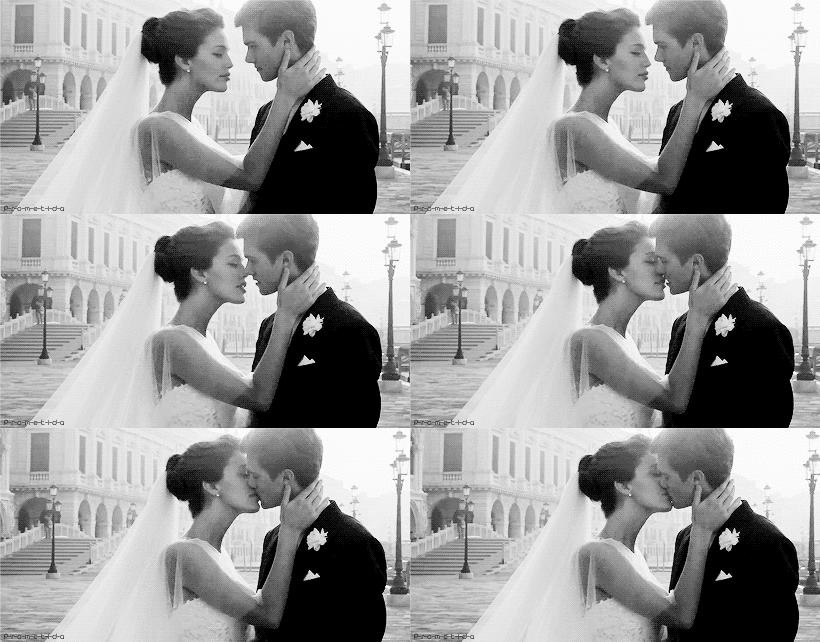
Most marriages start out pretty much the same - full of hope and love and dreams. So what happens? Why do half of all marriages end in divorce? (Or do they? That's one myth this book dispels!) What comes between couples, and how can you eliminate the problems and have a happily-ever-after ending with your soulmate?
The author, puzzled by her own divorce after a seemingly compatible match with her husband, decided to delve into the study of marriage, monogamy, parenting, coupling, what we get right, what we get wrong, and how we can have the strongest possible marriage.
Some of the statistical stuff in the beginning is interesting, particularly about monogamy among different animals. You may find yourself wondering what on earth it has to do with building a strong marriage, but if you hang in, it kind of makes sense as you get into later chapters.
Anyone who has ever been married can probably guess what the biggest stressors in a marriage are.

Yep.
Oh, yeah.
Not a surprise.
So probably, you won't be much surprised at what the "tricks" are for having a good marriage. Still, I'll consider that a spoiler and will let you discover it for yourself, should you choose to. Thing is, if you already have a good marriage, once you get to the tricks, you may find yourself wondering - as I was - why on earth you were wasting your time on this book. It's not that it's a bad book. It's just that I was expecting some kind of cool stuff I could use to make my marriage even more solid. I didn't get that, exactly, just kind of an affirmation that we are doing it right.
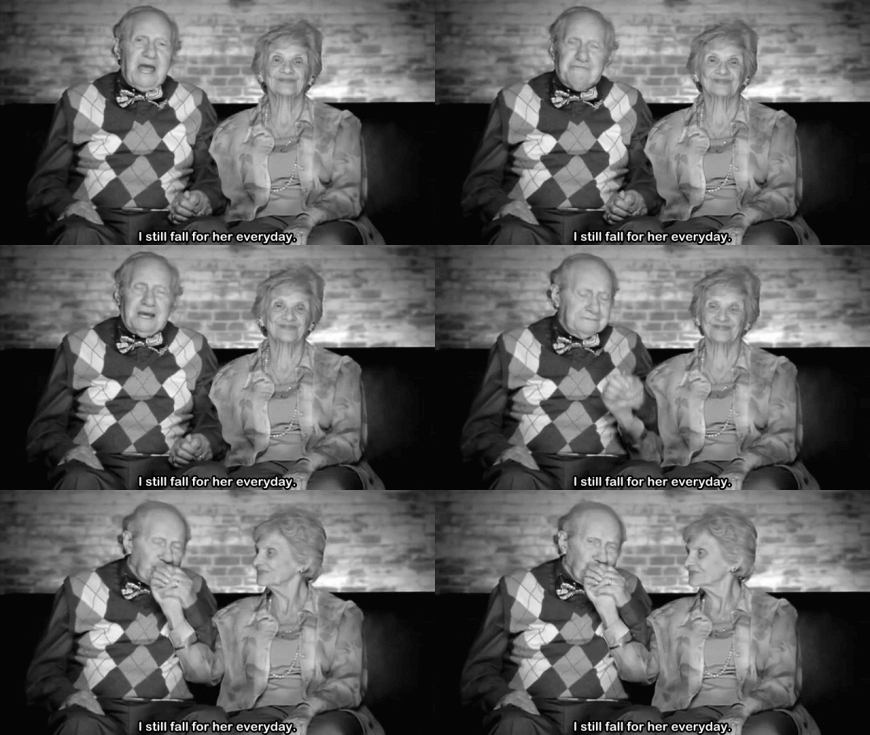
And that's a good thing, right? We all know how we want our marriages to end up, ideally...
One note for those that might listen to this on audiobook as I did - there are TONS of quizzes peppered throughout this book. If you want to take them, you'll have to be quick with grabbing a pen and paper when they come along. Don't try to keep track of your score in your head - some are short enough to do so, others definitely not. Then you have to fuss with waking up your iPhone and jabbing the "back" button while you try to extricate the cat from the laundry you were folding without losing your paper and dropping your pen again. This is not recommended. The other cat will steal your pen and run off into another room of the house and you will drop socks everywhere trying to catch him and will stub your toe on the doorway and cuss a lot. It makes you drop a star on a book rating. (Just kidding, that's not why it's 3 stars. Seriously. Maybe.)
Most marriages start out pretty much the same - full of hope and love and dreams. So what happens? Why do half of all marriages end in divorce? (Or do they? That's one myth this book dispels!) What comes between couples, and how can you eliminate the problems and have a happily-ever-after ending with your soulmate?
The author, puzzled by her own divorce after a seemingly compatible match with her husband, decided to delve into the study of marriage, monogamy, parenting, coupling, what we get right, what we get wrong, and how we can have the strongest possible marriage.
Some of the statistical stuff in the beginning is interesting, particularly about monogamy among different animals. You may find yourself wondering what on earth it has to do with building a strong marriage, but if you hang in, it kind of makes sense as you get into later chapters.
Anyone who has ever been married can probably guess what the biggest stressors in a marriage are.
Yep.
Oh, yeah.
Not a surprise.
So probably, you won't be much surprised at what the "tricks" are for having a good marriage. Still, I'll consider that a spoiler and will let you discover it for yourself, should you choose to. Thing is, if you already have a good marriage, once you get to the tricks, you may find yourself wondering - as I was - why on earth you were wasting your time on this book. It's not that it's a bad book. It's just that I was expecting some kind of cool stuff I could use to make my marriage even more solid. I didn't get that, exactly, just kind of an affirmation that we are doing it right.
And that's a good thing, right? We all know how we want our marriages to end up, ideally...
One note for those that might listen to this on audiobook as I did - there are TONS of quizzes peppered throughout this book. If you want to take them, you'll have to be quick with grabbing a pen and paper when they come along. Don't try to keep track of your score in your head - some are short enough to do so, others definitely not. Then you have to fuss with waking up your iPhone and jabbing the "back" button while you try to extricate the cat from the laundry you were folding without losing your paper and dropping your pen again. This is not recommended. The other cat will steal your pen and run off into another room of the house and you will drop socks everywhere trying to catch him and will stub your toe on the doorway and cuss a lot. It makes you drop a star on a book rating. (Just kidding, that's not why it's 3 stars. Seriously. Maybe.)

October 20, 2017
Just okay. Nothing revelatory. Sometimes too simplified ("marriage is easy and everyone fits into these nice boxes" kind of mentality), sometimes even sexist. Really she is just gathering other people's research but not drawing any new conclusions. I liked what she had to say about conflict and how to fight well, but again, these are not really her ideas so much as a summary of someone else's. A good book perhaps for people who haven't thought a lot about marriage before, for people who are just starting out. For others who have been working at it for years, skip this one and find a book with a little more meat, more depth.
May 3, 2011
The book was an interesting read and had some quizzes you could test your marriage against. But overall, I had some trouble with believing her statistics were any more valid than the ones she was refuting. I think it was worth reading, but with a critical eye.

November 8, 2017
Really good! Very research heavy but presented in a conversational way that made the information very accessible. I'm giving this book to my sister to read it, she could especially benefit from the chapter on how kids impact a marriage. Very interesting!
October 8, 2021
What does it take to maintain a healthy marriage? Here's my attempt to summarize what I read:
1. Be kind. 5 positive comments for every negative comment.
2. Soften the first 3 minutes of arguments. Conflict is healthy, but fight well.
3. Change things up. Seek excitement together.
4. Kids put strain on a marriage. Learn to prioritize adult time.
5. Resolve money problems if you have them.
6. Men, do more housework. Women, let them do it their way.
7. Don't place all your emotional needs on your spouse. Build other relationships, people you can confide in.
The book also provides data that may be encouraging for everyone that experiences the inevitable challenges of lifelong commitments:
- Divorce is not as common as we're made to think
- Conflict is normal and even healthy
- Having children does impact marital satisfaction - but it gets better over time
1. Be kind. 5 positive comments for every negative comment.
2. Soften the first 3 minutes of arguments. Conflict is healthy, but fight well.
3. Change things up. Seek excitement together.
4. Kids put strain on a marriage. Learn to prioritize adult time.
5. Resolve money problems if you have them.
6. Men, do more housework. Women, let them do it their way.
7. Don't place all your emotional needs on your spouse. Build other relationships, people you can confide in.
The book also provides data that may be encouraging for everyone that experiences the inevitable challenges of lifelong commitments:
- Divorce is not as common as we're made to think
- Conflict is normal and even healthy
- Having children does impact marital satisfaction - but it gets better over time

August 7, 2019
I actually really enjoyed this book. I am more logic-driven and less of a self-help person so this book worked for me. The book's statistics and data went further than sweeping generalizations about marriage and I appreciated the complexity of relationships and family that were addressed in this book.

Read
March 22, 2020I listened to For Better as an audio book, and while the narration was good, this is one I think might have been better in physical form. There were many quizzes throughout that were difficult to engage with through audio only; having the questions and answers on paper would make it easier to engage with the material. Just a heads up for those who may be debating whether to listen to or read this one.
2020 Reading Challenge Category: A book by or about a journalist.
2020 Reading Challenge Category: A book by or about a journalist.

December 17, 2019
This book enters with very traditional assumptions of what marriage is. It probably works very well for some, but I am not the audience for this book. I just couldn't do it.

February 21, 2021
This book definitely had some good points about marriage and the studies were very interesting. I think it could have made the same points in about half the amount of book- lots of repeated facts.
May 19, 2010
A few years ago, I had a dear friend confide in me she was contemplating divorce. I was astonished and baffled by her news as her relationship seemed rock solid and quite happy. My marriage research began with her plight. I made it my number one goal to help her through her tough time and to learn as much as I possibly could. What I discovered in my research was that our idea of marriage and divorce was completely wrong. Media loves to tell us half of all marriages end in divorce. This is a very skewed number with an intriguing story. I found amazing and helpful reading in "The Marriage Project" (Rutgers ongoing study) where research proved there are many factors to a marriage's success or failure. She and I spoke at length and in the end, she worked through her issues and remained married. Valuable lessons were learned by me. (I started a perpetual notebook of things to remember when married and when a parent.)
Two years ago, a best friend from high school married her long time boyfriend who had a medical condition. Their engagement lasted 2.5 years because he had a brain tumor. Once his condition was stable, they celebrated with a lovely wedding. The day after the wedding he had a seizure and ended up in the emergency room. The gravity of "in sickness and in health" loomed in the air like a very heavy storm cloud. Another lesson learned.
Both of these incidents in conjunction with my parent's situation have left lasting impressions on me. I see marriage as a living, growing thing in need of nurturing and attention. And much like Ms. Gilbert in her newest novel, "Committed" I intend on making the very best of it and doing my homework. This book was the first in my own personal research.
Parts of "For Better" were fascinating. Parker-Pope uses a great deal of science to state her point, which makes some of the chapters riveting while others are kind of dull. Some real life stories to which readers can relate would add value to the book. Overall though, I felt the material she presented was incredibly interesting. She covers areas of conflict and how to overcome them. There is discussion of biological gender differences, gender inequality, different types of marriages as well complexities in marriage science that gender cannot explain. Parker-Pope also explores how society, media, generational changes, and expectations of marriage impact these unions. Her writing is concise and full of a variety of studies and findings.
The research regarding the differences in heterosexual marriage versus same sex marriage was very insightful and thought-provoking. Gender roles in marriage were questioned as researchers headed to Vermont to compare the different types of marriage for the first time. Common issues such as sex, money, children, and household chores were studied at length (they are the "hot topics" in most marriages) and the conclusions were very interesting as same sex couples (gender roles are obviously non-existent here) dealt with these topics much better and more fairly than heterosexual couples. The author explores why and makes suggestions on how to learn from them. This chapter was the most interesting to me because it highlights how heterosexual women often times reinforce gender roles in their own relationships. (It was also a small portion of the book but the most memorable to me.)
My mother immediately came to mind during the section on gender roles because of her unique approach to child care and marriage. She and my dad were very much equals on nearly all fronts. Both worked outside the home, both did household chores, and both cooked (albeit vastly different foods). Division of labor seemed fair and their arguments were not the ones typically associated with marriage disagreements. Their marriage was obviously my first example until my friends started to marry. "For better" has encouraged me to gather up all the examples of friends and family who are getting it right and apply it to my marriage. The lessons learned inspired self-reflection and the insight provided made this book worth reading.
Two years ago, a best friend from high school married her long time boyfriend who had a medical condition. Their engagement lasted 2.5 years because he had a brain tumor. Once his condition was stable, they celebrated with a lovely wedding. The day after the wedding he had a seizure and ended up in the emergency room. The gravity of "in sickness and in health" loomed in the air like a very heavy storm cloud. Another lesson learned.
Both of these incidents in conjunction with my parent's situation have left lasting impressions on me. I see marriage as a living, growing thing in need of nurturing and attention. And much like Ms. Gilbert in her newest novel, "Committed" I intend on making the very best of it and doing my homework. This book was the first in my own personal research.
Parts of "For Better" were fascinating. Parker-Pope uses a great deal of science to state her point, which makes some of the chapters riveting while others are kind of dull. Some real life stories to which readers can relate would add value to the book. Overall though, I felt the material she presented was incredibly interesting. She covers areas of conflict and how to overcome them. There is discussion of biological gender differences, gender inequality, different types of marriages as well complexities in marriage science that gender cannot explain. Parker-Pope also explores how society, media, generational changes, and expectations of marriage impact these unions. Her writing is concise and full of a variety of studies and findings.
The research regarding the differences in heterosexual marriage versus same sex marriage was very insightful and thought-provoking. Gender roles in marriage were questioned as researchers headed to Vermont to compare the different types of marriage for the first time. Common issues such as sex, money, children, and household chores were studied at length (they are the "hot topics" in most marriages) and the conclusions were very interesting as same sex couples (gender roles are obviously non-existent here) dealt with these topics much better and more fairly than heterosexual couples. The author explores why and makes suggestions on how to learn from them. This chapter was the most interesting to me because it highlights how heterosexual women often times reinforce gender roles in their own relationships. (It was also a small portion of the book but the most memorable to me.)
My mother immediately came to mind during the section on gender roles because of her unique approach to child care and marriage. She and my dad were very much equals on nearly all fronts. Both worked outside the home, both did household chores, and both cooked (albeit vastly different foods). Division of labor seemed fair and their arguments were not the ones typically associated with marriage disagreements. Their marriage was obviously my first example until my friends started to marry. "For better" has encouraged me to gather up all the examples of friends and family who are getting it right and apply it to my marriage. The lessons learned inspired self-reflection and the insight provided made this book worth reading.

June 1, 2025
I listened to the audiobook and I liked it.
If you are married, want to be married or divorced and want to understand why or may be thinking about a second or subsequent marriage this book has some good advice and science backing too.
I recommend this book.
If you are married, want to be married or divorced and want to understand why or may be thinking about a second or subsequent marriage this book has some good advice and science backing too.
I recommend this book.

December 27, 2014
Not so much Science as "SKIENCE!" Most of the studies Parker-Pope cites are given an overly simplified and surface treatment and she seems unable to distinguish between causation and correlation. While she states that the aim of the book is to provide encouragement for married people she writes about her own marriage as doomed statistically before it even began and her divorce as inevitable. In another spot she writes "Spendthrifts and tightwads are destined for a life of conflict when they marry each other. There is, of course, the opportunity for both sides to meet in the middle, but often, values about money are rooted in family experience and too deeply entrenched to change much." Destine for a life of conflict? Too deeply entrenched to change? And that's supposed to be encouraging?
There's also an over-reliance on evolutionary biology that doesn't make a ton of sense in context -- i.e. she never provides a reason for why an impetus toward genetic diversity would actually benefit a modern couple, just takes it for granted that it would, so ladies get off your birth control and smell your man! Ugh.
The book is also incredibly heteronormative, often depending on tired stereotypes like "Men always want sex! Women are frigid nags!" The worst part was the clumsy attempt to provide "lessons from gay and lesbian couples" because, according to Parker-Pope, these are "couples in which gender differences were impossible." The conflation of sex and gender there is really inexcusable for a book published in 2010 and written from a supposedly scientific/social-scientific point of view.
Parker-Pope often runs through findings so quickly and grabs the most obvious interpretation rather than taking time to provide a more nuanced view. For example, she cites a study that she interprets as saying "Paying for outside help actually predicted less marital happiness, not more," with the takeaway that "something fundamental to marriage is lost when domestic chores are farmed out," without taking into account that participants for the study were recruited from a group of men and women who all held MBAs and perhaps were experiencing a high level of stress or marital unhappiness to begin with. There are many of these narrative shortcuts. At one point, Parker-Pope writes "women who were socialized to be homemakers and who married in the 1950s were inspired by the women's movement to pursue careers" as an example of a cultural shift that can occur seemingly overnight. What she neglects here is thinking about factors beyond the obvious -- how WWII, for example, provided an opportunity to work outside the home that then led into the women's movement.
By the end of the book I was really wishing that this was a book that collected all the studies that Parker-Pope cites, published them in full, and left them up to the reader to interpret with some "how to read scientific findings" tools rather than presenting a bunch of what seemed like really interesting studies through a singularly uninteresting pov.
There's also an over-reliance on evolutionary biology that doesn't make a ton of sense in context -- i.e. she never provides a reason for why an impetus toward genetic diversity would actually benefit a modern couple, just takes it for granted that it would, so ladies get off your birth control and smell your man! Ugh.
The book is also incredibly heteronormative, often depending on tired stereotypes like "Men always want sex! Women are frigid nags!" The worst part was the clumsy attempt to provide "lessons from gay and lesbian couples" because, according to Parker-Pope, these are "couples in which gender differences were impossible." The conflation of sex and gender there is really inexcusable for a book published in 2010 and written from a supposedly scientific/social-scientific point of view.
Parker-Pope often runs through findings so quickly and grabs the most obvious interpretation rather than taking time to provide a more nuanced view. For example, she cites a study that she interprets as saying "Paying for outside help actually predicted less marital happiness, not more," with the takeaway that "something fundamental to marriage is lost when domestic chores are farmed out," without taking into account that participants for the study were recruited from a group of men and women who all held MBAs and perhaps were experiencing a high level of stress or marital unhappiness to begin with. There are many of these narrative shortcuts. At one point, Parker-Pope writes "women who were socialized to be homemakers and who married in the 1950s were inspired by the women's movement to pursue careers" as an example of a cultural shift that can occur seemingly overnight. What she neglects here is thinking about factors beyond the obvious -- how WWII, for example, provided an opportunity to work outside the home that then led into the women's movement.
By the end of the book I was really wishing that this was a book that collected all the studies that Parker-Pope cites, published them in full, and left them up to the reader to interpret with some "how to read scientific findings" tools rather than presenting a bunch of what seemed like really interesting studies through a singularly uninteresting pov.

June 29, 2010
Overall, I really enjoyed this book - it struck me as similar in a lot of ways to "Stumbling on Happiness" by Daniel Gilbert, in that it tries to apply scientific (or "scientific") research to people's problems.
My only real gripe is that the author goes out of her way to target the book specifically to heterosexual married couples; while that's what most of the research focuses on, a lot of the lessons in the book should be applicable to unmarried couples (gay or straight) who live together, and while I think they could also gain from reading the book, the author presents the research in a way that's not unfriendly, but still may alienate these groups.
There is one chapter that focuses on research surrounding gay couples, but the author still goes out of her way to discuss how these studies apply to heterosexual married couples.
I think she does a good job overall of not being too stuck on conventional wisdom, and she does try to point out when there are notable exceptions to trends, but the book does rely on some research that I find a little annoying, like the evolutionary explanations for things. Women are more detail oriented because back when dinosaurs roamed the earth.... etc. etc.
There are some points where the book seems to contradict itself, or where the research sounds a little iffy. For example, she discusses how the language couples use to describe things like the way they met is a good predictor of their likelihood of divorce. That may be true, but I'm not sure it's so clear that it's a causal relationship - sure, maybe the language we use can indicate our true feelings in some cases, but maybe people who use more negative language are simply more likely to get divorced.
Overall, though, as someone who will soon join the ranks of the married, I found it a pretty helpful discussion of marriage, and a good review of the research that's out there.
My only real gripe is that the author goes out of her way to target the book specifically to heterosexual married couples; while that's what most of the research focuses on, a lot of the lessons in the book should be applicable to unmarried couples (gay or straight) who live together, and while I think they could also gain from reading the book, the author presents the research in a way that's not unfriendly, but still may alienate these groups.
There is one chapter that focuses on research surrounding gay couples, but the author still goes out of her way to discuss how these studies apply to heterosexual married couples.
I think she does a good job overall of not being too stuck on conventional wisdom, and she does try to point out when there are notable exceptions to trends, but the book does rely on some research that I find a little annoying, like the evolutionary explanations for things. Women are more detail oriented because back when dinosaurs roamed the earth.... etc. etc.
There are some points where the book seems to contradict itself, or where the research sounds a little iffy. For example, she discusses how the language couples use to describe things like the way they met is a good predictor of their likelihood of divorce. That may be true, but I'm not sure it's so clear that it's a causal relationship - sure, maybe the language we use can indicate our true feelings in some cases, but maybe people who use more negative language are simply more likely to get divorced.
Overall, though, as someone who will soon join the ranks of the married, I found it a pretty helpful discussion of marriage, and a good review of the research that's out there.

July 24, 2010
I bought this book a few months ago on a whim because I like Parker-Pope's well blog on the nytimes. Obviously I'm not getting married anytime soon, but as my friends get married I have been having lots of thoughts about the marriages all around me. This book really helped me reflect on and organize those thoughts. Parker-Pope does a good job summarizing and citing the research. There are times when the research could be used to draw different conclusions, but overall she is very careful to present all possible perspectives. She is especially good at emphasizing that correlation does not imply causation-- for example, studies show that married people are happier than average people (self-reported). But does that mean that marriage causes an increase in happiness, or that happy people are nice and fun to be with and therefore more likely to get married? Probably the latter, but just from the data of the study you can't say.
The parts of the book that appealed to me the most were those where Parker-Pope discussed research by psychologists where they looked at different relationships and created categories, for example categories of love styles or categories of marriages. This is probably the Myers-Briggs believer in me: I like to see categories not because I fit into one of them, but because they help me reflect on my behavior and the behavior of others with more perspective.
The parts of the book that appealed to me the most were those where Parker-Pope discussed research by psychologists where they looked at different relationships and created categories, for example categories of love styles or categories of marriages. This is probably the Myers-Briggs believer in me: I like to see categories not because I fit into one of them, but because they help me reflect on my behavior and the behavior of others with more perspective.

July 13, 2010
2.5 stars. Interesting, but not monumental.
She goes to great lengths in the first chapter to say, "This is not a self-help book." But, it kinda really is. Exhibit A: 19 Quizzes to assess various aspects of your marriage. Granted, I expected some marriage advice based on the research, but ... it didn't hit the right balance for me. I wanted more science, less advice.
I didn't feel like she did a very good job of presenting the research, either. It was sometimes too shallow of a treatment for me, other times I wanted her to compile the research in a more meaningful way (for instance, one study said men who work longer hours have more sex, but another study said men who made less money have more sex. She didn't address the seeming contradiction there), and yet other times I felt like she was holding out information that she presented later to make it all more dramatic. Also, I'd heard most of the stuff before. If you've read one marriage book, you've read them all?
I read most of the book, then skipped a bunch of chapters and read the conclusion. It may or may not have deserved that much of my time.
She goes to great lengths in the first chapter to say, "This is not a self-help book." But, it kinda really is. Exhibit A: 19 Quizzes to assess various aspects of your marriage. Granted, I expected some marriage advice based on the research, but ... it didn't hit the right balance for me. I wanted more science, less advice.
I didn't feel like she did a very good job of presenting the research, either. It was sometimes too shallow of a treatment for me, other times I wanted her to compile the research in a more meaningful way (for instance, one study said men who work longer hours have more sex, but another study said men who made less money have more sex. She didn't address the seeming contradiction there), and yet other times I felt like she was holding out information that she presented later to make it all more dramatic. Also, I'd heard most of the stuff before. If you've read one marriage book, you've read them all?
I read most of the book, then skipped a bunch of chapters and read the conclusion. It may or may not have deserved that much of my time.

November 4, 2012
There were a lot of studies quoted in this book and a lot of science explored, which I appreciated. The author pointed out that most marriages do *not* end in divorce and that the statistics that we hear about (that 50% of marriages end in divorce) are misleading. The book also explores how you can strengthen your marriage/relationship.
What I didn't like was the author's strong bias in certain areas. Twice, she looked at the rather clear statistics (one example: having a child lowers marriage satisfaction for the 18 years the child is at home) and dismissed the statistics, saying that they didn't apply to all marriages. Well, obviously not: the statistics represent an average. Nonetheless, the data quoted are pretty compelling. It doesn't mean you have to refrain from having children; it simply means that you should be aware of what could happen and take steps to remedy any problems. It bothered me how personally the author took some statistics in a book that was ostensibly "scientific" in nature.
What I didn't like was the author's strong bias in certain areas. Twice, she looked at the rather clear statistics (one example: having a child lowers marriage satisfaction for the 18 years the child is at home) and dismissed the statistics, saying that they didn't apply to all marriages. Well, obviously not: the statistics represent an average. Nonetheless, the data quoted are pretty compelling. It doesn't mean you have to refrain from having children; it simply means that you should be aware of what could happen and take steps to remedy any problems. It bothered me how personally the author took some statistics in a book that was ostensibly "scientific" in nature.

July 26, 2010
I'm giving up on this book, about 70 pages in. While I'm interested in the science of marriage, the writing feels lazy and simplistic. Despite all her research, it seems like the author resorts to dated stereotypes instead of doing original writing about the complex realities of relationships. The final straw for me was the chapter about sex. She opens it with the time-worn stereotype that many husbands wish their wives would have sex with them more, while the wives wish their husbands would understand how busy they are and give them a break. This doesn't come with any supporting data, and she's not quoting it as a stereotype, she just says it. Then, a few pages later, we learn that a study on sexless marriages revealed that in two thirds of the couples who never have sex, it was the man who had caused the sexlessness. The research completely contradicts that thing she just said. So, I'm done.

September 23, 2011
Finally, a science-based relationship book. Based on social science, but science nevertheless. The constant research summaries can be a little exhausting, but Parker-Pope constantly relates the studies to real life through quizzes and a few anecdotes (sometimes it feels like she's trying a little to hard to make it "relate-able"). Lots of interesting research stuff, which is of course interpreted by the author.
A few things that struck me: Parents who invest time in their relationship with each other have well-adjusted children. Best predictor of a father’s involvement with his children is his relationship with his wife. Men may not help with housework if they are micromanaged when they do, but women might not want to relinquish their household power. Relationships where one partner has more power than the other are also found in homosexual relationships, indicating that it is not a gendered trait.
A few things that struck me: Parents who invest time in their relationship with each other have well-adjusted children. Best predictor of a father’s involvement with his children is his relationship with his wife. Men may not help with housework if they are micromanaged when they do, but women might not want to relinquish their household power. Relationships where one partner has more power than the other are also found in homosexual relationships, indicating that it is not a gendered trait.

April 12, 2010
Journalist Tara Parker-Pope offers a convincing book of how to avoid divorce. She wishes she had gleaned some of the research before her own 17-year marriage ended. The book contains lots of advice on how to keep a marriage fresh, including several quizzes. It also shows who is headed for divorce by our actions: eye-rolling at a spouse's comments is a telltale sign. So is recounting how a person met the spouse or the wedding day; if the stories are told with sarcasm, watch out. But arguing is healthy; couples who never give voice to their disagreements are likelier to have troubles down the road. A weekly date night isn't enough; if you've been going to Perkin's every week, try Cracker Barrel just to be wild. The book has no spiritual emphasis, and Parker-Pope gives credence to animal mating patterns as well as same-sex couples.
October 4, 2010
I wanted to like this book better than I did. The author says it's research results, not a how-to manual, but in reality she presents research, looks at the results, and then tells you why / how you should behave to get the same results. That's not awful, but her grasp of statistics and especially causality seems weak & so I am not sure that the research she presents and especially the courses of action she promotes really show what she thinks they do.
Still, it was an interesting read. I especially liked the first section which analyzes the numbers behind "50 percent of marriages end in divorce", and talks about why the public perception of statistics is important.
Still, it was an interesting read. I especially liked the first section which analyzes the numbers behind "50 percent of marriages end in divorce", and talks about why the public perception of statistics is important.

May 19, 2011
This book touches on a large number of topics related to a "successful" marriage, but never really digs deep enough into any single area of interest to establish much of a point. The book includes many studies, yet it lacks in providing significant supporting evidence due to vague, generalized writing and conflicting arguments. It may be a good choice for readers who want a very brief introduction to basic relationship skills, but will probably prove frustrating for those coming from a research background.

September 17, 2012
I thoroughly enjoyed this book! It’s a fantastic read for anyone in a committed relationship, new or old. Well researched, succinctly written, and overall positive about marriage, Tara Parker-Pope has created a work of nonfiction applicable to anyone interested in lasting intimacy, partnership, and commitment. Perhaps most striking about the book is the wealth of scientific evidence behind all claims and suggestions—the numbers don’t lie—which really drives each point home. I also really enjoyed the take away points, which provide concrete suggestions for improvements both small and large.

June 5, 2011
Do not read this book if you are getting married. I put it down after the tidbit about how women can sniff out the man who is most genetically appropriate for them to mate with, but not if they're on birth control pills. There is nothing I want to read less 5 weeks before my wedding than the fact that I could have made a poor choice in husband because I couldn't smell him properly.

June 9, 2011
A Practical Wedding's write-up of people's reaction to this at the last APW book club is perfect: http://apracticalwedding.com/2011/06/...
Basically, questionable science, over-emphasis on gender roles, and not that useful/interesting/educational. Correlation does not equal causation!
Basically, questionable science, over-emphasis on gender roles, and not that useful/interesting/educational. Correlation does not equal causation!
Displaying 1 - 30 of 162 reviews