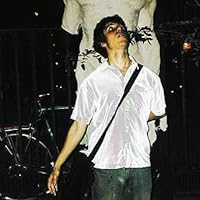
Soliloquy is a written record of every word (good, bad and indifferent), spoken by New York artist Kenneth Goldsmith during one week. The work originated as a gallery installation in 1997. As Gordon Tipper wrote in zingmagazine , "confronted with the clutter of 'real' speech... we realize that we all sound a bit like George Bush."
Note: I feel comfortable reviewing this book without having read it, on the idea alone, á la Vanessa Place blurb-style.
Soliloquy: What I Learned From This Book
Maybe I’m spending too much time http://picturepost.files.wordpress.co... on ubuweb, but last night I had a dream where Kenneth Goldsmith’s book, Soliloquy, was trying to decide what cover to give itself, and the choices were between Craig Dworkin’s The Imaginary Solution, which contextualizes Soliloquy, and this trailer http://vimeo.com/4625526 for Wax or the Discovery of Television Among the Bees.
Soliloquy was leaning toward The Imaginary Solution, which replaced its face http://www.youtube.com/watch?v=4g9Q-0... with the cover of All the Numbers from Numbers http://www.ubu.com/ubu/ by Goldsmith, part of the ubuweb unpublishable series that he edits.
I discovered Soliloquy in my Modern Poetry class at Coursera (which, by the way, I highly recommend to anyone interested in contemporary poetry). Kenneth Goldsmith uses a lot of found language in his poems, and this is a particularly ambitious project in which he recorded and transcribed everything - every single word, every utterance - that came out of his mouth during a week. What a journey.
I haven't read this volume in its entirety, and I don't think I will be able to anytime soon, but I did finish Act 1 (Day 1, that is). I mean, that's over a hundred pages. Just think about it. Each one of us pronounces approximately one hundred pages worth of stuff each day - and that's not even counting internal monologue! A lot of it is repetitive, like when Goldsmith has lunch with literary critic Marjorie Perloff and that's more or less what he talks about all day. A lot of it is small talk. A lot of it is incoherent when transferred to the print page.
It's both easy to read, flowing, - and impossible to read in large quantities. I'd feel almost nauseous after a few pages and have a strong need to close it. It was ironically unnatural to be reading this, well, supposedly natural speech. Which made me think whether there is such thing as natural speech. It also made me contemplate once again on how people speak in novels, drama, and movies. How we think we speak. It made me think - probably one of the primary ideas driving Goldsmith's experiment - whether one even needs to invent any new language with this amount of language hanging around. Speaking and writing like we do seems almost like another form of overindulgent consumerism in this context, and there is something clean about "recycling" already existing language.
The original recording probably had both the author and his interlocutors taped, but he chose to transcribe only his own speech, which raises the question of how much of your speech can make sense without the other side(s) of the conversation. I found that I could understand surprisingly a lot. Do we even communicate with other people or just get the information out there having a loop after a loop of the stuff that's going through our brain? The piece is called Soliloquy and not Monologue, the only difference between the two terms being the presence or absence of an audience. Soliloque is a speech that one gives to oneself, from the Latin solus ("alone") and loqui ("to speak"). Alone. Speak. Alone.
Thank you, Kenneth Goldsmith. As one other reviewers noted, someone had to do this.
Pas lu en entier (mais c'est plus ou moins impossible), j'ai plutôt parcouru le pdf un peu au hasard et lu ce qui attrapait mon regard. Un texte singulier (à savoir la retranscription de tout ce qu'a prononcé le gars sur une semaine), très intéressant dans sa représentation du quotidien. Ça donne envie de faire la même chose pour voir. Par ailleurs, Kenneth Goldsmith est moins insupportable que dans sa théorie mais reste insupportable.
If you know Kenneth, you probably know him as Kenny G, from his WFMU radio show of oddities for oddballs. Less likely, you know of him for his post-conceptualist stunt poetry, which is more about process than product. I found this book on sale in Williamsburg for 4$ -- they had a serious overstock going on. Soliloquy is a compilation of every word that came out of Kenneth's mouth (including his weekly radio show) for a whole week. Every um, every hesitation, every stammer. As is true for many writers and poets, Kenneth does not posess the gift of gab. His conversations (which are like listening to someone talking on a cell phone -- you only get his side) are dull, and full of verbal flatulence. What makes the book work is Kenneth's dutiful commitment to reality -- I've often realized that there's a huge difference between how people speak in life and how people speak in novels, tv, and in the movies. This is an excellent book for any aspiring authors wishing to give their dialogue a realist, Altman-esque twist. Along with Perec's 'A Void' translation (which doesn't contain the letter E) and a 1930's guide for girls "How to be a Woman" (which adumbrates such activities as banister sliding, for fear of the foul desires that might thereby be awakened) I keep this book on a shelf of antiques and oddities which I like to show guest's while giving them a tour of my digs.
You're not really supposed to read this as much as understand it, but I read it anyway. The whole thing. And it's surprisingly captivating the whole way through. I used a Kindle to read the online version, which is definitely not meant to be read in a continuous manner.