

What do you think?

The Crime of Sylvester Bonnard
Anatole France (1844-1924) -- born Jacques Anatole François Thibault -- was a French writer who achieved fame with the publications of his novels "The Crime of Sylvester Bonnard" (1881) and "Thaïs" (1890), also available in an edition from Wildside Press.
324 pages, Hardcover
First published January 1, 1881
About the author
Anatole France
1,794 books582 followersFrench critic Anatole France, pen name of Jacques Anatole François Thibault wrote sophisticated, often satirical short stories and novels, including
Penguin Island
(1908), and won the Nobel Prize of 1921 for literature.
Anatole France began his career as a poet and a journalist. From 1867, he as a journalist composed articles and notices.
In 1869, Le Parnasse Contemporain published La Part de Madeleine of his poems. In 1875, he sat on the committee in charge of the third such compilation. He moved Paul Verlaine and Stéphane Mallarmé aside.
Skeptical old scholar Sylvester Bonnard, protagonist of famous Le Crime de Sylvestre Bonnard (1881), embodied own personality of the author. The academy praised its elegant prose.
Anatole France in La Rotisserie de la Reine Pedauque (1893) ridiculed belief in the occult and in Les Opinions de Jerome Coignard (1893) captured the atmosphere of the fin de siècle.
People elected him to the Académie française in 1896.
People falsely convicted Alfred Dreyfus, a Jewish army officer, of espionage. Anatole France took an important part in the affair, signed manifesto of Émile Zola to support Dreyfus, and authored Monsieur Bergeret in 1901.
After the nearsighted Abbot Mael baptized the animals in error, France in later work depicts the transformation into human nature in 1908.
People considered most profound La Revolte des Anges (1914). It tells of Arcade, the guardian angel of Maurice d'Esparvieu. Arcade falls in love, joins the revolutionary movement of angels, and towards the end recognizes the meaningless overthrow of God unless "in ourselves and in ourselves alone we attack and destroy Ialdabaoth."
People awarded him "in recognition of his brilliant literary achievements, characterized as they are by a nobility of style, a profound human sympathy, grace, and a true Gallic temperament" in 1921.
In 1922, the Catholic Church put entire works of France on the Index Librorum Prohibitorum (Index of Prohibited Books).
He died, and people buried his body in the Neuilly-sur-Seine community cemetery near Paris.
Anatole France began his career as a poet and a journalist. From 1867, he as a journalist composed articles and notices.
In 1869, Le Parnasse Contemporain published La Part de Madeleine of his poems. In 1875, he sat on the committee in charge of the third such compilation. He moved Paul Verlaine and Stéphane Mallarmé aside.
Skeptical old scholar Sylvester Bonnard, protagonist of famous Le Crime de Sylvestre Bonnard (1881), embodied own personality of the author. The academy praised its elegant prose.
Anatole France in La Rotisserie de la Reine Pedauque (1893) ridiculed belief in the occult and in Les Opinions de Jerome Coignard (1893) captured the atmosphere of the fin de siècle.
People elected him to the Académie française in 1896.
People falsely convicted Alfred Dreyfus, a Jewish army officer, of espionage. Anatole France took an important part in the affair, signed manifesto of Émile Zola to support Dreyfus, and authored Monsieur Bergeret in 1901.
After the nearsighted Abbot Mael baptized the animals in error, France in later work depicts the transformation into human nature in 1908.
People considered most profound La Revolte des Anges (1914). It tells of Arcade, the guardian angel of Maurice d'Esparvieu. Arcade falls in love, joins the revolutionary movement of angels, and towards the end recognizes the meaningless overthrow of God unless "in ourselves and in ourselves alone we attack and destroy Ialdabaoth."
People awarded him "in recognition of his brilliant literary achievements, characterized as they are by a nobility of style, a profound human sympathy, grace, and a true Gallic temperament" in 1921.
In 1922, the Catholic Church put entire works of France on the Index Librorum Prohibitorum (Index of Prohibited Books).
He died, and people buried his body in the Neuilly-sur-Seine community cemetery near Paris.
Ratings & Reviews
Friends & Following
Create a free account to discover what your friends think of this book!
Community Reviews
Displaying 1 - 30 of 99 reviews

November 1, 2025
I needed this kind of therapy - reading a book like 'The Crime of Sylvestre Bonnard'.
It is a gentle, ironic, and deeply humane story told by a famous aging philologist and member of the Institute in his diary. It reveals a kind, simple, and humble man detached from worldly ambition yet profoundly aware of human frailty. One day Bonnard's quiet devotion to books, learning and philosophical reflection are disturbed by an unexpected call to action. So he has to commit 'a crime', in other words, an act of moral courage.
I think most of us would like to have one or two 'Sylvestre Bonnards' around us.
'I live surrounded by my books, which are more agreeable than most people. They speak only when I desire it, and they keep silence when I wish them to.'
------------------------------------------------------------------
'To be kind is sometimes more difficult than to be wise, but it is always better.'
-----------------------------------------------------------------
'Books are the mirror of the soul: we find in them only what we already possess within ourselves.'
-----------------------------------------------------------------
'Her eyes were bright with the trust of one who has suffered. I felt that to protect her would be to repair all the injustices of my long inaction.'
----------------------------------------------------------------
'To laugh at oneself is the beginning of wisdom; to laugh kindly at others is the end of it.'
It is a gentle, ironic, and deeply humane story told by a famous aging philologist and member of the Institute in his diary. It reveals a kind, simple, and humble man detached from worldly ambition yet profoundly aware of human frailty. One day Bonnard's quiet devotion to books, learning and philosophical reflection are disturbed by an unexpected call to action. So he has to commit 'a crime', in other words, an act of moral courage.
I think most of us would like to have one or two 'Sylvestre Bonnards' around us.
'I live surrounded by my books, which are more agreeable than most people. They speak only when I desire it, and they keep silence when I wish them to.'
------------------------------------------------------------------
'To be kind is sometimes more difficult than to be wise, but it is always better.'
-----------------------------------------------------------------
'Books are the mirror of the soul: we find in them only what we already possess within ourselves.'
-----------------------------------------------------------------
'Her eyes were bright with the trust of one who has suffered. I felt that to protect her would be to repair all the injustices of my long inaction.'
----------------------------------------------------------------
'To laugh at oneself is the beginning of wisdom; to laugh kindly at others is the end of it.'

September 14, 2026
بر خلاف عنوان کتاب، با داستانی لطیف و ملایم سر و کار داریم، شخصیت اصلی داستان آقای سیلوستر بونار مردی سالخورده و کتاب شناس که بیشتر عمرش را در میان کتاب ها و نسخه های خطی و متون قدیمی گذرانده است. بخش هایی از کتاب من را به یاد رمان کلاسیک «شاهزاده خانم کوچولو» اثر فرانسس هاجسن برنت انداخت.
ترجمه جناب آقای پارسایار هم خیلی دلنشین است.
« هر تغییری، حتی دل پذیرترینش، اندوهی بر دل می نشاند. زیرا آنچه ترکش می کنیم بخشی از خود ماست. باید از یک زندگی چشم بپوشیم تا وارد زندگی دیگری شویم.»
ترجمه جناب آقای پارسایار هم خیلی دلنشین است.
« هر تغییری، حتی دل پذیرترینش، اندوهی بر دل می نشاند. زیرا آنچه ترکش می کنیم بخشی از خود ماست. باید از یک زندگی چشم بپوشیم تا وارد زندگی دیگری شویم.»

May 18, 2014
Monsieur Sylvestre Bonnard, a member of The Institute, a philologist who in the twilight of his years lives in a City of Books accompanied by his condescending cat, Hamilcar, and Therese, his adroit and remarkably annoying house help, finds himself committing a crime. And you wonder, what crime he did commit? He commits two actually, both of which stems from love. The former impelled by the haunting quest for redemption of a failed unrequited love, the latter, inevitably constrained by a passion unmatched. Of the two, he was not indicted for the former, and I am sure you will understand and forgive the latter, as I did.
The Crime of Sylvestre Bonnard is divided into two stories, The Log and Daughter of Clementine, both presented as Bonnard's diary entries. The entries are intermittently recorded, sometimes years apart. In both stories, Bonnard is the central character, and the connection in the stories are subtly and beautifully formed.
Of all of France's works I've had the pleasure of reading so far, I've come to appreciateThe Crime of Sylvestre Bonnard the most. The differences were readily apparent. Bonnard is a warm and gentle kind man. He was not cynical, only true and honest. He wore his heart on his sleeves. "Then he said to her that the troubles in which we often involve ourselves, by trying to act according to our conscience and to do the best we can, are never of the sort that totally dishearten and weary us, but are, on the contrary wholesome trials."(148) The profound human sympathy and grace France is known for defines this book. It was poignant and beautiful, down from the vivid imagery he employed up to the ruminations in life, but still remaining to be critical without any hint of naivety just as he did on his later works. France's development as an author and a person is evident in this work too. Written earlier in his career in 1881 compared to Penguin Island and The Revolt of the Angels written in 1908 and 1912 respectively, both books the majority of which are criticisms on the church and of faith in the divine, The Crime of Sylvestre Bonnard professes however a faith in the church, and France even goes so far as ending this work by leaving a blessing in the name of God! It is so evident that what faith he had lost through those intervening years was still there. And it is interesting and amazing to experience a writer change and develop, and at times contradict himself, almost like how the young Nietzsche is so different to the old Nietzsche. And I like this kind and warm story, it makes you appreciate life.
Other Books by Anatole France:
Revolt of the Angels(4 Stars)
Penguin Island (3 Stars)
This book forms part of my remarkably extensive reading list on Nobel Prize for Literature Awardees
This review along with my other reviews has been cross-posted at
imbookedindefinitely
The Crime of Sylvestre Bonnard is divided into two stories, The Log and Daughter of Clementine, both presented as Bonnard's diary entries. The entries are intermittently recorded, sometimes years apart. In both stories, Bonnard is the central character, and the connection in the stories are subtly and beautifully formed.
Of all of France's works I've had the pleasure of reading so far, I've come to appreciateThe Crime of Sylvestre Bonnard the most. The differences were readily apparent. Bonnard is a warm and gentle kind man. He was not cynical, only true and honest. He wore his heart on his sleeves. "Then he said to her that the troubles in which we often involve ourselves, by trying to act according to our conscience and to do the best we can, are never of the sort that totally dishearten and weary us, but are, on the contrary wholesome trials."(148) The profound human sympathy and grace France is known for defines this book. It was poignant and beautiful, down from the vivid imagery he employed up to the ruminations in life, but still remaining to be critical without any hint of naivety just as he did on his later works. France's development as an author and a person is evident in this work too. Written earlier in his career in 1881 compared to Penguin Island and The Revolt of the Angels written in 1908 and 1912 respectively, both books the majority of which are criticisms on the church and of faith in the divine, The Crime of Sylvestre Bonnard professes however a faith in the church, and France even goes so far as ending this work by leaving a blessing in the name of God! It is so evident that what faith he had lost through those intervening years was still there. And it is interesting and amazing to experience a writer change and develop, and at times contradict himself, almost like how the young Nietzsche is so different to the old Nietzsche. And I like this kind and warm story, it makes you appreciate life.
Other Books by Anatole France:
Revolt of the Angels(4 Stars)
Penguin Island (3 Stars)
This book forms part of my remarkably extensive reading list on Nobel Prize for Literature Awardees
This review along with my other reviews has been cross-posted at
imbookedindefinitely

June 28, 2007
I remember picking this book at random from my local library. I can still see it on the shelf. I wasn't much of a reader at the time, but I liked the paper and font. It was old and felt good in my hands. It was the first American edition. I began to read and was instantly swept up in France's description of the protagonist's "City of Books" (his living room) and the second-hand booksellers on the quay. It was a beautiful story, visually evocative. I am sure it lit some sort of fire for me, a love of books that has never left. I was a late starter. Ever since, I feel I've been playing catch-up: there are so many books to read - so many I want to read - I'll never read them all.
This book changed my life, although I didn't know it at the time. It led me on a path to my current profession and to this moment right here, right now, writing this review. It did it subtly, not like a bolt of lightning.
If you read this book, be sure to get a nice old edition from the library or a used book dealer, not a modern paperback or reprint. Make sure the copy you read is from the 19th century. You'll be transported back in time.
This book changed my life, although I didn't know it at the time. It led me on a path to my current profession and to this moment right here, right now, writing this review. It did it subtly, not like a bolt of lightning.
If you read this book, be sure to get a nice old edition from the library or a used book dealer, not a modern paperback or reprint. Make sure the copy you read is from the 19th century. You'll be transported back in time.

January 16, 2019
I don't remember when the last time was that I enjoyed a book as much as this. This is the story of a gentle old man who has devoted his life to the study of books until circumstances disrupt his non-eventful life. This was evidently Anatole France's first novel. He, up to this point, was known only as a poet, but he didn't leave poetry far behind. His prose was written in an absolutely beautiful elegant poetic style. There were numerous memorable passages but one I particularly liked was:
"What a lot of books!" she acreamed. "And have you really read them all, Monsieur Bonnard?"
"Alas! I have," I replied, "and that is just the reason that I do not know anything; for there is not a single one of those books which does not contradict some other book; so that by the time one has read them all one does not know what to think about anything. That is just my condition, Madame."
Truly a sentiment that any bookworm can identify with.
"What a lot of books!" she acreamed. "And have you really read them all, Monsieur Bonnard?"
"Alas! I have," I replied, "and that is just the reason that I do not know anything; for there is not a single one of those books which does not contradict some other book; so that by the time one has read them all one does not know what to think about anything. That is just my condition, Madame."
Truly a sentiment that any bookworm can identify with.

December 17, 2016
"Όλες οι αλλαγές, ακόμα κι αυτές που τις ποθούμε τόσο πολύ, έχουνε την μελαγχολία τους. Γιατί ό,τι αφήνουμε πίσω μας είναι ένα κομμάτι του εαυτού μας. Πρέπει να πεθάνουμε στη μια ζωή για να μπούμε σε μια άλλη."
Ένα μικρό, ευχάριστο και γλυκό βιβλίο!
Ένα μικρό, ευχάριστο και γλυκό βιβλίο!

December 6, 2018
B.R.A.CE. 2018 4 βιβλία με όνομα στον τίτλο
(2/4)
Αυτό το βιβλίο μπορεί να χαρακτηριστεί γλυκό κι ευχάριστο!
Οι σκέψεις ενός ηλικιωμένου λόγιου σχετικά με το έργο του, τους ανθρώπους και την Ιωάννα, εγγονή της αγαπημένης Κλημεντίνης που ποτέ δεν προχώρησε μαζί της.
Όλοι οι χαρακτήρες εμφανίζονται μπροστά σου και οι σκέψεις του Συλβέστρου σου αφήνουν ένα χαμόγελο καθώς διαβάζεις.
Ηλικιωμένος και "σκονισμένος", αλλά τόσο μπροστά και τόσο ενεργητικός!
Αυτό το βιβλίο μπορεί να χαρακτηριστεί γλυκό κι ευχάριστο!
Οι σκέψεις ενός ηλικιωμένου λόγιου σχετικά με το έργο του, τους ανθρώπους και την Ιωάννα, εγγονή της αγαπημένης Κλημεντίνης που ποτέ δεν προχώρησε μαζί της.
Όλοι οι χαρακτήρες εμφανίζονται μπροστά σου και οι σκέψεις του Συλβέστρου σου αφήνουν ένα χαμόγελο καθώς διαβάζεις.
Ηλικιωμένος και "σκονισμένος", αλλά τόσο μπροστά και τόσο ενεργητικός!

October 30, 2020
Rögtön avval, hogy kiknek is ajánlanám: ún. eszképista olvasóknak.
Az élet mondatja ezt velem, mit tagadjam, magam is menekülőre fogtam, ezért olvastam el. Leemeltem a kiskönyvtár kis polcáról egy könyvet, mert meglepett, nem tudtam, mi lehet az, holott minden könyvről tudok a kiskönyvtárban, a kék gerincen nem látszott a szerző és a cím. De már eleve ezek a kötések! 1969-es kiadás, keményfedeles, abba a jellegzetes vászonba, vagy mibe bújtatva, Európa, Anatole France válogatott regényei, valami sorozat ez. Ez az első benn', Bonnard Szilveszter vétke, nem Sylvetre Bonnard-é.
Miért nyúlok ilyen könyvekhez? France igen jegyzett szerző, kíváncsiság. Aztán meg, zaklatott a lét, Höss emlékiratai, Beckett posztmodern-posztapokaliptikus látomásai, kortárs francia drámák, a 19. századi Oroszország leírása – és ezekhez a Fb kommentjei – mármint nem ezekről, de akár ezekről is szólhatnának – vagy szólnak is. Ebből a pokolból kellett menekülnöm, a mozdulat, ahogy levettem a polcról tk. nem is egy könyv leemelése, hanem egy könyvbe kapaszkodás.
Észrevette-e olvasóm, hogy ha elcsemegézhet egy-egy sokadik generációs polgárcsalád könyvtárában, azt találja, hogy a könyvek zöme a hatvanas és hetvenes évekből való? Vannak persze korábbiak is, de, nekem úgy tűnik, nem vásárolhattak olyan mennyiségben könyveket a háború előtt, mint egy kevéssel utána. És ezek a könyvek sokszor még hordozzák a könyvek korábbi eleganciáját, ugyanakkor a betűtípus, a szedés és tán a nyelvezet is már modern, átvezet a mába. Alapos okom van feltételezni, hogy a könyvnyomtatás csúcsidőszaka mennyiségi és minőségi téren az ötvenes és hatvanas évekre esik nálunk.
Megnyugtató volt olvasni. Mikszáthot ilyen olvasni, legalábbis nekem. Hangulatra Mikszáth és Jókai közé teszem, békebeli még a rossz is. Itt meg a rossz konkrétan angyali, és ez a rossz a legrafináltabb az egészben – az egészben, ami egy öregember naplója, és valójában két történet egymás mellé téve. Bonnard Sziveszter kissé elgyengül, kissé enged az érzelmeinek, nem vallja be magának sem, miről van szó, édes egy pofa, árad belőle az a valami, amit humanizmusnak neveznek, de, lehet, France-ból árad, hozzá kedves humor – a jelek szerint ezekre lehetett szükségem.
Az élet mondatja ezt velem, mit tagadjam, magam is menekülőre fogtam, ezért olvastam el. Leemeltem a kiskönyvtár kis polcáról egy könyvet, mert meglepett, nem tudtam, mi lehet az, holott minden könyvről tudok a kiskönyvtárban, a kék gerincen nem látszott a szerző és a cím. De már eleve ezek a kötések! 1969-es kiadás, keményfedeles, abba a jellegzetes vászonba, vagy mibe bújtatva, Európa, Anatole France válogatott regényei, valami sorozat ez. Ez az első benn', Bonnard Szilveszter vétke, nem Sylvetre Bonnard-é.
Miért nyúlok ilyen könyvekhez? France igen jegyzett szerző, kíváncsiság. Aztán meg, zaklatott a lét, Höss emlékiratai, Beckett posztmodern-posztapokaliptikus látomásai, kortárs francia drámák, a 19. századi Oroszország leírása – és ezekhez a Fb kommentjei – mármint nem ezekről, de akár ezekről is szólhatnának – vagy szólnak is. Ebből a pokolból kellett menekülnöm, a mozdulat, ahogy levettem a polcról tk. nem is egy könyv leemelése, hanem egy könyvbe kapaszkodás.
Észrevette-e olvasóm, hogy ha elcsemegézhet egy-egy sokadik generációs polgárcsalád könyvtárában, azt találja, hogy a könyvek zöme a hatvanas és hetvenes évekből való? Vannak persze korábbiak is, de, nekem úgy tűnik, nem vásárolhattak olyan mennyiségben könyveket a háború előtt, mint egy kevéssel utána. És ezek a könyvek sokszor még hordozzák a könyvek korábbi eleganciáját, ugyanakkor a betűtípus, a szedés és tán a nyelvezet is már modern, átvezet a mába. Alapos okom van feltételezni, hogy a könyvnyomtatás csúcsidőszaka mennyiségi és minőségi téren az ötvenes és hatvanas évekre esik nálunk.
Megnyugtató volt olvasni. Mikszáthot ilyen olvasni, legalábbis nekem. Hangulatra Mikszáth és Jókai közé teszem, békebeli még a rossz is. Itt meg a rossz konkrétan angyali, és ez a rossz a legrafináltabb az egészben – az egészben, ami egy öregember naplója, és valójában két történet egymás mellé téve. Bonnard Sziveszter kissé elgyengül, kissé enged az érzelmeinek, nem vallja be magának sem, miről van szó, édes egy pofa, árad belőle az a valami, amit humanizmusnak neveznek, de, lehet, France-ból árad, hozzá kedves humor – a jelek szerint ezekre lehetett szükségem.

August 4, 2020
3,5* Viết theo lối classic thôi câu chuyện không có gì đặc biệt thú vị cả. Anw kiến thức của tác giả sâu sắc (nhưng khác nền văn hóa nên đọc cũng không thấy hấp dẫn lắm). Có vài ý tưởng hay (nhưng đã biết cả rồi). Ban đầu đọc hơi chán nhưng về sau cũng ngộ. Viết hơi giống Hesse nhưng xấu tính hơn =))) Bản dịch (hoặc do làm ebook) rất lởm, đọc bực mình. Tóm lại là Anatole France nên đọc cho biết, không đến nỗi mất thời gian.

August 19, 2014
19 AUG 2014 -- I will be reading this from Project Gutenberg; however, I like this cover better.
Anyway, please find a free Project Gutenberg download here:
http://www.gutenberg.org/files/2123/2...
Or, Manybooks.net download here:
http://manybooks.net/titles/franceane...
4 JAN 2016 - Therese to Monsieur upon his announcement he will be travelling to Sicily:
"By the way, Theresa, I am going to Sicily."
***
"Well, then go, Monsieur," she answered at last, "only be back here by six o'clock! There is a dish for dinner today which will not wait for anybody."
9 JAN 2016 - Gosh; I enjoyed this story a lit! It was sweet and sentimental without being overly so. Mr Bonnard is a gem. And, the "crime" in the title is left for the reader to decide.
Anyway, please find a free Project Gutenberg download here:
http://www.gutenberg.org/files/2123/2...
Or, Manybooks.net download here:
http://manybooks.net/titles/franceane...
4 JAN 2016 - Therese to Monsieur upon his announcement he will be travelling to Sicily:
"By the way, Theresa, I am going to Sicily."
***
"Well, then go, Monsieur," she answered at last, "only be back here by six o'clock! There is a dish for dinner today which will not wait for anybody."
9 JAN 2016 - Gosh; I enjoyed this story a lit! It was sweet and sentimental without being overly so. Mr Bonnard is a gem. And, the "crime" in the title is left for the reader to decide.

February 23, 2022
خاطرات پیرمردی ادیب و صاحب فضل... سرراست و دلنشین. علاقمند شدم به آثارش و یکی یکی دارم میخونم و جذابه. علاقه این نویسنده به ایران و زبان فارسی هم جذابیت خودشو داره که جا به جا توی آثارش بهش اشاره میشه.
________
من باو نگاه کرده به خود میگویم: هر تغییری که در وضع روزگار ما پیش میآید خواه آن تغییر بر وفق دلخواه ما باشد یا نباشد بهرحال غبار ملالی از آن بر خاطر ما مینشیند زیرا که هر مرحله از زندگی که میگذاریم و میگذریم جزئی از خود ماست که میمیرد و دیگر باز نمیگردد. ورود در هر زندگی نو مستلزم مرگز زندگی کهن است.
تو گویی دخترک بکنه اندیشه من پی برد و گفت:
آقای بونارد من حقیقتا خوشبختم ولی میخواهم گریه کنم.
________
من باو نگاه کرده به خود میگویم: هر تغییری که در وضع روزگار ما پیش میآید خواه آن تغییر بر وفق دلخواه ما باشد یا نباشد بهرحال غبار ملالی از آن بر خاطر ما مینشیند زیرا که هر مرحله از زندگی که میگذاریم و میگذریم جزئی از خود ماست که میمیرد و دیگر باز نمیگردد. ورود در هر زندگی نو مستلزم مرگز زندگی کهن است.
تو گویی دخترک بکنه اندیشه من پی برد و گفت:
آقای بونارد من حقیقتا خوشبختم ولی میخواهم گریه کنم.

February 3, 2015
Great writing! I loved the title character, Sylvestre Bonnard.

February 5, 2015
This book is characterized by a certain sweetness. Its author, Anatole France, was only in his thirties when he undertook to write The Crime of Sylvestre Bonnard about an old bachelor who is a philologist and an honored member of the Academie Francaise.
What we have here are two stories, both about Bonnard's sentimental attempts to help much younger damsels in distress. The first is the widow of an impoverished bookseller, who later marries a Russian nobleman and helps Bonnard obtain a treasured manuscript he had been searching for. In the second, he finds the daughter of the girl whom he had loved as a child, and who is cruelly suppressed by an evil guardian and one Mlle Prefere, who persecutes the young girl at her school as a charity case.
At one point, the young girl and her schoolmistress are invited to M Bonnard's flat:
What we have here are two stories, both about Bonnard's sentimental attempts to help much younger damsels in distress. The first is the widow of an impoverished bookseller, who later marries a Russian nobleman and helps Bonnard obtain a treasured manuscript he had been searching for. In the second, he finds the daughter of the girl whom he had loved as a child, and who is cruelly suppressed by an evil guardian and one Mlle Prefere, who persecutes the young girl at her school as a charity case.
At one point, the young girl and her schoolmistress are invited to M Bonnard's flat:
"What a lot of books!" [Mlle Prefere] screamed. "And have you really read them all, Monsieur Bonnard?"The novel's sentimentality is laid on a bit thick at times, but the old man's sincerity and goodness makes it come out all right in the end.
"Alas! I have," I replied, "and that is just the reason that I do not know anything; for there is not a single one of those books which does not contradict some other book; so that by the time one has read them all one does not know what to think about anything."

Want to Read
February 18, 2015 Read Here
Opening: PART I—THE LOG: December 24, 1849: I had put on my slippers and my dressing-gown. I wiped away a tear with which the north wind blowing over the quay had obscured my vision. A bright fire was leaping in the chimney of my study. Ice-crystals, shaped like fern-leaves, were sprouting over the windowpanes and concealed from me the Seine with its bridges and the Louvre of the Valois.
I drew up my easy-chair to the hearth, and my table-volante, and took up so much of my place by the fire as Hamilcar deigned to allow me. Hamilcar was lying in front of the andirons, curled up on a cushion, with his nose between his paws. His think find fur rose and fell with his regular breathing. At my coming, he slowly slipped a glance of his agate eyes at me from between his half-opened lids, which he closed again almost at once, thinking to himself, "It is nothing; it is only my friend."
Is 'think find fur' supposed to be: 'thick, fine fur'? Looks as if this Gutenberg file needs some work.

February 17, 2009
I haven't met a fictional character more gentle since dear Miss Matty in Cranford. The chief pleasure of the book's title is to speculate on what sort of crime such a kindly old gentleman could commit. It will not spoil your pleasure in guessing to tell you that he actually commits two: one act that is a crime in the eyes of the world and another self-confessed crime, which I am sure you will understand and forgive. You will forgive, I think, because just reading about the possibility of such a good nature is bound to inspire your own better feelings.

June 13, 2017
Thanks Aida, for recommending this book to me. It was an enjoyable read!

Want to Read
May 21, 2014Free download available at Project Gutenberg.

March 17, 2025
An older man who devoted his life to books experiences some events which bring him much unexpected joy and a sense of purpose to his life.
It's so twee I want to puke. Terrifying till the end. Do not read in the dark or when alone or have a history of heart problems.
It's so twee I want to puke. Terrifying till the end. Do not read in the dark or when alone or have a history of heart problems.

Want to Read
January 8, 2026Unannotated Book in F. Scott Fitzgerald's College of One

November 13, 2022
My comments in video: https://youtu.be/oQJLNP-x_3w
Contrast of life and books. Quixote of history.
The book presents us with the intimate thoughts of an academic, scholar of history, who opens his heart to us through his diary. The two parts show us the kind heart of the scholar, and his relationship with magic and imagination, despite his serious profession. This Quixote, knight-lover of history is going to criticize history books with reflections very similar to those I have previously made in "What is history?" by Edward Carr, and also other relationships with other readings, such as "When life begins" by Bunin, and "Barry Lyndon" by Thackeray, where we recognize the existence of fictional characters with greater importance than the innumerable real anonymous ones, the great metaphor of furniture, and philanthropy that is often not valued because in human justice we stick more to juridical and legal forms than to intentions. I hope you leave me your comments.
Contraste de la vida y los libros. Quijote de la historia.
El libro nos presenta los pensamientos íntimos de un académico, erudito de la historia, que nos abre su corazón a través de su diario. Las dos partes nos muestran el corazón bondadoso del académico, y su relación con la magia y la imaginación, a pesar de su profesión tan seria. Este Quijote, caballero-amante de la historia va a realizar críticas a los libros de historia con reflexiones muy similares a las que he realizado anteriormente en "Qué es la historia?" de Edward Carr, y también otras relaciones con otras lecturas, como "Cuando la vida empieza" de Bunin, y "Barry Lyndon" de Thackeray, donde reconocemos la existencia de los personajes ficticios con mayor trascendencia que los innumerables anónimos reales, la gran metáfora de los muebles, y la filantropía que muchas veces no se valora pues en la justicia humana nos apegamos más a las formas jurídicas y legales que a las intenciones. Espero que me dejen sus comentarios.
Contrast of life and books. Quixote of history.
The book presents us with the intimate thoughts of an academic, scholar of history, who opens his heart to us through his diary. The two parts show us the kind heart of the scholar, and his relationship with magic and imagination, despite his serious profession. This Quixote, knight-lover of history is going to criticize history books with reflections very similar to those I have previously made in "What is history?" by Edward Carr, and also other relationships with other readings, such as "When life begins" by Bunin, and "Barry Lyndon" by Thackeray, where we recognize the existence of fictional characters with greater importance than the innumerable real anonymous ones, the great metaphor of furniture, and philanthropy that is often not valued because in human justice we stick more to juridical and legal forms than to intentions. I hope you leave me your comments.
Contraste de la vida y los libros. Quijote de la historia.
El libro nos presenta los pensamientos íntimos de un académico, erudito de la historia, que nos abre su corazón a través de su diario. Las dos partes nos muestran el corazón bondadoso del académico, y su relación con la magia y la imaginación, a pesar de su profesión tan seria. Este Quijote, caballero-amante de la historia va a realizar críticas a los libros de historia con reflexiones muy similares a las que he realizado anteriormente en "Qué es la historia?" de Edward Carr, y también otras relaciones con otras lecturas, como "Cuando la vida empieza" de Bunin, y "Barry Lyndon" de Thackeray, donde reconocemos la existencia de los personajes ficticios con mayor trascendencia que los innumerables anónimos reales, la gran metáfora de los muebles, y la filantropía que muchas veces no se valora pues en la justicia humana nos apegamos más a las formas jurídicas y legales que a las intenciones. Espero que me dejen sus comentarios.

December 2, 2021
هذا ما اسميه تحفة فنية
و رغم ما فعلته النسخة العربية بهذه التحفة الفنية -الاخطاء المطبعية التي تكاد لا تخلوا منها صفحة و الاخطاء التحريرية- ففصول الكتاب مقسمة على ايام مسيو بورنارد من العام ١٨٥٩ الى العام ١٨٧٩- و كثيرا ما تجد خطأ في كتابة الاعوام فتقفز للامام ثم تعود للوراء و هكذا- اقول رغم هذه المذبحة المطبعية العربية الا انها لم تفقد الكتاب جوهره و ظل كتابا اخاذا
يغزل اناتول فرانس تابلوة من دانتيل و ساتان و شيفون و قطيفة و حرير و و خيوط ذهب و فضة و ما ان ينتهي و تنظر اليه من بعيد حتى تقر عيناك و يذوب قلبك من الجمال
الكتاب مليئ بالموسيقا العذبة و العطور المنعشة و الزهور الجميلة و زقزقة الطيور المبهجة و رائحة الكتب و خفة الظل الطبيعية جدا غير المتكلفة -علاقة بورنار بمديرة منزلة تريز و بقطه و تعليقاته على بعض من يقابلهم لاول مرة الخ مع فقرات كاملة غاية في الطرافة و الانسيابية بطريقة مدهشة -فقرة الخلاف الطريف جدا الذي حاول سلفستر منعه بين خاله النابليوني للنخاع و والد الفتاة التي يهيم بها الملكي البوربوني الكارة لنابليون للنخاع ايضا و هو مما اختبرنا مثله في ظل ظروف اخرى بالطبع جميعا في اسرنا و بين معارفنا و لم يكن غالبا بهذه الطرافة المدهشة -
و فقرات تقطر عمق و شجن و حكمة كمشهد حديقة لوكسمبرج و تنصت بورنارد بدون قصد و استماعه لحديث طالبي التاريخ وطالب الطب
اناتول فرانس كتب كتابه هذا في شرخ الشباب و هو لم يكن كتابا عنه -كما فهم احد مترجمي الكتاب للعربية في مقدمته المتكلفة جدا للنسخة العربية - لم يكن متحدتا عن نفسه الاحرى متخيلا نفسه شيخا كبيرا و ما يتمنى ان يكون عليه في كبره حيث مدينة الكتب و السلام و المغامرات الصغيرة و جوائز السماء -و هو ما لم يحدثا في الواقع و الحقيقة في ظني !!!!
هذه الطبعة الاولى و يجب على مؤسسة النشر ان تصحح الاخطاء المطبعية و تظبط تحريره و خاصة ان تاريخ الترجمة العربية -معقولة لحد ما-يعود لثلاثينيات القرن الماضي- !!!!
سابحث عن النسخة الانجليزية و اظن انه لو قدر لي قرائتها سيقفز التقييم حينئذ من ٣ الى ٥ نجوم
و رغم ما فعلته النسخة العربية بهذه التحفة الفنية -الاخطاء المطبعية التي تكاد لا تخلوا منها صفحة و الاخطاء التحريرية- ففصول الكتاب مقسمة على ايام مسيو بورنارد من العام ١٨٥٩ الى العام ١٨٧٩- و كثيرا ما تجد خطأ في كتابة الاعوام فتقفز للامام ثم تعود للوراء و هكذا- اقول رغم هذه المذبحة المطبعية العربية الا انها لم تفقد الكتاب جوهره و ظل كتابا اخاذا
يغزل اناتول فرانس تابلوة من دانتيل و ساتان و شيفون و قطيفة و حرير و و خيوط ذهب و فضة و ما ان ينتهي و تنظر اليه من بعيد حتى تقر عيناك و يذوب قلبك من الجمال
الكتاب مليئ بالموسيقا العذبة و العطور المنعشة و الزهور الجميلة و زقزقة الطيور المبهجة و رائحة الكتب و خفة الظل الطبيعية جدا غير المتكلفة -علاقة بورنار بمديرة منزلة تريز و بقطه و تعليقاته على بعض من يقابلهم لاول مرة الخ مع فقرات كاملة غاية في الطرافة و الانسيابية بطريقة مدهشة -فقرة الخلاف الطريف جدا الذي حاول سلفستر منعه بين خاله النابليوني للنخاع و والد الفتاة التي يهيم بها الملكي البوربوني الكارة لنابليون للنخاع ايضا و هو مما اختبرنا مثله في ظل ظروف اخرى بالطبع جميعا في اسرنا و بين معارفنا و لم يكن غالبا بهذه الطرافة المدهشة -
و فقرات تقطر عمق و شجن و حكمة كمشهد حديقة لوكسمبرج و تنصت بورنارد بدون قصد و استماعه لحديث طالبي التاريخ وطالب الطب
اناتول فرانس كتب كتابه هذا في شرخ الشباب و هو لم يكن كتابا عنه -كما فهم احد مترجمي الكتاب للعربية في مقدمته المتكلفة جدا للنسخة العربية - لم يكن متحدتا عن نفسه الاحرى متخيلا نفسه شيخا كبيرا و ما يتمنى ان يكون عليه في كبره حيث مدينة الكتب و السلام و المغامرات الصغيرة و جوائز السماء -و هو ما لم يحدثا في الواقع و الحقيقة في ظني !!!!
هذه الطبعة الاولى و يجب على مؤسسة النشر ان تصحح الاخطاء المطبعية و تظبط تحريره و خاصة ان تاريخ الترجمة العربية -معقولة لحد ما-يعود لثلاثينيات القرن الماضي- !!!!
سابحث عن النسخة الانجليزية و اظن انه لو قدر لي قرائتها سيقفز التقييم حينئذ من ٣ الى ٥ نجوم

September 20, 2026
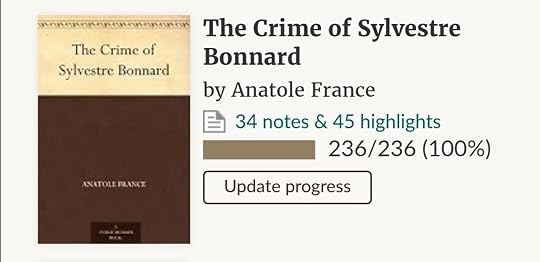
4.5⭐
This old bibliophile with his old books, manuscripts, and quiet existence won me.
I found this novel utterly charming.

March 10, 2020
Αυτή είναι λογοτεχνία.!! Κρίμα που είναι εξαντλημένο. Θα το ήθελα στη βιβλιοθήκη μου.Το διάβασα από τη δημοτική μας βιβλιοθήκη κ ήταν έκδοση του 1984 από τον Ψυχογιό.....

December 12, 2020
Ευχάριστο ανάγνωσμα. Σε κάποια σημεία (στην αρχή κυρίως) λίγο βαρετό, σε άλλα σημεία στα όρια του ποιητικού. Μία όμορφη ματιά στη Γαλλία - και όχι μόνο - του 2ου μισού του 19ου αιώνα.

February 5, 2015
It is such a joy to read a work of the nineteenth century after a streak of current works. I admired the writing of Anatole France, his wit and his humour. I didn't care much about the story itself, yet I highlighted paragraphs which I am sure I will be revisiting to enjoy their humour and their brilliance

February 9, 2020
Ένα κείμενο γεμάτο συναίσθημα, πνεύμα και ψυχή. Ο ήρωας Συλβέστερ Μπονάρ μου θύμισε τον άνθρωπο Ουμπέρτο Έκο απλά σε μία άλλη εποχή, σε ένα άλλο κράτος, σε μικρότερο πιο ταπεινό σπίτι, με λιγότερες βιβλιοθήκες αλλά με το ίδιο πάθος για τα βιβλία. Ο Ανατόλ Φρανς είναι "τριφερός" συγγραφέας. Όχι ρομαντικός, τρυφερός. Έτσι ένιωσα.

October 23, 2013
Warm and fuzzy while somehow being simultaneously classical and austere. I probably missed something. The copy I read was old and pleasantly floppy and smelled really good.

May 2, 2020
Klassisk. Från flydda dar ...
February 12, 2025
لا تستحق الشهرة في رأيي.
الرواية (من ترجمة دار تبارك) ملييييئة بالأخطاء المطبعية و الإملائية من أول جملة إلى آخر جملة.
الرواية (من ترجمة دار تبارك) ملييييئة بالأخطاء المطبعية و الإملائية من أول جملة إلى آخر جملة.
September 26, 2026
‘The Crime of Sylvestre Bonnard’ (1881) by Anatole France – but wait, what is the crime, indeed, the many crimes, of Sylvestre Bonnard? Bonnard is a gentle, scholarly old man, bullied by both his cat Hamilcar and his housekeeper Thérèse. Surely a man who cares only for a mediaeval manuscript said to be a copy of ‘The Golden Legend’ (la Légende dorée) compiled by the Dominican friar Jacques de Voragine can hardly be capable of a crime. Or can he?
His obsession with this document takes up the whole of Part I. One could call his obsession a crime, since it has become an object of reverence in itself, causing him to lose touch with humanity. He treats a sacred text as a mere aesthetic fetish and a piece of historical property to be hoarded in his private library. His obsession reduces divine grace to a scholar's trophy. This academic detachment is mockingly challenged from within his own study by the Fairy Clémentine. Materialising from the pages of an old tome, she playfully deflates his intellectual seriousness, tossing hazelnut shells at him—a whimsical warning against a life buried in dead parchment.
Even when he takes pity on a starving bookseller, Monsieur Coccoz, and his pregnant wife, his charity remains faceless and secondhand. He merely houses them in his attic, sending up hot soup and logs through others, keeping away from the sight of suffering. The bookseller dies soon after. A few months later, when Bonnard and the widow meet on the stairs, she holds up her newborn child in a touching, spontaneous gesture, embarrassing the old man with sudden human contact. Perhaps then his second crime is a passionless disconnect with life itself.
Safe in his study, he directs Thérèse to do the necessary good works, confining himself to writing academic papers. This isolation draws the young scholar Henri Gélis’s comment that he is an idiot. Then comes the fruitless journey to Sicily in search of the parchment, and the miraculous gift of the long-sought manuscript.
There is a delightful bit of narrative irony engineered by Anatole France here. The precious manuscript contains the hagiography of Saint Clémentine, who shares a name with the only woman Bonnard ever loved. She married someone else, passed away, and left behind a lineage that leads directly to Jeanne Alexandre, the centre around which the plot revolves. The manuscript represents the ultimate intersection of his dual identities. Academically, it is a rare vernacular text; emotionally, it is an unconscious sublimation of his lifelong romantic regret. He is chasing a dead saint on parchment because he cannot let go of his lost love.
The widow Coccoz, now remarried to the immensely wealthy Prince Trépof, has never forgotten Bonnard's early kindness. She outbids him at auction only to smuggle the precious manuscript into his home hidden inside a giant log packed with truffles, awakening in him the first seeds of human compassion. His third "crime" is the moment his humanity overrules his academic isolation. He moves from saving dead manuscripts to saving a living person.
This awakening is the prelude to Part II, where France’s style becomes almost Dickensian. His newfound compassion is put to the test when he discovers Jeanne Alexandre, the orphaned granddaughter of his earthly Clémentine, trapped under the abusive guardianship of the miserly notary Maître Mouche and the deceitful schoolmistress Mademoiselle Préfère. The gentle old scholar is forced out of his passive shell. In one sense, Bonnard's rejection of the schoolmistress's romantic advances is a kind of social crime—a refusal to conform to bourgeois expectations that triggers her wrath and uses the legal system against him.
If all the previous “crimes” were of a metaphysical or social character, Sylvestre Bonnard outdoes himself by actively abducting Jeanne from the villainies and tyrannies of her captors, shifting completely from a passive observer to an active protector.This does invite the retribution of the law, but Anatole France makes a distinction between an act and its motives, proving that a legal offense can be a moral triumph. And of course, the final crime, the one that Bonnard admits to, is turning into a thief within his own home by secretly hoarding a few beloved rare books from the inventory before the rest of his library is carted away to fund Jeanne’s dowry.
While the reader comes to love the old gentleman, his gentleness and vanities, no one can fail to recognise the iron will of his nature just as much as his tenderness towards Thérèse and Jeanne alike. Though Anatole France avoids sentimentality, especially when dealing with death, there is a disjointedness between Parts I and II; the characters are beautifully sketched, but lack growth or depth, except for Bonnard himself. And there is more than a whiff of the god in the machine in the sudden resolution of difficult situations.
His obsession with this document takes up the whole of Part I. One could call his obsession a crime, since it has become an object of reverence in itself, causing him to lose touch with humanity. He treats a sacred text as a mere aesthetic fetish and a piece of historical property to be hoarded in his private library. His obsession reduces divine grace to a scholar's trophy. This academic detachment is mockingly challenged from within his own study by the Fairy Clémentine. Materialising from the pages of an old tome, she playfully deflates his intellectual seriousness, tossing hazelnut shells at him—a whimsical warning against a life buried in dead parchment.
Even when he takes pity on a starving bookseller, Monsieur Coccoz, and his pregnant wife, his charity remains faceless and secondhand. He merely houses them in his attic, sending up hot soup and logs through others, keeping away from the sight of suffering. The bookseller dies soon after. A few months later, when Bonnard and the widow meet on the stairs, she holds up her newborn child in a touching, spontaneous gesture, embarrassing the old man with sudden human contact. Perhaps then his second crime is a passionless disconnect with life itself.
Safe in his study, he directs Thérèse to do the necessary good works, confining himself to writing academic papers. This isolation draws the young scholar Henri Gélis’s comment that he is an idiot. Then comes the fruitless journey to Sicily in search of the parchment, and the miraculous gift of the long-sought manuscript.
There is a delightful bit of narrative irony engineered by Anatole France here. The precious manuscript contains the hagiography of Saint Clémentine, who shares a name with the only woman Bonnard ever loved. She married someone else, passed away, and left behind a lineage that leads directly to Jeanne Alexandre, the centre around which the plot revolves. The manuscript represents the ultimate intersection of his dual identities. Academically, it is a rare vernacular text; emotionally, it is an unconscious sublimation of his lifelong romantic regret. He is chasing a dead saint on parchment because he cannot let go of his lost love.
The widow Coccoz, now remarried to the immensely wealthy Prince Trépof, has never forgotten Bonnard's early kindness. She outbids him at auction only to smuggle the precious manuscript into his home hidden inside a giant log packed with truffles, awakening in him the first seeds of human compassion. His third "crime" is the moment his humanity overrules his academic isolation. He moves from saving dead manuscripts to saving a living person.
This awakening is the prelude to Part II, where France’s style becomes almost Dickensian. His newfound compassion is put to the test when he discovers Jeanne Alexandre, the orphaned granddaughter of his earthly Clémentine, trapped under the abusive guardianship of the miserly notary Maître Mouche and the deceitful schoolmistress Mademoiselle Préfère. The gentle old scholar is forced out of his passive shell. In one sense, Bonnard's rejection of the schoolmistress's romantic advances is a kind of social crime—a refusal to conform to bourgeois expectations that triggers her wrath and uses the legal system against him.
If all the previous “crimes” were of a metaphysical or social character, Sylvestre Bonnard outdoes himself by actively abducting Jeanne from the villainies and tyrannies of her captors, shifting completely from a passive observer to an active protector.This does invite the retribution of the law, but Anatole France makes a distinction between an act and its motives, proving that a legal offense can be a moral triumph. And of course, the final crime, the one that Bonnard admits to, is turning into a thief within his own home by secretly hoarding a few beloved rare books from the inventory before the rest of his library is carted away to fund Jeanne’s dowry.
While the reader comes to love the old gentleman, his gentleness and vanities, no one can fail to recognise the iron will of his nature just as much as his tenderness towards Thérèse and Jeanne alike. Though Anatole France avoids sentimentality, especially when dealing with death, there is a disjointedness between Parts I and II; the characters are beautifully sketched, but lack growth or depth, except for Bonnard himself. And there is more than a whiff of the god in the machine in the sudden resolution of difficult situations.
Displaying 1 - 30 of 99 reviews