Livy (Titus Livius), the great Roman historian, was born at or near Patavium (Padua) in 64 or 59 BCE; he may have lived mostly in Rome but died at Patavium, in 12 or 17 CE.
Livy's only extant work is part of his history of Rome from the foundation of the city to 9 BCE. Of its 142 books, we have just 35, and short summaries of all the rest except two. The whole work was, long after his death, divided into Decades or series of ten. Books 1–10 we have entire; books 11–20 are lost; books 21–45 are entire, except parts of 41 and 43–45. Of the rest only fragments and the summaries remain. In splendid style Livy, a man of wide sympathies and proud of Rome's past, presented an uncritical but clear and living narrative of the rise of Rome to greatness.
The Loeb Classical Library edition of Livy is in fourteen volumes. The last volume includes a comprehensive index.
Titus Livius (Patavinus) (64 or 59 BC – AD 17)—known as Livy in English, and Tite-Live in French—was a Roman historian who wrote a monumental history of Rome and the Roman people – Ab Urbe Condita Libri (Books from the Foundation of the City) – covering the period from the earliest legends of Rome before the traditional foundation in 753 BC through the reign of Augustus in Livy's own time. He was on familiar terms with the Julio-Claudian dynasty, advising Augustus's grandnephew, the future emperor Claudius, as a young man not long before 14 AD in a letter to take up the writing of history. Livy and Augustus's wife, Livia, were from the same clan in different locations, although not related by blood.
Book 5 (Gauls at Rome) & Book 6 (Roman Campaigns) & Book 7 (Roman Expansion)
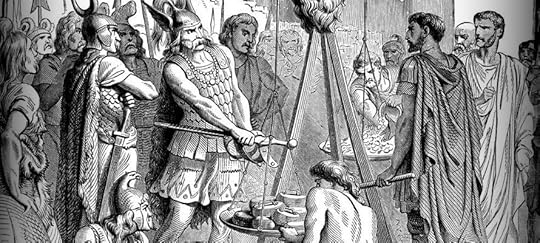
My third (of fourteen) Livy's History of Rome covers books 5, 6, and 7 (403-342 BC). One of my favorite characters in the book is Marcus Furius Camillus, one of Rome's great, early generals. He was given at his death the title of Second Founder of Rome after he helped to defend a sacked Rome against the Senoni chieftain Brennus and his gallic warriors.
Some men are generals. Some are statesmen. Others just seem to have it all. Camellus is one of those men who seem destined to lead, protect, and inspire. These three books are filled with battles, wars, and manly, martial speeches. I think one of the best parts of these early Roman histories of Livy are his speeches. Obviously, he is embellishing things and probably making a great deal up, but still -- this is damn good stuff.
Here are some of his best lines:
'Do we think the bodies of our soldiers so effeminate, their hearts so faint, that they cannot endure to be one winter in camp, away from home; that like sailors they must wage war with an eye on the weather, observing the seasons, incapable of withstanding heat or cold?" (Book V, vi 4)
"The gods themselves never laid hands upon the guilty; it was enough if they armed with an opportunity for vengeance those who had been wronged." (Book V, xi 16).
"...since it commonly turned out that in proportion as a man was prone to seek a leading share of toil and danger, he was slow in plundering." (Book V, xx 6).
"Soldiers, what means this gloom and this unwonted reluctance? Are you strangers to the enemy, or to me, or to yourselves? The enemy -- what else are they but inexhaustible material for you to fashion into glorious deeds of valor? " (Book VI, vii 3).
"...a young soldier rebuked them, so the story runs, for questioning whether any blessing were more Roman than arms and valor." (Book VII, vi 3).
I like plowing through primary sources in their entirety. Many events in Livy seem repetitive, but while in volume 3 a couple things finally sank in with me. First, how non-imperial Rome was for the first 400 years. It's almost like they're operating without the concept. It was hard for me to realize this since I know what follows, and Polybius writes his history as an account of their rise to dominion. But after they defeat the same neighbor in their annual war for the umpteenth consecutive time, I finally realized the notion of empire had not dawned on them yet.
Second, I'm getting a better appreciation for the gulf between patricians and plebs. There is a pretty interesting religious dimension that's at least as big a chasm as the wealth disparity.
Karl Marx said that history is about the struggle between people who have power and people who don’t. When you read Livy, you’re tempted to conclude that the old armchair revolutionary was right. A recurring theme in this volume, which covers the years 403 to 342 BCE, is the conflict between the patricians and the plebeians over issues like wars with neighbouring tribes (at that time the frontier of the Roman “empire” was still only about a day’s march from Rome itself), taxes, interest rates, the enforcement of debts, elections and who could run for political office. Livy tends to side with the patricians, though he occasionally sympathises with the plebs when their social superiors go too far. Occasionally. But those instances are noteworthy because they are so occasional. Generally, Livy’s view is that the social orders should know their place, and for the plebs that place is very firmly at the bottom of the pile. Here is an example. Every year the Roman citizens elect two consuls (the voting is rigged so the wealthy vote first and once two candidates have a majority, the election stops). Before the consuls go off to war they must perform certain religious rites called taking the auspices. If these aren’t performed correctly, superstition says that disaster will follow. By tradition only patricians can take the auspices. Therefore only patricians can be consuls. However, the plebeians agitate for decades to change the rules so that one of the consuls must be a pleb – an early example of positive discrimination. Eventually the patricians give in and in 362 BCE a pleb called Lucius Genucius is elected consul. He marches off to war against a nearby tribe, the Hernici. His army is ambushed and put to flight and he is killed. Livy tells us that the patricians, rather than being dismayed at the deaths of large numbers of their countrymen, are jubilant, sneering and taunting the plebs. That’s what you get when you give a nobody more power than they can handle. The message is clear – and it’s a message that runs throughout Livy’s writing – only chaps from the top of the pile are the right sort for leadership. The lower orders have no business thinking they can run governments or command armies. NB There is another notorious example of this in Livy’s account of the Battle of Cannae, the worst military disaster in Roman history. The army is led by two consuls: a posh boy (Lucius Aemilius Paullus) and a pleb (Gaius Terentius Varro). It’s clear from the narrative that posh boy Paullus was in charge on the day of the battle but Livy deliberately distorts the sequence to make out that the butcher’s son Varro was responsible for the disaster. This fiction is repeated in Wikipedia’s account of the battle. Two characters stand out in this volume. The first is Marcus Furius Camillus, war hero and saviour of Rome after its occupation in 390 BCE by an army of marauding Gauls. Camillus is depicted as the ideal patrician: courageous, supreme military strategist and leader, fair-minded towards the lower classes but aware that they are the lower classes for a reason – they are there to serve chaps like him. You can compare him favourably with another patrician war hero, Caius Marcius Coriolanus from a century earlier. Like Coriolanus, Camillus is exiled for a while; but unlike his predecessor, Camillus does not seek revenge by allying himself with Rome’s enemies. Instead, when he is recalled he leaps into action and saves Rome from the Gallic invasion. And he continues saving Rome into his old age with triumph after triumph after triumph. The other character who stands out is Marcus Manlius Capitolinus. He is holed up in the citadel when the Gauls occupy the rest of the city. And he is the one who leads the counterattack when the Gauls attempt to storm the citadel by night. He comes to resent Camillus’ success and is angry that his own role in saving the city is overlooked. He takes up the cause of the plebs and reinvents himself as what we would now call a populist politician. However, the difference between Capitolinus and our current generation of populists is that Capitolinus genuinely wants to tackle the big economic problems of the day: a credit crunch, high interest rates and increasing numbers of plebs falling into debt. And in those days an inability to repay a debt meant bondage and servitude. The problem got worse after the Gallic invasion because people had to borrow so they could rebuild homes that the Gauls had destroyed. Camillus agitates for debt relief and lower interest rates and for his pains he is imprisoned. His fellow patricians then accuse him of the worst crime a Roman can commit: plotting to make himself king. Even Livy has to admit that the evidence was thin, yet the people’s champion is hurled from the Tarpeian Rock. Loeb have recently been refreshing some of their other volumes of Livy but this translation dates from 1924 and I have to say that the English seems older than the Latin. However, I would still recommend it to anyone who is interested in Roman history. Up the workers!
‘Quid est veritas?’ Pontius Pilatus – a famous Roman
This volume opens with the sacking of Rome by the Gauls. A wonderfully told story. It has the ring of veracity to it (once you’ve accounted for Livy’s nationalistic bias), but I couldn’t help wondering how such a clear historical account could survive from what must have been total pandemonium. And further, if the city has mostly been burned, how have earlier records survived? Then at the beginning of book VI we get this:
‘The history of the Romans from the founding of the City of Rome to the capture of the same —at first under kings and afterwards under consuls and dictators, decemvirs and consular tribunes —their foreign wars and their domestic dissensions, I have set forth in five books, dealing with matters which are obscure not only by reason of their great antiquity —like far-off objects which can hardly be descried —but also because in those days there was but slight and scanty use of writing, the sole trustworthy guardian of the memory of past events, and because even such records as existed in the commentaries of the pontiffs and in other public and private documents, nearly all perished in the conflagration of the City. From this point onwards a clearer and more definite account shall be given of the City's civil and military history, when, beginning for a second time, it sprang up, as it were from the old roots, with a more luxuriant and fruitful growth.’
Perhaps I’m with Pilate in not really caring what the answer is. This is an account of how the Romans saw themselves. The modern equivalent would be those documentaries with periodic re-enactments.
The remainder of this volume has nothing as good as the sack. I think the problem is that for reasons of length you have the climax of the first pentad with the beginning of the second all in one volume. However, I think I can see where Livy is going. Up until this point the Romans have simply been beating up their neighbours and then going home. They’re a bit like the Assyrians and live with totally porous borders. For the first time the Romans start to leave garrisons in the cities they conquer. Their first attempt at this goes horribly wrong because the troops have not received the memo and try to control with violence the city they can occupy in peace. They also make first contact with the Carthaginians. Dionysius of Halicarnassus records this first contact much earlier so Livy might be engaging in a bit of foreshadowing here.
There’s also in interesting account of the development of drama. It opens like this:
‘The pestilence lasted during both this and the following year... with the object of appeasing the divine displeasure they mad a lectisternium, or banquet to the gods, being the third in the history of the City; and when neither human wisdom nor the help of Heaven was found to mitigate the scourge, men gave way to superstitious fears, and, amongst other efforts to disarm the wrath of the gods, are said also to have instituted scenic entertainments. This was a new departure for a warlike people, whose only exhibitions had been those of the circus; but indeed it began in a small way, as most things do, and even so was imported from abroad.’
There’s a theory that the Medieval mystery cycles may have begun as propitiatory rites following the Black Death.
my march through the history of the Roman republic continues. This is volume 3 comprising books 5-7 of Livy's work. He can be monotonous at times but I'm happy with the progress so far.
This review is the same for each of his volumes: Livy is the quintessential historian of ancient Rome. He had his obvious flaws - no one could consider him unbiased in his approach, and he creates dialogue between historical figures that encourage the virtues of the citizens. Still, he is very entertaining. Each of his extant works - most of his books have been lost - presents a far nobler Rome than we have come to expect. Reading Livy is a luxury few are privileged to partake of. Fantastic.