

What do you think?

At the Tomb of the Inflatable Pig: A Riotous Journey Into the Heart of Paraguay
A wildly humorous account of the author's travels across Paraguay -- South America's darkly fabled, little-known “island surrounded by land.”Rarely visited by tourists and barely touched by global village sprawl, Paraguay remains a mystery to outsiders. Think of this small nation and your mind is likely to jump to Nazis, dictators, and soccer. Now, John Gimlette’s eye-opening book -- equal parts travelogue, history, and unorthodox travel guide -- breaches the boundaries of this isolated land,” and illuminates a little-understood place and its people.It is a wonderfully animated telling of Paraguay's of cannibals, Jesuits, and sixteenth-century Anabaptists; of Victorian Australian socialists and talented smugglers; of dictators and their mad mistresses; bloody wars and Utopian settlements; and of lives transplanted from Japan, Britain, Poland, Russia, Germany, Ireland, Korea, and the United States. The author travels from the insular cities and towns of the east, along ghostly trails through the countryside, to reach the Gran Chaco of the the “green hell” covering almost two-thirds of the country, where 4 percent of the population coexists -- more or very-much-less peacefully -- with a vast array of exotic wildlife that includes jaguars, prehistoric lungfish, and their more recently evolved distant cousins, the great fighting river fish. Gimlette visits with Mennonites and the indigenas, arms dealers and real-estate tycoons, shopkeepers, government bureaucrats and, of course, Nazis.Filled with bizarre incident, fascinating anecdote, and richly evocative detail, At the Tomb of the Inflatable Pig is a brilliant description of a country of eccentricity and contradiction, of beguilingly individualistic men and women, and of unexpected and extraordinary beauty. It is a vivid, often riotous, always fascinating, journey.
363 pages, Paperback
First published February 19, 2003
About the author
John Gimlette
7 books37 followersJohn Gimlette was born in 1963. At seventeen, he crossed the Soviet Union by train and has since travelled to over 60 countries. In 1982, on the eve of the Falklands War, he was working on an estancia in Argentina. He returned to England via Paraguay and Bolivia to read law at Cambridge.
In 1997, he won the Shiva Naipaul Memorial Prize with ‘Pink Pigs in Paraguay’, which was published in The Spectator in May of that year. The following year he won the Wanderlust Travel Writing competition.
He is a regular contributor to a number of British broadsheets, including The Daily Telegraph, Times and The Guardian travel sections. He also contributes to other travel titles, including the Conde Nast Traveller and Wanderlust. His travel photographs have appeared in the Telegraph, Wanderlust and Geographical.
His first book was At the Tomb of the Inflatable Pig, which is described as a 'vivid, riotous journey into the heart of South America' (see the Reviews page). His second book, Theatre of Fish, set in Newfoundland and Labrador, was published in 2005.
Both books were nominated by The New York Times as being among the ‘100 Notable Books of the Year’.
John Gimlette’s third book was Panther Soup, which followed a wartime journey through France, Germany and Austria, comparing the battlefields of 1944-45 with what can be found there today.
He lives in London where he practices as a barrister. He is married to TV presenter, Jayne Constantinis, and they have one daughter.
In 1997, he won the Shiva Naipaul Memorial Prize with ‘Pink Pigs in Paraguay’, which was published in The Spectator in May of that year. The following year he won the Wanderlust Travel Writing competition.
He is a regular contributor to a number of British broadsheets, including The Daily Telegraph, Times and The Guardian travel sections. He also contributes to other travel titles, including the Conde Nast Traveller and Wanderlust. His travel photographs have appeared in the Telegraph, Wanderlust and Geographical.
His first book was At the Tomb of the Inflatable Pig, which is described as a 'vivid, riotous journey into the heart of South America' (see the Reviews page). His second book, Theatre of Fish, set in Newfoundland and Labrador, was published in 2005.
Both books were nominated by The New York Times as being among the ‘100 Notable Books of the Year’.
John Gimlette’s third book was Panther Soup, which followed a wartime journey through France, Germany and Austria, comparing the battlefields of 1944-45 with what can be found there today.
He lives in London where he practices as a barrister. He is married to TV presenter, Jayne Constantinis, and they have one daughter.
Ratings & Reviews
Friends & Following
Create a free account to discover what your friends think of this book!
Community Reviews
Displaying 1 - 30 of 131 reviews

February 9, 2015
Before reading this book, the only thing I knew about Paraguay is Leryn Franco, their female Olympic javelin thrower/model is quite fetching, and Paraguay is located in South America.
Now I know that Paraguay has had more than its share of totalitarian rulers, is land-locked, been home to many failed Utopias, numbers piranha and vampire bats among it’s fauna, is home to groups of Mennonites, suffered under the boot heels of the Spanish conquistadores, had a prostitute as its first lady, was a way station to on-the-run Nazis, was once teeming with cannibals and tribes who eat their dead and suffered through two wars that I had never heard of.
Author John Gimlette, who lived and traveled in Paraguay has an eye and ear for the eccentric, which is lucky because the motto for this country should be kind of like those apartment complex signs along the expressway, “If you lived here, you’d want to keep driving”.
It would be kind to say Paraguay has had a history of hard luck. In the mid-1800’s, Paraguay fought a war against Brazil, Argentina and Uruguay and the cost of the war was so destructive that at the end, the Paraguayan women outnumbered the men by a 10 to 1 margin.
Paraguay also fought Bolivia in the Chaco War, the bloodiest war in 20th century South American history. The conflict was fought in the inhospitable arid Chaco region and was nicknamed “The War of Thirst”. The area was thought to be rich in oil. Oops! Sorry, it wasn’t.
Joseph Conrad and Graham Greene based two of their best books, Nostromo (Conrad gave it a fictional name) and Travels with My Aunt (one of Greene’s more amusing works) on Paraguay. Greene said the national industry of Paraguay is smuggling. He wasn’t far off.
This is a witty and informative travelogue in the spirit of Paul Theroux, sans train travel. If you’re interested in the history and culture of an unfamiliar region of the world, I would highly recommend it.
Now I know that Paraguay has had more than its share of totalitarian rulers, is land-locked, been home to many failed Utopias, numbers piranha and vampire bats among it’s fauna, is home to groups of Mennonites, suffered under the boot heels of the Spanish conquistadores, had a prostitute as its first lady, was a way station to on-the-run Nazis, was once teeming with cannibals and tribes who eat their dead and suffered through two wars that I had never heard of.
Author John Gimlette, who lived and traveled in Paraguay has an eye and ear for the eccentric, which is lucky because the motto for this country should be kind of like those apartment complex signs along the expressway, “If you lived here, you’d want to keep driving”.
It would be kind to say Paraguay has had a history of hard luck. In the mid-1800’s, Paraguay fought a war against Brazil, Argentina and Uruguay and the cost of the war was so destructive that at the end, the Paraguayan women outnumbered the men by a 10 to 1 margin.
Paraguay also fought Bolivia in the Chaco War, the bloodiest war in 20th century South American history. The conflict was fought in the inhospitable arid Chaco region and was nicknamed “The War of Thirst”. The area was thought to be rich in oil. Oops! Sorry, it wasn’t.
Joseph Conrad and Graham Greene based two of their best books, Nostromo (Conrad gave it a fictional name) and Travels with My Aunt (one of Greene’s more amusing works) on Paraguay. Greene said the national industry of Paraguay is smuggling. He wasn’t far off.
This is a witty and informative travelogue in the spirit of Paul Theroux, sans train travel. If you’re interested in the history and culture of an unfamiliar region of the world, I would highly recommend it.

September 16, 2014
I knew bupkis about Paraguay before I read this book, and now I have a gained a fair perspective on its unusual history and attractions. There are lots of countries I know little about, but this case is pretty special. Paraguay is so off the beaten track, about a 1,000 miles up the Panana River from its mouth at Buenos Aires, that it presents a sort of experiment in human nature. On the big picture, with its centuries of dictators, the result is a sad drama. But the attraction of the place as a refuge for outcasts and utopian dreamers of all stripes provides some fascinating stories with lift.
A straight history would not have held much attraction for me. I admit that the ridiculous cover for this book and absurd title led me to expect entertainment along the lines of Bryson. But whereas his travelogues are on the order 75% in the present and 25% dipping into history, it is more like the reverse with Gimlette. I had the satisfaction of this approach with his wonderful book on Newfoundland, “Theatre of Fish.” Bits on current experiences with the geography and people of Paraguay followed by a full dip into the rivers of history is an approach that works for me by providing a context to digest what the mind might normally bounce out of in shock or disbelief, like realizing the river is full of parana. At times, Gimlette seems to delight a bit too much in the macabre or comes off as mean spirited. But his targets are so deserving, and he makes such a fine art in the subtle knife of his wordplay, I couldn’t resist.
The country had the lucky fortune to be so remote that imperial powers couldn’t easily exploit its resources and usually left it to go its own way. When the early conquistadors settled down so far from European women, they readily adopted the practice of intermarriage with the natives, quickly generating a majority population of mestizos. The friendly Guaranis quickly gave up their ritual cannibalism and converted to Catholicism. Guarani soon became the dominant language and remains so to this day. There was a long period where Madrid allowed the colony to choose its own governors and Jesuit power was in ascendancy. After a period of virtual slavery in the Jesuit settlements, a revolt ended that trend, and unlike most of South America, real slavery never made much of a foothold.
A large part of the colony in the west, the Chaco, was left mostly undisturbed due to its forbidding marshes and jungle and occupation by less accommodating tribes. Soon after its founding in the early 16th century, Asunción, became the capital of a vast region that included the future Brazil, Argentina, and much of Chile. Later, with the asendancy of the Portuguese colony, Paraguay shrank and served as a useful buffer state between Brazil and Spain’s other more lucrative colonies like Bolivia and Peru. Independence in 1811 came without much of a struggle. Even in its reduced dimension today, it’s a big place, roughly the size of California or Japan.
The captions to figures in the book provide a profile of prominent rulers and Gimlette’s satirical outlook, which helps me behold them without bolting in repulsion:
Dr. Gaspar Francia, ‘The Supreme One’ (1766-1840), whose brand of absolute power was much admired in Europe. He rule with savagery, genius, madness and extreme probity (even returning his unused salary to the treasury).
Carlos Antonio López (1790-1862), who scared off all opposition by the sheer monstrosity of his appearance. Despite personal engorgement, his presidency brought wealth and European sophistication to the isolated republic.
Francisco Solano López. Obesity and toothache brought out his less attractive side but diplomacy and warfare would reveal ‘The Monster.’ (The label pertains to his brutal treatment of his soldiers in the inept and disastrous war he provoked in 1865 with Brazil, Argentina, and Uruguay and later insane slaughter and imprisonment of allies and family suspected of treason)
General Alfredo Stoessner, described by Graham Greene as looking like ‘the amiable well-fed host of a Bavarian bierstube’. His dictatorship lasted 34 years [1954-89], outlasted only by Kim Il Sung. Stroessner took a 15-year-old mistress and called himself the ‘Lighthouse.’
A high point of the book for me is Gimlette’s treatment of Eliza Lynch, the consort of the country’s ruler in the 1860’s, Francisco Solano López. He first encounters her in Paris on a shopping spree as a playboy son during his father’s rule:
Francisco had not been neglecting his ravenous sexual urges, and back on St. Germain, he was hauling himself on and off selected courtesans. Then one of them stopped him in his sweaty tracks.
She was a young woman of slender and translucent beauty. All through her life she’d have a devastating effect on men, stripping them of their better judgement and fomenting dangerous urges and unruly bravado. The effect on López—and ultimately Paraguay—was disastrous. …
She was his most dazzling acquisition so far.
Eliza would have said that it was she who acquired López. She’d been considering how to secure her future for some time. …On reflection, she’d been keeping only one step ahead of poverty ever since the Lynches fled the Irish famine in 1845. …When this slightly exotic, explosively potent sultan dandled her on his fleshy knee and murmured of his empire in South America, the future began to map itself out in front of her.

The process of her remaking herself into the Empress of Paraguay was fun to experience through Gimlette’s jaundiced eye. Boatloads of shipments fulfilled her fantasy of remaking her hew home into a French palace, matching López’s affinity for all things Napoleanic. Her revenge on the snooty patricians of Asunción included such tactics as taking them out for a banquet on a river boat, then leaving them hot and hungry when some slight led her to have the food tossed overboard. At a fancy dress ball, she forced her guests to choose costumes of her own choosing. While she got to appear as Queen Elizabeth I and her German Baron friend as Lorenzo de Medici, her choices for others were even more fitting:
For Don Francisco’s mother [mother-in-law], who was by now a viperous old crone with a fluffy mustache, she chose Diana the Huntress. When she got her invitation, Mother Lopez wept acid tears and swore that she’d shoot an arrow into the little strumpet’s heart.
Her corpulent daughters were to come as ‘two emaciated Guarani Indians.’
But for the woman Madame Lynch loathed most of all—the French minister’s wife, Madame Cochelet—she ordered ‘Queen Victoria’. In that lot, even this old trollop wouldn’t be tempted to steal the glitz.
Gimlette makes up for his limited coverage of flora and fauna by his avid sampling of peoples, from aristocrats to lowly peasants. His focus is on descendants of various peoples who were drawn to Paraguay as a field of dreams to accommodate communities to either preserve old traditions or forge new modes of utopian living. The 19th century was witness to a wide variety of micro-colonies. A litany from a soil scientist he encounters skips quickly from the 16th century to the ferment of immigration in the 20th century:
First we had the conquistadors. Then the contractors—English, Americans, and French. After the Big War, it was Germans, Australians, and Arab traders. A “Turk’s Valise” is still a bag of tricks.
Next, there were the Italians. They’ve left us with our buildings and our good-for-nothing president. They had a revolution once. Paraguay was Italian for an hour!
After 1917, we started getting Russians: generals, Jews, and ballerinas. In the twenties it was Mennonites. Japanese in the thirties. Then half of Eastern Europe. Then Koreans arrived—and Taiwanese—hoping to hop into the States. Instead, they bought us up and stayed.
Ever since, it’s been people on the run: criminals jumping justice; Frenchmen escaping socialism; Germans fleeing Chernobyl; Afrikaners fleeing Africans. Oddballs from Norway. We became a sort of last resort
Now it’s the Brazilians. …
Communists and Nazis, conservative sects and polygamist cults, hucksters and farmers—all could find accommodation in the hinterlands or cities if they didn’t rock the boat of an economy long based on the laissez faire of smuggling and other corrupt enterprises. In his exploration of these trends, Gimlette follows in the tradition of Chatwin’s wonderful “In Patagonia” (1977), which is another place that drew oddballs and misfits to its lands. The comedy and tragedy of the human species are portrayed here like a vision of wild jungle, and I was adequately enthralled with the fertile wonder of its orchids and disgusted with its unchecked brutalities.
A straight history would not have held much attraction for me. I admit that the ridiculous cover for this book and absurd title led me to expect entertainment along the lines of Bryson. But whereas his travelogues are on the order 75% in the present and 25% dipping into history, it is more like the reverse with Gimlette. I had the satisfaction of this approach with his wonderful book on Newfoundland, “Theatre of Fish.” Bits on current experiences with the geography and people of Paraguay followed by a full dip into the rivers of history is an approach that works for me by providing a context to digest what the mind might normally bounce out of in shock or disbelief, like realizing the river is full of parana. At times, Gimlette seems to delight a bit too much in the macabre or comes off as mean spirited. But his targets are so deserving, and he makes such a fine art in the subtle knife of his wordplay, I couldn’t resist.
The country had the lucky fortune to be so remote that imperial powers couldn’t easily exploit its resources and usually left it to go its own way. When the early conquistadors settled down so far from European women, they readily adopted the practice of intermarriage with the natives, quickly generating a majority population of mestizos. The friendly Guaranis quickly gave up their ritual cannibalism and converted to Catholicism. Guarani soon became the dominant language and remains so to this day. There was a long period where Madrid allowed the colony to choose its own governors and Jesuit power was in ascendancy. After a period of virtual slavery in the Jesuit settlements, a revolt ended that trend, and unlike most of South America, real slavery never made much of a foothold.
A large part of the colony in the west, the Chaco, was left mostly undisturbed due to its forbidding marshes and jungle and occupation by less accommodating tribes. Soon after its founding in the early 16th century, Asunción, became the capital of a vast region that included the future Brazil, Argentina, and much of Chile. Later, with the asendancy of the Portuguese colony, Paraguay shrank and served as a useful buffer state between Brazil and Spain’s other more lucrative colonies like Bolivia and Peru. Independence in 1811 came without much of a struggle. Even in its reduced dimension today, it’s a big place, roughly the size of California or Japan.
The captions to figures in the book provide a profile of prominent rulers and Gimlette’s satirical outlook, which helps me behold them without bolting in repulsion:
Dr. Gaspar Francia, ‘The Supreme One’ (1766-1840), whose brand of absolute power was much admired in Europe. He rule with savagery, genius, madness and extreme probity (even returning his unused salary to the treasury).
Carlos Antonio López (1790-1862), who scared off all opposition by the sheer monstrosity of his appearance. Despite personal engorgement, his presidency brought wealth and European sophistication to the isolated republic.
Francisco Solano López. Obesity and toothache brought out his less attractive side but diplomacy and warfare would reveal ‘The Monster.’ (The label pertains to his brutal treatment of his soldiers in the inept and disastrous war he provoked in 1865 with Brazil, Argentina, and Uruguay and later insane slaughter and imprisonment of allies and family suspected of treason)
General Alfredo Stoessner, described by Graham Greene as looking like ‘the amiable well-fed host of a Bavarian bierstube’. His dictatorship lasted 34 years [1954-89], outlasted only by Kim Il Sung. Stroessner took a 15-year-old mistress and called himself the ‘Lighthouse.’
A high point of the book for me is Gimlette’s treatment of Eliza Lynch, the consort of the country’s ruler in the 1860’s, Francisco Solano López. He first encounters her in Paris on a shopping spree as a playboy son during his father’s rule:
Francisco had not been neglecting his ravenous sexual urges, and back on St. Germain, he was hauling himself on and off selected courtesans. Then one of them stopped him in his sweaty tracks.
She was a young woman of slender and translucent beauty. All through her life she’d have a devastating effect on men, stripping them of their better judgement and fomenting dangerous urges and unruly bravado. The effect on López—and ultimately Paraguay—was disastrous. …
She was his most dazzling acquisition so far.
Eliza would have said that it was she who acquired López. She’d been considering how to secure her future for some time. …On reflection, she’d been keeping only one step ahead of poverty ever since the Lynches fled the Irish famine in 1845. …When this slightly exotic, explosively potent sultan dandled her on his fleshy knee and murmured of his empire in South America, the future began to map itself out in front of her.
The process of her remaking herself into the Empress of Paraguay was fun to experience through Gimlette’s jaundiced eye. Boatloads of shipments fulfilled her fantasy of remaking her hew home into a French palace, matching López’s affinity for all things Napoleanic. Her revenge on the snooty patricians of Asunción included such tactics as taking them out for a banquet on a river boat, then leaving them hot and hungry when some slight led her to have the food tossed overboard. At a fancy dress ball, she forced her guests to choose costumes of her own choosing. While she got to appear as Queen Elizabeth I and her German Baron friend as Lorenzo de Medici, her choices for others were even more fitting:
For Don Francisco’s mother [mother-in-law], who was by now a viperous old crone with a fluffy mustache, she chose Diana the Huntress. When she got her invitation, Mother Lopez wept acid tears and swore that she’d shoot an arrow into the little strumpet’s heart.
Her corpulent daughters were to come as ‘two emaciated Guarani Indians.’
But for the woman Madame Lynch loathed most of all—the French minister’s wife, Madame Cochelet—she ordered ‘Queen Victoria’. In that lot, even this old trollop wouldn’t be tempted to steal the glitz.
Gimlette makes up for his limited coverage of flora and fauna by his avid sampling of peoples, from aristocrats to lowly peasants. His focus is on descendants of various peoples who were drawn to Paraguay as a field of dreams to accommodate communities to either preserve old traditions or forge new modes of utopian living. The 19th century was witness to a wide variety of micro-colonies. A litany from a soil scientist he encounters skips quickly from the 16th century to the ferment of immigration in the 20th century:
First we had the conquistadors. Then the contractors—English, Americans, and French. After the Big War, it was Germans, Australians, and Arab traders. A “Turk’s Valise” is still a bag of tricks.
Next, there were the Italians. They’ve left us with our buildings and our good-for-nothing president. They had a revolution once. Paraguay was Italian for an hour!
After 1917, we started getting Russians: generals, Jews, and ballerinas. In the twenties it was Mennonites. Japanese in the thirties. Then half of Eastern Europe. Then Koreans arrived—and Taiwanese—hoping to hop into the States. Instead, they bought us up and stayed.
Ever since, it’s been people on the run: criminals jumping justice; Frenchmen escaping socialism; Germans fleeing Chernobyl; Afrikaners fleeing Africans. Oddballs from Norway. We became a sort of last resort
Now it’s the Brazilians. …
Communists and Nazis, conservative sects and polygamist cults, hucksters and farmers—all could find accommodation in the hinterlands or cities if they didn’t rock the boat of an economy long based on the laissez faire of smuggling and other corrupt enterprises. In his exploration of these trends, Gimlette follows in the tradition of Chatwin’s wonderful “In Patagonia” (1977), which is another place that drew oddballs and misfits to its lands. The comedy and tragedy of the human species are portrayed here like a vision of wild jungle, and I was adequately enthralled with the fertile wonder of its orchids and disgusted with its unchecked brutalities.

May 30, 2017
If you despair of the standard of leadership in today's world, this wonderful travelogue and history of a country ruled by centuries of dictators (from cruel to simply insane) may make things look less depressing. Then again, Paraguay's despots wrought their havoc at home, not internationally.

December 2, 2015
The one takeaway from this review should be: This book is FUNNY. If being funny were easy, more people would do it. Mr. Gimlette has the sort of self-deprecating willingness to go over the top in service of the story that I love. I can remember three simple drives across town, each of which is hilarious in its own way: A lady who drank way too much, a creamy-skinned beauty who likes to drive really fast, and a friend who is blind in one eye and none too attentive with the other. A bullfight, in Gimlette's hands, left me shaking with laughter. (No bulls were killed, though at least one was "bemused.")
The people of Paraguay have endured some horrible history, and Gimlette doesn't gloss over this, but he does make a real effort to describe the monsters in sufficient detail to make them believable, if not sympathetic. But it's his immersion in the present that makes this book such a treat.
The people of Paraguay have endured some horrible history, and Gimlette doesn't gloss over this, but he does make a real effort to describe the monsters in sufficient detail to make them believable, if not sympathetic. But it's his immersion in the present that makes this book such a treat.

January 10, 2009
Clearly, this is the work of a failed novelist. The first quarter of the book was fragmented and uninteresting. The rest was better, as stories go, but I never learned to like the patchy and chronologically chaotic nature of the book.
I guess the author failed to write a novel about Paraguay, because he couldn't craft a plot that would stay together. For all I know, he can't even hold together a paragraph. Countless times now I've started one with interest, and halfway through the author has lost me, and reading the entire paragraph makes me none the wiser. On the level of chapters this is maddening - the author starts out with panache with an interesting anecdote that goes nowhere. I guess he figured he can't write a novel, and as a result he reheated the leftovers and serves them up as a travel book.
To me, the book feels like the author lazed by his foggy beer glass all day and half of the night, and the ramblings that make up this book were what scrambled together in the afternoons desperately trying to justify his "traveller" lifestyle.
BTW, the inflatable pig drifted in an out of this book, but I have no idea whether it was supposed to stand for.
If you wish to study deeply flawed writing - how not to carry a plot - this book is a great guide. Paraguay sounds fascinating, and probably deserves a much better book.
I guess the author failed to write a novel about Paraguay, because he couldn't craft a plot that would stay together. For all I know, he can't even hold together a paragraph. Countless times now I've started one with interest, and halfway through the author has lost me, and reading the entire paragraph makes me none the wiser. On the level of chapters this is maddening - the author starts out with panache with an interesting anecdote that goes nowhere. I guess he figured he can't write a novel, and as a result he reheated the leftovers and serves them up as a travel book.
To me, the book feels like the author lazed by his foggy beer glass all day and half of the night, and the ramblings that make up this book were what scrambled together in the afternoons desperately trying to justify his "traveller" lifestyle.
BTW, the inflatable pig drifted in an out of this book, but I have no idea whether it was supposed to stand for.
If you wish to study deeply flawed writing - how not to carry a plot - this book is a great guide. Paraguay sounds fascinating, and probably deserves a much better book.

June 2, 2012
I'll pretty much read anything to do with Paraguay because this little land-locked South American country is so dear to my heart and so obscure to the broader world. John Gimlette has an entertaining writing style, and the book is a quick and easy read, but I reached the end feeling like he had turned Paraguay into a freak show. It was all cannibals and Nazis. Granted, if so many weird things exist in one country, maybe that country is a little weird. Paraguay IS a little weird. But I felt like he missed the essence of Paraguay in his focus on the bizarre marginalia.

December 9, 2013
I don't even know why I read this book. I got it when I had in mind making a trip trough Latin America. The trip was postponed, the book remained in my shelf. So I decided to read it, finally. For no specific reason.
And what a good surprise it was. The author picks something potentially uninteresting, like the history of Paraguay, and he converts it in a fabulous tale. This books is a must to anybody vaguely interesting in this country. John is a story teller by vocation. A great writing style with all ingredients for an excellent reading.
And what a good surprise it was. The author picks something potentially uninteresting, like the history of Paraguay, and he converts it in a fabulous tale. This books is a must to anybody vaguely interesting in this country. John is a story teller by vocation. A great writing style with all ingredients for an excellent reading.
January 17, 2025
A splendid book about Paraguay from an author who has fallen more than a little bit in love with this extraordinary country. Paraguay has, almost from the beginning, been as much a land onto which the dreams of outsiders have been foisted. You have only to look at the legends Paraguay has inspired, from El Dorado through Ira Levin's 'Boys from Brazil', 'Marathon Man' and 'The Mission', none of them are true, even when based on fact. Indeed most people don't even realise that Paraguay is the source material for these stories.
The fact is that the best portrait of Paraguay, the Paraguay of Stosesner, is not the grand guignol cinematic fantasies of the Nazi hunters in the 1970s and 80s but the prose of the 1969 'Travels With My Aunt' by Graham Greene. Paraguay is there in all its true darkness and horror. Greene had an unerring way, despite his many faults, of seeing through to, excuse the inevitable cliche, the Heart of the Matter, just as he had done in the Quiet American with Vietnam.
A country that has suffered so much (the War of the Triple Alliance 1864-70 cost the country half its population and 90% of males of military age [for comparison Poland in WWII lost 21.4% of its population]; 36,000 or 3.5% its population in the Chaco War of 1932-35 and in 1947 a third of the country's population fled abroad) deserves to have its suffering treated not only seriously but with respect. When he recounts the way Paraguay's barefoot Guarani soldiery armed with bow and arrows made fools of the European outfitted, armed and trained armies of the empire of Brazil and republics of Uruguay and Argentina you know his thoughts were with these anything but ordinary people.
Paraguay's history is full of grotesques, but Mr. Gimlette does not treat the country or its people with condescension. There are many hilarious tales, but the funniest are the tales Paraguayans tell about themselves.
As a travel/history of Paraguay I cannot think of a better book. It is one of the best travel books I have read because he immerses himself in the country and its people. I place it with works like 'Cleopatra's Wedding Present: Travels Through Syria' by Robert Tewdwr-Moss; 'Midnight in Sicily', 'A street Fight in Nasples' and 'A death in Brazil', all by Peter Robb, because these are books that are written at particular time but are not trapped in it. Messers Gimlette, Tewdwr-Moss and Robb look at places through history and personal experience and end up providing on going understanding.
To return specifically to 'At the Tomb of the Inflatable Pig' (and wouldn't the title alone commend it to anyone?!) it is a wonderful book of such riches of the offbeat which are so much better then the cliches of Nazis. This is a land which became the home, and graveyard, of some of the most wonderful millenariens and Utopians who set out to create new homelands, Japanese, Ukrainian Mennonites, Socialist Australians and, yes, Friedrich Nietzsche's repellent antisemitic and Nazi loving sister. This book contains so much to delight, as well as horrify, so don't miss out on a truly wonderful reading experience.
The fact is that the best portrait of Paraguay, the Paraguay of Stosesner, is not the grand guignol cinematic fantasies of the Nazi hunters in the 1970s and 80s but the prose of the 1969 'Travels With My Aunt' by Graham Greene. Paraguay is there in all its true darkness and horror. Greene had an unerring way, despite his many faults, of seeing through to, excuse the inevitable cliche, the Heart of the Matter, just as he had done in the Quiet American with Vietnam.
A country that has suffered so much (the War of the Triple Alliance 1864-70 cost the country half its population and 90% of males of military age [for comparison Poland in WWII lost 21.4% of its population]; 36,000 or 3.5% its population in the Chaco War of 1932-35 and in 1947 a third of the country's population fled abroad) deserves to have its suffering treated not only seriously but with respect. When he recounts the way Paraguay's barefoot Guarani soldiery armed with bow and arrows made fools of the European outfitted, armed and trained armies of the empire of Brazil and republics of Uruguay and Argentina you know his thoughts were with these anything but ordinary people.
Paraguay's history is full of grotesques, but Mr. Gimlette does not treat the country or its people with condescension. There are many hilarious tales, but the funniest are the tales Paraguayans tell about themselves.
As a travel/history of Paraguay I cannot think of a better book. It is one of the best travel books I have read because he immerses himself in the country and its people. I place it with works like 'Cleopatra's Wedding Present: Travels Through Syria' by Robert Tewdwr-Moss; 'Midnight in Sicily', 'A street Fight in Nasples' and 'A death in Brazil', all by Peter Robb, because these are books that are written at particular time but are not trapped in it. Messers Gimlette, Tewdwr-Moss and Robb look at places through history and personal experience and end up providing on going understanding.
To return specifically to 'At the Tomb of the Inflatable Pig' (and wouldn't the title alone commend it to anyone?!) it is a wonderful book of such riches of the offbeat which are so much better then the cliches of Nazis. This is a land which became the home, and graveyard, of some of the most wonderful millenariens and Utopians who set out to create new homelands, Japanese, Ukrainian Mennonites, Socialist Australians and, yes, Friedrich Nietzsche's repellent antisemitic and Nazi loving sister. This book contains so much to delight, as well as horrify, so don't miss out on a truly wonderful reading experience.

December 27, 2010
This book transcends its genre, not because travel-writing is somehow unserious or trite, but because this book transcends genre of any kind. This is remarkable a book as has been written in the last 20 years. It is non-fiction as nightmare. Most incredible of all is that it was John Gimlette’s first book.
At the Tomb of the Inflatable Pig begins like any other humorous travelogue about a country you’ve never visited. Gimlette is witty and dry and prosaic in his opening descriptions of Paraguay:
Youth had rallied, too late, to register its protest at the Church, the army and everything. They’d set up a den called the Urban Cave in the merchants’ quarter, where they could loose off fusillade after fusillade of rap and self-indulgent anger.
And then it gradually turns crazier and darker and deeper. It is modeled on the very country it endeavors to describe. It is a land of vivid cruelty and misspent courage. And Gimlette’s purpose becomes clearer:
Usually, everything about the Ambassador – his wife from Thailand, his silver elephants in the dining room, his sour Scottish accent and his raw complexion – said “I want to be anywhere but here.”
Gimlette walks forgotten battlefields of mass slaughter, wars that cost large percentages of Paraguay’s population a decade before no monument to them even remained, and stops being witty so much as taken aback. His writing becomes genuinely startled by the Nazis and Irish courtesans and obese leaders and savagery towards the land’s savages. And then the book arrives at the war between Paraguay and its neighbor Bolivia, and goes disturbingly concise:
For three weeks the two sides poured fire into each other’s faces. The orchestras stopped and the forest wailed. The earth began to boil. Young men were vaporised in shell-bursts and their shreds pinned up in trees. Others were unexpectedly lopped and pruned and died in the open, peeled alive by ants. At midday the field was covered in butterflies, licking up the moisture from the dead. Then came the flies who, as the weeks passed, grew fat and blue and bloated.
This book is a remarkable thing. It’s hard to imagine a serious reader who could not find value of some sort in it.
At the Tomb of the Inflatable Pig begins like any other humorous travelogue about a country you’ve never visited. Gimlette is witty and dry and prosaic in his opening descriptions of Paraguay:
Youth had rallied, too late, to register its protest at the Church, the army and everything. They’d set up a den called the Urban Cave in the merchants’ quarter, where they could loose off fusillade after fusillade of rap and self-indulgent anger.
And then it gradually turns crazier and darker and deeper. It is modeled on the very country it endeavors to describe. It is a land of vivid cruelty and misspent courage. And Gimlette’s purpose becomes clearer:
Usually, everything about the Ambassador – his wife from Thailand, his silver elephants in the dining room, his sour Scottish accent and his raw complexion – said “I want to be anywhere but here.”
Gimlette walks forgotten battlefields of mass slaughter, wars that cost large percentages of Paraguay’s population a decade before no monument to them even remained, and stops being witty so much as taken aback. His writing becomes genuinely startled by the Nazis and Irish courtesans and obese leaders and savagery towards the land’s savages. And then the book arrives at the war between Paraguay and its neighbor Bolivia, and goes disturbingly concise:
For three weeks the two sides poured fire into each other’s faces. The orchestras stopped and the forest wailed. The earth began to boil. Young men were vaporised in shell-bursts and their shreds pinned up in trees. Others were unexpectedly lopped and pruned and died in the open, peeled alive by ants. At midday the field was covered in butterflies, licking up the moisture from the dead. Then came the flies who, as the weeks passed, grew fat and blue and bloated.
This book is a remarkable thing. It’s hard to imagine a serious reader who could not find value of some sort in it.

August 8, 2012
Did not choose this per se, but got it for free. An astoundingly good read for a first book. Gimlette is a natural writer, and the book is a continuous flow of original language and deft, hilarious description. He should write novels and not, as he mostly does, according to his about-the-author blurb, travel-magazine articles He relishes Paraguay's absurd, tragic, bloody, and literally Voltaireanly picaresque history. Makes me want to go to Paraguay, which is saying something, because he also makes a strong case for Paraguay being a miserable, godforsaken place to visit.
October 8, 2019
At the Tomb of the Inflatable Pig: Travels Through Paraguay by John Gimlette (Alfred A. Knopf 2003) (989.2) (3399).
What a strange little book! John Gimlette lived for a time in South America in the cashew-shaped country of Paraguay ("The Switzerland of South America"). Gimlette's book is equal parts travel guide / travel journal and quirky overview of the nation's history.
Though it is the size of California, Paraguay is dwarfed by its neighbors Bolivia, Argentina, and Brazil. Most of the population lives in eastern Paraguay, for the rest of the country is an uninhabitable desert of thorns and thirst in the north known as "The Chaco" which stretches to the foot of the Andes. The eastern portion of Paraguay is forested and lush; the southernmost portion of the country extends into “the Pantanal”, which is a region of boggy grassland covering much of Argentina.
Most of the population of Paraguay has its roots in the native race known as the Guairani. Spain sent its Conquistadores into Paraguay in the early 1500's; these soldiers dominated, slaughtered, and subjugated the Guairani. Spain maintained control of Paraguay through the Jesuits until the late eighteenth century.
Author John Gimlette has divided his book into three sections which correspond roughly with the nation's geographical divisions. The first section is about the capitol city of Asuncion; the second deals with Eastern Paraguay, and the third portion covers the Chaco. The first and third sections are basically a travelogue. The second portion, which is entitled “Eastern Paraguay”, is where the book gets weird and where the narrative goes off the rails.
The section on Eastern Paraguay is less a travel guide than it is a bizarre recounting of Paraguayan history. Paraguay was ruled from the early 1800's through 1989 by one despot after another. In Gimlette's account, each leader has been more hapless than his predecessor. Every single obscure and bizarre bit of Paraguayan historical trivia is trotted out and described with great relish. Gimlette obviously is titillated by the aberrant and the offbeat bits of Paraguayan history, and he dishes these out in spades.
Gimlette's recitation of the country's twisted history called to mind the bizarre characters and inexplicable tangents seen in some of the novels of Pat Conroy. Gimlette's account reminded me time and again of the scene in The Prince of Tides where a brutal rape was halted when a tiger entered a house in South Carolina and killed the perpetrators. Was it an interesting plot twist? Was it believable? Was it just so utterly bizarre that it failed to further Conroy's narrative?
Those are the questions that troubled me while reading John Gimlette's history of Paraguay. I believe that Pat Conroy and John Gimlette each became so absorbed by the tales they spun that each “jumped the shark.”
Paraguay seems to be plenty bizarre enough without exaggerating the weirdness. For example, the country was indisputably an ark for many German Nazis who fled Europe as World War II was winding down, and it was ruled with an iron fist by the dictator Alfredo Stroessner from 1954-1989. It was thus 1990 before Paraguay emerged from many years of cultural and economic stagnation at Stroessner's hands to join the rest of the world at the close of the twentieth century.
Unless one has some overwhelming interest in Paraguay, reading this volume would likely be a tedious exercise. And as far as I can tell, no explanation is offered for the reference in the title to the “Tomb of the Inflatable Pig.”
My rating: 7/10, finished 10/7/19 (3399). I purchased a used HB copy in excellent shape from Amazon 4/1/19. HHHHHHHHHHHHHHHHHHHHHHHHHHHHHHHHHHHHHHHHHHHHHHH

June 23, 2015
I don’t think it will be long. Paul Theroux’s grip on me as my favourite travel author is surely coming to an end. Two pretenders to the throne are coming up quickly, and out of the two, it is John Gimlette who is probably just ahead (Michael Jacobs is the other).
Having already enjoyed his trek around the top right hand corner of South America in Wild Coast, Gimlette is again back on my favourite continent, this time in it’s deepest heart, Paraguay. Originally there in 1982, Gimlette’s original intention for this book was for it to be a work of fiction, but in the end Paraguay’s incredible past proved larger than fiction and Gimlette trekked around the relatively unknown country, in all directions from the tropical capital of Asuncion.
Like Wild Coast, the level of research here is deep and exhaustive, but never for the reader. Gimlette casts a wry eye over the history, particularly politically or Paraguay, and he admits that he uses frivolity to cover his own anger at what the population have endured almost since their inception at the hands of their leaders. From his attempt to meet Stroessner, “We can’t find him, he must have gone for a walk”, tracking down Nazi runaways, Trekking to the back of beyond frontiers as he follows the massive, absurd figure of Francisco Lopez and his wife, the indomitable Eliza Lynch, Gimlette shares his knowledge in such a way that it is seamless with his travels, you can almost smell the gun powder from the triple alliance war and the tragic war in the Chaco as he travels to some of the remotest places there must be in the middle of a great continent.
Laugh out loud funny, Gimlette is unpretentious, engaging and genuinely curious about Paraguay and it’s colourful history. The engineers and doctors (including a seemingly large contingent of English at various times) that helped Paraguay fight it’s enemies throughout it’s history, as bits were torn off it and it’s population was decimated by the ‘flamboyant stupidity’ of it’s leaders. Talking with friends and other Paraguayans Gimlette probes them as much as he feels he can, in some cases they are piercingly honest and at other times there is almost complicit denial, or an acceptance of this is what it is like.
For some reason, Paraguay had been slowly creeping up on me, I’ve been to the triple frontier while visiting Iguazu falls, but that’s the closest I got. After reading this I definitely want to go, Gimlette has has illuminated the hidden heart of the continent and painted it in vivid colour.
(blog review here)
Having already enjoyed his trek around the top right hand corner of South America in Wild Coast, Gimlette is again back on my favourite continent, this time in it’s deepest heart, Paraguay. Originally there in 1982, Gimlette’s original intention for this book was for it to be a work of fiction, but in the end Paraguay’s incredible past proved larger than fiction and Gimlette trekked around the relatively unknown country, in all directions from the tropical capital of Asuncion.
Like Wild Coast, the level of research here is deep and exhaustive, but never for the reader. Gimlette casts a wry eye over the history, particularly politically or Paraguay, and he admits that he uses frivolity to cover his own anger at what the population have endured almost since their inception at the hands of their leaders. From his attempt to meet Stroessner, “We can’t find him, he must have gone for a walk”, tracking down Nazi runaways, Trekking to the back of beyond frontiers as he follows the massive, absurd figure of Francisco Lopez and his wife, the indomitable Eliza Lynch, Gimlette shares his knowledge in such a way that it is seamless with his travels, you can almost smell the gun powder from the triple alliance war and the tragic war in the Chaco as he travels to some of the remotest places there must be in the middle of a great continent.
Laugh out loud funny, Gimlette is unpretentious, engaging and genuinely curious about Paraguay and it’s colourful history. The engineers and doctors (including a seemingly large contingent of English at various times) that helped Paraguay fight it’s enemies throughout it’s history, as bits were torn off it and it’s population was decimated by the ‘flamboyant stupidity’ of it’s leaders. Talking with friends and other Paraguayans Gimlette probes them as much as he feels he can, in some cases they are piercingly honest and at other times there is almost complicit denial, or an acceptance of this is what it is like.
For some reason, Paraguay had been slowly creeping up on me, I’ve been to the triple frontier while visiting Iguazu falls, but that’s the closest I got. After reading this I definitely want to go, Gimlette has has illuminated the hidden heart of the continent and painted it in vivid colour.
(blog review here)

August 15, 2018
Paraguay is a country which is, for all intents and purposes, a black hole in the middle of South America. John Gimlette's At the Tomb of the Inflatable Pig: Travels Through Paraguay seeks to make the ill-fated country, as large as California, but with a fraction of the population, better known.
Did you know that Paraguay fought two of the most horrendous wars ever contested in the Western Hemisphere -- worse even than the American Civil War. I am referring to the War of the Triple Alliance (1865-1870) in which 80% of Paraguay's population died in battle with the combined forces of Brazil, Argentina, and Uruguay.
The other war, with fewer but more horrible casualties, was the Chaco War (1932-1935) between Paraguay and Bolivia. Battles were fought in the Grand Chaco desert with its few spread-apart waterholes, its vampire bats and cockroaches that ate human hair, its jaguars and poisonous snakes.
Gimlette manages to maintain a rather grim sense of humor as he tours around a country that has not had a good leader since the Brazilians expelled the Jesuits in the 18th century. There have been dictatorships such as the Stronato, in which General Alfredo Stroessner and his secret police held control from 1954 to 1989.
I first read this book over ten years ago. I liked it as much the second time around -- so much so that now I want to go to Paraguay to see for myself.
Did you know that Paraguay fought two of the most horrendous wars ever contested in the Western Hemisphere -- worse even than the American Civil War. I am referring to the War of the Triple Alliance (1865-1870) in which 80% of Paraguay's population died in battle with the combined forces of Brazil, Argentina, and Uruguay.
The other war, with fewer but more horrible casualties, was the Chaco War (1932-1935) between Paraguay and Bolivia. Battles were fought in the Grand Chaco desert with its few spread-apart waterholes, its vampire bats and cockroaches that ate human hair, its jaguars and poisonous snakes.
Gimlette manages to maintain a rather grim sense of humor as he tours around a country that has not had a good leader since the Brazilians expelled the Jesuits in the 18th century. There have been dictatorships such as the Stronato, in which General Alfredo Stroessner and his secret police held control from 1954 to 1989.
I first read this book over ten years ago. I liked it as much the second time around -- so much so that now I want to go to Paraguay to see for myself.

August 29, 2012
This is an excellent travel book, but the journey that you're taken on is not so much through the Paraguay of today but through its immensely interesting and often all too violent past. At the end of this book you'll not come out knowing the best places to eat in Asunción but you will come out with a better understanding of the trials and the wars that helped shape a nation and its national character, as well as a few places of interest. Gimlette helps define the undefinable of what it is to be Paraguayan, by showing us that through all it's internal problems, through numerous dictators and waves of immigration from every corner of the globe that time and again the Guaraní spirit of no surrender against any odds is the one thing that can truly define this nation and its people.
By alternating between past and present, Gimlette manages to bring Paraguay's historical character's to life in a way you'd almost expect them to find them sipping tereré in the streets of Acunsión.
This book is definitely more suited to those with an interest in history than those looking for a travel reference or a cultural guidebook.
Overall a great read, if writing from a somewhat anglocentric point of view at times. Then again where else are you going to get such an insight into such an interesting country in English?
By alternating between past and present, Gimlette manages to bring Paraguay's historical character's to life in a way you'd almost expect them to find them sipping tereré in the streets of Acunsión.
This book is definitely more suited to those with an interest in history than those looking for a travel reference or a cultural guidebook.
Overall a great read, if writing from a somewhat anglocentric point of view at times. Then again where else are you going to get such an insight into such an interesting country in English?

April 11, 2021
I found that this book was barely worth reading, and definitely not worth finishing.
You will learn about some aspects of Paraguay's official history, but they are few and far between. In the meantime you will have to wade through stories of the author sitting around in hotels, taking taxis, drinking in ex-pat bars, meeting 'eccentric' foreigners, and talking a lot about Mercedes, whiskey, and 'savages'. To gain a true understanding of Paraguay, you would have to hear from someone who has spent extensive time with real Paraguayans, which would require being immersed in their culture, ideally speaking Guaraní, but at the very least Spanish. The author, sadly, shows no signs of having done this.
His tone is often condescending, and constantly exoticizes the country to the point of ridicule. I got the sense that he took pleasure in making Paraguay seem like an impossibly wild and crazy place, in order to embellish his own travel stories to friends back home. The effect is dehumanising. A truly great author like Eduardo Galeano could impart more insight and wisdom on Paraguay in three sentences, than this author manages in 350 pages.
You will learn about some aspects of Paraguay's official history, but they are few and far between. In the meantime you will have to wade through stories of the author sitting around in hotels, taking taxis, drinking in ex-pat bars, meeting 'eccentric' foreigners, and talking a lot about Mercedes, whiskey, and 'savages'. To gain a true understanding of Paraguay, you would have to hear from someone who has spent extensive time with real Paraguayans, which would require being immersed in their culture, ideally speaking Guaraní, but at the very least Spanish. The author, sadly, shows no signs of having done this.
His tone is often condescending, and constantly exoticizes the country to the point of ridicule. I got the sense that he took pleasure in making Paraguay seem like an impossibly wild and crazy place, in order to embellish his own travel stories to friends back home. The effect is dehumanising. A truly great author like Eduardo Galeano could impart more insight and wisdom on Paraguay in three sentences, than this author manages in 350 pages.
September 3, 2020
No pude pasar de la página 100, los temas que se tocan son muy interesantes pero Gimlette escribe de una forma tediosa, caótica, salta de un tema a otro sin sentido y es difícil seguirle la trama si es que tiene alguna.
Otro problema que tuve con este libro es que el autor escribe con cierto aire de superioridad y en momentos parece ser despectivo o sentirse muy por encima de los paraguayos.
Paraguay se merece un mejor libro acerca de su historia y cultura que parecen ser muy ricas e interesantes. Un libro tal vez escrito por un paraguayo o algún otro extranjero más elocuente y con los pies en la tierra y no por este pseudo intelectual europeo con complejo de superioridad .
Otro problema que tuve con este libro es que el autor escribe con cierto aire de superioridad y en momentos parece ser despectivo o sentirse muy por encima de los paraguayos.
Paraguay se merece un mejor libro acerca de su historia y cultura que parecen ser muy ricas e interesantes. Un libro tal vez escrito por un paraguayo o algún otro extranjero más elocuente y con los pies en la tierra y no por este pseudo intelectual europeo con complejo de superioridad .

November 30, 2015
I liked this book, but I lived in Paraguay for a number of years and I feel like Gimlette knows very well the ex-pat Paraguay, but there was very little of the Paraguayan locals that I came to know and love. For example, there is quite a bit about Australian utopians, but very little about the Guarani Indians that shaped the culture. There also seemed to be a lot of boozing in shady hovels. I felt like it needed to be a bit more inclusive of the Paraguay that is endearing and quirky and less of the Paraguay that is freaky and salubrious.

July 25, 2011
One of the strangest of the many books by travel writers I have read. Who ever thought I'd want to visit Paraguay! Highly recommended and a great escape.

October 16, 2016
Funny book about Paraguay. Gives a good review of the history of the place.

March 18, 2023
This grew on me quite a bit after turning me off somewhat at first. To get some qualifiers out of the way, Gimlette's preoccupation with the settler and immigrant sectors of Paraguay feels exoticizing and weird (the vibe for too much of the book is something like: look at these funny Germans and Australians who chose to live here! Look at the Japanese people in chaps and spurs, isn't that weird!). It comes across as a Vice article or "Weird Japan" piece, where outlier qualities are superimposed on the whole to distort the big picture and make it more attention-grabbing. Gimlette's Spanish is also distracting for Spanish-speaking readers. The book is liberally peppered with italicized Spanish and Guaraní words and phrases, and the Spanish is so riddled with misplaced accents and gender non-agreement as to be slightly distracting.
That aside, Gimlette's affection for Paraguay and its people is infectious and clearly genuine. Given the dearth of material about the country (especially in English) this book offers not only snapshots of Paraguayan life and culture, but also decent and valuable primers on the War of the Triple Alliance, the Chaco War, and the tenures of presidents López, de Francia and Stroessner, as well as conquest and Jesuit tutelage. The prose is like Gimlette himself: fun, colorful, and not taking itself too seriously. The over 100 chapters average a few pages each, making it easy to read this surprisingly-hefty book in good time, and allows Gimlette to break up individual thoughts on broader themes and topics into digestible pieces. Definitely not a bad read for anyone interested in Paraguay but unable to read Spanish-language sources or queasy at the thought of shelling out the money for overpriced and dry academic books.
That aside, Gimlette's affection for Paraguay and its people is infectious and clearly genuine. Given the dearth of material about the country (especially in English) this book offers not only snapshots of Paraguayan life and culture, but also decent and valuable primers on the War of the Triple Alliance, the Chaco War, and the tenures of presidents López, de Francia and Stroessner, as well as conquest and Jesuit tutelage. The prose is like Gimlette himself: fun, colorful, and not taking itself too seriously. The over 100 chapters average a few pages each, making it easy to read this surprisingly-hefty book in good time, and allows Gimlette to break up individual thoughts on broader themes and topics into digestible pieces. Definitely not a bad read for anyone interested in Paraguay but unable to read Spanish-language sources or queasy at the thought of shelling out the money for overpriced and dry academic books.

May 14, 2022
Trigger warnings: animal death, war, death, graphic descriptions of murder, racism, cannibalism, child death, Holocaust.
3.5 stars.
Look, I literally only picked this up because it's set in Paraguay. I would NEVER have picked it up otherwise, because the title is bizarre, the cover is awful, and it's perhaps unnecessary long. But I did pick this up, and I'm glad I did because this was informative and often funny. It was a mixture of history and travel, of dark stories and lighthearted nonsense.
I did often have a tricky time keeping track of all the different players throughout the course of Paraguay's history, but I definitely learnt a lot about the different waves of immigration and the settlements that even decades later claim to be British, German, Australian, whatever. The discussion of, uh, post-war migration by various key figures in the Nazi Party was also utterly fascinating, if not mindblowing in terms of the sheer AUDACITY to just...list yourself in the phone book under your real name?!?!?!?!
Anyway. This was interesting. But also LONG. But also intriguing. But also SO LONG.
3.5 stars.
Look, I literally only picked this up because it's set in Paraguay. I would NEVER have picked it up otherwise, because the title is bizarre, the cover is awful, and it's perhaps unnecessary long. But I did pick this up, and I'm glad I did because this was informative and often funny. It was a mixture of history and travel, of dark stories and lighthearted nonsense.
I did often have a tricky time keeping track of all the different players throughout the course of Paraguay's history, but I definitely learnt a lot about the different waves of immigration and the settlements that even decades later claim to be British, German, Australian, whatever. The discussion of, uh, post-war migration by various key figures in the Nazi Party was also utterly fascinating, if not mindblowing in terms of the sheer AUDACITY to just...list yourself in the phone book under your real name?!?!?!?!
Anyway. This was interesting. But also LONG. But also intriguing. But also SO LONG.
Read
October 19, 2025p.131 is where I will pick up if I ever decide to finish this book. I only read the first part about Asencíon. There are two more parts, about Eastern Paraguay and about the Chaco.
Early on Gimlette apologizes for the forthcoming constant criticism of all things Paraguayan by saying that the people were always extremely kind to him. I’m more from the school of describe and let the audience do the judging themselves.
My only other criticism was his choice of adjectives. There was something dissonant about them that left me feeling ambiguity, similar to the title of the book. An example that you can check yourself without even referencing the book is: the late president of Paraguay, Alfredo Stroessner, had the signature of a “bumpkin.” Actually he used the adjective for bumpkin what ever that is. You can look for yourself on Stroessner’s Wikipedia entry. It certainly is an unusual signature but more like a logo executed with an autopen than the labor of an illiterate hayseed which I doubt he was anyway.
Early on Gimlette apologizes for the forthcoming constant criticism of all things Paraguayan by saying that the people were always extremely kind to him. I’m more from the school of describe and let the audience do the judging themselves.
My only other criticism was his choice of adjectives. There was something dissonant about them that left me feeling ambiguity, similar to the title of the book. An example that you can check yourself without even referencing the book is: the late president of Paraguay, Alfredo Stroessner, had the signature of a “bumpkin.” Actually he used the adjective for bumpkin what ever that is. You can look for yourself on Stroessner’s Wikipedia entry. It certainly is an unusual signature but more like a logo executed with an autopen than the labor of an illiterate hayseed which I doubt he was anyway.

March 29, 2020
When I picked up this book, I knew nothing about Paraguay; now I realize it is a country that is beyond complex, and I now know more than I can appreciably comprehend. Gimlette has written a thorough and detailed history of his travels through that country, and along the way, gives the reader details about the historical events to help the reader make sense of the events. The people he meets and the historical personages he discusses are all larger-than-life, and interesting specimens of humanity, forged into their personalities by their circumstances, most often negative ones. It is amazing to me that Gimlette could take all of the myriad experiences he had in this land, and could organize them so completely into this book. This is an in-depth look at a country that has often been forgotten by the rest of the world.

Read
December 29, 2020Interesting. Humorous.

January 7, 2024
This was my read the world selection for Paraguay.
The only book I found written by a Paraguayan author translated to English was about a dictator and I’m a little fatigued by such stories at the moment! So I selected this “travel” book about Paraguay instead, as there was not a lot to choose from.
This book covers a lot of Paraguayan history (so covers a number of dictators 🤦🏽♀️) and a cast of many colourful characters who contributed to Paraguay’s past including Nazis escaping war crime trials following WWII and even a community of Australian socialists who set up New Australia in the late 1800s 😬
The author travelled to many towns in addition to the capital Asunción retracing historical events and figures.
Whilst the author’s writing style is witty and at times very humorous, I can’t say I was particularly engaged by this book. The writing jumped between history and current travels frequently and felt a little erratic. It also didn’t follow any sort of timeline, so jumped between different periods in history.
There were also so many historical figures and current characters that the author met on his travels that it was really quite difficult to keep track of who was who. I came away from this book with the impression that Paraguay is one big freak show 🤷🏻♀️
⭐️⭐️⭐️/5
The only book I found written by a Paraguayan author translated to English was about a dictator and I’m a little fatigued by such stories at the moment! So I selected this “travel” book about Paraguay instead, as there was not a lot to choose from.
This book covers a lot of Paraguayan history (so covers a number of dictators 🤦🏽♀️) and a cast of many colourful characters who contributed to Paraguay’s past including Nazis escaping war crime trials following WWII and even a community of Australian socialists who set up New Australia in the late 1800s 😬
The author travelled to many towns in addition to the capital Asunción retracing historical events and figures.
Whilst the author’s writing style is witty and at times very humorous, I can’t say I was particularly engaged by this book. The writing jumped between history and current travels frequently and felt a little erratic. It also didn’t follow any sort of timeline, so jumped between different periods in history.
There were also so many historical figures and current characters that the author met on his travels that it was really quite difficult to keep track of who was who. I came away from this book with the impression that Paraguay is one big freak show 🤷🏻♀️
⭐️⭐️⭐️/5

November 20, 2017
At the Tomb of the Inflatable Pig: A Riotous Journey into the Heart of Paraguay is an extremely comprehensive and wry look at more than 500 years of Paraguayan history. In what was Gimlette's first travel literature book, he has shown a wonderful eye for the absurd and fascinating and put together what in all likelihood is the best all round book on Paraguay's unique history that exists today.
Gimlette has had a long association with Paraguay. He first visited this landlocked South American country as an 18 year old in 1982 - an interesting time for a Brit given his own country was in the opening stanza of its war with Argentina over the Falklands. Returning again in 1996, he then went on to make a further extended visit after yet another attempted coup d'etat in 2000, and from which he then wrote At the Tomb of the Inflatable Pig.
Travelling extensively throughout Paraguay enables Gimlette to play back the engrossing history of this relatively little known country and which often appears more like a work of fiction than truth. Beginning in the country's capital Asuncion, Gimlette then ventures through Eastern Paraguay and thence the hot and semi-arid region known as The Chaco. Each of these regions, has its own stories and accompanying histories to tell, which Gimlette provides in an unchronological and somewhat disjointed fashion.
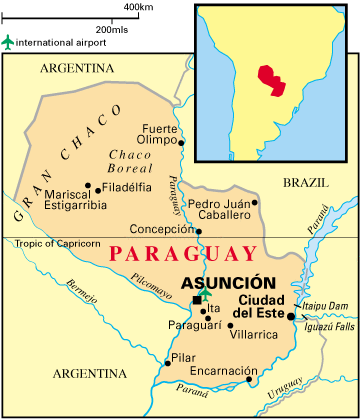
This writing style means there is fair amount of to and fro-ing in time. A train of thought or topic might last a page or so, before flitting back to continuing a story which we'd momentarily left, and which might then might run for a few pages, before again switching back to the prior story. Of help, to keep all of this somewhat ordered in our mind, is the Chronology provided at the back of the book and also, the map, provided at the front, without which, we'd remain forever lost.
While Paraguay might describe itself as the Switzerland of South America, others are more likely to call it the empty quarter of South America. At the Tomb of the Inflatable Pig isn't likely to dispel that belief and as such isn't a book that's going to make you book a flight to Paraguay in a hurry. However, it does provide a mesmerizing wander through history that has been crafted by Dons, Generals, Dictators, Conquistadores, Jesuits, ex-Nazi's, whores, real life Cassanova's and a whole raft of two-bit players, chancers and reprobates looking to make a name for themselves. So, for anyone looking for a book where the historical truth plays out as weirder than most fiction, then this is definitely the book for you. Full Review Here
Gimlette has had a long association with Paraguay. He first visited this landlocked South American country as an 18 year old in 1982 - an interesting time for a Brit given his own country was in the opening stanza of its war with Argentina over the Falklands. Returning again in 1996, he then went on to make a further extended visit after yet another attempted coup d'etat in 2000, and from which he then wrote At the Tomb of the Inflatable Pig.
Travelling extensively throughout Paraguay enables Gimlette to play back the engrossing history of this relatively little known country and which often appears more like a work of fiction than truth. Beginning in the country's capital Asuncion, Gimlette then ventures through Eastern Paraguay and thence the hot and semi-arid region known as The Chaco. Each of these regions, has its own stories and accompanying histories to tell, which Gimlette provides in an unchronological and somewhat disjointed fashion.
This writing style means there is fair amount of to and fro-ing in time. A train of thought or topic might last a page or so, before flitting back to continuing a story which we'd momentarily left, and which might then might run for a few pages, before again switching back to the prior story. Of help, to keep all of this somewhat ordered in our mind, is the Chronology provided at the back of the book and also, the map, provided at the front, without which, we'd remain forever lost.
While Paraguay might describe itself as the Switzerland of South America, others are more likely to call it the empty quarter of South America. At the Tomb of the Inflatable Pig isn't likely to dispel that belief and as such isn't a book that's going to make you book a flight to Paraguay in a hurry. However, it does provide a mesmerizing wander through history that has been crafted by Dons, Generals, Dictators, Conquistadores, Jesuits, ex-Nazi's, whores, real life Cassanova's and a whole raft of two-bit players, chancers and reprobates looking to make a name for themselves. So, for anyone looking for a book where the historical truth plays out as weirder than most fiction, then this is definitely the book for you. Full Review Here

January 14, 2012
One of three books I've given up on in my entire life. Gimlette is a brilliant person, that much is clear. However, he's not someone I want to read. In fact, he's the kind of person with whom I dread being stuck in conversation or some social situation. Clever, convinced of his cleverness, and eager to show it off by casually referencing obscure historical factoids without giving you any context for them and then moving on to something else, leaving you to wonder what the hell he's talking about. In this book, he jumps in and out of different time periods—something which doesn't typically bother me—but gives the reader only oblique clues as to which period he's talking about. He begins the book as an 18 year old who can get an appointment with the president of the country, but doesn't care to tell the reader why the hell an English 18-year-old is in Paraguay and why the hell he has access to the upper echelons of society. He doesn't tell us why he leaves or why he comes back a couple years later. I am terribly disappointed that I hated this book as much as I did because I'd truly like to know more about Paraguay. I guess I'll just have to go look for that information from someone who actually cares more about presenting it in a more logical, memorable, less-self-indulgent way.

February 5, 2021
Let me invite you to new vocabulary words, words almost certainly foreign to you, but not to the Devil.
pyragues (Guarani): those who have hairy feet. Used to refer to security agents who appear silently, savagely, and successfully. They are groups of exterminators defending the regime of General Stroessner, son of a Bavarian brewer and a Paraguayan mother. How do these pyragues conduct interviews of those detained?
Pastor Coronel: sessions involve immersion of suspects in bathtubs of human excrement. If the suspects were not driven insane by this humiliation, the interview was concluded with a cattle prod inserted into the rectum as a "final comment."
Pastor Coronel: noted for having the leader of a Communist Party cell torn apart by chainsaw. While this was happening a polka played in the background in order to keep the occasion celebratory.
Don Alfredo: He had an appetite for erotic sex. Many people do. But how many have a procurer, a Ghislaine Maxwell type, for finding and forcing fourteen year old girls to submit to an man old enough to be great-granddad?
pyragues (Guarani): those who have hairy feet. Used to refer to security agents who appear silently, savagely, and successfully. They are groups of exterminators defending the regime of General Stroessner, son of a Bavarian brewer and a Paraguayan mother. How do these pyragues conduct interviews of those detained?
Pastor Coronel: sessions involve immersion of suspects in bathtubs of human excrement. If the suspects were not driven insane by this humiliation, the interview was concluded with a cattle prod inserted into the rectum as a "final comment."
Pastor Coronel: noted for having the leader of a Communist Party cell torn apart by chainsaw. While this was happening a polka played in the background in order to keep the occasion celebratory.
Don Alfredo: He had an appetite for erotic sex. Many people do. But how many have a procurer, a Ghislaine Maxwell type, for finding and forcing fourteen year old girls to submit to an man old enough to be great-granddad?
March 12, 2021
I knew nothing of Paraguay or it’s history before reading this book. I found the authors style of writing quite erratic, especially when it came to the nations history. He attached the history to the places he visited rather than placing it chronological order so I was forever trying to remember who was who and what era they belonged to. Considering it was the history I was interested in rather than his travels I found this annoying. It must be remembered though that first and foremost this is a travel book. The author was at times rather amusing, the people he meets quirky. This is not a book for the faint hearted as the countries history is not a pretty one and the author does not leave those details out. It’s definitely an interesting place with fascinating people although if someone were to sit me down and ask what I learnt, I don’t know that I’d be able to answer with anything major.

June 25, 2008
What to say about this book? It is a strange combination of history and travel journal set in Paraguay. It was never really clear to me why the author wrote this book, and perhaps this is where my confusion about it lies. Although I enjoyed the fact that it was all about Paraguay (how many books are?!), I didn't feel like it was a captivating enough to be of interest to someone who had never been there nor in depth enough to be enchanting to someone who knows the country really well. However, the reality is that there are very few books about Paraguay (and most were written a long time ago), so overall I would recommend this book to people attached to Paraguay in some way (either literally or figuratively) since the pickings otherwise are a bit slim.
Displaying 1 - 30 of 131 reviews