From the creator of the Academy Award-winning Spirited Away , a legend of the days of the first flying machines, where fantastic adventure takes to the air in search of the Castle In The Sky ! Pirates greedy for treasure and secret agents hungry for power are both chasing Sheeta, a young girl who wears a mysterious blue stone around her neck. The stone's power makes Sheeta defy gravity?and float down into the life of Pazu, a tough young orphan boy inventor. What ancient secrets link Sheeta's stone to the incredible dangers and mysteries of the Castle In The Sky ? Unlike other graphic novels, this series features full-color illustrated stills from the movie printed on quality paper and is published in the original right-to-left format. Together, these four volumes give readers the complete story of the animated feature, and are the perfect gift for fans of the movie and Japanese graphic novels.
The legends were true! Somewhere high in the clouds, human beings have again set foot on the floating island of Laputa, for centuries a peaceful, park-like ruin, tended only by its silent, faithful robots. But just behind Pazu and Sheeta are soldiers from the aerial dreadnought Goliath --who have captured Dola and her pirate crew, and are now looting the gold and jewels of the Castle In The Sky for themselves! But the man who guided them there, Muska, has his eyes on power, not money--and he alone knows how to activate the Castle's ancient superweapons that could make him master of the world! Can Pazu and Sheeta stop his sinister plan?
Hayao Miyazaki (Japanese: 宮崎 駿) is a celebrated Japanese animator, filmmaker, screenwriter, and manga artist, widely regarded as one of the most influential figures in the history of animation. He is the co-founder of Studio Ghibli, the animation studio responsible for producing many of Japan’s most beloved and internationally acclaimed animated films. Over the course of a career spanning decades, Miyazaki has developed a reputation for creating visually rich, emotionally resonant stories that often explore themes such as nature, pacifism, flight, childhood, and the human condition. Miyazaki was born in Tokyo and developed an early interest in drawing and animation. His father’s work in the aviation industry had a significant influence on him, particularly in fostering his fascination with aircraft and flight, motifs that would become prominent throughout his later works. After studying political science and economics at university, Miyazaki began his professional career in animation when he joined Toei Animation. There, he worked under the mentorship of directors like Isao Takahata, with whom he would later form a lifelong creative partnership. In his early years at Toei and other studios, Miyazaki contributed to several television series and animated films. He worked as a key animator and storyboard artist, gradually gaining recognition for his storytelling abilities and attention to detail. Among his early projects were contributions to series such as Heidi, Girl of the Alps and Future Boy Conan. His directorial debut in feature films came with The Castle of Cagliostro, a film adaptation of the Lupin III manga series, which already showed signs of his distinctive style and sensibilities. Miyazaki's breakthrough came with the film Nausicaä of the Valley of the Wind, based on his own manga. The success of that film prompted the establishment of Studio Ghibli, which he co-founded with Takahata and producer Toshio Suzuki. From that point forward, Miyazaki directed and wrote many of Ghibli’s most iconic works, including My Neighbor Totoro, Kiki’s Delivery Service, Porco Rosso, Princess Mononoke, and Howl’s Moving Castle. His films are known for their hand-drawn animation, strong character development, and philosophical underpinnings. In 2001, Miyazaki directed Spirited Away, which became one of the most critically and commercially successful animated films of all time. The film received numerous awards and international recognition, including an Academy Award for Best Animated Feature. It also became the highest-grossing film in Japanese history at the time of its release. The film’s success further solidified Miyazaki’s reputation as a master storyteller and a visionary in global cinema. Despite announcing his retirement several times, Miyazaki repeatedly returned to filmmaking. His later works, such as Ponyo and The Wind Rises, continued to showcase his evolving themes and storytelling maturity. His most recent project, The Boy and the Heron, marked a highly anticipated return to the director’s chair and once again captivated audiences with its dreamlike visuals and emotional depth. Miyazaki’s films are often distinguished by their complex female protagonists, environmental messages, and moral ambiguity. Rather than presenting clear-cut villains and heroes, his stories explore the nuances of human behavior and often focus on characters finding their place in the world. Throughout his career, he has received numerous accolades and honors for his contributions to the arts, including lifetime achievement awards recognizing his impact on both Japanese and international cinema. His legacy continues to influence generations of animators and filmmakers worldwide, and Studio Ghibli remains one of the most respected names in animation.
She is a descendent of the royal Laputians, and know many spells. She was the one who taught Sheeta the spell to awaken the robots, and the destruction spell to destroy Laputa.
***
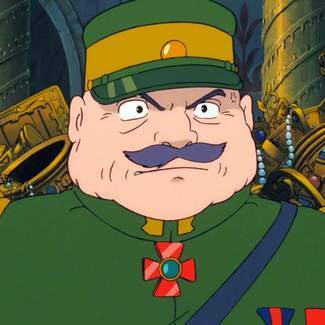
General Muoro
Assigned by the government to search for Laputa, but works in a different division than Mooska. He does not have a good temper and did not realize he was used by Mooska. He died when Mooska used Laputa's technology to kill all the military officers.
***
''Take root in the ground, live in harmony with the wind, plant your seeds in the Winter, and rejoice with the birds in the coming of Spring.''
The robots from Laputia are back. The secret agents land on the castle in the sky in search of the source of Laputia's power, and the big fight scene happens. What's cool about the chase scenes on a floating island is they can be in land, air, or through old ruins and roots, so the scenery is amazing. Sheeta and Pazu are so cute. One thing I like about reading the graphic novel adaptation of the film is that I can control the pacing, whereas the movie is a bigger time commitment, and easy to become distracted.
Maybe it’s the airships, which are also all kinds of cool, in their variety. A Japanese engineer actually built a functioning scale model “Flapter,” and you can see it on Youtube: https://www.youtube.com/watch?v=rJwIh...
Or perhaps it is the robots. The way they first make their appearance (slowly and mysteriously and then suddenly, BOOM) is the best kind of awesome. Watching it, I felt like I was seven years old again.
Perhaps it is the pirate group, run by a hardnose granny, not afraid to fight against the oligarch rulers and their army, if they can make a buck. Or the tough-as-nails granny herself, telling the boy to go save the girl like he wants to.
Or maybe it is the old-school plot driving this story—a once powerful civilization, an earth eons behind in technology, the rise of a single power-hungry man (who just happens to have a Russian sounding name), bound and determined to have his way, by gaining access to advanced technology so he can lord it over everyone. (Doesn’t this sound like the tech-bro oligarchs of today?) In his bid to become an all-powerful king and have all people of the earth bow down before him, only a hardy band of pirates, and a young man and woman appear to stand in his way. Wanting to become a Goliath, he is stopped by the good-hearted and agile David. (I hope we get the same result in our time.)
But, honestly, the main reason I like it is probably the airships.
Reading the book (as opposed to seeing the movie) allows me to better understand the details of the story, filling in the words and phrases I did not catch in the movie. Great story, great illustrations.
Oh, and, fun fact, the idea of this floating island is from Jonathan Swift’s Gulliver’s Travels—Laputa. How cool is that?
Friendly robots in Laputa and they co-exist peacefully with plants and birds! Muska turns to be a bigger villain than expected. Dola's gang, Pazu and Sheeta help each other. The setting of Laputa is wonderful and beautiful! :)