The second of two volumes, this companion to every song that Bob Dylan ever wrote is not just opinionated commentary or literary interpretation: it consists of facts first and foremost. Together these two volumes form the most comprehensive books available on Dylan's words. Clinton Heylin is the world's leading Dylan biographer and expert, and he has arranged the songs in a continually surprising chronology of when they were actually written rather than when they appeared on albums. Using newly discovered manuscripts, anecdotal evidence, and a seemingly limitless knowledge of every Bob Dylan live performance, Heylin reveals hundreds of facts about the songs. Here we learn about Dylan's contributions to the Traveling Wilburys, the women who inspired "Blood on the Tracks "and "Desire," " "the sources Dylan "plagiarized" for "Love and Theft "and "Modern Times," " "why he left "Blind Willie McTell" off of "Infidels "and "Series of Dreams" off of "Oh Mercy," " "what broke the long dry spell he had in the 1990s, and much more. This is an essential purchase for every true Bob Dylan fan.
Dylan started his songwriting, tentatively, as a plagiarist and is finishing, magnificently, as a plagiarist.
WHAT DYLAN STOLE
1) HE ROBBED FOLK AND BLUES BLIND
When you're a folkie you are allowed, nay, expected to steal because that's the folk process. So you take a tune from there and some lines from here and stir em up with a new guitar intro and a harmony et voila, new folk song. So Dylan cranked out a whole lot of early terrible songs like that, but also quite a few early good songs, also like that. Then the words became more & more original, and finally, after two or three years, he figured out how to create original melodies. So the melody of With God on Our Side is from Dominic Behan's The Patriot Song, and Blowin' in the Wind is from the old spiritual No More Auction Block, but Mr Tambourine Man is 100% Bob.
2) THEN HE STARTED IN ON THE MOVIES (YOU KNOW HOW TO WHISTLE, DON'T YOU?)
It pretty much stayed 100% Bob (with a few stolen moments) until the mid 80s, when fans began to notice the bizarre appearance in Bob's songs of various lines of dialogue taken almost verbatim from old movies. Examples:
Alan Ladd: I don't mind leaving, I'd just like it to be my idea. (Shane)
Bacall to Bogart: You gave me something to think about, said you can help me. (To Have and Have Not)
Bob :
You give me something to think about, baby, Every time I see ya. Don't worry, baby, I don't mind leaving, I'd just like it to be my idea.
(Song : Never going to be the Same Again from the awful Empire Burlesque)
Karl Malden: You want to know what's wrong with our waterfront? It's the love of a lousy buck. It's making love of a buck---the cushy job---more important than the love of man! (On the waterfront)
Bogart to Bacall: Stick around - we're not through yet. (To Have and Have Not)
Bob:
I saw thousands who could have overcome the darkness, For the love of a lousy buck, I've watched them die. Stick around, baby, we're not through, Don't look for me, I'll see you When the night comes falling from the sky. (Song "When The Night Comes Falling From The Sky" )
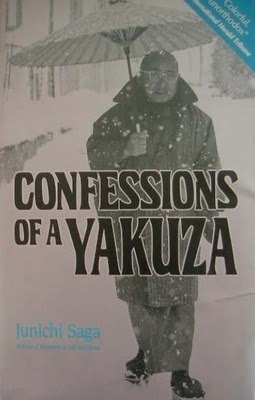
3) CONFESSIONS OF A YAKUZA - huh? A what?
Then jumping forward to the brilliant album "Love and Theft", the title itself being lifted from this interesting book we have various quotes and paraphrases embedded in the songs which are – bizarrely, but this is Bob we’re talking about – from Confessions of a Yakuza
"If it bothers you so much," she'd say, " why don't you just shove off?" ("Confessions," page 9)
Bob:
Juliet said back to Romeo, 'Why don't you just shove off If it bothers you so much?' ("Floater")
My mother...was the daughter of a wealthy farmer...(she) died when I was eleven...I heard that my father was a traveling salesman who called at the house regularly, but I never met him. (My uncle) was a nice man, I won't forget him...After my mother died, I decided it'd be best to go and try my luck there. ("Confessions," pages 57-58)
Bob:
My mother was a daughter of a wealthy farmer My father was a traveling salesman, I never met him When my mother died, my uncle took me in - he ran a funeral parlor He did a lot of nice things for me and I won't forget him ("Po' Boy")
Actually, though, I'm not as cool or forgiving as I might have sounded." ("Confessions," page 158)
Bob:
I'm not quite as cool or forgiving as I sound I've seen enough heartaches and strife ("Floater””)
Just because she was in the same house didn't mean we were living together as man and wife...I don't know how it looked to other people, but I never even slept with her- not once. ("Confessions," page 208)
Bob:
Samantha Brown lived in my house for about four or five months Don't know how it looked to other people I never slept with her even once ("Lonesome Day Blues")
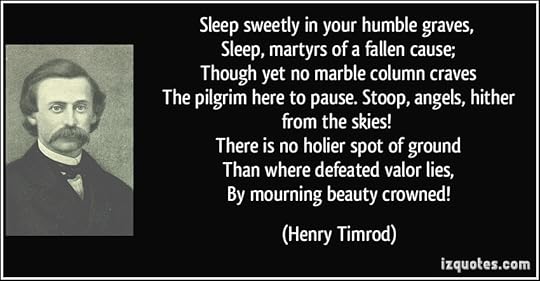
4) HENRY TIMROD - COME ON, YOU SHOULD KNOW WHO HE WAS
After that, Modern Times lifted various tunes and lyrics from old songs – e.g. When the Deal Goes Down uses the tune of Bing Crosby’s When the Blue of the Night meets the Gold of the Day, and Beyond the Horizon uses the tune of Red sails in the Sunset, and then Dylan starts up again with the literature, this time your favourite Confederate poet ole Henry Timrod.
Bob:
More frailer than the flowers, these precious hours (“When the Deal Goes Down”)
Henry (from “Rhapsody of a Southern Winter Night”)
A round of precious hours Oh! here, where in that summer noon I basked And strove, with logic frailer than the flowers.
And so forth. Okay, what does Bob himself say?
Well, you have to understand that I'm not a melodist... My songs are either based on old Protestant hymns or Carter Family songs or variations of the blues form. What happens is, I'll take a song I know and simply start playing it in my head. That's the way I meditate. A lot of people will look at a crack on the wall and meditate, or count sheep or angels or money or something, and it's a proven fact that it'll help them relax. I don't meditate on any of that stuff. I meditate on a song. I'll be playing Bob Nolan's "Tumbling Tumbleweeds," for instance, in my head constantly – while I'm driving a car or talking to a person or sitting around or whatever. People will think they are talking to me and I'm talking back, but I'm not. I'm listening to a song in my head. At a certain point, some words will change and I'll start writing a song.
And later he became a little more tetchy:
And as far as Henry Timrod is concerned, have you even heard of him?" he asks. "Who's been reading him lately? And who's pushed him to the forefront? Who's been making you read him? And ask his descendants what they think of the hoopla. And if you think it's so easy to quote him and it can help your work, do it yourself and see how far you can get.
and even tetchier:
Wussies and pussies complain about that stuff.
T S Eliot said "Good artists borrow, great artists steal" John Fahey (who stole some lines from T S Eliot for some song titles, there's a little homage for you) reminded his fellow artists to steal from obscure sources, and he did all the time.
5) and HE DOESN'T STOP
Then there was the big hoohah when they found out about Bob's book Chronicles which just might be a giant mosaic of quotes from Jack London and Melville and 1963 Life magazine and many others. Now that's taking actual lines from some other guy's book and putting them right there in your own actual book. Hey, wait a minute - THAT AIN'T THE FOLK PROCESS! That's actual plagiarism. Isn't it? Oooh my head. My brain hurts. Because James Joyce and TS Eliot, to name but two, use LOTS of other people's words, and they don't attribute them neither. And Warhol used everyone else's images; and Liechtenstein stole outright from comic books and yet no one busted them. Aw shit, I don't know.
6) ONE THING I DO KNOW
I've been immersing myself in Dylan's goldenhued late period which started with Time Out of Mind in 1996. This is where his voice is like a deathbed confession and all the songs are quarried out of ancient riverbeds, tunes and words, and filtered through his brain, where they become something rich, and strange, and beautiful. No song makes complete sense, you can take any verse from here and stick it in another song there. Well, pretty much. And it's great. Bob has to be Bob, you know.
Finally done! I still come away with the impression that Clinton Heylin doesn't like Bob Dylan half as much as he claims to, but this second volume of an epic song-by-song trawl across Dylan's career (to 2008) does a more than fair job of picking apart the man's long and patchy downslope rambling. I'm less familiar with 70s and 80s Dylan material, and it's good to know that - in the main - I don't have to go there unless I really want to.
One warning to the curious: never listen to Dylan's "christmas album" (not covered herein). Holy shit, it's bad. Clears a shop floor in 30 seconds flat.
I think I liked this more than the first volume, mostly because the '60s songs have been discussed to death. They're the first Dylan everyone hears (I assume), and they're often what everyone fixates on. But, as Heylin's two-volume examination of six hundred Dylan originals demonstrates, the man has a lot more worthy music. So a book that works its way from Blood on the Tracks to Modern Times is almost guaranteed to hold some surprises.
First, though, my complaints. As in the first book, Heylin's angry, insulting asides about fellow Dylan writers gets old pretty quickly. It might not bother me so much if his criticisms didn't revolve so much around scholarly accuracy and research and just paying some fucking attention to what's in front of them. All of which is fine, and probably warranted in some cases, but the problem is that Heylin's own work is riddled with errors and questionable analysis. In the latter category are too many of what he sees as deliberate Biblical allusions, which look to me like coincidences, or like Dylan was using a really commonplace phrase and not alluding to anything in particular. Heylin makes the same assertions regarding a number of other things, especially songs, where he'll say something like "Dylan is almost certainly referring to X" when the similarity is just barely there. None of this would really bother me if Heylin were merely noting similarities. That he's ascribing to Dylan so much intent, so often, can be a bit much.
As for the errors, gee whiz. Throughout the book apostrophes are rendered as quotation marks, such that a word like walkin' appears as walkin". This happens probably dozens of times, and it's such a little thing, but for a guy who's so picky, and so nasty about others' perceived failings as writers and scholars, you'd think he'd take more care with his own work. He'll also use phrases over and over, sometimes so close together that it's distracting. For example, on p. 466-467, he uses the phrase "with The Band back in 1967" and then, two paragraphs later, writes "taught to The Band back in 1967." Ack! And he repeatedly refers to Muddy Waters as "Morgan," rather than "Morganfield," in his discussions of the Modern Times songs. Details, details.
And yet I still rate this higher than the first volume. Blood on the Tracks, Desire, Street-Legal, the Jesus albums, Infidels, Oh Mercy, Under the Red Sky, and all the folk-and-blues patchworks he's done starting with Time Out of Mind -- all of them are fascinating, and so many of them are so rarely discussed in this detail and with this much enthusiasm, that I couldn't help being pulled in at every turn. I figure I'll eventually appreciate every last one of Dylan's albums. Empire Burlesque and, god help me, Saved turned out to be revelations this time around, and I blame Heylin. And at the end of the day, he's still one of my favorite Dylan writers. (I'm glad to see he loves the Tell Tale Signs version of "Someday Baby" as much as I do.)
On a final note, when the inevitable release of the Blood on the Tracks sessions occurs, they'd best include a facsimile of the notebook wth Dylan's lyric drafts, because Heylin made that material sound fascinating.
Having read Dylan's lyrics, his one novel, and a commentary on the earlier songs, I was hoping when I found this at the library that it would give me a better appreciation of the later songs. Unfortunately, the book is rather heavier on the kind of minutiae about recording sessions, takes, order of tracks, performances and so forth that would be of interest only to a hard core fan. As much as I like much of Dylan, I've never been a "fannish" kind of person.
Even more of a problem, though, is that the author is a total egotistical jerk, which almost caused me to abandon this book several times before I finally slogged my way through it. Oddly, for someone who devotes so much effort to Dylan trivia, he doesn't actually seem to like Dylan very much; or to be exact, he perversely likes only the born-again religious Dylan, while having a supercilious contempt for the more socially conscious Dylan (unlike the gullible Dylan, he knows that George Jackson, Hurricane Carter and the Rosenbergs were all guilty.) What kept me reading it were the explanations of many of Dylan's references, especially to earlier music. There must be better commentaries around, but for now I think I am finished with this subject.
Like the first book in this series, "Revolution in the Air," Heylin takes on the forensic task of writing about every Bob Dylan song in an attempt to figure out the order in which Dylan wrote them. Here Heylin tackles 1974-2006, which means he's writing about a few key albums, but also the '80s, unquestionably the most questionable period of Dylan's songwriting career. But that's also much of the fun, since Heylin is working within a fairly untrodden era compared to the well-documented '60s & '70s. It can be a bit of a slog at points, and (unlike the first volume) Heylin starts to cross the line from academic to pedantic. And by "pedantic," I basically mean douchey and petty. Also, he generally seems to have terrible taste in later period Dylan--or at least vastly different than mine--which makes him a fairly annoying guide for "Time Out of Mind" & "'Love & Theft.'" Still, these two volumes combine to make for one of the truest biographies of Dylan.
Along with the first volume, this may be the most important book to date about Dylan. Deals chronologically with every song known to be written by Dylan, telling when known the story of its composition and recording. You don't have to always agree with Heylin to appreciate that he's speaking from a place of deep knowledge. Unlike other books about the songs, Heylin doesn't consider them frozen at the time of writing, but also talks about how Bob changed them in performance over the years, with good recommendations of live versions to seek out. With the first volume, this is one to re-read.
I'm a little torn on this one. On the plus side, this is an exhaustively researched deep dive into the songs of Dylan's career's second half. Heylin is an expert and has enough connections to really make this a fascinating trawl. On the negative, Heylin's bias and inability to keep his thoughts to himself was aggravating. Multiple digs at the Grateful Dead and other bands were bad enough, but I was really turned off by his digs at other Dylan researchers. It smacked of self-importance at times. Still, probably a great resource for Dylanologists.
Clinton Heylin, the indefatigable chronicler of Dylan (and others), turns his laser like focus on the 'rest' of Bob Dylan's career (ugh, he's STILL at it), as he mutates from brilliant songster to religious bigot and now, croaking blues frog. Still there is nothing like Dylan and never has been, even when he continues to steal, collaborate and mangle his songs nightly on his Never Ending Tour.
It seems to me Clinton should have drawn more conclusions than the obvious - he's the greatest songwriter of the 20th Century (which is unarguably true, if you've been paying attention.) Bob has always played the role of 'angry, old testament style prophet' and THAT is his contribution to songwriting. Instead of writing only vacuous love songs, Bob became famous for vituperative songs of warning. First, he warned us about government and society, his so called protest songs. Next, he warned us about personal slights and relationships (from Another Side to Blonde on Blonde). Then he turned to religion (John Wesley Harding) but that proved unpopular, until he found his hate and regret groove again with Blood on the Tracks, Desire and Street Legal. At last, the Born Again period freed Bob to pour scorn on unbelievers and he emerged as a religious Zealot, hating everyone righteously - which he continues to do till this day, as Heylin reminds us.
So the man who made rock adult also made rock mean and angry at the world. Bob's talent has always been turned against somebody or something and has found during his 44 years of religious intolerance since he was 'saved', his mission in life. It is the reason for the Never Ending Tour - he is the St. Paul of the 20th-21st Century and will stop only when he dies.
One has to wonder how Clinton Heylin, so lost in the weeds, so perceptive in details can miss the big picture so badly- yet he does. His book is an invaluable resource of delusional Dylan, that great, angry poet of our times, so mad at us, so forensic in his appreciation of God's will.
I read the first book a few years back and I might have liked that a little bit better. That's probably just because the songs were better, though. This actually did make me want to revisit some of the lesser Dylan albums.
My one issue with Heylin is that he seems to just hate everything. "Love And Theft" is a pretty great album, but he treats it like it was Dylan's worst. He still thinks Saved is pretty bad, though, so that's fine.
Other than that, I love his snarky writing style and the constant use of Dylan lyrics to comment on the songs. He's a punny guy, and I get it.
This is a pretty exhaustive and important resource for Dylan fans. I commend Heylin's efforts and hope that he finishes the job in a few years. This one stops at Modern Times, so he's got three more albums of originals (so far) to go. I'm sure he'd have a word or two for the Christmas album and the five LPs worth of American standards, too.
Obsessively detailed and extremely informative. Heylin's opinionated and does a fair bit of second guessing Dylan's decisions but it's such a fascinating read, that those bits don't detract from the book at all.
What are the motives for offering what amounts to a hatchet job such as this? The author purports to be a fan but is nothing less than disrespectful. With fans like this who needs enemies? One star for the research that has undoubtedly been carried out.
Even more nerdy than Vol 1. Clinton Heylin once again analyses all the songs Dylan wrote (from 1974 to 2008), including the different studio takes and releases, and the consequent word changes that Dylan frequently indulged in, and even the sources he drew upon. It was somehow a less interesting read than vol 1, partly because it deals with some of the lesser Dylan albums that came out in that period..
A read for the rabid Dylan freak, not the casual fan. Detailed song-by-song analysis of Dylan's canon from Blood on the Tracks to Modern Times. The only problem with this book is the author's insertion of his own very strong opinions about certain songs (or versions of songs), which not all fans may share.
Ah, my non-abandon tendency was stressed through this one. I don't especially like Bob Dylan's music, so one would think this wasn't a great choice for me to read. (One would be right) On the up side, I know so much more about the process of recording songs than I ever imagined.
Heylin is brilliant, arrogant, knowledgable, frustrating, erudite, opinionated and about 10,000 other things. But I just can't imagine where he gets all of this fascinating information. Both books were a fascinating trip for a Dylan freak.
Got this book from Brother Steve. I've read Vol 1. and loved it. Makes you want to play all the albums of course Just so informative and some marvellous stories and insights. For Dylan fans only though...