

What do you think?

Hitzefühler
SIGNED by author and illustrator (No inscription). Limited edition #197/250. Hardcover in slipcase. Also includes laid-in press photo of author. First printing. Book is in perfect shape. A true collector's copy.
444 pages, Mass Market Paperback
First published January 1, 1988
About the author
John Shirley
338 books489 followersJohn Shirley won the Bram Stoker Award for his story collection Black Butterflies, and is the author of numerous novels, including the best-seller DEMONS, the cyberpunk classics CITY COME A-WALKIN', ECLIPSE, and BLACK GLASS, and his newest novels STORMLAND and A SORCERER OF ATLANTIS.
He is also a screenwriter, having written for television and movies; he was co-screenwriter of THE CROW. He has been several Year's Best anthologies including Prime Books' THE YEAR'S BEST DARK FANTASY AND HORROR anthology, and his nwest story collection is IN EXTREMIS: THE MOST EXTREME SHORT STORIES OF JOHN SHIRLEY. His novel BIOSHOCK: RAPTURE telling the story of the creation and undoing of Rapture, from the hit videogame BIOSHOCK is out from TOR books; his Halo novel, HALO: BROKEN CIRCLE is coming out from Pocket Books.
His most recent novels are STORMLAND and (forthcoming) AXLE BUST CREEK. His new story collection is THE FEVERISH STARS. STORMLAND and other John Shirley novels are available as audiobooks.
He is also a lyricist, having written lyrics for 18 songs recorded by the Blue Oyster Cult (especially on their albums Heaven Forbidden and Curse of the Hidden Mirror), and his own recordings.
John Shirley has written only one nonfiction book, GURDJIEFF: AN INTRODUCTION TO HIS LIFE AND IDEAS, published by Penguin/Jeremy Tarcher.
John Shirley story collections include BLACK BUTTERFLIES, IN EXTREMIS, REALLY REALLY REALLY REALLY WEIRD STORIES, and LIVING SHADOWS.
source: Amazon
He is also a screenwriter, having written for television and movies; he was co-screenwriter of THE CROW. He has been several Year's Best anthologies including Prime Books' THE YEAR'S BEST DARK FANTASY AND HORROR anthology, and his nwest story collection is IN EXTREMIS: THE MOST EXTREME SHORT STORIES OF JOHN SHIRLEY. His novel BIOSHOCK: RAPTURE telling the story of the creation and undoing of Rapture, from the hit videogame BIOSHOCK is out from TOR books; his Halo novel, HALO: BROKEN CIRCLE is coming out from Pocket Books.
His most recent novels are STORMLAND and (forthcoming) AXLE BUST CREEK. His new story collection is THE FEVERISH STARS. STORMLAND and other John Shirley novels are available as audiobooks.
He is also a lyricist, having written lyrics for 18 songs recorded by the Blue Oyster Cult (especially on their albums Heaven Forbidden and Curse of the Hidden Mirror), and his own recordings.
John Shirley has written only one nonfiction book, GURDJIEFF: AN INTRODUCTION TO HIS LIFE AND IDEAS, published by Penguin/Jeremy Tarcher.
John Shirley story collections include BLACK BUTTERFLIES, IN EXTREMIS, REALLY REALLY REALLY REALLY WEIRD STORIES, and LIVING SHADOWS.
source: Amazon
Ratings & Reviews
Friends & Following
Create a free account to discover what your friends think of this book!
Community Reviews
Displaying 1 - 15 of 15 reviews

September 9, 2019
After rereading "The Belonging Kind," the collaboration with William Gibson included in Burning Chrome, I tracked down this collection by coauthor John Shirley. Very weird but quite enjoyable.

September 11, 2015
1988 was a vintage year for John Shirley, in which In Darkness Waiting, A Splendid Chaos, and Eclipse Penumbra all saw publication. Any year in which an author has three novles published can only be considered a banner year, but when each novel is a separate piece of work, each in a different “field” of writing, and each receiving critical praise, that’s fine work indeed. Shirley’s been proving to people that he can write well in almost any genre for years in his short stories, but up until now you had to search for these gems in strange and far away places like Stardate and High Times.
Scream/Press has done us all a favor with Heatseeker by gathering together a selection of Shirley’s short work ranging from 1975 to his most recent publication, “Wolves of the Plateau,” from the Mississippi Review. Also included are three original stories: “I Live in Elizabeth,” “Equilibrium,” and “Recurrent Dreams of Nuclear War Lead B.T. Quizenbaum into Moral Dissolution.” Like his novels, the stories range from Cyberpunk to fantasy, from metaphysical horror to humorous SF. Less than a third of Shirley’s total short fiction is included, but the nineteen stories collected are a fine example of Shirley’s muse.
The lead story, “What Cindy Saw,” is a combination of horror, fantasy, and SF like that of A Splendid Chaos. A disorienting view of mental illness (or is that mental sanity?), the story leaves you spellbound in misunderstanding, always wondering if this is actually taking place or only in Cindy’s head. “The Peculiar Happiness of Professor Cort” uses the IAMton particle that provide the magic of A Splendid Chaos. Like the scene in that novel, where the particle reveals telling thoughts of the characters, here it leads Prof. Cort into a study of himself and his life.
For fans of the Eclipse novels, “What It’s Like to Kill a Man” examines the political and ethical problems with capital punishment, the media, and quick steps to power. The ending is noble, though unlikely, but the questions raised are the right ones, and the answer that there isn’t a quick cure to the problem of death row is on target. Another story in that vein, “Recurrent Dreams…” deals with the threat of imminent nuclear war on the personal level. Surrealistic in its imagining of a ground zero happening in New York, the story is one of the few to cope with fear and anxiety from the viewpoint of the dead rather than the survivors.
“I Live in Elizabeth” is the best of the unpublished stories, and one of the best stories in the collection. What happens when you find yourself suddenly “with” another person, seeing through their eyes as if they were your own, feeling what they feel? It’s an intriguing concept, but what makes the story is the relationship between the underage girl and her thirty-year-old boyfriend. These two ideas mesh together in this story like the two lovers and the result is indeed frightening and appealing. “I Live in Elizabeth” is an award-winning story, and should receive publication elsewhere beyond this collection.
For those wondering what Cyberpunk was all about, the collection reprints “Ticket to Heaven,” “Six Kinds of Darkness,” “Sleepwalkers,” and “Under the Generator”–not only did Shirley talk about the movement, he put his writing forward as an example. And, for something completely different, there is “Quill Tripstickler Eludes a Bride,” the best science fictional P.G. Wodehouse pastiche in print.
Following the divisions that are now common-place on the book-spines and labelled on the shelf in the imaginative field, many authors specialize in one field. Except for those few like John Shirley, who know that imagination need never limit you to one type of writing.
Scream/Press has done us all a favor with Heatseeker by gathering together a selection of Shirley’s short work ranging from 1975 to his most recent publication, “Wolves of the Plateau,” from the Mississippi Review. Also included are three original stories: “I Live in Elizabeth,” “Equilibrium,” and “Recurrent Dreams of Nuclear War Lead B.T. Quizenbaum into Moral Dissolution.” Like his novels, the stories range from Cyberpunk to fantasy, from metaphysical horror to humorous SF. Less than a third of Shirley’s total short fiction is included, but the nineteen stories collected are a fine example of Shirley’s muse.
The lead story, “What Cindy Saw,” is a combination of horror, fantasy, and SF like that of A Splendid Chaos. A disorienting view of mental illness (or is that mental sanity?), the story leaves you spellbound in misunderstanding, always wondering if this is actually taking place or only in Cindy’s head. “The Peculiar Happiness of Professor Cort” uses the IAMton particle that provide the magic of A Splendid Chaos. Like the scene in that novel, where the particle reveals telling thoughts of the characters, here it leads Prof. Cort into a study of himself and his life.
For fans of the Eclipse novels, “What It’s Like to Kill a Man” examines the political and ethical problems with capital punishment, the media, and quick steps to power. The ending is noble, though unlikely, but the questions raised are the right ones, and the answer that there isn’t a quick cure to the problem of death row is on target. Another story in that vein, “Recurrent Dreams…” deals with the threat of imminent nuclear war on the personal level. Surrealistic in its imagining of a ground zero happening in New York, the story is one of the few to cope with fear and anxiety from the viewpoint of the dead rather than the survivors.
“I Live in Elizabeth” is the best of the unpublished stories, and one of the best stories in the collection. What happens when you find yourself suddenly “with” another person, seeing through their eyes as if they were your own, feeling what they feel? It’s an intriguing concept, but what makes the story is the relationship between the underage girl and her thirty-year-old boyfriend. These two ideas mesh together in this story like the two lovers and the result is indeed frightening and appealing. “I Live in Elizabeth” is an award-winning story, and should receive publication elsewhere beyond this collection.
For those wondering what Cyberpunk was all about, the collection reprints “Ticket to Heaven,” “Six Kinds of Darkness,” “Sleepwalkers,” and “Under the Generator”–not only did Shirley talk about the movement, he put his writing forward as an example. And, for something completely different, there is “Quill Tripstickler Eludes a Bride,” the best science fictional P.G. Wodehouse pastiche in print.
Following the divisions that are now common-place on the book-spines and labelled on the shelf in the imaginative field, many authors specialize in one field. Except for those few like John Shirley, who know that imagination need never limit you to one type of writing.

May 20, 2013
I finished reading Heatseeker this morning after breakfast. It's an interesting collection of stories by John Shirley. I buy almost everything with Shirley's name on it and so far haven't been disappointed.
Most of the stories in this collection are very good and most are pretty strange; I expect both from a John Shirley story. A couple of the stories were beyond my comprehension ("Tahiti in Terms of Squares" and "Silent Crickets") and one I wished had been ("Equilibrium").
One complaint I have about the collection is that most of the stories (15 of 19) are reprinted in other Shirley collections: Really, Really, Really, Really Weird Stories (9 stories), Darkness Divided (3 stories), Living Shadows: Stories: New and Preowned (2 stories), and New Noir (2 stories).
The four stories not in any other collection ("Under the Generator", "Quill Tripsticker Eludes a Bride", "Uneasy Chrysalids, Our Memories" and "Wolves of the Plateau") are amusing ("Quill Tripsticker..."), disturbing ("Under the Generator" & "Uneasy Chrysalids, Our Memories") and somewhat ordinary (but enjoyable) cyberpunk ("Wolves of the Plateau").
The three stories that also appear in Darkness Divided were new to me, as I don't (yet) have a copy of that collection. "What's it Like to Kill a Man" is an almost predictable story about controlling crime by streamlining the justice system, with a nice twist ending I didn't see coming; "Six Kinds of Darkness" is an interesting story of drug use gone bad; and "The Unfolding" (with Bruce Sterling) is a fun story about (I guess) the evolution of life.
All in all, a pretty good collection of John Shirley stories; and better if you're new to Shirley's works.
Most of the stories in this collection are very good and most are pretty strange; I expect both from a John Shirley story. A couple of the stories were beyond my comprehension ("Tahiti in Terms of Squares" and "Silent Crickets") and one I wished had been ("Equilibrium").
One complaint I have about the collection is that most of the stories (15 of 19) are reprinted in other Shirley collections: Really, Really, Really, Really Weird Stories (9 stories), Darkness Divided (3 stories), Living Shadows: Stories: New and Preowned (2 stories), and New Noir (2 stories).
The four stories not in any other collection ("Under the Generator", "Quill Tripsticker Eludes a Bride", "Uneasy Chrysalids, Our Memories" and "Wolves of the Plateau") are amusing ("Quill Tripsticker..."), disturbing ("Under the Generator" & "Uneasy Chrysalids, Our Memories") and somewhat ordinary (but enjoyable) cyberpunk ("Wolves of the Plateau").
The three stories that also appear in Darkness Divided were new to me, as I don't (yet) have a copy of that collection. "What's it Like to Kill a Man" is an almost predictable story about controlling crime by streamlining the justice system, with a nice twist ending I didn't see coming; "Six Kinds of Darkness" is an interesting story of drug use gone bad; and "The Unfolding" (with Bruce Sterling) is a fun story about (I guess) the evolution of life.
All in all, a pretty good collection of John Shirley stories; and better if you're new to Shirley's works.

August 7, 2026
Rec. by: The Bookloft in Enterprise, Oregon; presentation, and other work
Rec. for: Punks, cyber or otherwise
John Shirley's short-story collection Heatseeker was my fourth and final find from The Bookloft, that utterly charming shop in Enterprise, Oregon, that I've already endorsed on an entirely unsolicited basis for three other reviews.
This collection contains illustrations by Harry O. Morris, along with a Foreword (that even name-checks my adopted home town of Portland!) by one Stephen P. Brown, and an Introduction by none other than William Gibson, who notes (accurately) that
I have adapted the Table of Contents this time from Risingshadow, which bills itself as "a dedicated platform for fans of speculative fiction":
"What Cindy Saw"
Cindy saw a lot, actually, after Dr. Gainsborough dropped her off at the house post-discharge and her Stelazine wore off...
"Under the Generator"
"Sleepwalkers"
Jules would do almost anything for Zinn, but he won't do... what? Jules can't quite remember...
Robert Silverberg and Carol Emshwiller have also written longer works about this very creepy trope, but this one still hits hard and fast.
"Tahiti in Terms of Squares"
This one, a stilted story of the hazards involved in interdimensional present tense, was oddly reminiscent of the more Victorian flourishes in the Barrington J. Bayley collection I just read.
"Silent Crickets"
A vignette. Art should be dangerous... but only to a point(illist), eh?
"I Live in Elizabeth"
Souls, mating inextricably... this is deeply creepy, dark psychological horror, even before DJT gets a mention.
"The Almost Empty Rooms"
How can you stave off a nuclear apocalypse that desperately wants to happen?
It'll be... Fun.
"The Gunshot"
I've had a dream just like... well, no, not exactly like this... but if anyone tells you that you can't ever die in a dream, just know that it isn't true.
"Equilibrium"
"Uneasy Chrysalids, Our Memories"
Ann is an amnesiac... until Dr. Fosdick gives her something to remember.
This one's set in a totally unrealistic future, filled with fascist vigilantes and loud cars.
"Quill Tripstickler Eludes a Bride"
Quill, and his robotic butler Fives, must venture into... the secret center of the Sils, to put it delicately. Stiff upper—and lower—lips, what what?
"Recurrent Dreams of Nuclear War Lead B.T. Quizenbaum into Moral Dissolution"
This story reminded me a bit—but only a bit—of Norman Spinrad's "The Big Flash," if you've read that one. Something in the air, no doubt...
"What It's Like to Kill a Man"
Even Senators can learn, sometimes, if they're put under enough pressure... and you must know that deepfakes were a concept long before the software was up to the task.
"Triggering"
"Six Kinds of Darkness"
The Hollow Head gives you a planarian high...
"The Unfolding"
"The Peculiar Happiness of Professor Cort"
Sometimes it takes an extraordinary event to show us—to show Brian Cort, in particular—what should have been apparent all along...
"Ticket to Heaven"
Of course they would sell tickets, if they could, to "something only a few could afford" (p.219).
"Wolves of the Plateau"
Jerome-X (whom we met earlier in this book, by the way) was in jail, and they hadn't taken away his implanted augment chip. Big mistake.
But Jerome can't escape on his own...
*
The copy of Heatseeker that I acquired from The Bookloft is a beautiful hand-wrought hardback, published by the late Scream/Press in Los Angeles—it's not the numbered and slipcased limited edition, mind you, but this one was signed by the author and inscribed "To Mike."
I do hope Mike is still okay... but at any rate I was very glad to add this relative rarity to my own collection!
Rec. for: Punks, cyber or otherwise
John Shirley's short-story collection Heatseeker was my fourth and final find from The Bookloft, that utterly charming shop in Enterprise, Oregon, that I've already endorsed on an entirely unsolicited basis for three other reviews.
This collection contains illustrations by Harry O. Morris, along with a Foreword (that even name-checks my adopted home town of Portland!) by one Stephen P. Brown, and an Introduction by none other than William Gibson, who notes (accurately) that
Sometimes, reading Shirley, I can hear the guitars, like there's some monstrous subliminal wall-o'-sound chewing at the edges of the text.
—p.v
I have adapted the Table of Contents this time from Risingshadow, which bills itself as "a dedicated platform for fans of speculative fiction":
"What Cindy Saw"
Cindy saw a lot, actually, after Dr. Gainsborough dropped her off at the house post-discharge and her Stelazine wore off...
"Under the Generator"
"{...}The common fallacy that entropic generators promote death has been proven untrue, but what do they do to ease or inhibit death?{...}"
—p.24
"Sleepwalkers"
Jules would do almost anything for Zinn, but he won't do... what? Jules can't quite remember...
Robert Silverberg and Carol Emshwiller have also written longer works about this very creepy trope, but this one still hits hard and fast.
"Tahiti in Terms of Squares"
This one, a stilted story of the hazards involved in interdimensional present tense, was oddly reminiscent of the more Victorian flourishes in the Barrington J. Bayley collection I just read.
"Silent Crickets"
A vignette. Art should be dangerous... but only to a point(illist), eh?
"I Live in Elizabeth"
Souls, mating inextricably... this is deeply creepy, dark psychological horror, even before DJT gets a mention.
"The Almost Empty Rooms"
How can you stave off a nuclear apocalypse that desperately wants to happen?
It'll be... Fun.
"The Gunshot"
I've had a dream just like... well, no, not exactly like this... but if anyone tells you that you can't ever die in a dream, just know that it isn't true.
"Equilibrium"
My fingers were swollen from the humidity, and I had to take off the little platinum ring with the equal ( = ) sign on it.It's all about... balance.
—p.106
"Uneasy Chrysalids, Our Memories"
Ann is an amnesiac... until Dr. Fosdick gives her something to remember.
This one's set in a totally unrealistic future, filled with fascist vigilantes and loud cars.
Somewhere, there is a very important lie.
—p.122
"Quill Tripstickler Eludes a Bride"
Quill, and his robotic butler Fives, must venture into... the secret center of the Sils, to put it delicately. Stiff upper—and lower—lips, what what?
"Recurrent Dreams of Nuclear War Lead B.T. Quizenbaum into Moral Dissolution"
This story reminded me a bit—but only a bit—of Norman Spinrad's "The Big Flash," if you've read that one. Something in the air, no doubt...
"What It's Like to Kill a Man"
Even Senators can learn, sometimes, if they're put under enough pressure... and you must know that deepfakes were a concept long before the software was up to the task.
"Triggering"
"When did you die?" I asked, watching him. He made me nervous.Karma can take a long, long time to arrive... but it's sweet when it does.
"I died in 1982," he said, not even blinking. "Care for a drink?"
—p.170
"Six Kinds of Darkness"
The Hollow Head gives you a planarian high...
"The Unfolding"
Brisen hated illiterates. The Unliterates Liberashun Frunt had blown Brisen to pieces with a fragmentation bomb during the labor riots of 2057. {...} But most of Brisen's natural body had been so riddled with shrapnel that it had been cheaper to scrap it.All of this puts Philip Brisen into a unique position.
—p.189
"The Peculiar Happiness of Professor Cort"
Sometimes it takes an extraordinary event to show us—to show Brian Cort, in particular—what should have been apparent all along...
"Ticket to Heaven"
Of course they would sell tickets, if they could, to "something only a few could afford" (p.219).
"The Shacktowns are tenanted by people who, a decade or two ago, built the affluence that the privileged feed off of now. Jobless Blacks are in the Shacktowns, of course. And the old. Since the demographic shifts of the '70s and '80s, and the growth of geriatric medicine, the old have become a huge, mouldering slice of the population.If only fixing everything were that easy... was this one prescient, or just observant?
—p.220
"Wolves of the Plateau"
Jerome-X (whom we met earlier in this book, by the way) was in jail, and they hadn't taken away his implanted augment chip. Big mistake.
But Jerome can't escape on his own...
*
The copy of Heatseeker that I acquired from The Bookloft is a beautiful hand-wrought hardback, published by the late Scream/Press in Los Angeles—it's not the numbered and slipcased limited edition, mind you, but this one was signed by the author and inscribed "To Mike."
I do hope Mike is still okay... but at any rate I was very glad to add this relative rarity to my own collection!

March 24, 2014
I love this book. I have the hardcover with creepy illustrations by Harry O. Morris. I first discovered it at the library while I was in college.
I put off buying it forever because I wasn’t sure it would stretch my mind the way it did back then. But if anything I have a deeper appreciation for it. “Triggering” and “Six Kinds of Darkness” are just as haunting as they were for me 20 years ago, and now I’m equally possessed by “What Cindy Saw” and “The Almost Empty Rooms.”
William Gibson – who writes the introduction – is right: Reading Shirley’s work I “hear the guitars.” He plays a guitar like no one else, a word-guitar of reality inversion, paranoia and nightmare. To borrow from one of his own stories, it’s “a music of shivery sensations, like a funnybone sensation, sickness sensation, chills and hot flashes like influenza.” Of course I like some more than others, but every story in this collection makes me happy.
I put off buying it forever because I wasn’t sure it would stretch my mind the way it did back then. But if anything I have a deeper appreciation for it. “Triggering” and “Six Kinds of Darkness” are just as haunting as they were for me 20 years ago, and now I’m equally possessed by “What Cindy Saw” and “The Almost Empty Rooms.”
William Gibson – who writes the introduction – is right: Reading Shirley’s work I “hear the guitars.” He plays a guitar like no one else, a word-guitar of reality inversion, paranoia and nightmare. To borrow from one of his own stories, it’s “a music of shivery sensations, like a funnybone sensation, sickness sensation, chills and hot flashes like influenza.” Of course I like some more than others, but every story in this collection makes me happy.

April 8, 2022
John Shirley's 1st short story collection.
I made it to this after reading all of Shirley's novels that were released before it--currently making my way through most of his work in order of release. If you have as well it may be worth knowing that a few of these stories are adapted from, or companions to a couple of these earlier works.
What It's Like to Kill a Man is senator Spector's interview, criminal charges, and everything that follows, from the Eclipse trilogy. You do get some added depth maybe a bit more insight into Spector. but nothing has really changed from the novel's telling.
Six Kinds of Darkness is the drug overdose at The Hollow Head bone music club, also from Eclipse. This is a pretty direct translation from the book with details of the resistance/greater plot removed, if you've read Eclipse recently it can be skipped.
The Peculiar Happiness of Professor Cort relates to the IAMton particle from A Splendid Chaos, but is a new exploration of the idea, otherwise unrelated.
Wolves of the Plateau is Jerome X's prison escape from Eclipse. This one too is a pretty direct copy from the novel, and can probably be skipped if you remember it.
The other stories were most interesting to me, What Cindy Saw, Sleepwalkers, I Live in Elizabeth and Ticket to Heaven were all standouts. Equilibrium was very creepy.
There are a couple that I feel like I didn't fully grasp, like Silent Crickets, but even when I'm left with a feeling that I've missed things, I almost always still fully enjoy the experience of reading Shirley's writing. There's just something about him.
I made it to this after reading all of Shirley's novels that were released before it--currently making my way through most of his work in order of release. If you have as well it may be worth knowing that a few of these stories are adapted from, or companions to a couple of these earlier works.
What It's Like to Kill a Man is senator Spector's interview, criminal charges, and everything that follows, from the Eclipse trilogy. You do get some added depth maybe a bit more insight into Spector. but nothing has really changed from the novel's telling.
Six Kinds of Darkness is the drug overdose at The Hollow Head bone music club, also from Eclipse. This is a pretty direct translation from the book with details of the resistance/greater plot removed, if you've read Eclipse recently it can be skipped.
The Peculiar Happiness of Professor Cort relates to the IAMton particle from A Splendid Chaos, but is a new exploration of the idea, otherwise unrelated.
Wolves of the Plateau is Jerome X's prison escape from Eclipse. This one too is a pretty direct copy from the novel, and can probably be skipped if you remember it.
The other stories were most interesting to me, What Cindy Saw, Sleepwalkers, I Live in Elizabeth and Ticket to Heaven were all standouts. Equilibrium was very creepy.
There are a couple that I feel like I didn't fully grasp, like Silent Crickets, but even when I'm left with a feeling that I've missed things, I almost always still fully enjoy the experience of reading Shirley's writing. There's just something about him.
October 7, 2024
Always tough to review a story collection, as the quality can vary quite a bit. This is the only collection I could find of John Shirley's work, so I read it as part of my ongoing cyperpunk 'thing'.
And yeah, the quality does vary. 'Under the Generator', 'I Live In Elizabeth', 'Six Kinds of Darkness' and 'Ticket to Heaven' for example are pretty solid stories and if the collection stayed at their level I'd be rating it as 4 stars - but they are nestled among too many stories that are mediocre and a drag to get to. Or even, as is the case with 'Quill Tripstickler Eludes a Bride', extremely annoying...
The topics also vary quite a lot - this feels much less focused than, say, 'Burning Chrome'. It's cyberpunk in that it's interested in where technology intersects with social progress and the nature of humanity... but it does that in a different way from William Gibson did. Much like Jack Womack there's a more metaphysical bent than what cyberpunk often can be (dispassionately listing brand names of products and how they can kill you) so those invested in tales of ice-cold hackers living on the edge may walk away unfulfilled.
'Wolves of the Plateau' I'd say is a 5-star tale and possibly the only thing that matches our modern conception of what cyberpunk 'was'. It feels like it could have been the beginning of a really good cyberpunk novel, but it also is so unpleasant and tense it seems to be about to collapse under its weight. Maybe Shirley did write a full book like this - but this collection was uneven enough I'm not sure I'll be seeking out more of his work.
6/10
And yeah, the quality does vary. 'Under the Generator', 'I Live In Elizabeth', 'Six Kinds of Darkness' and 'Ticket to Heaven' for example are pretty solid stories and if the collection stayed at their level I'd be rating it as 4 stars - but they are nestled among too many stories that are mediocre and a drag to get to. Or even, as is the case with 'Quill Tripstickler Eludes a Bride', extremely annoying...
The topics also vary quite a lot - this feels much less focused than, say, 'Burning Chrome'. It's cyberpunk in that it's interested in where technology intersects with social progress and the nature of humanity... but it does that in a different way from William Gibson did. Much like Jack Womack there's a more metaphysical bent than what cyberpunk often can be (dispassionately listing brand names of products and how they can kill you) so those invested in tales of ice-cold hackers living on the edge may walk away unfulfilled.
'Wolves of the Plateau' I'd say is a 5-star tale and possibly the only thing that matches our modern conception of what cyberpunk 'was'. It feels like it could have been the beginning of a really good cyberpunk novel, but it also is so unpleasant and tense it seems to be about to collapse under its weight. Maybe Shirley did write a full book like this - but this collection was uneven enough I'm not sure I'll be seeking out more of his work.
6/10
August 13, 2019
John Shirley är en av cyberpunkens förgrundsfigurer, enligt i alla fall Bruce Sterling och William Gibson (och jag är benägen att hålla med), men i "Heatseeker" finns det inte mycket renodlad cyberpunk. Det är väl utdragen från "A Song Called Youth" som av någon anledning stoppats in som enskilda noveller, utan sammanhang, som hör till genren mest. Det är en jävla spännvid. "What Cindy Saw", som öppnar samlingen, är en bisarr knark-psykos och "The Gunshot" nästan magisk realism - om än att jag hatar termen - filtrerad genom Shirleys punkiga stil. Sistnämnda är nog den vanligaste typen av novell, med. En salig blandning av cyberpunkig SF-estetik och nån slags touch av vad jag skulle tycka är mer åt surrealism (J.G Ballard är en ofta återkommande association), som i "Tahiti in Terms of Squares" och "The Almost Empty Rooms", och ibland en touch komik.

August 23, 2024
A terrific anthology of weird science fiction and horror stories.
My main thought after this one was "must read more Shirley." He's aptly described as a precursor of Clive Barker in the foreword, but I think that would be to undersell the man, as his imagination is so wide-ranging. As well as being foundational weird horror, he's also foundational cyberpunk, and lots of other things which defy genre categorisation. Apparently this is one of his strongest anthologies, but it could be a lot worse and still be better than most.
My main thought after this one was "must read more Shirley." He's aptly described as a precursor of Clive Barker in the foreword, but I think that would be to undersell the man, as his imagination is so wide-ranging. As well as being foundational weird horror, he's also foundational cyberpunk, and lots of other things which defy genre categorisation. Apparently this is one of his strongest anthologies, but it could be a lot worse and still be better than most.

November 7, 2022
NOTE: this review was rejected by amazon.com for failure to comply with their 'guidelines'.
'Heatseeker' first was issued in hardcover by the small press publisher Scream/Press in 1989. A mass-market paperback edition (364 pp.) was published in the U.K. by Grafton in 1990, with cover art by Chris Moore.
The 19 stories collected in this collection all first saw print in the interval from 1975 to 1989, in magazines, digests, and anthologies like ‘Interzone’, ‘Omni’, and ‘New Dimensions’. Accordingly, they represent Shirley's progression as a writer of the freeform, 'speculative fiction' material that exemplified the New Wave ethos, to the more defined prose of the cyberpunk era.
Rather than critique each of the entries, I'll state outright that the best stories in 'Heatseeker' are those with Shirley's singularly street-level sensibility, written with a clear and unadorned prose style and a willingness to depict humanity in its less-than-salutary moments:
'Under the Generator' is a 1976 story from Terry Carr’s ‘Universe 6’ anthology that displays a Harlan Ellison-esque flavor in its treatment of the commodification of the process of dying. With its downbeat atmosphere, 'Generator' thoroughly rejects the humanism that, as of 1976, still persisted in the pages of ‘Universe’ and other New Wave collections of the era.
'Sleepwalkers', from 1988, showcases cyberpunk themes with its depiction of a group of junkies (the opening pages detail the process of cooking, and shooting up, meth) living in squalor in a bad neighborhood of a near-future Los Angeles. Needing money, would-be rock star guitarist Jules decides to temporarily rent his body to the Sleepwalkers Agency. Upon waking from his 'rental' period, Jules leaves the Agency 200 dollars richer.........but with an ache between his legs..............
'Six Kinds of Darkness', which appeared in ‘High Times’ magazine in 1988, features a near-future New York City where the 'Hollow Head' drug den offers users a genuinely life-changing experience. The first page of the story is quintessential cyberpunk and, I would argue, an exemplar of how to begin any story, novelette, or novel in the genre.
'Wolves of the Plateau' (1988), from the highbrow literary journal ‘Mississippi Review’ (!), places recurring character Jerome-X in a prison setting. A breakout attempt involving the collective use of inmates' wetware 'chips' may be successful......or a quick path to a group lobotomy.......this story is another example of Shirley's ability to take the tropes of cyberpunk and work them into something memorable.
Serving as a change of theme from the grim vistas presented in the above stories, 'Quill Tripstickler Eludes a Bride' deploys ribald humor in its tale of the eponymous hero's diplomatic mission to a planet ruled by a female entity with a decidedly........Freudian........ manifestation.
The remaining stories in 'Heatseeker' are less impressive. A number of tales fashioned around New Wave-era prose stylings have aged poorly: 'Tahiti in Terms of Squares', 'Silent Crickets', 'The Almost Empty Rooms' (which features a chapter titled 'Part III of Secondary Syntax'), 'Equilibrium', and 'Recurrent Dreams of Nuclear War Lead B. T. Quizenbaum Into Moral Dissolution'.
'What Cindy Saw', 'The Unfolding', and 'The Peculiar Happiness of Professor Cort' are absurdist tales that didn't strike me as particularly effective, while the more structured narratives of 'I Live in Elizabeth', 'The Gunshot', 'What It's Like to Kill a Man', 'Triggering', and 'Ticket to Heaven' suffer from less-than-convincing denouements. 'Uneasy Chrysalids, Our Memories' tries to meld psychological drama with the concept of 'injectable memories', but is overwritten and difficult to follow.
Summing up, as with 99% of anthologies, there are more misses than hits in the pages of 'Heatseeker'. That said, in my opinion there are sufficient memorable tales in its pages to justify the effort to acquire the Grafton edition from UK booksellers, particularly if you are a fan of cyberpunk from its early days in the 1980s.
'Heatseeker' first was issued in hardcover by the small press publisher Scream/Press in 1989. A mass-market paperback edition (364 pp.) was published in the U.K. by Grafton in 1990, with cover art by Chris Moore.
The 19 stories collected in this collection all first saw print in the interval from 1975 to 1989, in magazines, digests, and anthologies like ‘Interzone’, ‘Omni’, and ‘New Dimensions’. Accordingly, they represent Shirley's progression as a writer of the freeform, 'speculative fiction' material that exemplified the New Wave ethos, to the more defined prose of the cyberpunk era.
Rather than critique each of the entries, I'll state outright that the best stories in 'Heatseeker' are those with Shirley's singularly street-level sensibility, written with a clear and unadorned prose style and a willingness to depict humanity in its less-than-salutary moments:
'Under the Generator' is a 1976 story from Terry Carr’s ‘Universe 6’ anthology that displays a Harlan Ellison-esque flavor in its treatment of the commodification of the process of dying. With its downbeat atmosphere, 'Generator' thoroughly rejects the humanism that, as of 1976, still persisted in the pages of ‘Universe’ and other New Wave collections of the era.
'Sleepwalkers', from 1988, showcases cyberpunk themes with its depiction of a group of junkies (the opening pages detail the process of cooking, and shooting up, meth) living in squalor in a bad neighborhood of a near-future Los Angeles. Needing money, would-be rock star guitarist Jules decides to temporarily rent his body to the Sleepwalkers Agency. Upon waking from his 'rental' period, Jules leaves the Agency 200 dollars richer.........but with an ache between his legs..............
'Six Kinds of Darkness', which appeared in ‘High Times’ magazine in 1988, features a near-future New York City where the 'Hollow Head' drug den offers users a genuinely life-changing experience. The first page of the story is quintessential cyberpunk and, I would argue, an exemplar of how to begin any story, novelette, or novel in the genre.
'Wolves of the Plateau' (1988), from the highbrow literary journal ‘Mississippi Review’ (!), places recurring character Jerome-X in a prison setting. A breakout attempt involving the collective use of inmates' wetware 'chips' may be successful......or a quick path to a group lobotomy.......this story is another example of Shirley's ability to take the tropes of cyberpunk and work them into something memorable.
Serving as a change of theme from the grim vistas presented in the above stories, 'Quill Tripstickler Eludes a Bride' deploys ribald humor in its tale of the eponymous hero's diplomatic mission to a planet ruled by a female entity with a decidedly........Freudian........ manifestation.
The remaining stories in 'Heatseeker' are less impressive. A number of tales fashioned around New Wave-era prose stylings have aged poorly: 'Tahiti in Terms of Squares', 'Silent Crickets', 'The Almost Empty Rooms' (which features a chapter titled 'Part III of Secondary Syntax'), 'Equilibrium', and 'Recurrent Dreams of Nuclear War Lead B. T. Quizenbaum Into Moral Dissolution'.
'What Cindy Saw', 'The Unfolding', and 'The Peculiar Happiness of Professor Cort' are absurdist tales that didn't strike me as particularly effective, while the more structured narratives of 'I Live in Elizabeth', 'The Gunshot', 'What It's Like to Kill a Man', 'Triggering', and 'Ticket to Heaven' suffer from less-than-convincing denouements. 'Uneasy Chrysalids, Our Memories' tries to meld psychological drama with the concept of 'injectable memories', but is overwritten and difficult to follow.
Summing up, as with 99% of anthologies, there are more misses than hits in the pages of 'Heatseeker'. That said, in my opinion there are sufficient memorable tales in its pages to justify the effort to acquire the Grafton edition from UK booksellers, particularly if you are a fan of cyberpunk from its early days in the 1980s.

June 22, 2011
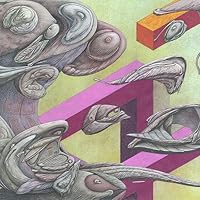
I own a signed copy of this hardcover edition, and it is the most frequently read book of my college years. Heatseeker is an original, unforgettable, and highly influential volume of 19 short stories. With amazing illustrations by Harry O. Morris. The opening story, "What Cindy Saw" is the cyberpunk equivalent of Jack Finney's "Invasion of the Body Snatchers." Long before there was a Matrix franchise where the dead were harnessed for power, John Shirley wrote "Under the Generator" and "Sleepwalkers." My favorite is the subliminal flash fiction piece, "Silent Crickets." The maddening level of disquiet generated by this story alone will stay with the reader for a long time. Apocalyptic nuclear horror is the recurring theme of the collection. This is most evident in "Uneasy Chrysalids, Our Memories" and "Recurrent Dreams of Nuclear War Lead B.T. Quizenbaum into Moral Dissolution."
May 14, 2008
I grabbed this off the shelf of the public library when I was about 13 years old and it exploded my gourd. I'm not sure I'd like it so much if I read it for the first time now, but these stories have kind of a special place for me as the first time I'd really encountered this sort of surreal, fantastic writing.

December 5, 2012
My favourite short story collection by any author. "What Cindy Saw" is a surreal masterpiece. "Wolves of the Plateau", "Triggering" and "Six Kinds of Darkness" all remain fresh - exquisite examples of what can happen when SF, noir, and horror merge seamlessly. These stories are brutal, concise, mindbending and poetic.
September 21, 2010
I can see why authors I like have spoken highly of Shirley's work. He's a good writer, and his ideas are anything but derivative. I'm glad I read this collection... but I have to admit that none of the stories really caught my attention.

October 10, 2008
What Cindy Saw is savage bizarre chunk of surrealims which the rest of this collection can't quite match.
Displaying 1 - 15 of 15 reviews