

What do you think?

Poesie
Nel 1970 Pier Paolo Pasolini curò personalmente un volume di "poesie vecchie" tratte da "Le ceneri di Gramsci" (1957), "La religione del mio tempo" (1961) e "Poesia in forma di rosa" (1964). Considerava questa scelta come "un atto conclusivo di un periodo letterario per aprirne un altro" e su richiesta di Livio Garzanti ne scrisse l'introduzione, intitolandola "Al lettore nuovo". L'antologia - qui riedita integralmente con l'aggiunta di una breve nota proponeva un volume di poesie a sei anni di distanza dall'ultima raccolta pubblicata.
234 pages, Paperback
First published January 1, 1970
About the author
Pier Paolo Pasolini
380 books920 followersItalian poet, novelist, critic, essayst, journalist, translator, dramatist, film director, screenwriter and philosopher, often regarded as one of the greatest minds of XX century, was murdered violently in Rome in 1975 in circumstances not yet been clarified. Pasolini is best known outside Italy for his films, many of which were based on literary sources - The Gospel According to Saint Matthew, The Decameron, The Canterbury Tales...
Pasolini referred himself as a 'Catholic Marxist' and often used shocking juxtapositions of imagery to expose the vapidity of values in modern society.
His essays and newspaper articles often critized the capitalistic omologation and also often contributed to public controversies which had made him many enemies. In the weeks leading up to his murder he had condemned Italy's political class for its corruption, for neo-fascist terrorist conspiracy and for collusion with the Mafia and the infamous "Propaganda 2" masonic lodge of Licio Gelli and Eugenio Cefis.
His friend, the writer Alberto Moravia, considered him "the major Italian poet" of the second half of the 20th century.
Pasolini referred himself as a 'Catholic Marxist' and often used shocking juxtapositions of imagery to expose the vapidity of values in modern society.
His essays and newspaper articles often critized the capitalistic omologation and also often contributed to public controversies which had made him many enemies. In the weeks leading up to his murder he had condemned Italy's political class for its corruption, for neo-fascist terrorist conspiracy and for collusion with the Mafia and the infamous "Propaganda 2" masonic lodge of Licio Gelli and Eugenio Cefis.
His friend, the writer Alberto Moravia, considered him "the major Italian poet" of the second half of the 20th century.
Ratings & Reviews
Friends & Following
Create a free account to discover what your friends think of this book!
Community Reviews
Displaying 1 - 30 of 39 reviews

September 17, 2021
Why does lyric poetry exist? Because I alone,
and nobody else in my place, know what long traditions
lie behind the sorrow born of the hue of the darkening air.
The evening and the clouds together herald night and winter.
What eyes will fill with this sad light if not mine?
and nobody else in my place, know what long traditions
lie behind the sorrow born of the hue of the darkening air.
The evening and the clouds together herald night and winter.
What eyes will fill with this sad light if not mine?

April 16, 2018
Italy in the 50s.
"La Dolce Vita", "Volare", Sophia Loren, Audrey & Gregory riding the Vespa... a dream country, a post-war wonderland.
Uh-huh. Sure.
We tend not to remember the political clash, the corruption, the poverty, the criminality, the slums surrounding the glamourous boutiques of Via Condotti. Because Italy in the 50s was not only Anita Ekberg calling Marcello ("Come he-e-ere!"). It was also a goldmine for profiteers of any sort; it was a country in which a devastating internal migration was turning the South into a waste land, the inhabitants moving to the industrialised North full of illusions and hopes, just to find "No Southerners" signs in the doorways of the residential buildings. A country in which children were still dying of meningitis and being crippled by poliomyelitis.
The newly established Republic was run by a government of beaurocrats (accurately selected by the USA and the Vatican) and a few Communists (accurately selected by the Russians); criminality was spreading like an octopus and intellectuals were kindly invited to look the other way... or ostracised for good.
What about the bright future heralded by the Left? What about the marvelous present promised by Capitalism?
Pasolini's Italy is the country nobody sees in the movies. Rossellini's Neo-realism was little more than décor, a curiosity for tourists. The Roman suburbs were (are) more like the Brazilian favelas than the directors' poetic tableau of blinding sunshine and barefoot kids.
Pasolini was a homosexual in a deeply homophobic country and a honest intellectual in a politicised world: a novelist, essayist, poet, film director who was hated by the establishment, despised by the Left, cuddled by the avant-garde as long as he kept his distance and behaved properly. Both his human and intellectual life were basically a threat.
This anthology is a collection of poems from his works of the 50s and 60s: it allows a good insight on the poet's passion and discontent.
I suppose it's tough for a non-Italian reader to get much of Pasolini's poetry, precisely because it focus on political and social matters we ourselves today find hard to understand; hence my three-star rating.
What is universally comprehensible is the author's pessimistic (but sadly realistic) depiction of a mood, an attitude - a condition of existential abandonment: ideology has turned out to be a sham, dangerously ambiguous or overtly violent, without having truly improved the lives of those who had suffered for it.
In the ode "Gramsci's Ashes" (Antonio Gramsci was a socialist leader and victim of the facist regime) the poet asks the dead man what became of those struggles and hopes, associating the warm light of the Roman sunset and the decadent beauty of the urban landscape to the moral twilight of a decade.
Most poems are long monologues in which Pasolini wonders through the city outskirts, looking at the people around him and recording their daily misery and greatness. Let aside his well-known fondness for (young) male prostitutes and the Roman underworld of petty thieves, drunkards, southern immigrants and middle-aged whores, what he sees is the immutability of the poor's existence, the humble man forever being the same in spite of any social and historical turmoil. In "The Weeping of the Backhoe" the poet wonders whether any Revolution could ever mean anything to the people living out of their work (or crime), for whom life itself is a struggle, hard enough for them to care about ideology and dreams.
Predictably enough, the Church is not spared his criticism, even though Pasolini's anticlericalism is more the expression of his spiritual disappointment than a political attack. In "To a Pope" he compares the life of a Pope to that of a worker; the final lines are a poignant 'j'accuse' in which he asks the Pope about his indifference toward the souls he is supposed to take care of:
" Evil is not in doing bad
Evil is in not doing good
There's never been
Worst sinner than you."
Pasolini's pessimism was the ultimate proof of his love for Italy and Italians. He cried all his life over the 'anthropological genocide' that was occurring since the end of fascism, when Italy found itself too bewildered by its own freedom - politically and culturally speaking - to put its culture in discussion and discern between what was to be kept and what was to be got rid of. Italy had been put out for sale and Pasolini witnessed and recorded the whole process: in fact he himself paid the highest price in 1975, when he was killed with the help of one of those boys he loved and hated so passionately.
He died as he had lived all his life: as an outsider, a man struggling against himself in the attempt to define his own personality, forever wondering through a maze of paradoxes and contradictions:
" The whole world is my unburied body,
An atoll crushed
By blue sea grains..."
Today we must admit Pasolini was the most lucid intellectual of his time, sort of a seer who denounced the evil he saw and felt every day.
And yet the worst was yet to come... a whole decade of terrorism, financial crimes, cultural void was in store for the country.
"La Dolce Vita", "Volare", Sophia Loren, Audrey & Gregory riding the Vespa... a dream country, a post-war wonderland.
Uh-huh. Sure.
We tend not to remember the political clash, the corruption, the poverty, the criminality, the slums surrounding the glamourous boutiques of Via Condotti. Because Italy in the 50s was not only Anita Ekberg calling Marcello ("Come he-e-ere!"). It was also a goldmine for profiteers of any sort; it was a country in which a devastating internal migration was turning the South into a waste land, the inhabitants moving to the industrialised North full of illusions and hopes, just to find "No Southerners" signs in the doorways of the residential buildings. A country in which children were still dying of meningitis and being crippled by poliomyelitis.
The newly established Republic was run by a government of beaurocrats (accurately selected by the USA and the Vatican) and a few Communists (accurately selected by the Russians); criminality was spreading like an octopus and intellectuals were kindly invited to look the other way... or ostracised for good.
What about the bright future heralded by the Left? What about the marvelous present promised by Capitalism?
Pasolini's Italy is the country nobody sees in the movies. Rossellini's Neo-realism was little more than décor, a curiosity for tourists. The Roman suburbs were (are) more like the Brazilian favelas than the directors' poetic tableau of blinding sunshine and barefoot kids.
Pasolini was a homosexual in a deeply homophobic country and a honest intellectual in a politicised world: a novelist, essayist, poet, film director who was hated by the establishment, despised by the Left, cuddled by the avant-garde as long as he kept his distance and behaved properly. Both his human and intellectual life were basically a threat.
This anthology is a collection of poems from his works of the 50s and 60s: it allows a good insight on the poet's passion and discontent.
I suppose it's tough for a non-Italian reader to get much of Pasolini's poetry, precisely because it focus on political and social matters we ourselves today find hard to understand; hence my three-star rating.
What is universally comprehensible is the author's pessimistic (but sadly realistic) depiction of a mood, an attitude - a condition of existential abandonment: ideology has turned out to be a sham, dangerously ambiguous or overtly violent, without having truly improved the lives of those who had suffered for it.
In the ode "Gramsci's Ashes" (Antonio Gramsci was a socialist leader and victim of the facist regime) the poet asks the dead man what became of those struggles and hopes, associating the warm light of the Roman sunset and the decadent beauty of the urban landscape to the moral twilight of a decade.
Most poems are long monologues in which Pasolini wonders through the city outskirts, looking at the people around him and recording their daily misery and greatness. Let aside his well-known fondness for (young) male prostitutes and the Roman underworld of petty thieves, drunkards, southern immigrants and middle-aged whores, what he sees is the immutability of the poor's existence, the humble man forever being the same in spite of any social and historical turmoil. In "The Weeping of the Backhoe" the poet wonders whether any Revolution could ever mean anything to the people living out of their work (or crime), for whom life itself is a struggle, hard enough for them to care about ideology and dreams.
Predictably enough, the Church is not spared his criticism, even though Pasolini's anticlericalism is more the expression of his spiritual disappointment than a political attack. In "To a Pope" he compares the life of a Pope to that of a worker; the final lines are a poignant 'j'accuse' in which he asks the Pope about his indifference toward the souls he is supposed to take care of:
" Evil is not in doing bad
Evil is in not doing good
There's never been
Worst sinner than you."
Pasolini's pessimism was the ultimate proof of his love for Italy and Italians. He cried all his life over the 'anthropological genocide' that was occurring since the end of fascism, when Italy found itself too bewildered by its own freedom - politically and culturally speaking - to put its culture in discussion and discern between what was to be kept and what was to be got rid of. Italy had been put out for sale and Pasolini witnessed and recorded the whole process: in fact he himself paid the highest price in 1975, when he was killed with the help of one of those boys he loved and hated so passionately.
He died as he had lived all his life: as an outsider, a man struggling against himself in the attempt to define his own personality, forever wondering through a maze of paradoxes and contradictions:
" The whole world is my unburied body,
An atoll crushed
By blue sea grains..."
Today we must admit Pasolini was the most lucid intellectual of his time, sort of a seer who denounced the evil he saw and felt every day.
And yet the worst was yet to come... a whole decade of terrorism, financial crimes, cultural void was in store for the country.
August 7, 2016
Ridiculed and expelled from the Italian communist party for his outspoken views on homosexuality and the decline of society (although he still lived as a communist until his dying day), apparently murdered while supposedly meeting with a male prostitute (personally I think that stinks) that would lead to many conspiracy theories regarding his death, and cruelly judged for his films that carried more meaning and intellect than the brain dead cinema of today, the irony is that most of the controversy came from people who either did not know him or were responsible for far greater misdoings themselves!. Regarded by his close friend the novelist Alberto Moravia as the most important poet of the second half of the century and other associates who sung his praises as a very intelligent human being with a composed and dignified mindset and of course gained the respect of the gay community. Here in this collection that is widely described as some of his best work he deals mainly in themes of realism/neo-realism that are political, social, sexual and yes controversial but there is no denying he could write, speak his mind and care passionately in the process.

November 12, 2016
Dear friend, to whom I'm writing because you're far away,
these are not the kind of things one tells a reader
lost in his dreams
they're the nothings of life only friends can believe
- from 'Last Dreams Before Dying'
Would you, in death unadorned,
have me abandon my desperate
passion for being in the world?
- 'Ashes of Gramsci'
Pier Paolo Pasolini was either murdered by rough trade in a trick gone awry or else assassinated by fascists for speaking dangerous truths to power. Either way seems like a fitting end to a brilliant and chaotic life.
A committed anti-fascist who nonetheless couldn't help lusting after the enemy. He was able to live his contradictions without compromising his principles.
That atheistic obsession with god, hunger for experience, love of squalor and prostitutes; Pasolini is a link to all that was best in life before the event; in his courage and political commitment he also points to a way forward after the event. That night, after casting my ballot, before the results came in, I made a somewhat flippant pledge that no matter what happened I wouldn't despair. Well, I've been keeping my pledge, as best I can, but it hasn't been easy.
Here lies a noble soul -
conscious as an injured bird
that gently dies but never forgives.
*
... Behind
Clearings of peonies, Rome in moonlight gilds
Hellenic and Baroque remains and grimy
faithless suburbs, where no one knows
anything but sex, and the caves are slimy
with feces and children.
*
... At almost forty years of age,
I find myself in a rage like a young man
who knows nothing of himself but his youth
and rails against the old world.
And, like a young man, without pity
or shame, I do not hide
my condition: I shall never find peace. Never.
*
In an epileptic fit of murderous
pain. I protested
like one imprisoned for life, shutting myself up
in my room
- without anyone's knowing it -
and screaming, mouth
stuffed with blankets
blackened with iron burns,
those precious family blankets
on which I nursed the flowers of my youth.
And one afternoon or evening, I ran
screaming
down the Sunday streets, after the game,
to the old cemetery behind the railroad tracks,
to perform and repeat, until I bled,
the sweetest act there is in life,
myself alone, atop a little mound of earth,
some two or three graves
of Italian or German soldiers
nameless on the wooden crosses,
buried there in the previous war.
Then that night, between dry tears
the bloody bodies of those wretched strangers
dressed in olive drab
came in swarms over my bed,
where I slept naked and drained,
to soil me with blood until dawn.
*
(All that said, I still really don't like Salo, and even kind of resent him for making that movie; but maybe it's one of those had-to-be-there-at-the-time type phenomena. I've heard that the Italian left in the sixties and seventies put the French one to shame in terms of sheer craziness. So maybe in that context Salo kind of made sense.)
these are not the kind of things one tells a reader
lost in his dreams
they're the nothings of life only friends can believe
- from 'Last Dreams Before Dying'
Would you, in death unadorned,
have me abandon my desperate
passion for being in the world?
- 'Ashes of Gramsci'
Pier Paolo Pasolini was either murdered by rough trade in a trick gone awry or else assassinated by fascists for speaking dangerous truths to power. Either way seems like a fitting end to a brilliant and chaotic life.
A committed anti-fascist who nonetheless couldn't help lusting after the enemy. He was able to live his contradictions without compromising his principles.
That atheistic obsession with god, hunger for experience, love of squalor and prostitutes; Pasolini is a link to all that was best in life before the event; in his courage and political commitment he also points to a way forward after the event. That night, after casting my ballot, before the results came in, I made a somewhat flippant pledge that no matter what happened I wouldn't despair. Well, I've been keeping my pledge, as best I can, but it hasn't been easy.
Here lies a noble soul -
conscious as an injured bird
that gently dies but never forgives.
*
... Behind
Clearings of peonies, Rome in moonlight gilds
Hellenic and Baroque remains and grimy
faithless suburbs, where no one knows
anything but sex, and the caves are slimy
with feces and children.
*
... At almost forty years of age,
I find myself in a rage like a young man
who knows nothing of himself but his youth
and rails against the old world.
And, like a young man, without pity
or shame, I do not hide
my condition: I shall never find peace. Never.
*
In an epileptic fit of murderous
pain. I protested
like one imprisoned for life, shutting myself up
in my room
- without anyone's knowing it -
and screaming, mouth
stuffed with blankets
blackened with iron burns,
those precious family blankets
on which I nursed the flowers of my youth.
And one afternoon or evening, I ran
screaming
down the Sunday streets, after the game,
to the old cemetery behind the railroad tracks,
to perform and repeat, until I bled,
the sweetest act there is in life,
myself alone, atop a little mound of earth,
some two or three graves
of Italian or German soldiers
nameless on the wooden crosses,
buried there in the previous war.
Then that night, between dry tears
the bloody bodies of those wretched strangers
dressed in olive drab
came in swarms over my bed,
where I slept naked and drained,
to soil me with blood until dawn.
*
(All that said, I still really don't like Salo, and even kind of resent him for making that movie; but maybe it's one of those had-to-be-there-at-the-time type phenomena. I've heard that the Italian left in the sixties and seventies put the French one to shame in terms of sheer craziness. So maybe in that context Salo kind of made sense.)

August 13, 2019
"This light is a poor woman, dainty and mild,
who has barely the heart to exist
and remains in the shadows like a child,
with her thinning hair, her now modest,
almost shabby clothes, which hide surviving
secrets that still smell of violets,
and a strength she summons in the silent
troubles of one afraid to be no longer
equal to her tasks. But she never laments
rewards she’s never known. Poor woman,
she knows only how to love, heroically."
- Pier Paolo Pasolini, Appendix to “Religion”: A Light
Today is a terribly sad Tuesday night because I had to say my last goodbye to the one and only copy of Pier Paolo Pasolini poetry that I will read for a very long time since it is almost impossible to find anything else, or get anything shipped to the war-zone I sadly live in (unless you are a capitalist prick then you get all the material pleasures of the world but let us not go there).
I did prolong the read as much as I can. I tried to take the littlest doses of his poetry, of his words and I tried to stay afloat and sodden for as long as I can before my skin wrinkles and it becomes onerous and impossible to step out of his lexical sea. And I have to say that I fell in love with him as a poet more than I did as a film-maker, nevertheless, this is not a degradation of his cinematic work at all because it is outstanding, but his poetry? No, his poetry is a different story.
I was surprised the first time I knew that he wrote poetry, and honestly, knowing that he had adapted the 120 Days of Sodom made me even more intrigued to read what he created. And let me tell you: he was fuel and his words were the match that had set me ablaze and I was ever so delighted to see myself smoulder with his poetry slipping over, out of my tongue, and into my being. He was the godliest arsonist I have met, and by burning me he also saved me.
This book and his poetry felt like verbal miniatures of films and as I read more I realised how clear it is that he IS a film-maker because his work is so rich, so intense and vivid that there is an undeniable tangibility to his words that just sits next to you as you peruse over and over. And I have never been to Italy, but whilst reading his work I felt that I was there, walking the same streets, seeing the same places, the same people. Smelling, touching, and tasting everything as if I’m a time-traveller between the lines. I felt I wandered Europe, went back and forth in time, and lived the politics and the events that took place.
His poetry is a beautiful camera through which his world unravelled to us and that blend of arts that lived inside him was so touching. Every means he used to channel and divulge his life and art was just a marvel. It is just so beautiful that I have no more words...
I am truly saddened that I had to part with him way too soon, and I regret not prolonging this poetic high even more because the withdrawal is going to hurt plenty.
who has barely the heart to exist
and remains in the shadows like a child,
with her thinning hair, her now modest,
almost shabby clothes, which hide surviving
secrets that still smell of violets,
and a strength she summons in the silent
troubles of one afraid to be no longer
equal to her tasks. But she never laments
rewards she’s never known. Poor woman,
she knows only how to love, heroically."
- Pier Paolo Pasolini, Appendix to “Religion”: A Light
Today is a terribly sad Tuesday night because I had to say my last goodbye to the one and only copy of Pier Paolo Pasolini poetry that I will read for a very long time since it is almost impossible to find anything else, or get anything shipped to the war-zone I sadly live in (unless you are a capitalist prick then you get all the material pleasures of the world but let us not go there).
I did prolong the read as much as I can. I tried to take the littlest doses of his poetry, of his words and I tried to stay afloat and sodden for as long as I can before my skin wrinkles and it becomes onerous and impossible to step out of his lexical sea. And I have to say that I fell in love with him as a poet more than I did as a film-maker, nevertheless, this is not a degradation of his cinematic work at all because it is outstanding, but his poetry? No, his poetry is a different story.
I was surprised the first time I knew that he wrote poetry, and honestly, knowing that he had adapted the 120 Days of Sodom made me even more intrigued to read what he created. And let me tell you: he was fuel and his words were the match that had set me ablaze and I was ever so delighted to see myself smoulder with his poetry slipping over, out of my tongue, and into my being. He was the godliest arsonist I have met, and by burning me he also saved me.
This book and his poetry felt like verbal miniatures of films and as I read more I realised how clear it is that he IS a film-maker because his work is so rich, so intense and vivid that there is an undeniable tangibility to his words that just sits next to you as you peruse over and over. And I have never been to Italy, but whilst reading his work I felt that I was there, walking the same streets, seeing the same places, the same people. Smelling, touching, and tasting everything as if I’m a time-traveller between the lines. I felt I wandered Europe, went back and forth in time, and lived the politics and the events that took place.
His poetry is a beautiful camera through which his world unravelled to us and that blend of arts that lived inside him was so touching. Every means he used to channel and divulge his life and art was just a marvel. It is just so beautiful that I have no more words...
I am truly saddened that I had to part with him way too soon, and I regret not prolonging this poetic high even more because the withdrawal is going to hurt plenty.
February 14, 2020

The Selected Poems stretches from Pasolini's lyrical Fruelian poems of 1954 to his combative poems of 1971. Sartarelli does a first hand job of representing the growth of Pasolini's poetry and his translations are in keeping with Pasolini's changing styles. Initially, I wasn't convinced by the claim that Pasolini was more of a poet than film-maker, but about half way through this volume, I realised that such an assertion was absolutely correct.
When Pasolini is mentioned, the scandal comes first: his sexual encounter with under-aged youths and subsequent expulsion from his educational post; flight from his pastoral, Italian homeland to urban Rome. The poems are far greater than the scandal and reveal a man who was emotionally literate and culturally aware. As the finely written Introduction points out, Pasolini was a "one man political party," loathed by the Right as much as the Left, a poet-novelist-film-maker-painter-activist-intellectual who was the scourge of the Fascists.
Many threads weave through Pasolini's poetry, his love of the lowly peasant, his hatred of the highly sophisticated bourgeoise, his passion for young men, a belief in a sexuality untouched by modern commercialism, his belief in a simple Christ, a spirituality not sullied by religion. Poetry is a world of paradoxes negotiated by a complex mind.
Mi innamaro dei corpi
che hanno la mia carne
di figlio -- col grembo
che brucia du pudere--
I fall in love with bodies
that have my same
filial flesh--loins
burning with modesty--
There is no slush in Pasolini, no apologies, no saccharine. The bird that sings in The Nightingale of the Catholic Church is hard, literate, polyphonic, and rebellious. The poem Lingua is a magnificent meditation on sexuality and art.
This bilingual edition is a magnum opus, a revelation.
October 6, 2014
Le centri di Gramsci
Non é di maggio questa impura aria
che il buio giardino straniero
fa ancora piú buio, o l'abbaglia
con cieche schiarite...questo cielo
di bave sopra gli attici giallini
che in semicerchi immensi fanno velo
alle curve del Tevere, ai turchini
monti del Lazio...Spande una mortale
pace, disamorata come i nostri destini,
Pier Paolo Pasolini
1947
Gramsci’s Ashes
It is not May’s impure air
that darkens this foreign garden
to a deeper dark, or the glare
that blinds…this sky, cloud laden
above the burr of yellowish lofts
which in semicircles veil eden,
the Tiber’s course, and the crofts
of Lazio’s sky blue hills…Bestrewing a deathly
peace, as dissatisfied as all our lots,
Translated by David Joseph Cribbin
I've just bought The Selected Poetry of Pier Paolo Pasolini Translated by Stephen Sartarelli. As always with translations of poetry from Italian into English, the translation is not by a poet, so when it comes to poems that employ the terza rima, this rhyme form is abandoned in favour of a standard transliteration of the original. e.g. the three stanzas above from Gramsci's Ashes, which is translated by Sartarelli as...
It’s not May that brings impure air,
makes the darkness of the foreign garden
darker still, or dazzles with the glare
of blind sunbursts…this frothy sky
over pale-yellow penthouses
in vast semicircles that deny
a view of the Tiber’s meanders and
Latium’s deep-blue hills…Between these old
walls the autumn May extends
a deadly peace as unloved as our
destinies. It carries all the greyness
of the world, the close of a decade where
The line "a deadly peace as unloved as our destinies" is moved to the first line of the fourth stanza and dropped as the last line of the third. This typifies the translation throughout, i.e. it evades rhyme, and it transliterates, rather than attempting to translate in an adaptive way the original music and imagery of Pasolini's poetry.
The 1 star is for the dull translation not the original poems, luckily it is a Bilingual Edition.
Non é di maggio questa impura aria
che il buio giardino straniero
fa ancora piú buio, o l'abbaglia
con cieche schiarite...questo cielo
di bave sopra gli attici giallini
che in semicerchi immensi fanno velo
alle curve del Tevere, ai turchini
monti del Lazio...Spande una mortale
pace, disamorata come i nostri destini,
Pier Paolo Pasolini
1947
Gramsci’s Ashes
It is not May’s impure air
that darkens this foreign garden
to a deeper dark, or the glare
that blinds…this sky, cloud laden
above the burr of yellowish lofts
which in semicircles veil eden,
the Tiber’s course, and the crofts
of Lazio’s sky blue hills…Bestrewing a deathly
peace, as dissatisfied as all our lots,
Translated by David Joseph Cribbin
I've just bought The Selected Poetry of Pier Paolo Pasolini Translated by Stephen Sartarelli. As always with translations of poetry from Italian into English, the translation is not by a poet, so when it comes to poems that employ the terza rima, this rhyme form is abandoned in favour of a standard transliteration of the original. e.g. the three stanzas above from Gramsci's Ashes, which is translated by Sartarelli as...
It’s not May that brings impure air,
makes the darkness of the foreign garden
darker still, or dazzles with the glare
of blind sunbursts…this frothy sky
over pale-yellow penthouses
in vast semicircles that deny
a view of the Tiber’s meanders and
Latium’s deep-blue hills…Between these old
walls the autumn May extends
a deadly peace as unloved as our
destinies. It carries all the greyness
of the world, the close of a decade where
The line "a deadly peace as unloved as our destinies" is moved to the first line of the fourth stanza and dropped as the last line of the third. This typifies the translation throughout, i.e. it evades rhyme, and it transliterates, rather than attempting to translate in an adaptive way the original music and imagery of Pasolini's poetry.
The 1 star is for the dull translation not the original poems, luckily it is a Bilingual Edition.

December 12, 2018
At home in Pasolini's lyrical voice - and often in bed with one another - are both the sacred and the profane (watch Pasolini's Salo to witness this styling manifested in film).
Such beauty and filth emanate and ooze from his verse; such touching and rapturous lyricism (in tribute to the working poor, to the Catholicism of his native Italy, to his love for his mother, to poetry and art themselves).
Pasolini is an auteur in a filmic, poetic, and literary sense; an artist in every sense of the word. His poetry is not confined to the boundaries of language as it is written, but manifested in words as they are spoken, in bodies in motion in film, in the petty crimes of the poor in his stories and movies, and so on. I mean, my God, Pasolini is perhaps one of the very precious few who could produce a work of art consisting of its subjects being abused, tortured, murdered, sodomized, forced to eat and drink bodily waste that could be widely hailed, despite it all, as BEAUTIFUL.
All hail Saint Pasolini.
Such beauty and filth emanate and ooze from his verse; such touching and rapturous lyricism (in tribute to the working poor, to the Catholicism of his native Italy, to his love for his mother, to poetry and art themselves).
Pasolini is an auteur in a filmic, poetic, and literary sense; an artist in every sense of the word. His poetry is not confined to the boundaries of language as it is written, but manifested in words as they are spoken, in bodies in motion in film, in the petty crimes of the poor in his stories and movies, and so on. I mean, my God, Pasolini is perhaps one of the very precious few who could produce a work of art consisting of its subjects being abused, tortured, murdered, sodomized, forced to eat and drink bodily waste that could be widely hailed, despite it all, as BEAUTIFUL.
All hail Saint Pasolini.

August 16, 2019
"Death lies not
in not being able to communicate
but in no longer being understood."
"I am like a cat burnt alive,
crushed by a tractor-trailer’s wheels,
hung by boys from a fig tree,
but with eight
of its nine lives still left"
"The scandal of self-contradiction — of being
with you and against you; with you in my heart,
in the light, against you in the dark of my gut."
"Oh cruelty
do not pierce my body
with your eyes !
Yes, it is naked,
warm and innocent …
In the harsh love
of those eyes
I feel myself dying."
"The sad voice
of my sigh
forever dies
across the darkened fields."
"I no longer want to want you,
I want only my naked silence"
"… and now you are nothing,
NOTHINGNESS, pure
wrong."
"As in a spasm of thought,
a flash, I suddenly see people
as real. Sordid … innocent … and unable
to step out of their fusion with the world
— the world in which they are the living …"
in not being able to communicate
but in no longer being understood."
"I am like a cat burnt alive,
crushed by a tractor-trailer’s wheels,
hung by boys from a fig tree,
but with eight
of its nine lives still left"
"The scandal of self-contradiction — of being
with you and against you; with you in my heart,
in the light, against you in the dark of my gut."
"Oh cruelty
do not pierce my body
with your eyes !
Yes, it is naked,
warm and innocent …
In the harsh love
of those eyes
I feel myself dying."
"The sad voice
of my sigh
forever dies
across the darkened fields."
"I no longer want to want you,
I want only my naked silence"
"… and now you are nothing,
NOTHINGNESS, pure
wrong."
"As in a spasm of thought,
a flash, I suddenly see people
as real. Sordid … innocent … and unable
to step out of their fusion with the world
— the world in which they are the living …"

December 21, 2018
Many powerful poems. My favorite is “Gramsci’s Ashes.” I was surprised by how much I liked his work. Pasolini is both passionate and intellectual. A distinctive and valuable voice.

August 25, 2025
Beautiful, powerful, and political poems, which is no surprise. What a lot of other people have been saying in these reviews is that some of the translations are odd, and you obviously can’t capture the rhythm and rhyming of the original Italian by translating it to English, and that’s very true. My limited Italian helped me get a better understanding of the more odd translations, and every time I referred to the Italian portion I found much more compelling word play. I still do think that purely in terms of content the English version of the poems hold up and paint a deeply emotional and breath taking picture, even if it’s missing a lot. That would probably be the case on general principle no matter what small choices made to alter the text for a smoother translation.
They did totally miss out on the fun opportunity to translate “sopra i figli dei figli, il sole” into “above the sons of the sons, the Sun” and for that I have to say, for shame!
They did totally miss out on the fun opportunity to translate “sopra i figli dei figli, il sole” into “above the sons of the sons, the Sun” and for that I have to say, for shame!

June 29, 2008
It's the same old story: traduttore, traditore. I know, I know, it's much easier to rhyme in Italian than English. That still doesn't excuse the would-be translator in my book. Pasolini is considered to be one the most significant post-war Italian poets and, with respect to the political content of his work, is often compared favorably to Brecht. Supposedly at the time of publication many of these poems, in particular "The Ashes of Gramsci," dominated the cafe chatter of the Roman cognoscenti. This trans. completely failed to recreate that kind of urgency, though I must admit that my occasional glances at the verso page led me to believe that I would not be enamored with them even if my command of Italian approached something near a working competence.
I won't, however, hear a word against the man's movies, which are sublime and sorely underrated.
I won't, however, hear a word against the man's movies, which are sublime and sorely underrated.

January 24, 2023
O antologie bogată ce descoperă un poet cât se poate de complex, măcinat de o biografie zbuciumată (moartea fratelui mai mic la doar 19 ani îl marchează profund) și definit de un set de valori puternice (și uneori antagonice) cum ar fi atașamentul față de Biserica Catolică, dragostea de mamă și de patrie, precum și oscilarea între comunism și mica burghezie.

April 24, 2009
A nice collection of works from this Italian, queer, Marxist film-maker and poet. Definitely a departure from 'Salo, or 120 Days in Sodom', but still attempting to address questions about emotions and struggle in the master-slave dialectic.

April 7, 2015
I didn't he was a poet, and a good one. I didn't read the ENTIRE book, but much of it.



August 27, 2024
Poezia lui Pasolini este un rezultat al secolului-fiară, după cum numea Mandelștam secolul XX. Resimțirea totalitarismului și a declinului cauzat de morțile teoretizate ale lui Dumnezeu (la care el încă se întoarce prin primele sale poeme) construiesc nevoia unui spațiu pentru a-fi-în-lume. Și în această nevoie se naște poezia sa, într-o temporalitate care întrece istoria și, stricto sensu, întreaga idee despre umanitate.
“Uneori e înăuntrul nostru ceva
(ce tu știi bine, căci este poezia)
ceva întunecat ce dă lumină
vieții: un plâns lăuntric, nostalgie
plină de uscate, pure lacrimi.”
“Uneori e înăuntrul nostru ceva
(ce tu știi bine, căci este poezia)
ceva întunecat ce dă lumină
vieții: un plâns lăuntric, nostalgie
plină de uscate, pure lacrimi.”

August 9, 2022
CIVIC POETRY

December 31, 2018
If the endnotes had been footnotes, I probably would have liked this more.
Favorite lines:
"...Here they are,
the wretched enjoying the evening..." - The Ashes of Gramsci
"...None of man's true
passions were reflected
in the Church's words and deeds.
Indeed, woe to him who comes
to It for the first time, who
naively gives It everything
undulating in him like a sea of trembling love.
Woe to him who filled with vital joy
desires to serve a law that's only sorrow!
Woe to him who filled with vital sorrow
gives himself to a cause whose only aim
is to defend what little remains of faith
and so give resignation to the world!
Woe to him who believes reason's impulse
should answer the heart's!
Woe to him who can't be miserly
when measuring the soul's deep
levels of egoism and its ridiculed
follies of pitying! Woe to him who believes
--more through innocence than faith--
that history at its eternal beginning
stood still, like the sun
in the dream; and doesn't know the Church
is heir to each creating century;
and this awful animal greyness,
which defeats man's light and darkness,
defends Its corporate goods!
Woe to him who doesn't know
this Christian faith is bourgeois,
in every privilege, every rendering,
every servitude; that sin is
only a crime against offended
daily certitude, is hated because of
fear and sterility; that the Church
is the merciless heart of the State." - The Religion of My Time
"...for we never have
despair without some small hope." - Appendix to the 'Religion': A Light
"...tear apart the world of well-born men!" - Reality
"...there's happiness
in verifying even the worst of destiny's atrocities..."
and
"Help!...the solitude's advancing!" - The Beautiful Banners
Favorite lines:
"...Here they are,
the wretched enjoying the evening..." - The Ashes of Gramsci
"...None of man's true
passions were reflected
in the Church's words and deeds.
Indeed, woe to him who comes
to It for the first time, who
naively gives It everything
undulating in him like a sea of trembling love.
Woe to him who filled with vital joy
desires to serve a law that's only sorrow!
Woe to him who filled with vital sorrow
gives himself to a cause whose only aim
is to defend what little remains of faith
and so give resignation to the world!
Woe to him who believes reason's impulse
should answer the heart's!
Woe to him who can't be miserly
when measuring the soul's deep
levels of egoism and its ridiculed
follies of pitying! Woe to him who believes
--more through innocence than faith--
that history at its eternal beginning
stood still, like the sun
in the dream; and doesn't know the Church
is heir to each creating century;
and this awful animal greyness,
which defeats man's light and darkness,
defends Its corporate goods!
Woe to him who doesn't know
this Christian faith is bourgeois,
in every privilege, every rendering,
every servitude; that sin is
only a crime against offended
daily certitude, is hated because of
fear and sterility; that the Church
is the merciless heart of the State." - The Religion of My Time
"...for we never have
despair without some small hope." - Appendix to the 'Religion': A Light
"...tear apart the world of well-born men!" - Reality
"...there's happiness
in verifying even the worst of destiny's atrocities..."
and
"Help!...the solitude's advancing!" - The Beautiful Banners

February 24, 2018
I had no idea going into the book what kind of poems to expect. Furthermore, I have never seen any of Pasolini's films. So it was a surprise to encounter such engaging writing, deep in the Italy of the post-war. It is serendipity that I am also reading Elena Ferrante's Neapolitan novels (The Neapolitan Novels which covers the same time period. Whereas the US has been encountering the modern for over a century, it seems that post-war Italy only accelerated it during this era. Both Ferrante's Lena and Pasolini are observers on the sidelines, so to speak - a Neapolitan woman escaping poverty and the slums through writing and Pasolini, a gay poet/filmmaker creating a new art form in his films.
Pasolini writes about his neighborhood, his days, his loves, his everyday encounters in a free, conversational manner, but firmly centered on his viewpoint. He is not particularly interested in staking an aesthetic other than what is required to get across how he is responding to his subjects.
One of those subjects is particularly timely. Both in Ferrante and Pasolini we encounter Fascists. I had always thought that the Fascists were thoroughly defeated in WWII - and that any reference to them was metaphorical. In America, until recently, it was just hyperbole. But not in Italy - the Fascists survived in the Mafia and other places and make their evil known to all. That's the thing about Fascists isn't it - they revel in their outrageousness and dare us to stop them. Pasolini's mockery certainly didn't.
Pasolini writes about his neighborhood, his days, his loves, his everyday encounters in a free, conversational manner, but firmly centered on his viewpoint. He is not particularly interested in staking an aesthetic other than what is required to get across how he is responding to his subjects.
One of those subjects is particularly timely. Both in Ferrante and Pasolini we encounter Fascists. I had always thought that the Fascists were thoroughly defeated in WWII - and that any reference to them was metaphorical. In America, until recently, it was just hyperbole. But not in Italy - the Fascists survived in the Mafia and other places and make their evil known to all. That's the thing about Fascists isn't it - they revel in their outrageousness and dare us to stop them. Pasolini's mockery certainly didn't.

August 19, 2019
I'm very out of practice in reading poetry, so I missed most of this. Bits and pieces that stuck with me: images of the seaside, youth, holy poverty, souls in wait or transit; themes of spirituality and religion, revolution and terror. It's a collection that reads as incredibly personal, with Pasolini sometimes explicitly and sometimes subtly working through death drive, homosexuality, the victories of fascism, his own place within the world.
If I were less rusty, I think more would have stood out to me, both good and bad. I should read more poetry though, probably. I'm much more inclined to the sort that explores the joys of text as text, rather than building out narrative or image primarily. I think I am, at least. Maybe I'll keep looking.
If I were less rusty, I think more would have stood out to me, both good and bad. I should read more poetry though, probably. I'm much more inclined to the sort that explores the joys of text as text, rather than building out narrative or image primarily. I think I am, at least. Maybe I'll keep looking.
January 10, 2010
One of the greatest Italian poets killed because of who he was.
February 5, 2016
I' sure the poetry loses something in the translation. Found images of youth, family and religion repetitive. Not enough gay content.
Read
February 26, 2016Patti Smith

February 25, 2017
Maybe Later in life. Laterzzzz.

October 10, 2018
i'm not super into poetry but even i can tell that there are some pretty remarkable excerpts in this

August 7, 2019
曾经的梦想之一就是这样独特又有力的政治写作。但现在看来,和诗人为此付出的代价相比,他的成绩是多么微不足道啊。。。ps,他好像很爱用terza rima ps2,才注意到导言是西西里亚诺写的

May 5, 2022
Did not expect to love this as much as I did!!

May 9, 2025
Sometimes I resent people for being too talented. Pier Paolo Pasolini (1922-1975) is one such person. I mostly know him as a filmmaker—his Gospel According to Matthew (1964) is one of my favorite movies—and he was also a skilled journalist, novelist, playwright, literary critic, public intellectual, but most of all he identified as a “verse poet” (p. 221). This book of poems, first compiled by him in 1970, is what Pasolini himself considered his best. I can’t speak to the accuracy of Norman MacAfee and Luciano Martinengo’s translation, but the verse they render into English is powerful. Pasolini was always a divisive figure—an outspoken Marxist, homosexual, and atheist, along with being an outspoken critic of the degeneration of Italian culture he perceived in his lifetime. His passionate personality comes through in Pier Paolo Pasolini: Poems.
Quotes:
*
*
*
“Those two moving arms in arm through neighborhoods
Of alternating light and poverty, rejoicing
Like pagans in their footsteps’ sound.” (p. 79)
*
*
*
*
*
*
*
*
*
Quotes:
“And if I happen
To love the world, it’s a naive
violent sensual love, just as I
Hated it when I was a confused
Adolescent and its bourgeois evils
Wounded my bourgeois self; and now, divided—
With you—doesn’t the world—or at least
That part which holds power—seem worthy only
Of ranchor and an almost mystical contempt?
Yet without your rigor, I survive because
I do not choose. I live in the non-will
of the dead postwar years: loving
the world I hate, scorning it, lost
In it’s wretchedness—in an obscure scandal
of consciousness” (p. 11)
*
“But while I possess history,
It possesses me. I’m illuminated by it;
But what’s the use of such light?” (p. 13)
*
“Woe to him who doesn’t know this Christian faith is bourgeois,
In every privilege, every rendering,
Every servitude; that sin is
Only a crime against offended
Daily certitude, is hated because of
fear and sterility; that the Church
is the merciless heart of the State” (p. 71)
*
“Those two moving arms in arm through neighborhoods
Of alternating light and poverty, rejoicing
Like pagans in their footsteps’ sound.” (p. 79)
*
“Inflexible and grim, they
Judge you; those in
hairshirts can’t forgive.
You can’t expect even a crumb of mercy” (p. 87)
*
“But oh…there in the sunlight’s my sole delight…
Those bodies, their summer trousers slightly
Worn at the groin by unconscious caresses
Of rough dusty hands…Sweaty
Bands of teen-age males” (p. 113)
*
“I don’t know
Your God; I’m an atheist: prisoner
Only of my love, but in all else I’m free,
In every judgment, every passion.” (p. 119)
*
“Ah, I don’t know how to hate: and so I know
I can’t describe them with the ferocity necessary
To poetry.” (p. 129)
*
“In my sleep, a children frightened silent
Asks for pity, runs frantically for shelter
With an agitation
That conquers virtue, poor creature,
The idea terrifies him
Of being alone
Like a corpse deep in the earth.” (p. 141)
*
“Death is not
In not being able to communicate
But in no longer being able to be understood.” (p. 151)
*
“Fucking professors,
Neo or paleo patriots, assholes up to their ears
In all that knowledge, who see twelfth-to fourteenth-
Century texts only as functions
Of other texts.” (p. 185).
*
“Oh Marx—all is gold—oh Freud—all
Is love—oh Proust—all is memory—
Oh Einstein—all is end—oh Chaplin—all
Is man—oh Kafka—all is terror—-
Oh population of my brothers—-
Oh fatherland—oh that which ressaures identity—” (p. 197).
*
“I’m insatiable for our life,
Because something unique in all the world can never be exhausted.” (p. 207).
*“There’s no lunch or dinner or satisfaction in the world
Equal to an endless walk through the streets of the poor,
Where you must be wretched and strong, brothers to the dogs.” (p. 213).
*
***************************************************************************
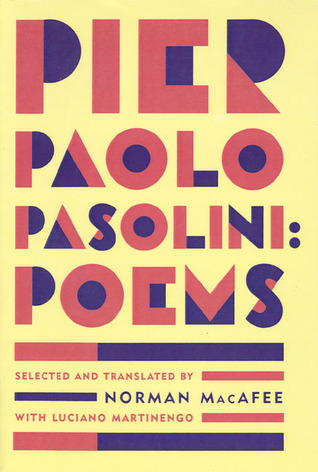
[Image: Book Cover]
Citation:
Pasolini, P. P. (1996). Pier Paolo Pasolini: Poems (N. MacAfee & L. Martinengo, Trans.). Farrar, Strauss & Giroux. (Original work published 1970)
Title: Poems: Pier Paolo Pasolini
Author(s): Pier Paolo Pasolini (1922-1975), Norman MacAfee with Luciano Martinengo (selected and translated by)
Year: 1970 (original publication), 1996 (English version published)
Genre: Poetry
Page count: 256 pages
Date(s) read: 5/7/25 - 5/8/25
Book 91 in 2025
***************************************************************************
Displaying 1 - 30 of 39 reviews