

What do you think?
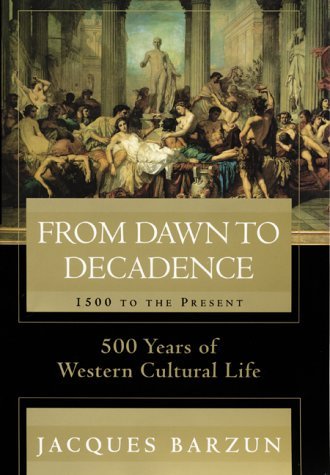
From Dawn to Decadence: 500 Years of Western Cultural Life, 1500 to the Present
Highly regarded here and abroad for some thirty works of cultural history and criticism, master historian Jacques Barzun has now set down in one continuous narrative the sum of his discoveries and conclusions about the whole of Western culture since 1500.
In this account, Barzun describes what Western Man wrought from the Renaisance and Reformation down to the present in the double light of its own time and our pressing concerns. He introduces characters and incidents with his unusual literary style and grace, bringing to the fore those that have "Puritans as Democrats," "The Monarch's Revolution," "The Artist Prophet and Jester"--show the recurrent role of great themes throughout the eras.
The triumphs and defeats of five hundred years form an inspiring saga that modifies the current impression of one long tale of oppression by white European males. Women and their deeds are prominent, and freedom (even in sexual matters) is not an invention of the last decades. And when Barzun rates the present not as a culmination but a decline, he is in no way a prophet of doom. Instead, he shows decadence as the creative novelty that will burst forth--tomorrow or the next day.
Only after a lifetime of separate studies covering a broad territory could a writer create with such ease the synthesis displayed in this magnificent volume.
In this account, Barzun describes what Western Man wrought from the Renaisance and Reformation down to the present in the double light of its own time and our pressing concerns. He introduces characters and incidents with his unusual literary style and grace, bringing to the fore those that have "Puritans as Democrats," "The Monarch's Revolution," "The Artist Prophet and Jester"--show the recurrent role of great themes throughout the eras.
The triumphs and defeats of five hundred years form an inspiring saga that modifies the current impression of one long tale of oppression by white European males. Women and their deeds are prominent, and freedom (even in sexual matters) is not an invention of the last decades. And when Barzun rates the present not as a culmination but a decline, he is in no way a prophet of doom. Instead, he shows decadence as the creative novelty that will burst forth--tomorrow or the next day.
Only after a lifetime of separate studies covering a broad territory could a writer create with such ease the synthesis displayed in this magnificent volume.
895 pages, Hardcover
First published January 1, 2000
About the author
Jacques Barzun
139 books214 followersWorks of French-American educator, author, and historian Jacques Martin Barzun include
Darwin, Marx, Wagner
(see Charles Robert Darwin, Karl Marx, and Richard Wagner) (1941) and
The American University
(1968).
He presented ideas and culture.
https://en.wikipedia.org/wiki/Jacques...
He presented ideas and culture.
https://en.wikipedia.org/wiki/Jacques...
Ratings & Reviews
Friends & Following
Create a free account to discover what your friends think of this book!
Community Reviews
Displaying 1 - 30 of 365 reviews

April 4, 2016
This is Barzun's “magnum opus”: an original, multi-faceted, ambitious interpretation of the cultural history of the West of the last half millennium. This is a unique, idiosyncratic, provocative work that is definitely not a linear, dispassionate account, but a critical, personal and thorough re-evaluation of the modern era.
Before getting into the merits of this important work, it is necessary to highlight that this book is quite heavily weighted towards what is commonly called “the fine arts” (literature, poetry, music, painting), occasionally at the significant expense of other fundamental aspects of European culture (philosophy and science, in particular). Moreover, the environmental and political/military influences, that played such an important role in the development of the European cultural evolution in the last half millennium, are occasionally underestimated and frequently treated too succinctly.
The major and significant limitation of Barzun's historical and cultural perspective is, in my opinion, his thinly disguised dismissive, if not outright hostile, attitude towards the sciences and technology, compounded by embarrassing mistakes whenever he briefly ventures into the history of science: for example he says that Newton's notation for the calculus rather than Leibniz's is the notation that is still currently in use; his definition of chaos theory betrays his clear ignorance of what it is about, and when referring to the second law of thermodynamics he says that it “records how matter and energy perpetually disintegrate” (sigh).
He confuses/identifies science with scientism, analysis with reductionism; and rather than appreciating the power of scientific thinking to identify patterns out of disorder, and the epistemological strength of the scientific method, he claims that science “leaves behind the facts of experience”. Science is not about “leaving behind the facts of experience”, it is about making order and sense out of them! Another sentence that clearly betrays his attitude: “faith in science excludes dissent on important matters; the method brings everyone to a single state of mind”. It is, in my opinion, no coincidence that the only philosopher of science who really gets any attention in his book is Thomas Kuhn – who else. To him, Internet “makes still more general the nerveless mode of existence – sitting and staring” - he ignores the tremendous push towards the democratization of cultural opportunities that Internet has been responsible for in recent times (how about MOOCs, arXiv.org, Project Gutenberg, Good Reads etc.). But I get the strong feeling that, in his ultimately conservative and possibly even elitist view of culture, these are aspects that would not gain his approval.
Coming to the history of philosophical thought, he has a clear preference for Schopenhauer - this is OK, after all he is one of my favourite philosophers! :-) - but I think that his treatment of Kant is way too simplified and succinct, and it does not fairly reflect the fundamental importance of this great thinker in the development of European thinking. Nietzsche is treated quite well, but I strongly disagree with the author's perspective of Existentialism, which he mainly sees as a negative, pessimistic, “decadent” current of thought, and which I personally consider quite the opposite: in my view there is, in Existentialism, also an element of profoundly liberating, deeply invigorating, almost Nietzschean and ultimately optimistic urge for Man to create His own meaning. It must also be said that many important philosophers do not get mentioned, while for example obscure writers get the attention of the author.
On the positive side, the author is an absolute master in providing a multi-perspectival, realistic, credible and nuanced perspective of the ideological, social and cultural climate of some of the most important or interesting historical periods/events/trends of the last 500 years: such as Humanism, the Protestant Reformation, the period of Charles V, Venice around 1650, the emergence of Absolutism, The Enlightenment and the French Revolution, the Romanticism, which are all masterfully brought to life by the author. The author is erudite, highly original and insightful. These parts are riveting, instructive, of high scholarly value, fully rounded, and a joy to read – historical writing at its best. Many very interesting points are elaborated convincingly and with strength – he destroys several common misconceptions and intellectual superstitions that have been perpetuated by much popular history writing. There are so many interesting and original points that I can only just begin to list them within the constraints of a book review. Just a few examples: I really liked how he debunks the myth that Galileo was tried because the Inquisition believed the Copernican model threatened the Church's teachings and Man’s place in the Universe, and also how the author highlights some deeply reactionary aspects of the Reformation. His rendering of the unique and utterly fascinating Venetian Republic is masterful. His debunking of the erroneous concept of the Middle Ages as divorced from the legacy and heritage of the culture of Classical Times is convincing and well argued.
It must be said though that, maybe in the effort of pursuing originality at all costs, the author occasionally makes some questionable, or at least severely selective or highly idiosyncratic, statements: for example when he claims that "the Kaiser did everything in his power for Austria to avert war" – from what I remember this is a statement that, at best, only partially represents what happened: in reality Wilhelm and his Chancellor, after the assassination, incited Austria-Hungary to exact revenge against Serbia and pushed it to declare an ultimatum! Events then quickly spiraled out of control, but Wilhelm appeared not to foresee (or did not want to foresee) the consequences of the Austro-Hungarian attack on Serbia, and when he later feebly attempted to scale things back, it was too late, and he was dissuaded by the German generals, who convinced him that Germany would easily win the war. Hardly a committed pacifist, I would think.
While I am one who agrees that WWI Germany has often received an unfair treatment in much historical writing, I can't agree with the apologetic attitude of the author in this particular instance.
There is also an embarrassing, huge mistake in page 225, when the author states that the Carolingian Renaissance was “swamped by a fresh wave of Germanic invaders – Franks, Vandals, and Goths” (sigh).
Apart from these issues, though, the author's historical writing is generally compelling, precise, very interesting and rich with insights. I also strongly agree with the author's perspective on historical research: contrarily to the fashionable historical over-determinism that sadly affects too many authors (see my review about the book "Guns, Germs and Steel" as a glaring example of such approach), the author correctly states that: “to begin with, cause in history cannot be ascertained any better than motive in its human agents. Both must be represented as probable, and it is wiser to speak of conditions rather than causes, and of influence rather than a force making for change”. I would personally add to the recipe the strong element of pure, simple element of randomness, and irreducible elements of feedback loops and of chaotic behaviour that necessarily govern multi-agent complex systems such as human societies.
The author narrative style is quaintly and charmingly unique, highly original, somewhat old-fashioned and ornate, but pleasant and effective enough to make reading this book a generally highly pleasant experience – it just takes a little while to get fully used to it. Many under-appreciated and under-reported authors and thinkers are dutifully represented, and this is highly laudable, but occasionally the author really goes too far, and in such cases the narrative becomes a dull list of unknown authors and books that are only very succinctly described, that are forgotten as soon as the reader turns the page, and that add absolutely nothing to the value of the overall story.
The final chapter (the one dealing with contemporary times) is unfortunately a significant disappointment and of much lesser quality than all the other chapters (a real pity in what is otherwise such an important and valuable book): it amounts to no much more than a series of rantings about a supposed decadence of contemporary “demotic” society – and this is done from a point of view that is difficult not to perceive as really conservative, even plain anachronistic at times.
Regardless of these issues, it is important to highlight however that this is a very important and ambitious book, well written and highly insightful and original, interesting and a pleasurable reading experience, instructive and highly recommended to anybody interested in the Western cultural history of the last 500 years.
3.5 stars (rounded up to 4).
Before getting into the merits of this important work, it is necessary to highlight that this book is quite heavily weighted towards what is commonly called “the fine arts” (literature, poetry, music, painting), occasionally at the significant expense of other fundamental aspects of European culture (philosophy and science, in particular). Moreover, the environmental and political/military influences, that played such an important role in the development of the European cultural evolution in the last half millennium, are occasionally underestimated and frequently treated too succinctly.
The major and significant limitation of Barzun's historical and cultural perspective is, in my opinion, his thinly disguised dismissive, if not outright hostile, attitude towards the sciences and technology, compounded by embarrassing mistakes whenever he briefly ventures into the history of science: for example he says that Newton's notation for the calculus rather than Leibniz's is the notation that is still currently in use; his definition of chaos theory betrays his clear ignorance of what it is about, and when referring to the second law of thermodynamics he says that it “records how matter and energy perpetually disintegrate” (sigh).
He confuses/identifies science with scientism, analysis with reductionism; and rather than appreciating the power of scientific thinking to identify patterns out of disorder, and the epistemological strength of the scientific method, he claims that science “leaves behind the facts of experience”. Science is not about “leaving behind the facts of experience”, it is about making order and sense out of them! Another sentence that clearly betrays his attitude: “faith in science excludes dissent on important matters; the method brings everyone to a single state of mind”. It is, in my opinion, no coincidence that the only philosopher of science who really gets any attention in his book is Thomas Kuhn – who else. To him, Internet “makes still more general the nerveless mode of existence – sitting and staring” - he ignores the tremendous push towards the democratization of cultural opportunities that Internet has been responsible for in recent times (how about MOOCs, arXiv.org, Project Gutenberg, Good Reads etc.). But I get the strong feeling that, in his ultimately conservative and possibly even elitist view of culture, these are aspects that would not gain his approval.
Coming to the history of philosophical thought, he has a clear preference for Schopenhauer - this is OK, after all he is one of my favourite philosophers! :-) - but I think that his treatment of Kant is way too simplified and succinct, and it does not fairly reflect the fundamental importance of this great thinker in the development of European thinking. Nietzsche is treated quite well, but I strongly disagree with the author's perspective of Existentialism, which he mainly sees as a negative, pessimistic, “decadent” current of thought, and which I personally consider quite the opposite: in my view there is, in Existentialism, also an element of profoundly liberating, deeply invigorating, almost Nietzschean and ultimately optimistic urge for Man to create His own meaning. It must also be said that many important philosophers do not get mentioned, while for example obscure writers get the attention of the author.
On the positive side, the author is an absolute master in providing a multi-perspectival, realistic, credible and nuanced perspective of the ideological, social and cultural climate of some of the most important or interesting historical periods/events/trends of the last 500 years: such as Humanism, the Protestant Reformation, the period of Charles V, Venice around 1650, the emergence of Absolutism, The Enlightenment and the French Revolution, the Romanticism, which are all masterfully brought to life by the author. The author is erudite, highly original and insightful. These parts are riveting, instructive, of high scholarly value, fully rounded, and a joy to read – historical writing at its best. Many very interesting points are elaborated convincingly and with strength – he destroys several common misconceptions and intellectual superstitions that have been perpetuated by much popular history writing. There are so many interesting and original points that I can only just begin to list them within the constraints of a book review. Just a few examples: I really liked how he debunks the myth that Galileo was tried because the Inquisition believed the Copernican model threatened the Church's teachings and Man’s place in the Universe, and also how the author highlights some deeply reactionary aspects of the Reformation. His rendering of the unique and utterly fascinating Venetian Republic is masterful. His debunking of the erroneous concept of the Middle Ages as divorced from the legacy and heritage of the culture of Classical Times is convincing and well argued.
It must be said though that, maybe in the effort of pursuing originality at all costs, the author occasionally makes some questionable, or at least severely selective or highly idiosyncratic, statements: for example when he claims that "the Kaiser did everything in his power for Austria to avert war" – from what I remember this is a statement that, at best, only partially represents what happened: in reality Wilhelm and his Chancellor, after the assassination, incited Austria-Hungary to exact revenge against Serbia and pushed it to declare an ultimatum! Events then quickly spiraled out of control, but Wilhelm appeared not to foresee (or did not want to foresee) the consequences of the Austro-Hungarian attack on Serbia, and when he later feebly attempted to scale things back, it was too late, and he was dissuaded by the German generals, who convinced him that Germany would easily win the war. Hardly a committed pacifist, I would think.
While I am one who agrees that WWI Germany has often received an unfair treatment in much historical writing, I can't agree with the apologetic attitude of the author in this particular instance.
There is also an embarrassing, huge mistake in page 225, when the author states that the Carolingian Renaissance was “swamped by a fresh wave of Germanic invaders – Franks, Vandals, and Goths” (sigh).
Apart from these issues, though, the author's historical writing is generally compelling, precise, very interesting and rich with insights. I also strongly agree with the author's perspective on historical research: contrarily to the fashionable historical over-determinism that sadly affects too many authors (see my review about the book "Guns, Germs and Steel" as a glaring example of such approach), the author correctly states that: “to begin with, cause in history cannot be ascertained any better than motive in its human agents. Both must be represented as probable, and it is wiser to speak of conditions rather than causes, and of influence rather than a force making for change”. I would personally add to the recipe the strong element of pure, simple element of randomness, and irreducible elements of feedback loops and of chaotic behaviour that necessarily govern multi-agent complex systems such as human societies.
The author narrative style is quaintly and charmingly unique, highly original, somewhat old-fashioned and ornate, but pleasant and effective enough to make reading this book a generally highly pleasant experience – it just takes a little while to get fully used to it. Many under-appreciated and under-reported authors and thinkers are dutifully represented, and this is highly laudable, but occasionally the author really goes too far, and in such cases the narrative becomes a dull list of unknown authors and books that are only very succinctly described, that are forgotten as soon as the reader turns the page, and that add absolutely nothing to the value of the overall story.
The final chapter (the one dealing with contemporary times) is unfortunately a significant disappointment and of much lesser quality than all the other chapters (a real pity in what is otherwise such an important and valuable book): it amounts to no much more than a series of rantings about a supposed decadence of contemporary “demotic” society – and this is done from a point of view that is difficult not to perceive as really conservative, even plain anachronistic at times.
Regardless of these issues, it is important to highlight however that this is a very important and ambitious book, well written and highly insightful and original, interesting and a pleasurable reading experience, instructive and highly recommended to anybody interested in the Western cultural history of the last 500 years.
3.5 stars (rounded up to 4).

September 7, 2008
Brief synopsis: A book for the stalwart who love learning and intellectual gymnastics. A brain workout.
I have to agree with Elizabeth S who reviewed as follows:
A very deep read. One of those that, to really enjoy, takes more time than just the reading time. It isn't a book to read, it is a book to experience. A book that, when you are done, you feel you know less than you thought you knew when you started. Overall, absolutely amazing.
Jacques Barzun is extremely well respected and won the National Book Critics' Circle Award for this epic. For those folks who devote the time and the energy into actually reading and studying the book; this book is like a college program in cultural history. You will learn that much.
There are so many sidebar discussions and detours that one can take reading this book. I marveled at the knowledge and the breadth of Mr. Barzun's intellect. Yes, he did have a few opinions; but that made the reading that much more personal and sometimes controversial.
This bears a careful, slow and thoughtful reading. Those folks who want a quick mystery or want to be entertained by a book will not enjoy this work at all. If you give up on things easily, you will not have the stamina to complete this opus. This is not a Patterson or a Grafton novel.
If you love to be tested, be prodded into exploring ideas and different ways of thinking, you will love From Dawn to Decadence.
I found in our group discussions that those folks who just did not want to dive in and challenge themselves and/or had fitful starts and finishes as they read the book will not get anything out of the book at all; in fact those folks could not finish it and if they somehow finally held their nose and stuck it out...they did not enjoy the experience.
The book has to be read continuously so that all of the pieces fit together and the reader sees their dependencies; otherwise you will be totally lost and not see the causal relationships.
The book is really a marvel and easily 100 years of a lifelong love of learning is poured into this cultural history masterpiece by Barzun - this is really his life's work and all of his learning along with the touch of a brilliant mind really inspired me.
You may not always agree with some of his opinions and statements. I found more than a few of these (smile).
But what is even more remarkable is that Barzun, himself, would be happy that you challenged him or his ideas...that was the kind of professor he once was. So for those who do not give up easily and can persevere and accept challenges in learning and in life, this is the book for you.
If you want to be entertained, you will never finish this book or like it one iota...so be forewarned. It is a little like undertaking War and Peace without those beloved characters; it is more like reading a college text.
I was in awe of the book; but I can understand that it is not for everyone.

November 5, 2009
Perhaps the single most amazing thing about this tome - an absolutely brilliant compendium of wisdom, erudition, commentary, and insight, written with a detached passion that illuminates the topics and breathes life into its actors - is that Barzun assembled most of this five-star gem whilst in his early nineties! That the cobwebs of senescence have never been allowed to gather in this transplanted Frenchman's mind becomes abundantly clear as one works their way through this absolute exemplarity of a cultural history.
Taking as his lift-off point the nailing of Luther's ninety-five theses to a church-door in Wittenberg, Barzun covers virtually every significant Western cultural, intellectual, literary and/or artistic achievement - through flowing paragraphs and scattered aphoristic quotes, all the while directing the reader to the most salutary literature on the specific topic at hand. With scarcely a dull moment or uninteresting subject over the course of some nine hundred pages and five hundred years, this magnificent achievement in western history from a conservative viewpoint reaches for the stars and comes awfully close to brushing them.
Taking as his lift-off point the nailing of Luther's ninety-five theses to a church-door in Wittenberg, Barzun covers virtually every significant Western cultural, intellectual, literary and/or artistic achievement - through flowing paragraphs and scattered aphoristic quotes, all the while directing the reader to the most salutary literature on the specific topic at hand. With scarcely a dull moment or uninteresting subject over the course of some nine hundred pages and five hundred years, this magnificent achievement in western history from a conservative viewpoint reaches for the stars and comes awfully close to brushing them.

September 17, 2020
How can anyone (much less me!) possibly write a review which does justice to a book like this?! And even to call it a mere book seems like an injustice to this tome. It seemed more like an encyclopedia, a tour de force, a library unto itself.
First off, I have had my audio edition of it for several years but shortly after beginning to listen I knew I HAD to have a written copy as well because I could see there was just SO MUCH material here I would want to refer back to—names, dates, quotes, titles, etc.—that without a text copy, I might as well not even listen to it. So, I paused in my listening to acquire a used copy to follow along as I listened.
Next, I will say that I have only listened once which is not saying much. Listening once to a book like this is like saying, “Oh yes I passed through Rome once for a day.” Big deal! You know nothing and have not begun to assimilate what Mr. Barzun has written. Still, I am glad that I have done this much because I do at least have something of the lay of the land and I know generally where things are when I want to return—God granting me that much time.
Almost every topic Barzun covered he had a book or books to recommend for further information. Ah to live so long! Will there be libraries in the afterlife? Hopefully so, and hopefully they will not always be purging the old ones as our libraries here do! I digress…
The real value of From Dawn to Decadence is that it is the magnum opus of a genuinely Great Mind near the end of life. And while you may not agree with all of his conclusions, and hopefully you don’t, there is the benefit of knowing he has probably studied the cultural history of this era more than any other soul who has ever lived. And it is also a resource to return to again and again for information, which I am quite sure I will do.
Also, it was a cultural history, i.e., it covers those aspects often overlooked by more conventional historians—religion, literature, music, art, economics, popular beliefs, social trends, and their impact on each other and on daily life—making it a unique addition to the deposit of our common understanding of ourselves over time.
Thank you so much Mr. Barzun for all your hard work. I stand in admiration of your accomplishment! And thank you also for introducing me to more than a few new authors! Just when I think I have a fairly good handle on most of the big Western names in literature, I discover there are a bunch more. Yay!
Most highly recommended!
March 11, 2021: After 6 months, I finally finished it! What an accomplishment for the author! And I feel like I achieved something as its reader as well, though I only listened to it. Still, persisting to the end was almost like taking a college course. Mr. Barzun is hyper-intelligent. It will take a little while to put together a review, if I can even manage to do one, but I am going to try.
September 28, 2020: This book is phenomenal! It is so rich I am in awe of what the author knows and has read. Almost every other paragraph has this statement, “The book to read for further information is...” Not that I want to read all of them, but I keep making note of those I do and have significantly added to my ‘to-read’ list! I also keep learning all these little tidbits of information, not to mention the famous quotes which pepper the pages, at least one to every two-page spread. He provides an excellent defense of poor Christopher Columbus, too long to reproduce here, but basically placing him squarely in the larger tradition of the history of humanity where ‘might makes right’ – a saying which is so well known, not because it is just, but because it's truth has been confirmed throughout history across cultures, races, and religions, even for the native peoples, who we want to assume all lived peacefully among themselves. This is a myth. Yes, there were some peaceful tribes, that is true. There were also some who owned slaves and had barbaric practices. However, warlike or not, the author does not say nor imply this justifies the great atrocities committed by Europeans, but he wants to draw attention to the good Europeans who fought for and helped the native peoples as well as the prevailing mores, conditions and politics of an era so very different from our own. People have been conquering each other, stealing land, taking hostages, raping and subjugating people from the beginning of time. Is it ‘nice’? Of course not! But to blame poor Columbus for all that happened after his voyages is ludicrous!
The author introduces many little-known women who were influential in during these years and how they impacted the history. This is a cultural and religious history as much as it is a chronological report of the time. It will not be easy to review. I’m pausing here on p.111.
First off, I have had my audio edition of it for several years but shortly after beginning to listen I knew I HAD to have a written copy as well because I could see there was just SO MUCH material here I would want to refer back to—names, dates, quotes, titles, etc.—that without a text copy, I might as well not even listen to it. So, I paused in my listening to acquire a used copy to follow along as I listened.
Next, I will say that I have only listened once which is not saying much. Listening once to a book like this is like saying, “Oh yes I passed through Rome once for a day.” Big deal! You know nothing and have not begun to assimilate what Mr. Barzun has written. Still, I am glad that I have done this much because I do at least have something of the lay of the land and I know generally where things are when I want to return—God granting me that much time.
Almost every topic Barzun covered he had a book or books to recommend for further information. Ah to live so long! Will there be libraries in the afterlife? Hopefully so, and hopefully they will not always be purging the old ones as our libraries here do! I digress…
The real value of From Dawn to Decadence is that it is the magnum opus of a genuinely Great Mind near the end of life. And while you may not agree with all of his conclusions, and hopefully you don’t, there is the benefit of knowing he has probably studied the cultural history of this era more than any other soul who has ever lived. And it is also a resource to return to again and again for information, which I am quite sure I will do.
Also, it was a cultural history, i.e., it covers those aspects often overlooked by more conventional historians—religion, literature, music, art, economics, popular beliefs, social trends, and their impact on each other and on daily life—making it a unique addition to the deposit of our common understanding of ourselves over time.
Thank you so much Mr. Barzun for all your hard work. I stand in admiration of your accomplishment! And thank you also for introducing me to more than a few new authors! Just when I think I have a fairly good handle on most of the big Western names in literature, I discover there are a bunch more. Yay!
Most highly recommended!
March 11, 2021: After 6 months, I finally finished it! What an accomplishment for the author! And I feel like I achieved something as its reader as well, though I only listened to it. Still, persisting to the end was almost like taking a college course. Mr. Barzun is hyper-intelligent. It will take a little while to put together a review, if I can even manage to do one, but I am going to try.
September 28, 2020: This book is phenomenal! It is so rich I am in awe of what the author knows and has read. Almost every other paragraph has this statement, “The book to read for further information is...” Not that I want to read all of them, but I keep making note of those I do and have significantly added to my ‘to-read’ list! I also keep learning all these little tidbits of information, not to mention the famous quotes which pepper the pages, at least one to every two-page spread. He provides an excellent defense of poor Christopher Columbus, too long to reproduce here, but basically placing him squarely in the larger tradition of the history of humanity where ‘might makes right’ – a saying which is so well known, not because it is just, but because it's truth has been confirmed throughout history across cultures, races, and religions, even for the native peoples, who we want to assume all lived peacefully among themselves. This is a myth. Yes, there were some peaceful tribes, that is true. There were also some who owned slaves and had barbaric practices. However, warlike or not, the author does not say nor imply this justifies the great atrocities committed by Europeans, but he wants to draw attention to the good Europeans who fought for and helped the native peoples as well as the prevailing mores, conditions and politics of an era so very different from our own. People have been conquering each other, stealing land, taking hostages, raping and subjugating people from the beginning of time. Is it ‘nice’? Of course not! But to blame poor Columbus for all that happened after his voyages is ludicrous!
The author introduces many little-known women who were influential in during these years and how they impacted the history. This is a cultural and religious history as much as it is a chronological report of the time. It will not be easy to review. I’m pausing here on p.111.

June 11, 2009
This a book for the person who thinks that they will not live long enough to learn everything they want to learn. It is huge. It is marvelous. If one looks at the bibliography, it is stunning that any one person could have accessed all this knowledge. This book is 500 hundred year of Western culture, everything from politics, to cookbooks. It took me from October to May to read this book ( of course I put it down for periods or time to read a fast mystery or thriller for a break) but I felt like I had climbed a mental Mt Everest when I finished. If was a single girl, the line that a guy could use to pick me up would be, "Have your read from DAWN TO DECADENCE?". I wish I could give it ten stars

February 6, 2018
A book to read with your pinky out.
Barzun's erudition is dazzling. Analysis, however, is often absent or rather shallow. A good analogy for this work is like that first intro paragraph of a Wikipedia article. It gives you a great sense of the subject without any considerable depth, just few key highlights aside.
He does draw a few arcs of ideas throughout the 500 years of Western European history, but that insight is nothing groundbreaking. The greatest value is his intricate knowledge of an endless array of brilliant characters who play important roles in Europe's intellectual and cultural development. However the barrage of names and works is overwhelming, and the haphazard organization of the book makes it a poor reference. I actually wish I kept some notes while reading it.
Despite the considerable length - 800 pages of densely set text - the scope is quite narrow. The book really focuses on England, France, and Germany. Spain and Italy are give some token attention. Russia and the US are side attraction. South America is covered in a brief, glancing reference to Pablo Neruda.
References to scientific concepts are inept. References to political history are scant.
The best part of the book is that dedicated to the 1800s, an epoch he romanticizes unabashedly - though this leads him to provide the most acute observations and most detailed discussions. His analysis of the 20th century is deeply flawed. In the last 30 pages of the book, he degenerates into an old man yelling at clouds - he is completely at sea culturally. His discussion of music, for example, focuses largely on abstract experimentalists such as John Cage - jazz and blues get a passing mention, while punk and electronika get nothing at all, even though any one of those movements had a greater political, social, and cultural weight than the experimental evolutions of "classical" music.
Barzun's knowledge is vast, and his writing is eloquent. But the book suffers from too broad a take, and Barzun's own monarchist tendencies which make him sound dismissive and ridiculous.
Barzun's erudition is dazzling. Analysis, however, is often absent or rather shallow. A good analogy for this work is like that first intro paragraph of a Wikipedia article. It gives you a great sense of the subject without any considerable depth, just few key highlights aside.
He does draw a few arcs of ideas throughout the 500 years of Western European history, but that insight is nothing groundbreaking. The greatest value is his intricate knowledge of an endless array of brilliant characters who play important roles in Europe's intellectual and cultural development. However the barrage of names and works is overwhelming, and the haphazard organization of the book makes it a poor reference. I actually wish I kept some notes while reading it.
Despite the considerable length - 800 pages of densely set text - the scope is quite narrow. The book really focuses on England, France, and Germany. Spain and Italy are give some token attention. Russia and the US are side attraction. South America is covered in a brief, glancing reference to Pablo Neruda.
References to scientific concepts are inept. References to political history are scant.
The best part of the book is that dedicated to the 1800s, an epoch he romanticizes unabashedly - though this leads him to provide the most acute observations and most detailed discussions. His analysis of the 20th century is deeply flawed. In the last 30 pages of the book, he degenerates into an old man yelling at clouds - he is completely at sea culturally. His discussion of music, for example, focuses largely on abstract experimentalists such as John Cage - jazz and blues get a passing mention, while punk and electronika get nothing at all, even though any one of those movements had a greater political, social, and cultural weight than the experimental evolutions of "classical" music.
Barzun's knowledge is vast, and his writing is eloquent. But the book suffers from too broad a take, and Barzun's own monarchist tendencies which make him sound dismissive and ridiculous.

October 3, 2014
This one was a bit of an impulse buy. Generally, I am one to do my due diligence with book purchases by reading reviews both favorable and unfavorable. Seeing the praise being lavished upon this work with so few exceptions, however, I decided to throw caution to the wind and give this a try. Regrettably, this haphazard approach did not pay off.
Admittedly, I did not finish this book, plodding through 200 or so pages, and so cannot give this book the fair, and thoroughgoing review it deserves considering its impressive scope. For readers more intrepid than I who finished this you have my admiration, because 200 pages felt like a labor. Like a few others, I found very little in terms of content and analysis to make continued reading worthwhile. Barzun's style is overly and pointlessly pedantic (quibbling over language evolution and etymology despite an apparent lack of understanding of both), and most of his analysis, which amounts to little more than pithy invective, fails to adequately address historical events in terms of their significance in regards to cause and effect. Worse still is his arbitrary value judgments of historical figures, deciding that Columbus was blameless more or less for the horrors visited upon the natives -- characterizing him as a victim of the beliefs of the time. Yet, he seems to have no qualms about censuring modernists of the day and going so far as to call them "bigoted."
Unless this book does an about-face in terms of style and execution over the remaining 700 pages, I wouldn't recommend this book to novice history buffs, let alone serious ones. Barzun's heavy-handed analyses, and smugness which he hides under the aegis of stilted erudition, make for a boring, unfulfilling read heavy on opinion and word count, but sorely lacking in content and scholarly expertise. Avoid this one.
Admittedly, I did not finish this book, plodding through 200 or so pages, and so cannot give this book the fair, and thoroughgoing review it deserves considering its impressive scope. For readers more intrepid than I who finished this you have my admiration, because 200 pages felt like a labor. Like a few others, I found very little in terms of content and analysis to make continued reading worthwhile. Barzun's style is overly and pointlessly pedantic (quibbling over language evolution and etymology despite an apparent lack of understanding of both), and most of his analysis, which amounts to little more than pithy invective, fails to adequately address historical events in terms of their significance in regards to cause and effect. Worse still is his arbitrary value judgments of historical figures, deciding that Columbus was blameless more or less for the horrors visited upon the natives -- characterizing him as a victim of the beliefs of the time. Yet, he seems to have no qualms about censuring modernists of the day and going so far as to call them "bigoted."
Unless this book does an about-face in terms of style and execution over the remaining 700 pages, I wouldn't recommend this book to novice history buffs, let alone serious ones. Barzun's heavy-handed analyses, and smugness which he hides under the aegis of stilted erudition, make for a boring, unfulfilling read heavy on opinion and word count, but sorely lacking in content and scholarly expertise. Avoid this one.


October 26, 2012
I came across Jacques Barzun in the late nineties as his book, From Dawn to Decadence - 1500 to the Present - 500 Years of Western Cultural Life, began to gain traction. I was still bogged down in an engineering career then, had divorced my first wife and 2.4 kids, and was in the early stages of re-marriage, but I felt compelled by the idea of this book and began to read it in what spare time I could summon.
What a book! And what a mind. Barzun was in his mid-nineties then, an age in which you - stereotypically - expect to listen to addled, semi-remembered stories from these elderlies and watch them hobble from bed to bathroom on a rickety walker. Not so with Barzun, as this book attests.
He had and eye on the past, to be sure, and he wasn't about to be ensnared by the candy floss of modern culture. We in our age tend to dismiss the elderly, but in previous eras, younger folk sought out these aged ones, simply because they'd seen so much of life and consequently were expected to have a broader vision of where their society had come from, where it was going. Sometimes such views were a tad jaundiced, but it has always been hard to dismiss the views of someone who has seen so much of life.
Barzun's book, Dawn to Decadence, gives us both ends of this personal spectrum. In it he traces western society's evolution from its Greek and Roman roots, in which our understanding of the world we live in - and of ourselves - began to develop from the minds and experiences of a few. Subsequent cultures built on the ideas of these few individuals, then more collective ideas wrung from cities, then nations, each differing to a great degree in its approaches to life and culture based on what each had to work with, geographically and ethnically.
What seems to have troubled Barzun was the ephemeralization of culture as it began to manifest in the late 1800 and as it reached a crescendo in our modern times. Art, literature, philosophy, politics - all these and more - began to reach deep within the global hodgepodge to find some common, abstracted ground. This is where we seem logjammed today with our postmodern sensibilities (note that postmodernism isn't a what-is; instead it's a what-is-not), and this is where Barzun began to wring his hands. As tribal, national, and regional cultures interacted more and more, there were bound to be conflicts in habits and beliefs, and this has led to all of today's "isms," (Pick one or a pair: socialism, fascism, communism, Catholicism, Mormonism, evangelism, modernism, postmodernism...on and on).
A great deal of our current social angst has its roots in our clinging belief in practices that led to many of western society's earlier stages: conflict, violence, war. These now are cultural norms - from the push-pull of regional conflicts to man-woman interactions - and Barzun was right to point this out. And he was also right in another thing: our urge for some abstract common ground begat superficiality: fashion, political correctness, compounding fantasies in politics and religion, and even science.
But is Barzun right? Will we look over our shoulders, just before we see the dark side of the sod, and see western society fallen to a smoldering piles of ashes? We can't know, of course, because there are too many steps yet to take, too many possibilities yet unborn. All we can know is that we're on the cusp of something. We at least owe Jacques Barzun a tip of the hat for bringing us up to speed on this realization.
What a book! And what a mind. Barzun was in his mid-nineties then, an age in which you - stereotypically - expect to listen to addled, semi-remembered stories from these elderlies and watch them hobble from bed to bathroom on a rickety walker. Not so with Barzun, as this book attests.
He had and eye on the past, to be sure, and he wasn't about to be ensnared by the candy floss of modern culture. We in our age tend to dismiss the elderly, but in previous eras, younger folk sought out these aged ones, simply because they'd seen so much of life and consequently were expected to have a broader vision of where their society had come from, where it was going. Sometimes such views were a tad jaundiced, but it has always been hard to dismiss the views of someone who has seen so much of life.
Barzun's book, Dawn to Decadence, gives us both ends of this personal spectrum. In it he traces western society's evolution from its Greek and Roman roots, in which our understanding of the world we live in - and of ourselves - began to develop from the minds and experiences of a few. Subsequent cultures built on the ideas of these few individuals, then more collective ideas wrung from cities, then nations, each differing to a great degree in its approaches to life and culture based on what each had to work with, geographically and ethnically.
What seems to have troubled Barzun was the ephemeralization of culture as it began to manifest in the late 1800 and as it reached a crescendo in our modern times. Art, literature, philosophy, politics - all these and more - began to reach deep within the global hodgepodge to find some common, abstracted ground. This is where we seem logjammed today with our postmodern sensibilities (note that postmodernism isn't a what-is; instead it's a what-is-not), and this is where Barzun began to wring his hands. As tribal, national, and regional cultures interacted more and more, there were bound to be conflicts in habits and beliefs, and this has led to all of today's "isms," (Pick one or a pair: socialism, fascism, communism, Catholicism, Mormonism, evangelism, modernism, postmodernism...on and on).
A great deal of our current social angst has its roots in our clinging belief in practices that led to many of western society's earlier stages: conflict, violence, war. These now are cultural norms - from the push-pull of regional conflicts to man-woman interactions - and Barzun was right to point this out. And he was also right in another thing: our urge for some abstract common ground begat superficiality: fashion, political correctness, compounding fantasies in politics and religion, and even science.
But is Barzun right? Will we look over our shoulders, just before we see the dark side of the sod, and see western society fallen to a smoldering piles of ashes? We can't know, of course, because there are too many steps yet to take, too many possibilities yet unborn. All we can know is that we're on the cusp of something. We at least owe Jacques Barzun a tip of the hat for bringing us up to speed on this realization.

March 17, 2015
Jacques Barzun fue un connotado historiador y escritor francés cuyo poderoso intelecto le permitió abordar de manera brillante diversos temas como la historia de las ideas, el arte, la ciencia, la política y la sociedad entre otros.
Esta obra en particular nos habla prolijamente del surgimiento y evolución de las ideas, la ciencia, el arte, la política, la educación, en una palabra de todo aquello que imbrica al ser humano y que abarca los últimos 500 años de los cuales el autor fue testigo presencial de los últimos 105. Prácticamente acudió a todo el acontecer humano del siglo XX dada su longeva vida. La obra de Barzun es un portento que me ha dejado sorprendido con ese caudal de sabiduría que derrocha a lo largo y ancho del libro y también con esa capacidad para poder expresar todo ese conocimiento. Creo que describir 500 años en 1,300 páginas no está nada mal. Esta colosal tarea requiere de vastísimos conocimientos, de una gran capacidad de síntesis, de un talento enorme y de un gran sentido de organización para ser capaz de difundirla de manera accesible.
Además de un gran historiador considero que Jacques Barzun es un magnífico escritor pues todos sus conocimientos los ha sabido expresar con entusiasmo, ponderación y sencillez; la lectura es amena y se hace inteligible en la mayor parte de la obra, excepto cuando incurre en alguna clase de digresiones y abstracciones para dilucidar una idea o un término que él considera importante para seguir conectando y avanzando en su obra.
Después de haber concluido de leer este libro me queda la sensación de que vivimos en un mundo tan caótico como maravilloso, aunque parezca un contrasentido. Ahora sé con certeza que me encuentro sostenido por miles de manos, de mentes, de conciencias, de inquietudes, ideas, sufrimientos, talentos, debates y empeños de millones de seres humanos que vivieron en el pasado y que nos elevan a un mundo que ha llegado a una altura insospechada y es ahí donde ahora nos ha tocado vivir: una elevada cima conquistada por todas esas personas a las que les tocó vivir antes que a nosotros y que, repito, es un mundo sumido en un caos pero también un mundo maravilloso y lleno de hazañas. De nosotros depende qué lado es el que queremos ver o vivir.
Es tan vasta y deslumbrante esta obra que me siento incapaz de hacer una reseña decorosa sólo quisiera recordar, tal y como el autor lo hace en un apartado de su libro o, más que recordar, hacer una mención de todas aquellas personas que participaron en este prodigioso proceso que ha llevado a la humanidad al estado que guarda el mundo actualmente; esas personas ya olvidadas para siempre que no alcanzaron un lugar en la historia ya que de hecho sería imposible abarcar ese infinito universo de gente. Se trata de personas desaparecidas en las arenas del tiempo pero que pusieron su granito de esfuerzo, talento y buena voluntad para que pudiésemos acceder al mundo actual. El autor los recuerda someramente en algún pasaje de su obra con el muy apropiado nombre de “La Tropa Olvidada” y menciona a algunos personajes totalmente desconocidos para mí pero que en su tiempo tuvieron notoriedad por alguna razón. Héroes anónimos para la eternidad.
Tomando una de tantas ideas que vierte el autor quisiera plasmar su concepto sobre la labor de la historia: “La historia es una obra de arte literario que versa sobre el cambio cultural y es una influencia moralizante por los llamativos ejemplos de virtud y vicio que presenta”
Finalmente concluyó con algunas palabras que atraviesan todo el texto y que dado que aparecen enfatizadas una y otra vez durante la obra entera parecieran ser conceptos claros que han guiado o delimitado un poco la evolución de la humanidad en la época descrita:
• Emancipación.
• Primitivismo.
• Individualismo.
• Abstracción
• Secularización.
• Análisis.
• Separatismo.
• Autoconciencia.
La obra de Barzun inevitablemente nos incita a pensar en todos los caminos y disyuntivas que ha acometido el Hombre con todas sus consecuencias buenas y malas y al mismo tiempo nos hace cavilar sobre la validez de algunas sendas sobre las que caminamos aún y sobre todos nos hace dudar sobre qué caminos habrá que tomar para el futuro.
Habiendo concluido esta titánica obra, y al igual que el mundo, he quedado sumido en el caos y la estupefacción, asombrado con tantas ideas, obras, debates, descubrimientos, luchas, nombres, inventos, guerras, valores y mucho más: un alud se me ha venido encima y espero no dure mucho esta barahúnda mental en que me encuentro.
Esta obra en particular nos habla prolijamente del surgimiento y evolución de las ideas, la ciencia, el arte, la política, la educación, en una palabra de todo aquello que imbrica al ser humano y que abarca los últimos 500 años de los cuales el autor fue testigo presencial de los últimos 105. Prácticamente acudió a todo el acontecer humano del siglo XX dada su longeva vida. La obra de Barzun es un portento que me ha dejado sorprendido con ese caudal de sabiduría que derrocha a lo largo y ancho del libro y también con esa capacidad para poder expresar todo ese conocimiento. Creo que describir 500 años en 1,300 páginas no está nada mal. Esta colosal tarea requiere de vastísimos conocimientos, de una gran capacidad de síntesis, de un talento enorme y de un gran sentido de organización para ser capaz de difundirla de manera accesible.
Además de un gran historiador considero que Jacques Barzun es un magnífico escritor pues todos sus conocimientos los ha sabido expresar con entusiasmo, ponderación y sencillez; la lectura es amena y se hace inteligible en la mayor parte de la obra, excepto cuando incurre en alguna clase de digresiones y abstracciones para dilucidar una idea o un término que él considera importante para seguir conectando y avanzando en su obra.
Después de haber concluido de leer este libro me queda la sensación de que vivimos en un mundo tan caótico como maravilloso, aunque parezca un contrasentido. Ahora sé con certeza que me encuentro sostenido por miles de manos, de mentes, de conciencias, de inquietudes, ideas, sufrimientos, talentos, debates y empeños de millones de seres humanos que vivieron en el pasado y que nos elevan a un mundo que ha llegado a una altura insospechada y es ahí donde ahora nos ha tocado vivir: una elevada cima conquistada por todas esas personas a las que les tocó vivir antes que a nosotros y que, repito, es un mundo sumido en un caos pero también un mundo maravilloso y lleno de hazañas. De nosotros depende qué lado es el que queremos ver o vivir.
Es tan vasta y deslumbrante esta obra que me siento incapaz de hacer una reseña decorosa sólo quisiera recordar, tal y como el autor lo hace en un apartado de su libro o, más que recordar, hacer una mención de todas aquellas personas que participaron en este prodigioso proceso que ha llevado a la humanidad al estado que guarda el mundo actualmente; esas personas ya olvidadas para siempre que no alcanzaron un lugar en la historia ya que de hecho sería imposible abarcar ese infinito universo de gente. Se trata de personas desaparecidas en las arenas del tiempo pero que pusieron su granito de esfuerzo, talento y buena voluntad para que pudiésemos acceder al mundo actual. El autor los recuerda someramente en algún pasaje de su obra con el muy apropiado nombre de “La Tropa Olvidada” y menciona a algunos personajes totalmente desconocidos para mí pero que en su tiempo tuvieron notoriedad por alguna razón. Héroes anónimos para la eternidad.
Tomando una de tantas ideas que vierte el autor quisiera plasmar su concepto sobre la labor de la historia: “La historia es una obra de arte literario que versa sobre el cambio cultural y es una influencia moralizante por los llamativos ejemplos de virtud y vicio que presenta”
Finalmente concluyó con algunas palabras que atraviesan todo el texto y que dado que aparecen enfatizadas una y otra vez durante la obra entera parecieran ser conceptos claros que han guiado o delimitado un poco la evolución de la humanidad en la época descrita:
• Emancipación.
• Primitivismo.
• Individualismo.
• Abstracción
• Secularización.
• Análisis.
• Separatismo.
• Autoconciencia.
La obra de Barzun inevitablemente nos incita a pensar en todos los caminos y disyuntivas que ha acometido el Hombre con todas sus consecuencias buenas y malas y al mismo tiempo nos hace cavilar sobre la validez de algunas sendas sobre las que caminamos aún y sobre todos nos hace dudar sobre qué caminos habrá que tomar para el futuro.
Habiendo concluido esta titánica obra, y al igual que el mundo, he quedado sumido en el caos y la estupefacción, asombrado con tantas ideas, obras, debates, descubrimientos, luchas, nombres, inventos, guerras, valores y mucho más: un alud se me ha venido encima y espero no dure mucho esta barahúnda mental en que me encuentro.

Did Not Finish
May 22, 2023

March 16, 2011
This Book Is 13,680 Pages Long.
After having read Jacques Barzun's summa fifteen times, I have concluded that this book is not really 912 pages long as it appears in the product details, but rather 13,680 pages. Every time I read this masterpiece, I find new ideas and fresh material on every page. Seemingly, the book is an endless fount of intellect, culture, etiquette, morals, art, science, politics, and genius that serves as the capstone of the last era and the cornerstone for the next.
The first thing to note about `From Dawn to Decadence' is that it is no ordinary history. It is a `cultural history' (Barzun is the preeminent scholar in that department), which means that you will not get a thorough account of the events and even personalities of the last 500 years.
Culture is made up of the people in general, social trends, and the product of man, and so historical elements such as war and disaster, which are admittedly important to understanding our past, are not covered here. The author does investigate the lives of prominent people and of course explores the events, but does so only with regard to the `ideas' that have arisen in our era. With that focus, Barzun uses the historical pretext to uncover the kind of truths about life that can only be found in philosophical works.
The ideas are summarized in the Part heads, whose style mirror the book's title. They take the reader `From Luther's Ninety-five Theses to Boyle's Invisible College'; `From the Bog and Sand of Versailles to the Tennis Court'; `From Faust, Part I, to "Nude Descending a Staircase No. 2"'; and `From "the Great Illusion" to "Western Civ Has Got to Go"'. Through each transition, one can see how Western man grows and develops from a restless, nascent people to a mature, decadent culture.
Do not read this book hoping to get a fresh reiteration of what we learn in modern media or even what we learn in school about what was important in our history, especially of the 20th century. You will be disappointed to find that the Great Depression and World War II are mentioned only in passing and Ernest Hemmingway and Jackson Pollack are not touted as amazing geniuses. Do not expect to read about Ayn Rand or the Beatles.
These elements of our past that we believe to be so important in our lives are shown to be insignificant consequences of larger, more dominant historical forces. The people and events mentioned here are actually consequences of the historical force of Decadence, which, in a cultural history, is rightly demeaned. The reader realizes how insignificant the 20th century is after reading about the previous 400 years of cultural growth anyway. The people and events covered in first three parts are shown to be much more deserving of our attention and admiration.
One must smile upon reflection--Erasmus, Petrarch, Montaigne, Bruno, Pascal, Cromwell, Diderot, Beddoes, Hazlitt, Bagehot, William James. The modern reader does not recognize half of the names that Barzun features, but realizes once he has read about them what kind of genius they offered and why it is important to learn about them and multiply their ideas.
Attached to some of the names, but also quite independent elements in themselves, are the nine themes that this book presents: Emancipation, Primitivism, Reductivism, Analysis, Abstraction, Scientism, Secularism, Specialization, and Self-consciousness. Designated by all-caps, these themes appear throughout the story as currents that flow through the era's cultural stream, each introducing its own captivating idea worth significant attention.
This technique and other innovations make `From Dawn to Decadence' a ground-breaking work in style as well as in content. Barzun employs reference tools (forward and backward-pointing page numbers, `the book to read is' recommendations, and unique formatting for section breaks) to accommodate study. He also institutes `add-ins', which function like the familiar `pull-outs', but offer the reader extra material in the form of "`the real self and voice' of the persons in the drama."
Aside from the original techniques, the book stands out because of Barzun's literary genius, a talent that must rival the talent of all of history's great writers. It would be a challenge to find another work that expresses so many ideas and educates so thoroughly while constantly engaging and entertaining the audience as this masterpiece does. The book must be considered a new standard for cultural history and letters in general as well as a benchmark for all future cultural works. There simply is not a more rewarding book out there.
Read this book once and your life will change forever. Read it a seventh time and you will vow to return to the book as often as possible. Read it a fifteenth time and you will agree that it is among the world's greatest cultural treasures.
After having read Jacques Barzun's summa fifteen times, I have concluded that this book is not really 912 pages long as it appears in the product details, but rather 13,680 pages. Every time I read this masterpiece, I find new ideas and fresh material on every page. Seemingly, the book is an endless fount of intellect, culture, etiquette, morals, art, science, politics, and genius that serves as the capstone of the last era and the cornerstone for the next.
The first thing to note about `From Dawn to Decadence' is that it is no ordinary history. It is a `cultural history' (Barzun is the preeminent scholar in that department), which means that you will not get a thorough account of the events and even personalities of the last 500 years.
Culture is made up of the people in general, social trends, and the product of man, and so historical elements such as war and disaster, which are admittedly important to understanding our past, are not covered here. The author does investigate the lives of prominent people and of course explores the events, but does so only with regard to the `ideas' that have arisen in our era. With that focus, Barzun uses the historical pretext to uncover the kind of truths about life that can only be found in philosophical works.
The ideas are summarized in the Part heads, whose style mirror the book's title. They take the reader `From Luther's Ninety-five Theses to Boyle's Invisible College'; `From the Bog and Sand of Versailles to the Tennis Court'; `From Faust, Part I, to "Nude Descending a Staircase No. 2"'; and `From "the Great Illusion" to "Western Civ Has Got to Go"'. Through each transition, one can see how Western man grows and develops from a restless, nascent people to a mature, decadent culture.
Do not read this book hoping to get a fresh reiteration of what we learn in modern media or even what we learn in school about what was important in our history, especially of the 20th century. You will be disappointed to find that the Great Depression and World War II are mentioned only in passing and Ernest Hemmingway and Jackson Pollack are not touted as amazing geniuses. Do not expect to read about Ayn Rand or the Beatles.
These elements of our past that we believe to be so important in our lives are shown to be insignificant consequences of larger, more dominant historical forces. The people and events mentioned here are actually consequences of the historical force of Decadence, which, in a cultural history, is rightly demeaned. The reader realizes how insignificant the 20th century is after reading about the previous 400 years of cultural growth anyway. The people and events covered in first three parts are shown to be much more deserving of our attention and admiration.
One must smile upon reflection--Erasmus, Petrarch, Montaigne, Bruno, Pascal, Cromwell, Diderot, Beddoes, Hazlitt, Bagehot, William James. The modern reader does not recognize half of the names that Barzun features, but realizes once he has read about them what kind of genius they offered and why it is important to learn about them and multiply their ideas.
Attached to some of the names, but also quite independent elements in themselves, are the nine themes that this book presents: Emancipation, Primitivism, Reductivism, Analysis, Abstraction, Scientism, Secularism, Specialization, and Self-consciousness. Designated by all-caps, these themes appear throughout the story as currents that flow through the era's cultural stream, each introducing its own captivating idea worth significant attention.
This technique and other innovations make `From Dawn to Decadence' a ground-breaking work in style as well as in content. Barzun employs reference tools (forward and backward-pointing page numbers, `the book to read is' recommendations, and unique formatting for section breaks) to accommodate study. He also institutes `add-ins', which function like the familiar `pull-outs', but offer the reader extra material in the form of "`the real self and voice' of the persons in the drama."
Aside from the original techniques, the book stands out because of Barzun's literary genius, a talent that must rival the talent of all of history's great writers. It would be a challenge to find another work that expresses so many ideas and educates so thoroughly while constantly engaging and entertaining the audience as this masterpiece does. The book must be considered a new standard for cultural history and letters in general as well as a benchmark for all future cultural works. There simply is not a more rewarding book out there.
Read this book once and your life will change forever. Read it a seventh time and you will vow to return to the book as often as possible. Read it a fifteenth time and you will agree that it is among the world's greatest cultural treasures.

February 17, 2025
This is Barzun's capstone work of cultural history. The last 25 years has done a lot to simultaneously validate and invalidate elements of the dawn-to-decadence thesis. Some of this goes to fundamental problems inherent to making generalized claims about the state of a culture - let alone of a culture as loose and slippery as "The West." Barzun is wise to the issue but persists in the effort.
The work is impressive and deserves to be read - not so much for the perspective it provides on the broad sweep of history so much as what Barzun, a close and astute observer, has to say about the work of particularly notable figures. He's done the work. He's not a zealous ideologue. He's not a prophet of doom. He has a genuine fondness for the people and ideas comprising the West. What's remarkable is how few figures like Barzun populate the academy today.
The book does sometimes just feels like a collection of essays or notes rather than a coherent work, though a lot of reviewers have noted the continuity of the work is impressive. There certainly is a flow but sometimes it is easy to get lost in slipstreams of thought. Barzun is also not the most equipped to deal with some of the most important changes in the West over this time. Technological change and science play substantially smaller roles than they should in the work. Although Barzun argues that he's trying to do something altogether separate from science itself. Subsequently, it is perhaps better to think of this work as a selective survey of Western ideas rather than Western culture, which sometimes provides a preview of how ideas and culture are in conversation over time.
To really say something valuable about this work, I think I will need to read it over many many times.
The work is impressive and deserves to be read - not so much for the perspective it provides on the broad sweep of history so much as what Barzun, a close and astute observer, has to say about the work of particularly notable figures. He's done the work. He's not a zealous ideologue. He's not a prophet of doom. He has a genuine fondness for the people and ideas comprising the West. What's remarkable is how few figures like Barzun populate the academy today.
The book does sometimes just feels like a collection of essays or notes rather than a coherent work, though a lot of reviewers have noted the continuity of the work is impressive. There certainly is a flow but sometimes it is easy to get lost in slipstreams of thought. Barzun is also not the most equipped to deal with some of the most important changes in the West over this time. Technological change and science play substantially smaller roles than they should in the work. Although Barzun argues that he's trying to do something altogether separate from science itself. Subsequently, it is perhaps better to think of this work as a selective survey of Western ideas rather than Western culture, which sometimes provides a preview of how ideas and culture are in conversation over time.
To really say something valuable about this work, I think I will need to read it over many many times.


June 3, 2015
Review title: Draw up a chair; Jacques Barzun has a treasure map to share
The treasure is the inheritance of the 500 years of Western cultural life of Barzun's subtitle that is at my fingertips today. The map is Barzun's lifework documented in 800-plus pages of hard-learned and hand-drawn (as it were) survey marking the the routes to the treasure caches that have been created, assembled, saved, and lost over the five centuries of modern Western culture.
While this is a survey in the grand professorial style (for example, Barzun will define each of those terms ending the previous paragraph), this is no mere textbook. At age 93 when this book was published in 2000, Barzun has lived through almost 20% of the period he covers, and he approaches the topic with the personal knowledge and style that his eminence has earned. He has done his research, he has drawn the map himself with a craftsmanship all his own, and he is going to share it with us with his own style as well.
As he unfolds the map in front of us, Barzun is going to define the term "decadence" lest we question his relevance and attempt to pigeonhole him as a sour old man intent on preserving the way things used to be. Decadence is not a slur, it is a technical term defined as: "When people accept futility and the absurd as normal. . . . A decadent culture offers opportunities chiefly to the satirist" (p. 11). As his finger traces the path to today's landscape, it lands in a spot where art is "intended to be uninspired. . . . The ridicule mocks itself as well as its object" (p. 731).
No mere transcriber, Barzun brings a method and a plan to his map of Western cultural life. It advanced (yes, that term will be defined as well) through four revolutions roughly 125 years apart:
The 16th Century religious revolution known as the Protestant Reformation
The 17th and 18th Century monarchical revolution represented by the English and the French civil wars
The 19th Century liberal revolution that enthroned the individual and individualism represented by Evolution (more definitions ensue) in the sciences and Romanticism in the arts.
The 20th Century social revolution that established collective individualism, a working out of the effects of the first three revolutions that is still underway, even after the establishment and partial dismantling of massive socialism in political organization.
Throughout these revolutions, Barzun traces the interplay of major recurring themes (highlighted in caps in his text):
emancipation, or universal independence
primitivism, or reversion to the beginning to cleanse current culture
individualism
secularism, which emerged from humanism, or "dealing with the affairs of the world in a man-centered way" (p. 44).
self-consciousness, or awareness of the individual as distinct
specialism
analysis
reductivism
scientism, defined as using the methods of science in all forms of experience to solve every issue
abstraction
With his craftsmanship Barzun brings his own unique formatting to this book, which includes the references to the major themes in caps throughout the book. Introductions to the biographies and ideas of key participants are announced by bold and centered headings. Representative quotes from these and other contemporaries are placed in bold in marginal sidebars that intrude on the left or right margins of the main text. Further reading (a full curriculum of great literature) is called out in the main text by short parenthetical references to author/title instead of footnotes or endnotes. The one formatting choice that I felt an unnecessary oddity was his decision to abbreviate Century to C, so 16th Century becomes "16C", ostensibly to save space (in a book that totals nearly 900 pages?!).
So, we are seated around the map laid out on the table in Barzun's study, and we see the outlines of the map. Now, in the manner of a Sherlock Holmes, Barzun takes his time lighting his pipe, leans toward us over the map, and traces the routes through history to today in detail, again in a style all his own. This is fine writing by a powerful and opinionated mind. I found myself taking notes of ideas, turns of phrase, and sources i I wanted to followup on. Just a selection of those notes:
p. 23: Disbelief can be explained as "perverse wickedness". Unbelief is different and far more unsettling. The Protestant Reformation destroyed the possibility of "single truth". Now believers are surrounded by unbelievers--and believers in different things.
p. 134-135 (in reference to the Stoics): Are we learning how to live, or learning to die (philosophy vs. theology)?
p. 153: In art we have progressed from epic hero to tragic hero to common hero to anti-hero.
p. 348: As Barzun discusses why a writer who was considered the best by his contemporaries but completely forgotten by history, I wonder which very well known current writers, artists, directors, musicians will be completely forgotten in future generations?
p. 355: "The good sentence is the clockwork put back together again after careful analysis . . . but it is not natural. it is a product of extreme SELF-CONSCIOUSNESS."
p. 511: A quote from William Hazlitt: "If we are more catholic in our notions and want variety of excellence and beauty, it is spread abroad for us in provision in the variety of books." This is exactly the sentiment that led me to name my lunch.com blog "The catholic reader."!
p. 588: Das Capital is one of a class of (long, turgid, unreadable) books that "every intellectual thinks he has read."
p. 689: "Nowadays, a sensible voter should call himself a Liberal Conservative Socialist, regardless of the election returns."
With this final quote, Barzun has traced his finger close to our time on the map to a fork in the road he has called the Great Switch (caps by Barzun) which was triggered by the confluence of influences from the religious, monarchical, and individualist revolutions of the past 500 years, and the failure of religion, politics, economics, science, art, literature, and music to resolve or synthesize these influences into a workable pattern to live. This failure is represented by the traumatic events leading to and culminating in the Great War of 1914-1918, which was surprising in its near-unanimous support by the intellectual and cultural leaders of the time (p. 700-703). I have long found the period between the end of the American Civil War and 1914 the most fertile, fervent, and fascinating period of history, and Barzun's map reveals why in the detailed landscape of this period.
If you can afford the time to read only one map to your world, make it this one. It is a rare work of profundity and fun, depth and clarity, that needs to be read and rewards the reading.
The treasure is the inheritance of the 500 years of Western cultural life of Barzun's subtitle that is at my fingertips today. The map is Barzun's lifework documented in 800-plus pages of hard-learned and hand-drawn (as it were) survey marking the the routes to the treasure caches that have been created, assembled, saved, and lost over the five centuries of modern Western culture.
While this is a survey in the grand professorial style (for example, Barzun will define each of those terms ending the previous paragraph), this is no mere textbook. At age 93 when this book was published in 2000, Barzun has lived through almost 20% of the period he covers, and he approaches the topic with the personal knowledge and style that his eminence has earned. He has done his research, he has drawn the map himself with a craftsmanship all his own, and he is going to share it with us with his own style as well.
As he unfolds the map in front of us, Barzun is going to define the term "decadence" lest we question his relevance and attempt to pigeonhole him as a sour old man intent on preserving the way things used to be. Decadence is not a slur, it is a technical term defined as: "When people accept futility and the absurd as normal. . . . A decadent culture offers opportunities chiefly to the satirist" (p. 11). As his finger traces the path to today's landscape, it lands in a spot where art is "intended to be uninspired. . . . The ridicule mocks itself as well as its object" (p. 731).
No mere transcriber, Barzun brings a method and a plan to his map of Western cultural life. It advanced (yes, that term will be defined as well) through four revolutions roughly 125 years apart:
The 16th Century religious revolution known as the Protestant Reformation
The 17th and 18th Century monarchical revolution represented by the English and the French civil wars
The 19th Century liberal revolution that enthroned the individual and individualism represented by Evolution (more definitions ensue) in the sciences and Romanticism in the arts.
The 20th Century social revolution that established collective individualism, a working out of the effects of the first three revolutions that is still underway, even after the establishment and partial dismantling of massive socialism in political organization.
Throughout these revolutions, Barzun traces the interplay of major recurring themes (highlighted in caps in his text):
emancipation, or universal independence
primitivism, or reversion to the beginning to cleanse current culture
individualism
secularism, which emerged from humanism, or "dealing with the affairs of the world in a man-centered way" (p. 44).
self-consciousness, or awareness of the individual as distinct
specialism
analysis
reductivism
scientism, defined as using the methods of science in all forms of experience to solve every issue
abstraction
With his craftsmanship Barzun brings his own unique formatting to this book, which includes the references to the major themes in caps throughout the book. Introductions to the biographies and ideas of key participants are announced by bold and centered headings. Representative quotes from these and other contemporaries are placed in bold in marginal sidebars that intrude on the left or right margins of the main text. Further reading (a full curriculum of great literature) is called out in the main text by short parenthetical references to author/title instead of footnotes or endnotes. The one formatting choice that I felt an unnecessary oddity was his decision to abbreviate Century to C, so 16th Century becomes "16C", ostensibly to save space (in a book that totals nearly 900 pages?!).
So, we are seated around the map laid out on the table in Barzun's study, and we see the outlines of the map. Now, in the manner of a Sherlock Holmes, Barzun takes his time lighting his pipe, leans toward us over the map, and traces the routes through history to today in detail, again in a style all his own. This is fine writing by a powerful and opinionated mind. I found myself taking notes of ideas, turns of phrase, and sources i I wanted to followup on. Just a selection of those notes:
p. 23: Disbelief can be explained as "perverse wickedness". Unbelief is different and far more unsettling. The Protestant Reformation destroyed the possibility of "single truth". Now believers are surrounded by unbelievers--and believers in different things.
p. 134-135 (in reference to the Stoics): Are we learning how to live, or learning to die (philosophy vs. theology)?
p. 153: In art we have progressed from epic hero to tragic hero to common hero to anti-hero.
p. 348: As Barzun discusses why a writer who was considered the best by his contemporaries but completely forgotten by history, I wonder which very well known current writers, artists, directors, musicians will be completely forgotten in future generations?
p. 355: "The good sentence is the clockwork put back together again after careful analysis . . . but it is not natural. it is a product of extreme SELF-CONSCIOUSNESS."
p. 511: A quote from William Hazlitt: "If we are more catholic in our notions and want variety of excellence and beauty, it is spread abroad for us in provision in the variety of books." This is exactly the sentiment that led me to name my lunch.com blog "The catholic reader."!
p. 588: Das Capital is one of a class of (long, turgid, unreadable) books that "every intellectual thinks he has read."
p. 689: "Nowadays, a sensible voter should call himself a Liberal Conservative Socialist, regardless of the election returns."
With this final quote, Barzun has traced his finger close to our time on the map to a fork in the road he has called the Great Switch (caps by Barzun) which was triggered by the confluence of influences from the religious, monarchical, and individualist revolutions of the past 500 years, and the failure of religion, politics, economics, science, art, literature, and music to resolve or synthesize these influences into a workable pattern to live. This failure is represented by the traumatic events leading to and culminating in the Great War of 1914-1918, which was surprising in its near-unanimous support by the intellectual and cultural leaders of the time (p. 700-703). I have long found the period between the end of the American Civil War and 1914 the most fertile, fervent, and fascinating period of history, and Barzun's map reveals why in the detailed landscape of this period.
If you can afford the time to read only one map to your world, make it this one. It is a rare work of profundity and fun, depth and clarity, that needs to be read and rewards the reading.

September 13, 2015
The work of Jacques Barzun's lifetime -- how could a reader not profit from this summary of so much of what this scholar and thinker had studied in his generous span? [Editing in a good example of his take on a subject most are familiar with -- how we read, he says misread, Hamlet; see farther below...]
Since he lived to 105, that makes for a lot of curiosity, thought, and learning. This summary of modern western civilization was published in 2000 when Barzun was 93, although it reads like the work of a man in his prime. He traces themes through these 500 years and will stimulate and provoke you on darned near every page. Can't do more justice than to quote his own purposes:
"It takes only a look at the numbers to see that the 20th century is coming to an end. A wider and deeper scrutiny is needed to see that in the West the culture of the last 500 years is ending at the same time. Believing this to be true, I have thought it the right moment to review in sequence the great achievements and the sorry failures of our half millennium.
"This undertaking has also given me a chance to describe at first hand for any interested posterity some aspects of present decadence that may have escaped notice, and to show how they relate to others generally acknowledged. But the lively and positive predominate: this book is for people who like to read about art and thought, manners, morals, and religion, and the social setting in which these activities have been and are taking place. I have assumed that such readers prefer discourse to be selective and critical rather than neutral and encyclopedic. And guessing further at their preferences, I have tried to write as I might speak, with only a touch of pedantry here and there to show that I understand modern tastes."
The framework runs from Martin Luther to the internet. There are so many surprising things in here that its density is delightful. I have been reading it off and on for several years, and now that I am solidly past the halfway point, I wanted to get this little notice up here rather than wait another couple years when the treatment of the 20th century might, I fear, fatally discourage me. That may not sound like much of a recommendation but this is a tremendous book, as my rating and all the other reviews here must have made clear already.
So, on Hamlet, from p. 254:
The common notion of Hamlet is that he vacillates. In Olivier's film, the play is called "the tragedy of a man who could not make up his mind." That the play is first and foremost political is ignored. Everybody since Coleridge has concentrated on Hamlet's character and forgotten his situation. It is true that his character is finer than that of his entourage; he has a conscience and does not kill first and think afterward. Killing a king accepted by the populace is not a bagatelle. Laertes is the impetuous boy, put in to make the contrast clear. Hamlet has to think and watch, because from the outset he is in danger, a threat to the usurper and his aides; all conspire against him, including, though unwittingly, his betrothed. And he has his mother to consider. His soliloquies show him superior to his barbaric times, but what he thinks must not be taken for what he does. He wipes out the hired killers sent with him to England; he comes back resolved but wary and fails only by treachery.
Two further facts reinforce the corrective view. Fortinbras says about Hamlet at his burial: he would have been a great king. This forecast would sound ridiculous if through five acts the hero had shown nothing but indecision. The other is the conclusion of a modern playwright that the text of Hamlet transposes scenes which, in a different order, would make the action go straight and fast. To appreciate the argument and the result, read Shakespeare's Game by William Gibson.
Since he lived to 105, that makes for a lot of curiosity, thought, and learning. This summary of modern western civilization was published in 2000 when Barzun was 93, although it reads like the work of a man in his prime. He traces themes through these 500 years and will stimulate and provoke you on darned near every page. Can't do more justice than to quote his own purposes:
"It takes only a look at the numbers to see that the 20th century is coming to an end. A wider and deeper scrutiny is needed to see that in the West the culture of the last 500 years is ending at the same time. Believing this to be true, I have thought it the right moment to review in sequence the great achievements and the sorry failures of our half millennium.
"This undertaking has also given me a chance to describe at first hand for any interested posterity some aspects of present decadence that may have escaped notice, and to show how they relate to others generally acknowledged. But the lively and positive predominate: this book is for people who like to read about art and thought, manners, morals, and religion, and the social setting in which these activities have been and are taking place. I have assumed that such readers prefer discourse to be selective and critical rather than neutral and encyclopedic. And guessing further at their preferences, I have tried to write as I might speak, with only a touch of pedantry here and there to show that I understand modern tastes."
The framework runs from Martin Luther to the internet. There are so many surprising things in here that its density is delightful. I have been reading it off and on for several years, and now that I am solidly past the halfway point, I wanted to get this little notice up here rather than wait another couple years when the treatment of the 20th century might, I fear, fatally discourage me. That may not sound like much of a recommendation but this is a tremendous book, as my rating and all the other reviews here must have made clear already.
So, on Hamlet, from p. 254:
The common notion of Hamlet is that he vacillates. In Olivier's film, the play is called "the tragedy of a man who could not make up his mind." That the play is first and foremost political is ignored. Everybody since Coleridge has concentrated on Hamlet's character and forgotten his situation. It is true that his character is finer than that of his entourage; he has a conscience and does not kill first and think afterward. Killing a king accepted by the populace is not a bagatelle. Laertes is the impetuous boy, put in to make the contrast clear. Hamlet has to think and watch, because from the outset he is in danger, a threat to the usurper and his aides; all conspire against him, including, though unwittingly, his betrothed. And he has his mother to consider. His soliloquies show him superior to his barbaric times, but what he thinks must not be taken for what he does. He wipes out the hired killers sent with him to England; he comes back resolved but wary and fails only by treachery.
Two further facts reinforce the corrective view. Fortinbras says about Hamlet at his burial: he would have been a great king. This forecast would sound ridiculous if through five acts the hero had shown nothing but indecision. The other is the conclusion of a modern playwright that the text of Hamlet transposes scenes which, in a different order, would make the action go straight and fast. To appreciate the argument and the result, read Shakespeare's Game by William Gibson.

October 2, 2015
How did we get to where we are today in Western culture? One of my favorite books of all time, A Secular Age by Charles Taylor, seeks to answer that question. Specifically, Taylor looks at how we moved from believing in God,mostly without question, in 1500 to having many options today. When I saw this book at the used bookstore, I was intrigued because of the topic (and the great deal!). But though Barzun covers the same period as Taylor, his book is quite different.
As I read the book I perused some reviews and Barzun's Wikipedia page. Through that I learned he wrote this book in his 90s as his magnum opus! Near the end when he finally gets to WWI he writes from firsthand memory, which kind of nearly blew my mind. It was also amazing that he wrote this in his 90s for the book is filled with references to all sorts of people that casual students of history have never even heard of. He tells the story you may think you have heard before, but soon realize is vastly more complex then you knew.
Though I was enjoying this book, I was not sure what to make of it. At first it seemed like what you would expect - beginning in 1500 the first figure discussed is Luther. But soon Barzun is discussing opera and poetry. It was not till I got to his chapter on the French Revolution that I finally realized the genuis of this book. Barzun discussed Napolean's invasion of Egypt, but his focus was not on the battles but on the thinkers Napolean took with and their work which has mostly been forgotten, influential as it was. If you want a history book that tells you history focused on political leaders and war, there are other books. Such books are probably a prerequisite for this one, as Barzun assumes a basic understanding of much of the actual historical events. This book is centered on culture - music and art and literature. Of course, philosophy and politics and economics appear too. But I learned more then I ever cared to know about the history of opera, for example.
The final chapter, where Barzun discusses the present day (well, 1995) is worth the price of the book. We've reached decadence and it is not pleasant.
Overall, highly recommended.
As I read the book I perused some reviews and Barzun's Wikipedia page. Through that I learned he wrote this book in his 90s as his magnum opus! Near the end when he finally gets to WWI he writes from firsthand memory, which kind of nearly blew my mind. It was also amazing that he wrote this in his 90s for the book is filled with references to all sorts of people that casual students of history have never even heard of. He tells the story you may think you have heard before, but soon realize is vastly more complex then you knew.
Though I was enjoying this book, I was not sure what to make of it. At first it seemed like what you would expect - beginning in 1500 the first figure discussed is Luther. But soon Barzun is discussing opera and poetry. It was not till I got to his chapter on the French Revolution that I finally realized the genuis of this book. Barzun discussed Napolean's invasion of Egypt, but his focus was not on the battles but on the thinkers Napolean took with and their work which has mostly been forgotten, influential as it was. If you want a history book that tells you history focused on political leaders and war, there are other books. Such books are probably a prerequisite for this one, as Barzun assumes a basic understanding of much of the actual historical events. This book is centered on culture - music and art and literature. Of course, philosophy and politics and economics appear too. But I learned more then I ever cared to know about the history of opera, for example.
The final chapter, where Barzun discusses the present day (well, 1995) is worth the price of the book. We've reached decadence and it is not pleasant.
Overall, highly recommended.

October 7, 2010
This is a wonderful book that could be written only by someone like Barzun and only near the end of a deeply distinguished career that spanned several decades.
The scope of the book is breath-taking. And the learning necessary to write it is mind-boggling. The book is exactly what the sub-title suggests: an erudite discussion of 500 years of western cultural life.
In particular, I love Barzun's definition of decadence: a state of affairs where futility and absurdity are accepted as normal. Barzun finds ample evidence of the acceptance of absurdity in 20th century literature, science, art, theatre and politics. Yet, the reader senses that Barzun himself believes that western culture has not lost its roots in rationality and pragmatism.
For this reason, the book is optimistic. Indeed, Barzun's conversation with his reader repeatedly affirms that the the best of western culture is beautiful and rational even in the face of the uncertainty, incompleteness, alienation and relativity that arose in the late 19th and early 20th centuries.
By the way, though I read the first 200 pages or so sequentially, I found that for me the best way to read this unique book is to pick sections of interest and let my curiosity lead me.
The scope of the book is breath-taking. And the learning necessary to write it is mind-boggling. The book is exactly what the sub-title suggests: an erudite discussion of 500 years of western cultural life.
In particular, I love Barzun's definition of decadence: a state of affairs where futility and absurdity are accepted as normal. Barzun finds ample evidence of the acceptance of absurdity in 20th century literature, science, art, theatre and politics. Yet, the reader senses that Barzun himself believes that western culture has not lost its roots in rationality and pragmatism.
For this reason, the book is optimistic. Indeed, Barzun's conversation with his reader repeatedly affirms that the the best of western culture is beautiful and rational even in the face of the uncertainty, incompleteness, alienation and relativity that arose in the late 19th and early 20th centuries.
By the way, though I read the first 200 pages or so sequentially, I found that for me the best way to read this unique book is to pick sections of interest and let my curiosity lead me.

February 4, 2014
A very rewarding read. It is, however, better without the last chapter describing contemporary intellectual fashion circa 1995, where the author failed to take his own advice, viz.:
“The belief that contemporaries are aware of what history records as significant is not well-founded, which is why history has on the whole a more balanced view of the past than the past has of itself.”
After reading Herman’s latest … work, “The Cave and the Light,” I thought I would finally look at another work that covered the same period (well, a shorter period) in much greater detail. Herman covers over 2,000 years in 500 odd pages, Barzun covers “only” 500 years in close to 800 pages.
This is a thoughtful, scholarly work. It is apparent that the good professor spent a good many years in close reading of innumerable scholarly and famous works, without holding to any pre-formed opinion on what he was reading. This enables Professor Barzun to calmly correct many common misconceptions made by popular “thinkers” regarding, for example, Rousseau, Hegel, Byron, Dickens, Nietzsche and Mills. If you are curious as to what these misconceptions are, please see, for example, Herman’s “The Light and the Cave,” because he does not disappoint in demonstrating each of them. Perhaps the lighting is not too good in his particular cave.
Of course, Barzun wrote this in his later years, and so he has his moments of back-in-my-day entertainment, for example, when he is raging against the machine:
“[These days—circa 1995] especially with literacy in decline [!], [t]o remain distinct within the mass we must be branded with a series of numbers and must recite them to be known and served and allowed to pursue our lives.”
Apparently he is unable to get a cup of coffee without showing a tattoo of his social security number.
And this, about 100 pages later:
“In the 20C we may be said to be living a largely abstract life; and we suffer concretely from it when for lack of a classifying number on a piece of cardboard, our desires are balked, our rights denied, out identity doubted. Your declaration and even your presence have become worthless as proof under the reign of ABSTRACTION.”
Those long lines at the Department of Motor Vehicles can be very trying on the soul, especially in Manhattan.
The aged professor was raised on heroes, and wishes that literature and theater would be about them once again, instead of being about the stream of consciousness of libidinous wives (Joyce) or the cries of common salesmen (Miller), both of which leave him feeling depressed:
“[In] The language of INDIVIDUALISM [he practically sneers]—every human being is as important as any other … [but] this reasoning leaves something out: the acts of a prince or a great soldier affect a whole people, decide the course of history.”
I suppose that depends on how you measure history. For example, seen from this distance, does it really matter whether that English King fell off his horse and lost that battle? Xerxes was repulsed, but the Greeks still fell. If Columbus hadn’t made the trip, do you think no one else would have? If Luther hadn’t broken away from the Catholic Church is it true that no one else would have? If Churchill hadn’t stepped up, no one else would have? Yes, there are heroes. But I must disagree with the idea that there is just ONE, IRREPLACEABLE hero. Moreover, not all heroes affect something. Bonhoeffer was a hero, and he didn’t change anything. In Japan, the most famous heroes failed, miserably.
The professor goes on:
“Compared with this [the historical hero] the common man’s lot is inconsequential. The non-hero makes no stir—and he is replaceable. Salesmen are plentiful. Besides, proud words and penetrating thoughts are more plausible in the mouths of movers and shakers than in those of the average man.”
What he should have said is that we should not tear down heroes because we need to encourage that sort of behavior. And perhaps they do need encouragement. But perhaps taking heroic actions is entirely within their nature, like Achilles, or Odysseus. In any case, why cannot the deeds of an average man be heroic? Is not the taking of a right action in the face of evil opposition and possible failure, an action that will never be acknowledged or even known, in fact more heroic than a deed done when everyone is watching and cheering you on?
Barzun rescues Rousseau from recent pile-ons. After covering the idiocy of the attacks, he moves to the most oft mistaken point:
“His best known political work, “The Social Contract,” is the one in which occurs, near the beginning, the over-quoted sentence about men born free everywhere and everywhere in chains. The journalist mind assumes that the words can only mean “Break the chains.” But Rousseau’s next sentence, left unquoted, says: “I will now endeavor to show how they [the chains] are legitimate.” Farther on we come upon the savage once more and learn that although he is free of some faults, he is not a moral being—not immoral, amoral. … As for the social contract, which critics then and now think ridiculous, it was Locke’s starting point a quarter century before Rousseau’s birth; yet Locke is praised as sound.”
After summarizing Hegel’s “most readable work,” the “Philosophy of History,” and the theory of thesis and antithesis, Barzun writes: “How in the light of these facts Hegel has been made the apostle of tyranny by the state and the advocate of German aggression can be explained only by the effect of two world wars, coupled with the vice of literalism.”
John Stuart Mill, a Herman hero, we find, is in fact “a special case”: “It was in revising his “Principles of Political Economy” that Mill broke with the liberal school by asserting that the distribution of the national product could be redirected at will and that it should be so ordered for the general welfare.”
Barzun uncovers a direct link between 19th century “God is dead” nihilists (who, it should be made clear, predated Nietzsche) and Ayn Rand’s latter day Objectivism:
“In the Germany of the 1840s a group known as Die Freien asserted their desperate freedom by the declaration: “God is dead”; all is permitted. One of their number, Max Stirner, developed a system under the title of “The Ego and His Own” that made it a duty for the individual to fulfill all his wants by any means at hand; there is no reason not to; EMANCIPATION has no natural limits.”
The book was well-written and enlightening, with unique insights and myriad interesting characters from French and English history.
When reading Barzun I wondered whether he might not be rolling in his grave if he could see what passes for scholarship these days. And then I ran across this passage:
“Most 19C historians can be read with pleasure; those who came after and were afraid to write well encouraged worse writing in their disciples and these ended by seeing the public for history turn away, leaving the glib popularizer a free field.”
We have given Herman and his ilk a free field.
“The belief that contemporaries are aware of what history records as significant is not well-founded, which is why history has on the whole a more balanced view of the past than the past has of itself.”
After reading Herman’s latest … work, “The Cave and the Light,” I thought I would finally look at another work that covered the same period (well, a shorter period) in much greater detail. Herman covers over 2,000 years in 500 odd pages, Barzun covers “only” 500 years in close to 800 pages.
This is a thoughtful, scholarly work. It is apparent that the good professor spent a good many years in close reading of innumerable scholarly and famous works, without holding to any pre-formed opinion on what he was reading. This enables Professor Barzun to calmly correct many common misconceptions made by popular “thinkers” regarding, for example, Rousseau, Hegel, Byron, Dickens, Nietzsche and Mills. If you are curious as to what these misconceptions are, please see, for example, Herman’s “The Light and the Cave,” because he does not disappoint in demonstrating each of them. Perhaps the lighting is not too good in his particular cave.
Of course, Barzun wrote this in his later years, and so he has his moments of back-in-my-day entertainment, for example, when he is raging against the machine:
“[These days—circa 1995] especially with literacy in decline [!], [t]o remain distinct within the mass we must be branded with a series of numbers and must recite them to be known and served and allowed to pursue our lives.”
Apparently he is unable to get a cup of coffee without showing a tattoo of his social security number.
And this, about 100 pages later:
“In the 20C we may be said to be living a largely abstract life; and we suffer concretely from it when for lack of a classifying number on a piece of cardboard, our desires are balked, our rights denied, out identity doubted. Your declaration and even your presence have become worthless as proof under the reign of ABSTRACTION.”
Those long lines at the Department of Motor Vehicles can be very trying on the soul, especially in Manhattan.
The aged professor was raised on heroes, and wishes that literature and theater would be about them once again, instead of being about the stream of consciousness of libidinous wives (Joyce) or the cries of common salesmen (Miller), both of which leave him feeling depressed:
“[In] The language of INDIVIDUALISM [he practically sneers]—every human being is as important as any other … [but] this reasoning leaves something out: the acts of a prince or a great soldier affect a whole people, decide the course of history.”
I suppose that depends on how you measure history. For example, seen from this distance, does it really matter whether that English King fell off his horse and lost that battle? Xerxes was repulsed, but the Greeks still fell. If Columbus hadn’t made the trip, do you think no one else would have? If Luther hadn’t broken away from the Catholic Church is it true that no one else would have? If Churchill hadn’t stepped up, no one else would have? Yes, there are heroes. But I must disagree with the idea that there is just ONE, IRREPLACEABLE hero. Moreover, not all heroes affect something. Bonhoeffer was a hero, and he didn’t change anything. In Japan, the most famous heroes failed, miserably.
The professor goes on:
“Compared with this [the historical hero] the common man’s lot is inconsequential. The non-hero makes no stir—and he is replaceable. Salesmen are plentiful. Besides, proud words and penetrating thoughts are more plausible in the mouths of movers and shakers than in those of the average man.”
What he should have said is that we should not tear down heroes because we need to encourage that sort of behavior. And perhaps they do need encouragement. But perhaps taking heroic actions is entirely within their nature, like Achilles, or Odysseus. In any case, why cannot the deeds of an average man be heroic? Is not the taking of a right action in the face of evil opposition and possible failure, an action that will never be acknowledged or even known, in fact more heroic than a deed done when everyone is watching and cheering you on?
Barzun rescues Rousseau from recent pile-ons. After covering the idiocy of the attacks, he moves to the most oft mistaken point:
“His best known political work, “The Social Contract,” is the one in which occurs, near the beginning, the over-quoted sentence about men born free everywhere and everywhere in chains. The journalist mind assumes that the words can only mean “Break the chains.” But Rousseau’s next sentence, left unquoted, says: “I will now endeavor to show how they [the chains] are legitimate.” Farther on we come upon the savage once more and learn that although he is free of some faults, he is not a moral being—not immoral, amoral. … As for the social contract, which critics then and now think ridiculous, it was Locke’s starting point a quarter century before Rousseau’s birth; yet Locke is praised as sound.”
After summarizing Hegel’s “most readable work,” the “Philosophy of History,” and the theory of thesis and antithesis, Barzun writes: “How in the light of these facts Hegel has been made the apostle of tyranny by the state and the advocate of German aggression can be explained only by the effect of two world wars, coupled with the vice of literalism.”
John Stuart Mill, a Herman hero, we find, is in fact “a special case”: “It was in revising his “Principles of Political Economy” that Mill broke with the liberal school by asserting that the distribution of the national product could be redirected at will and that it should be so ordered for the general welfare.”
Barzun uncovers a direct link between 19th century “God is dead” nihilists (who, it should be made clear, predated Nietzsche) and Ayn Rand’s latter day Objectivism:
“In the Germany of the 1840s a group known as Die Freien asserted their desperate freedom by the declaration: “God is dead”; all is permitted. One of their number, Max Stirner, developed a system under the title of “The Ego and His Own” that made it a duty for the individual to fulfill all his wants by any means at hand; there is no reason not to; EMANCIPATION has no natural limits.”
The book was well-written and enlightening, with unique insights and myriad interesting characters from French and English history.
When reading Barzun I wondered whether he might not be rolling in his grave if he could see what passes for scholarship these days. And then I ran across this passage:
“Most 19C historians can be read with pleasure; those who came after and were afraid to write well encouraged worse writing in their disciples and these ended by seeing the public for history turn away, leaving the glib popularizer a free field.”
We have given Herman and his ilk a free field.

January 6, 2017
From Dawn to Decadence is the masterwork of an accomplished author whose cultural knowledge is both broad and deep. Moving from 1500 to 1995, Barzun takes the reader by the hand directing attention to both well and little known people and the activities that characterized the most recent centuries of Western civilization.
Barzun identifies themes that connect one period to another, making them stand out with capitalization. EMANCIPATION, INDIVIDUALISM, PRIMITIVISM and ABSTRACTION are four. These hold the 800 page work together in what otherwise could be a confusing amount of information. I admit that there were times when I was lost in the detail he provides. His love of the arts and the written word is evident as is the fact that he has read and can compare many of history's great works. When I think of the state of education in the United States at present, while knowing that I am ignorant of many of the things Barzun mentions, I wonder where the audience for this book is (will be) and what will happen to the history that to Barzun is so fascinating but to most people is completely unknown.
When Barzun speaks of decadence, he means the loss of vision, of the eagerness to discover that carried Western culture through the centuries. Life is not taken seriously. Instead of looking forward with wonder to what may come next, there is anxiety, a lack of foundation and a restless insecurity about what we know will come next - our jobs lost to robots, for example. It seems everything has been tried before in the arts, so technique in and of itself is pursued. Culture churns rather than advances. "reality" shows are laughably contrived. Standards are suspect. The claim is made that the reader of a book is just as qualified as the author to state the meaning of the text. Nothing is sacred (religious or otherwise). Progress, except in technology, is seriously in doubt. The exciting drive to open up the new that began with the Renaissance has played out with glorious man now transformed into many individuals wanting the world to go away, to find the shelter that Mick Jagger sang about. The book could well have been titled "From Anticipation to Anxiety". Freud and psychoanalysis are not left out.
Intellectuals will love the book, but the average reader will go to sleep. If you have been to the opera and the ballet, have attended orchestra concerts, have a collection of classical music and enjoy reading classic literature then you will be delighted at the evaluations Barzun provides as well as his telling of how these things came to be as you know them. If not, you'll be lost. Almost everyone can follow his account of the 20th century simply because there is enough common knowledge and known figures to which the average reader can relate, but earlier parts of the book will strike many as something only professors could enjoy. The author has tried hard to open things up to all but he can't escape what he is, the highly educated aesthete, that most are not.
Be warned, Barzun makes recommendations of sources to read, noted where appropriate in his text. You may, like me, end up with many more books to read after finishing this one.
Barzun identifies themes that connect one period to another, making them stand out with capitalization. EMANCIPATION, INDIVIDUALISM, PRIMITIVISM and ABSTRACTION are four. These hold the 800 page work together in what otherwise could be a confusing amount of information. I admit that there were times when I was lost in the detail he provides. His love of the arts and the written word is evident as is the fact that he has read and can compare many of history's great works. When I think of the state of education in the United States at present, while knowing that I am ignorant of many of the things Barzun mentions, I wonder where the audience for this book is (will be) and what will happen to the history that to Barzun is so fascinating but to most people is completely unknown.
When Barzun speaks of decadence, he means the loss of vision, of the eagerness to discover that carried Western culture through the centuries. Life is not taken seriously. Instead of looking forward with wonder to what may come next, there is anxiety, a lack of foundation and a restless insecurity about what we know will come next - our jobs lost to robots, for example. It seems everything has been tried before in the arts, so technique in and of itself is pursued. Culture churns rather than advances. "reality" shows are laughably contrived. Standards are suspect. The claim is made that the reader of a book is just as qualified as the author to state the meaning of the text. Nothing is sacred (religious or otherwise). Progress, except in technology, is seriously in doubt. The exciting drive to open up the new that began with the Renaissance has played out with glorious man now transformed into many individuals wanting the world to go away, to find the shelter that Mick Jagger sang about. The book could well have been titled "From Anticipation to Anxiety". Freud and psychoanalysis are not left out.
Intellectuals will love the book, but the average reader will go to sleep. If you have been to the opera and the ballet, have attended orchestra concerts, have a collection of classical music and enjoy reading classic literature then you will be delighted at the evaluations Barzun provides as well as his telling of how these things came to be as you know them. If not, you'll be lost. Almost everyone can follow his account of the 20th century simply because there is enough common knowledge and known figures to which the average reader can relate, but earlier parts of the book will strike many as something only professors could enjoy. The author has tried hard to open things up to all but he can't escape what he is, the highly educated aesthete, that most are not.
Be warned, Barzun makes recommendations of sources to read, noted where appropriate in his text. You may, like me, end up with many more books to read after finishing this one.

October 4, 2010
This was an excellent overview which turned into a diatribe against (what he sees as) the modern world. The last 20 pages or so are so odd that I was dizzy. Fraud as a substitute for artistic creativity (because everyone wants to be an artist, of course, and fraud is an apt substitute)? Terrible literary biographers actually "Interview surviving contemporaries." This is just a selection. I would say--read the whole thing until he gets to his vision of today (when he wrote the book). I knew he was conservative and in most of the book it is the kind of conservative one can live with. Then he turns into a raving conservative who pulls out random and extreme examples and uses them as "typical." Let's put this behind us. He was very old when he wrote this (a remarkable fact) and perhaps a bit cranky? It was otherwise an excellent book. Don't let that last 20 pages ruin the experience for you.

August 30, 2024
What a brick! 802 pages! I think the old guy, with his immense erudition, just decided to do a final brain dump of all his thinking about Western culture in the second half of the second millennium. It's a meandering narrative of the ebb and flow of ideas mainly, but also art, science, theater, literature, criticism, etc. The focus is on France, but there are excursions to Italy, England, Germany, and even to Spain and America. He makes regular digressions to discuss pivotal figures in the history of ideas, many well-known but a few new to me. Especially from the 1800s, the blizzard of names he just mentions becomes bewildering. Sometimes his judgments seem a bit idiosyncratic, but who knows? His learning far exceeds mine, and his arguments seem well-reasoned enough.
He highlights a few long-term trends, not perfectly systematically, by printing them in ALL CAPS. In alphabetical order, they are by my tally: ABSTRACTION, ANALYSIS, EMANCIPATION, INDIVIDUALISM, NIHILISM, PRIMITIVISM, REDUCTIONISM, SCIENTISM, SECULARISM, SELF-CONSCIOUSNESS, SEPARATISM, SPECIALISM.
He makes an acute observation about revolutions (pp. 520-521). Citing Burke, he notes that stable government depends on habit. Replacing one government wholesale by another, even if improved, inevitably makes things worse. "Evolution, not revolution, yields betterment."
Other tidbits:
- "[N]early all revolutions and social utopias begin by decreeing free love and then turn puritanical when the leaders see that license undermines authority" (p.562).
- The humanities were ruined by taking on the research orientation of the sciences. Liberal arts courses "are useless as education if they are not taught humanistically" (p. 607).
He is not afraid to make some curmudgeonly assessments of how Western culture went off the rails starting in the 1890s. Among the pathologies of the late 20th century:
- The evaporation of national feeling, replacing the melting pot with a salad bowl
- Huge bureaucracies and mountains of regulations
- Legislators more concerned with balancing the desires of lobbyists and donors than with the good of the country
- Sharp decline in formality of manners and dress
- "Decadence," meaning the awareness of dysfunction without the ability to act to correct it
By God's mercy the author passed away in 2012 and did not have to suffer the past decade.
He highlights a few long-term trends, not perfectly systematically, by printing them in ALL CAPS. In alphabetical order, they are by my tally: ABSTRACTION, ANALYSIS, EMANCIPATION, INDIVIDUALISM, NIHILISM, PRIMITIVISM, REDUCTIONISM, SCIENTISM, SECULARISM, SELF-CONSCIOUSNESS, SEPARATISM, SPECIALISM.
He makes an acute observation about revolutions (pp. 520-521). Citing Burke, he notes that stable government depends on habit. Replacing one government wholesale by another, even if improved, inevitably makes things worse. "Evolution, not revolution, yields betterment."
Other tidbits:
- "[N]early all revolutions and social utopias begin by decreeing free love and then turn puritanical when the leaders see that license undermines authority" (p.562).
- The humanities were ruined by taking on the research orientation of the sciences. Liberal arts courses "are useless as education if they are not taught humanistically" (p. 607).
He is not afraid to make some curmudgeonly assessments of how Western culture went off the rails starting in the 1890s. Among the pathologies of the late 20th century:
- The evaporation of national feeling, replacing the melting pot with a salad bowl
- Huge bureaucracies and mountains of regulations
- Legislators more concerned with balancing the desires of lobbyists and donors than with the good of the country
- Sharp decline in formality of manners and dress
- "Decadence," meaning the awareness of dysfunction without the ability to act to correct it
By God's mercy the author passed away in 2012 and did not have to suffer the past decade.

December 11, 2018
This is a magisterial work of history, an extended tour of the key cultural events of the past five hundred years. It is astonishing in its depth and insight, the kind of book that can change a reader’s views about the developments that led to the modern world. Barzun’s key thesis is summed up in the very first paragraph of the book, “It takes only a look at the numbers to see that the 20th century is coming to an end. A wider and deeper scrutiny is needed to see that in the West the culture of the last 500 years is ending at the same time.” What he sees as coming to an end is the impulse to continuously seek out and discover new lands, new ideas, new music, art, and culture. In its place is ironical detachment, a sense of futility about life and a belief that all notions of progress, development, and enhancement are fundamentally absurd and meaningless. He arrives at this idea by tracing cultural antecedents across the centuries, showing how one milestone built upon another until, somewhere in the late nineteenth century, it all started to run out of steam.
As an example, painting developed a technically brilliant near photo-realism that was impressive but lifeless, and just repeated the same classical tropes over and over. Impressionism provided a bold and innovative new approach, but it exhausted its ideas within a few decades. Cubism held some promise, but it soon devolved into abstraction and irony, so that by the 60s things like a painting of a soup can could be considered a masterpiece. And now what works from the past half century can anyone even remember, much less assign a style or substance to?
Music too bled away from romanticism to modernism to attempts to toss aside all previous conceptions of what music should be, to an embrace of cacophony which was called art. Like painting, music’s ideas have fizzled out, and those who make their living creating it today do so by aping the styles of previous centuries.
If the present really is decadent, getting here was a wild ride, and Barzun is a wonderful guide to the highlights along the way. He is brilliant at recreating the nuances and import of social and cultural trends, from the Reformation through the Age of Kings to the Enlightenment and French Revolution, to Romanticism and finally Modernism. Along the way the reader meets most of the great minds of their times and is shown the complex interactions that led to their new ways of seeing the world. Barzun presents his own opinions and perspectives rather than attempting a strict objectivity, but he is so learned, so well versed in Western culture, that it is hard to argue with him for the most part. One area where he is not as good is his understanding of the sciences, where some of his pronouncements are off base and show a misunderstanding of the ideas and processes at work.
It is hard to speak too highly of this book. This is big-picture history in the grand sense, tracing the key ideas that led to the modern world. It is interesting, informative, and very well written. This is the kind of book that you keep recommending to friends as a must-read. It is worth your time.
As an example, painting developed a technically brilliant near photo-realism that was impressive but lifeless, and just repeated the same classical tropes over and over. Impressionism provided a bold and innovative new approach, but it exhausted its ideas within a few decades. Cubism held some promise, but it soon devolved into abstraction and irony, so that by the 60s things like a painting of a soup can could be considered a masterpiece. And now what works from the past half century can anyone even remember, much less assign a style or substance to?
Music too bled away from romanticism to modernism to attempts to toss aside all previous conceptions of what music should be, to an embrace of cacophony which was called art. Like painting, music’s ideas have fizzled out, and those who make their living creating it today do so by aping the styles of previous centuries.
If the present really is decadent, getting here was a wild ride, and Barzun is a wonderful guide to the highlights along the way. He is brilliant at recreating the nuances and import of social and cultural trends, from the Reformation through the Age of Kings to the Enlightenment and French Revolution, to Romanticism and finally Modernism. Along the way the reader meets most of the great minds of their times and is shown the complex interactions that led to their new ways of seeing the world. Barzun presents his own opinions and perspectives rather than attempting a strict objectivity, but he is so learned, so well versed in Western culture, that it is hard to argue with him for the most part. One area where he is not as good is his understanding of the sciences, where some of his pronouncements are off base and show a misunderstanding of the ideas and processes at work.
It is hard to speak too highly of this book. This is big-picture history in the grand sense, tracing the key ideas that led to the modern world. It is interesting, informative, and very well written. This is the kind of book that you keep recommending to friends as a must-read. It is worth your time.

October 9, 2020
This is a masterfully in-depth survey of cultural evolution. Barzun goes several layers of fame down, to show the significance of numerous poorly remembered innovators, whose contributions rival those of more often-repeated names. For just one example we have Lady Marquise de Ramboullet, who in the 1600s opened her Paris salon, dedicated to high-minded conversation between men and women. The issues her guests discussed included government, science, or the church -- subjects which were previously matters for men of rank. But here a cultured woman set the rules and tone for debate on matters public and private. In de Ramboullet's game, the object was not to "win" arguments or humiliate opponents, but to stimulate creativity, interaction, and mutual admiration. The participants were to treat each other as ladies and gentlemen, the way they dreamed of being treated themselves. Their competition was to raise the level of consideration and self-respect for every guest. Perhaps de Ramboullet's salon was a sophisticated play, set apart from the real world. But the play soon became a standard by which the world and its human relations were judged.
With loads of lights like this for century after century, who cares if Barzun turns into a sour-puss on contemporary culture by the book's end?
With loads of lights like this for century after century, who cares if Barzun turns into a sour-puss on contemporary culture by the book's end?

January 3, 2011
It's not often that one is sorry to finish a nearly 800-page book, or that the process of wending one's way through those 800 pages is so consistently engaging, enjoyable and even exciting. Being so thoroughly a product of this decadent era, I have to make an ironic comment: part of the reason this romp through 500 years of history was so enjoyable -- for me and I suspect for many of those who put it on the NYT bestseller list -- is because of a level of culture and education that renders only a few pages each on Erasmus, Marguerite of Navarre, Rabelais, Calvin, Goethe, Madame de Stael, the French Revolution, Art Deco, William James, and Surrealism (to give only a few examples) edifying rather than maddeningly superficial; Barzun's book perhaps only could have resonated with a "decadent" audience. But I think it's also because the book is genuinely insightful, reflective of the author's deep knowledge of the pretty astounding range of subjects covered, and persuasive in its articulation and interpretation of broad cultural trends and themes and their significance. Loved it and -- newly conscious of the depth of my ignorance -- have now added another 100 books or so to my "to read" list...

July 5, 2008
Not the kind of book that you can't put down. I use this as my exercycle reading. That way I digest a little each day. This is not only a book about history, but a book about ideas. Barzun traces the intellectual history of Western Civilization since its "Dawn" with the birth of the printing press and consequent proliferation of ideas. I never pick it up without feeling that I've found insight into why things have played out the way they have, or at least confirmation of something I've suspected. Only occasionally do I disagree with the author's take on things. He is indisputably extremely well-read, and at times brilliant.

May 5, 2015
Critical review of 500 years of intellectual development and retreat. Skewers the isms and 'wings' with equal veracity, my preferred style. Excellent survey, likely best to read rather than to listen as the detail requires a bit of replay.

February 14, 2015
3.5 stars

February 17, 2014
This article reviews two masterpieces of intellectual history: From Dawn to Decadence: 500 Years of Western Cultural Life (by Jacques Barzun) and The Modern Mind: An Intellectual History of the 20th Century (by Peter Watson)
Reading intellectual history is like looking out at the window when the plane takes off. The colossal buildings become smaller and smaller until they are no more than little blocks of lego. It is then you realize how those distinct and individual blocks are connected through streets and roads, so that a coherent image of cityscape begins to emerge. Intellectual history is such a bird’s eye view of the whole intellectual landscape.
A good work of intellectual history should narrate the development of ideas with acute observations and describe the landscape of ideas in a concise and understandable manner. The historian can not satisfy himself in detailing the concepts of an idea; otherwise it is simply encyclopedic. He can neither ignore the range of forces that propel the evolvements of ideas. Personalities, social changes, history and intellectual climate must be all taken into account. A historian walks along a tightrope. He must balance between purely writing encyclopedic entries of ideas and narrating an overly simplistic historical account.
Two particular works stand out in these respects: From Dawn to Decadence: 500 Years of Western Cultural Life (by Jacques Barzun) and The Modern Mind: An Intellectual History of the 20th Century (by Peter Watson). From Dawn to Decadence starts the story from the year 1500 – a defining year in the Western history. The fall of Constantinople in 1453 signified the end of the rivalry between the Vatican Pope and Orthodox Patriarch. Columbus discovered America in 1492 and that marked the beginning of the end of the mediterranean politics in the Old World. In other words, Barzun’s work describes and narrates Western cultural life at periods that prospered and began to dominate the world.
Watson’s Modern Mind begins where Barzun has thinly covered: 20th century. For me, the 20th century is particularly important for a very simple reason: it is the century that is most chronologically relevant, and whose ideas have the most immediate impact in our present time. Watson offered a more sophisticated reason. Unlike previous centuries, science in 20th century not only played the dominant role but other fields of inquiry, including anthropology, mathematics, history, genetics and linguistics, all came together to tell one coherent story about the natural world.
Barzun followed a roughly chronological line with each part and chapter devoting to a particular cultural theme of the periods. The work is divided into four parts that started from Luther’s Ninety-five theses to ‘demotic’ life and times in our present age. A glance at the content will show chapter titles like ‘The Good Letters’ and ‘The Artist is Born’ for the Renaissance period and ‘The Reign of Etiquette’ and ‘The Encyclopedic Century’ for the Enlightenment age. The narrative story is expanded horizontally through different ‘cross-sections’ such as the views from Madrid and London around 1540 and 1715 respectively. These are intended to provide the flavor or the geist of the times.
These parts, chapters and cross-sections are interspersed with loose and recurring remarks, like primitivism, boredom, abstraction, analysis, specialism, self-consciousness and emancipation. Superficially, these mark as the features of Western civilization but Barzun often used them for idiosyncratic observations. For example, boredom was primarily responsible for the shift of tastes while primitivism and emancipation embodied in notions like Protestantism and ‘Noble Savage’ ally with each to break the existing chains.
Barzun’s approach to intellectual history is best described as deeply learned but provocative. He revealed his deep learning and willingness to disturb common notions when he argued that Leonardo da Vinci, though a genius in science and art, does not deserve the title of Renaissance man because, if we are to understand the Renaissance culture in its proper historical light, a Renaissance man must be also good at ‘good letters’ (poems and orations), sculpting, architecture and music – areas that Leonardo da Vinci did not necessarily excel. Such observation, among many others, shows characteristics of the Annales School as he seeks to bring forth the cultural and historical complexities behind ideas.
However this approach can sometimes be pedantic and bring conservative conclusions. Barzun made much distinctions between utopia and eutopia and between democratic and demotic. Most pedantic of all is that ‘Bagehot’ in Walter Bagehot must be pronounced as ‘Badjet‘. Some observations are interesting but also conservative. He analyzed the word ‘man’ and argued, with Biblical references, linguistic Sanskrit roots and historical facts, that it included both man and woman, so that by implication, the polemics of the feminists are not well-justified. Moreover he listed out distinguished women, such as Queen Elizabeth and Margaret of Navarre, as proof that women played a historical role not less prominent than men.
Barzun can often explain cultural ideas in clear and lucid manner but he showed a tendency to write highly dense prose that suggests his relative inexpertise in certain areas. He can explain Romanticism and clearly distinguish realism from naturalism. However in music, he vaguely described polyphony and harmony and then mixed in some jargons that suggested paraphrasing from secondary works. Very often, he crammed so much references in a single sentence that they are destined to be ignored or forgotten.
Like a feng shui master, Barzun traced the flow of ideas in the last 500 years. In a more soldierly manner, Watson concentrated his fire on the 20th century – the century that most of us have lived through. Again, Watson followed a roughly chronological line that traced the rise of Freudianism in the early 20th century to Stephen Hawkins’ A Brief History of Time. He divided the story into four parts with numerous little digestible chapters that group ideas loosely into a theme. The four parts described four periods: before World War 1, inter-wars period, after World War 2, and from 1970s onward. Like whirlwind, he covered a wide range of topics in each chapter, encompassing music, arts, literature, mathematics, philosophy, particle/atomic/astro- physics, genetic/evolutionary biology, chemistry, cosmology, political theories, economics, sociology, anthropology, ethnology, historiography and whatnot.
The breath of knowledge that Watson displays is immense, and this bring outs some relationship between ideas that I have never thought of. I did not realize that Wittgenstein’s philosophy is related to Skinner’s psychology insofar that they were committed to the positivist trend. Neither did I realize that Cubism was, in some measures, a response to the distorted reality as revealed by the dramatic discovery of subatomic particles in physics. Only an aerial view of the flows of idea could show such connections.
Nevertheless, not all those connections are reasonable. Sometimes Watson grouped ideas too loosely and made some superficial connections. In the chapter ‘Cold Comfort’, for example, he believed that he already made a theme by repeating the chapter title, ‘cold comfort’, several times. In ‘Local Knowledge’, he introduced the views of several philosophers relating to the relationship between science and philosophy but his comparisons among the views constitute several vague remarks in the beginning of the sentences.
The problem is that Watson packed his prose with too much information. Even in the concluding chapter, Watson continued to stuff in with information. I occasionally felt information overload. As a result, there is little space left for Watson to step back and see the overall picture. He did identify science, free-market economics, and mass media as the driving forces, but the actual interactions among them were less clear as he was busy outlining the details of the ideas for the bulk of the story.
Nevertheless, he relaxed his pace by occasionally narrating anecdotes. He recounted the rivalries between scientists, especially the space race in the Cold War, and, in one instance, narrated the love story between Heiddeger and Arendt. These made the information much more memorable than the sometimes crammed sentences in Barzun’s work.
One inadequacy is Watson’s excessive reliance on secondary works. Reliance per se is necessary and desirable because no one can be expertise in everything. However he sometimes ‘pillages, précised and paraphrased shamelessly’ (his own words) by not rendering the difficult ideas into more understandable forms. His entry on the origin of life account by Cairns-Smith is so layered with scientific jargons that it suggested he simply copied and pasted the key words from another author. His account on antibiotics is similarly obscure and difficult to understand. Without doubts he can write clearly, but he also needs to digest the ideas.
Overall, Barzun and Watson show different tendencies. Barzun excelled his job at narrating intellectual history with some over-arching themes in his mind, but he is occasionally inept at outlining concepts in an understandable or meaningful manner. Watson tended to write in an encyclopedic manner but his concise chapters, mostly coherent and thematic, saved him from being unduly pedantic.
One common pitfall is that none of them can be an expertise at every fields. This is not their faults. It is rather the constraints of writing an ambitious volume all by themselves. There is a tradeoff between a single-author volume with a guiding vision or a multi-authors volume with a less focused theme. Both Barzun and Watson consulted secondary sources to overcome their relative inexpertise, but as we have seen, the result is sometimes less than satisfactory. Perhaps a solution is to have a framework set out by a guiding editor with details filled in by specialists.
These criticisms should in no way undermine the grand projects that both Barzun and Watson have accomplished. It is easier to point the finger at something to criticize than to construct anything. Both Barzun and Watson painted a panoramic picture of the Western civilization that few can parallel. Now that we have seen the historical flow of ideas, it is time to see the philosophical flow in Anthony Kenny’s A New History of Western Philosophy.
From: http://1989nineteeneightynine.wordpre...
Reading intellectual history is like looking out at the window when the plane takes off. The colossal buildings become smaller and smaller until they are no more than little blocks of lego. It is then you realize how those distinct and individual blocks are connected through streets and roads, so that a coherent image of cityscape begins to emerge. Intellectual history is such a bird’s eye view of the whole intellectual landscape.
A good work of intellectual history should narrate the development of ideas with acute observations and describe the landscape of ideas in a concise and understandable manner. The historian can not satisfy himself in detailing the concepts of an idea; otherwise it is simply encyclopedic. He can neither ignore the range of forces that propel the evolvements of ideas. Personalities, social changes, history and intellectual climate must be all taken into account. A historian walks along a tightrope. He must balance between purely writing encyclopedic entries of ideas and narrating an overly simplistic historical account.
Two particular works stand out in these respects: From Dawn to Decadence: 500 Years of Western Cultural Life (by Jacques Barzun) and The Modern Mind: An Intellectual History of the 20th Century (by Peter Watson). From Dawn to Decadence starts the story from the year 1500 – a defining year in the Western history. The fall of Constantinople in 1453 signified the end of the rivalry between the Vatican Pope and Orthodox Patriarch. Columbus discovered America in 1492 and that marked the beginning of the end of the mediterranean politics in the Old World. In other words, Barzun’s work describes and narrates Western cultural life at periods that prospered and began to dominate the world.
Watson’s Modern Mind begins where Barzun has thinly covered: 20th century. For me, the 20th century is particularly important for a very simple reason: it is the century that is most chronologically relevant, and whose ideas have the most immediate impact in our present time. Watson offered a more sophisticated reason. Unlike previous centuries, science in 20th century not only played the dominant role but other fields of inquiry, including anthropology, mathematics, history, genetics and linguistics, all came together to tell one coherent story about the natural world.
Barzun followed a roughly chronological line with each part and chapter devoting to a particular cultural theme of the periods. The work is divided into four parts that started from Luther’s Ninety-five theses to ‘demotic’ life and times in our present age. A glance at the content will show chapter titles like ‘The Good Letters’ and ‘The Artist is Born’ for the Renaissance period and ‘The Reign of Etiquette’ and ‘The Encyclopedic Century’ for the Enlightenment age. The narrative story is expanded horizontally through different ‘cross-sections’ such as the views from Madrid and London around 1540 and 1715 respectively. These are intended to provide the flavor or the geist of the times.
These parts, chapters and cross-sections are interspersed with loose and recurring remarks, like primitivism, boredom, abstraction, analysis, specialism, self-consciousness and emancipation. Superficially, these mark as the features of Western civilization but Barzun often used them for idiosyncratic observations. For example, boredom was primarily responsible for the shift of tastes while primitivism and emancipation embodied in notions like Protestantism and ‘Noble Savage’ ally with each to break the existing chains.
Barzun’s approach to intellectual history is best described as deeply learned but provocative. He revealed his deep learning and willingness to disturb common notions when he argued that Leonardo da Vinci, though a genius in science and art, does not deserve the title of Renaissance man because, if we are to understand the Renaissance culture in its proper historical light, a Renaissance man must be also good at ‘good letters’ (poems and orations), sculpting, architecture and music – areas that Leonardo da Vinci did not necessarily excel. Such observation, among many others, shows characteristics of the Annales School as he seeks to bring forth the cultural and historical complexities behind ideas.
However this approach can sometimes be pedantic and bring conservative conclusions. Barzun made much distinctions between utopia and eutopia and between democratic and demotic. Most pedantic of all is that ‘Bagehot’ in Walter Bagehot must be pronounced as ‘Badjet‘. Some observations are interesting but also conservative. He analyzed the word ‘man’ and argued, with Biblical references, linguistic Sanskrit roots and historical facts, that it included both man and woman, so that by implication, the polemics of the feminists are not well-justified. Moreover he listed out distinguished women, such as Queen Elizabeth and Margaret of Navarre, as proof that women played a historical role not less prominent than men.
Barzun can often explain cultural ideas in clear and lucid manner but he showed a tendency to write highly dense prose that suggests his relative inexpertise in certain areas. He can explain Romanticism and clearly distinguish realism from naturalism. However in music, he vaguely described polyphony and harmony and then mixed in some jargons that suggested paraphrasing from secondary works. Very often, he crammed so much references in a single sentence that they are destined to be ignored or forgotten.
Like a feng shui master, Barzun traced the flow of ideas in the last 500 years. In a more soldierly manner, Watson concentrated his fire on the 20th century – the century that most of us have lived through. Again, Watson followed a roughly chronological line that traced the rise of Freudianism in the early 20th century to Stephen Hawkins’ A Brief History of Time. He divided the story into four parts with numerous little digestible chapters that group ideas loosely into a theme. The four parts described four periods: before World War 1, inter-wars period, after World War 2, and from 1970s onward. Like whirlwind, he covered a wide range of topics in each chapter, encompassing music, arts, literature, mathematics, philosophy, particle/atomic/astro- physics, genetic/evolutionary biology, chemistry, cosmology, political theories, economics, sociology, anthropology, ethnology, historiography and whatnot.
The breath of knowledge that Watson displays is immense, and this bring outs some relationship between ideas that I have never thought of. I did not realize that Wittgenstein’s philosophy is related to Skinner’s psychology insofar that they were committed to the positivist trend. Neither did I realize that Cubism was, in some measures, a response to the distorted reality as revealed by the dramatic discovery of subatomic particles in physics. Only an aerial view of the flows of idea could show such connections.
Nevertheless, not all those connections are reasonable. Sometimes Watson grouped ideas too loosely and made some superficial connections. In the chapter ‘Cold Comfort’, for example, he believed that he already made a theme by repeating the chapter title, ‘cold comfort’, several times. In ‘Local Knowledge’, he introduced the views of several philosophers relating to the relationship between science and philosophy but his comparisons among the views constitute several vague remarks in the beginning of the sentences.
The problem is that Watson packed his prose with too much information. Even in the concluding chapter, Watson continued to stuff in with information. I occasionally felt information overload. As a result, there is little space left for Watson to step back and see the overall picture. He did identify science, free-market economics, and mass media as the driving forces, but the actual interactions among them were less clear as he was busy outlining the details of the ideas for the bulk of the story.
Nevertheless, he relaxed his pace by occasionally narrating anecdotes. He recounted the rivalries between scientists, especially the space race in the Cold War, and, in one instance, narrated the love story between Heiddeger and Arendt. These made the information much more memorable than the sometimes crammed sentences in Barzun’s work.
One inadequacy is Watson’s excessive reliance on secondary works. Reliance per se is necessary and desirable because no one can be expertise in everything. However he sometimes ‘pillages, précised and paraphrased shamelessly’ (his own words) by not rendering the difficult ideas into more understandable forms. His entry on the origin of life account by Cairns-Smith is so layered with scientific jargons that it suggested he simply copied and pasted the key words from another author. His account on antibiotics is similarly obscure and difficult to understand. Without doubts he can write clearly, but he also needs to digest the ideas.
Overall, Barzun and Watson show different tendencies. Barzun excelled his job at narrating intellectual history with some over-arching themes in his mind, but he is occasionally inept at outlining concepts in an understandable or meaningful manner. Watson tended to write in an encyclopedic manner but his concise chapters, mostly coherent and thematic, saved him from being unduly pedantic.
One common pitfall is that none of them can be an expertise at every fields. This is not their faults. It is rather the constraints of writing an ambitious volume all by themselves. There is a tradeoff between a single-author volume with a guiding vision or a multi-authors volume with a less focused theme. Both Barzun and Watson consulted secondary sources to overcome their relative inexpertise, but as we have seen, the result is sometimes less than satisfactory. Perhaps a solution is to have a framework set out by a guiding editor with details filled in by specialists.
These criticisms should in no way undermine the grand projects that both Barzun and Watson have accomplished. It is easier to point the finger at something to criticize than to construct anything. Both Barzun and Watson painted a panoramic picture of the Western civilization that few can parallel. Now that we have seen the historical flow of ideas, it is time to see the philosophical flow in Anthony Kenny’s A New History of Western Philosophy.
From: http://1989nineteeneightynine.wordpre...
March 24, 2025
‘From Dawn to Decadence’ is one of the few nonfiction works that genuinely deserves to be called an epic: Barzun ambitiously traces the cultural and intellectual lives of Western civilization through the last 500 years of our turbulent history. The work is a monument to scholarly ambition and the capstone of an unusually long lifespan; it is the type of book that is unlikely to be written again and therefore all the more valuable in a literary age that, for various reasons, often strikes me as preemptively defensive, cagey, and under-ambitious.
The work begins with the Reformation, perhaps the most consequential event in Western Culture since the collapse of the Roman Empire. The Reformation and the Renaissance, which immediately preceded it, led to the birth of the major ‘themes’ that serve as the principal organizational method of the book: Individualism, Emancipation, Primitivism, Analysis, and Self-Consciousness. Each of these themes recurs throughout the text, as Barzun traces the ways that they evolved and interacted across the centuries.
History is not determined, but it is intelligible. Barzun is not a Marxist (or any other -ist) and does not believe in the old canards about repetition or determination; instead, he notes that the key themes mentioned above are played out in various ways, numerous combinations or antagonisms, throughout the 500 years under consideration. Emancipation, for example, started with the idea of freeing one’s soul from the corruption of the Church and eventually evolved into the desire to cast off the traditions or modalities of the past altogether, a desire very much alive today. He would note that this wasn’t *determined* — there is no law of history a la Marx that made it inevitable — but it is a recognizable commonality between now and the distant past that links us together, even as the outward expression of the value has shifted. I really like this way of approaching history: it allows for trends and motives to be discerned while respecting the role of contingency and individual human agency in the course of events.
Barzun usefully proposes that eras are defined more by the problems that they try to solve than by the particular solutions or ideas proposed in them. Each period has its own set of unique challenges, distinctive at least in combination if not in substance. Many of these are driven by new technologies — the printing press in the Reformation; the steam engine in the Industrial Revolution, etc. The problems of each era are reflected in the culture of the time, and the themes mentioned above express themselves in new ways as solutions to the problems. The inhumanity of the early Industrial period, for example, gave rise to the Romantic backlash in which a newfound appreciation of nature was discovered (Primitivism) and there also developed a new celebration of individual human achievement (Individualism).
Barzun lived through an astounding 1/5 of the 500 year period covered here; he was personally acquainted with many of the major figures of 20th century arts and letters. Born in the Belle Epoque, before the First World War, he wrote this book in the internet age and lived until the Obama Presidency. This unusual longevity, and his advanced age at time of writing, lead to a remarkable sense of calm amidst the changes that he describes. Barzun writes as one who truly has seen it all, which lends a sense of detachment even in the sections that cover roughly our own era (c. 1999). He is conservative in a sense that hardly exists anymore — not to be conflated with the radicals who pass as “conservative” today — and certainly does not approve of many of the changes that he labels as the ‘Demotic Age’. The book is probably at its weakest in these sections, which is understandable since the consequences of the Demotic Age are still playing out. But, to be fair to him, many of Barzun’s predictions in this latter section have largely borne out in the quarter century since this work was published. Barzun ends on a hopeful note, observing that periods of disorder and extremism are often followed by eras of great energy and rejuvenation.
The work begins with the Reformation, perhaps the most consequential event in Western Culture since the collapse of the Roman Empire. The Reformation and the Renaissance, which immediately preceded it, led to the birth of the major ‘themes’ that serve as the principal organizational method of the book: Individualism, Emancipation, Primitivism, Analysis, and Self-Consciousness. Each of these themes recurs throughout the text, as Barzun traces the ways that they evolved and interacted across the centuries.
History is not determined, but it is intelligible. Barzun is not a Marxist (or any other -ist) and does not believe in the old canards about repetition or determination; instead, he notes that the key themes mentioned above are played out in various ways, numerous combinations or antagonisms, throughout the 500 years under consideration. Emancipation, for example, started with the idea of freeing one’s soul from the corruption of the Church and eventually evolved into the desire to cast off the traditions or modalities of the past altogether, a desire very much alive today. He would note that this wasn’t *determined* — there is no law of history a la Marx that made it inevitable — but it is a recognizable commonality between now and the distant past that links us together, even as the outward expression of the value has shifted. I really like this way of approaching history: it allows for trends and motives to be discerned while respecting the role of contingency and individual human agency in the course of events.
Barzun usefully proposes that eras are defined more by the problems that they try to solve than by the particular solutions or ideas proposed in them. Each period has its own set of unique challenges, distinctive at least in combination if not in substance. Many of these are driven by new technologies — the printing press in the Reformation; the steam engine in the Industrial Revolution, etc. The problems of each era are reflected in the culture of the time, and the themes mentioned above express themselves in new ways as solutions to the problems. The inhumanity of the early Industrial period, for example, gave rise to the Romantic backlash in which a newfound appreciation of nature was discovered (Primitivism) and there also developed a new celebration of individual human achievement (Individualism).
Barzun lived through an astounding 1/5 of the 500 year period covered here; he was personally acquainted with many of the major figures of 20th century arts and letters. Born in the Belle Epoque, before the First World War, he wrote this book in the internet age and lived until the Obama Presidency. This unusual longevity, and his advanced age at time of writing, lead to a remarkable sense of calm amidst the changes that he describes. Barzun writes as one who truly has seen it all, which lends a sense of detachment even in the sections that cover roughly our own era (c. 1999). He is conservative in a sense that hardly exists anymore — not to be conflated with the radicals who pass as “conservative” today — and certainly does not approve of many of the changes that he labels as the ‘Demotic Age’. The book is probably at its weakest in these sections, which is understandable since the consequences of the Demotic Age are still playing out. But, to be fair to him, many of Barzun’s predictions in this latter section have largely borne out in the quarter century since this work was published. Barzun ends on a hopeful note, observing that periods of disorder and extremism are often followed by eras of great energy and rejuvenation.
Displaying 1 - 30 of 365 reviews