

What do you think?

Star Trek TOS: Movie Novelizations #3
Star Trek III - The Search for Spock
No One On The Enterprise Can Believe That Mr. Spock Is Gone!
As the crew grieves for Mr. Spock, the awesome Genesis Device, now controlled by the Federation, has transformed an inert nebula into a new planet teeming with life. But Genisis can also destroy existing worlds. The creators of the Device want it given freely to the Galaxy. But Starfleet Command fears that it will become a force for evil. And the enemies of the Federation will not rest until they seize it -- as their most powerful weapon in the battle to conquer the Galaxy!
As the crew grieves for Mr. Spock, the awesome Genesis Device, now controlled by the Federation, has transformed an inert nebula into a new planet teeming with life. But Genisis can also destroy existing worlds. The creators of the Device want it given freely to the Galaxy. But Starfleet Command fears that it will become a force for evil. And the enemies of the Federation will not rest until they seize it -- as their most powerful weapon in the battle to conquer the Galaxy!
297 pages, Paperback
First published June 1, 1984
About the author
Vonda N. McIntyre
138 books391 followersVonda Neel McIntyre was a U.S. science fiction author. She was one of the first successful graduates of the Clarion Science fiction writers workshop. She attended the workshop in 1970. By 1973 she had won her first Nebula Award, for the novelette "Of Mist, and Grass and Sand." This later became part of the novel Dreamsnake, which won both the Hugo and Nebula Awards. The novelette and novel both concern a female healer in a desolate primitivized venue. McIntyre's debut novel was The Exile Waiting which was published in 1975. Her novel Dreamsnake won the Nebula Award and Hugo Award for best novel in 1978 and her novel The Moon and the Sun won the Nebula in 1997. She has also written a number of Star Trek and Star Wars novels, including Enterprise: The First Adventure and The Entropy Effect. She wrote the novelizations of the films Star Trek II: The Wrath of Khan, Star Trek III: The Search for Spock, and Star Trek IV: The Voyage Home.
Ratings & Reviews
Friends & Following
Create a free account to discover what your friends think of this book!
Community Reviews
Displaying 1 - 30 of 122 reviews
December 6, 2020
I particularly liked this novelization because it fleshes out some of what characters are thinking and what their motivations are. It feels a bit deeper and more connected to the broader Trek universe in general than movies usually do for me.

September 9, 2025
The Search for Spock by Vonda N. McIntyre is a novelization of Star Trek III: The Search for Spock, and it’s everything you’d want from a Star Trek tie-in: thoughtful, emotionally charged, and packed with action. McIntyre does a fantastic job expanding on the movie’s plot, giving us deeper insight into the characters’ thoughts and motivations while staying true to the spirit of the franchise. If you’re a Trek fan, this book is a must-read.
The story picks up after the devastating events of The Wrath of Khan, with Admiral Kirk and the crew of the Enterprise mourning the loss of Spock. But when they discover that Spock’s essence—or katra—might still be alive and tied to Dr. McCoy, the crew embarks on a daring mission to retrieve Spock’s body from the Genesis Planet and return it to Vulcan. Along the way, they face the ruthless Klingon Commander Kruge, who’s determined to claim the Genesis Device for himself.
McIntyre’s writing really shines in how she explores the emotional weight of Spock’s death. Kirk’s grief feels raw and real, and McCoy’s torment as he grapples with Spock’s katra adds an intriguing layer of complexity. The bond between the Enterprise crew is the heart of the story, and McIntyre captures their camaraderie perfectly, balancing the tension of their mission with moments of humor and warmth.
What’s particularly great about the novel is how it dives deeper into the science and lore of the Genesis Device and the Vulcan rituals surrounding katras. These details enrich the story and make the stakes feel even higher. The action scenes, especially the confrontations with Kruge, are intense and cinematic, but the quieter, character-driven moments are just as compelling. You really feel the weight of every decision Kirk makes as he risks everything for Spock.
Critiques? Well, if you’re not already a Trek fan, the book might not hit as hard it assumes a familiarity with the characters and their dynamics. And while McIntyre’s prose is solid, it occasionally leans toward being overly descriptive, which might slow things down for readers who prefer a quicker pace. But for fans, these are minor quibbles.
The Search for Spocki s a touching, action-packed novelization that adds depth to an already beloved story. It’s a love letter to friendship, loyalty, and the enduring legacy of Spock, making it a fantastic read for Trekkies and anyone who loves character-driven sci-fi.
The story picks up after the devastating events of The Wrath of Khan, with Admiral Kirk and the crew of the Enterprise mourning the loss of Spock. But when they discover that Spock’s essence—or katra—might still be alive and tied to Dr. McCoy, the crew embarks on a daring mission to retrieve Spock’s body from the Genesis Planet and return it to Vulcan. Along the way, they face the ruthless Klingon Commander Kruge, who’s determined to claim the Genesis Device for himself.
McIntyre’s writing really shines in how she explores the emotional weight of Spock’s death. Kirk’s grief feels raw and real, and McCoy’s torment as he grapples with Spock’s katra adds an intriguing layer of complexity. The bond between the Enterprise crew is the heart of the story, and McIntyre captures their camaraderie perfectly, balancing the tension of their mission with moments of humor and warmth.
What’s particularly great about the novel is how it dives deeper into the science and lore of the Genesis Device and the Vulcan rituals surrounding katras. These details enrich the story and make the stakes feel even higher. The action scenes, especially the confrontations with Kruge, are intense and cinematic, but the quieter, character-driven moments are just as compelling. You really feel the weight of every decision Kirk makes as he risks everything for Spock.
Critiques? Well, if you’re not already a Trek fan, the book might not hit as hard it assumes a familiarity with the characters and their dynamics. And while McIntyre’s prose is solid, it occasionally leans toward being overly descriptive, which might slow things down for readers who prefer a quicker pace. But for fans, these are minor quibbles.
The Search for Spocki s a touching, action-packed novelization that adds depth to an already beloved story. It’s a love letter to friendship, loyalty, and the enduring legacy of Spock, making it a fantastic read for Trekkies and anyone who loves character-driven sci-fi.

September 20, 2020
So :) before I get cyberbullied for being a nerd, please allow me to say that reading these novels during such a dark time in human history is literally doing so much for my own mental wellbeing and also my genuine belief in and optimism for humanity's capacity to do good. Maybe some people will call me naive for that, but I don't care lol. And also I disagree because we do see so much good in humanity despite it all, particularly in things like activism and mutual aid, as well as our own personal, loving relationships.
Star Trek draws on all of the good of humanity already apparent to us and re-envisions it in a future where we've acknowledged the darkness and evils in human history in order to move forward in a society that values infinite diversity, equality and the pursuit of knowledge. Can you really blame me for grasping onto that fantasy right now...
This novel continues the first two installments' themes of creation and destruction (perhaps more aptly described as creation born out of destruction) but, I think, more subtly so in this one, drawing its main themes instead from the healing power of love. I don't care how corny I sound during all of this because that's how I feel and also? I'm right. This book is literally all about love, sorry.
Kind of torn between three and four stars, but I'm only giving three just because of how this novel tends to drag... I think reading the novelizations are essential for fans wanting more of the story-- the novelizations do so much more for characterization, details, and world building, plus several "deleted scenes." However, I found that this novel occasionally got stuck on world building aspects that seemed largely irrelevant to the plot or even to the book's themes. I appreciate the author's obvious passion for exploring details of this universe for us, but I found myself often being like ok but can we continue Searching For Spock? lol. Still loved it though LLAP <3
Star Trek draws on all of the good of humanity already apparent to us and re-envisions it in a future where we've acknowledged the darkness and evils in human history in order to move forward in a society that values infinite diversity, equality and the pursuit of knowledge. Can you really blame me for grasping onto that fantasy right now...
This novel continues the first two installments' themes of creation and destruction (perhaps more aptly described as creation born out of destruction) but, I think, more subtly so in this one, drawing its main themes instead from the healing power of love. I don't care how corny I sound during all of this because that's how I feel and also? I'm right. This book is literally all about love, sorry.
Kind of torn between three and four stars, but I'm only giving three just because of how this novel tends to drag... I think reading the novelizations are essential for fans wanting more of the story-- the novelizations do so much more for characterization, details, and world building, plus several "deleted scenes." However, I found that this novel occasionally got stuck on world building aspects that seemed largely irrelevant to the plot or even to the book's themes. I appreciate the author's obvious passion for exploring details of this universe for us, but I found myself often being like ok but can we continue Searching For Spock? lol. Still loved it though LLAP <3

October 10, 2018
I'm not a huge fan of the movies featuring Kirk; I prefer the television series. However, this book surprised me by drawing me in until the end. It's been a while since I've seen the original flick, but, I still recommend this to all Star Trek fans.

October 2, 2023
Review 44. Star Trek The Original Series Movies #3 The Search for Spock by Vonda McIntyre
Page Count : 287
Like the two other books in this series I have already reviewed, this book expands on the story of the film greatly.
I always wondered why in the film, Dr Carol Marcus, was never seen after the events of the Wrath of Khan and this book more than explains why.
This book also introduces a large number of secondary characters in more detail who are used to setup different parts of the story.
This book also explains how one particular character is given extremely poor treatment by Starfleet after the events of book 2 due to his knowledge of what happened in the so called Genesis sector and is denied his next assignment as Captain of the USS Excelsior. It sets up exactly why this character decides to help Kirk and the others in their mission.
The author carried on her habit of calling the USS Enterprise the wrong type of starship. Considering the name Constitution class, has been associated with the Enterprise since the original series aired, I think the author should have done a bit better research before writing this book or at least it should have been proofread a bit better.
Overall I absolutely loved this book and will definitely reread it in the future.
5*
*****
Page Count : 287
Like the two other books in this series I have already reviewed, this book expands on the story of the film greatly.
I always wondered why in the film, Dr Carol Marcus, was never seen after the events of the Wrath of Khan and this book more than explains why.
This book also introduces a large number of secondary characters in more detail who are used to setup different parts of the story.
This book also explains how one particular character is given extremely poor treatment by Starfleet after the events of book 2 due to his knowledge of what happened in the so called Genesis sector and is denied his next assignment as Captain of the USS Excelsior. It sets up exactly why this character decides to help Kirk and the others in their mission.
The author carried on her habit of calling the USS Enterprise the wrong type of starship. Considering the name Constitution class, has been associated with the Enterprise since the original series aired, I think the author should have done a bit better research before writing this book or at least it should have been proofread a bit better.
Overall I absolutely loved this book and will definitely reread it in the future.
5*
*****

September 1, 2009
This is what a novelization of a movie should be! It provides supporting detail and backstory, without making the story drag or contradicting the events of the film. Everything McIntyre does here enriches the story, and it's a different experience going back and watching the film again after reading this. It's extremely impressive how well the author fleshes out even minor characters, giving them depth, motivation and unique voices.
This was a rewarding read, as a stand-alone novel or as a companion to the film.
This was a rewarding read, as a stand-alone novel or as a companion to the film.

March 21, 2026
Continued from Star Trek II: The Wrath of Khan
This is my least favorite of the four original series movies I like, but I still enjoy it. The book adds depth to a lot of things, just like with The Wrath of Khan. In fact, the movie part of the book doesn't even start until page 80. Everything preceding it expands on various relationships in the Star Trek universe but not to the detriment of the main story. In fact, it adds to it. Events that happen later are more meaningful due to what was set up before. Also, matters that were rushed in the film are explained here and thus aren't quite so lame, like just what in the hell Kruge thought he was doing with that Genesis worm.
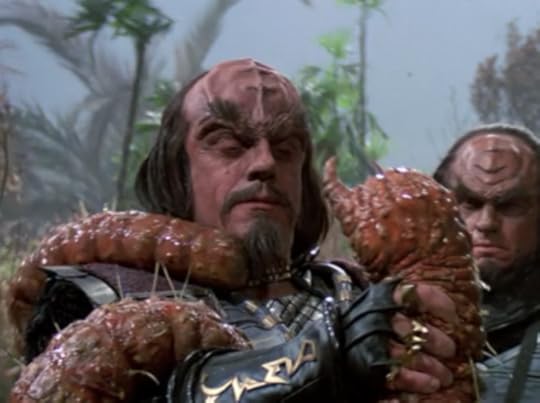
It looks like he just wanders into the mass of them like a complete Klingtard when he could've just blown them away with his phaser, but it turns out he saw fighting it with his bare hands as a challenge, and he also wanted to reestablish the fact that he's still the biggest and baddest among his crew. It's a warrior thing. It would've been nice if that had been explained in the movie because it just makes him look like an idiot there.
That doesn't mean the book was perfect, for there were a couple of fumbles. The purpose of Farrendahl and Tran escaping the merchant ship escapes me since there's no follow-up except a brief mention at the end that they were picked up. Farrendahl is a POV character in a few sections, and her relationship with Tran is set up, but I'm really not sure why they're in the book at all. It's possible they're in one of the many Star Trek novels, but the internet doesn't mention them as being in anything other than this, and I guess that settles the matter. Axing them completely from the movie was the right call.
This movie is peppered with more comedic moments than The Wrath of Khan but nowhere near as much as The Voyage Home. All of them are included in the book, though. The best parts on that score involve the crew's escape from Earth. McCoy trying to charter a flight to Genesis.
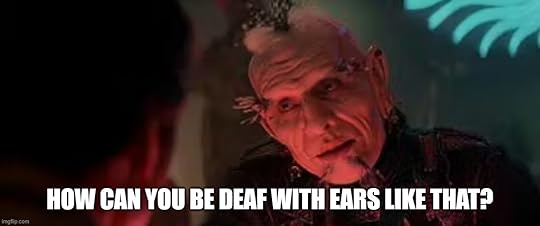
Kirk explaining McCoy's predicament to him.
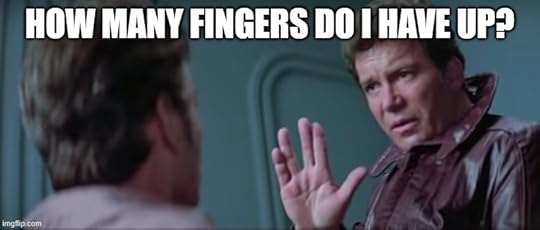
"That green-blooded son of a bitch. It's his revenge for all those arguments he lost."
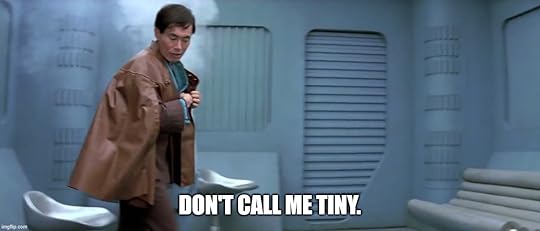
Sulu taking care of the guard.
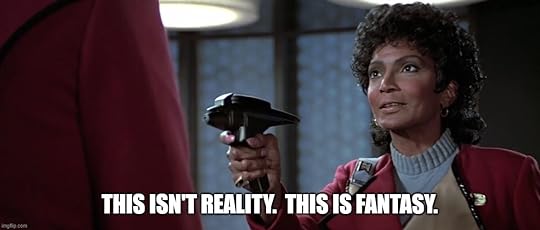
Uhura dealing with Mr. Adventure.
Scotty sabotaging the Excelsior.
...Okay, that exact shot wasn't in the book, but I had to add something for Scotty, and I already did "up your shaft" in my Star Trek Encyclopedia review (linked at the bottom of this one). Chekov doesn't have much going for him with witty lines in this, and Spock has no chance since he's in it for about three seconds, but both of them more than make up for it in the next installment.
I have several go-to scene's that play in my head when I just can't deal with someone or something anymore, and this movie provides one of them.
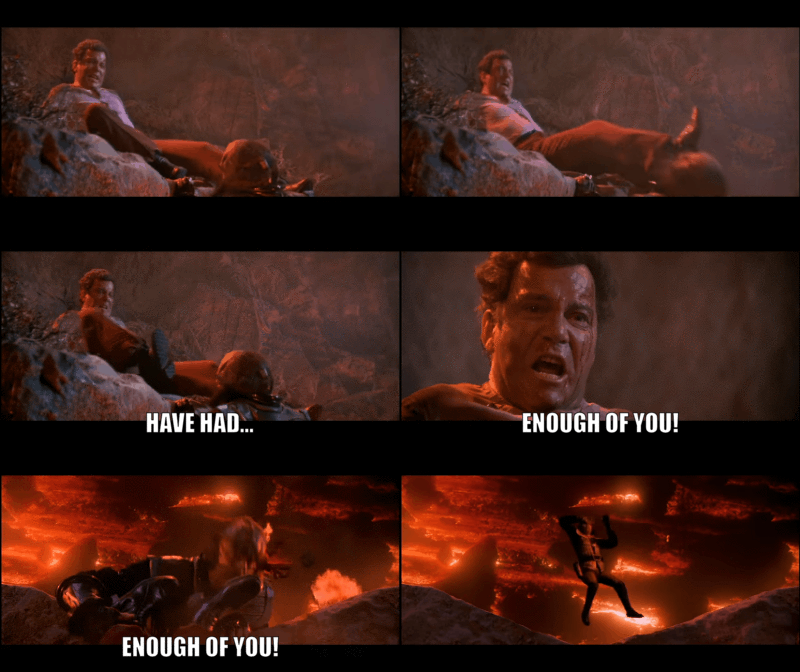
That works for an individual, but Darth Vader's merry march down the hall of the rebel flagship in Rogue One provides comfort when multiple people have irritated me beyond the bounds of sanity. (I revisit both of these several times during tax season, especially last year. Oof!) Dr. Claw...
...and Cobra Commander chime in when I have to deal with complete morons (singular and plural respectively), and Skeletor comes in handy too. But for the rage, it's Kirk kicking Kruge into perdition's flames that bring me satisfaction.
This is another book where I hemmed and hawed over putting it on the "liked movie better" shelf, but I think it belongs there for the face kicking scene alone. Besides, movies play out in my head as I read novelizations. I think if I didn't have the actors and scenery set in place, it wouldn't make as much of an impact. One thing's for sure, Vonda McIntyre is a great novelizationist, and I'm glad she did The Voyage Home too. J.M. Dillard's really going to have to bring his A-game when I get to Undiscovered Country. Same for Alan Dean Foster with Into Darkness, but I'm already not expecting much from him for some reason I can't define. I could've sworn I read something by him once before that left me underwhelmed, but hell if I can figure out what it was. Maybe I'm thinking of someone else. Only one way to find out.
Anyway, this book is worth your time if you're a fan of the movie.
Trek continued in Star Trek IV: The Voyage Home
All Star Trek novelization reviews corralled here.
This is my least favorite of the four original series movies I like, but I still enjoy it. The book adds depth to a lot of things, just like with The Wrath of Khan. In fact, the movie part of the book doesn't even start until page 80. Everything preceding it expands on various relationships in the Star Trek universe but not to the detriment of the main story. In fact, it adds to it. Events that happen later are more meaningful due to what was set up before. Also, matters that were rushed in the film are explained here and thus aren't quite so lame, like just what in the hell Kruge thought he was doing with that Genesis worm.
It looks like he just wanders into the mass of them like a complete Klingtard when he could've just blown them away with his phaser, but it turns out he saw fighting it with his bare hands as a challenge, and he also wanted to reestablish the fact that he's still the biggest and baddest among his crew. It's a warrior thing. It would've been nice if that had been explained in the movie because it just makes him look like an idiot there.
That doesn't mean the book was perfect, for there were a couple of fumbles. The purpose of Farrendahl and Tran escaping the merchant ship escapes me since there's no follow-up except a brief mention at the end that they were picked up. Farrendahl is a POV character in a few sections, and her relationship with Tran is set up, but I'm really not sure why they're in the book at all. It's possible they're in one of the many Star Trek novels, but the internet doesn't mention them as being in anything other than this, and I guess that settles the matter. Axing them completely from the movie was the right call.
This movie is peppered with more comedic moments than The Wrath of Khan but nowhere near as much as The Voyage Home. All of them are included in the book, though. The best parts on that score involve the crew's escape from Earth. McCoy trying to charter a flight to Genesis.
Kirk explaining McCoy's predicament to him.
"That green-blooded son of a bitch. It's his revenge for all those arguments he lost."
Sulu taking care of the guard.
Uhura dealing with Mr. Adventure.
Scotty sabotaging the Excelsior.
...Okay, that exact shot wasn't in the book, but I had to add something for Scotty, and I already did "up your shaft" in my Star Trek Encyclopedia review (linked at the bottom of this one). Chekov doesn't have much going for him with witty lines in this, and Spock has no chance since he's in it for about three seconds, but both of them more than make up for it in the next installment.
I have several go-to scene's that play in my head when I just can't deal with someone or something anymore, and this movie provides one of them.
That works for an individual, but Darth Vader's merry march down the hall of the rebel flagship in Rogue One provides comfort when multiple people have irritated me beyond the bounds of sanity. (I revisit both of these several times during tax season, especially last year. Oof!) Dr. Claw...
...and Cobra Commander chime in when I have to deal with complete morons (singular and plural respectively), and Skeletor comes in handy too. But for the rage, it's Kirk kicking Kruge into perdition's flames that bring me satisfaction.
This is another book where I hemmed and hawed over putting it on the "liked movie better" shelf, but I think it belongs there for the face kicking scene alone. Besides, movies play out in my head as I read novelizations. I think if I didn't have the actors and scenery set in place, it wouldn't make as much of an impact. One thing's for sure, Vonda McIntyre is a great novelizationist, and I'm glad she did The Voyage Home too. J.M. Dillard's really going to have to bring his A-game when I get to Undiscovered Country. Same for Alan Dean Foster with Into Darkness, but I'm already not expecting much from him for some reason I can't define. I could've sworn I read something by him once before that left me underwhelmed, but hell if I can figure out what it was. Maybe I'm thinking of someone else. Only one way to find out.
Anyway, this book is worth your time if you're a fan of the movie.
Trek continued in Star Trek IV: The Voyage Home
All Star Trek novelization reviews corralled here.

August 20, 2025
Huh. I've not actually watched the films, but as I was surfing I found out that Carol Marcus was 'entirely written out of' TSfS. Odd, because her role is fairly rich and important in the book. At least so far. It looks like, according to Wikipedia, there's a lot more in the book before the movie gets underway. I'm so exasperated with all this 'non-canon' stuff, though I respect why it happened and that I have to bear with it. I will finish this, and keep reading the series, since I inherited a big box from my brother.
---
Ok done. When do the books get good? Has my taste really changed that much, or my standards gotten higher? Or do I just have to be patient for the ones truly worth reading?
If this Genesis accelerated evolution stuff makes any sort of scientific sense, please illuminate me.
Lovely bits of writing encourage me to round this up to three stars. "The evening [in Scotland] was extraordinary. In the west, the sun lined the horizon from below in a thick ochre gold. The color shaded upward into a soft, intense, and glowing mauve.... What color did one name the region where the sky shaded from predominantly gold to predominantly violet?" (As it happens, I just read Sky Color, an all-ages book that beautifully illustrates the same concept.)
Also I do like Saavik. "If I understand them properly, anger and hatred are two very different emotions. And again, if I understand correctly - it is unusual to hate a person that one loves."
---
Ok done. When do the books get good? Has my taste really changed that much, or my standards gotten higher? Or do I just have to be patient for the ones truly worth reading?
If this Genesis accelerated evolution stuff makes any sort of scientific sense, please illuminate me.
Lovely bits of writing encourage me to round this up to three stars. "The evening [in Scotland] was extraordinary. In the west, the sun lined the horizon from below in a thick ochre gold. The color shaded upward into a soft, intense, and glowing mauve.... What color did one name the region where the sky shaded from predominantly gold to predominantly violet?" (As it happens, I just read Sky Color, an all-ages book that beautifully illustrates the same concept.)
Also I do like Saavik. "If I understand them properly, anger and hatred are two very different emotions. And again, if I understand correctly - it is unusual to hate a person that one loves."

May 15, 2025
the GRIEF!!!!!!!!!!!!!!!!!!!!! vonda is so so good at it. can't believe she's out here making art out of movie novelizations. she adds so much depth and complexity and nuance and tenderness to this, which is wild bc the script already had so much tenderness as-is??? her treatment of saavik specifically stands out, but everyone gets a chance to shine in this. everyone gets a chance to be ambiguously intimate with and unambiguously devoted to their friends. absolute legend. will be thinking abt this one for years

May 9, 2021
Again, this novel expands on the film's plot and characters, and does an amazing job. Specifically, David and Saavik's relationship was really explored here. I appreciated what McIntyre did with these characters, that the films did not.

May 25, 2009
(This review applies equally to Star Trek II The Wrath of Khan, Star Trek III The Search for Spock, and Star Trek IV The Voyage Home.)
In a move that (if I remember correctly) was rather unusual for the time, the Star Trek franchise created three films that were direct sequels: each stands alone as its own story, but they also comprise three parts of one overarching story, with all the events taking place over the course of just a few months.
In a wonderful turn of events, author Vonda N. McIntyre handled the novelization of each of the three films, and did a masterful job of adapting each one, creating a whole at least as good as the sum of its parts. Diving deeply into not just the events of the films, but the motivations and repercussions for the characters and the universe as a whole in each book, McIntyre's novels stand as a model of what successful movie-to-film adaptations should be, and all too often aren't.
In a move that (if I remember correctly) was rather unusual for the time, the Star Trek franchise created three films that were direct sequels: each stands alone as its own story, but they also comprise three parts of one overarching story, with all the events taking place over the course of just a few months.
In a wonderful turn of events, author Vonda N. McIntyre handled the novelization of each of the three films, and did a masterful job of adapting each one, creating a whole at least as good as the sum of its parts. Diving deeply into not just the events of the films, but the motivations and repercussions for the characters and the universe as a whole in each book, McIntyre's novels stand as a model of what successful movie-to-film adaptations should be, and all too often aren't.

July 6, 2021
The novelization of the movie is actually possibly better than the movie it is based on. A truly rare case, but then the film wasn't really that great. What the novel does is go much deeper into the relationships of the characters, fleshing them out, and adding some new and welcome scenes and characters to the story.
McIntyre isn't a spectacular writer but is a pretty good and clear storyteller, and the book makes a great job of centering Saavik as an important character exploring her relation to Spock, Kirk's son David and her own past as a half-Romulan in a way that works better than in the filmed version. David also gets a better role which makes his fate all the more impactful.
McIntyre also adds a lot of new material, in fact the film proper only starts late into the book, allowing a lot of context and a bridging between Wrath of Khan and this movie to take place in a way that is much better than in the film. She also goes deep into the story of the Klingons commanded by Kruge making the stakes much higher and particularly more understandable.
McIntyre isn't a spectacular writer but is a pretty good and clear storyteller, and the book makes a great job of centering Saavik as an important character exploring her relation to Spock, Kirk's son David and her own past as a half-Romulan in a way that works better than in the filmed version. David also gets a better role which makes his fate all the more impactful.
McIntyre also adds a lot of new material, in fact the film proper only starts late into the book, allowing a lot of context and a bridging between Wrath of Khan and this movie to take place in a way that is much better than in the film. She also goes deep into the story of the Klingons commanded by Kruge making the stakes much higher and particularly more understandable.

October 4, 2026
The Search for Spock
This was an excellent extension of the Search for Spock. It gave additional insight that the film wasn't always able to convey. The additional scenes really made a difference. The Enterprise crew returns home to a galactic controversy and Kirk must risk all to save his best friend and soul.
This was an excellent extension of the Search for Spock. It gave additional insight that the film wasn't always able to convey. The additional scenes really made a difference. The Enterprise crew returns home to a galactic controversy and Kirk must risk all to save his best friend and soul.

July 9, 2018
It's all the little extra backstory that makes these books a real pleasure to read. Though some of the sequences are still superior in the film version.

May 30, 2020
This novelization of the movie is nicely done.
August 11, 2026
mår SKIT! återigen, McIntyre och hennes förbannade förmåga att få en att bry sig om vem som helst i bakgrunden. JAG SAKNAR DAVID

February 27, 2022
Star Trek III: The Search for Spock is a novelization of the movie screenplay written and produced by Harve Bennett and adapted by Vonda N. McIntyre.
I have not reviewed too many movie novelizations before, mostly due to the fact that I generally don’t like them as much as original books. However, after the wonderful experience I had with J.M. Dillard’s The Undiscovered Country novelization, I thought I would give this one a try. The Search for Spock is up there as one of my favorite Star Trek movies, and I thought the book might provide some great insights…which it did!
The first 75 pages of this book is entirely new material. These are new scenes and new viewpoints that we never got in the movie. It does an excellent job of bridging the gap between the end of The Wrath of Khan and Search for Spock. Several characters are given viewpoints that the movie doesn’t, and I quite enjoyed them.
It isn’t just the beginning of the book that features original material. Throughout the book, each chapter includes new moments, new perspectives, and new mini-scenes that add so much to the movie. I’m surprised at how much Vonda McIntyre was able to include in such a short page count!
The two standout characters in the book are Savik and David. Both of them have lots of page time in this book, and their original scenes really added the most. David has this sense of despair about Genesis, as well as a burgeoning love for Savik. Savik has conflicted feelings about David, as well as mournfulness for Spock. Their interplay throughout the book was really great and made their moments in the movie so much more impactful.
Other characters also get new scenes and moments. Although they aren’t quite as impactful, they do provide some great context. Scotty has some time in the book to mourn his nephew who died during the battle with Khan, and he takes the opportunity to meet with his family. Uhura gets some pagetime and her escape in the movie makes much more sense now, as well as why she is already on Vulcan. Carol Marcus also gets some new scenes of her mourning her lover’s death, but those scenes were the weakest in my opinion.
The book does tell the story faithfully and does have the same tone and general flow. McIntyre does have a good handle of writing prose for Star Trek, which is why she wrote so many ST books. McIntyre’s description of Genesis and what it looks like was truly excellent and showed excellent skill at general science-fiction writing, not just adapting a screenplay. I would be interested in reading some of her other Star Trek and even original works after reading this book.
Overall, I really enjoyed this book. It was an easy and fast read, but it added so much context and history to the story! I give it a 9.5 ut of 10! Excellent work indeed!
I have not reviewed too many movie novelizations before, mostly due to the fact that I generally don’t like them as much as original books. However, after the wonderful experience I had with J.M. Dillard’s The Undiscovered Country novelization, I thought I would give this one a try. The Search for Spock is up there as one of my favorite Star Trek movies, and I thought the book might provide some great insights…which it did!
The first 75 pages of this book is entirely new material. These are new scenes and new viewpoints that we never got in the movie. It does an excellent job of bridging the gap between the end of The Wrath of Khan and Search for Spock. Several characters are given viewpoints that the movie doesn’t, and I quite enjoyed them.
It isn’t just the beginning of the book that features original material. Throughout the book, each chapter includes new moments, new perspectives, and new mini-scenes that add so much to the movie. I’m surprised at how much Vonda McIntyre was able to include in such a short page count!
The two standout characters in the book are Savik and David. Both of them have lots of page time in this book, and their original scenes really added the most. David has this sense of despair about Genesis, as well as a burgeoning love for Savik. Savik has conflicted feelings about David, as well as mournfulness for Spock. Their interplay throughout the book was really great and made their moments in the movie so much more impactful.
Other characters also get new scenes and moments. Although they aren’t quite as impactful, they do provide some great context. Scotty has some time in the book to mourn his nephew who died during the battle with Khan, and he takes the opportunity to meet with his family. Uhura gets some pagetime and her escape in the movie makes much more sense now, as well as why she is already on Vulcan. Carol Marcus also gets some new scenes of her mourning her lover’s death, but those scenes were the weakest in my opinion.
The book does tell the story faithfully and does have the same tone and general flow. McIntyre does have a good handle of writing prose for Star Trek, which is why she wrote so many ST books. McIntyre’s description of Genesis and what it looks like was truly excellent and showed excellent skill at general science-fiction writing, not just adapting a screenplay. I would be interested in reading some of her other Star Trek and even original works after reading this book.
Overall, I really enjoyed this book. It was an easy and fast read, but it added so much context and history to the story! I give it a 9.5 ut of 10! Excellent work indeed!

December 26, 2020
Wow! I was hooked. This book had a lot going on and I felt it wasn’t as focused as McIntyre’s Wrath of Khan. But what an emotional doozy. I can’t wait to read McIntyre’s take on The Voyage Home. Although I’m going to miss Saavik. I really like how McIntyre follows Saavik so closely in both Khan and this one. I’m going to miss Saavik in the next one—unless McIntyre makes that one about her too (here’s hoping).

December 25, 2019
not enough spock
reread edit: ok yes it's padded quite a bit but....goddamn, why was i so harsh on this the first time? i have no idea. i'd give this 3.5 stars if i could, because of some canon issues i don't quite agree with, but other than that? mcintyre can write a damn compelling star trek story
reread edit: ok yes it's padded quite a bit but....goddamn, why was i so harsh on this the first time? i have no idea. i'd give this 3.5 stars if i could, because of some canon issues i don't quite agree with, but other than that? mcintyre can write a damn compelling star trek story

Read
October 29, 2022I will always have a deep love for this film, despite its contributing one of my more heartbreaking moments as a child. Still, I can also admit that the movie has its flaws. As the middle act of an unintended trilogy it’s hard to stand on its own. When the predicating event that establishes the tone of the story has already happened and the ultimate ending point is going to leave things open ended and unresolved, you have challenges to deal with.
What I find impressive is how well these challenges are addressed in this and the book manages, despite its short length to add so much more content and context to the story. Where the movie may feel somewhat unfocused and not work as well, the novel has much more of the feel of a complete product. The movies are referred to as the accidental trilogy but the books actually feel like this was the intention all along.
First, I love that we see characters dealing with the trauma of Khan’s actions. Carol Marcus is actually still around, she doesn’t just vanish like she does in the movies and we get a front row seat to her confronting her grief over the death of her friends and colleagues on the Regulus lab. We get a great sequence of scenes involving Scotty traveling home to Scotland for his nephew’s funeral and there is much more of a sense of Saavik, McCoy and Kirk mourning the loss of Spock.
Speaking of McCoy, his transition is dealt with much more gradually as we get some kernels of odd behavior which more naturally progresses into his mental collapse from carrying Spock’s katra. His development as he struggles to figure out what is happening to him is very effective.
The issue of the Genesis planet and the dangerous instabilities are allowed to develop more slowly and as a result there is far more tension and dramatic weight to David’s ultimate confession about his shortcuts he took through the process. And his relationship with Saavik is so much better and more nuanced than we got on screen. That aspect of the story is light years ahead of what ended up in the movie and I think gives even more tragedy to the plot.
In fact I would say that in all, the book just feels like it takes more time to properly develop . And while the story does start and end in the middle of things, it seems to have much more going for it and at times I think it actually out-paces the movie.
What I find impressive is how well these challenges are addressed in this and the book manages, despite its short length to add so much more content and context to the story. Where the movie may feel somewhat unfocused and not work as well, the novel has much more of the feel of a complete product. The movies are referred to as the accidental trilogy but the books actually feel like this was the intention all along.
First, I love that we see characters dealing with the trauma of Khan’s actions. Carol Marcus is actually still around, she doesn’t just vanish like she does in the movies and we get a front row seat to her confronting her grief over the death of her friends and colleagues on the Regulus lab. We get a great sequence of scenes involving Scotty traveling home to Scotland for his nephew’s funeral and there is much more of a sense of Saavik, McCoy and Kirk mourning the loss of Spock.
Speaking of McCoy, his transition is dealt with much more gradually as we get some kernels of odd behavior which more naturally progresses into his mental collapse from carrying Spock’s katra. His development as he struggles to figure out what is happening to him is very effective.
The issue of the Genesis planet and the dangerous instabilities are allowed to develop more slowly and as a result there is far more tension and dramatic weight to David’s ultimate confession about his shortcuts he took through the process. And his relationship with Saavik is so much better and more nuanced than we got on screen. That aspect of the story is light years ahead of what ended up in the movie and I think gives even more tragedy to the plot.
In fact I would say that in all, the book just feels like it takes more time to properly develop . And while the story does start and end in the middle of things, it seems to have much more going for it and at times I think it actually out-paces the movie.

July 9, 2025
Star Trek III: The Search for Spock by Vonda N. McIntyre is nice, relaxing book for a warm summers day. This is part of the original Star Trek Original Series. It was famously made into a movie of the same title. So reading it brought back memories for me. I watched the Original Series in the 1960's with my mom. She loved William Shatner and Leonard Nimoy. We always enjoyed the crew of the Starship Enterprise and all the adventures they brought into our home every week.
In this episode, Spock is killed. However, right before his death, he was able to transfer his "essence" (essentially, his mind and internal consciousness) to Dr. McCoy. His body remained behind on a new planet called, "Genesis". Genesis was started by scientists who colonized it with life through a new scientific process that would encourage eco-systems, climate and plant life to flourish. In this environment, Spock regenerates and later, he is found in child-size form, suffering from not having use of his mind and growing rapidly due to the effects of Genesis.
It takes the Enterprise crew sometime to put this all together and realize they need to seek help from Spock's Vulcan parent to get his body melded back with his mind before he or Dr. Mc-Coy or both go insane from having to live in an incomplete state.
In the meantime, the Romulans are after the Genesis process, believing that it will serve their evil plan to take over the galaxy. In it's last battle, the Enterprise and crew must face the Romulan chief and get Spock to the planet Vulcan before it is too late.
It's a great plot, a wonderful story and the characters are fun and engaging. It has the typical subtle humor and human qualities we expect from Star Trek. This was fun and was happy to be a part of #booktrek so I could join in the summer Star Trek festivities.
In this episode, Spock is killed. However, right before his death, he was able to transfer his "essence" (essentially, his mind and internal consciousness) to Dr. McCoy. His body remained behind on a new planet called, "Genesis". Genesis was started by scientists who colonized it with life through a new scientific process that would encourage eco-systems, climate and plant life to flourish. In this environment, Spock regenerates and later, he is found in child-size form, suffering from not having use of his mind and growing rapidly due to the effects of Genesis.
It takes the Enterprise crew sometime to put this all together and realize they need to seek help from Spock's Vulcan parent to get his body melded back with his mind before he or Dr. Mc-Coy or both go insane from having to live in an incomplete state.
In the meantime, the Romulans are after the Genesis process, believing that it will serve their evil plan to take over the galaxy. In it's last battle, the Enterprise and crew must face the Romulan chief and get Spock to the planet Vulcan before it is too late.
It's a great plot, a wonderful story and the characters are fun and engaging. It has the typical subtle humor and human qualities we expect from Star Trek. This was fun and was happy to be a part of #booktrek so I could join in the summer Star Trek festivities.

February 21, 2021
A solid 3 stars from me. It's not a bad read, but it's the least polished of the novelizations thus far, and has a tendency to drone on somewhat meaninglessly.
There's a good deal of additional backstory worked in, which is entertaining, but some of it makes no sense at all. Transporting is "expensive"? Scotty is absolutely vicious to his niece? The Klingon cloaking device makes the people inside appear transparent to one another and often drives them insane? (Um. A theoretical cloaking device simply bends light around an item to make it invisible, it doesn't change its molecular structure.) Klingons' forehead ridges flare, lift, and flatten with emotion? Yikes.
The writing often becomes painfully stilted for a paragraph or two at a time, as though bits are still in draft form: Person does action. Other person does other action. Person does another action. Person has a feeling or sensation. Other person does another action... Then the writing will pick back up again, with varied, flowing sentences that seem to actually have some thought put into them. It's very odd. Perhaps the author was being rushed and didn't have time to return to some of her draft work?
That said, it's a rich novelization that works hard to flesh out and provide dimension to even the film's minor characters. It's definitely worth the read to get some interesting backstory for Saavik, David, Kruge, and Valkris. (If you don't remember who the heck Valkris is, that's fully understandable.)
I also appreciated the insight into Sulu's feelings about his Captaincy and Uhura's thoughts as she handled Lt. Heisenberg. One of these days, one of these novels will give some insight into Chekov's thoughts, too...
There's a good deal of additional backstory worked in, which is entertaining, but some of it makes no sense at all. Transporting is "expensive"? Scotty is absolutely vicious to his niece? The Klingon cloaking device makes the people inside appear transparent to one another and often drives them insane? (Um. A theoretical cloaking device simply bends light around an item to make it invisible, it doesn't change its molecular structure.) Klingons' forehead ridges flare, lift, and flatten with emotion? Yikes.
The writing often becomes painfully stilted for a paragraph or two at a time, as though bits are still in draft form: Person does action. Other person does other action. Person does another action. Person has a feeling or sensation. Other person does another action... Then the writing will pick back up again, with varied, flowing sentences that seem to actually have some thought put into them. It's very odd. Perhaps the author was being rushed and didn't have time to return to some of her draft work?
That said, it's a rich novelization that works hard to flesh out and provide dimension to even the film's minor characters. It's definitely worth the read to get some interesting backstory for Saavik, David, Kruge, and Valkris. (If you don't remember who the heck Valkris is, that's fully understandable.)
I also appreciated the insight into Sulu's feelings about his Captaincy and Uhura's thoughts as she handled Lt. Heisenberg. One of these days, one of these novels will give some insight into Chekov's thoughts, too...
January 25, 2023
I just finished re-reading the Star Trek II novelization two days ago, yesterday I re-watched Search for Spock (for what feels like the eight thousandth time), and today I read the III novelization for the first time ("What we did in there, we did in a day"-Carol Marcus about Genesis Stage II, me about reading this entire book in 12 hours).
This really is what a great novelization should be: still containing the plot, dialogue, and events of the film, but expanding on the worldbuilding, giving greater motivation to characters' actions and decisions, and letting us hear their internal dialogue in a way that a film just can't. Watching the movie and reading this almost immediately after made the whole experience of this feel so complete and well-rounded. III is one of my favorite movies because I watched it a bunch at a formative age, but I can also acknowledge that the film version has a zillion plot holes. The novel does a great job filling just about all of them, plus serving almost as a II.5, with the first 80 pages or so filling in the events of the few weeks that elapse between Wrath of Khan and this film.
I would absolutely recommend this book in tandem with watching the film, or if you've already seen the film, or I guess if you haven't seen or don't plan on watching the film. Idk. Just read it.
This really is what a great novelization should be: still containing the plot, dialogue, and events of the film, but expanding on the worldbuilding, giving greater motivation to characters' actions and decisions, and letting us hear their internal dialogue in a way that a film just can't. Watching the movie and reading this almost immediately after made the whole experience of this feel so complete and well-rounded. III is one of my favorite movies because I watched it a bunch at a formative age, but I can also acknowledge that the film version has a zillion plot holes. The novel does a great job filling just about all of them, plus serving almost as a II.5, with the first 80 pages or so filling in the events of the few weeks that elapse between Wrath of Khan and this film.
I would absolutely recommend this book in tandem with watching the film, or if you've already seen the film, or I guess if you haven't seen or don't plan on watching the film. Idk. Just read it.

August 27, 2019
A brilliant, well-written novelization of the third Star Trek film.
After Spock's death in the previous installment, everyone is still grieving- no one can believe it.
Saavik and David (Kirk's son) are sent down to the Genesis planet to investigate its environment, and there they find something incredible.
As is with many other film novelizations, the film was basically playing out in my head while I read this. However, unlike other movie novelizations I've read, this wasn't a direct adaptation of the film- Ms. Vonda McIntyre not only added more detail to the existing movie scenes, but expanded on and incorporated chapters from subplots that weren’t even in the film- It’s sort of like rewatching the film with alternate takes and deleted scenes. I love it because of that.
Star Trek III: The Search for Spock/i> is a great, entertaining and action-packed novelization of its namesake SciFi Star Trek film.
After Spock's death in the previous installment, everyone is still grieving- no one can believe it.
Saavik and David (Kirk's son) are sent down to the Genesis planet to investigate its environment, and there they find something incredible.
As is with many other film novelizations, the film was basically playing out in my head while I read this. However, unlike other movie novelizations I've read, this wasn't a direct adaptation of the film- Ms. Vonda McIntyre not only added more detail to the existing movie scenes, but expanded on and incorporated chapters from subplots that weren’t even in the film- It’s sort of like rewatching the film with alternate takes and deleted scenes. I love it because of that.
Star Trek III: The Search for Spock/i> is a great, entertaining and action-packed novelization of its namesake SciFi Star Trek film.

June 6, 2018
This doesn't quite reach the heights of The Wrath of Khan, but then nothing ever does for me in Star Trek. Still, it's an extremely entertaining follow-up - McIntyre is a reliably excellent writer in this franchise - and this is one of the very few times in the speculative genres that I'm prepared to overlook the reset button and see a beloved character brought back to life. The reset button is an overused trope that I often really dislike... but not here. Yes, it's fickle of me, no I don't care. The relationships between Kirk and Spock and McCoy, and between Spock and Saavik, and Spock and Sarek, are all interesting and sympathetic. My favourite part, though, has to be the arrival at Mount Seleya and all those Vulcans turning up to witness the incipient resurrection. For all the prejudice Spock has encountered from his father's people, for all he's internalised so very much of it, seeing him finally valued in this way is genuinely touching.

September 2, 2022
The hardest thing about Star Trek III The Search For Spock is that so many of the primary characters are completely sidelined. Spock is dead, of course. McCoy is out of his mind. Uhura is hiding out on Vulcan while the remaining crew are in the background trying to make things happen behind the scenes in getting to Genesis. For instance, you know that Scotty did something clever in the bowels of Excelsior, but it’s not clear what he had been up to. I imagine writing a book based on a movie is a unique challenge, being largely confined to the script. Still, I’m glad it retained one of the best lines in all Star Trek:
Jim knelt beside the cot.
“Jim—“ McCoy said.
“Shh.” He raised his hand, shielding it from the surveillance camera. “How many fingers”?”
His fingers parted in the Vulcan salute.

April 10, 2025
I'm sure I read this one as a wee lad (applies also to the rest of these novelizations), and probably missed a lot. Another good adaptation of a bad movie, though this is probably the best of the odd numbered abominations that are the Star Trek films.
Saavik continues to be expounded upon, as does David Marcus, as does McCoy, who really shines in this one. It was a film, so Kirk and Shatner had to get first billing, but if this was an episode, it'd be a McCoy episode and DeForest Kelley would've gotten a chance to spread out more.
I'm probably going to have to rewatch these for the sake of comparison, aren't I? Good think I'm flat out refusing to give Star Trek V a shot. I hate Star Trek V. It's the worst.
(Also this one was rough to read because the ebook I was using had some definite formatting issues, but that's on me...)
Saavik continues to be expounded upon, as does David Marcus, as does McCoy, who really shines in this one. It was a film, so Kirk and Shatner had to get first billing, but if this was an episode, it'd be a McCoy episode and DeForest Kelley would've gotten a chance to spread out more.
I'm probably going to have to rewatch these for the sake of comparison, aren't I? Good think I'm flat out refusing to give Star Trek V a shot. I hate Star Trek V. It's the worst.
(Also this one was rough to read because the ebook I was using had some definite formatting issues, but that's on me...)

July 29, 2021
The Movie and Then Some
I don’t know that I would say this is better than the film but there’s certainly a lot more in the book than the film brought out. I enjoyed reading about the romance between Saavik and David in the first half of the book, which really added to the heroic moment of sacrifice later in the story. The book moves at a slow pace but not a boring pace by any means. You almost think the book is about David more than Kirk in some ways and it adds a new layer to the strained father and son dynamic that we find between Kirk and his estranged child. I think I may have personally enjoyed this a little more than the movie, but I see it more as a commentary to the film than a strict adaptation. Quite enjoyable.
I don’t know that I would say this is better than the film but there’s certainly a lot more in the book than the film brought out. I enjoyed reading about the romance between Saavik and David in the first half of the book, which really added to the heroic moment of sacrifice later in the story. The book moves at a slow pace but not a boring pace by any means. You almost think the book is about David more than Kirk in some ways and it adds a new layer to the strained father and son dynamic that we find between Kirk and his estranged child. I think I may have personally enjoyed this a little more than the movie, but I see it more as a commentary to the film than a strict adaptation. Quite enjoyable.
July 29, 2026
Read the whole thing during a power outage while out of town. For a book called "the search for Spock" it's barely about Spock. I do appreciate all of Jim Kirk the most in this novel, just reaching out for anyone close to him but no one matches his t'hy'la. Also Sarek being like "omg I thought you were the chosen one, wdym it's this random guy?" Was very funny to me. ALSO loved how Sulu got more of a starring role.
Hot take hot take. I really didn't care for David. Now knowing that pretty much everything was his fault is crazy. But he's also a kid(my age) so I also sympathize with him at least in his impulsiveness. Saavick my goat my diva my shining rose.
Really excited for the amnesia hurt/comfort Spirk fanfic that is "the voyage home"
Hot take hot take. I really didn't care for David. Now knowing that pretty much everything was his fault is crazy. But he's also a kid(my age) so I also sympathize with him at least in his impulsiveness. Saavick my goat my diva my shining rose.
Really excited for the amnesia hurt/comfort Spirk fanfic that is "the voyage home"
This entire review has been hidden because of spoilers.

October 6, 2017
I really appreciated the first 80 or so pages of this book which were pretty much a Star Trek 2.5 as it filled in the events from 2 to 3 for what short period of time it was. Sulu's struggle with losing the Excelsior due to the events of the Genesis Planet was also something I appreciated. I was surprised at the length of the book at first but really enjoyed what was added (or taken away from the film) that gave it that much greater depth to each character (minus Chekov, who was...there) despite it not being "canon".
Displaying 1 - 30 of 122 reviews