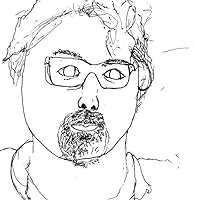
A major new monograph on the work of celebrated and controversial British artist Grayson Perry. Grayson Perry, famous for his ceramic vases decorated with shocking and unconventional imagery, is one of a generation of contemporary British artists to have emerged on the international stage in the last two decades. He rose to fame in 2003 when he won the prestigious Turner Prize and collected the award wearing a lilac babydoll dress and red pumps. His hard-hitting yet exquisite work, which includes prints, embroidery, sculpture, drawings, and ceramics, references his own upbringing and his life as a transvestite as well as engaging with broader issues such as war, religion, and sex.
This lavishly illustrated monograph explores Perry’s work through a discussion of his major themes and subjects, and the text is complemented by a series of intimate, insightful commentaries on individual pieces by the artist himself. The book features some 150 of Perry’s works as well as a rich selection of the visual material that has inspired him, from Afghan war rugs, medieval altarpieces, and satirical prints to the paintings of Pieter Brueghel, Anselm Kiefer, and the American Outsider artist Henry Darger. With an up-to-date biography, bibliography, and exhibition history, this definitive book is the first to explore fully the achievements of Perry’s twenty-five-year career. 300 color illustrations
As a great Grayson Perry fan I found this a very entertaining read. Loved his take on the world, and finding out what makes him tick (personally and artistically) was fascinating. Thoroughly enjoyed it.
So, I dunno what the formal definition is, but if you'd asked me what mine is, I'd say conceptual art is art you don't need to see. That is, if someone just tells you about it, you gain nothing by actually then going and looking at it. Examples would be Equivalent VII, which is a pile of bricks (not bricks in a particularly pleasing arrangement, just a boring set of bricks on the floor) or Piss Christ, which is a crucifix in a glass jar full of urine. The former just says, "Anything I call art is art because I say so, because I'm artist." The latter says, "I can't be bothered to do anything artistic so I'm just going to try to shock you." Wasting time/money going to see either does not benefit one once you've been told about them. Contrast with The Haywain - hearing it described doesn't remotely replace actually seeing it.
But Perry Grayson fairly aggressively claims to be a conceptual artist in the early part of this book and there is definitely more to be gained from seeing his work than just hearing it described. This made me think a bit and I concluded that there's a kind of second tier of highly intellectual art that nevertheless benefits the viewer's time and attention. This doesn't make it worse, in my view (quite the opposite) but it's art that isn't purely a concept that doesn't need to be physically present to achieve its aims. Later in the book, Perry very much lays claim to the craft of his work (mainly pottery) which also runs counter to my notions of conceptual art, as does the extensive social, religious and political commentary and autobiographical content. He talks about not liking the idea of an artist who merely has the idea and gets his "assistants" to actually make it. (Damien Hirst gets called out in this context.)
Perry's work is typically very dense with imagery, some of which is recurring across many pieces, becoming a personal iconography and because usually a continuous surface in three dimensional space, photos struggle somewhat to capture everything. Actually seeing a Perry pot is the best way to appreciate it - the antithesis of my definition of conceptual art. On the other hand, Perry's own commentary on the work is extremely helpful in understanding what is going on in it and often times more interesting than the actual object - veering back towards the conceptual.
The book itself is a thorough and comprehensive look at Perry's career, divided into thematic sections but also illustrating Perry's changing attitudes as he has grown older and I can highly recommend it if you are interested in his work.
A comprehensive look into Perry's art, life, ideas, technique and artistic process. I thoroughly enjoyed it and would recommend to any Perry's fan. I read the revised and updated version. It contained a lot of the artist's work in wonderful detail!
My wife enjoys sculpting in clay and Grayson Perry has been a person of interest for years. During lockdown his art programs on channel 4 were a highlight of the TV week. This book was interesting because when I look at his work en-masse I realised that I don’t actually like a lot of it and some of the explanations didn’t really make sense. To be fair I am more interested in figurative potters such as Sally Macdonald, but this still surprised me, as I often like some of his individual items, perhaps they just had novelty value.
A brilliantly put together anthology of Grayson Perry's many many works (wow has that guy been busy!)
Jacky Klein provides an overview at the beginning of each chapter, with discussions of that aspect of Perry's life or work featured, then she lets the work speak for itself with Perry's explanations against each piece.
The photographs are extremely high quality with varied featured pieces, including ceramics, tapestries, digital drawings, friezes, clothing, sculptures and finally "the house"!!
Highly recommended if you're into Perry's art or if you've watched Grayson Perry's Art Club and enjoyed it. Brilliant.
A comprehensive look into Perry's art, ideas, technique and artistic process. Covers big known and less known works. Good pictures and well commented. the new edition of 2020 includes updated chapters on identity. Highly recommended.
Well I enjoyed this extremely large and heavy paperback from World of Books which arrived on Friday. I have spent the weekend diving in and out of it and I really really enjoyed it. The photographs were absolutely superb.
Grayson may not be the best potter in the world but I love his work, some of it I get and understand and some of it I don't. I think he is brave to be standing up as a transvestite as generally they don't get thought of too highly by people out there in the big world because they are so different, I love the fact that he can wear "trashy" dresses which have a theme on them if you look very closely. I even love Alan Measles, and after reading about his childhood I can understand why Alan figures so much in his life.
All in all I just love Grayson Perry, and I also love him for all the work he put into Art Club over lockdowns, he is right in that art takes you out of yourself and you find a way to release tension and pain and fear and boredom by just picking up a brush or a pencil and having a go. I did. I went out and bought a drawing pad, rubber and pencils, then sat with a blank space in front of me and couldn't think where to start, so I started with my childhood. My efforts are definitely an E but I don't really care, they helped me to take me "out of myself" and bring some peace. So well done Grayson, and thank you.
I came across Perry's work on Pinterest and have become a big fan. I totally identify with the soul-searching aspects of his work... plus the works are beautiful and insightful commentaries on segments of life in our society.
Beautifully produced, comprehensively structured monograph...well-written, thorough essays, and every piece presented comes with a long, thoughtful presentation by Perry. The experience being like a private tour through a career retrospective, with the artist and 6 expert critics as guides.
A look into Grayson Perry’s work, the ideas behind it and offers some insight into how he feels and thinks. I know Grayson Perry a little better now and I like.
It's a mammoth tribute of self-indulgence to an artist who claims far more introspection than can be observed in its 279 pages, but it is also a uniquely formatted window into one of the more (not most) influential figures on the contemporary art scene. There is something annoying about Perry, a sort of self-pity masquerading as self-deprecation, that makes reading him rather difficult. He has a tendency to claim great enlightened truth whilst saying small minded things; a good example is his remarks that Greek pots "have a matt, lumpy quality and look a bit like they've been made with poster paint... such a cliche". This is of course just his humble opinion, but it's the sort of opinion that one hears from bored teenagers on school trips - there is always an undertone in Perry's work that all the later chapters are just reworkings of Chapter One, 'beginnings'. The approach is thematic, which always hinders seeing progression, but the same motifs, beliefs and stylistic features occur again and again and again. (Honest to God, if I never hear the words Alan Measles again it will be too soon.)
That said, one can't be too hard on Perry overall, merely on what the work exposes about him. There is a similar effect to a magician explaining his tricks, or more aptly, a minor celebrity entering the Big Brother House. The intensity of exposure on his thought processes and the vastness of his thirty years of work means that it has a distinctly uncurated feel, utterly unlike the careful selections made in art exhibitions. Rembrandt's late works can all feel a bit same-same too, if you look at them as a block.
Overall, this book is so large that I would only recommend it to dedicated Perry fans and students, or as a flick through picture book (the quality and quantity of the images are incredible). Having read all of it, it has damaged my awed opinion of Perry, that I largely picked up when viewing his exhibition in Margate. However, there are few times in art history where we get to see the thoughts of the artists on every one of his or her major works, and whilst it breaks the mystery, it is a unique contribution to how we approach art. (It raises for me interesting questions of how far one wants to interpret art through the eyes of the artist, and whether art pieces are less remarkable if they exist in an oeuvre of mediocre works.) Above all, this book as a working embodiment of Grayson Perry - simply too much of the same thing.