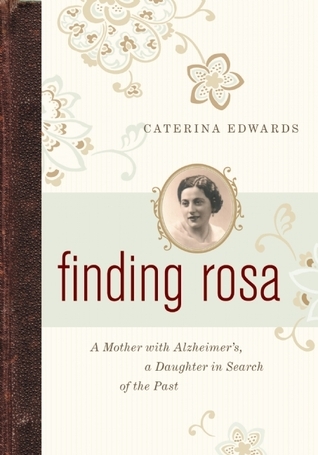
When her mother, Rosa, begins to show signs of dementia, Caterina Edwards embarks on what turns out to be a search for the meaning of the past and of home. During the four years she cares for her mother, Edwards must navigate between conflicting responsibilities while dealing with her mother's troubled mind and her own exhaustion. This frank memoir tells a complex story of two women in crisis, one struggling to maintain a sense of self, the other seeking to understand and accept both her past and her present.
Finding Rosa is part memoir, part history lesson, part detective work, about the author's years of caring for her mother with deteriorating Alzheimer's, while trying to piece together the history of her mother's life. Complicating things, Rosa's homeland no longer exists. Istria is now mostly Croatian, but also belonged to Austria, Italy and Yugoslavia all in rapid succession. The Istriani are described as the 'forgotten Italians', and the author learns of atrocities and ethnic cleansing, hundreds of thousands of displaced refugees, and unknown numbers missing or murdered by being buried alive in 'le foibe' (deep sinkholes). She makes several trips to Trieste and her mother's homeland to visit relatives and interview 'i rimasti' (the remaining ones) and finds public records have been destroyed to hide the evidence of missing persons. Since I know a few Istriani, I knew about some of the things that happened in Istria's history, but I did not know the extent of the horrors or the fact that displacement happened not once, but 3 times in the 20th Century. Brutally honest, Finding Rosa pieces together Rosa's life, as we slowly begin to understand her angry, hypercritical, dictatorial personality and also her fear and paranoia. It also explores the challenges of caring for a parent with Alzheimer's, the effects of displacement on future generations and the importance of making the truth known. Ciao, Cristina
Excellent book that more than delivers on its promise. Caterina Edwards' story is about her mother, but also about Edwards' odyssey to learn about her mother's past. By the time Edwards is ready to discover who her mother really is, Rosa is suffering from Alzheimer's. Further complicating Edwards' quest, Rosa's homeland, Istria, has basically been wiped off the map, making historical research particularly challenging. Edwards is left trying to piece together the history of a woman whose personal history is disappearing, and whose country has already disappeared. And the reader is left with a moving story about family, love, and loss.
I loved this book on so many levels: a human interest story about the conflicted relationship between a daughter and her mother; a historical and genealogical exploration that rediscovers, explains, imagines and enlivens a lost world; a window into the life of one writer; instruction in the craft of writing creative non-fiction that draws on a multitude of disciplines--archival research, oral history, memoir, biography, travel writing, and more.
Caterina Edwards is teaching a writing family history course in Calgary in May. I was interested, so checked out her book. Now I'm convinced.
True story. Understanding that her mother has Alzheimer’s, Caterina Edwards tries to find out her past. And uncovers many things that were never known: exactly how old was her mother? Are the stories she tells true or just stories? She learns of the family’s past in Istria (now part of Croatia, but owned by many, in rapid succession). And many times, she's unable to answer her questions, but does have a better understanding of her mother and her mother's past in a war-torn country.
A fantastically researched book on the history of Istria, but I found all the dates and names and politicians to be dry reading. The plot of losing her mother mirrors the way Istria was lost to history, but overall, I wish she had written two books: one that compiles all the facts she found and one that has the story of her mother with a simpler rendition of Istrian history woven in.
What is it about a hypercritical, withholding parent that makes us forever seek their approval? In this moving, multi-layered memoir—part history, part genealogical exploration—Caterina Edwards painstakingly explores her conflicted relationship with her mother Rosa, a woman ruled by a “foolish, frightening anger.”
The roots of Rosa’s discontent lie partially in her displacement. Like thousands of Italians in WW11, she was displaced from her home—in this case Istria, a virtually unknown land that is now part of Croatia. Relocating from its sunny shores to frigid Edmonton, Rosa not only has to cope with the loss of her beloved homeland, but also a loss of status. As a young girl, she worked as maid in upper class homes, and aspired to be like the refined gentlewomen she worked for, the Chatelaine. As Edwards writes:
“I found the prototype in nineteenth-century novels—the lady, modest, sheltered and accomplished, who knew how to run a household, who knew how to command servants, who could entertain dinner guests with a turn at the piano, who could exchange witty conversation with her head bent becomingly over her embroidery ring. A lady fulfilled by her service to her husband, her children, and her aged parents.”
Determined to mold her young daughter into this antiquated ideal, Rosa becomes a domestic dictator, enforcing a set of draconian rules. Nothing Edwards does is good enough. Her cleaning isn’t up to “sparkling standards.” Her fashionable clothes are vulgar. Her bureau drawers are upended if the contents are not neatly folded. All to the cry of Rosa’s favorite favourite insult, “Buona da niente” (Good for nothing!) followed by the scathing, “You’ll never become a woman.”
When Rosa begins to show signs of dementia, Edwards takes on the role of caretaker and makes a room in her house. Rosa’s memory may be going, but her criticisms are as stinging as ever. In one of the book’s most poignant passages, Edwards receives a morsel of praise she has been hungering for— a few months before her death, Rosa grants her the long withheld “thank you”.
At times, Edwards can come across as a little too self-sacrificing. But her poetic prose, along with her ability to weave together disparate narratives, elevates her story far above the clichéd ‘mommy dearest’ confessional into the realm of fine literature. At the end, Edwards has a quiet pride in knowing that “by nature and design” she has “become her own woman”—nothing like her mother. For anyone who longs to understand—and overcome— the effects of a difficult parent, Finding Rosa is an essential read.
Per tanti dei profughi istriani, cacciati sia dagli italiani che dai croati-sloveni, abbandonare le proprie case e i propri averi fu un duro colpo. I più ricominciarono vita emigrando in Australia, Argentina o Stati Uniti. Ci fu chi persino occultò il proprio passato.
Cosa è significata questa migrazione almeno per sua madre ce lo spiega Caterina Edwards. Inizia nella sua narrazione parlando del difficile rapporto avuto fin fa bambina con lei, risultata sempre scontrosa e intrattabile.
In seguito alla diagnosi di Alzheimer della mamma in età avanzata, l’autrice ha voluto andare a fondo, scoprire chi fosse nel profondo, capire se fosse stata così di carattere fin da bambina o se qualcosa l’avesse cambiata nel tempo.
Le sue ricerche l’hanno portata a Lussino, in Istria (amata, perduta patria, la sorgente della nostalgia) e ad un passato soppresso, nebuloso, distante.
Caterina intraprende un lungo viaggio nel tempo e nell’anima, consapevole che solo la memoria del passato conferisce un senso al presente.
Una testimonianza a tratti amara che consiglio a chi ama le storie famigliari e a chi cerca di comprendere la realtà storica di quegli anni.