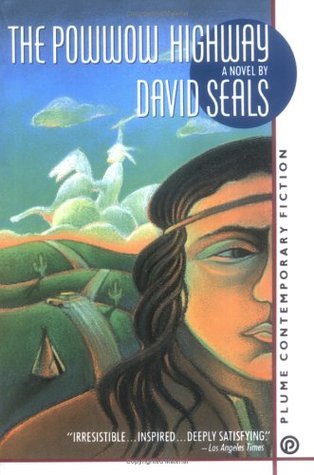
Philbert Bono and Buddy Red Bird are about to prove that the spirit of the great Cheyenne warriors is still alive and kicking. Their "war pony," a burned-out, rusty, '64 Buick LeSabre, has left a trail of dust from Montana's Lame Deer Reservation halfway down Interstate 25 toward New Mexico. It's a journey of enlightenment, a quest for greatness... and it just might be one of the wildest, funniest, most outrageous rides you've ever been on - a beer-guzzling, joint-smoking, staggering gallop down that twisting road to self-discovery... The Powwow Highway
A powwow is an event of profound inner peace and singular power. At the powwows I have attended, in Delaware and Maryland and Virginia, the opening warriors’ march and the fancy dances evoke Native American pride in an impressive heritage, coupled with determination to prevail in the face of modern challenges. I was a bit surprised, therefore, to find that David Seals’s 1979 novel Powwow Highway, while powerful, has almost nothing peaceful about it. Seals’s book is a loud, raw, rude, crude, uncompromising, in-your-face look at the issues confronting modern Native Americans; and therein, I think, lies the book’s considerable value.
The Powwow Highway is a picaresque narrative, a story of voyage and return, featuring two Native American men with different yet converging approaches to their heritage. Philbert Bono, a 300-pound man whom many people look at only in terms of his weight, is at heart a Cheyenne warrior of his Indigenous nation’s greatest days, though his “war pony” is only a badly malfunctioning 1964 Buick LeSabre. Buddy Red Bird, a college-educated Vietnam veteran, aligns with the militant American Indian Movement (AIM), and stands against many of the “official” tribal leaders of his region, whom he views as sell-outs to white authority. Author Seals, himself a former AIM member, may identify with Buddy’s contemporary militancy; but he seems also to respect Philbert’s odd, quirky version of traditionalist Native American spirituality.
When Buddy’s sister Bonnie finds herself in legal trouble in New Mexico, Buddy enlists Philbert on a mission to drive down from the Cheyenne lands of Montana to rescue Bonnie from her Southwestern imprisonment. Philbert is willing, but there is a catch: Philbert wants to use the journey as a chance to visit major sites of Native American history, so that he can identify spiritually with the courage and suffering of fellow Native Americans at places like Wounded Knee. Buddy is impatient with Philbert’s, shall we say, indirect way of proceeding from the Northern Cheyenne Reservation to Santa Fe; but Philbert has the car, and Buddy has the money (tribal funds diverted from their intended use). Therefore, these two very different men have to find a way to work together.
The conflicting perspectives of Buddy and Philbert come forth with particular strength in a conversation late in the novel, when, driving past the nation’s largest power plant in Wyoming, Buddy states that the whites “ain’t gonna feel guilty about what they done much longer. They need our coal, our oil, our uranium. They’re hungry, man!”, and insists that the whites will, as always, get what they want. Philbert replies serenely that “Wihio the Trickster won’t let them, for Wihio is also the creator of the universe. He will play a little trick on the whiteman, you wait and see” (p. 201). Thematically, Seals may be seeking to reconcile Philbert’s cultural traditionalism and Buddy’s contemporary militancy.
Buddy’s and Philbert’s adventures often bring some chaos into the outwardly genteel respectability of white U.S. society. In these scenes, Seals may be suggesting that the placid and prosperous façade of modern American life was founded upon a centuries-long process of tyranny and oppression by which the original Americans, the Native Americans, were dispossessed of their land, confronted with the danger of annihilation, and reduced to a state of poverty and social dislocation. When Buddy and Philbert, or other Native American characters from the book, visit that chaos upon white America – as when Buddy and Philbert make an ill-fated visit to an electronics store in search of a stereo system for their Buick – it is as if they are offering some payback, fighting the latest rear-guard action of the old “Indian wars.”
Comparing The Powwow Highway with the work of other modern Native American writers, I find that Seals’s workmanlike prose lacks the poetic quality that one sees in the work of Sherman Alexie, and that his plotlines are not as tightly constructed as what one sees in the work of Martin Cruz Smith. The humor of the book sometimes seems forced, and Seals also shows an unfortunate tendency to depend a bit too much on onomatopoeia, as when he describes the sound of a knife striking a basketball backboard during a tense scene of confrontation between the AIM-affiliated Buddy and a tribal leader who uses muscle-bound goons to intimidate the tribal population. “DANG-FHWOPP! fhwop-fhwop-fhwop-fhwoppppp!” (p. 150) Really? The following passage – “Something struck the basketball backboard over their head. The music stopped. A hush settled over the gym….A huge Buck knife was throbbing from the board where someone had thrown it. It was embedded two inches in the wood” (p. 150) – says what needs to be said, and says it well. Seals has a good story to tell, and there were times when I thought he was trying too hard to tell it.
Yet The Powwow Highway possesses vivid characterizations, and tells a story on behalf of people whose voices often go unheard. Part of why The Powwow Highway speaks to me at this time is because I read it at the time of the standoff over the Dakota Access Pipeline, a proposed underground oil pipeline that generated widespread Native American protests when the pipeline’s designated route was moved closer to areas of the Standing Rock Reservation that are considered sacred by the Indigenous people of the reservation. Images of violence against the Standing Rock protesters provided a haunting echo of other times when Native Americans, outnumbered and outgunned, have fought for their survival.
The Powwow Highway also commands attention because of its 1989 film adaptation. Along with providing the debut role for a young Wes Studi, the film Powwow Highway is noteworthy as the first of a number of feature films - Thunderheart (1992), Smoke Signals (1998), Skins (2002) - that focused upon the real-life problems facing contemporary Native American communities, and that featured Native Americans both as actors in front of the camera and as creative personnel behind the camera.
The uncompromising qualities of The Powwow Highway are, I think, there for a reason. Seals wrote this book almost 40 years before the Dakota Access Pipeline protests, but I think he would have been the first to say that, for modern Native Americans, the struggle for rights and justice and survival itself continues.
This is a really great road trip book along the lines of Dharma Bums or On the Road. I had seen the film adaptation made by George Harrison's Handmade Films. I really liked the film but I love the book. The writting style is similar to Kerouac but origional at the same time. One really feels as if they are riding along side Buddy and Philbert (and Philbert's poney Protector) as their adventure unfolds. It's a really great read to be sure!
Some people won't like this book because of the profanity, violence, sex, racial antagonism, and drug culture portrayed here. But our culture would miss out if everyone wrote like Louisa May Alcott. This is a very engaging story that can be read as a Bildungsroman -- a tale of how a kicked-down milquetoast Cheyenne (Philbert) grows in cultural knowledge, acquires his medicine bundle, and saves his friends. Seals is a master writer with a keen sense of action, character, and comedy. I wonder if he influenced Sherman Alexie, who writes similar kinds of books. I would not give this book to a teen, but I definitely would assign it in a college course, especially if we were covering the '70s counterculture.
DNF - I really like the movie, but I can't finish this. In the movie they stripped most of the extraneous, crude, and coarse stuff that didn't add anything to the story to begin with - and made it watchable and funny. It doesn't happen very often that the book is more disappointing than the movie.
For anyone interested in modern Native American culture, this novel is a "must read." You won't find much political correctness, and the characters portrayed may offend academic types who romanticize Native culture but remain disconnected from it. What you will find, however, is a gritty, authentic portrayal of American Indian life on and off the reservation from an insider's perspective.
The two protagonists have little in common, and likely wouldn't associate with each other if they didn't both live in the same small community of Lame Deer. Buddy Red Bird is a radical who views life through the lens of politics. He takes his American Indian Movement revolutionary ideas very seriously, and is consequently always bristling with memorized facts, statistics, and grievances against the U.S. government. Phil Bono is nearly his opposite, a simple man with simple appetites who, as a result of this very simplicity, is open to the current of American Indian spirituality. Together, these two characters merge opposing forces throughout the narrative: profanity and sublime grace, history and the present, politics and transcendent spirituality.
Phil and Buddy's adventures lead the reader through various aspects of Indian life, from the corrupt B.I.A. on the reservation to the surreal middle-class world of assimilated Indians. Some of the sequences are less than convincing (the frantic police car chase scenes are keystone caper-style, and pale-faces mostly exist to gape or faint with surprise at the protagonist's antics), but others are distinctly authentic. For instance, the AIM meetings fueled by marijuana and cheap beer were so similar to the anarchist gatherings I'd attended in my twenties that I knew the author to be an authority on the subject.
Some readers may find the characters "stuck in the seventies," as one reviewer complained, apparently not noting that the novel was, in fact, written in the seventies. The value of this book in understanding the American Indian perspective has not diminished with time, however, and is probably a better resource than academic non-fiction written by scholars of Native American culture.
I had to knock off a star for the apparent lack of editing in the Plume (Penguin Group) edition that I read. The book was unfortunately plagued by phrases that didn't hang together well, unintentional repetitions of words in consecutive sentences, and even flat-out typos. The book was unable to reach its full potential due to being published in what appears to be first-draft form. Still, its value in understanding the American Indian psyche, as well as the likeable protagonists, more than compensate for its dysfunctional writing--which is sort of the point.
I hope to find a DVD copy of the indie film version soon.
Long live Whirlwind's "Protector". I had started this book years ago but watched the movie adaptation while reading it and set the book a-side. But being in a "shelter in place" order during this COVID-19 crisis I decided was a good time to read through the books I have laying around. This book was a quick read written with humor and social observations that are presents today.
I've read it before, but I love this book. It's at times a hilarious adventure, at other times poignant observation American Indian philosophy and reality. Never fails to entertain and provoke reflection.
I am not familiar with most of the literature out there on Native Americans (and there is a lot of it), but I can't think of a better way to become acquainted with the issues of American Indians on reservations and in mainstream America than this rollicking, raucous, good road adventure. The story centers on Buddy Redbird, who grew up on a Cheyenne reservation in Montana, left for service in Vietnam and an Ivy League education, participated in the uprising at Wounded Knee in 1973, and now has come back. He and his overweight friend Philbert now must go the the rescue of buddy's sister Bonnie, a former actress in New York's East Greenwich Village (where Native American actors are chic), who has been jailed in Santa Fe in connection with her boyfriend's drug dealing. Her two small children escape from a shelter and are at large in the city. Whew! Buddy and Philbert begin their odyssey in an old Buick they call "Protector," to help Bonnie, but they end up taking a detour to South Dakota to attend a powwow of fellow Native Americans. They meet old friends and revive their ethnic awareness about numerous issues that their people face in the modern-day USA. Lots of Native American rituals and philosophies figure significantly into the personalities and epiphanies that Buddy, Philbert, Bonnie, and others experience along the way. Buddy reflects on the current situation of reservations. "Two hundred and twenty million taxpayers out there who are getting sick of one million of us not trying to be Americans? They're sick of us, man, and they ain't gonna feel guilty about what they done to us much longer. They need our coal, our oil, our uranium. They're hungry, man. We got fifty million acres of land that's got one f***ing trillion dollars worth of energy on it that the want. And they're gonna get it . . . " (201). The ending of this adventure is exciting and simply terrific. Catch the film version, too. It's wonderfully faithful to the spirit of the novel.
This is an irreverent story for sure. The intent of the author is quite clearly giving a more realistic, less idealized image of Indians, which is particularly clear in some amusing episode. He uses stereotypes to create humor, sometimes with a lot of fun. Some other times I even wondered whether the crudeness of some passages depends on this need to demystify the image of Indians as the wise man, the one connected to the spirit world, the honorable one. Some episodes find more meaning in this light, in my opinion.
It is an episodic story, and this is what made it a bit difficult for me to connect with it sometimes. There is a main plot evolving, but it is intertwined with many short episodes relating life in the rez, which sometimes seem completely out of context, although they do offer insight into Indian life. The episodic nature of the story was in the way – for me – to a full immersion in the events. But some episodes are simply powerful. My favourit is the one happening at the powwow in Pine Ridge, where Buddy meets some of his old companions from the war and Wounded Knee. Here, Buddy meets Jimmy, a fellow veteran broken by the war experience. Jimmy can’t speak properly and this makes him look disabled, although it’s quite clear that his mind is still sharp, but his body just can’t follow. Still Buddy doesn’t need to hear his voice. He can connect to him fully because of the shared experience. He understands what Jimmy wants to say even if he can’t say it. And the bond between them – as with all the other veterans – is so strong, the reader can’t help but feeling touched. I loved it.
Buddy and Philbert are really unlikely companions. Sour and bitter Buddy, with no trust for anyone or anything; full of ideals and trust for people Philbert. Still it is quite clear that the one complete the other, that only by exchanging their experiences and feelings both characters can grow and gain the power that may make a difference for them and their people. It is, after all, a journey and not only on the road.
not very often do i read a story about Native Americans in modern U.s. Usually movies and books represent american indians in romanticized atmospheres of the past, amidst conflict with the incoming europeans.
So, this was a fresh perspective. It was a simple, fast read that was more enjoyable than I anticipated.
Interesting to compare to the movie. I can see why some of the weirdness of the movie was that way, and some bits were actually better fleshed out in the movie but I think a better version of the movie is possible.
A great read...loved the movie and the book! The character Philbert is just lovable!!!! (Made me a huge fan of actor Gary Farmer, who played Philbert in the movie.) David has a good understanding of Indian Country and its issues, and the humor.
I must have watched the film a thousand times when I was a kid. The story is still great, but all the overt sex stuff is a little disconcerting. Also, unexpected as it was wisely left out of the film.