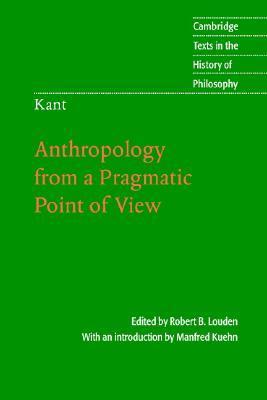
Anthropology from a Pragmatic Point of View essentially reflects the last lectures Kant gave for his annual course in anthropology, which he taught from 1772 until his retirement in 1796. The lectures were published in 1798, with the largest first printing of any of Kant's works. Intended for a broad audience, they reveal not only Kant's unique contribution to the newly emerging discipline of anthropology, but also his desire to offer students a practical view of the world and of humanity's place in it. With its focus on what the human being 'as a free-acting being makes of himself or can and should make of himself,' the Anthropology also offers readers an application of some central elements of Kant's philosophy. This volume offers an annotated translation of the text by Robert B. Louden, together with an introduction by Manfred Kuehn that explores the context and themes of the lectures.
Immanuel Kant was an 18th-century philosopher from Königsberg, Prussia (now Kaliningrad, Russia). He's regarded as one of the most influential thinkers of modern Europe & of the late Enlightenment. His most important work is The Critique of Pure Reason, an investigation of reason itself. It encompasses an attack on traditional metaphysics & epistemology, & highlights his own contribution to these areas. Other main works of his maturity are The Critique of Practical Reason, which is about ethics, & The Critique of Judgment, about esthetics & teleology.
Pursuing metaphysics involves asking questions about the ultimate nature of reality. Kant suggested that metaphysics can be reformed thru epistemology. He suggested that by understanding the sources & limits of human knowledge we can ask fruitful metaphysical questions. He asked if an object can be known to have certain properties prior to the experience of that object. He concluded that all objects that the mind can think about must conform to its manner of thought. Therefore if the mind can think only in terms of causality–which he concluded that it does–then we can know prior to experiencing them that all objects we experience must either be a cause or an effect. However, it follows from this that it's possible that there are objects of such a nature that the mind cannot think of them, & so the principle of causality, for instance, cannot be applied outside experience: hence we cannot know, for example, whether the world always existed or if it had a cause. So the grand questions of speculative metaphysics are off limits, but the sciences are firmly grounded in laws of the mind. Kant believed himself to be creating a compromise between the empiricists & the rationalists. The empiricists believed that knowledge is acquired thru experience alone, but the rationalists maintained that such knowledge is open to Cartesian doubt and that reason alone provides us with knowledge. Kant argues, however, that using reason without applying it to experience will only lead to illusions, while experience will be purely subjective without first being subsumed under pure reason. Kant’s thought was very influential in Germany during his lifetime, moving philosophy beyond the debate between the rationalists & empiricists. The philosophers Fichte, Schelling, Hegel and Schopenhauer saw themselves as correcting and expanding Kant's system, thus bringing about various forms of German Idealism. Kant continues to be a major influence on philosophy to this day, influencing both Analytic and Continental philosophy.
Ondanks dat dit werk op het eerste zicht nogal banaal, vreemd en saai overkomt, is het volgens mij Kants belangrijkste werk! Wie het kritische werk van Kant wil begrijpen, zal allereerst moeten grijpen naar de Antropologie.
While it's safe to say that Kant is the most important philosopher of the modern world, the sine qua non for the understanding of the field, it is also fair to warn that the reading of his three critiques is not an easy task, even for those well-prepared by the study of his antecedents. Having basically invented a philosophical German, his prose is dry and abstract, his systematic method with its classical terminologies strained and artificial-sounding.
Alternatively, to get a taste of Kant at his readable best, one can try the texts based on his lecture notes, particularly the Anthropology. Its content alone, given the many asides and anecdotes, its very subject matter, is more generally interesting than his usual, more technical writing. It is as if one were reading a modern Herodotus.
There is a prevailing stereotype of Kant which maintains that he led a dull, sheltered life, governed by routine, in remote East Prussia. Based on the period of his fame when he was already an old man, it misrepresents the character of his whole life. In fact, as a struggling academic, given the character of German university economics of the time, Kant not only had to support himself by gambling (in billiards and cards, in both of which he apparently had some aptitude) and tutoring (which often took him beyond the confines of Konigsberg), but also by providing interesting courses which could sell by subscription to the public. The Anthropology was one such popular, and relatively lucrative, course of lectures.
Kant's sources for the contents of these lectures ranged beyond the published materials of the time. The son of a saddler himself, comfortably identified with his working class origins, he maintained comfortable relations with his kind and found, in the sailors at the port and in its neighboring bars (the young Kant being a notable tippler), much of interest about far off places and exotic peoples to report to his students. As an instance of some importance, note his report about apes and monkeys and his surmise of their origins, common with ours--almost a century before Darwin.
This bizarre little book is one of the last pieces Kant published – a collection of lectures that made up his anthropology course. As the introduction points out, the content of the book and the lectures was mostly tangential from his main critical project. Indeed, the piece seems to really only have interest as a historical relic – it alternates between a sort of endearing book of manners and a hilariously outdated manual of psychology. His definition of Anthropology is so far from the contemporary one (“the study of what man can make of himself”), that it can serve very little practical function to either philosophers or anthropologists. All that said, it’s certainly a lighter and more entertaining read than most of Kant’s primary critical project, for which the word “dense” seems like a ridiculous understatement.
A reviewer writes that this collection is “an endearing book of manners, combined with a hilariously outdated psychology.” I cannot help but think the book’s “faults” lie within him.
Sẽ là có chút sai lầm khi xem cái tiêu đề (anthropology) như là một trình thuật về khái niệm "nhân học" như đúng thuật ngữ kỹ thuật mà thế kỷ 20 (và bây giờ, một phần, of course) người ta dùng. Câu chuyện (ok đúng là câu chuyện) mà Kant kể này có phần hài hước hơn đống sách dày cộp làm trũng cả cái giá sách nhà tôi, nhưng cũng đừng tưởng là dễ đọc, đúng là nếu mà đọc cuốn này đầu tiên thì cũng ra khoai đấy (và thất vọng nữa hehe), nhưng mà với cái thằng đọc hết sách của Kant trong tiếng Việt và hai ba cuốn quan trọng ở tiếng Anh thì cuốn này chỉ là bài khởi động nhè nhẹ sau bữa ăn chiều.
Nói thế thôi chứ cuốn này quan trọng vcl luôn ý. Một tiền giả định phố biến là về khái niệm "con người". Ôi con người là gì? Một con vật có lý tính, vâng, và lý tính với khả năng ban bố quy luật và tham gia vào đời sống đạo đức, cộng thêm việc nó luôn luôn là tốt hơn và mục đích luận tối cao cho nó là hướng đến cái tốt tuyệt đối. Thực ra thì khái niệm về con người mới được sáng tạo cũng gần gần đây thôi, và Kant là cái lão già làm nó ăn sâu bám rễ, tức là chả có bản chất luận nào đâu. Nói thế cũng định nói là cuốn này nó có giá trị cực lớn về mặt ý hệ, và diễn ngôn về con người ấy ưu việt để hệ thống sử dụng để điều hành. Và dĩ nhiên diễn ngôn nó bao hàm trong nó việc loại bỏ những diễn ngôn khác.
Bên cạnh ý nghĩa đó thì cuốn này đóng vai trò như quan trọng với tâm lý học hơn là lãnh vực của nhân học, nhất là tâm lý học phát triển.
Ôi đọc cuốn này cười vcl, nó giống như, bên cạnh những cuốn có cái văn phong đmmm của Kant thì cuốn này tỏ ra đáng yêu hơn nhiều. Haha, mà tóm lại là đếch thích lắm hahaha.
Konstrukcija rečenica jako zamršena, od prostodušnih misli pa do onih težih. Zahtijeva još jedno čitanje. Kant je doduše u mnogim stvarima (sada se vidi) bio u pravu i generalno dobro čita čovječanstvo i čovjekove težnje.
De drie kritieken van Kant zijn in feite maar het voorbereidende werk voor waar het eigenlijk om gaat. Wat is de mens, en hoe dient deze zich te gedragen? Deze toch wel unieke tekst is wars van het formele academische discours van de meer bekende kritieken. Speels en associatief is het een trukendoos van menselijkheden, vermakend, maar misschien niet voortdurend even grondig.
Opvallend genoeg volgt Kant de logica van de drie kritieken, maar met pragmatische insteek. Dat wil zeggen, naar het gebruik van het gedrag van mensen. De lezer zal dan ook verrast zijn dat de these van de drie kritieken in een ander jargon zijn weg terugvinden.
Dit leidt naar een tekst vanuit de persoon van Kant, met alle tekorten en zelfonthulling die erbij horen. Als product van jarenlange lezingen over antropologie zie je een kinderlijke verwondering over alles wat er is. Soms moraliserend, soms abstinent geeft Kant zijn gefilosofeerde mening over wat het is mens te zijn, van het gebruik van de lusten over de betekenis van geestesziekten tot wat goede tafelmanieren zouden moeten zijn.
Een opvallende insteek is het moraliserende van de 18de-eeuwse etiquette, een gelijkenis met John Lockes pedagogische boekje 'De leidraad van het verstand' (1706) is makkelijk te maken. Kant wil het goed gebruik van de Rede aanleren aan zijn studenten, en hoe ze zich tussen vrijheid en gedetermineerdheid kunnen bewegen, zo ook tussen hartstochten en rede, tussen empirie en ratio.
Naar mijn weten verschijnt Kant hier als mens, als persoon. Met enerzijds een grote dosis humor en ironie, en anderzijds een aantal 18de-eeuwse nogal provinciale opvattingen over gender en ras. Lezen naar de geest, niet naar de letter, maar toch te bestuderen. Centraal staat namelijk de verwondering, en toont bij uitstek deze tekst de oude Kant als een belichaamd subject.
Admittedly, I didn't read the whole thing; I skimmed around quite a bit because, despite being rather short, it is, like most of Kant's works, dense. The book is an edited compilation of his lecture notes throughout the years on anthropology. It's simultaneously un-Kantian and yet highly Kantian at the same time: The book can be read like a practical manual for conducting oneself in civil society, as it's told in a technical yet conversational tone, full of highly quotable definitions—there's something Johnsonian about it. Kant tells jokes and anecdotes, all the while providing his famously pretentious, highly specific Latin classifications like the taxonomist that he is. So even as he describes recognizable people types, he also incorporates elements from all of his three Critiques and other writings, sprinkling in helpful clarifications of sensibility and understanding, intuition, inner and outer sense, inclination toward evil, taste, the sublime, etc.
Accordingly, as the most accessible of Kant, the book can be read in one of two ways: Deeply, from cover to cover, as a scholar of Kant; or superficially, picked up at random, for amusement. I found the former method too demanding for the moment, so I'll return to the book at a later point for a more serious perusal; for now, I found it a nice little curiosity. Of course, Kant sprinkles in some good 'ole misogyny, physiognomy (I'm shocked he took this seriously), and humoralism along the way (and I didn't even bother to glance at what he had to say about race).
I want to add a disclaimer that I am not well-versed in philosophy or even Kant for that matter. I read philosophy occasionally and some of my observations might not be really accurate, or rather limited. But I still feel I'd like to say what this book makes me feel about Kant.
While there is no doubt Kant was writing in the late 18th century and he did a tremendous impact to quite a few fields of philosophy, I do believe many of his points presented in this particular book aged to sound rather silly right now. It also felt as if many things he claimed in the book are not well reasoned and as such, after reading it through, I felt it was rather shallow. Many of his claims (especially about sex, race) seemed more like his own personal observations of what was going on at the time, rather than an actual philosophical input to the nature of those things. And although I liked many of his takes (for example, on human egoism and how that is a driving force for the society) many of his points just did not resonate with me at all. I feel that his book is interesting in the context of history, but I would not say I took away much from it. Then again, it might be that I do not have the sufficient philosophical baggage to fully understand what Kant was trying to convey and perhaps I might try to return to this book at some point later in life.
Titlul cărții poate stârni ceva confuzie. "Antropologia" lucrării nu are legătură cu domeniul consacrat cu același nume, apoi aspectul "pragmatic", din nou, nu se leagă în nici un fel de filosofia pragmatică/pragmatistă. Titlul exprimă bine conținutul cărții, însă termenii folosiți s-au încărcat de noi înțelesuri între timp, sensul cuvintelor avut în vedere de Kant este cel de bază: "Antropologie" e gândit etimologic ("studiu asupra omului", din greacă), iar pragmatic e sinonim aici cu practic, util, deci deslușim din titlu acum (în mod corect) că e vorba aici de un studiu asupra omului, axat pe lucrurile practice, utile de știut.
Practic(intended), lucrarea de față cuprinde sfaturile de viață ale unui Kant bătrân și înțelept, către studenții săi inițial (lucrarea reprezintă forma redactată a cursurilor ținute de el la Königsberg între 1772 - 1789), ascunse îndărătul unor observații generale asupra sensibilității umane, asupra pasiunilor, caracterului, vieții în societate etc
Dacă lucrările asupra moralei ale lui Kant răspund la întrebarea "ce trebuie să fac", "Antropologia din perspectivă pragmatică" răspunde la întrebarea pereche "ce pot să fac", astfel trasând limitele libertății umane. În orice caz, făcând abstracție de intențiile doctrinare ale lucrării, "Antropologia din perspectivă pragmatică" se prezintă ca un festin de generalități diverse și teorii, lucrare insolită in opera lui Kant, atât prin conținut (imposibil să uiți ampla teoretizare asupra a ceea ce înseamnă "o masă bună într-o societate aleasă"), cât și prin stilul neașteptat de vioi, expresiv și limpede. De data aceasta, Kant nu doar educă, ci și surprinde și distrează.
Well that was... interesting. This was far less a philosophical text (as one could assume by the author) than an anthropological text (as the title screams). It's really just a collection of Kant's observations about human nature, many of which tend to be laughably outdated, if not offensively so. Not all, but enough. The real value of this text is reading it alongside Kant's Critique of Pure Reason to get a sense of how the very technical, very abstract analysis of cognition and consciousness in CPR connects (or could connect??) in Kant's mind to the actual, tangible, physically lived experience.
4/5- Vermutlich habe ich es aus dem falschen Grund gelesen, da mir gesagt wurde, da gäbe es einige witzige Stellen, wegen derer ich das dann auch gelesen habe. Und entsprechend hat es auch nicht enttäuscht, vielleicht habe ich es dann aus den richtigen Gründen gelesen. Glaube meine Highlights waren u.a. seine Bewertungen der Sinne, seine Polemiken zu Hypochondern sowie Sprichwörtern und seine Überzeugung, dass man nicht alleine Essen solle (sofern man sich als philosophisch denkender Mensch sieht). Also kann es für einen Read nebenbei durchaus empfehlen, hatte viel Spaß!
Tiene cosas buenas y novedosas, sobre todo al principio y al final. Mucho antes que Freud propuso algo muy similar al inconsciente, y sus reflexiones finales sobre filosofía de la historia están guay. Lo más curioso es que hace, realmente, un resumen muy muy bueno de sus tres críticas. El resto son un conjunto de ideas divertidas y curiosas, páginas de puro machismo en vena o cosas súper irrelevantes cómo una jerarquía del delirio, la locura...
Ein spannendes Buch von Kant. Z. B. über Abstraktionsvermögen, Bewusstsein, Anschauung - Verstand - Erkenntnis, Erscheinung, Erfahrung, Verstand - Urteilskraft - Vernunft, Vernünftelei, vorläufig zu urteilen, gesittete Glückseligkeit, u. v. a.