Jump to ratings and reviews
Rate this book

Nothing; Doting; Blindness

Rate this book
Book by Green, Henry

503 pages, Paperback

First published January 1, 1979

10 people are currently reading
194 people want to read

About the author

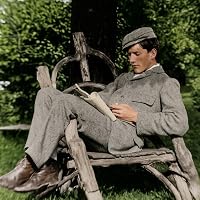
Henry Green

63 books207 followers
Henry Green was the nom de plume of Henry Vincent Yorke.

Green was born near Tewkesbury, Gloucestershire, into an educated family with successful business interests. His father Vincent Wodehouse Yorke, the son of John Reginald Yorke and Sophia Matilda de Tuyll de Serooskerken, was a wealthy landowner and industrialist in Birmingham. His mother, Hon. Maud Evelyn Wyndham, was daughter of the second Baron Leconfield. Green grew up in Gloucestershire and attended Eton College, where he became friends with fellow pupil Anthony Powell and wrote most of his first novel, Blindness. He studied at Oxford University and there began a friendship and literary rivalry with Evelyn Waugh.

Green left Oxford in 1926 without taking a degree and returned to Birmingham to engage in his family business. He started by working with the ordinary workers on the factory floor of his family's factory, which produced beer-bottling machines, and later became the managing director. During this time he gained the experience to write Living, his second novel, which he worked on during 1927 and 1928. In 1929, he married his second cousin, the Hon. Adelaide Biddulph, also known as 'Dig'. They were both great-grandchildren of the 1st Baron Leconfield. Their son Sebastian was born in 1934. In 1940, Green published Pack My Bag, which he regarded as a nearly-accurate autobiography. During World War II Green served as a fireman in the Auxiliary Fire Service and these wartime experiences are echoed in his novel Caught; they were also a strong influence on his subsequent novel, Back.

Green's last published novel was Doting (1952); this was the end of his writing career. In his later years, until his death in 1973, he became increasingly focused on studies of the Ottoman Empire, and became alcoholic and reclusive. Politically, Green was a traditional Tory throughout his life.

Ratings & Reviews

What do you think?
Rate this book

Friends & Following

Create a free account to discover what your friends think of this book!

Community Reviews

5 stars
15 (24%)
4 stars
29 (47%)
3 stars
13 (21%)
2 stars
3 (4%)
1 star
1 (1%)
Displaying 1 - 9 of 9 reviews
Profile Image for Bob.
892 reviews82 followers
July 4, 2023
Having read "Nothing" a few years ago, I pursued this in chronological order, starting with "Blindness", Green's first novel from when he was barely 21.

Since Green became one of the most distinctively sui generis English stylists of the mid-twentieth century, it is tempting at this point to spot a few not yet fully assimilated influences. There is a bit of "Stalky & Co." about the opening school days section (though a bit more modernist - written in diary form with all sorts of abbreviations and inferences needed, where a few pages later you understand something previously opaque), and some Thomas Hardy about the central character's romance with a socially inferior local girl.

"Doting", in one sentence, is about 40-year-old men with the usual somewhat sedentary marriages, flirting with and trying to bed 19-year-old young women, the latter enjoying the expensive meals, and the change from their callow contemporaries. The women enjoy the attention but observe that the men are in some way feeding on their youth and beauty, expressed with the rather archaic usage "they batten on one." Making this more charming, there is no gross sexual coercion or quid pro quo offers of career advancement in this version of the ballet; one of the men finds his sex life with his wife marvelously rejuvenated every time she expresses some jealousy about his lunch dates (and his only overt attempt at seduction ends in slapstick).
Profile Image for Lisa.
3,784 reviews491 followers
June 9, 2025
Nothing, by British author Henry Green (1905-1973) is a sly comedy of manners that is almost Shakespearean in its twists and turns. It features a young couple who become engaged to marry but – having discovered some gossip – fear that they may be siblings, because their respective parents had an affair in the past. The engagement offers opportunities for their parents to have renewed close contact, which in turn creates jealousies from their respective suitors, and a denouément that is breathtaking.

To read the rest of my review please visit
https://anzlitlovers.com/2015/06/18/n...

Update 23/3/23 Have now read Doting.
Doting, by British author Henry Green (1905-1973) is another of his comedy of manners novels, but because it's written almost entirely in dialogue between a tangled cast of characters, it takes reading between the lines to work out what Green was 'on about' in this, his last novel.  It was first published in 1952, two decades before he died.  Wikipedia tells me that...
In his later years, until his death in 1973, he became increasingly focused on studies of the Ottoman Empire, and became alcoholic and reclusive.

Despite its sparkling wit, perhaps this last novel is a hint of the depression that may have beset him in the last years of his life.

While it's not true to say I made heavy weather of Doting, I found myself increasingly puzzled by it. The dialogue often seems inconclusive.  Characters talk past each other, sentences aren't finished, and there are cultural allusions that are, for an Australian reader in the C21st century, just out of sight. The characters know what the other is thinking, but we don't.  Or not quite.

So the novel seems lightweight, as the blurb at Goodreads implies:
Written almost completely in dialogue, Henry Green's final novel is a biting comedy of manners that exposes the deceptive difference between those who love and those who "dote." Arthur Middleton is a middle-aged member of the upper-middle class living in post-World War II London with his wife. Stuck in a passionless marriage, Arthur becomes infatuated with Annabel, a much younger woman. Their relationship sets into motion a series of intertwining affairs between five close friends less concerned with love than with their attempts to keep the other lovers apart.

The introduction in my edition by literary critic D J Taylor has little to say about it so perhaps he was puzzled too.

It was not until I came to an exchange between the young flirt Annabel and her older admirer, the widower Charles Addinsell, that I joined the dots...

Annabel is flirting with a purpose.  She's looking for a husband because she comes of the class where it's expected that she marry, and marry well.  Charles tells her that he's not up for marriage because he lost his wife Penelope in childbirth:
'Then why not marry a second time?' Ann asked in a bewildered voice.  'Another mother for your child.'

'Might die again,' the man replied, with obvious distaste.

'Oh no!' she cried.

'Not much use for poor little Joe if she did, after all?'

'I suppose not, Charles.  Yet there's no reason she should, is there?'

'Oh none,'he appeared to agree.  'Still, that's all a part of what life has in store for one.' (p.262)

[Notice the way Green universalises Charles.  It's 'the man' who replies; it's what life has in store for 'one'.]

He goes on to say that what he has against 'living', is the dirty tricks fate has in store. 
...No good blinking facts.  Do better to realise, they probably will be coming for you.  I couldn't stand a second kick in the pants of the kind.'

'But if you've already had one really terrible misfortune, aren't the chances against another, Charles? [LH: see how this sentence drifts off without an ending?]

'Same as with roulette,' he answered. 'When you're at the tables, identical numbers will keep cropping up!' (p.263)

In a novel which skewers the generation gap, this exchange reveals the gulf between them.  This is the difference between loving, and doting. As Arthur Middleton explains to Ann:
Love must include adoration of course, but if you just dote on a girl you don’t necessarily go so far as to love her. Loving goes deeper. (p.203)

Arthur Middleton and his wife love each other, enough to withstand their respective infatuations and indiscretions.  But Charles, through loss, has learned that loving can be painful and that doting is perhaps wiser. Ann, with all her life before her in a world that seems full of possibility, remains hopeful and idealistic despite her scatty behaviour.

To read the rest of my review please visit https://anzlitlovers.com/2023/03/23/d...

And finally, here's my review of Blindness, the pick of the bunch!
https://anzlitlovers.com/2025/06/09/b...
Profile Image for Ellen.
1,588 reviews456 followers
April 20, 2011
I've finally finished Blindness by Henry Green. I found the first 2 sections extremely difficult but loved the third and final one. I found suddenly that if I read the prose as though I were reading poetry it flowed much more easily & made more sense as well.
Blindness is the story of a very young man (18 or 19) who is returning home from school for a brief holiday when he blinded in an accident while riding the train. The book (as can be inferred from the above) is not much concerned with plot. The focus is on the interior experience of the character & his interactions with those around him-his step-mother, ancient Nanny, and a girl from the village. The prose is a stream of consciousness that shifts without warning from one character to another. The reader must deduce who is thinking by the quality and content of the prose.
In actuality, I think that the book is not even about John, the blinded young man who is unhappy at school and yearns to be an artist or any of the characters. I would guess the true subject of this book to be the language itself, the minimalist style and the metaphors of how limited the sight of even the "seeing" is and how blind, ultimately, to ourselves, to those around us, to the world we live in & to the life we are given.
Recommended: for those who love language and stylistically unusual (albeit difficult) prose.
Profile Image for Rhys.
Author 326 books320 followers
December 7, 2023
Of the three Vintage omnibus volumes featuring Henry Green's novels (three novels per omnibus) this is the weakest. But it is still good. What I mean is that all three novels here have value. They just aren't as good (in my view) as the novels in the other two omnibuses.

NOTHING is about nothing and it's effective in what it seeks to achieve. But I wasn't too interested in the shenanigans of the characters, the attempted sabotage by the manipulative older people of an inappropriate courtship and engagement of a young couple. It is about nothing because nothing really changes. It could have been entitled Stasis. The situation it depicts is witheringly real and skilfully done, but it just didn't appeal to me very much.

DOTING was a lot better. A social comedy but harder and funnier. The ridiculous lust of middle aged men for young women is a theme that has been done to death, but Green still somehow makes it feel fresh. The obliqueness of the communication of the characaters is what lifts it from the mundane and quotidian into something more approaching a mild Kafkesque farce.

BLINDNESS is remarkable because it was written when Green was only nineteen years old. It's a good novel by any standards but while reading it I was constantly aware of the author's precocious talent. However, it is somewhat youthfully overwrought at moments. Green's control wasn't so good yet, although some of the individual descriptive passages, and some of the dialogue, and some of the insights are extraordinary.

I finished reading this omnibus today, so this means I have read all nine of Henry Green's novels in three and a half months. My intention is to write some sort of essay on him, but I have too much to do at the moment, so I will probably wait until next year to do that. In the meantime I have rated his novels as follows, in reverse order, with the best at the end of the list... I know other Henry Green enthusiasts whose lists will be very different from mine (here's looking at the well-known author and creative writing teacher Brian Evenson) but that's the beauty of literature...

09: NOTHING
08: BLINDNESS
07: DOTING
06: LIVING
05: LOVING
04: BACK
03: CONCLUDING
02: PARTY GOING
01: CAUGHT

CAUGHT as my favourite is perhaps an unusual choice. It's one of Green's most underrated novels. I thought it was tremendous and strange and sort of inevitably offbeat, being set among auxiliary firemen in WW2 in London. Will the order of this list change? It might do. CONCLUDING and PARTY GOING, and even BACK, are strong candidates for the number #1 position
Profile Image for Ian B..
171 reviews
December 2, 2024
Nothing. The English experimental novelist Henry Green wrote nine novels, of which this is the penultimate and the seventh I have read. Unlike the earlier books, there is less of his trademark rhapsodic, idiosyncratically (un)punctuated, run-on sentences and more conversation. In fact there are long passages of dialogue that could be lifted wholesale and transferred into a more typical society novel or West End comedy of manners. His rhapsodic mode can be challenging to read, but I like it: it makes the everyday world strange, and produces an atmosphere unlike almost anything else. There is a section in Nothing describing the stillness of a mirrored dining room just before a party that communicates via the effort it takes to disentangle its complexities an impression of slowed-down time corresponding to that stillness, as well as the shimmering textures of any particular hour – this one – on any particular day if looked at with sufficiently close attention.

The plot concerns the romantic and sexual manoeuvrings of some fairly awful people in London society a few years after the war. Green is extremely good at dialogue, at the way in which characters reveal themselves without meaning to, at undercurrents. The puzzling title – I had wondered whether it hinted at the general meaninglessness of the protagonists’ lives – becomes clear on the final page in a context ostensibly romantic but actually rather chilling. (11th January 2024)

Blindness. The author’s first novel (published 1926), and an amazingly accomplished work for someone of 20 or 21. I was surprised that it wasn’t more experimental in tone: his subsequent novel, Living, which came out at the end of the decade, represents a sea change in approach. This story of a young man blinded in an accident and who must adjust to an upended life isn’t hugely unconventional in structure or language. There are some early signs of his later taste for lyrical incoherency and a distinctly personal syntax. Much of the narrative takes place in the country, and Green’s descriptions of the natural world (I generally do not enjoy ‘nature writing’) are agreeably offbeat: ‘A blackbird thought aloud of bed,’ ‘The sky was enjoying herself after the boredom of being blue all day,’ ‘a rabbit was feeding quietly, trembling at being alive.’ I found myself reminded of some of the songs in the Sky of Honey sequence on Kate Bush’s Aerial.

Unusually for Green, I was moved by the predicaments of his characters: John’s sudden disability; his stepmother’s decency (amounting to virtue) in wanting only to do the best for him; the plight of Joan, who has come down in the world thanks to the drunkenness of her clergyman father, and with whom John strikes up a brief friendship; all of them come to life on the page. In the works of his high style, Green’s unusual technique tends to keep his people and their situations at more of a remove from the reader. (27th April 2024)

Doting. The last of Henry Green’s nine novels; I have no more of them to read now. The convoluted style of the earlier works is even less apparent than in its predecessor, Nothing. There are similarities between the two: a small cast of upper-middle class Londoners, some prosperous, some not, of varying degrees of awfulness, jostle for predominance, pair up, betray one another. Part comedy of manners, part dance of death, part intellectual bedroom farce, it is easy to imagine it dramatized for the West End stage of the 1950s (the modernistic elements discarded in the transfer); Margaret Leighton would have been ideal for one of the characters.

I liked the book’s enigmatic qualities: Arthur Middleton, the middle-aged husband whose infatuation for nineteen year old Annabel Paynton kicks off the plot, has a best friend, Charles Addinsell, and buried in both their pasts is some sort of service (or disservice) undertaken by Arthur, not necessarily for noble reasons, for the good of Charles’ relationship with his late wife Penelope; we never find out what it was. There is also a strange anecdote of Arthur’s first meeting with Annabel when she was a child: impersonating her rabbit, she crawled onto the roof of its hutch (situated in a ruined chapel on a lawn of ‘the greenest grass’), and Arthur, worried that the hutch would collapse and both she and the rabbit be injured, grabbed her by the ankle to pull her down, whereupon she screamed ‘like a stuck pig.’ This has the air of something that happened in real life, but transported into the world of Henry Green it becomes, despite being only mildly out of the ordinary, singular and bizarre. It almost takes on the air of a prophecy. (2nd December 2024)
Profile Image for Rose Gowen.
Author 1 book18 followers
May 21, 2012
Earlier I wanted to say how surprised I was at how much this HG novel, NOTHING, reminded me of D. Barthelme. But, I couldn't find good representative passages in either NOTHING or 60 STORIES, and then I got distracted. But, it surprises me! It's the dialogue: there's a ton of dialogue (in a bunch of different formats, I had forgotten that!) in Barthelme, and NOTHING is almost exclusively back and forth dialogue between pairs of people. It's witty and quippy in both books, and tinged with despair, but Barthelme heads toward absurdity, and Green goes into farce.
Profile Image for Michael.
837 reviews13 followers
March 5, 2015
Haven't read Blindness yet but he other two are his last two novel--mostly dialogue, great departure from his earlier masterpieces. Not quite a successful perhaps but another chapter (the final one, alas) in his restless project to tell stories in the most truthful way. Not for everyone but one of the mostly undervalued writers of the century.
Profile Image for Sherwin.
51 reviews4 followers
November 11, 2013
A great collection of works by a masterful author; his witty dialogue and humour were a delight to experience. I only feel silly in first thinking, "these characters are SUCH GREAT FRIENDS... wait, are they actually? ... wait, oh, OHHHH, oh dear."
Profile Image for Gabriel.
Author 21 books20 followers
August 2, 2008
The first two books in this collection are darker than Green's other books, and less dense. The last one is his first book, and not as good.
Displaying 1 - 9 of 9 reviews

Can't find what you're looking for?

Get help and learn more about the design.