

What do you think?

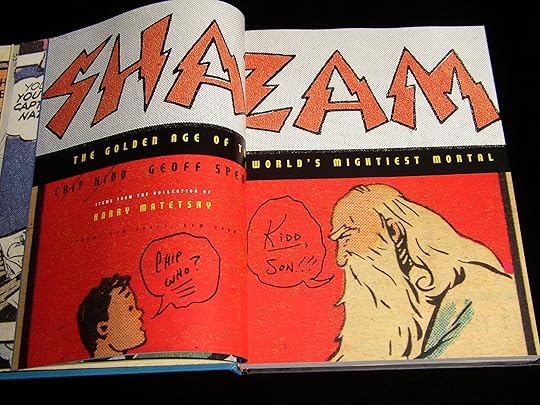
Shazam!: The Golden Age of the World's Mightiest Mortal
Shazam made his debut in Whiz Comics in 1940, and outsold his biggest competitor, Superman, by 14 million copies a month. It wasn’t long before a variety of merchandise was licensed—secret decoders, figurines, buttons, paper rockets, tin toys, puzzles, costumes—and a fan club was created to keep up with the demand. These collectibles now sell for outrageous prices on eBay or in comic book stores and conventions. Seventy years later, an unprecedented assortment of these collectibles are gathered together by award-winning writer/designer Chip Kidd and photographer Geoff Spear. Join Kidd, Spear, and the World’s Mightiest Mortal in this first, fully authorized celebration of ephemera, artwork, and rare, one-of-a-kind toys, and recapture the magic that was Shazam!
Praise for Shazam!:
" Superman has always gotten more press, but Captain Marvel may be the greatest expression of comics' A young boy says a magical word and turns into the World's Mightiest Mortal. Chip Kidd and Geoff Spear's gorgeous new book, Shazam! The Golden Age of the World's Mightiest Mortal (ABRAMS) pays tribute to the hero's bright colors and medium-spanning stories, all lovingly displayed in Kidd's signature style . . . It's a coffee-table book that provides a glimpse into a world where the powers of the gods are just an acronym away."
-The Onion's A.V. Club
" Despite the quite reasonable price, this features typical ABRAMS art and production quality. Fans will grab this Marvel-ous piece of Americana faster than you can say 'Shazam!'"
-Mike Rogers, Library Journal Express
"A handsome follow up to Bat-Manga!"
--ComicsAlliance.com
"This is a collector's Page after page of Captain Marvel art, premiums, posters, toys, and ephemera from the biggest-selling superhero of all time . . . This book is a true time capsule and worthy of any comic fan's bookshelf."
--USATODAY.com
"Shazam! allows its rich imagery to tell the exciting story of this superhero. Between Kidd's glorious layout and Spear's highly detailed photography, the reader can feel the excitement and fabric that would eventually lead Captain Marvel to outsell Superman during the glorious Golden Age of comics!"
--Comic Book Resources
" Shazam! beautifully documents the creation and success of Fawcett's Captain Marvel franchise . . . Indeed, for non-Captain Marvel enthusiasts, the book may be most interesting as a compendium of historical documents, a glimpse not just of a bygone pop phenomenon but also of a larger cultural ethos."
-Forward.com
Praise for Shazam!:
" Superman has always gotten more press, but Captain Marvel may be the greatest expression of comics' A young boy says a magical word and turns into the World's Mightiest Mortal. Chip Kidd and Geoff Spear's gorgeous new book, Shazam! The Golden Age of the World's Mightiest Mortal (ABRAMS) pays tribute to the hero's bright colors and medium-spanning stories, all lovingly displayed in Kidd's signature style . . . It's a coffee-table book that provides a glimpse into a world where the powers of the gods are just an acronym away."
-The Onion's A.V. Club
" Despite the quite reasonable price, this features typical ABRAMS art and production quality. Fans will grab this Marvel-ous piece of Americana faster than you can say 'Shazam!'"
-Mike Rogers, Library Journal Express
"A handsome follow up to Bat-Manga!"
--ComicsAlliance.com
"This is a collector's Page after page of Captain Marvel art, premiums, posters, toys, and ephemera from the biggest-selling superhero of all time . . . This book is a true time capsule and worthy of any comic fan's bookshelf."
--USATODAY.com
"Shazam! allows its rich imagery to tell the exciting story of this superhero. Between Kidd's glorious layout and Spear's highly detailed photography, the reader can feel the excitement and fabric that would eventually lead Captain Marvel to outsell Superman during the glorious Golden Age of comics!"
--Comic Book Resources
" Shazam! beautifully documents the creation and success of Fawcett's Captain Marvel franchise . . . Indeed, for non-Captain Marvel enthusiasts, the book may be most interesting as a compendium of historical documents, a glimpse not just of a bygone pop phenomenon but also of a larger cultural ethos."
-Forward.com
246 pages, Hardcover
First published January 1, 2010
About the author
Chip Kidd
73 books292 followersChip Kidd is an American author, editor and graphic designer, best known for his innovative book covers.
Born in Reading, Pennsylvania, Kidd grew up in a Philadelphia suburb, strongly influenced by American popular culture. While a design student at Penn State, an art instructor once gave the assignment to design a book cover for Museums and Women by John Updike, who is also a Shillington native. The teacher panned Kidd's work in front of the class, suggesting that book design would not be a good career choice for him. However, Kidd later received professional assignments to design covers for Memories of the Ford Administration and other books by Updike.
Kidd is currently associate art director at Knopf, an imprint of Random House. He first joined the Knopf design team in 1986, when he was hired as a junior assistant by Sara Eisenman.
Publishers Weekly described his book jackets as "creepy, striking, sly, smart, unpredictable covers that make readers appreciate books as objects of art as well as literature." USA Today called him "the closest thing to a rock star" in graphic design today, while author James Ellroy has called him “the world’s greatest book-jacket designer.”
Born in Reading, Pennsylvania, Kidd grew up in a Philadelphia suburb, strongly influenced by American popular culture. While a design student at Penn State, an art instructor once gave the assignment to design a book cover for Museums and Women by John Updike, who is also a Shillington native. The teacher panned Kidd's work in front of the class, suggesting that book design would not be a good career choice for him. However, Kidd later received professional assignments to design covers for Memories of the Ford Administration and other books by Updike.
Kidd is currently associate art director at Knopf, an imprint of Random House. He first joined the Knopf design team in 1986, when he was hired as a junior assistant by Sara Eisenman.
Publishers Weekly described his book jackets as "creepy, striking, sly, smart, unpredictable covers that make readers appreciate books as objects of art as well as literature." USA Today called him "the closest thing to a rock star" in graphic design today, while author James Ellroy has called him “the world’s greatest book-jacket designer.”
Ratings & Reviews
Friends & Following
Create a free account to discover what your friends think of this book!
Community Reviews
Displaying 1 - 20 of 20 reviews

September 22, 2016
At one time Captain Marvel (CM) was bigger than Superman. This book is the definitive history on one of the icons of comics. If you are (or know) a CM fan this is the book for them. The complete history of CM and why he 'disappeared' is covered extensively. The Chip Kidd design only adds to the wonderful visual experience of this book.

October 27, 2019
Shazam!: The Golden Age of the World's Mightiest Mortal details the Captain Marvel phenomenon of the 1940s.
I've known for a long time that Captain Marvel outsold Superman in the 1940s but I had no idea what a media juggernaut he really was. This volume contains lots of art from the adventures of Captain Marvel and the Marvel Family in comics, but also touches upon the movie serials, I had no idea Captain Marvel was the first superhero ever depicted on screen, and the extensive merchandise that was churned out during Captain Marvel's heyday.
In the '40s, kids could get their hands on Captain Marvel tin cars, Captain Marvel temporary tattoos, Captain Marvel patches, Captain Marvel buttons, and pretty much any other piece of crap you could slap the likeness of Captain Marvel or the Marvel Family on.
Mac Raboy had a pretty good section devoted to him. Unless I missed it, there wasn't much about CC Beck. Spy Smasher got a little more time than I thought he would, especially since the Lieutenant Marvels didn't get a peep. The book is more of a scrapbook than anything else. There isn't much in the way of text apart from a page here and there. It's jam packed with art and photos, though. Would it kill DC to put out a collection of CC Beck Captain Marvel covers at some point?
I find it interesting that before the comics code & deliberately phased out Steamboat because even then they knew the character was an offensive stereotype.
Shazam!: The Golden Age of the World's Mightiest Mortal is an interesting scrapbook detailing the phenomenon that was Captain Marvel in the 1940s. I wouldn't have minded more in the way of actual text, though. 4 out of 5 lightning bolts.
I've known for a long time that Captain Marvel outsold Superman in the 1940s but I had no idea what a media juggernaut he really was. This volume contains lots of art from the adventures of Captain Marvel and the Marvel Family in comics, but also touches upon the movie serials, I had no idea Captain Marvel was the first superhero ever depicted on screen, and the extensive merchandise that was churned out during Captain Marvel's heyday.
In the '40s, kids could get their hands on Captain Marvel tin cars, Captain Marvel temporary tattoos, Captain Marvel patches, Captain Marvel buttons, and pretty much any other piece of crap you could slap the likeness of Captain Marvel or the Marvel Family on.
Mac Raboy had a pretty good section devoted to him. Unless I missed it, there wasn't much about CC Beck. Spy Smasher got a little more time than I thought he would, especially since the Lieutenant Marvels didn't get a peep. The book is more of a scrapbook than anything else. There isn't much in the way of text apart from a page here and there. It's jam packed with art and photos, though. Would it kill DC to put out a collection of CC Beck Captain Marvel covers at some point?
I find it interesting that before the comics code & deliberately phased out Steamboat because even then they knew the character was an offensive stereotype.
Shazam!: The Golden Age of the World's Mightiest Mortal is an interesting scrapbook detailing the phenomenon that was Captain Marvel in the 1940s. I wouldn't have minded more in the way of actual text, though. 4 out of 5 lightning bolts.

February 18, 2018
Slight but fun collection of history, anecdotes, and memorabilia relating to Captain Marvel and his "family" of heroes. Excellent production value on this tome of eye candy. I only wish more storyline had been reproduced, but I guess that would take too much space.

February 3, 2011
Bound: Shazam!
SunPost Weekly December 23, 2010 | John Hood
http://bit.ly/eid4rL
Chip Kidd Revisits “The World’s Mightiest Mortal”
The boy’s power derives from saying the name of the wizard that selected him to be the champion of good in the world. When he says the magic word a lightning bolt strikes down from the heavens and transforms the lad into “the world’s mightiest mortal.” That name, of course, is Shazam, an acronym representing the wisdom of Solomon, the strength of Hercules, the stamina of Atlas, the power of Zeus, the courage of Achilles, and the speed of Mercury. That boy is Billy Batson, a young gun radio reporter determined to fight evil wherever it rears its ugly head. And when little Billy says the magic words, he becomes Captain Marvel.
Throughout the ‘40s Captain Marvel dominated America’s comic book universe. In fact he not only out-sold Superman, but he was the first superhero to make it to the big screen too. And his immense popularity paved the way for a merchandising onslaught pretty much unparalleled in pop culture.
That’s where Chip Kidd comes in. Kidd, an acclaimed creator of book cover jackets who’s also authored a couple rather clever novels, first came across Captain Marvel back in 1973, after DC Comics brought the superhero back to life. Initially Kidd was “thrown” by the good Captain’s, er, redness. Then he was taken by Marvel’s charm. In the process Kidd got into the superhero’s spirit with the gusto only eight-year-olds can muster. And he became a member Marvel Family.
Yes, there really was a Marvel Family, and all a kid had to do was join Captain’s Marvel’s Fan Club to be a part of it. Naturally, Family members were privy to all sorts of goodies, and it is just those goodies that Kidd’s compiled in the thoroughly robust Shazam! The Golden Age of the World’s Mightiest Superhero (Abrams $35).
But Kidd’s interest isn’t in whatever Marvel merchandise DC foisted upon the public in the ‘70s. No, he’s into the Captain’s Golden Age (hence the subtitle), the era that came about after artist C. C. Beck and writer Bill Parker created the crusading character in the first place. The time when there was a clear delineation between Good and Evil (i.e. WWII) and merchandising was still in its innocent infancy.
The collection is as vast and as colorful as Captain Marvel’s adventures themselves. There are whistles and patches and race cars; wristwatches and coloring books and paper airplanes. There are key chains and pennants, pins and hats, and enough statuettes to fill an outpost of Madame Tussaud’s
And the Captain isn’t the only one to go be immortally merchandised either. Mary Marvel (Billy Batson’s twin sister) has her own rather extensive line, as does Captain Marvel, Jr., the alter-ego of Freddy Freeman, a crippled newsboy Marvel himself saved from the clutches of Captain Nazi. And Kidd’s come up with page-upon-page of rather enticing offerings to prove it.
In addition to the goods though, there’s also a spectacular array of film stills, movie posters, page proofs and, of course, comic book covers, any one of which will transport you right back into the future of the Golden Age itself. And there are letters, lots and lots of letters, almost all from Captain Marvel and addressed directly to his Pal – you!
If you’ve got a thing for superheroes (and who doesn’t), and you’d like a quick trip back to their heyday, then this book is for you. If you don’t, well, that’s not my fault. But I just bet you know someone who does. So why not pick up a copy of Shazam! and put it under their tree? Before you do though, leaf through a page or three. Who knows? You might find yourself struck by some benevolent lightning yourself.
SunPost Weekly December 23, 2010 | John Hood
http://bit.ly/eid4rL
Chip Kidd Revisits “The World’s Mightiest Mortal”
The boy’s power derives from saying the name of the wizard that selected him to be the champion of good in the world. When he says the magic word a lightning bolt strikes down from the heavens and transforms the lad into “the world’s mightiest mortal.” That name, of course, is Shazam, an acronym representing the wisdom of Solomon, the strength of Hercules, the stamina of Atlas, the power of Zeus, the courage of Achilles, and the speed of Mercury. That boy is Billy Batson, a young gun radio reporter determined to fight evil wherever it rears its ugly head. And when little Billy says the magic words, he becomes Captain Marvel.
Throughout the ‘40s Captain Marvel dominated America’s comic book universe. In fact he not only out-sold Superman, but he was the first superhero to make it to the big screen too. And his immense popularity paved the way for a merchandising onslaught pretty much unparalleled in pop culture.
That’s where Chip Kidd comes in. Kidd, an acclaimed creator of book cover jackets who’s also authored a couple rather clever novels, first came across Captain Marvel back in 1973, after DC Comics brought the superhero back to life. Initially Kidd was “thrown” by the good Captain’s, er, redness. Then he was taken by Marvel’s charm. In the process Kidd got into the superhero’s spirit with the gusto only eight-year-olds can muster. And he became a member Marvel Family.
Yes, there really was a Marvel Family, and all a kid had to do was join Captain’s Marvel’s Fan Club to be a part of it. Naturally, Family members were privy to all sorts of goodies, and it is just those goodies that Kidd’s compiled in the thoroughly robust Shazam! The Golden Age of the World’s Mightiest Superhero (Abrams $35).
But Kidd’s interest isn’t in whatever Marvel merchandise DC foisted upon the public in the ‘70s. No, he’s into the Captain’s Golden Age (hence the subtitle), the era that came about after artist C. C. Beck and writer Bill Parker created the crusading character in the first place. The time when there was a clear delineation between Good and Evil (i.e. WWII) and merchandising was still in its innocent infancy.
The collection is as vast and as colorful as Captain Marvel’s adventures themselves. There are whistles and patches and race cars; wristwatches and coloring books and paper airplanes. There are key chains and pennants, pins and hats, and enough statuettes to fill an outpost of Madame Tussaud’s
And the Captain isn’t the only one to go be immortally merchandised either. Mary Marvel (Billy Batson’s twin sister) has her own rather extensive line, as does Captain Marvel, Jr., the alter-ego of Freddy Freeman, a crippled newsboy Marvel himself saved from the clutches of Captain Nazi. And Kidd’s come up with page-upon-page of rather enticing offerings to prove it.
In addition to the goods though, there’s also a spectacular array of film stills, movie posters, page proofs and, of course, comic book covers, any one of which will transport you right back into the future of the Golden Age itself. And there are letters, lots and lots of letters, almost all from Captain Marvel and addressed directly to his Pal – you!
If you’ve got a thing for superheroes (and who doesn’t), and you’d like a quick trip back to their heyday, then this book is for you. If you don’t, well, that’s not my fault. But I just bet you know someone who does. So why not pick up a copy of Shazam! and put it under their tree? Before you do though, leaf through a page or three. Who knows? You might find yourself struck by some benevolent lightning yourself.
June 18, 2019
A delightful closeup look at hundreds of pieces of Captain Marvel merchandise

December 8, 2019
This is a fun scrapbook type volume. Every page is chock full of images that will make any Shazam fan smile, with anecdotal tidbits on the characters, their creation, and their merchandise.

December 16, 2011
Chip Kidd is a noted graphic designer and comic enthusiast! This is a beautiful book showcasing a visual history (with text) of one of the Golden Age's most celebrated heroes, Captain Marvel.
It was a fascinating read! I would have totally been a member of the Capt. Marvel Fan Club. There were several letters included that were sent to fans by Capt. Marvel. It was also fascinating to read how much the war effort reached out to the young readers of comics, boys and girls.
Detective Comics comes across as a bit of a jerk because of a series of trials that went on for several years in which they claim that Captain Marvel was just a copy of Superman which in some ways could be true, but he was enough of his own hero. In addition, Capt. Marvel's alter ego was just a mere boy named Billy Bastian. In some ways, Capt. Marvel must have been much more accessible to children than Superman because Capt. Marvel outsold Superman by 14 million copies a month which likely made him a target.
I also enjoyed learning briefly about the artist Mac Raboy who produced some beautiful covers and died too soon.
Very well done and interesting history of one of the Golden Age's best loved heroes!
It was a fascinating read! I would have totally been a member of the Capt. Marvel Fan Club. There were several letters included that were sent to fans by Capt. Marvel. It was also fascinating to read how much the war effort reached out to the young readers of comics, boys and girls.
Detective Comics comes across as a bit of a jerk because of a series of trials that went on for several years in which they claim that Captain Marvel was just a copy of Superman which in some ways could be true, but he was enough of his own hero. In addition, Capt. Marvel's alter ego was just a mere boy named Billy Bastian. In some ways, Capt. Marvel must have been much more accessible to children than Superman because Capt. Marvel outsold Superman by 14 million copies a month which likely made him a target.
I also enjoyed learning briefly about the artist Mac Raboy who produced some beautiful covers and died too soon.
Very well done and interesting history of one of the Golden Age's best loved heroes!

November 19, 2010
Chip Kidd is not only a great book designer but he's a man of great passion - with respect to comic book history. But it is not only the history of a particular comic, it is also the history of the by-products of that work - meaning the cinema, the toys, and interesting enough, the clothing. In his latest book he covers Captain Marvel.
Captain Marvel via the eyes of the 21st Century is a poor cousin to Superman - but alas, Captain Marvel is much more then that. Young boy Billy Batson yells out the word "Shazam" and he becomes super hero Captain Marvel. What boy would not want to have those powers!?! And that is the inner-beauty of Captain Marvel connection to the youth at the time.
One also admires the beauty of the toys, the wrist watches (that can't break!), bean bags, and the Captain Marvel costume that was made for the Republic serial. This book is more of a fetish object than anything else. It drips with passion and beauty of the drawings and lettering of a classic comic. Beautiful production job as well.
Captain Marvel via the eyes of the 21st Century is a poor cousin to Superman - but alas, Captain Marvel is much more then that. Young boy Billy Batson yells out the word "Shazam" and he becomes super hero Captain Marvel. What boy would not want to have those powers!?! And that is the inner-beauty of Captain Marvel connection to the youth at the time.
One also admires the beauty of the toys, the wrist watches (that can't break!), bean bags, and the Captain Marvel costume that was made for the Republic serial. This book is more of a fetish object than anything else. It drips with passion and beauty of the drawings and lettering of a classic comic. Beautiful production job as well.

September 16, 2018
The original Captain Marvel was incredibly popular during the 1940's, even outselling Superman. Chip Kidd takes the reader through a fairly extensive retrospective of all the merchandise produced in the character's heyday. From puzzles to rockets to capes there's a plethora of weird and wonderful collectibles on display along with highlights from the Marvel Family's comic book history as well. Full colour fun!

April 29, 2019
This is NOT a collection of Golden-Age Captain Marvel stories. It is the story of Captain Marvel nee Shazam! through memorabilia--from Cap's first appearance in Whiz Comics in 1940 to the final issue of The Marvel Family in 1952. In those 12 short years, there was a fan club with thousands of members, an innumerable amount of merchandise, and hundreds of publications--pretty much one a week from 1942 on. In addition, the movie serial "The Adventures of Captain Marvel" is one of the better examples of the genre. All told, this is a remarkable book. It's like visiting a museum. It was really interesting to me because I've been a huge fan of Captain Marvel since his resurrection in the 1970's, and I've never seen any of this merchandise in antique shops. This book will probably only appeal to fans of the character, but there are a lot more of them now than there were before the Shazam! movie arrived in theaters. I highly recommend this book for fans of The Original Captain Marvel.

October 12, 2012
This is a great book, and another example of the awesome stuff that Chip Kidd and Geoff Spear have done with other books like "Batman Collected" and "Batman Animated" or "Bat-Manga." While Captain Marvel isn't super interesting to me, per se, I did like learning more about the character's origins and how he was even more popular than Superman for a while. The photos capture the ephemera beautifully, but overall, this is a book for artists and pop culture aficionados. Shazam fans might be disappointed by the shallowness of info, but collectors would surely appreciate it.
March 22, 2011
Absolutely beautiful design and a wonderful picture book, I think it lacked some of the historical insight I was looking for especially towards the end when they completely summarized the National/DC lawsuit. While a love letter to the character, hardly essential reading but a pleasure to flip through and lovely memento none the less.

Currently Reading
April 16, 2011beautifully designed, inspiring

February 9, 2012
Beautiful book. If you're a Captain Marvel fan, you must own this book. (It could only have been better if it had included the original Monster Society of Evil story line.)

July 4, 2013
A charming book which illustrates the history of Captain Marvel (now Shazam) and the practical merchandise empire that the character spawned during the Golden Age of Comic Books.

November 15, 2013
Nearly 60 years a fan. What can I say?

April 25, 2023
This book concentrates on all the marketing tie-ins for the Marvel family and some other Fawcett characters. It does this very well photographically, but anybody who wants an in-depth study of these artifacts will not find it here. Those, like me, who want more depth about Fawcett as a publisher and comic book publisher will also be disappointed. Joining us in disappointment will be those who want something like a biography of the Marvel family with lots of reprints. This book does what it does extremely well, but that does not add up to much.
July 6, 2022
A visually lovely book that is, perhaps, light on actual information. To be fair, I guess it doesn't actually claim to be a history of maybe the most popular character of Comics' Golden Age, but even some of the photos of rare memorabilia lack captions or explanations.

June 24, 2018
While the various items sold during “The Big Red Cheese’s” golden age were interesting, I was hoping for more stories/ artwork from the comics. The covers were well chosen.
June 19, 2011
While a fun look back at "the Big Red Cheese," this book disappointed as it was not the history and full 70th anniversary retrospective I'd hoped to read.
Instead, it's a coffee table book (with great graphic design, I'll admit) filled with photos of very rare collectibles and miscellanei connected to Fawcett Comics and the Marvel Family.
If that's of interest, I recommend the book; if you're looking for more on the characters and history, this book barely covers the basics, I'm afraid.
Instead, it's a coffee table book (with great graphic design, I'll admit) filled with photos of very rare collectibles and miscellanei connected to Fawcett Comics and the Marvel Family.
If that's of interest, I recommend the book; if you're looking for more on the characters and history, this book barely covers the basics, I'm afraid.
Displaying 1 - 20 of 20 reviews