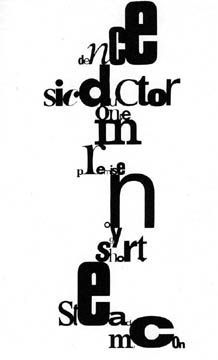
Mainly mesostics inspired by music, mushrooms, Marcel Duchamp, Merce Cunningham, Marshall McCluhan, etc. and includes "Mureau"-composed from the writings of Henry David Thoreau.
John Milton Cage Jr. was an American composer, philosopher, poet, music theorist, artist, printmaker, and amateur mycologist and mushroom collector. A pioneer of chance music, electronic music and non-standard use of musical instruments, Cage was one of the leading figures of the post-war avant-garde. Critics have lauded him as one of the most influential American composers of the 20th century. He was also instrumental in the development of modern dance, mostly through his association with choreographer Merce Cunningham, who was also Cage's romantic partner for most of their lives.
Cage is perhaps best known for his 1952 composition 4′33″, the three movements of which are performed without a single note being played. The content of the composition is meant to be perceived as the sounds of the environment that the listeners hear while it is performed, rather than merely as four minutes and thirty three seconds of silence, and the piece became one of the most controversial compositions of the 20th century. Another famous creation of Cage's is the prepared piano (a piano with its sound altered by placing various objects in the strings), for which he wrote numerous dance-related works and a few concert pieces, the best known of which is Sonatas and Interludes (1946–48).
His teachers included Henry Cowell (1933) and Arnold Schoenberg (1933–35), both known for their radical innovations in music and coincidentally their shared love of mushrooms, but Cage's major influences lay in various Eastern cultures. Through his studies of Indian philosophy and Zen Buddhism in the late 1940s, Cage came to the idea of chance-controlled music, which he started composing in 1951. The I Ching, an ancient Chinese classic text on changing events, became Cage's standard composition tool for the rest of his life. In a 1957 lecture, Experimental Music, he described music as "a purposeless play" which is "an affirmation of life – not an attempt to bring order out of chaos nor to suggest improvements in creation, but simply a way of waking up to the very life we're living".
"trgOn efosnr uJvaR mbthr mnols htbu." What? I don't doubt that the avant-garde John Cage was a very intelligent person, and I'm sure this collection of diaries meant something to him. As a reader, it seems this experimental journal could only hold meaning to the author. The visual poetry is unintelligible—"mon ten three sicords posreimbie." For the readable parts, the subjects are society, technology, mushrooms, politics, music, traveling and Thoreau, either in poem format or non-lyrical stanzas. Everything from how to solve societal problems to mushroom cooking documentation. I'm giving it two stars because there are a lot of good quotes that can be extracted. It's just not a pleasurable or understandable read. Probably only of interest to serious fans or scholars.
sparrowsitA gROsbeak betrays itselfby that peculiar squeakariEEFECT OF SLIGHTEst tinklink measures soundness ingplease We hear! Does it not rather hear us? sWhen he hears the telegraph, he thinksthose bugs have issued forthThe owl touches the stops, wakes reverberation d gwalky In verse there is no inherent music eofsttakestakes a man to make a room silent It takes to make a roomIt IS A Young appetite and theappETITEFOR IsHe Oeyssee morningYou hear scream of great hawka ydgh bodyShelie beingsilence It would be noblest to sing with the windTo hear a neighbour singing! u it wood The triosteum a day or twob mtryTheysays to-wee , to-weecalling to his team livees heard over high open fields day instead of the drum thensav pa with young birdswith young birdsfrom a truck ndat every postt ed der oglects in the meantime o pi at so piercing ders archeTheyo ato sing in earnest...