

What do you think?
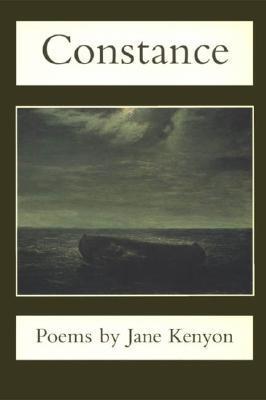
Constance
Poems deal with depression and the grief brought about by the sickness and death of loved ones
64 pages, Paperback
First published July 1, 1993
About the author
Jane Kenyon
17 books106 followersJane Kenyon was born in Ann Arbor, Michigan, and earned both her BA and MA from the University of Michigan. While a student at the University of Michigan Kenyon met her future husband, the poet Donald Hall, who taught there. After her marriage, Kenyon moved with Hall to Eagle Pond Farm, a New Hampshire farm that had been in Hall’s family for generations.
Kenyon published four volumes of poetry during her life: From Room to Room (1978), The Boat of Quiet Hours (1986), Let Evening Come (1990), and Constance (1993), and, as translator, Twenty Poems of Anna Akmatova (1985). Despite her relatively small output, her poetry was highly lauded by critics throughout her lifetime. As fellow poet Carol Muske remarked in the New York Times when describing Kenyon’s The Boat of Quiet Hours, “These poems surprise beauty at every turn and capture truth at its familiar New England slant. Here, in Keats’s terms, is a capable poet.” Indeed, Kenyon’s work has often been compared with that of English Romantic poet John Keats; in an essay on Kenyon for Contemporary Women Poets, Gary Roberts dubbed her a “Keatsian poet” and noted that, “like Keats, she attempts to redeem morbidity with a peculiar kind of gusto, one which seeks a quiet annihilation of self-identity through identification with benign things.”
The cycles of nature held special significance for Kenyon, who returned to them again and again, both in her variations on Keats’s ode “To Autumn,” and in other pastoral verse. In Let Evening Come, her third published collection—and one that found the poet taking what Poetry essayist Paul Breslin called “a darker turn”—Kenyon explored nature’s cycles in other ways: the fall of light from day to dusk to night, and the cycles of relationships with family and friends throughout a long span of years brought to a close by death. Let Evening Come “shows [Kenyon] at the height of her powers,” according to Muske in a review of the 1990 volume for the New York Times Book Review, with the poet’s “descriptive skills… as notable as her dramatic ones. Her rendering of natural settings, in lines of well-judged rhythm and simple syntax, contribute to the [volume’s] memorableness.”
Constance began Kenyon’s study of depression, and her work in this regard has been compared with that of the late poet Sylvia Plath. Comparing the two, Breslin wrote that “Kenyon’s language is much quieter, less self-dramatizing” than that of Plath, and where the earlier poet “would give herself up, writing her lyrical surrender to oblivion,… Kenyon fought to the end.” Breslin noted the absence of self-pity in Kenyon’s work, and the poet’s ability to separate from self and acknowledge the grief and emotional pain of others, as in her poems “Coats,” “Sleepers in Jaipur,” and “Gettysburg: July 1, 1863,” which imagines a mortally wounded soldier lying in wait for death on the historic battlefield.
New Hampshire’s poet laureate at the time of her untimely death at age forty-seven, Kenyon’s verse probed the inner psyche, particularly with regard to her own battle against depression. Writing for the last two decades of her life at her farm in northern New England, Kenyon is also remembered for her stoic portraits of domestic and rural life; as Gary Roberts noted, her poetry was “acutely faithful to the familiarities and mysteries of home life, and it is distinguished by intense calmness in the face of routine disappointments and tragedies.”
In Otherwise: New and Selected Poems (1996), a posthumous collection containing twenty poems written just prior to her death as well as several taken from her earlier books, Kenyon “chronicles the uncertainty of living as culpable, temporary creatures,” according to Nation contributor Emily Gordon. As Muske added in the New York Times Book Review, Kenyon avoids sentimentality throughout Otherwise. “The poet here sears a housewife’
Kenyon published four volumes of poetry during her life: From Room to Room (1978), The Boat of Quiet Hours (1986), Let Evening Come (1990), and Constance (1993), and, as translator, Twenty Poems of Anna Akmatova (1985). Despite her relatively small output, her poetry was highly lauded by critics throughout her lifetime. As fellow poet Carol Muske remarked in the New York Times when describing Kenyon’s The Boat of Quiet Hours, “These poems surprise beauty at every turn and capture truth at its familiar New England slant. Here, in Keats’s terms, is a capable poet.” Indeed, Kenyon’s work has often been compared with that of English Romantic poet John Keats; in an essay on Kenyon for Contemporary Women Poets, Gary Roberts dubbed her a “Keatsian poet” and noted that, “like Keats, she attempts to redeem morbidity with a peculiar kind of gusto, one which seeks a quiet annihilation of self-identity through identification with benign things.”
The cycles of nature held special significance for Kenyon, who returned to them again and again, both in her variations on Keats’s ode “To Autumn,” and in other pastoral verse. In Let Evening Come, her third published collection—and one that found the poet taking what Poetry essayist Paul Breslin called “a darker turn”—Kenyon explored nature’s cycles in other ways: the fall of light from day to dusk to night, and the cycles of relationships with family and friends throughout a long span of years brought to a close by death. Let Evening Come “shows [Kenyon] at the height of her powers,” according to Muske in a review of the 1990 volume for the New York Times Book Review, with the poet’s “descriptive skills… as notable as her dramatic ones. Her rendering of natural settings, in lines of well-judged rhythm and simple syntax, contribute to the [volume’s] memorableness.”
Constance began Kenyon’s study of depression, and her work in this regard has been compared with that of the late poet Sylvia Plath. Comparing the two, Breslin wrote that “Kenyon’s language is much quieter, less self-dramatizing” than that of Plath, and where the earlier poet “would give herself up, writing her lyrical surrender to oblivion,… Kenyon fought to the end.” Breslin noted the absence of self-pity in Kenyon’s work, and the poet’s ability to separate from self and acknowledge the grief and emotional pain of others, as in her poems “Coats,” “Sleepers in Jaipur,” and “Gettysburg: July 1, 1863,” which imagines a mortally wounded soldier lying in wait for death on the historic battlefield.
New Hampshire’s poet laureate at the time of her untimely death at age forty-seven, Kenyon’s verse probed the inner psyche, particularly with regard to her own battle against depression. Writing for the last two decades of her life at her farm in northern New England, Kenyon is also remembered for her stoic portraits of domestic and rural life; as Gary Roberts noted, her poetry was “acutely faithful to the familiarities and mysteries of home life, and it is distinguished by intense calmness in the face of routine disappointments and tragedies.”
In Otherwise: New and Selected Poems (1996), a posthumous collection containing twenty poems written just prior to her death as well as several taken from her earlier books, Kenyon “chronicles the uncertainty of living as culpable, temporary creatures,” according to Nation contributor Emily Gordon. As Muske added in the New York Times Book Review, Kenyon avoids sentimentality throughout Otherwise. “The poet here sears a housewife’
Ratings & Reviews
Friends & Following
Create a free account to discover what your friends think of this book!
Community Reviews
Displaying 1 - 30 of 37 reviews

July 27, 2021
This was the first of three volumes of poetry I decided to read during a recent, leisurely trip along the Oregon coast. The poems are mostly beautiful meditations on how Kenyon found strength to cope with depression, illness, and death, by attending to the simple, quiet pleasures of experiencing each day as it came. I could see myself returning to these when I need consolation. Recommended.
The dog searches until he finds me
upstairs, lies down with a clatter
of elbows, puts his head on my foot.
Sometimes the sound of his breathing
saves my life - in and out, in
and out; a pause, a long sigh....
~ from "Having it Out with Melancholy"
The dog searches until he finds me
upstairs, lies down with a clatter
of elbows, puts his head on my foot.
Sometimes the sound of his breathing
saves my life - in and out, in
and out; a pause, a long sigh....
~ from "Having it Out with Melancholy"

June 9, 2019
Jane Kenyon's work is special in the way it bridges the natural and philosophical world, even the range of poets who endorsed her work her make it clear: Annie Dillard and Adrienne Rich. Kenyon's direct speech is always controlled and polished, almost pristine. Even in her longer poems in this collection, such as the very rich "Having it out with Melancholy," that control is maintained. An excellent collection.

March 22, 2013
These poems, like so many of Kenyon's, are absolutely amazing. "Having It Out With Melancholy" alone is worth the cost of purchase. That long-ish poem, for me, encapsultes everything Kenyon does well. Check it out.

January 23, 2022
I read this largely for "Having It Out with Melancholy," hoping that Kenyon would offer language that would be somehow sufficient for depression. During my initial reading, I was disappointed because the language never transcends its own futility, but I think that's kind of the point.
The bluntness of certain sections, like "Suggestion from a Friend," demonstrates the difficulty of even getting words on a page, let alone shaping them into something "beautiful," and that kind of gentle desperation guides the reader through what, by the end of the sequence, is clearly a recurrent cycle.
If nothing else, I find the book encouraging because it suggests that shaping language into anything with form is itself an act of healing.
The bluntness of certain sections, like "Suggestion from a Friend," demonstrates the difficulty of even getting words on a page, let alone shaping them into something "beautiful," and that kind of gentle desperation guides the reader through what, by the end of the sequence, is clearly a recurrent cycle.
If nothing else, I find the book encouraging because it suggests that shaping language into anything with form is itself an act of healing.
September 11, 2020
Wow! Kenyon's poems resonate long after the book is closed. Her musings on clinical depression, growing up, her mother's failing health, finding contentment, and then facing her own mortality. As always, she connects the everyday here and now to the natural and the eternal. This is another slim volume of Kenyon's poems that holds a deep well.

November 28, 2021
Most of the poems in this book are in the Best Poems of Jane Kenyon but it was lovely to read them in their original context. There are a few that are NOT in the Best Poems that are quite good, so I was glad to read this book. Apparently I bought this book in 1994, and read it then, though I don't remember it. Read it again now after reading the Best Poems. She was a truly wonderful poet.
June 16, 2022
Wow! Kenyon's poems resonate long after the book is closed. Her musings on clinical depression, growing up, her mother's failing health, finding contentment, and then facing her own mortality. As always, she connects the everyday here and now to the natural and the eternal. This is another slim volume of Kenyon's poems that holds a deep well.

June 17, 2024
A good collection, sometimes very good. Most of these poems have to do with illness, sorrow, and death.
but my disordered soul thirsts
after something it cannot name (7)
Melancholy as "the anti-urge, / the mutilator of souls" (22).
overcome / by ordinary contentment (26)
the smells of drastic occasions (29)
and God, as promised, proves
to be mercy clothed in light (59)
but my disordered soul thirsts
after something it cannot name (7)
Melancholy as "the anti-urge, / the mutilator of souls" (22).
overcome / by ordinary contentment (26)
the smells of drastic occasions (29)
and God, as promised, proves
to be mercy clothed in light (59)

February 23, 2019
Jane Kenyon used her everyday life to explore philosophical concerns, and more often than not, her work succeeded. Her language is relatively common, a reflection of the commonplace happenings of life, but there is so much more happening in her work.

December 23, 2019
Heartbreaking and beautiful collection about love, loss, illness -- yet somehow, through all of it, hope and the joy of life's "small" things. "The Stroller," "Not Writing," "Having it out with Melancholy," "Peonies at Dusk," and "Otherwise" were all poems that I found myself re-reading.

January 11, 2020
Reread—this book and Kenyon’s others in the order her books were written (along with her translations of Akhmatova and her new poems in Otherwise and the Collected).
Beautiful. Clarity in ordinary details. Resonant.
Beautiful. Clarity in ordinary details. Resonant.

April 17, 2021
Poems of everyday life, of grief and depression, of life and sickness. I only know a few details of her life, so I look for my life in these poems. I will reread Kenyon often I think. Looking for the poems and phrases I highlighted the last time. Seeing what I highlight this time.

May 15, 2023
Kenyon's poems in this volume are weighty, dealing with the difficult topics of depression, illness, grief, and death - not a book you can love, but one that illustrates how words and a deep connection to nature can heal.

December 30, 2024
A deeply moving collection of poems addressing loss and faith in the midst of sorrow. The last line of the last poem, "Notes from the Other Side" is a sample of the beauty and insight in Kenyon's writing: "....and God, as promised, proves/to be mercy clothed in light."

December 29, 2025
Beautiful.
And God, as promised, proves
to be mercy clothed in light.
what a lovely line to end on. The whole book is perfect, sad is not quite the word, allows room for grief while seeing the beauty through pain. It is a light book not heavy, like there is something eternal in the words.
And God, as promised, proves
to be mercy clothed in light.
what a lovely line to end on. The whole book is perfect, sad is not quite the word, allows room for grief while seeing the beauty through pain. It is a light book not heavy, like there is something eternal in the words.

May 16, 2017
An absolutely beautiful work. Most especially her longer piece: "Having It Out with Melancholy."
I flew through it and may need to buy it. So tragic she died so young from leukemia.
I flew through it and may need to buy it. So tragic she died so young from leukemia.


July 29, 2018
Kenyon's touch on dying and death are as insightful and moving as you would expect.

November 4, 2018
Kenyon's poetry is such a gift. Small, simpler verses that pinprick you awake. Anyone who loves poetry needs her words in the collection.
August 2, 2019
Gentle - I suppose it's how a life freer of neuroses might be lived - I should probably move to the country eventually
Read
February 9, 2020One of the most spot on accessible and personal yet unerringly and masterfully poetic expressions of a life affected.

March 3, 2021
A spare and lovely collection, where loss and hope are intertwined.

May 15, 2021
I loved these poems. Each a treat to sweetly sip and savor.

March 19, 2022
“…one day, I know, it will be otherwise.”
Just something that I needed today.
Just something that I needed today.
February 12, 2024
This is really great.

May 21, 2024
Absolutely loved this volume of down to earth, real-works, accessible poems. Nothing fancy here - just words from the heart.

January 12, 2026
Alright. This got sadder and sadder until it didn’t. The last portion of the book, part IV, was a refreshing revisitation of joy. I found myself encumbered by Kenyon’s own emotional experience. When she imagined the Peonies at dusk, I could practically smell them. This joy emerging toward the end seemed tacitly Christian throughout the book, but it got tangible at the end. I would come back to some of these poems every now and again, but I enjoyed it a lot.

October 20, 2017
“What hurt me so terribly all my life until this moment?”
https://soundcloud.com/brainpicker/ha...
HAVING IT OUT WITH MELANCHOLY
by Jane Kenyon
If many remedies are prescribed
for an illness, you may be certain
that the illness has no cure
FROM THE NURSERY
When I was born, you waited
behind a pile of linen in the nursery,
and when we were alone, you lay down
on top of me, pressing
the bile of desolation into every pore.
And from that day on
everything under the sun and moon
made me sad — even the yellow
wooden beads that slid and spun
along a spindle on my crib.
You taught me to exist without gratitude.
You ruined my manners toward God:
“We’re here simply to wait for death;
the pleasures of earth are overrated.”
I only appeared to belong to my mother,
to live among blocks and cotton undershirts
with snaps; among red tin lunch boxes
and report cards in ugly brown slipcases.
I was already yours — the anti-urge,
the mutilator of souls
https://soundcloud.com/brainpicker/ha...
HAVING IT OUT WITH MELANCHOLY
by Jane Kenyon
If many remedies are prescribed
for an illness, you may be certain
that the illness has no cure
FROM THE NURSERY
When I was born, you waited
behind a pile of linen in the nursery,
and when we were alone, you lay down
on top of me, pressing
the bile of desolation into every pore.
And from that day on
everything under the sun and moon
made me sad — even the yellow
wooden beads that slid and spun
along a spindle on my crib.
You taught me to exist without gratitude.
You ruined my manners toward God:
“We’re here simply to wait for death;
the pleasures of earth are overrated.”
I only appeared to belong to my mother,
to live among blocks and cotton undershirts
with snaps; among red tin lunch boxes
and report cards in ugly brown slipcases.
I was already yours — the anti-urge,
the mutilator of souls

August 23, 2007
Moving poetry.

October 12, 2007
I love love love these poems.
Displaying 1 - 30 of 37 reviews