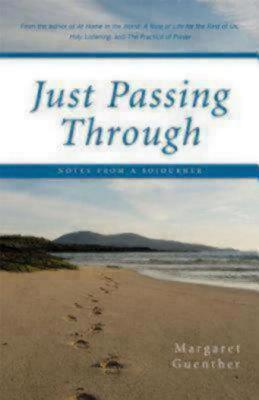
Sojourner is an Old French word with jour--day--at its heart. It reminds us of our transience and of the inexorable passage of time. It reminds us that we do not own this world but that we are merely passing through. It reminds us that God's time is not our time. Fans of Margaret Guenther will welcome this salty and wise collection of reflections on her life journey her childhood in Kansas City, her college days, her career, her travels, and her slow awakening to transience of all things. This writer and spiritual director looks back over the nearly eight decades of her life, tackling themes of childhood, friendship, moving, the magic of words, heaven, spirituality in cyberspace, asking the right questions, and things never to do again. Readers of Holy Listening, On Holy Ground, My Soul in Silence Waits, At Home in the World, and The Practice of Prayer will delight in this book of fresh, humorous insights.
“Pruning does not kill; rather it promotes good growth and prevents what the experts call “overcropping.” An unpruned vine can produce up to one hundred times more buds than are necessary for a good harvest of grapes. The vine’s inner urge is toward quantity; the vinegrower seeks quality.”
“No longer do we read of sojourners. These folk have become “resident aliens” and “passing guests.””
“It is an Old French word with jour (day) at its heart. It reminds us of our transience and of the inexorable passage of time. It reminds us of our smallness and ultimate powerlessness. It reminds us that we do not own this world but are merely passing through. It reminds us that God’s time is not our time”
“the prodigal is not the wayward, wastrel son.The true prodigal is his recklessly extravagant father.”
“we fail to realize the absurdity and the exuberance of this story because it’s just too much for us”
“the prodigality of God”
“the prodigality of God’s love. This is love lavished with abandon and, by my standards, with poor taste”
“let everyone who is thirsty, come. Remember though: you have to be truly thirsty, not just mindlessly taking in, consuming for the sake of consumption. This invitation is issued to the spiritually alive, which may rule out some people whose physical vital signs are in order, but who don’t yet know about the thirst for God.”
“For free! This reminds me of play with very small children, where transactions are conducted with pretend money and prices are absurd. Two cents, a million dollars, what’s the difference? Just name a number. Just pull some grown-up sounding figures out of the air. Could it be that we are dealing with a playful God? A God who says: I’ll pretend with you, we’ll use the vocabulary you understand, but it’s really free. Pay no attention to the price list. The numbers don’t matter.”
“God the economist is interested in our use and stewardship of our resources, how we spend our precious substance, the best that we have.”
“I would love to hear Sarah’s version of the almost-sacrifice of Isaac. Or for that matter, what did she say when Abram told her that the Lord was sending them on a wild goose chase, away from Haran and all that they knew and valued”
“Martha-work is invisible when it is done right. The rooms are orderly, the clothes are clean, the food is good and plentiful; and it all seems just to happen. Martha’s mistake perhaps was that she tried too hard and that—like most of us—she grew tired of being invisible”
“Meister Eckhart preached on her spiritual maturity, indeed her superiority to her sister. “Martha knew Mary,” he says, “better than Mary knew Martha.””
“To read this Word, to know this Word, and to be embraced by this Word is the work of a lifetime. And then some. I’m just beginning to learn to read.”
“Jesus asked questions too. His first recorded words are a question to his anxious mother: “Why were you searching for me? Did you not know that I must be in my Father’s house?” (Luke 2:49). And his last anguished cry from the cross was also a question: “My God, my God, why have you forsaken me?” (Matthew 27:46). He never got out of the habit of asking direct, probing questions. “Whom do you seek? What do you want? What do you want me to do for you? How many loaves have you? Who do people say that I am? Do you know what I [as I kneel to wash your feet] have done to you? Why are you sleeping?””
“His questions bear no resemblance to the multiple-choice queries of standardized tests, nor are they easy examples of the true-false variety. They get at the truth. They force us to see ourselves and know ourselves. They press us to articulate what we truly want. They are never trivial conversation. Jesus asks questions that challenge, open new vistas, and”
“there are fewer and fewer words that cannot be uttered anywhere and by anyone”
“I lament the loss of forbidden words; the language is weaker without them—flatter and lacking its old potential for magic.”
“There are plenty of four-letter words that should be treated with greater care, perhaps to be uttered less frequently and then with intent. Work needs be reclaimed and honored.”
“And then there is rest”
“I must ask myself: what am I missing now? What am I carefully or carelessly not seeing?”
“All babies are holy, even the funny-looking and fussy ones. But this baby is the Holy Child. What a great disguise!”
“The little river in Jenkins Hollow is for me a picture of God. Or maybe a picture of God’s love and grace, of God’s peace flowing like a river. In hurricane season, it can be a picture of the terror of God. Or sometimes it is a picture of the soul’s journey God-ward. Its symbolism shifts and changes, but it is always my teacher. And one of the questions it asks is this: where is the flow impeded? Where are we stuck? Where am I contributing to others’ stuckness?”
“I wanted to stop one of them— any one would have done—and tell them how I used to own this space, how these sidewalks and shops used to be mine, how I indeed thought that I owned the world, just as they claimed ownership now”
“I love being my present age. There is great power and freedom in its powerlessness”
“Things I Will Never Do Again Sometimes I catch myself thinking of things that I will never do again. Some of them are things that I have never done, so maybe they can be classified as “missed opportunities.””
“I’ll never worry about a prom date or indeed any other date again.”
“I’ll never write another term paper. I have written so many highly disposable pieces”
“I want to be sure that I have said “I love you” to all the people whose love I take for granted.”
“Bach managed to bring a great harmonious chord out of the complexity of his fugues. Why can’t I do that with my life?”
“Emptying the dishwasher, one of the most boring bits of my housewifery, can be sanctified if I remember to give thanks for the dishes, the food that was on them, the loved ones who ate from them, the hot water that cleaned them.”
“Jesus is saying, “Be at home with me, and don’t be afraid to touch me.You will neither hurt nor offend me.””
“But the risen Christ did not appear to his followers in dreams or visions: he came among them in the homeliness and everydayness of shared walks and meals.”
“To produce great wine, the vines must suffer, rather like athletes.”* In the same vein, another observed: “One viticultural theory is that a struggling vine produces better wine that one that has better growing conditions. If this is true, the reason may be that the struggling vine has smaller berries than the vine growing under more favorable conditions.”† These small grapes are brighter colored, and their flavor is more intense”
“To prune properly—whether to train a young vine or maintain a mature one—it’s necessary to understand how a grapevine grows. Otherwise, a vine is an unintelligible jumble of trunks, arms, canes, shoots, leaves, tendrils, and fruit clusters.”* There is real intimacy between grower and vine, for each plant is treated as an individual.”
“I would rather not be pruned. It looks like much more fun to be one of the wild grapes that I find in the woods, their vines tangled in the host tree and their fruit—what little there is—way up there in the sky somewhere. Nobody tells them what to do. But they aren’t worth much, either. If we are to bear good fruit, we must be pruned.”
“I yearn to be known, and at the same time I fear it. Most of the time, we let ourselves be known by bits and pieces”
“To be known, fully known, is not possible in our human relationships, but it is the foundation of our relationship with Christ. To be known, fully known, is both painful and profoundly comforting. It is to accept the humble status of sheep, to let the masks and defenses drop away, and to let ourselves be carried on the shepherd’s shoulders and occasionally poked by his staff”
“We have to want wholeness, even when it brings difficulty, pain of a different kind, and new burdens”
“When the beggar Bartimaeus asked to receive his sight, did he know how much his blindness had protected him from pain and ugliness, how it had shielded him from really knowing the world around him? Being healed restored him to full participation and accountability in the human family.”
“To embrace our identity in Christ, we need to know and recognize the false, shallow self, the self that lacks generosity and vision, the self that resolutely refuses to move God-ward. We need to see it for what it is and then bit by bit to strip away all those bits that sully and impede us.”