Jump to ratings and reviews
Rate this book

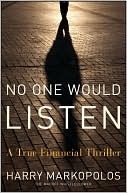
No One Would Listen

Rate this book
No One Would Listen is the thrilling story of how the Harry Markopolos, a little-known number cruncher from a Boston equity derivatives firm, and his investigative team uncovered Bernie Madoff's scam years before it made headlines, and how they desperately tried to warn the government, the industry, and the financial press.

Page by page, Markopolos details his pursuit of the greatest financial criminal in history, and reveals the massive fraud, governmental incompetence, and criminal collusion that has changed thousands of lives forever-as well as the world's financial system.

The only book to tell the story of Madoff's scam and the SEC's failings by those who saw both first hand Describes how Madoff was enabled by investors and fiduciaries alike Discusses how the SEC missed the red flags raised by Markopolos

Despite repeated written and verbal warnings to the SEC by Harry Markopolos, Bernie Madoff was allowed to continue his operations. No One Would Listen paints a vivid portrait of Markopolos and his determined team of financial sleuths, and what impact Madoff's scam will have on financial markets and regulation for decades to come.

368 pages, Kindle Edition

First published January 1, 2010

322 people are currently reading
3607 people want to read

About the author

Harry Markopolos

1 book24 followers

Ratings & Reviews

What do you think?
Rate this book

Friends & Following

Create a free account to discover what your friends think of this book!

Community Reviews

5 stars
927 (28%)
4 stars
1,247 (39%)
3 stars
771 (24%)
2 stars
195 (6%)
1 star
57 (1%)
Displaying 1 - 30 of 427 reviews
27 reviews1 follower
April 1, 2011
Interesting but terribly written

I was curious to learn more about this story, and this book did the trick, but the whole time I was frustrated by the poor writing. So many "really"s, "very"s, and things like, "They are so lame, they couldn't ______ a ______ in ______" (catch/cold/winter, find/steer/a stampede, find/steak/an Outback, find/batter/a batter's box, etc.). Markopolos repeats stories and tells over and over his reasoning for various choices he made. It feels like he is filling in space because he just didn't have enough for a whole book without the repetition. Honestly, it's like he didn't have an editor!

Another noticeable feature was Markopolos' arrogance. He's obviously a brilliant guy and the SEC is remarkably incompetent. But he is also that guy who goes through life drawing a very sharp lines between who is smart and stupid, and who is ethical and immoral (guess which categories he places himself in) and this book was his chance to share these judgments with the world as much as it was for him to tell the Madoff story. He tells his story in such a smug way. There is some justification for his self-importance, given the circumstances, but a little humility would have gone a long way with me. I was often distracted from the story so I could think to myself, "Man, I really don't like this guy."

In all, worth the read to hear the whole story, but be prepared that you might feel like you are reading the diary of a smart but arrogant and socially awkward middle school boy. I wish he would have gotten Michael Lewis (or Jon Krakauer!) to write his story for him.
Profile Image for Terri.
379 reviews30 followers
July 6, 2012
This is a terrible book. I have respect for the fact that Harry Markopolos and his team figured out that Madoff was running a ponzi scheme in 1998. That's impressive. I think the process by which they came to this conclusion is very interesting. The book, however, is poorly written. Markolpolos's hyperbole makes many chapters hard going and his many digressions (about offering to buy his wife a boob job for an engagement gift or about a friend's sailing accident) bog down the story and feel like filler. Every time he shares his approach to the SEC or newspapers or anyone, I find myself more sympathetic for why they didn't listen to this guy. He understands mathematics, but he certainly doesn't understand people. Given the facts, it is very clear that the SEC fell down on the job in this case, but I totally get why they didn't listen to this insulting, bombastic "whistleblower." I am glad I checked this out of the library rather than buying it.

I would love to read this same account written by a journalist or other third party biographer with solid fact checking and better writing.
Profile Image for Trish.
1,418 reviews2,709 followers
March 9, 2010
This is an outstanding piece of work. Bernie Madoff was investigated by Markopolos and his team over a period of ten years, and yet this book reads with all the urgency and thrills of a case unfolding now and in a short window. Markopolos admits he is not politically correct, and he holds back no punches for agencies that obstructed, obscured, and ignored information that could have led to the detention of Madoff years before his scheme became widely known. And Markopolos is funny. The language in the book reads as though he were speaking--it has an immediacy, and an irreverence that most of us wouldn't dare commit to paper but which gives the book a refreshing and unstudied artlessness. It is so not lawyerspeak.

This is a book we all need to read. I am here to say it is no burden to put this on your reading list. It is another example of how a good democracy can work. Citizens must take notice of fraud, and speak of it, lest it overtake us. Incompetence in the regulatory agencies we hire to protect us is unacceptable. We might even recognize unfettered greed as the social ill it is. Sometimes I think Americans get confused about this--they might even admire it.
Profile Image for Sher.
761 reviews16 followers
April 7, 2012
Everyone knows what a ?*&% / Bernie Madoff was, but how many people know that most of the damage he did could have been prevented by a simple phone call from the SEC to verify his trades several years before, and some 55 billion dollars before, his collapse? The incompetence of the SEC is legend. They simply refused to even consider so much as asking a question about the legality of what Madoff was doing. The question that comes to my mind is what WERE they doing with their time, if it wasn't investigating things like this? Wasn't that their job description? Although Madoff was the biggest fish, there were many other crooks that they also ignored. Maybe a better word would be 'protected' because that is what they were doing, protecting the bad guys from their investors - the exact opposite of what they had been hired to do.

Having once been Securities licensed myself, this book was all the more interesting to me. I know a little of what goes on in the world of finance, and in fact was burned myself to the point that I just don't want anything to do with it. That is probably not a good place to be either, but it is tough to have some dishonest person effect the quality of the rest of your life. Luckily I didn't lose everything as so many of these investors did, but I will be paying for my mistake of trusting someone who seemed so good and who turned out to be a crook for the rest of my life. I wept when I heard the stories of some of these people. Hell is too good a place for people like Bernie Madoff.

This book reads like a novel. I recommend it to anyone who has an interest in finance, or in bringing bad guys to justice. It was ultimately satisfying to see that justice was done. This country owes a huge debt to Harry Markopolos and his team (who were never paid for their work in bringing Madoff down) for hanging in there when it would have been so easy to quit. Thanks to them, the whole SEC is restructured and re-staffed. I hope the people at the SEC today are doing their jobs the way they should be done. If they are, things like this should never be able to happen again.
Profile Image for David.
Author 19 books402 followers
October 1, 2018
Harry Markopolos is seething with anger. You realize this by chapter two, and by midway through the book, he has fully given vent to his rage and contempt. If his version of events is correct, he has good reason. His anger is particularly directed at the SEC, which he repeatedly calls inept, incompetent, ineffective, inefficient, unqualified, corrupt, and just about every other insult he can think of, sometimes even descending to schoolyard zingers. But he also indicts the entire financial industry, which basically knew what Bernie Madoff was doing long before his scheme collapsed and nearly brought down the economy with it.

The short version, for those who only vaguely remember Bernie Madoff as a big Wall Street con-man: for many years (from the 90s to 2008), Madoff, a "financial wealth manager," ran a huge Ponzi scheme in the form of a hedge fund. He promised a 1% rate of return every month. Every month. Without fail. As Markopolos points out, this is essentially impossible. No fund, no investor, no financial analyst, can run a portfolio that never has a down month for ten straight years. Yet Madoff did it, and this incredible rate kept the money flowing in. He had the backing of large banks. It turned out later that entire funds were basically invested 100% in Madoff's fund. There was a huge amount of overseas investment from Europe, the extent of which we'll never know because much of it was money being invested by organized crime and rich tax evaders.

It was all a Ponzi scheme. Madoff was never investing anything. He was just taking money from new suckers and using it to pay returns to old suckers. It worked until the financial crisis of 2008, when suddenly his investors needed their money and he couldn't pay them all.

Ponzi schemes are nothing new on Wall Street, of course, but the sheer scale of Madoff's scheme is what made it remarkable. There were hundreds of billions of dollars invested in him, and when he went down, it was mostly rich people who lost their shirts, but not a few individual investors who'd invested their retirement savings with him. Pension funds were also destroyed. As a member of New York's wealthy Jewish community, he was trusted by everyone in that community and so he also shamelessly looted synagogues from New York to Florida.

Madoff, who is now serving life in prison without the possibility of parole, has in many respects done more damage to America, and the world, than Osama Bin Laden ever did.

How did he get away with it? A combination of trust, ineptitude, and greed.

Harry Markopolos was a small fish on Wall Street. He was a financial analyst for a Boston firm. He first became aware of Bernie Madoff when his bosses asked him to come up with a financial product that could compete with Madoff. All of their clients were looking at Madoff's returns and asking why they couldn't do the same thing.

(Incidentally, one of the things I find particularly telling about Wall Street is how all sorts of bizarre, complicated, and downright fraudulent investment schemes are called "products" - as Markopolos points out, anyone can create a "product" that you can get someone to invest in. People can invest money in your "product" that is based on trading according to the tides and astrological signs.)

Markopolos began looking at Madoff's fund, and the numbers didn't add up. The more he studied it, the more he became convinced that something fishy was going on.

It turns out that Markopolos wasn't the only one, though he was the only one who made a thorough, documented study of Madoff. Basically everyone knew that Madoff was running some sort of scheme, but they were okay with it as long as it kept paying them off. Most people did not think Madoff was running a Ponzi scheme - they thought he was doing something called "front running," which is a complicated form of short-term "insider trading" that is technically illegal but almost impossible to catch.

Markopolos went to the SEC, multiple times, and each time the SEC blew him off. When the SEC finally investigated Madoff after he confessed to his sons what he was doing, it was far too late.

Harry Markopolos, who spent years being the boy who cried wolf in the eyes of Wall Street and the government, finally got his vindication, and he describes the utter delight he felt as Congress raked the SEC over the coals in the wake of Madoff's downfall. He ends the book was a set of prescriptions for reforming the SEC. As far as I can tell, very few of these have been implemented. All the SEC officials in charge at the time have resigned and "moved on to other opportunities," of course, but no one was fired, or went to jail (except Madoff), and the SEC of course made a lot of noise about reform and reorganization, but I have little confidence that anything has really changed.

The problem here is that while Markopolos, in his book, walks us through the reasoning he used and the evidence he gathered to prove Madoff was running a Ponzi scheme, it's not immediately obvious and intuitive to anyone except a financial analyst who's good with math. Markopolos had to convince people by showing them graphs, charts, and spreadsheets. The evidence was there, but as long as Madoff could confront his accusers with a plausible-sounding alternate explanation, it's all just a bunch of numbers. SEC investigators evidently do not have the background to crunch those numbers. And Madoff appears to have been a stone-cold sociopath who was unfazed by any accusations and able to placate anyone who questioned him.

No One Would Listen really is a fascinating and dramatic book, much more interesting than you'd expect from a book by a math geek about a Wall Street hedge fund. Markopolos gets personal quite often, and his anger and frustration is palpable. Although he is never directly threatened, some of his friends are, and he spends years fearing that Madoff might literally send hit men after him, or that the SEC would raid his house to confiscate his evidence proving their ineptitude. So when he finally gets to unleash in front of Congress, he tells us his goal was to make sure that the SEC had a very, very bad day.

Understanding what happened in the Bernie Madoff scandal should be a wake-up call to everyone involved in the financial industry (and we all are, one way or the other). Markopolos is quite sure there are other Bernie Madoffs out there, and the government watchdogs that are supposed to be protecting us aren't. And as with several other books I've read about Wall Street, this one leaves you with the unsettling realization that the biggest fish in the market, the people who handle billions of dollars and can shake the economy (and wreck your pension fund), more often than not are not the wise investors we'd hope, motivated to take some responsibility out of self interest if for no other reason. No, they are greedy, short-sighted, and sometimes downright clueless.
Profile Image for Randy.
43 reviews7 followers
March 11, 2017
Harry Markopolous was a "quant" mathematician with a hedge fund in Boston in the late 1990s. His supervisor came to him with the results from a secret, unregistered management fund ran by the former chairman of NASDAQ, and asked him to devise a product that could compete with that fund's returns. Markopolous did the math and realized that Bernard L. Madoff was a fraud. He gathered up as much information as he could, then reported the matter to the SEC--in 1999. Markopolous and three other men spent the next several years investigating Madoff on their own, albeit with the support of their employers. Markoplous submitted the matter to the SEC four more times, each time with more detail than in the previous submission. The Boston SEC field office was concerned, but it followed protocol and turned the case over to the New York office, which failed to pursue it. Markopolous was written off as a nut, and it's easy to see in the book how he might have come off that way. However, he gave the SEC hard numbers and mathematical analysis explaining why Madoff's returns were impossible. Despite Markapolous's whistleblowing, it was Madoff himself who admitted the fraud after he saw that he would soon run out of money because there were not enough new investors coming into the scheme to pay absurd returns to current investors and the feeder funds that sent Madoff money. The red flags of a Ponzi scheme were all over the place. Indeed, Markopolous set out all of the red flags explicitly in one of his submissions to the SEC. Markopolous and his team discovered during the course of researching Madoff that probably hundreds of other Wall Street players believed Madoff was a fraud, yet failed to report him, probably because they did business with the funds that pumped money into the Ponzi scheme or because they didn't want to cross a powerful Wall Street icon like Madoff.

Markopolous is justifiably angry at the SEC for failing to heed his warnings and for transforming itself from an agency that ensured a level playing field on Wall Street on behalf or we the people into an advocate for, and protector of, the industry it was supposed to regulate. More recently, we have seen this same seen this same kind of transformation with the mine safety regulators and the Minerals Management Service, which failed us as to BP with potentially devastating consequences to the ecosystem a few miles from my house. To my mind, this collusion of regulators and industry is an issue that transcends partisan politics. These federal agencies exist to ensure that the markets work fairly and efficiently, and that the worst case scenarios of potentially dangerous practices never come to pass. There has always been bipartisan support for the kinds of regulatory agencies that have failed us so terribly in the past couple of years; now even that does not appear to be a given.

"No One Would Listen" is a book that anybody concerned about corruption on Wall Street and the cooption of federal regulatory agencies should read.
Profile Image for James.
301 reviews71 followers
June 24, 2010
This should have been a good book, but the author is so repetative and egotistic that the 300+ pages should have been reduced to about 50.

The author fails to discuss quite a few interesting aspects of the case and leaves a person wondering about so many things.

After reading the book I went to Wikipedia and found much more interesting information with 5% of the words.

http://en.wikipedia.org/wiki/Madoff_i...

http://en.wikipedia.org/wiki/Bernard_...

http://en.wikipedia.org/wiki/Recovery...

The quoted sections below are from wiki.

The author ignores Madoff's last and perhaps greatest coup,
he had his sons turn him in to the FBI,
that way it'd look like they weren't involved in the fraud.

For instance:
"Andrew Madoff deposited almost $1 million into his accounts and withdrew $17 million;
Mark Madoff deposited $745,482 and withdrew $18.1 million"

"Mark and Andrew Madoff withdrew more than $35 million from a small original investment."

And: "Madoff did not plea bargain with the government.
Rather, he pleaded guilty to all charges.
It has been reported that he did so because he refused to cooperate and name any conspirators"

"In settlement with federal prosecutors, Madoff's wife Ruth agreed to forfeit her claim to US$85 million in assets,
leaving her with $2.5 million in cash"

"Massachusetts regulators also accused her of withdrawing $15 million from company-related accounts shortly before he confessed"

Why should she be able to keep $2.5 million when so many lost so much?

And who really lost money?
Using rule of 72, if a person draws out annual earnings for 6 years they have their original investment back.

"About half of Madoff's investors were "net winners," earning more than their investment."

"about $36 billion was invested into the scam, returning $18 billion to investors, with $18 billion missing"

Where did it go?

The hedge funds that fed the money to Madoff probably took 30% or more of the missing money, but this question isn't addressed.

Finally, at the end his gives an internet site that has victims statement and promising much more, but when you go there,
it's run by the publisher and is just a plug to buy the book with 6 internet book sellers hot linked.


Profile Image for Danielle.
1,094 reviews2 followers
April 21, 2010
I'm not remotely interested in financial intrigue, but I saw this guy on Jon Stewart and he was just so mad that I had to pick up the audio book. It was a delightful listening experience - the financial details were made so easy to understand. The book also uses the real audio clips from the Congressional hearings into the SEC and Madoff, which makes for an exciting listen.
Profile Image for Jenny Zarate.
22 reviews1 follower
April 17, 2010
While reading about the Bernie Madoff scandal was fascinating, you can put the book down after he's arrested. Really. You want to, unless you just want to hear the author toot his own horn for the remainder of the book.

The author's language is very boring and dubious to read, in my opinion, because he sounds like a high school geek who has been vindicated, which, most likely is what he is. Although he was right, and no one would listen as the book title claims, it's no wonder; he is abrasive, annoying and pedantic. I wouldn't want to listen to him either. He makes sweeping statements that are very insulting and if I have to hear another of his comparisons, it will be too soon.

Here are some of his moronic examples:

"The SEC roars like a mouse and bites like a flea" 8

"It was like the Red Sox trading Babe Ruth to the Yankees" 140

"Lawyers are trained to follow the black-letter law and regulation the way Hansel and Gretel tried to follow the bread crumbs home from the forest"269 (What does that even mean????)

"These college greenhorns couldn't find cattle in a stampede" 269

"Maybe lawyers know the difference between a tort and a tortilla, but there is a reason that most firms in the industry are run by business people [...:] Obviously that didn't prevent the industry from barely surviving the 2008 crisis, but just about anything would be an improvement over lawyers attempting to lead an industry whose complexities they don't understand" 269 (Make an insulting comparison and then discredit your statement = AWESOME)

"No Child Left Behind tests students to determine if they're learning, yet we don't test those people given power to regulate our financial industry"270 (Because we've pumped out some real winners since that program has been instituted)

"That particular inspection team wouldn't have been able to find a batter in the batter's box" 272

There are numerous more of these blanket statements and idiotic comparisons that stick out like a sore thumb when you are reading, but there is no need to torture you with them.

Also, he's just kinda an asshole. It is with a kind of erotic excitement that he gets to nail the SEC (starts on 226 at the chapter break if you want to read it) for all their failure. He obviously takes great pleasure in it and doesn't have the sense to edit that out of the book. In fact, I think I blame his editor for a lot of the huffing and puffing that the author does in this book, but I am going to go out on a limb and guess the editor didn't want to talk to him either!


Profile Image for Lobstergirl.
1,914 reviews1,435 followers
July 26, 2010
I already knew much of the Madoff story, having read articles and a book on it, and watched Harry Markopolos's congressional testimony. But No One Would Listen was still a gripping read, as Markopolos and his "team" of fellow derivatives experts tried to figure out over the span of a decade how Madoff's secret hedge fund was getting the returns it was getting with almost zero volatility, and tried repeatedly and unsuccessfully to get the Securities and Exchange Commission to pay attention. Markopolos's writing style is pleasant and engaging and the story really does unfold like a thriller, albeit one where everyone is a geek wearing pocket protectors. He is susceptible to a certain folksiness: "If blank looks were dollar bills I would have walked out of that room a rich man." (On his first meeting with an SEC lawyer.) On his Chinese wife: "We got engaged the old-fashioned way. She gave me a deadline and told me if we weren't engaged by that date I was history." (Following this is a silicone breast implants anecdote which should have been edited out.) Toward the end of the book in particular, the metaphors are laid on fast and thick: the SEC couldn't find ice cream in a Dairy Queen....couldn't find a batter in the batter's box....couldn't find a steer in a stampede....couldn't find their asses in the dark with two hands (maybe that came from a member of Congress)...

In a book filled with astonishing and dismaying revelations, two rather small but significant ones struck me: 1) the SEC had no publications budget. If employees wanted subscriptions to the Wall Street Journal or anything else, they had to pay for it themselves. And the WSJ would be among the cheapest publications they might want; hedge fund newsletters, like the one which ran an admonitory article on Madoff in 2001, would run $1,000/year or more. SEC employees needing to do research on derivatives they knew nothing about would have to turn to internet search engines. And 2) the SEC did not buy its employees business cards. If they wanted them, they had to pay for them. So after an SEC audit, the auditor could not turn to a Wall Street trader, analyst, or manager and say, "Here's my card. Please call me if there's any fraud you want to discuss privately."

Typos: Six times, principal is spelled principle. And the name of Marc Rich is misspelled.

Appendices contain the 2001 hedge fund newsletter article by Michael Ocrant, a member of Markopolos's team, and Markopolos's 2005 submission to the SEC.
Profile Image for Brian.
674 reviews290 followers
March 17, 2011
Marcopolos still hadn't cooled down while writing this...and it suffers

It's totally understandable. He'd been investigating Madoff for about 10 years, frustrated and angered by the SEC's brushoffs, so it makes sense that he's still furious about the whole affair. Trouble is that it completely colors his writing, even the organization of the book. You can tell how angry he is by the tone of contempt he holds throughout. He could have polished this book much better, and used some sort of organizational scheme. Yes, it's largely chronological, but we hear many arguments repeated several times. We also hear his "SEC couldn't catch a cold in a freezer" type comments (my impression is that he compiled a list and made sure he worked every one of them into the text).


My other big criticism is his narrative style. Way too much time is spent on rant and complaint rather than actual narrative. This too is tied to his venting of decade-old frustration, but we'd learn a lot more and pay more attention if he stuck to the story.


I would also encourage readers to read his (2005?) submission to the SEC that he included as an attachment (at least in the Kindle version). I was a little shocked to see that the same style he employed in the book was used in his evidence for fraud. I'm actually a little less surprised that they didn't take it seriously when they read it (if they did), because he does come off a little scatterbrained, a lot incensed and not well organized. He could have done a much better job, especially given that he'd been working on it for several years at that point. The tone should've been much more professional (not to mention spellchecked), and he should have laid out his points more carefully, summarizing them up front so the full weight of the evidence could be felt at once. It reads more like a rant and you're drawn away from the evidence into concern about his temper.


All that said, it is a compelling story, albeit not well told. So I give it points just for how interesting the whole endeavor was, and how unlikely it was that anyone else had stepped forward. Makes me even more creeped out by what goes on in the financial world. Also reaffirmed my aim never to place my money in a hedge fund (if they even continue to exist).
Profile Image for Kim.
329 reviews16 followers
July 1, 2017
Part crime story part indictment of the U.S. government, this book tells the story of a few investment specialists who determined that Bernie Madoff was running a multi-billion investment scam, but also how they handed the story to the Securities and Exchange Commission (SEC) and various journalists with barely any attention given to the story.

Harry Markopolos is a math geek, slightly OCD, and what is known in the investment industry as a "quant", someone who studies the statistics and patterns of various stocks and bonds and then designs investment products for investment firms.

Working in Boston, some 200 miles from the financial center of the world in New York City, Markopolos first ran into the investment company being run by Madoff when he started being nagged by a manager to design a product that was as attractive to investors as what Madoff was offering. Madoff was a former chairman of NASDAQ and founded the investment company Bernard L. Madoff Investment Securities LLC in 1960. When he came to Markopolos' attention his firm was running an investment program that consistently earned 1% per month returns, with the investments supposedly increasing in a nearly straight upward line. He claimed that over several years his firm lost money for clients in only three months. 

This is, basically, impossible. If you look at any stock graph the graph will always go through periods of increase and decrease, even on a single day. The objective is to earn money over an extended period of time, with losses and increases along the way. He was claiming to outperform all stock exchanges and all other investment firms in existence,

Markopolos, with several friends, began to investigate how Madoff managed this. Even with stocks Madoff was claiming to buy and sell they couldn't figure out a way to match the performance. It finally became clear that Madoff was involved in one of two illegal activities. He was "front running", or basically buying based on illegal insider information, or he was running a Ponzi scheme, where he would pretend to invest but was actually paying dividends to older clients by using the money from new investors. Imagine a friend gives you $10 to invest. Instead of investing you get another $10 from another friend. You don't invest that either, but you pay your first friend a "dividend" from the second 'money. The more people who get excited about the program the more successful you can pretend to be. Madoff was doing this, but was requiring a minimum investment of $1,000,000 from new clients. He took money from individuals and companies from all over the world.

Markopolos took evidence to the SEC (the federal agency that is supposed to protect investors) three times. The SEC went to Madoff and asked some basic questions, decided that he was doing nothing wrong without even looking at the bookkeeping, and left. Usually with the investigators asking if they could leave a resume with Madoff.

Things finally fell apart in 2008 during the housing bubble. People were suddenly facing financial troubles and began trying to withdraw their money out of Madoff's company. The money wasn't there. Madoff told his sons that the company was a sham and they went to the FBI the next day. By then Madoff had taken around $65-billion from his investors. People lost their life savings, some investors committed suicide. 

Markopolos details his attempts to get the attention of the authorities for several years, often fearing the Madoff might hire someone to kill him. He found the SEC to be poorly staffed with people who didn't understand business. They were underpaid, and the SEC refused to pay for basic news like the Wall Street Journal (they had to pay for it out of their own salaries). None of the offices were equipped with either research books or Bloomsburg terminals (a computer system that tracks stocks and investments, available in every investment office) because of the expense.

Markopolos closes the book with a description of his own testimony to Congress, as well as personal stories by some who lost everything and suggestions for changes in government regulators. 

It can be a scary read for anyone, even if you don't invest in stocks yourself but are hoping to rely on a pension at retirement, as many of those pension funds invest with companies not entirely unlike Madoff's.

Profile Image for Jeff Hunt.
20 reviews5 followers
January 26, 2014
“Why are male SEC employees smarter than their female counterparts? Because the males can count to 21…..but only if you pull their pants down.”

“No One Would Listen” is Harry Markopolos’s account of his attempts to expose Madoff’s operation as a ponzi scheme. His main arguments (the “red flags” in his lingo) concerned the lack of volatility reported by Madoff’s strategies, the secrecy surrounding the operation, Maddoff’s fee structure to his feeder funds, and the shear impossibility of running a split strike conversion strategy the size of Madoff’s given the open interest in the relevant option markets.

Despite the title, many people within the quantitative finance world did in fact listen to Harry and his cohorts and even agreed that Madoff was likely a fraud. In fact, it appears that this was an open secret within the large wirehouse banks with derivative expertise. Where Harry’s claims fell upon deaf ears was when he submitted his information to the SEC. And it is clear from this account that Harry harbors much hate for the securities regulator. In hindsight, the SEC was particularly inept in this case.

Markopolos is no doubt an eccentric. It is apparent from the tone of Harry’s narrative that is prickly and condescending. He also appears extremely paranoid – fearful of his life and thinking the SEC would bust into his home to confiscate his materials once Madoff’s scheme became public. At times, the reader is left wondering if Markopolos has a mild form of Asperger’s syndrome – high functioning in the technical area of quantitative finance yet totally lacking in emotional intelligence. This reader believes this in part explains why his submissions never gained traction with the SEC. Harry just isn’t a sympathetic figure. And it is clear that his initial frustration with the Madoff strategy was his inability, as a quantitative finance professional, to produce a product with the same risk/return profile at the behest of his firm. So it was easy for his audience at the SEC to write him off as airing sour grapes without taking a deep dive into his quantitative arguments which they were not staffed to understand or appreciate.

So despite heaping blame upon the SEC for not catching Madoff sooner, this reader’s view is that Harry Markopolos shares some of the blame. Someone with a higher level self awareness would have proceeded differently and structured his material to better suit his intended audience. In the SEC’s internal investigation one of the reasons cited for not pursuing Harry’s tips were that motivations were those of a disgruntled competitor and the possibility of a whistleblower award. Furthermore, there were other government regulators that Harry could have approached including the FBI, DOJ, NYAG, or maybe even the Secret Service. And yet he focused all his attention on the SEC, an organization that overtime he increasingly believed was inept. Furthermore, he could have gone public to the finance press. He tried to go to the WSJ, but less prestigious publications would have thrilled to have the scoop.

Despite these criticisms of the author, this book is an entertaining read and offers a unique perspective on the Madoff scandal.


Profile Image for Esther Bradley-detally.
Author 4 books45 followers
April 10, 2010
No One Would Listen, a True Financial thriller by Harry Markopolos is a gripper. Forget that I, a daughter of a municipal bond person, can't read the stock page, and this book is filled with discussions of derivatives, Ponzi Scheme (think Madoff), Harry Markopolos grips the reader to his account of discovering Bernie Madoff and his scheme which was ignored by the SEC and eventually grew to the size of $65 billion Ponzi scheme.

Markopolos is a wonderful writer, chatty, very intelligent, a math geek, quant, who sees relationships among number as a writer would letters to a page and a composer stairways to the sky in a jazz rift. He struggled for 8 years trying to warn investors, the SEC of Madoff's schemes, only to meet disinterest and disfunction.

Totally huge event. Had agencies listened to Markopolis. Had the SEC listened to Markopolos in the year 2000, the money saved would have been forty-three billion dollars.

Amazing story; brave man, and it was dangerous for himself, his family and his team. a must read.
28 reviews
May 24, 2017
I thought I had mixed feelings about this book until I started writing this review and then I realized this is a very good book. The story itself and how it played out is all very tragic but also interesting. The way Harry Markopolous and his "team" learned so early on and so easily that Madoff was in fact running a Ponzi scheme was down right scary because it makes you think, if a Ponzi scheme could be carried out so blatantly just how safe is my 401k? If for no other reason, that one alone has made me pay a lot more attention to where my retirement funds are invested and has made me believe this to be a very good book. Markopolous hits on the fact that many other players on Wall St. were aware something wasn't quite right with Bernie Madoff and the returns he touted but almost none of them made an effort to report him to the SEC and that's very disconcerting. Some people may be put off by the repeated comparisons Markopolous uses in making his point about how inept the SEC was and I get that, but overlooking his ego and those types of statements wasn't that hard for me, especially since it was the truth. The SEC was probably the most useless federal agency in existence at the time and boy did they prove it on a huge scale. His repeated attempts to try to get them to investigate Madoff were maddening. To his credit, he didn't purposely go after individuals within the SEC but the agency as a whole. Yes he did point out specific names at the SEC but he had to because they were the ones he interacted with however he still realized it was a bigger problem than the individuals themselves. Has the SEC changed today? We don't really know but with the investigation that went on within the industry and the report that appeared to be pretty blunt, one hopes changes have been made. To sit back and watch this picture develop over the years through the lens of Markopolous and his team is very sad because you think of all the victims, the people that are struggling to get by now on a day to day basis when they thought their retirement was secure. It makes you wonder how secure your retirement is.
Profile Image for Samantha.
155 reviews23 followers
August 15, 2010
Frankly, I found this book exceedingly self-congratulatory and didactic. If the praising comments are to be believed, Harry Markopolos is a hero among men and a god among mere mortals. He and his two comrades figured out that Bernie Madoff and his hedge fund were frauds long before anyone else, but alas, their numerous cries were unheard by the Securities and Exchange Commission (SEC) for years. It was only when Madoff's Ponzi scheme collapsed under its own weight that Markopolos, et al. were proven correct, whereupon he took every opportunity to tell anyone who would listen - especially the U.S. government - just how right he was.

Blech. Okay, so the man deserves some accolades for seeing the truth through all the lies and willful blindness. But to then go around chanting "nanny-nanny-boo-boo" is too self-serving for my taste.

There were other problems with the book, too.

1. It lacked focus. One moment Markopolos is talking about Madoff's hedge fund, the next he's off on some other tangent regarding some anecdote or another.

2. Not enough about Madoff. Bernie Madoff's ability to snow people for so many years is fascinating to me. And I was hoping this book would shed more light on the man and his hedge fund, especially since that's how the book is marketed. But no. As previously mentioned, this book was more of a "wow, look at me, I'm smarter than you" chronicle. Disappointing.

3. Metaphors that made my teeth hurt. Granted, the man is not a writer by trade, but presumably he had a "real" writer helping him out, right? You are not funny, Mr. Markopolos. Please stop trying to be.

4. Too melodramatic. The downtrodden, heroic analyst who gave up a lucrative but boring job to become a professional whistleblower, who stood up to the SEC and won, who fruitlessly exposed a fraudster at the risk of life and limb. Give me a break.

Overall, disappointing and irritating. I do not recommend this book to anyone but Markopolos' family. Ugh.
Profile Image for Gabby.
204 reviews45 followers
January 27, 2013
How on earth does it happen that a Ponzi scheme of the size and scope of the Madoff creation goes undetected for so long in spite of the regulatory agencies in place to keep such a thing from happening much less sustain itself for such a long period of time? That's what Harry Markopolos explains in this book. I cannot say that I understood all of the explanations outlined here, but I don't think that's the fault of Markopolos. He tries to explain some pretty sophisticated and complex principles of finance, and because all of that was not always clear to me, Markopolos was able to make his points very effectively. For example, why doesn't the SEC employ individuals who thoroughly understand what they are supposed to be overseeing? Because financial institutions have become so large with such a complicated variety of products in which investors may participate, shouldn't monitoring agencies do their utmost to keep up with such involved mathematical computations? If it takes a PhD to understand the intricacies of such a system, why are we entrusting the monitoring instead to those who barely understand those concepts, IF they understand them at all? This was a scary book in my opinion because Markopolos pointed out so many of the ways people like Madoff can walk off with the savings of people who depend upon that money for a number of important reasons. The infuriating thing to me is that there will never be enough years in jail Madoff can spend or enough apologies he can make that will ever undo the damage he has done. What we can do, though, is implement policies to prevent this kind of thing from repeating itself. The thing is, I haven't seen anything to indicate that's the path we're taking. Sew your money into your mattress.
568 reviews2 followers
April 29, 2011
If you aren't spitting mad about corruption on Wall Street and the incompetence of the government agencies tasked with regulating them you will be after you read this book. The author was working as a "quant" for an investment firm in 2000 when he was asked to look at the Bernie Madoff fund to try to create a new fund to mimic Bernie's returns. After 5 minutes he knew it was a fraud. Over the next 9 years he submitted his increasingly detailed findings to the SEC 5 separate times and was ignored each time. He even tried to get the Wall Street Journal on board to expose the fraud but was strung along for over a year before they dropped the story in 2007. He did everything he could to warn anybody and everybody that Bernie was a fraud and nobody had the slightest interest in doing anything about it. This book left me considering taking all my money and putting it in a shoebox under my bed!
25 reviews1 follower
March 24, 2016
I agree with other reviewers that this isn't a terribly well written book, but I am just absolutely intrigued by Harry Markopolos and the Madoff story. I read his 2005 (?) letter to the SEC with the 30 or so red flags a while ago. I thought it was so awesome that someone was out there, a little unsung hero, trying to fight Goliath. I was actually glad I read other people's reviews first so I anticipated some of the repetition and cheesy joke analogies and it didn't ruin the experience for me.

So because of my interest in the Madoff case and Harry Markopolos in particular, I was willing to read anything and I loved this book. This is not like Moneyball, which I also gave 5 stars, where I have no interest in baseball but I still found the story very interesting. I would say this book is kind of like Moneyball but you have to already know all about Billy Beane and be really into baseball to like it. So not really like Moneyball at all I guess :)
Profile Image for Nathan Schrock.
93 reviews4 followers
July 6, 2018
Apparently as a 12yo kid in 2008 I was oblivious to the news, so I didn't even know that the Madoff scheme occurred during my lifetime. Markopolos tells the story in a fascinating way, giving good layman's explanations of stock-exchange terms like "front-running" or "split-strike conversion", but without getting bogged down trying to explain how the stock market works. As a dude with next to no knowledge of stocks, hedge funds, and capital markets, I understood Markopolos' explanation of Madoff's scheme, so I'd say it was a win. 👍

But the book really focused less on Madoff and more on Markopolos' struggle with the Security and Exchange Commission. Markopolos literally knew Madoff was a fraud years before he was caught, but the SEC wouldn't do anything about it. Of course, Markopolos only tells one side of the story, but it's a fairly well documented, condemning story for the SEC. Great book, and I recommend the narration by Scott Brick.
Profile Image for Anastasia.
2,232 reviews102 followers
August 11, 2017
No one would listen is a true financial thriller by whistle blower Harry Markopolos tells the story of the Bernie Madoff Ponzi scheme scandal, the largest financial fraud of all time. An interesting account that is hard to believe that it actually happened. It is amazing and frightening that it could go on for sol long when it could have been stopped.
Profile Image for Traci.
28 reviews1 follower
April 12, 2017
Wow. Even if you are familiar with Bernie Madoff and his Ponzi scheme, this book is a disturbing look at the ineptness of the SEC and its unwillingness to protect investors and investigate Madoff even after multiple tips.
Profile Image for Ryan Lowry.
5 reviews
February 5, 2017
The story was interesting, but got drowned out by how vain and out of touch the author was. "For a while, we would have to survive on only one Wall Street salary" was cringe worthy.
6 reviews2 followers
June 17, 2014
Our human greed burdens the policemen overseeing financial markets with a unique regulatory responsibility. Other regulators, those overseeing meat packing or nuclear power for example, are not forced to guard against greed. The butcher and physicist are not corrupted by their craft to exploit their customers.
In finance, a trade ruled by “greed is good” and “caveat emptor,” predators will steal from the public. The financial cops at the Securities and Exchange Commission must out smart, hunt down and capture the criminals for the good of the shire.
It’s a responsibility the SEC sentinels failed to uphold as they missed the greatest Ponzi scheme ever attempted.
In his telling of the SEC’s greatest failure, Harry Markopolos trumpets his role as the Bernard Madoff whistleblower who no one would listen to.
He casts himself as the protagonist. He was the whistleblowing Captain Ahab and the financial “quant” Cassandra. In screed after screed, Markopolos criticizes the SEC for ignoring the evidence he brought them for almost a decade before the Madoff Ponzi scheme collapsed in September 2008.
“We had discovered the largest financial crime in history. Many people knew about it, and apparently there was no mechanism available to stop it,” Markopolos wrote.
His Madoff chase started with greedy self interest: Markopolos simply could not reproduce the mathematics behind Madoff’s perfect investment record. The guy never lost money in the financial markets, leaving Markopolos feeling emasculated.
Until his Ponzi scheme collapsed, Madoff was an immortal god. He overcame the rules of economics to conquer financial market risk. Markopolos was the jealous loser, whining to anyone who would listen because he could not match Madoff’s perfection.
Markopolos does not acknowledge the psychological confidence game that Madoff pulled off to fool regulators and the public for so long. Clearly, the SEC missed one of the biggest crimes in American history.
But until events proved him right, Markopolos had the burden of proof. He had to prove Madoff was bogus, rather than Madoff having to prove he was legitimate. Madoff – a philanthropist and New York powerbroker – had no motive to conduct a Ponzi scheme. Markopolos acknowledges this lack of motive was a high hurdle for the SEC to jump. But he does not acknowledge how people must have viewed his own motive – as a scorned lover, not a socially-conscious whistleblower.
Then the characters’ roles reversed in the dark hours of September 2008. In a story about the faceless alphabet soup of concocted financial products, the financial crisis saga found its icon in Bernard Madoff. No American citizen recent history came this close to becoming the devil incarnate. Madoff was enigmatic, unconscionable evil. Why? Why? Why would he do it? No sophisticated trading algorithm could handle that problem. The world is simply risky.
Americans turned to Markopolos for answers. He trumpeted what he’d known all along: The signs of the Ponzi scheme had been visible for years, but no one would listen to his evidence.
Markopolos is wrong. As Markopolos himself admits, plenty of people knew Madoff was a fraud. Even if the SEC did not trust Markopolos, influential people in the New York financial community knew Madoff was corrupt. But these people simply chose not to do business with him. For the thousands of investors who handed their money to Madoff – “caveat emptor” buyer beware. The world is simply risky.
For all his admirable perseverance, Markopolos is an unsatisfying protagonist. Where is his climatic showdown with Madoff? Where is the epic battle where the hero defeats the monster in battle?
Readers wonder if Madoff knew or cared Markopolos was hunting him. Madoff obviously didn’t fear the protagonist. This underscores the tragedy of the financial crisis: Its most righteous and tenacious prophet could not overcome American apathy.
“The world is a dangerous place. Not because of the people who are evil; but because of the people who do nothing about it.” – Albert Einstein.
That’s a quote used by Michael Woodford in his whistleblower memoir, “Exposure” (better title).
Woodford was first non-Japanese CEO of Olympus, an optics technology company. A few months into his new job, Woodford reported to shareholders a massive bookkeeping corruption that had gone on for years before him.
Both Markopolos and Woodford came from working-class, middle-class families. These families had the winning formula for creating a noble whistleblower. They were close enough to painful family situations that they could handle whatever pain a whistleblower travail would bring them. A child of an elite, privileged household who never experienced hardship does not make a good whistleblower candidate. This child could not handle the painful endurance of blowing the whistle – even if he felt morally responsible to do it.
The child of poverty probably does not make a good whistleblower. When you go from rags to riches, you might not risk going all the way back to rags again. Your willingness to blow the whistle is influenced by the long slog you took to get to the top. You’re unlikely to risk that no matter how bad the corruption is that you’re seeing.
Woodford was an accidental whistleblower. He came to blow the whistle as a boardroom decision. Markopolos was a more inspiring whistleblower because he stuck with it for almost a decade. Woodford was quickly vindicated by the public. Markopolos remained in obscurity for years.
The whistleblower psychology fascinates me. I study whistleblowers the way most people study sports. A whistleblower is a misfit who takes on personal pain. If the whistleblower knew what he was getting into he’d probably not do it (they seem to be all men).
After Madoff, the Obama administration and Congress gave whistleblowers more incentive and opportunity to come forward and expose corruption that the SEC is not seeing. With hope, future whistleblowers won’t face the same resistance that Markopolos endured.
4 reviews
October 6, 2025
Really well written book by someone who clearly doesn’t specialize in long form writing. Markopolos is a bit of an eccentric, a little dramatic at times, but has one of the more interesting stories I’ve ever read.
26 reviews1 follower
June 6, 2016
One might ask who Harry Markopolos is and why should one care about his book. Well, he is the whistleblower that launched an investigation towards Madoff investment scandal and managed to figure out that it was a Ponzi scheme in 1999 while everyone (at least the SEC) did not take him seriously or thought he was crazy. At the very least, they wanted to pretend that whatever Markopolos said was not true and they would rather not know anything untoward about Madoff. ‘No One Would Listen’ is his account of the investigation and its aftermath.

Despite throwing around words like thriller, it is not exactly an adrenaline-filled read that will make your heart race. However, you may want to smack your head in several times given your opinion on Markopolos. While I am positive that he is a brilliant whistleblower, quant, and financial professional he is not the most polished writer. This can be viewed as a good thing his writing is very conversational ; in fact I am contemplating if I should listen to the audiobook if Markopolos narrated it (he didn’t), because there’s nothing like hearing an author’s exact tone when conveying his/her message. He does have a very wry sense of humour in spades. Unfortunately, he also slips in plenty of frustration, smugness and vindication in the narrative. Again, I can understand where he’s coming from: he was one of the people in a team who realized that Madoff was too-good-to-be-true and had all the documentation to prove it, and was ignored constantly. Just be aware of his treatment towards certain individuals and organizations, since he is clearly a biased person involved in the case.

And this is why I thought it is such an interesting and important read; to witness the incompetence of certain agencies of the government in such a spectacular fashion as a bystander seems hilarious, but it is also pretty horrifying given that these are institutes that people put great faith in. Reading about Markopolos’ various methods to gather intelligence is interesting, but that is hardly the heart of the book. Markopolos’ initial interest in the magical abilities of Madoff producing such consistent returns to his (correct) theory of Madoff running a Ponzi scheme occurred in approximately the first third of the book; the rest is a very much back-and-forth battle to get other people to acknowledge that something fraudulent is happening (which plenty of industry experts agree, they just don’t care) and to prompt the SEC into action. The more informative parts come from Markopolos’ explanations of how the financial industry really works, how most laws are obsolete then minute they become law since firms will find new products to circumvent them, how poorly compensated (if at all compensated) whistleblowers are, and how exactly the SEC operates (or not operate).

Speaking of people’s lives, don’t expect a human account of the investigation aside from Markopolos’ life consisting mostly of paranoia, the threat of someone trying to assassin him which again may or may not be true, and frustration with the SEC. This is mainly an account for Markopolos to get his feelings out about his quick investigation and his very long battle to get the SEC to take action with all the facts that he gathered.

According to Markopolos’ words, everyone is black or white, competent or incompetent, and one gets the feeling that he does not tolerate fools. While he does have unique word choices (no, not swear words) for those that cannot see what is in front of them, his most scathing remarks are always reserved for the SEC. Here’s a choice selection of them: “These college greenhorns couldn’t find cattle in a stampede”, “That particular inspection team wouldn’t have been able to find a batter in the batter’s box”, and the “SEC couldn’t find ice cream in a Dairy Queen”. Trust me, there are plenty more in the book for you to find. During the read, while I completely understand Markopolos’ frustration, I could also understand why the SEC didn’t want to pay attention to him.

Ultimately though, it is an informative read and while the author’s voice is very brash, it is an excellent eye-opener regarding the financial industry and a fascinating primary source for those who would one day like to write about this particular financial meltdown/fraud.

Also published at https://somethingbookishthiswaycomes.....
Profile Image for Lis Carey.
2,213 reviews138 followers
October 9, 2011
In December 2008, Bernie Madoff, one of the most respected figures on Wall Street, co-founder and former president of NASDAQ, confessed to running the largest Ponzi scheme in history. On the heels of that revelation, we learned that this fraud had been going on for decades, and then that it was international in reach.

We also learned that there had been a whistleblower, who had warned the SEC a decade earlier, and when he was ignored had continued to investigate, and made additional filings, with additional and more complete information, including the growing size of the fraud.

That whistleblower was Harry Markopolos, and this is his story.
Markopolos was working in an investment firm as a quantitative analyst when a colleague mentioned Bernie Madoff and his unusually consistent and profitable returns on investments. They quickly concluded that Madoff's returns were impossible, and the only question was whether he was running a Ponzi scheme or engaging in "front trading"; using the information on stock trading available to him from his stockbroker business to do trades for his money management business beforehand, benefiting from the knowledge of the effect the other trades would have on the market.

Then they began to uncover the number of feeder funds channeling money into Madoff's care and management. At the time that Markopolos filed his first complaint with the SEC, he and his small crew of friends and helpers estimated the size of his "invested" funds at between three and seven billion dollars--an amount that would have moved the market if Madoff were really making those trades. By the time the 2008 financial crisis forced Madoff's Ponzi scheme into collapse, they estimated the size of his scheme at fifty billion dollars. What they didn't know until more and more of Madoff's victims came forward was that he was also accepting funds directly from individuals, and perhaps as much as $65 billion was involved, and perhaps as many as a million people around the world had suffered major losses, even the loss of everything they owned.

In crisp, clear terms, Markopolos tells the story of how he discovered Madoff's fraud, uncovered the size of it, and repeatedly tried to get the SEC to investigate and shut Madoff down. We see how many people had some understanding that Madoff's returns couldn't be real, but who ignored it because he was so respected, or so big, or, even worse, because his returns were so good. We see Markopolos' growing strain, eventually causing him to leave the financial industry and become a full-time fraud investigator, as well as the effects on the other members of his team. We also see the tragic effects on Madoff's victims and those in the industry who really believed that Madoff couldn't possibly be committing fraud.

Most importantly for the country as a whole, those of us who were not directly affected by Madoff's fraud, we see the incompetence and indolence of the SEC in the face of detailed, compelling, credible information that one of the major players on Wall Street was running a massive fraud. We thought the SEC was protecting us when we invested, and it wasn't. We were utterly without protection. New laws and regulations have been enacted, but there are efforts to roll those back, on the theory that the industry can regulate itself. The Madoff story, taken together with the other frauds, crimes, and reckless gambles that created the 2008 financial crisis and the current Great Recession, prove that it can't.

This is a moving, compelling story, but also an incredibly important one.

Highly recommended.

I borrowed this book from a friend.
Profile Image for Doug Cornelius.
Author 2 books31 followers
December 17, 2014
You can’t really criticize Harry Markopolos. He was right. He had spotted something wrong with Bernie Madoff years before the biggest Ponzi scheme collapsed. Unlike many others, Markopolos contacted the Securities and Exchange Commission about his suspicions. They ignored him. Markopolos went to the press, but no meaningful article came of it.

When Madoff’s scheme collapsed and he turned himself in, Markopolos became lauded by the press, testified in Congress about the failings of the SEC, and was even offered the job of Chairman of the SEC by an ill-informed Congressman. No One Would Listen is another step in the Markopolos victory lap.

He celebrates his brilliance in discovering the fraud and the incompetence of the SEC for not stopping it. He fills his attacks with similes:

“His returns were as reliable as the swallow returning to Capistrano.”

“As I continued examining the numbers, the problems with them began popping out as clearly as a red wagon in a field of snow.”

Markopolos lays out how he first ran into Madoff and the years he spent trying to figure out how Madoff was generating his returns. Eventually, he came to the conclusion that he couldn’t do it. Since Madoff ran a big trading organization, he could have been front-running orders to generate illicit profits. Effectively, he would be stealing from his brokerage customers and giving it to his money management operations.

The other likely possibility was that Madoff was making up his returns and using new funds coming in to redeem those leaving. Markopolos could not find any footprints of Madoff’s split-strike trading strategy. There didn’t seem to be enough options traded on the markets to support the amount Madoff had under management.

I think it’s important to see why Markopolos was focused on Madoff. The principals at his firm wanted him to reverse engineer Madoff strategy so they could offer a similar product to their clients. Markopolos could not figure out how Madoff was generating his steady returns. He first contacted the SEC as a way to get his boss off his back. If he could prove Madoff was a fraud, his boss would quit demanding that Markopolos duplicate the Madoff strategy.

Markopolos starts off No One Would Listen by stating that he made five separate submissions to the Securities and Exchange Commission over a nine-year period. So far, I’ve only seen one, his December 22, 2005 letter. Frankly, I found the letter to be a rambling, half-coherent diatribe. It was penned by a competitor who couldn’t figure out the trading strategy of the legendary Bernie Madoff, the founder of NASDAQ.

As Chris MacDonald notes “Markopolos is a bit of a strange cat. He’s a likeable guy, and apparently a man of integrity, but also a bit paranoid-sounding.” (He had seen the new movie, Chasing Madoff, based on the book.)

Clearly the SEC was unable to stop Madoff. Was it their fault? Yes. They relied on the well-established credentials of Madoff and dismissed the paranoid ramblings of an eccentric analyst. Markopolos’s barbs against the SEC are over-the-top and eventually got distracting. On top of that, I was often distracted by his misuse of “principle” instead of “principal” in the book. You would think that a financial analyst would know the difference.
Profile Image for Scott Wilson.
314 reviews33 followers
February 19, 2022
Bernie Madoff pulled off the biggest fraud in history and I don't think it's even close. A former head of the Nasdaq and somewhat respected man in investment circles started a hedge fund of sorts but did not list himself as a hedge fund which was step one in pulling off his crime. Until the very end he didn't even take money directly from investors, he was able to convince other mutual funds to invest with him. The fact that hundreds of fund managers took money and turned it over to Bernie Madoff without doing their due diligence is stunning and pathetic. Madoff basically ran a ponzi scheme for decades taking in up to 60 billion. When it finally came crashing down thousands were wiped out.

Having read a few business corruption books it is once again almost more shocking how many corrupt people aided and abetted the massive crime. The SEC was complicit or best case scenario totally incompetent.

Madoff was sentanced to 150 years but big deal he didn't have long to live. His brother was sentanced to 10 years and his personal assistant 6 years. I'm sorry these are not long enough and many many other people should have been charged.

The author makes a compelling case that the SEC needs to be fixed if Americans are going to be able to trust the markets.

The reason for the rating of 3 is I found the author to be very self serving and annoying. He did recognize Madoff was a fake early and tried to warn people but he still comes accross as arrogant and unlikeable.

I would have loved to known more about the actual Madoff operation. Where did he park the money? How many employees knew?

Interesting story but I would recommend reading a different book about Bernie Madoff.
Displaying 1 - 30 of 427 reviews

Can't find what you're looking for?

Get help and learn more about the design.