Read Alicia Bessette's blogs and view other content on the Penguin Community.
Alicia Bessette writes with compassion and tenderness to illuminate the many unexpected ways people save each others' lives every day-often without even knowing it. Poignant, bittersweet, and strikingly honest, Simply from Scratch is a radiant celebration of friendship and the strength of the human spirit.
Rose-Ellen ("Zell") Carmichael Roy wears her late husband Nick's camouflage apron even when she's not in the kitchen. That's her widow style.
It's been over a year since Nick died tragically during a post-Katrina relief mission in New Orleans. Long enough, according to the grief pamphlets, to have begun to move on with her life. But Zell is still unable to enter her attic, which is full of Nick memories. She hasn't even turned on her oven because cooking was Nick's chore. That is, until she decides to enter the first annual Desserts that Warm the Soul baking contest, hoping to donate the grand prize to Katrina survivors in Nick's memory.
Meanwhile, Zell's nine-year-old neighbor, Ingrid Knox, is learning to cope with the loneliness of growing up without a mother. With an imagination as big as her heart, Ingrid treasures her doting father but begins to plot how she will meet the woman who abandoned her so many years ago. When an embarrassing baking mishap brings Zell and Ingrid together, they form an unlikely friendship that will alter both of their lives forever. Together, and with the help of a lively and loveable cast of friends and family, Zell and Ingrid embark on winning the Desserts that Warm the Soul contest - and learn that through the many sorrows and joys of life, with a little bit of flour and a pinch of love, anything is possible.
Alicia Bessette is the Edgar® Award-nominated author of the bestselling Outer Banks Bookshop mystery series. Before writing fiction, she worked as a reporter in her home state of Massachusetts, where her journalism won a first-place award from the New England Newspaper & Press Association. A pianist, published poet, and enthusiastic birdwatcher, she now loves living in coastal North Carolina with her husband, novelist Matthew Quick. https://www.instagram.com/aliciabesse...
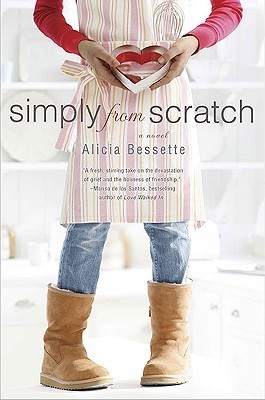
I wasn’t expecting this at all; I certainly didn’t expect it to thump my heart around like it did. Look at the cover. I bought it because it’s written by a fraternity brother’s sister-in-law. I figured, hell, she’s got the guts to drop everything and freelance fulltime, I should support the cause. I figured I’d get around to it someday, would read about 30 pages, find that it wasn’t my thing (I mean look at the cover!), and maybe let my girlfriend or sister read it or something.
And the funny thing is, I’m still not sure why I did start reading it over all the other books ahead of it in the queue. Did I want to get it over with, so I could say I gave it a shot? I have no clue. It was sitting in front of me and I picked it up and started reading. That’s all I know.
But God I’m glad I did. It is a beautiful, beautiful novel, and it touched me in a different way than most novels do. From the get-go the narrator was an interesting and likable (though flawed) person; someone that could entertain me, someone I genuinely liked. And Bessette was perfect with the slow reveal: you learn information as you go; slowly your questions are answered and the holes filled. “Babysitting? At thirty-four years old? Well, maybe that’s my widow style. My awesome widow style.” See the personality in the voice? You want to have a conversation with this person. But the quote is revealing, too -- and given the context, completely seamless.
I talked to myself while reading, saying weird, embarrassing things like, “I had to get healthy before my heart would grow, so I could appreciate this.” I said that to myself out loud! It’s kind of a “yuck” thing to say: it sounds cheesy, right? But it’s g.d. true.
(I also talked like a pirate a few times….)
So why did this book make my eyes moist? And what makes it so beautiful? It’s still coming to me, but I’ll try to impart what I can. Part of it, for sure, is its realness. A story about a widow, whose husband died while helping in New Orleans after Katrina, could have easily been written coldly, in a painfully detached manner by someone who didn’t “get it.” Or it could have been too soppy and dramatic, and therefore unrealistic. It’s the little things that are shown, and over a year after the narrator’s husband’s death, it’s those little things that still affect her and continue to make life difficult.
And you know what? That’s pretty much how life goes. Life is full of memory smacks of past situations. Life is the slow reveal. Life is growth; and real growth is always slow. Life is the coffee brewing in the morning, and your dog by your side while you try to cook. It’s those little details of everyday life that we take for granted; that we don’t even realize. It’s calming to be reminded of these things, because as unreliable as life is, there’s much consistency in a day: the wooden edge of the desk will always be so; the evaporation of my breath showing in the cold is always going to look the same. Reliable but then again slightly different: even that desk, despite being the same, will always be a little different too, because you’re always different. Your feelings, your perceptions, are never the same as they were the moment before, and the interplay of all of this is everyday. And that is utterly beautiful.
Bessette knows that people aren’t perfect; that things don’t always work out. Yet she remains optimistic; her view of human nature is a positive one. I can tell she loves most of her characters. She gets that the small, unexpected events in life that involve other people are the events that we remember; that those are the events that shape us and impact the trial of our lives, and impact who we are: not the who we are in the moment, but the who we are thirty years from now; that part deep inside us that never fully goes away … the real us.
And life is about the slow aches we hold in our hearts, too, isn’t it? The little aches that never fully go away, but are brought to our full attention through memory smacks. This novel gave me a slow ache in my heart from early on. It was slight, but it never fully went away; just as it never fully went away for Zell, the narrator.
Finishing up, I want to say one last thing here. I have to say it, and I think Alicia may read this and hate me for the comparison, but it's what’s in the cage in my chest and it's gotta come out. Her novel affected me the way John Irving novels do. I know, you say she may very well HATE John Irving. And that's fine. I'm talking about affect here, anyway -- and I'm talking about me. I’ll try to illustrate it this way:
For me, Dostoevsky and Greene are scotch; Woolf and Kundera are wine; and Irving is beer. And Bassett to me is beer. When I drink beer and read, I want a slow calm -- a reality based, slow moving wisdom. And the reality of this novel -- the everydayness of it when someone has to live with a slight, ongoing sadness, is there. And that ongoing sadness is life.
“EJ closes his eyes at the sound of her warm-honey voice. He feels washed with sudden gratitude: Dogs go missing; people fight, divorce, and die; but he can call Charlene any time, day or night, and she consoles him.”
You see, though, life is also full of other people; people that can help us make it through. People leave your life, and new people enter it. But that person you no longer hear on the phone isn’t replaced. They’ll never be replaced: they’re a part of who you are, and they’re a part of your heart. And what you hold in your heart will never fully go away.
And you know what? Even that inescapable sadness that we all have, has love in it. And I'll take a slow, wise, ongoing sadness that has love in it, any day of the week. And I think I'll crack open a beer and just think about my life tonight.
Alicia Bessette's debut marries a big social issue with an intimate story of mourning. From the opening page there's a sad edge to the humor found in Zell's narration that neatly highlights both the setting (a wintery Massachusetts's town) and the tenuous bonds between characters that once felt united forever. The relationship between Zell and Ingrid gives the story its best, most emotionally profound moments -- moreso than the romantic moments between Zell and Ingrid's determined but struggling single-dad. I assume Bessette understands that a novel about recovering from the loss of a husband one loves completely would be made trite by a storyline that revolved solely around a love interest. More importantly, though, this is not a book about one connection but many connections -- from the bonds of local townspeople to the unexpected links between people brought together through tragedies big (Katrina) and small (the death of a husband that everyone loved).
I read this book in just two sittings, propelled forward by the voice and curiosity as to how things would work out (hoping it would not be a neat, overly sweet finish -- the kind I'm usually not satisfied by when there's a major social crisis involved). As it turns out, I was not disappointed, because Simply From Scratch, despite all the things fiction can 'get away' with, does not pretend to be about a perfect world with perfect people; instead it's a book with the invisible, difficult to vanquish villains of pain and loss. Ultimately, the Katrina backstory involving Zell's husband (whose death is directly related to his time in New Orleans) fits perfectly in terms of tone -- the details of the Katrina aftermath stand on their own and also work as a metaphor for Zell's own life disaster -- how she will have to save what she can from the rubble.
While this can be a difficult line to walk, Bessette doesn't leave the reader thinking that Katrina is a convenient contemporary issue that serves her characters. She avoids insulting the survivors of that real tragedy by celebrating survival and community in both storylines. It's a compelling use of the real life moment. In fact, I think the author would be more than capable of delving into Katrina more directly in a future book.
I'm exhausted and spent in a good way. This is the best book I have read in a long, long time and my first 5-star read this year. Though it sounds cliched, I can't think of a better way to say that I laughed out loud, I cried big weeping sobs at times, and laughed and cried simultaneously several times. This novel reached the darkest corners of my heart and warmed them in an almost 'divine union' kind of way. The story was so bittersweet, redemptive, heart-warming, adorable, lovable in every way without ever being sappy or overly sentimental. I'm just absolutely blown away by how much I loved this book. It scares me to think that I randomly picked this up from a sale shelf because I liked the cover - I had not heard of this book and it was sheer chance that put it in my hands. I shudder to think I might not have read this book and how less enriched my life might have been.
This book is going on my shelf next to Pat Conroy's The Prince of Tides. Anyone who knows me well will know what a high honor that is. What are you waiting for?! Get out and grab this book right now - get reading!!
Wow. What a heart wrenching book, yet also a book that assures the reader that there is hope waiting in the wings.
I looked over some of the one star reviews to see what the reviewers could have possibly read that I did not. Alas, as per the norm, most were simply a one star with no review. I wish Goodreads forced us to write reviews. It would be so helpful. I want to know why this book had such a strong impact on me and not these folks. I don’t expect a 20 page essay from everyone but a few words at least. Maybe a reason one person likes a book would be a reason for someone else to not like the book and vice versa.
Anyway back to my review. In recent years I have read a few books that I know will stay with me always: The Story of Arthur Truluv by Elizabeth Berg, Dear Edward by Ann Napolitano and A Redbird Christmas by Fannie Flagg. This book gave me the same feelings. Simply beautiful. Heavy content but written in such a way that the book could be read in one sitting without it weighing you down. That is a skillful writer!
This book had so much going on yet everything was tied together nicely. The characters are all beautiful and realistic.
There is one gripe. One glaring loose end. I won’t give it away. But I wish that smaller story line had closure. But like I said earlier the author gives us hope. So I hope I know how that particular story line would have gone if there was a book two. And that elephant in the room did not take away from the main storyline in any way.
One other observation, but not quite a gripe. The English cover. It by no means fits the book. It actually brings it down a peg or two. The book deserved more. The German cover is actually beautiful. Much better of a fit.
Just a thoroughly enjoyable read. Beautiful, sad, hopeful, entertaining and funny at times.
This was my first time reading Alicia Bessette, and since Simply from Scratch is her debut novel (published in 2010), I went in with fairly open expectations. The story centers around starting over, grief, healing, and the quiet ways people rebuild their lives after loss. It leans heavily into food, memory, and the comfort of familiar routines, which I usually love in a book.
That said, this one landed squarely in the middle for me. I didn’t love it, but I also didn’t hate it. It was… okay. There were moments that felt tender and thoughtful, especially in how food was used as a connector, but other parts felt predictable and didn’t fully pull me in emotionally. I wanted just a bit more depth and surprise from the story and characters.
Still, I can see this being a comforting, low-stakes read for the right person, especially if you enjoy gentle, food-centered fiction and stories about starting over. While it wasn’t a standout for me, I don’t regret reading it, and I’d be curious to see how Bessette’s writing evolves in her later books.
I was drawn to the cover of this book when I discovered it among donations for my Heartland Little Free Libraries and I set it aside to read before sharing (Steward perk. Or hazard, lol). The story is both sweet and sad, and the ending has a few surprises (as it should). Overall, I enjoyed this heart warming book :)
This book really hit a lot of the feel good spots for me. Moving with laugh out loud and desperately sad moments. I love how it was written - absolutely beautiful story.
Alice Bessette's SIMPLY FROM SCRATCH was an enjoyable read...sort of a quirky little story with interesting characters. I liked the fact that it wasn't just another happy ending--not that the ending was unhappy, but all of the loose ends weren't tied up in a perky bow. Zell, the main character, is a young widow. Her husband has been dead for three years, yet she can't seem to get past his death at all. She doesn't mix with their old friends, and lives a reclusive life in their home with their adopted greyhound. Next door, a young girl, Ingrid Knox, is learning to cope with life without her mother, who abandoned her at birth. Because Ingrid believe a cooking show host to be her mother, she subscribes to the woman's magazine, and wants to learn to cook. Zell is delivered one of Ingrid's magazine's by mistake, and decides (despite the fact that she knows nothing about cooking) to enter a cooking contest where the award prize is $20,000 in cash--the amount of money her deceased husband wanted to raise to give to Katrina victims. Zell is determined. She wears Nick's camouflage apron and tries her hardes to make something that "Warms the soul" as the contest describes. Instead, she causes a fire in her oven that brings Ingrid and her father into Zell's life, and reunites her with many of Nick's friends in the volunteer fire department. Alicia Bessette writes in a way that is tender and honest. When she makes her story about friendship, celebrating life, and being able to let go. SIMPLY FROM SCRATCH is both humorous and touching. As we watch the relationship between Zell and Ingrid and Ingrid's father blossom. Zell begins to unfold, and reach out to old friends, and lets herself be vulnerable once more to new relationships. Zell and Ingrid make it to the finalists with their strange but interesting dessert, but the real prize is in how teaming together for the contests brings these two unlikely characters together. This is a book I would recommend!
First, let me thank you for the free book. You are awesome in so many ways, even Ms. Browning would be unable to count them. That being said, I'm sorry, but I cannot review this book properly. It wasn't because I was incapacitated (though I did seriously consider utilizing this method to make it more fun) or because I'm anti-foodie (though I really don't mind if my burger is cooked at a McDonald's or Little Owl's. Hell, more power to those with a love for food and the preparation that goes into making it). And as far as love and all the emotions that accompany it...people, there is nothing I adore more than L.O.V.E..
My real problem, the sole reason I can't write a review: I can't remember it. It was completely forgettable. Wait, I'm lying. There is one thing I remember and that's the style of writing. I didn't dig it. It was coarse, simplistic, and lazy. That's it. That's all I got. I don't remember loving or hating the plot, characters, etc. Just that it was good enough to keep reading, but ho-hum enough to have made no lasting impression.
So, why a 3 you ask? Because I don't love food, I'm not really that big on Chick Lit and because maybe it really all does come down to right place/right time and those reasons deserve to be taken into account. I entered the giveaway to try something different, thanks for the sampler.
Zell a newly widowed woman finds a new friendship whiles mourning her husband's passing, she seeks comfort from an unlikely person, her 9 year old neighbour, Ingrid, where they bond over the love of baking, despite neither of them baking ever.
This book was a 3.5 stars for me. I bought this book at Elizabeth Book Store in Newtown as a bline book (a blind book that is covered with brown paper and just dot points about the book), soI hade no idea what I was going into.
This was a cute story, warm your heart like a pie. I wasn't sure if I was going to be a fan of this book, but I started warming to the characters, some parts, I didn't really care for, but understood why they were in the book, it was to add another dimension to the character. I really started caring about Zell and wanted to know what was happening in her life when I was out and about, I wanted to just go home and continue reading and see what recipe she was going to conjure up.
I really do recommend this book for a quick sweet read, one that tugs at the heart strings and makes you feel warm inside. Of course if you are a foodie that likes a little romance and friendship's on the side, this book is for you.
SPOILER
I really wish they could have found Ahab :( This is why I gave it 3.5 and not 4, this made me very sad that Ahab was never found.
First, let’s accentuate the positive. The chronology of Simply from Scratch really drives it. Certain elements of the plot are left mysterious, and you really do want to know how it ends. I was completely unsure about what Zell’s last present would be, whose Ingrid’s mother would be, and how Nick was killed. I think these mysteries made this book rise above the normal “chick lit” fare and made it more literary.
Simply from Scratch also got me when Zell remembered how life used to be. Bessette had the excellent idea to give Nick, the dead husband, a voice. He is seen throughtout the novel in past emails to Zell. I felt for Zell the most in the emails and “memory smacks” that she relived along the way. I could tell that she really lost something.
Now, her “widow style”-that I did have some issues with. For example, her “widow style” includes speaking to her dog in pirate-ese. A This language problem continued when Zell referred to her old home-ec teacher. The name was mentioned so much that I grew bored.
Simply from Scratch is the debut novel of Alicia Bessette, and I am hoping to see more things from her in the future. While it wasn’t my favorite book, I did enjoy it, and I hope that the features of Simply that I didn’t love can be ironed out in her next work.
A grieving widow, a deserted daughter, a single dad, a guilt ridden best friend, a New England town of close knit, hard working, very real people, a TV cooking personality, an old lady no nonsense chainsaw artist and a greyhound who communicates in pirate talk...I just loved this book. It is a book about relationships between characters that I wanted to call freinds. Characters that I found myself cheering for as they cared for, tended to and helped each other cope with the realities of life which wound us all. Characters that deserved to be in a book read by many because of their noble example This is a book of compassion, encouragement and hope. It made me laugh out loud, sit up straight (what?) and cry as it touched my heart. All that with a recipe (which I tried true by the way) and a lovable greyhound named Capt Ahab....who fills the void...as do all "smartly hounds...arrr!"
This is an entirely charming tale of Zell, Ingrid and Garrett amid a cast of wonderful, warm, wacky small-town characters set in snowy little Wippamunk.
Zell is still reeling more than a year from the day she learned that Nick died instantly in a freak accident while on a mission in post Katrina New Orleans. Taking a shot at redemption, she decides to enter the Polly Pinch of Love Live Desserts that Warm the Soul baking contest. This is a leap because Nick did All the cooking before he died. Entering the kitchen is not just entering a foreign country, it is entering Nick's country. Slammed with grief at almost every turn, Zell's baby steps back to the land of the living are guided by her irrepressible young neighbor Ingrid who has demons of her own to slay.
It is a joy to watch these lovely, loving characters and hear their unique and affectionate voices as they struggle with and meet the challenges of being better, stronger and truly kind.
Zell has been a widow for a year after losing her husband in a freak accident while on a rescue mission post hurricane Katrina, when nine year old Ingrid Knox and her father move in next door. The two become friends and decide to enter a cooking contest, which is a good distraction as both have issues they are trying to work through. Adding depth to the storyline there are also some mysteries to solve , some humor ( as some of their cooking projects sound truly awful) and of course some hearts to be mended. This is an easy to read book. , with plenty of small town characters to love . 3.5 stars
I really liked a lot of the Massachusetts and New England references in this book. Zell's husband died a little over a year ago during a mission trip for Katrina relief. She is not a great cook but when her neighbor's daughter volunteers to help her win a contest she can't say no. This encounter may have happened when she almost burned down her kitchen but who asked.
The story is light and fun. The romance is really light and not the focus. The characters are fun and they form great friendships, as well as Zell reconnecting with old friendships.
What a fantastic debut novel! The characters are complex and the plot was good enough to capture my interest through the end. I was fascinated by Zell and the habits she picked up to cope with her husband's death. There were several phrases repeated regularly throughout the book that are very endearing; I loved "Zell's widow style" and the idiosyncrasies that were given to other characters.
Simply from Scratch was a pleasant surprise and I look forward to Bessette's next book.
This book is called Scrumpy Delight for Polly Pinch according to the cover of the copy I own. I bought it from the clearance table and when I began to read, I didn't think I was going to enjoy it. However, I fell in love with the central character, Zell, and the little girl neighbour, Ingrid. I could identify well with what Zell was going through and loved that it was the little girl who virtually forced her out of her funk. A thoroughly enjoyable and often poignant read.
The genre this novel is tagged as the most on Goodreads is Women's Fiction-Chick Lit. This surprised me a little because I tend to connect the term "chick lit" with light hearted and amusing novels either about friendship or romance and not so much with a more serious novel like this that deals with deep emotions. I won't say that nothing in this novel is amusing, but that description definitely isn't my first thought when thinking of the novel as a whole. It's about grief, depression, forgiveness, friendship, a new attraction, and parenting. It also deals with the fact that past assumptions from childhood about people aren't always accurate when interacting with them as an adult. Perhaps "Women's fiction" although vague is a better label than "chick lit" for this book and others like it and perhaps even for those more lighthearted, amusing, often sassy novels I more readily think of as "chick lit" because the truth found in fiction isn't always serious and more "literary" novels are not inherently better than "silly" ones.
“Babysitting? At thirty-four years old? Well, maybe that’s my widow style. My awesome widow style.”
Zell, a widow of over a year, doesn’t have the strength or heart to move on after her husband's passing in a relief mission. One day she decides to enter a baking contest hoping to win money to donate in her husband's name. Her next door neighbor, a 9 year old who is aching for a mother begins to form an unlikely friendship with Zell. Together, they set out to win the content and learn that baking can bring you one step closer to healing a broken heart.
For this #tbt I’m taking you back to Zell’s kitchen. I loved this book and the unlikely friendship that these two formed. Sometimes, people come into your life at just the right time and give you exactly what you need. Make sure you have ingredients on hand after this one as I’m sure you’ll want to bake something of your own!
Zell lost her husband Nick over a year ago to a post Katrina relief mission in New Orleans. She continues to send him emails despite the fact that he’s gone. Then another unthinkable thing happens, Ahab, the couples greyhound runs out of the house and goes missing for a couple days and Zell goes around town looking for him but is unable to find him. But luckily with the help of one of her friends putting up posters around town, the dog returns home. Zell’s nine year old neighbor Ingrid Knox thinks that the host of the TV show Pinch of Love (Polly Pinch) is her mother. Zell on the other hand doesn’t think that it’s a good idea for Ingrid to meet the woman that she believes is her mother.
A decent little work of fluff. The description of the utter heartbreak the main character goes through was incredibly vivid, and the characters felt real enough. There were a few writing quirks that I found grating - primarily the pirate voice, and ridiculousness of the idea of someone throwing ingredients together without a method as their form of baking. Overall, it did it's job as a pleasant little book.
The book did grab my notice because of the cover art – a novel about baking? Widow Zell is still trying to recover emotionally from her husband’s tragic accident, when neighbor Garrett asks her to watch his 9-year-old daughter, Ingrid, in a pinch. A friendship begins between Zell and Ingrid, based on their interest in entering a baking contest. This was a great story, and I really liked the friendship between Zell and her ingenious pal, Ingrid.
This was a great break from the "serious" books that I've been reading lately. Wonderful story with great characters. I had a few LOL moments which were good for the soul. I only rated it 3 stars because I'm very picky about lighter reads so my rating is a bit biased. I'd definitely recommend this to anyone.
Totally bummed that the dog was never found 🙁
This entire review has been hidden because of spoilers.
As perfect as fiction can be venturing into grief and depression, and other loss. This was beautifully written, filled with lovely character and plot development and not rushed. I selected this book at my favorite thrift store based on the quote on the covers from my FAV author, Marisa de los Santos. So good, and, I hope to pass this on. This book should be a must read.
This was a really sweet book. I cared about the characters and I liked how they developed as the story progressed. I'm always a sucker for stories about kids and adults connecting with one another, and in this book the relationship between the narrator and the little girl next door was a major plot point.
This is the kind of book I'll want to read again at some point in the future.
It was really hard for me to get into, and once I was in the middle of the book there was little to no surprise or action. I was hoping for maybe a little romance, adventure or something to keep me intrigued. It's still a cute read once I got myself to read the entire thing.
Sweet story with a non-baking main character who enters a baking contest. I liked the twists and turns in the book, and it helped me understand grief a little more, because the main character is a young widower.