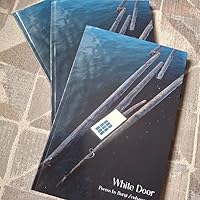
While Hoffman’s debut collection interrogated the mythos built around grief, inhabiting an Alaska of the mind, her stunning sophomore collection When There Was Light looks at the past for what it was.These poems map out a topography where global movements of diaspora and war live alongside personal a house’s foreclosure, parents’ divorce, the indelible night spent drunk with a best friend “[lying] down inside a chronic row of corn.” Here, her father’s voice “is the stray dog barking / at the snow, believing the little strawberries grow wilder / against a field.” In these pages, she points to Russia and Poland and Germany, saying, “It was / another time. My people / another time. The synagogues burn decades / of new snow.” The brilliance of this collection illuminates the relationship between memory and language; “another time” means different, back then, gone and lost to us, and it means over and over, always, again. With this linguistic dexterity and lyrical tenderness, Hoffman’s work bridges private and public histories, reminding us of the years cloaked in shadows and the years when there was light.
I loved Hoffman’s first book of poetry, “This Alaska,” and couldn’t wait to pre-order this next one, which arrived about a week ago. I also had the wonderful good fortune of participating in a workshop with her through Brooklyn Poets.
“When There Was Light” feels very different from “This Alaska,” which was full of beautiful poems and had a lovely “first book” quality to it. “Light” is the work of a more accomplished poet, and the quality of the poems is more consistent. Hoffman has an exceptional ability to write stunningly beautiful poems, “Elegy for Selma Meerbaum-Eisinger” being probably my favorite in the collection:
(excerpt):
“A rainbow lives in the throat of the Gods, landlords of Earth, your leaf-eyed season cast over a tenantless world — girl at the threshold catching the light with her hands.”
Light is a theme running through most of the poems. Many of the poems are personal in a family history way (although the story is never explicitly clear), and these poems can be very moving at times. She doesn’t have the Mina Loy-like quality of Cynthia Cruz, nor the kind of crazy rage of Diane Seuss. While lyrical they aren’t like Louise Gluck or Mary Oliver - Hoffman has her own personal, consistent style which can have surprises and some wonderful word choice, but I feel in her words and rhythm there’s a beauty of cadence she’s always focused on.
Anyway, strongest recommendation to those who love beautiful, rich, deep, meaningful poetry.
Another solid collection. I appreciated the connection to ancestry and history as well as many of the surprising and powerful images. It was probably a touch too far into the narrative for my personal taste but that doesn’t make it bad poetry just less powerful to me. I would have liked to see more of those images!!!
Chose my annual foray into poetry in a usual fashion: perusing winners and runners up from last year’s National Jewish Book Awards. My knowledge of poetry is very limited, but this collection felt like it adhered to contemporary mores, in that the language was visceral but not always direct.
Hoffman’s collection starts out with some pieces that hue very close to her character’s emotional state. Her first title aligns closely to that of the entire book; it is “Poem Ending in the Light.” In it, her speaker writes of leaving her home because she’s “suffering” due to a relationship with a painter “…who was obsessed with Atlantic City / and the color blue, who was in love / with a married man from Virginia.” This change seemed to bring a positive aspect to the speaker’s life: “The night I left I watched the bull / spread above the earth, whole as grief, like a moon. / And like the moon I was drawing myself inside / an unconditional orb of light.”
Hoffman seems to find meaning in the small spaces, where lengthy titles denote specific incidents but the text of the poems can balloon into something much larger. For example, in “While Waitressing at the Kosher Restaurant a Man Calls Me a Whore and a Woman Rushes Behind Me into the Kitchen to Hand Me Her Baby,” Hoffman opines about the suffering of biblical women like Eve “shivering naked beneath the alder / watching God get angry— /is it anger or is it grief—all of us doing / what we have been trained to do.”
Judaism crops up in other places as well, largely through the prism of immigration and antisemitism. In “Ocean Liner to the United States, 1935” Hoffman’s character writes of her grandfather’s unrequited love for a German girl: “there are laws / of merging and parting, the law / in which because he is Jewish, / the girl my grandfather loves, pretty, / shiny as a missile in her uniform / on the way to school, plucking / orange blossoms, remains eiene Madchen / while he becomes the wind.”
She writes a eulogy to Selma Meerbaum-Eisinger, a Jewish poet and cousin to Paul Celan, who also inspired a lot of Hoffman’s offerings, according to her afterward. Meerbaum-Eisinger died of typhus in an SS labor camp at 18.
A poem about her family farm, “Gustav Barmann, Who Has Put Extensive Alterations on Historic Pine Lane Farm, Contrasts Our Freedom with Regimentation in Reich,” draws inspiration from Pablo Neruda and also borrows language from an actual news article in 1937: “Former German Banker Happy as a Farmer Here.”
The farm, and its loss over time (“The farm/ where his boyhood was buried / is now a blue thread of smoke, / a caged-off landscape of quavering bone,” From “A Blessing, Again or my Grandfather Chooses Against Getting a Pacemaler”), play heavily into other poems as well, as does imagery of horses. In her review on the Jewish Book Council website, Stephanie Barber Hammer writes of the horses as “untamed, fast-running animals…[a] complex, challenging stampede of poems, whose lines are at every moment poised to run in four directions.”
To me, I’m in awe of what inspires poetry, and the balance between freedom and intention where poets like Hoffman can make these images, tangible and emotional, past and present, come alive.
nice coils of language, but kind of failed to find a vein with me.
Lord of this hour was a wintercreature. I go astray in everything but now I am rushing behind his grey coat, in the grizzled afternoon, eavesdropping. What’s carved in me is biting in.
All my life I have wanted to Be immense, thoroughly a self. I have wished to ask for nothing Or at the very least that when I pray The store-bought streamers Of language would be rid of men. Of course, it is logical to look toward A body at this hour. I am Looking for God, it’s not romantic
I love the lyricism and imagery of When There Was Light and how the poems hint at stories--a story never quite told. Poetry is in the approaching and leaving, the circling about and back--in the movement. When There Was Light is also about origins, traditions, (family) lore, the searching as well as the interrogating (of the telling, of the power of stories/lore/traditions). What is identity after all, what individuality?
I love how Carlie's language shimmers understanding, twisting images into new ways to be seen among the world we've inherited simply by living in it. This is a remarkable second collection.