Joseph Sheridan Le Fanu (1814-1873) was an Irish writer of Gothic tales and mystery novels. He was the premier ghost story writer of the nineteenth century and had a seminal influence on the development of this genre in the Victorian era. Le Fanu studied law at Trinity College in Dublin. He soon abandoned law for journalism. In 1838 he began contributing stories to the Dublin University Magazine. He became owner of several newspapers from 1840, including the Dublin Evening Mail and the Warder. Le Fanu worked in many genres but remains best known for his mystery and horror fiction. He was a meticulous craftsman, with a penchant for frequently reworking plots and ideas from his earlier writing in subsequent pieces of writing. He specialised in tone and effect rather than "shock horror," often following a mystery format. Key to his style was the avoidance of overt supernatural effects. Among his famous works are: The House by the Church-Yard (1863), Uncle Silas (1864), Carmilla (1872), The Purcell Papers (1880), and The Evil Guest (1895).
NB: "The Familiar" is a revision of "The Watcher."
Joseph Thomas Sheridan Le Fanu was an Irish writer of Gothic tales and mystery novels. He was the leading ghost-story writer of the nineteenth century and was central to the development of the genre in the Victorian era. M.R. James described Le Fanu as "absolutely in the first rank as a writer of ghost stories". Three of his best-known works are Uncle Silas, Carmilla and The House by the Churchyard.
"But however the truth may be, as to the origin and motives of this mysterious persecution, there can be no doubt that, with respect to the agencies by which it was accomplished, absolute and impenetrable mystery is like to prevail until the day of doom."
I seem to be reading a string of "meh". I love JSlF, but this one he left too many thing unexplained. And I cared very little for the "love" story - which was pretty much nonexistent. It was an interesting mystery, but I felt I got no payoff.
The Familiar By Joseph Sheridan Le Fanu This story is part of the posthumous case files of occult detective Dr. Martin Hesselius. Captain Barton is tortured by a being who looks like a dead crew member. "there is a spiritual system great Heavens, how frightfully I have been convinced! a system malignant, and inexorable, and omnipotent, under whose persecutions I am, and have been, suffering the torments of the damned!"
le fanu’s writing is the kind of reading that i feel like i need to analyse in class bc if i didn’t i would be questioning my intelligence but he hits hard on the effect of colonialism if you’re into psychoanalysing people and their writing like any english student is bred to
Tercer caso del doctor Martin Hesselius, misterioso detective de lo paranormal. En éste, Le Fanu narra la historia de un hombre sujeto a unas terribles apariciones que lo ponen al borde de la locura e, incluso, la muerte.
Me gustó porque refleja directamente uno de los grandes miedos que tienen las personas, y es el hecho de ser atormentados por aquellos a los que se les hizo mucho daño en el pasado.
Leer a Le Fanu siempre es gratificante, no deja de sorprendernos su capacidad para imaginar historias de horror sobrenatural, gótico, fantásticamente narrado.
En este caso, "El Familisr" va acompañado de otro relato corto del autor, "Te Verde".
En ambos es protagonists uno de sus personajes mas carismáticos, el doctor Hesselius que se verá obligado a utilizar su pericia para resolver dos situaciones inexplicables.
En "El familisr" nos adentraremos en una antigua casa encantada donde ocurren fenómenos extraños, Hesselius se enfrentara a demonios y extraños fenómenos paranormales.
En"Te verde" un parroco sera acosado por un extraño ser representado por un mono negro, Hesselius investigará estos sucesos que llevan al párroco a cometer actos terribles.
Ambos relatos trasmiten muy acertadamente tensión y angustia, suspense y misterio con una narración excepcional.
No cabe duda de la gran maestría de Le Fanu para ser uno de los grandes autores clasicos de horror gótico, uno de los primeros autores irlandeses en trascender mas allá de sus fronteras por su ingenio y capacidad para transmitir ese desasosiego al lector en tan cortos relatos.
Son obras que, quizás, hoy en dia parezcan sencillas a un avezado lector de terror, pero si pensamos en la época en que fueron escritas no cabe duda de que, además de por su calidad literaria y exquisita narrativa, constituyen un "catalogo" inigualable de obras muy notables que lograrán emocionar al lector.
Son lugar a dudas, en mi opinión muy recomendables.
I am reading the short stories of Joseph Sheridan Le Fanu slowly, and I am up to The Familiar which was first published in 1872. The book begins with this line:
Out of about two hundred and thirty cases more or less nearly akin to that I have entitled "Green Tea," I select the following which I call "The Familiar."
The Narrative of the Rev. Thomas Herbert, which furnishes all that is known of the case will be found in the chapters that follow.
There, now we're ready. Or we should be, I must not have been ready because there were many times, even though it is a short story, I found myself wondering what in the world was going on. I never find out. The person telling the story tells us that he was a young man at the time and acquainted with some of the people in this strange event, and the incidents made an impression that was deep and lasting. He is telling us this intending to illuminate the darkness which involves its progress and termination. If he illuminated the darkness it wasn't the darkness in my mind.
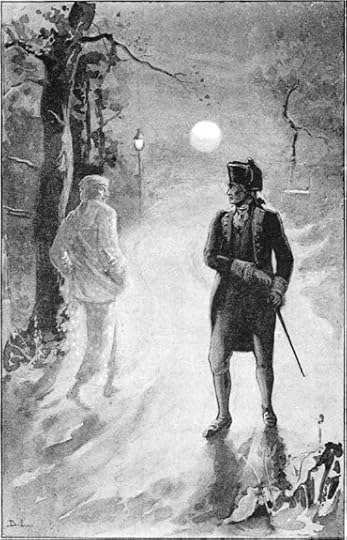
We start with Sir James Barton, a younger brother of a certain baronet, and a captain in the navy. He is around forty two or three years of age and was an intelligent and agreeable companion. When he wasn't reserve and moody that is. When all this mystery is going on he has become engaged to a young lady by the name of Miss Montague, who was pretty and accomplished. And now Captain Barton was a constant visitor at the home of Miss Montague. So staying a little later than usual, one night he returns to his mansion walking alone as he usually did. Only this night he hears someone walking behind him. He turned around, but of course no one was there. The entire time home he could hear the person behind him. But always as he walks he hears the steps behind him and finally runs the rest of the way.
The next day he receives this letter:
"Mr. Barton, late captain of the 'Dolphin,' is warned of DANGER. He will do wisely to avoid Street--[here the locality of his last night's adventure was named] if he walks there as usual he will meet with something unlucky--let him take warning, once for all, for he has reason to dread THE WATCHER."
After this he is followed every where he goes, but no matter how he turns, he never sees who it is. And more letters from the Watcher come. Then comes the strange man:
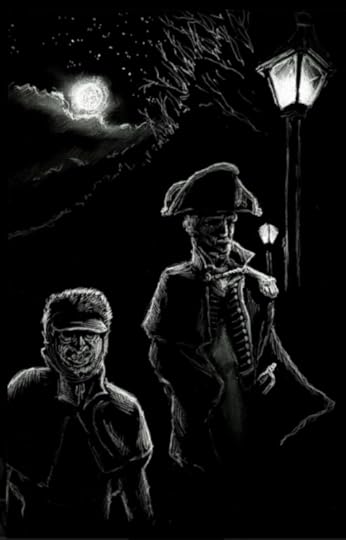
As we were walking in at the passage from College Green a man, of whom I remember only that he was short in stature, looked like a foreigner, and wore a kind of fur travelling-cap, walked very rapidly, and, as if under fierce excitement, directly towards us, muttering to himself fast and vehemently the while. This odd-looking person walked straight toward Barton, who was foremost of the three, and halted, regarding him for a moment or two with a look of maniacal menace and fury; and then turning about as abruptly he walked before us at the same agitated pace and disappeared at a side passage.
By this time I had already said a few "what is going on" comments because I was getting tired of reading about a guy walking around in the dark hearing footsteps but seeing no one. Let's move it along, well we are finally moving it along. This meeting made quite the impression on our poor captain:
I was absolutely astonished, however, at the effect of this apparition upon Captain Barton. I knew him to be a man of proud courage and coolness in real danger--a circumstance which made his conduct upon this occasion the more conspicuously odd. He recoiled a step or two as the stranger advanced, and clutched my arm in silence, with what seemed to be a spasm of agony or terror! And then, as the figure disappeared, shoving me roughly back, he followed it for a few paces, stopped in great disorder, and sat down upon a form. I never beheld a countenance more ghastly and haggard.
After this there are more footsteps heard walking at night of course, he is even shot at, with the bullet going by close to his head. Then again he meets the man in the fur cap who walks past him and says as he goes by: "Still alive, still alive!"
That gets another "what is going on" from me. And a few times more I say the same thing. I don't want to say any more about it, since there is only so much I can say and the short story will all be told, I will give you the last paragraph though:
POSTSCRIPT BY THE EDITOR
The preceding narrative is given in the ipsissima verba of the good old clergyman, under whose hand it was delivered to Doctor Hesselius. Notwithstanding the occasional stiffness and redundancy of his sentences, I thought it better to reserve to myself the power of assuring the reader, that in handing to the printer the MS. of a statement so marvelous, the Editor has not altered one letter of the original text--[Ed. Papers of Dr. Hesselius].
This story feels like a longer, less confident version of "Green Tea". While I found the stalking scenes and Barton's growing paranoia compelling, the source of the horror itself left me underwhelmed. I also find Le Fanu's prose pretty dry at times. Here, and in some of his other stories, his narration reads more like a history textbook; highly technical, emotionally distant and prone to summarizing key story beats. But delving deeper into his corpus, you'll find that he's fully capable of writing rich, flowery and immersive prose in the Romantic tradition. (Carmilla is a good example). I overall enjoyed this story, but it's probably among the weaker Le Fanu tales.
In the Explanatory Notes by Robert Tracy in the 1993 edition of In A Glass Darkly he states that "Apart from a few slight verbal changes and omissions, and a change of title, The Familiar is a reprinting of The Watcher from Le Fanu's Ghost Stories and Tales of Mysteries (Dublin: J McGlashan, 1851)". The main differences being the 1851 Watcher had a different opening paragraph and the narrator is presented as having personally witnessed some of the story's incidents. 3.5⭐
God I wish there were .5 stars, so I could give this 3.5. very solid, pretty short, and a really creative concept. probably could have been fleshed out a little more and pushed a little further, but nonetheless a nice little story. admittedly the 19th century language serves as more of a distraction than it does a benefit, but not too bad. again, this should be adapted into a movie and further developed.
Was the titular familiar the ? A good passage would have been: as it flew through the door it ejected a copious stream of noisome glaucous guano all over the General’s, Montague’s, and the servant’s heads. It’s what they do, familiars; ectoplasm! A pretty familiar tale, despite its title.
És estranyot, però m'agrada veure com atormeten a un vell groomer. Tot i això, li poso 2.5 perquè l'he trobat massa ambigu pel meu gust (encara que és un dels punts forts d'aquest terror psicològic, per lo qual crec que el problema és que no m'agrada llegir terror psicològic).
A mystery which piqued my interest enough, but the author left too many loose ends and unanswered questions. I know with mystery books, that's part of the allure to them; but you have to draw the line at a certain point.