

What do you think?

Tender Buttons
Before becoming the patron of Lost Generation artists, Gertrude Stein established her reputation as an innovative author whose style was closer to painting than literature. Stein's strong influence on 20th-century literature is evident in this 1915 work of highly original prose rendered in thought-provoking experimental techniques.
52 pages, Paperback
First published January 1, 1914
About the author
Gertrude Stein
438 books1,249 followersGertrude Stein was an American writer who spent most of her life in France, and who became a catalyst in the development of modern art and literature. Her life was marked by two primary relationships, the first with her brother Leo Stein, from 1874-1914, and the second with Alice B. Toklas, from 1907 until Stein's death in 1946. Stein shared her salon at 27 rue de Fleurus, Paris, first with Leo and then with Alice. Throughout her lifetime, Stein cultivated significant tertiary relationships with well-known members of the avant garde artistic and literary world of her time.
Ratings & Reviews
Friends & Following
Create a free account to discover what your friends think of this book!
Community Reviews
Displaying 1 - 30 of 827 reviews
March 7, 2010
Hope in gates, hope in spoons, hope in doors, hope in tables, no hope in daintiness and determination. Hope in dates.
Okay, besides the semaphored helplessness of a giant ‘WTF’, what would be the correct response to these lines, and to Tender Buttons as a whole? Don’t look at me. I have no idea what any of this means, or whether it means anything at all. Maybe this prose poem is just a gourmet word salad, maybe it’s just a series of non-sequiturs to which I’ve foolishly assented. I don’t know. I don’t care. I love it. It’s magnificent. I love it.
I’m not ashamed to admit that, by the last page, Tender Buttons had me on my feet, declaiming, actually declaiming its thrilling nonsense to an empty apartment, in impassioned tones and with theatrical gestures, my bathrobe flying open in my enthusiasm.
This is gonna sound like a big helping of crazy, but I choose to read Tender Buttons as wisdom literature. Seriously. From Heraclitus to Jesus to Yoda, all the great teachers have spoken in riddles, paradoxes, weird-ass aphorisms. And Stein has the whole gnomic oracle thing down pat:
There is no gratitude in mercy and medicine.
Perhaps if borrowing is not natural there is some use in giving.
If the party is small a clever song is in order.
The sudden spoon is the wound in the decision.
Kindness is not earnest, it is not assiduous it is not revered.
Surprise, the only surprise has one occasion.
A curving example makes righteous fingernails.
I’m not quite insane enough to try and live by these precepts, but I am just insane enough to think there might be something in them, something very odd and possibly schizophrenic, but still worth listening to. Stein was a shrewd old bird, I tell you. If she went to the trouble of inventing a bizarre idiolect in which to encipher her wisdom, well, I’ll give her the benefit of the doubt: she must have had her reasons. But, as I say, I love this stuff, so maybe I’m just casting about for ways to justify my love (to quote another shrewd old bird).
Now sit down, Buck, and do up your bathrobe.
Okay, besides the semaphored helplessness of a giant ‘WTF’, what would be the correct response to these lines, and to Tender Buttons as a whole? Don’t look at me. I have no idea what any of this means, or whether it means anything at all. Maybe this prose poem is just a gourmet word salad, maybe it’s just a series of non-sequiturs to which I’ve foolishly assented. I don’t know. I don’t care. I love it. It’s magnificent. I love it.
I’m not ashamed to admit that, by the last page, Tender Buttons had me on my feet, declaiming, actually declaiming its thrilling nonsense to an empty apartment, in impassioned tones and with theatrical gestures, my bathrobe flying open in my enthusiasm.
This is gonna sound like a big helping of crazy, but I choose to read Tender Buttons as wisdom literature. Seriously. From Heraclitus to Jesus to Yoda, all the great teachers have spoken in riddles, paradoxes, weird-ass aphorisms. And Stein has the whole gnomic oracle thing down pat:
There is no gratitude in mercy and medicine.
Perhaps if borrowing is not natural there is some use in giving.
If the party is small a clever song is in order.
The sudden spoon is the wound in the decision.
Kindness is not earnest, it is not assiduous it is not revered.
Surprise, the only surprise has one occasion.
A curving example makes righteous fingernails.
I’m not quite insane enough to try and live by these precepts, but I am just insane enough to think there might be something in them, something very odd and possibly schizophrenic, but still worth listening to. Stein was a shrewd old bird, I tell you. If she went to the trouble of inventing a bizarre idiolect in which to encipher her wisdom, well, I’ll give her the benefit of the doubt: she must have had her reasons. But, as I say, I love this stuff, so maybe I’m just casting about for ways to justify my love (to quote another shrewd old bird).
Now sit down, Buck, and do up your bathrobe.

August 17, 2008
Some call it nonsense, but if you derive pleasure from reading these vignettes, you can't understand how someone else doesn't.
Here's how I see it: When we were learning our language, we learned how to link the word with the object the word represents. Gertrude Stein seeks to dismantle this link and consequently abstract our common understanding of language. While we learned to easily state, "this equals that," we should not simply place an equal sign between the descriptive word and the actual object described. It is in fact more accurate to state, "this is parallel to that." And though parallel lines may be infinitely in sync, there will always exist a gap. Likewise, the object in the material world and the word representing it are two autonomous entities. Stein works with this gap between word and object, not to evaluate it, but to explore it. Gertrude Stein finds loopholes in the defining social and prescriptive grammatical rules as well as the sounds of our language to make a text that bounces between nonsense play and thoughtful deliberation.
A great source of inspiration for me personally.
Here's how I see it: When we were learning our language, we learned how to link the word with the object the word represents. Gertrude Stein seeks to dismantle this link and consequently abstract our common understanding of language. While we learned to easily state, "this equals that," we should not simply place an equal sign between the descriptive word and the actual object described. It is in fact more accurate to state, "this is parallel to that." And though parallel lines may be infinitely in sync, there will always exist a gap. Likewise, the object in the material world and the word representing it are two autonomous entities. Stein works with this gap between word and object, not to evaluate it, but to explore it. Gertrude Stein finds loopholes in the defining social and prescriptive grammatical rules as well as the sounds of our language to make a text that bounces between nonsense play and thoughtful deliberation.
A great source of inspiration for me personally.

February 23, 2010
"A CARAFE, THAT IS A BLIND GLASS.
A kind in glass and a cousin, a spectacle and nothing strange a single hurt color and an arrangement in a system to pointing. All this and not ordinary, not unordered in not resembling. The difference is spreading."
...okay.
Gertrude Stein was once quoted as saying that Ernest Hemingway was "all bullfights and bullshit."
That may be true, but you, madam, are just bullshit. At least Hemingway threw some bullfighting in every now and then.
Read for: Modern Poetry
A kind in glass and a cousin, a spectacle and nothing strange a single hurt color and an arrangement in a system to pointing. All this and not ordinary, not unordered in not resembling. The difference is spreading."
...okay.
Gertrude Stein was once quoted as saying that Ernest Hemingway was "all bullfights and bullshit."
That may be true, but you, madam, are just bullshit. At least Hemingway threw some bullfighting in every now and then.
Read for: Modern Poetry

May 12, 2011
This is kind of the literary equivalent of the guy who takes a shit and gets it put into a museum as sculpture, sneezes onto a canvass, etc. I can see the argument that it's "profound" in its implied questioning of "what really is art" but is there a future in it? Does anybody enjoy it?
Well, judging from the reviews, some people do. I don't, but usually when I don't like something I at least have a clue as to why other people do. With Stein, I mean, it's nonsense, not the Lewis Carroll kind, but really just words thrown together at random. What are the "pleasures" of such a text? The musicality of the words is still there, I get that (big fan of the Ursonate). Maybe I was just so trapped in my normal mode of reading for content that I missed the beauty of the sounds. Honestly, though, I'm not in love with the sounds of conversational English words thrown together willy-nilly; I'd rather listen to someone speaking German for the sound of the words.
Well, judging from the reviews, some people do. I don't, but usually when I don't like something I at least have a clue as to why other people do. With Stein, I mean, it's nonsense, not the Lewis Carroll kind, but really just words thrown together at random. What are the "pleasures" of such a text? The musicality of the words is still there, I get that (big fan of the Ursonate). Maybe I was just so trapped in my normal mode of reading for content that I missed the beauty of the sounds. Honestly, though, I'm not in love with the sounds of conversational English words thrown together willy-nilly; I'd rather listen to someone speaking German for the sound of the words.

September 24, 2012
"It was a garden and belows belows straight. It was a pea, a pea pour it in its not a succession, not it a simple, not it a so election, election with."
Gertrude Stein's aim in writing Tender Buttons was, in some sense, to reinvent the English language, and the foreword explains that "the reader is forced to question the meanings of words, to become reacquainted with a language that Stein thought had become dulled by long use". In this sense her project is the literary counterpart of Stravinsky's twelve-tone composition, a deliberate effort to break away from unnecessary constraints on the language of music, which themselves constrain the way we think.
The problem is that, in an overzealous attempt to emancipate the language, she exiles it. What appears in Tender Buttons is not really language, because it doesn't really mean anything. James Joyce's later works may be incredibly difficult to understand, but at least there is something to be understood.
For a comparison, it might help to look to Don van Vliet, otherwise known as Captain Beefheart. He would often paint in black, white and grey, so that (he explained) your imagination could fill out the colours for itself. But this is exactly the opposite of what Gertrude Stein does: she provides the vocabulary - the colours, if you like - and leaves you to make something of it, to form it into shapes. One might as well put a dictionary through a blender.
This isn't just a matter of style over substance. The two are inextricable. The style is the manner in which you deliver the substance, and if there is no substance I really don't think I can say anything of the style. Stein wanted to sound lyrical, but again the way language looks and sounds derives from what it means. Have you ever overheard two people fluently speaking a foreign language on the bus, and it sounds like there are no gaps between the words? That's because there aren't. There aren't when other English people speak either: your brain inserts them for you. Everything about the way language looks, sounds, feels, can't be entirely pulled apart from what it means.
And I defy you to read bits like this...
"A no, a no since, a no since when, a no since when since, a no since when since a no since when since, a no since, a no since when since, a no since, a no, a no since a no since, a no since, a no since."
...without glazing over. It's a crap, a crap, crap a, a book, crap book, a crap book, it's crap.
As such, Gertrude Stein's idea is more interesting than her book, the theory better than what it entails. Or as Voltaire wrote to Rousseau: "Never was such a cleverness used in the design of making us all stupid".
Gertrude Stein's aim in writing Tender Buttons was, in some sense, to reinvent the English language, and the foreword explains that "the reader is forced to question the meanings of words, to become reacquainted with a language that Stein thought had become dulled by long use". In this sense her project is the literary counterpart of Stravinsky's twelve-tone composition, a deliberate effort to break away from unnecessary constraints on the language of music, which themselves constrain the way we think.
The problem is that, in an overzealous attempt to emancipate the language, she exiles it. What appears in Tender Buttons is not really language, because it doesn't really mean anything. James Joyce's later works may be incredibly difficult to understand, but at least there is something to be understood.
For a comparison, it might help to look to Don van Vliet, otherwise known as Captain Beefheart. He would often paint in black, white and grey, so that (he explained) your imagination could fill out the colours for itself. But this is exactly the opposite of what Gertrude Stein does: she provides the vocabulary - the colours, if you like - and leaves you to make something of it, to form it into shapes. One might as well put a dictionary through a blender.
This isn't just a matter of style over substance. The two are inextricable. The style is the manner in which you deliver the substance, and if there is no substance I really don't think I can say anything of the style. Stein wanted to sound lyrical, but again the way language looks and sounds derives from what it means. Have you ever overheard two people fluently speaking a foreign language on the bus, and it sounds like there are no gaps between the words? That's because there aren't. There aren't when other English people speak either: your brain inserts them for you. Everything about the way language looks, sounds, feels, can't be entirely pulled apart from what it means.
And I defy you to read bits like this...
"A no, a no since, a no since when, a no since when since, a no since when since a no since when since, a no since, a no since when since, a no since, a no, a no since a no since, a no since, a no since."
...without glazing over. It's a crap, a crap, crap a, a book, crap book, a crap book, it's crap.
As such, Gertrude Stein's idea is more interesting than her book, the theory better than what it entails. Or as Voltaire wrote to Rousseau: "Never was such a cleverness used in the design of making us all stupid".

May 26, 2013
If I find myself long on sleep and short on hallucinations I open this little paperback and wait for the words to start pushing crazy around in my brain. Once thoroughly confused, I close the book, satisfied.

July 28, 2021
Ne znam ko sam, ne znam šta sam, kako sam, i gde sam, ne znam šta sam pročitao, niti zašto.
Dok termiti neznalaštva grickaju moje ganglije, mogu samo da primetim da je Gertruda Stajn ostala najpoznatija po čuvenom „rose is a rose is a rose”. Krajnja želja Gertrudinog ponavljanja je da bude stalno ponavljano, ali retko ko zna njegovo (pesničko) poreklo. Ima nečeg zaista privlačnog u tom virusu repetitivnosti što vodi u gmizavu magiju samopotvrđivanja. A ima, još više, neke šašave ironije u tome da se od sve spisateljske megalomanije Gertrude Stajn (ne zaboravimo hiljadu stranica romana „The Making of Americans”), zadržala samo jedna jedina rečenica. Mada, ukoliko ružama dodamo još i Hemingvejeve tračeve o Gertrudi iz „Pokretnog praznika”, kao i famu o njenom statusu besprekornog autoriteta, koja je i Pikasu znala da očita bukvicu, to bi bilo, otprilike, to.
Nije sasvim slučajno što je to tako, a rekao bih, ni bez razloga. Ipak, kako to često zna da bude, ovde je ono što je najbolje ujedno i najgore, a to je totalna neprozirnost bilo čega. Gertruda je udarila šamar čitalačkoj intuiciji i u svom literarnom kubizmu napravila takve verbalne vratolomije koje premašuju najtvrdokorniju neoavangardu. Delo koje je, najverovatnije najispravnije nazvati poezijom, ima interesantnu katalošku strukturu – tri dela (Objekti; Hrana; Sobe), bave se predmetima i pojavama svakodnevice. Ipak, ne da ništa nije kako izgleda, nego ne postoji nada da će tekst biti na bilo koji način prohodan – makar i domaštavanjima i dopisivanjima. „Meka dugmad” nisu dugačka, ali je to jedno od najgušćih dela koja sam uopšte čitao, pritom savršeno ne znajući šta čitam ni gde me vodi. Opet, spiskove obožavam, jezičku eksperimentalnu drečavu dreku takođe i to je verovatno razlog što mi se, s vremena na vreme, palila lampica ushićenosti. Međutim, njen kontakt sa izvorom je bio nestalan, gotovo kao moja pažnja prilikom čitanja.
Nataši Kampmark svaka čast na prevodu, bio je ovo neverovatan izazov, naročito što prevođenje ovakvih dela predstavlja, u izvesnom smislu, ponovno pisanje. S vremena na vreme provirio bih u original, da vidim da li će mi nešto biti, makar zvukom, dostupnije, ali ne. Čitao sam, naravno, i fusnote-komentare vezane za celine, međutim, samo su me još više zbunile i, sem par čisto jezičkih napomena, ništa ja tu ne razumem. Zašto je, na primer, kišobran falusni simbol, a sviranje klavira lezbijska ljubav?
Možda će neki gost iz budućnosti moći da nam došapne šta je Gertuda zapravo rekla i možda to saznanje dovede, na primer, do otkrića nuklearne fisije ili drugih oblika inteligentnog života u svemiru, sve zajedno sa Đorđem Markovićem Koderom* i Vojničevim manuskriptom. A možda je sve ovo kula bez vrata i prozora – enigma koja se i snovima opire.
*(Ipak nije da Koderove razjasnice, spram Gertudinih dugmića, deluju kao male mace, ali mogu slobodno da kažem da mi je bio dostupniji. I to je verovatno jedina prilika da se tako nešto za njega može reći.)
Predivno, ali i ružno. Sramite se! Čestitke.
Dok termiti neznalaštva grickaju moje ganglije, mogu samo da primetim da je Gertruda Stajn ostala najpoznatija po čuvenom „rose is a rose is a rose”. Krajnja želja Gertrudinog ponavljanja je da bude stalno ponavljano, ali retko ko zna njegovo (pesničko) poreklo. Ima nečeg zaista privlačnog u tom virusu repetitivnosti što vodi u gmizavu magiju samopotvrđivanja. A ima, još više, neke šašave ironije u tome da se od sve spisateljske megalomanije Gertrude Stajn (ne zaboravimo hiljadu stranica romana „The Making of Americans”), zadržala samo jedna jedina rečenica. Mada, ukoliko ružama dodamo još i Hemingvejeve tračeve o Gertrudi iz „Pokretnog praznika”, kao i famu o njenom statusu besprekornog autoriteta, koja je i Pikasu znala da očita bukvicu, to bi bilo, otprilike, to.
Nije sasvim slučajno što je to tako, a rekao bih, ni bez razloga. Ipak, kako to često zna da bude, ovde je ono što je najbolje ujedno i najgore, a to je totalna neprozirnost bilo čega. Gertruda je udarila šamar čitalačkoj intuiciji i u svom literarnom kubizmu napravila takve verbalne vratolomije koje premašuju najtvrdokorniju neoavangardu. Delo koje je, najverovatnije najispravnije nazvati poezijom, ima interesantnu katalošku strukturu – tri dela (Objekti; Hrana; Sobe), bave se predmetima i pojavama svakodnevice. Ipak, ne da ništa nije kako izgleda, nego ne postoji nada da će tekst biti na bilo koji način prohodan – makar i domaštavanjima i dopisivanjima. „Meka dugmad” nisu dugačka, ali je to jedno od najgušćih dela koja sam uopšte čitao, pritom savršeno ne znajući šta čitam ni gde me vodi. Opet, spiskove obožavam, jezičku eksperimentalnu drečavu dreku takođe i to je verovatno razlog što mi se, s vremena na vreme, palila lampica ushićenosti. Međutim, njen kontakt sa izvorom je bio nestalan, gotovo kao moja pažnja prilikom čitanja.
Nataši Kampmark svaka čast na prevodu, bio je ovo neverovatan izazov, naročito što prevođenje ovakvih dela predstavlja, u izvesnom smislu, ponovno pisanje. S vremena na vreme provirio bih u original, da vidim da li će mi nešto biti, makar zvukom, dostupnije, ali ne. Čitao sam, naravno, i fusnote-komentare vezane za celine, međutim, samo su me još više zbunile i, sem par čisto jezičkih napomena, ništa ja tu ne razumem. Zašto je, na primer, kišobran falusni simbol, a sviranje klavira lezbijska ljubav?
Možda će neki gost iz budućnosti moći da nam došapne šta je Gertuda zapravo rekla i možda to saznanje dovede, na primer, do otkrića nuklearne fisije ili drugih oblika inteligentnog života u svemiru, sve zajedno sa Đorđem Markovićem Koderom* i Vojničevim manuskriptom. A možda je sve ovo kula bez vrata i prozora – enigma koja se i snovima opire.
*(Ipak nije da Koderove razjasnice, spram Gertudinih dugmića, deluju kao male mace, ali mogu slobodno da kažem da mi je bio dostupniji. I to je verovatno jedina prilika da se tako nešto za njega može reći.)
Predivno, ali i ružno. Sramite se! Čestitke.

June 7, 2007
"Experimental" but also funny and sexy. Its like pages covered in little droplets of word rain.

September 13, 2026
Let us why, let us why weight, let us why winter chess, let us why way.
I was not expecting to love Tender Buttons as I did—a lack of expectation that only grew as I read and read until suddenly, in the face of the book’s modest magnificence, expectation beat a hasty retreat. I expected to appreciate it, perhaps; tolerate it, maybe; enjoy it, even—but love it? No, no. But here I am, enchanted despite myself.
Sugar any sugar, anger every anger, lover sermon lover, center no distractor, all order in a measure.
I treated the book like poetry, at first—read it in the morning, when I read poetry—but it is no more poetry than it is a novel. What is it? I don’t know.
The sister was not a mister. Was this a surprise. It was.
Despite the appearance of nonsense, the book was written with great care. This is evidenced, in my corrected edition, by editor Seth Perlow’s fascinating “Note on the Text.” Stein very carefully corrected the first edition after publication, noting 22 errors—missing words, missing letters (“imitations” for “imitation,” missing commas). The book is not stream of consciousness—that is very important. It is careful, precise, and deliberate, and that deliberateness can be felt very clearly.
A Whole soldier any whole soldier has no more detail than any case of measles.
The last section, “Rooms,” reaches a glorious crescendo—
. . . the single surface centered and the question in the placard and the singularity, is there a singularity, and the singularity, why is there a question and the singularity why is the surface outrageous, why is it beautiful why is it not when there is no doubt, why is anything vacant, why is not disturbing a center no virtue, why is it when it is and why is it when it is and is and there is no doubt, there is no doubt that the singularity shows.
—the pleasure of which is something like the pleasure of the crescendo of a great 19th century novel, of the sublimity of Anna Karenina at the railroad station or Effi Briest explaining that she never blamed her husband for being incapable of love—only without everything, without characters, without stable meaning-making at all.
All the standards have steamers and all the curtains have bed linen and all the yellow has discrimination and all the circle has circling. This makes sand.
The afterward by Juliana Spahr, about colonialism, is fascinating, with I think a sentence of bullshit for every sentence of insight, which is fitting in some sense, I suppose.
Is there pleasure when there is a passage, there is when every room is open.
Tender Buttons was a gift from a close friend, a book not on my radar that I am so glad to have read.
Dining is west.
I was not expecting to love Tender Buttons as I did—a lack of expectation that only grew as I read and read until suddenly, in the face of the book’s modest magnificence, expectation beat a hasty retreat. I expected to appreciate it, perhaps; tolerate it, maybe; enjoy it, even—but love it? No, no. But here I am, enchanted despite myself.
Sugar any sugar, anger every anger, lover sermon lover, center no distractor, all order in a measure.
I treated the book like poetry, at first—read it in the morning, when I read poetry—but it is no more poetry than it is a novel. What is it? I don’t know.
The sister was not a mister. Was this a surprise. It was.
Despite the appearance of nonsense, the book was written with great care. This is evidenced, in my corrected edition, by editor Seth Perlow’s fascinating “Note on the Text.” Stein very carefully corrected the first edition after publication, noting 22 errors—missing words, missing letters (“imitations” for “imitation,” missing commas). The book is not stream of consciousness—that is very important. It is careful, precise, and deliberate, and that deliberateness can be felt very clearly.
A Whole soldier any whole soldier has no more detail than any case of measles.
The last section, “Rooms,” reaches a glorious crescendo—
. . . the single surface centered and the question in the placard and the singularity, is there a singularity, and the singularity, why is there a question and the singularity why is the surface outrageous, why is it beautiful why is it not when there is no doubt, why is anything vacant, why is not disturbing a center no virtue, why is it when it is and why is it when it is and is and there is no doubt, there is no doubt that the singularity shows.
—the pleasure of which is something like the pleasure of the crescendo of a great 19th century novel, of the sublimity of Anna Karenina at the railroad station or Effi Briest explaining that she never blamed her husband for being incapable of love—only without everything, without characters, without stable meaning-making at all.
All the standards have steamers and all the curtains have bed linen and all the yellow has discrimination and all the circle has circling. This makes sand.
The afterward by Juliana Spahr, about colonialism, is fascinating, with I think a sentence of bullshit for every sentence of insight, which is fitting in some sense, I suppose.
Is there pleasure when there is a passage, there is when every room is open.
Tender Buttons was a gift from a close friend, a book not on my radar that I am so glad to have read.
Dining is west.

December 14, 2021
I HAVE to read this for THE LISTS, but I’m not going to enjoy it. I mean you gotta be kidding me with that synopsis! She was in the right place at the right time that’s all
WintheAF is she even talking about? Good lord
What do you get when you have Jack Kerouac, Hunter Thompson, and Charles Bukowski coauthoring a book? Something that makes more sense than this crap! 💩 does this book come with pot? Is this a variety pack? I can’t I just can’t. This book was written by pulling out the leftover slips from the game of charades the lost generations played the night before. UGH
WintheAF is she even talking about? Good lord
What do you get when you have Jack Kerouac, Hunter Thompson, and Charles Bukowski coauthoring a book? Something that makes more sense than this crap! 💩 does this book come with pot? Is this a variety pack? I can’t I just can’t. This book was written by pulling out the leftover slips from the game of charades the lost generations played the night before. UGH

December 12, 2024
I have not written a review on GR for almost a year, shame on me.
So I am taking the opportunity of this easy one for my come back.
To put it simply I don't think I understood, optimistically, half a sentence in that book. I mean, honestly?
"RHUBARB
Rhubarb is susan not susan not seat in bunch toys not wild and laughable not in little place not in neglect and vegetable not in fold coal age not please."
I may have an obtuse mind, apologies if I have, but to me these are just random words put one after the other, and it does not even sound beautiful.
I am just a bit disappointed, as, sincerely, I had started the book with an open mind, but the result was as described by Edmund Wilson, quoted in the afterword by Juliana Spahr, when he talks about Stein's work saying it is "absolutely unintelligible even to a sympathetic reader."
There is a sentence on page 20, the meaning of which I am no more confident of getting than the rest of the book, but which I associated with my own latest painting, it is a barn of course, so I will use the sentence and this review to promote my art instead of promoting the book, that way not all is lost:
"Pick a barn, a whole barn, and bend more slender accents than have ever been necessary, shine in the darkness necessarily."
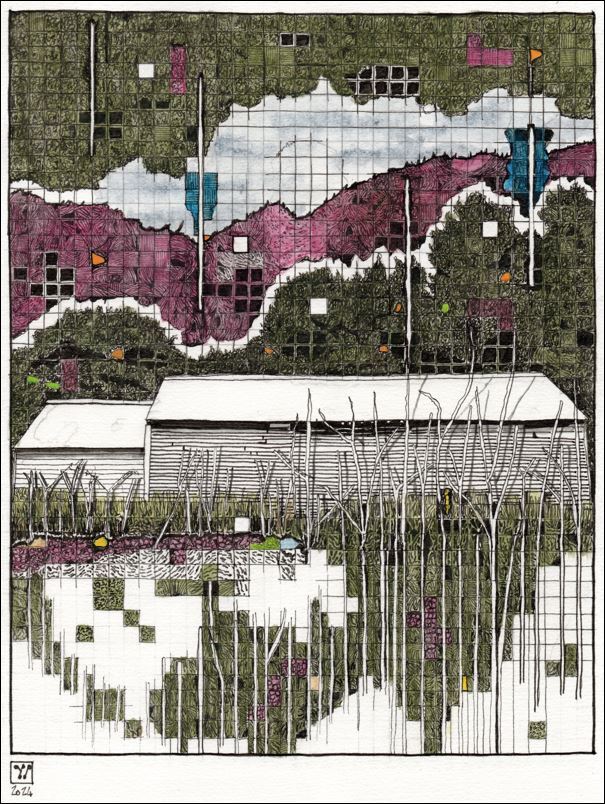
The Barn - Ink and watercolour on paper - 2024
(More of my art can be seen in my Instagram account, link in my profile / bio.)
To conclude there is one other thing that amused me in Spahr's afterword. It is anecdotal. It is a quote taken from Edith Sitwell's enthusiastic review, in 1926, of this book : "bringing back life to our language."
I find this amusing because, in the past, I have also read Sitwell's damning criticism, in her much older days, of Willam S. Burroughs' work, in The Selected Letters of Edith Sitwell at the date of 28 November 1963 to the editor of the Times Literary Supplement. Mrs Sitwell had certainly become much more conventional in 1963, much less avant-garde.
However The Naked Lunch is much more intelligible and, in my opinion, much more important a work, than these Tender Buttons.
So I am taking the opportunity of this easy one for my come back.
To put it simply I don't think I understood, optimistically, half a sentence in that book. I mean, honestly?
"RHUBARB
Rhubarb is susan not susan not seat in bunch toys not wild and laughable not in little place not in neglect and vegetable not in fold coal age not please."
I may have an obtuse mind, apologies if I have, but to me these are just random words put one after the other, and it does not even sound beautiful.
I am just a bit disappointed, as, sincerely, I had started the book with an open mind, but the result was as described by Edmund Wilson, quoted in the afterword by Juliana Spahr, when he talks about Stein's work saying it is "absolutely unintelligible even to a sympathetic reader."
There is a sentence on page 20, the meaning of which I am no more confident of getting than the rest of the book, but which I associated with my own latest painting, it is a barn of course, so I will use the sentence and this review to promote my art instead of promoting the book, that way not all is lost:
"Pick a barn, a whole barn, and bend more slender accents than have ever been necessary, shine in the darkness necessarily."
The Barn - Ink and watercolour on paper - 2024
(More of my art can be seen in my Instagram account, link in my profile / bio.)
To conclude there is one other thing that amused me in Spahr's afterword. It is anecdotal. It is a quote taken from Edith Sitwell's enthusiastic review, in 1926, of this book : "bringing back life to our language."
I find this amusing because, in the past, I have also read Sitwell's damning criticism, in her much older days, of Willam S. Burroughs' work, in The Selected Letters of Edith Sitwell at the date of 28 November 1963 to the editor of the Times Literary Supplement. Mrs Sitwell had certainly become much more conventional in 1963, much less avant-garde.
However The Naked Lunch is much more intelligible and, in my opinion, much more important a work, than these Tender Buttons.

June 17, 2017
This reads like a cut-up, that is to say that the words, the words, words and the, have been scrambled or reassembled to create striking instances of imagery juxtaposed in surprising and exciting ways and highly original and fascinating collocations as a result.
This is a book to be appreciated in terms of its wordplay and harmonics rather than in terms of any strict notion of meaning. Just like in cubism, new and incongruous images and ideas are placed alongside more contiguous ones.
If you are unfamiliar with Stein, this is definitely not a good diving-off spot so instead start with her more 'conventional' works such as Three Lives or even better the terrific Autobiography of Alice B. Toklas (see my review on that for more information).
This is a book to be appreciated in terms of its wordplay and harmonics rather than in terms of any strict notion of meaning. Just like in cubism, new and incongruous images and ideas are placed alongside more contiguous ones.
If you are unfamiliar with Stein, this is definitely not a good diving-off spot so instead start with her more 'conventional' works such as Three Lives or even better the terrific Autobiography of Alice B. Toklas (see my review on that for more information).
February 5, 2025
I like text that presents language in unexpected ways. I didn’t warm to this as much as I wanted to but there were parts that stood out, here’s one of my favourites:
And then the parts that were ok but I wanted more from it.
But in its time, I could see how daring this was.
ROOM
Blind and weak and organised and worried and betrothed and resumed and also asked to a fast and always asked to consider and never startled and not at all bloated, this which is no rarer than frequently is not so astonishing when hair brushing is added. There is quiet, there certainly is.
And then the parts that were ok but I wanted more from it.
BREAKFAST.
A change, a final change includes potatoes. This is no authority for the abuse of cheese. What language can instruct any fellow.
But in its time, I could see how daring this was.

January 2, 2026
Tender Buttons makes more sense to me than most conversations with regular people. And by ‘regular people’ I mean people who don’t like Tender Buttons, or people who wouldn’t consider reading any of it at all. These people are always very concerned with why I don’t have a normal job, why I’m not more pressed with propping myself up with more money than I need for rent, food, and a few books; or gaining a long-term and specifically male companion (ew); or going out a lot with people I don’t even fucking like. i.e. I like to surround myself with people who adore Tender Buttons or at least find it amusingly puzzling.
I had some friends when I was younger, as hard as that is to believe. Anyway, we would share conversations that consisted of one word each. Being of similar minds the way that people who grow up as very strange people, strange in a way that is considered and named as a given fact by others, along with these and other similar circumstances, we could intuit how each of us wound up with their word from the one proceeding. This sounds very boring, but I do this with the few friends I have today, doubled over in stupid laughter. No performance or sanding down of one’s self for comprehension and finding that the right people will comprehend anyway. I’m only explaining this to let you know events that are analogously as fun as reading Tender Buttons. Associates in association in all except a fondness of Vichy France. I’m not about that life at all, Gertrude.
Unfortunately, and despite, and because, and because not, she still finds her words constantly circling and pushing my tender buttons in a way that would make you believe your elevator will arrive just that little bit faster, bourgeois interiors and all.
And with no further ado, as there was rather much more ado than I intended, here is what I cooked (cooking, something which may have been beneath Stein’s hands) for dinner a bit ago, to act as if there is no use in a centre, a centre which now includes Tender Buttons. The differences are spreading:
arugula w vinaigrette, smoked salmon, gnocchi,
arrabbiata.
Clinging spilt up sideways – the white circle. Still water verde sunken long breathless underwater much too much too wet too breathless. Never mind, peppery green acorn crunch.
Was it the crushed garlic added too late for what it not knows? Celtic salt – evaporated sea – crumbling druid magic tempering the extra virgin – olive oil! One extra virgin to greet you in paradise. Beige swaths that could only have birthed themselves onto the world palette in Dijon. Emulsify Emulsify Emulsify – a small diver forks fast movements. Balsamic whomst?
Pink and lithe in the water, palpitating. Cigarette after? Proust ruins everything: smoked salmon decorates.
White little pillows rising soft now buoyant tempting to squash. Tiny head on the tiny pillow, two little lumps rising. Nourished in scalding hot water drained. So tired – little white pillows.
Red! Piquant sour delicious – Red! Simmer Simmer now cauldron to paint the pillow red in the night sky my plate. Bloody spicy gumption in the night.
I had some friends when I was younger, as hard as that is to believe. Anyway, we would share conversations that consisted of one word each. Being of similar minds the way that people who grow up as very strange people, strange in a way that is considered and named as a given fact by others, along with these and other similar circumstances, we could intuit how each of us wound up with their word from the one proceeding. This sounds very boring, but I do this with the few friends I have today, doubled over in stupid laughter. No performance or sanding down of one’s self for comprehension and finding that the right people will comprehend anyway. I’m only explaining this to let you know events that are analogously as fun as reading Tender Buttons. Associates in association in all except a fondness of Vichy France. I’m not about that life at all, Gertrude.
Unfortunately, and despite, and because, and because not, she still finds her words constantly circling and pushing my tender buttons in a way that would make you believe your elevator will arrive just that little bit faster, bourgeois interiors and all.
And with no further ado, as there was rather much more ado than I intended, here is what I cooked (cooking, something which may have been beneath Stein’s hands) for dinner a bit ago, to act as if there is no use in a centre, a centre which now includes Tender Buttons. The differences are spreading:
arugula w vinaigrette, smoked salmon, gnocchi,
arrabbiata.
Clinging spilt up sideways – the white circle. Still water verde sunken long breathless underwater much too much too wet too breathless. Never mind, peppery green acorn crunch.
Was it the crushed garlic added too late for what it not knows? Celtic salt – evaporated sea – crumbling druid magic tempering the extra virgin – olive oil! One extra virgin to greet you in paradise. Beige swaths that could only have birthed themselves onto the world palette in Dijon. Emulsify Emulsify Emulsify – a small diver forks fast movements. Balsamic whomst?
Pink and lithe in the water, palpitating. Cigarette after? Proust ruins everything: smoked salmon decorates.
White little pillows rising soft now buoyant tempting to squash. Tiny head on the tiny pillow, two little lumps rising. Nourished in scalding hot water drained. So tired – little white pillows.
Red! Piquant sour delicious – Red! Simmer Simmer now cauldron to paint the pillow red in the night sky my plate. Bloody spicy gumption in the night.
May 5, 2011
tender: one who tends or waits upon
one who attends or has charge of
a ship or boat used to attend to a larger ship or boat in various capacities
an act of tendering
an offer of money in exchange for goods or services
an offer of anything for acceptance
an offer made in writing by one party to another to execute an order for the supply or purchase of goods or for the execution of work
currency prescribed by law
literal and physical senses
soft or delicate in texture
of the ground, soft with moisture, rotten
frail, fine, thin, slender
to offer or present formally for acceptance
to present for approval or acceptance, to proffer
to become tender, to soften
to render gentle
to mitigate
to ship on board a tender
buttons: small knob for decoration or use
a type of anything of small value
playfully used
one who attends or has charge of
a ship or boat used to attend to a larger ship or boat in various capacities
an act of tendering
an offer of money in exchange for goods or services
an offer of anything for acceptance
an offer made in writing by one party to another to execute an order for the supply or purchase of goods or for the execution of work
currency prescribed by law
literal and physical senses
soft or delicate in texture
of the ground, soft with moisture, rotten
frail, fine, thin, slender
to offer or present formally for acceptance
to present for approval or acceptance, to proffer
to become tender, to soften
to render gentle
to mitigate
to ship on board a tender
buttons: small knob for decoration or use
a type of anything of small value
playfully used

October 27, 2007
Mostly a collection of self-pleasuring on the topic of difference for its own sake. Some ear there for sound and concept, but mostly ringing as an overbearing attempt to be new. Stein's hatred of punctuation strikes one as an affectation, but then so do most of her opinions or ideas. I suppose Hemingway's sense that she was 'always right' stemmed from the lacking of his imagination (beyond that which bolstered his sense of self, and perhaps in that their true connection). Stein's importance to literary and artistic movements seems less creative and more like that of the town itself: that she happened to be a locale.
February 17, 2022
I have no idea what Stein is saying, but my goodness she says it so well.
July 17, 2023
Tender Buttons Again
Review of the City Lights Publishers paperback edition (2014) edited with notes by Seth Perlow with an Afterword by poet Juliana Spahr of the original Claire Marie hardcover (1914).
I read a public domain eBook of Tender Buttons earlier this summer and reviewed it as Bastardized Buttons. That was more a reflection of the lack of editorial care that went into that edition, even if it did have bonus poems included without any source references, which I then had to research for myself.
The contrast in this corrected centennial edition is immense. The editor Seth Perlow discusses the various correction sources (these are either Stein's own manuscript or her handwritten notes on either proofs or published copies) and provides a complete appendix section of the variances from the original as published in 1914. The changes are not major but there are over 100 of them. A lot of them are punctuation. It is the care and attention that went into this edition which really makes it stand out. The bonus is the wonderful Afterword by Juliana Spahr which puts Tender Buttons into the context of its modernist times in the early 20th century saying that "Tender Buttons says something feminist, something queer, something opposed to those big modernist epics such as T.S. Eliot's "The Waste Land" or Ezra Pound's "The Cantos", works that were being written at the time Stein was writing hers."
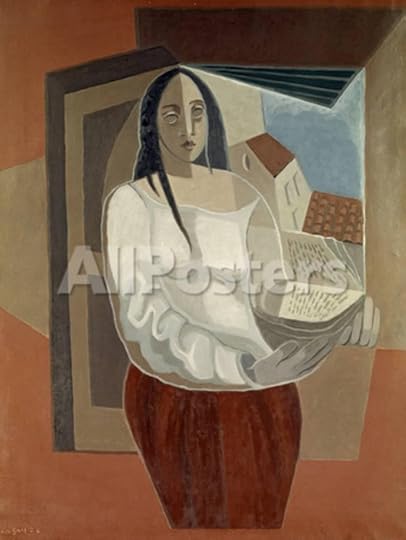
The cover art for this edition is cropped from the painting La Femme au Livre (Woman with Book) by Juan Gris, oil on canvas, 1926. Image sourced from AllPosters.com.
My 5 star rating is relative to the various free or cheap public domain editions which provide no additional information or context.
Trivia and Links
Tender Buttons is in the Public Domain and can be read online at various locations such as Wikisource and Bartleby [Note: the layout at Bartleby is entirely wrong with the texts all mashed together, rather than spaced out by each subject.].
Review of the City Lights Publishers paperback edition (2014) edited with notes by Seth Perlow with an Afterword by poet Juliana Spahr of the original Claire Marie hardcover (1914).
Tender Buttons is written in what one might call prose, the word that tends to get used for sentences that do not follow realist conventions and instead have poetry's associational drive but not its line breaks. While it uses fairly simple language in that there are few words that require a dictionary, it indulges in a lot of grammatical variations. It runs on... it hangs fire in fragments... it frequently indulges in a fragmented listing... at moments it even manages to run on in fragments... it seems often to have a definitional desire. But it is a complicated desire. Things get defined all the time... and then Stein follows with a list of negatives... Sometimes all is grammatically set up for a definition but the words seem to have only the vaguest relation to each other. - excerpts from the Afterword by Juliana Spahr.
I read a public domain eBook of Tender Buttons earlier this summer and reviewed it as Bastardized Buttons. That was more a reflection of the lack of editorial care that went into that edition, even if it did have bonus poems included without any source references, which I then had to research for myself.
The contrast in this corrected centennial edition is immense. The editor Seth Perlow discusses the various correction sources (these are either Stein's own manuscript or her handwritten notes on either proofs or published copies) and provides a complete appendix section of the variances from the original as published in 1914. The changes are not major but there are over 100 of them. A lot of them are punctuation. It is the care and attention that went into this edition which really makes it stand out. The bonus is the wonderful Afterword by Juliana Spahr which puts Tender Buttons into the context of its modernist times in the early 20th century saying that "Tender Buttons says something feminist, something queer, something opposed to those big modernist epics such as T.S. Eliot's "The Waste Land" or Ezra Pound's "The Cantos", works that were being written at the time Stein was writing hers."
The cover art for this edition is cropped from the painting La Femme au Livre (Woman with Book) by Juan Gris, oil on canvas, 1926. Image sourced from AllPosters.com.
My 5 star rating is relative to the various free or cheap public domain editions which provide no additional information or context.
Trivia and Links
Tender Buttons is in the Public Domain and can be read online at various locations such as Wikisource and Bartleby [Note: the layout at Bartleby is entirely wrong with the texts all mashed together, rather than spaced out by each subject.].

November 21, 2012
Well this isn't for everyone but like some of the others here on Goodreads I have an unjustifiable love for Tender Buttons. Is it just a small selection of modernist gibberish? Maybe. Is there a great key that can be used to unlock significant meaning from Stein's famous tome of word salad? Maybe not. I don't really know. Keeping in mind her project (to paint with language like an artist... just the words, not the grammar... sort of) gives one at least some way to talk about the unusual poems here when discussing them without feeling like some kind of literary bully. Then again, that is how I'm starting to think of modernism in general.
All meaning making aside, I love this book. Honestly? I couldn't tell you why. I just like the way the words sound. The pleasurable catharsis of meaning always feels just out of reach so the work never provides that sort of satisfaction. Still, in a weird sort of tantric way, there is simply joy in the way Stein rolls around in language. Here's one:
A PETTICOAT
A light white, a disgrace, an ink spot, a rosy charm.
That's the entire poem. Frustrating if read in a certain way, beautiful if read in another. There were longer poems and certainly poems that tested my endurance and focus but all in all this is a book I'm going to dip into every once in a while because it reminds me what the best poetry can: that language doesn't only convey meaning in one way and that reading language doesn't always have to recite the same discourse.
All meaning making aside, I love this book. Honestly? I couldn't tell you why. I just like the way the words sound. The pleasurable catharsis of meaning always feels just out of reach so the work never provides that sort of satisfaction. Still, in a weird sort of tantric way, there is simply joy in the way Stein rolls around in language. Here's one:
A PETTICOAT
A light white, a disgrace, an ink spot, a rosy charm.
That's the entire poem. Frustrating if read in a certain way, beautiful if read in another. There were longer poems and certainly poems that tested my endurance and focus but all in all this is a book I'm going to dip into every once in a while because it reminds me what the best poetry can: that language doesn't only convey meaning in one way and that reading language doesn't always have to recite the same discourse.

September 5, 2020
2023!!!! she keeps! its true and I just find, more every year ., a sideways love,.,, act so that there is no use in a centre
2022Reread this lovely I adore her so much & look I wrote a review, stumbling as it is, back in 2020 which I'm not writing over (palimpsestically!) for once. Diagonal prose
2020:
All sorts of strangeness & obscurity. So experimental, yet so early - it has been suggested that this experimental masterpiece was ignored due to Stein's being a woman.
I'm sure anyone that tries to read this will blink at the first page and question whether it is worth pursuing. It's undeniably a difficult work, crab-like in such a way that reminds me of Derrida's 'diagonal prose'. A possible key to this book is to (attempt to) read it rhizomatically. It is centreless.
I was reminded at times of the poems of W.S. Graham - I think this is because both Stein and Graham were literary figures that associated with sculptors and painters, rather than with poets. There is something in the defamiliarised, abstract descriptions of objects that reminds me of modernist sculpture. All is extension and shape - a practice often neglected by writers.
2022Reread this lovely I adore her so much & look I wrote a review, stumbling as it is, back in 2020 which I'm not writing over (palimpsestically!) for once. Diagonal prose
2020:
All sorts of strangeness & obscurity. So experimental, yet so early - it has been suggested that this experimental masterpiece was ignored due to Stein's being a woman.
I'm sure anyone that tries to read this will blink at the first page and question whether it is worth pursuing. It's undeniably a difficult work, crab-like in such a way that reminds me of Derrida's 'diagonal prose'. A possible key to this book is to (attempt to) read it rhizomatically. It is centreless.
I was reminded at times of the poems of W.S. Graham - I think this is because both Stein and Graham were literary figures that associated with sculptors and painters, rather than with poets. There is something in the defamiliarised, abstract descriptions of objects that reminds me of modernist sculpture. All is extension and shape - a practice often neglected by writers.

November 24, 2008
Stein continues her experiments with a "continuous present" in this classic work written in 1912, emphasizing sounds, rhythms, and repetitions over and against "sense." To live in this state is "to begin again and again," to "use everything." She sums it up best: "The teasing is tender and trying and thoughtful."
Recommended by Jack, Powells.com
Recommended by Jack, Powells.com
March 28, 2007
Sexy. But just read this for fun. This is a book that literature classes can't deal with--and will make literature classes something you can't deal with.

December 10, 2017
I echo Stein's sentiments: "All this makes a magnificent asparagus, and also a fountain" (Stein 52).

Read
December 3, 2019Video review: https://www.youtube.com/watch?v=6EWMJ...

June 22, 2022
good for understanding early 20th century avantgarde & cubist art, but very hard to actually read.

July 1, 2024
Moving apartments makes me nervous. I have never been fond of the things which populate my life, except for my books, clothes, and perfume. Moving makes one hyperconscious of objects. When did I get this tchotchke? Should I throw away that birthday card? This is Marie Kondō’s intervention in the world.
To state the case for objects, let us consider that we couldn’t live without them, or could barely have a play or a film without props, and isn’t the grand gesture of many modernist poets (and what makes poetry seem insincere to people who read little of it) their curious investment in objects – wheelbarrows, jars, petals.
Objects rarely require our interpretation, in so far as they are not associated with Marcel Duchamp. They simply are. Yet when inserted into poetry, we have disastrously been taught that objects are always a surrogate something else, something bigger like capitalism – which sometimes they are, but in most cases they aren’t. Gertrude Stein agrees when she says, “rose is a rose is a rose.” In her essay ‘Against Interpretation,’ Susan Sontag saw much of the art of the 60s as motivated by a flight from this interpretation. “To avoid interpretation, art may become parody. Or it may become abstract. Or it may become (“merely”) decorative. Or it may become non-art.”
Sweeping the irony of me using Sontag’s words to interpret a text under the rug, I will say there is a way to read Tender Buttons by Gertrude Stein as each of these.
Written in 1916, much before Sontag’s essay and more notably before postmodernism, Stein escaped many of her interpreters for many years. She did this by evacuating syntax and logic as we know them from her writing to create essentially a bricolage of daily experience. The result is a work that is phenomenological in two senses: One, because it owes a lot to automatic writing (the process of writing while attention is not on the words one is writing), it is a record of unfiltered mental experience. Two, in its focus on the mundane (the three sections of Tender Buttons – Food, Objects, Rooms) it reflects on the banal components of lived experience and animates them with more weight, like the experience of moving apartments. However, Stein’s modality is not pathetic fallacy; it is persuasion, which makes the lack of logic and syntax puzzling for some readers, infuriating for others and fun and whimsical for few. I personally went through all these emotions at some point in reading it. One gets the sense that Stein is always trying to persuade you of something, but not give you logical premises to follow. The famous opening section which meditates on a carafe is emblematic of the psychedelic-academic sounding tone of much of the collection:
So it is both ontological and phenomenological in that it meditates on the nature of the carafe (a kind in glass and a cousin) and perception of it (system to pointing). The “hurt” here is limp. Stein rarely moves, rather she insists through repetitions both great and small. In ‘Carafe’ I hear a faint anticipation of the opening of T.S. Eliot’s ‘Four Quartets.’ Eliot allegedly said at Cambridge “the work of Stein is very fine but not for us.”
Her fascinations too are repeated, there is throughout 'Objects,' and much of Tender Buttons, a fascination with surfaces, their coating, dirt, the colour red, translucency, geometry. Yet it is not all science, one cannot miss a subtly strange pathos underlying the piece. Is it curiosity? Experiencing it has frequently been compared to going through Wonderland. Though such a comparison overstates the whimsicality to me. There is instead a sort of synaesthesia in Tender Buttons which erupts at some points:
It is in the section 'Food' that Stein allows herself to be more whimsical. She is at her best, most fun and most readable when she rhymes:
Literary critics have made lofty headed speculations on her influence on Hemingway and Joyce’s writing – she held a literary salon with her wife in France where she entertained and mentored many Modernist writers and visual artists including the aforementioned two. But these comparisons can only truly be ideological not stylistic. Her stylistic descendant is really Dr. Seuss, whose absurdity, rhyme, and lack of claim to meaning is most appreciated by children. It is no surprise that the artist Lisa Congdon made an illustrated book of Tender Buttons which looks essentially like a children’s book.
It has been hard to find her literary descendants, as it is to find her ancestors. Most surmise that she was more influenced by the abstract painters who allowed her to liberate her idea of what poetry is supposed to be and represent.
The last section in Tender Buttons 'Rooms' is more prosaic. The tone no longer feels completely academic but plays with more languages. It to me sounds sermonic in parts: “Sugar any sugar, anger every anger, lover sermon lover, center no distractor, all order is in measure.” 'Rooms' leaves the domestic and explores beyond that to look at willows, bridges, mountains, clouds. It builds up to something quite moving, quite serious sounding, which Stein cuts down with the final words of the collection, an ending which I can only read as a mockery of those who take her deathly serious.
Indeed Stein’s interpreters have now caught up to her. No one can decide whether it is a provocation, a writing exercise (automatic writing is often a warmup in creative writing classes), a parody of poetry. Some have gone the identity route of saying it is an expression of Stein’s identity as a lesbian, a reading that perplexes me, though I can see a queer alterity in it. One thing that is for certain is that the time it was written pulls a lot of weight in our understanding of its aesthetic merit. If it were written today, nobody would see it as worthy of interpretation. Few people in Stein’s time saw it as worth anything, so it has been passed down to us, a balloon hurt beyond hurting meaning. An exercise in white with hurt to looking. It has a little top!
Poems I found inexplicably moving:
A RED STAMP
A SELTZER BOTTLE
A WAIST
SALAD
To state the case for objects, let us consider that we couldn’t live without them, or could barely have a play or a film without props, and isn’t the grand gesture of many modernist poets (and what makes poetry seem insincere to people who read little of it) their curious investment in objects – wheelbarrows, jars, petals.
Objects rarely require our interpretation, in so far as they are not associated with Marcel Duchamp. They simply are. Yet when inserted into poetry, we have disastrously been taught that objects are always a surrogate something else, something bigger like capitalism – which sometimes they are, but in most cases they aren’t. Gertrude Stein agrees when she says, “rose is a rose is a rose.” In her essay ‘Against Interpretation,’ Susan Sontag saw much of the art of the 60s as motivated by a flight from this interpretation. “To avoid interpretation, art may become parody. Or it may become abstract. Or it may become (“merely”) decorative. Or it may become non-art.”
Sweeping the irony of me using Sontag’s words to interpret a text under the rug, I will say there is a way to read Tender Buttons by Gertrude Stein as each of these.
Written in 1916, much before Sontag’s essay and more notably before postmodernism, Stein escaped many of her interpreters for many years. She did this by evacuating syntax and logic as we know them from her writing to create essentially a bricolage of daily experience. The result is a work that is phenomenological in two senses: One, because it owes a lot to automatic writing (the process of writing while attention is not on the words one is writing), it is a record of unfiltered mental experience. Two, in its focus on the mundane (the three sections of Tender Buttons – Food, Objects, Rooms) it reflects on the banal components of lived experience and animates them with more weight, like the experience of moving apartments. However, Stein’s modality is not pathetic fallacy; it is persuasion, which makes the lack of logic and syntax puzzling for some readers, infuriating for others and fun and whimsical for few. I personally went through all these emotions at some point in reading it. One gets the sense that Stein is always trying to persuade you of something, but not give you logical premises to follow. The famous opening section which meditates on a carafe is emblematic of the psychedelic-academic sounding tone of much of the collection:
A CARAFE, THAT IS A BLIND GLASS
A kind in glass and a cousin, a spectacle and nothing strange a single hurt color and an arrangement in a system to pointing. All this and not ordinary, not unordered in not resembling. The difference is spreading.
So it is both ontological and phenomenological in that it meditates on the nature of the carafe (a kind in glass and a cousin) and perception of it (system to pointing). The “hurt” here is limp. Stein rarely moves, rather she insists through repetitions both great and small. In ‘Carafe’ I hear a faint anticipation of the opening of T.S. Eliot’s ‘Four Quartets.’ Eliot allegedly said at Cambridge “the work of Stein is very fine but not for us.”
Her fascinations too are repeated, there is throughout 'Objects,' and much of Tender Buttons, a fascination with surfaces, their coating, dirt, the colour red, translucency, geometry. Yet it is not all science, one cannot miss a subtly strange pathos underlying the piece. Is it curiosity? Experiencing it has frequently been compared to going through Wonderland. Though such a comparison overstates the whimsicality to me. There is instead a sort of synaesthesia in Tender Buttons which erupts at some points:
DIRT AND NOT COPPER
Dirt and not copper makes a colour darker. It makes the shape so heavy and makes no melody harder…
It is in the section 'Food' that Stein allows herself to be more whimsical. She is at her best, most fun and most readable when she rhymes:
(FROM) ROAST BEEF
To bury a slender chicken, to raise an old feather, to surround a garland and to bake a pole splinter, to suggest a repose and to settle simply, to surrender one another, to succeed saving simpler, to satisfy a singularity and not to be blinder, to sugar nothing darker and to read redder, to have the colour better, to sort out dinner, to remain together, to surprise no sinner, to increase in resting recreation to design string not dimmer.
Literary critics have made lofty headed speculations on her influence on Hemingway and Joyce’s writing – she held a literary salon with her wife in France where she entertained and mentored many Modernist writers and visual artists including the aforementioned two. But these comparisons can only truly be ideological not stylistic. Her stylistic descendant is really Dr. Seuss, whose absurdity, rhyme, and lack of claim to meaning is most appreciated by children. It is no surprise that the artist Lisa Congdon made an illustrated book of Tender Buttons which looks essentially like a children’s book.
It has been hard to find her literary descendants, as it is to find her ancestors. Most surmise that she was more influenced by the abstract painters who allowed her to liberate her idea of what poetry is supposed to be and represent.
The last section in Tender Buttons 'Rooms' is more prosaic. The tone no longer feels completely academic but plays with more languages. It to me sounds sermonic in parts: “Sugar any sugar, anger every anger, lover sermon lover, center no distractor, all order is in measure.” 'Rooms' leaves the domestic and explores beyond that to look at willows, bridges, mountains, clouds. It builds up to something quite moving, quite serious sounding, which Stein cuts down with the final words of the collection, an ending which I can only read as a mockery of those who take her deathly serious.
Indeed Stein’s interpreters have now caught up to her. No one can decide whether it is a provocation, a writing exercise (automatic writing is often a warmup in creative writing classes), a parody of poetry. Some have gone the identity route of saying it is an expression of Stein’s identity as a lesbian, a reading that perplexes me, though I can see a queer alterity in it. One thing that is for certain is that the time it was written pulls a lot of weight in our understanding of its aesthetic merit. If it were written today, nobody would see it as worthy of interpretation. Few people in Stein’s time saw it as worth anything, so it has been passed down to us, a balloon hurt beyond hurting meaning. An exercise in white with hurt to looking. It has a little top!
Poems I found inexplicably moving:
A RED STAMP
A SELTZER BOTTLE
A WAIST
SALAD

Read
November 19, 2024Siis absoluuttisesti mitäänhän en tästä ymmärtänyt, luin koska kumppani lempeästi pakotti. Rakastin runojen tunnelmaa kun luin niitä itselleni ääneen, annoin niiden vain virrata, kerätä voimaa, kertoa jotain välittämättä saanko kiinni siitä mitä ne kertovat. Tekee hyvää haastaa itseään kirjallisuuden parissa, näinkin vaikean, oudon, kumman ja itselleen vieraan.

Read
July 10, 2011I read Three Lives ages ago and found it to be modernism at its most sweethearted. This is modernism at its coldest.
Sometimes Stein's peculiar linguistic juxtapositions serve her cause, but other times, it feels without purpose. At the height of the cubist era, after 150 years of miserable sentimental novels, this was probably a total breath of fresh air.
I was really into Dada when I was a sniveling little punk-rock youth. I would have liked it more then. Now so many of these haute-moderne language experiments just feel so tired. Some of them still have a spark, but it's when they're in a less "CONCEPTS ONLY" framework-- Woolf, Joyce, and Faulkner still feel as revolutionary now as they did when they first hit the scene.
Sometimes Stein's peculiar linguistic juxtapositions serve her cause, but other times, it feels without purpose. At the height of the cubist era, after 150 years of miserable sentimental novels, this was probably a total breath of fresh air.
I was really into Dada when I was a sniveling little punk-rock youth. I would have liked it more then. Now so many of these haute-moderne language experiments just feel so tired. Some of them still have a spark, but it's when they're in a less "CONCEPTS ONLY" framework-- Woolf, Joyce, and Faulkner still feel as revolutionary now as they did when they first hit the scene.

January 1, 2021
This is utter nonsense, no doubt about that, but it was the most comforting experience of defamiliarization, so intense and grounded in the small "moments of conciousness" of objects; their existence outside of our experience of them (and Woolf's explanation of phenomenology in To the Lighthouse: "Think of a kitchen table, when you're not there").
Dunno, I might just be going insane, liking this as much as I did. But anyways, I will refer to Stein's technique in this book from now on as lesbian bracketing.
Dunno, I might just be going insane, liking this as much as I did. But anyways, I will refer to Stein's technique in this book from now on as lesbian bracketing.
June 25, 2007
My copy of this book is permanently tucked into my messenger bag. I carry it everywhere I travel--in the city, outside of the country--and is one of those rare books that actually inspires me to write each time I open to any one of its pages. I love this most tender of buttons, in spite of the occasional racist phrase inside it. "Act as if there is no use in a centre"? Gertrude Stein 4-ever.
Displaying 1 - 30 of 827 reviews