

What do you think?

Mystery Cults of the Ancient World
A richly illustrated history of antiquity's secret religious rituals
This is the first book to describe and explain all of the ancient world's major mystery cults--one of the most intriguing but least understood aspects of Greek and Roman religion. In the nocturnal Mysteries at Eleusis, participants dramatically re-enacted the story of Demeter's loss and recovery of her daughter Persephone; in the Bacchic cult, bands of women ran wild in the Greek countryside to honor Dionysus; and in the mysteries of Mithras, men came to understand the nature of the universe and their place within it through frightening initiation ceremonies and astrological teachings. These cults were an important part of life in the ancient Mediterranean world, but their actual practices were shrouded in secrecy, and many of their features have remained unclear until now.
By richly illustrating the evidence from ancient art and archaeology, and drawing on enlightening new work in the anthropology and cognitive science of religion, Mystery Cults of the Ancient World allows readers to imagine as never before what it was like to take part in these ecstatic and life-changing religious rituals--and what they meant to those who participated in them. Stunning images of Greek painted pottery, Roman frescoes, inscribed gold tablets from Greek and South Italian tombs, and excavated remains of religious sanctuaries help show what participants in these initiatory cults actually did and experienced.
A fresh and accessible introduction to a fascinating subject, this is a book that will interest general readers, as well as students and scholars of classics and religion.
This is the first book to describe and explain all of the ancient world's major mystery cults--one of the most intriguing but least understood aspects of Greek and Roman religion. In the nocturnal Mysteries at Eleusis, participants dramatically re-enacted the story of Demeter's loss and recovery of her daughter Persephone; in the Bacchic cult, bands of women ran wild in the Greek countryside to honor Dionysus; and in the mysteries of Mithras, men came to understand the nature of the universe and their place within it through frightening initiation ceremonies and astrological teachings. These cults were an important part of life in the ancient Mediterranean world, but their actual practices were shrouded in secrecy, and many of their features have remained unclear until now.
By richly illustrating the evidence from ancient art and archaeology, and drawing on enlightening new work in the anthropology and cognitive science of religion, Mystery Cults of the Ancient World allows readers to imagine as never before what it was like to take part in these ecstatic and life-changing religious rituals--and what they meant to those who participated in them. Stunning images of Greek painted pottery, Roman frescoes, inscribed gold tablets from Greek and South Italian tombs, and excavated remains of religious sanctuaries help show what participants in these initiatory cults actually did and experienced.
A fresh and accessible introduction to a fascinating subject, this is a book that will interest general readers, as well as students and scholars of classics and religion.
256 pages, Hardcover
First published April 4, 2010
About the author
Hugh Bowden
9 books14 followersHugh Bowden (DPhil, Ancient History, University of Oxford, 1990) is Professor of Ancient History and former head of arts in the Faculty of Arts and Humanities at King's College, London.
Ratings & Reviews
Friends & Following
Create a free account to discover what your friends think of this book!
Community Reviews
Displaying 1 - 30 of 75 reviews

June 16, 2025
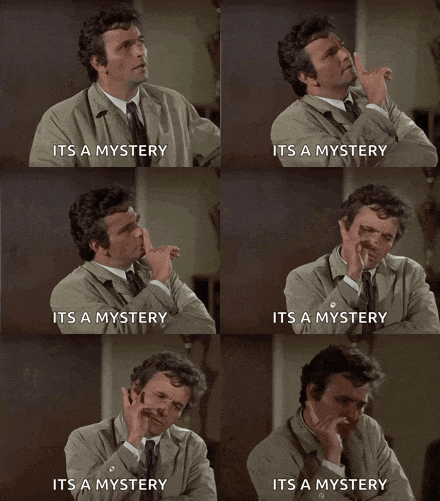
Seems to be that no one knows much about these secretive cults.
Go figure.
Because MYSTERY cults. <--it's right there in the name!
The cults of Isis, Dionysus, the Mother, and the Eleusinians are all interesting in their own way. But if I took one thing away from this, it's that it seems as though they were probably an outlet for zealots.

There have always been people who are just into that religious stuff waaaaaay too much, and this was probably where the ancient people stuffed their crazies. You know, most of the people at church are there to meet and greet, find a bit of community, and do a little Sunday worship service. But there are always those oddballs in the front row, crying and waving their hands in the air during the music. Amening loudly after everything the pastor says. A little too excited and earnest for the rest of the group, but since everyone is supposedly there for the same reason, you've just got to act like it's normal.
Where's a mystery cult when you need it? Back in the day, they could have joined up with other like-minded fanatics and gotten all of their funk out in a cave or temple set up to cater to that sort of thing.
As it is, I just have to dodge my modern-day Susan and her attempts to drag me to her home Bible study group, Christian Women's Retreat, or some Quilters for Christ meeting.
Go away, Susan!

I am interested in the subject matter & I swear, I do enjoy learning new things, but wow this was dry and the audiobook narrator was not helping matters. I found myself sort of zoning out quite a bit while he droned on and on.
It was like listening to the adults from the Peanuts cartoons.
wahwahwahwahwah
No lie, once I had finished the book, instead of returning it to the digital library, I actually used it as background noise to help me go to sleep one night. I had a big day ahead of me, and this was an excellent sleep aid.
And while I'm not sorry I listened to this, I'm not sure I would recommend it to someone looking for a little something-something to pass the time.
Recommended as a somewhat niche read.
Go figure.
Because MYSTERY cults. <--it's right there in the name!
The cults of Isis, Dionysus, the Mother, and the Eleusinians are all interesting in their own way. But if I took one thing away from this, it's that it seems as though they were probably an outlet for zealots.
There have always been people who are just into that religious stuff waaaaaay too much, and this was probably where the ancient people stuffed their crazies. You know, most of the people at church are there to meet and greet, find a bit of community, and do a little Sunday worship service. But there are always those oddballs in the front row, crying and waving their hands in the air during the music. Amening loudly after everything the pastor says. A little too excited and earnest for the rest of the group, but since everyone is supposedly there for the same reason, you've just got to act like it's normal.
Where's a mystery cult when you need it? Back in the day, they could have joined up with other like-minded fanatics and gotten all of their funk out in a cave or temple set up to cater to that sort of thing.
As it is, I just have to dodge my modern-day Susan and her attempts to drag me to her home Bible study group, Christian Women's Retreat, or some Quilters for Christ meeting.
Go away, Susan!
I am interested in the subject matter & I swear, I do enjoy learning new things, but wow this was dry and the audiobook narrator was not helping matters. I found myself sort of zoning out quite a bit while he droned on and on.
It was like listening to the adults from the Peanuts cartoons.
wahwahwahwahwah
No lie, once I had finished the book, instead of returning it to the digital library, I actually used it as background noise to help me go to sleep one night. I had a big day ahead of me, and this was an excellent sleep aid.
And while I'm not sorry I listened to this, I'm not sure I would recommend it to someone looking for a little something-something to pass the time.
Recommended as a somewhat niche read.

February 18, 2024
Another 5 star... it's been a good run of books lately. Takes an esoteric subject and made it so readable. I don't know enough of the subject to know if it's "good" in that sense, but copious footnotes and seemed to resist taking flights of fancy. The comparisons to snake-handling Pentecostal cults and ancient mystery religions was excellently done-- again, doesn't overstate the point but draws interesting parallels.

April 25, 2024
شامل وتفصيلي لكل الطوائف السريّة في العصور القديمة، طوائف سمعت بها وطوائف أقرأ عنها لأول مرة هنا، مشكلتي الوحيدة مع الكتاب أن أسلوب الكتابة كان جافًا جدًا.

October 1, 2023
I have been interested in the mystery cults of Ancient Greece for a while and have always wanted to learn more so when I saw this in the book shop I had to get it.
I found it really well informed and there were no sweeping assumptions every things is well considered and we are told when something is merely guesswork.
I found it accessible enough, although I have prior knowledge I found it easy to follow.
I am really interested in the time of our history where the ancient Roman polytheistic religions dropped out of favour for Christianity and the similarity between stories from our well known myths to bible stories. I found the last two chapters in the book fascinating for that reason, where there are comparisons between the mystery cults and Christianity and how even modern day Pentecostal church’s hold a lot of similarities with the mystery cults.
I found it really well informed and there were no sweeping assumptions every things is well considered and we are told when something is merely guesswork.
I found it accessible enough, although I have prior knowledge I found it easy to follow.
I am really interested in the time of our history where the ancient Roman polytheistic religions dropped out of favour for Christianity and the similarity between stories from our well known myths to bible stories. I found the last two chapters in the book fascinating for that reason, where there are comparisons between the mystery cults and Christianity and how even modern day Pentecostal church’s hold a lot of similarities with the mystery cults.

November 16, 2023
Well written and extremely well researched overview of ancient mystery cults. Amazingly interesting!

April 18, 2025
The information itself is incredibly interesting, however this reader for the audiobook is so bad and constantly mispronounces things, has weird pauses and cadence. I've wondered constantly if it's AI reading this book to me.
I might pick this book up again later in text to try again because I think this is a MUST read book, but please spare your poor ears and skip the audiobook.
I might pick this book up again later in text to try again because I think this is a MUST read book, but please spare your poor ears and skip the audiobook.

December 27, 2023
A good, level-headed survey of what is known, or can be reasonably deduced, about the mystery cults of the ancient world.
The author examines the most famous of these, the mysteries of Eleusis, in some detail, and then fans out to look at the cults of the Mother of the Gods, of Dionysus, of Isis, and of Mithras, along with some others. Often the evidence is scanty, but the author makes the most of it, while taking care not to overplay his hand. His preference is to be conservative in interpreting the known facts. He does make an interesting comparison between ancient mysteries and the modern phenomenon of spiritual ecstasy within Pentacostalism, with its frenzies, snake-handling, and speaking in tongues.
But my sense is that this author is not very sympathetic with the spiritual mindset of the ancient world or mysticism more generally. Rudolf Otto's excellent book The Idea of the Holy is devoted to the dimension of human experience represented by the notion of the holy--a dimension that cannot be explained in terms beyond the immediate felt experience. In this way it is like the experience of beauty or being in love, and anyone who talked about these things without having had any experience of them would be at a significant disadvantage. I felt that this author was somewhat in this situation here; nonetheless, he has produced a clear and useful work that brings together a lot of information about this fascinating and hidden aspect of the ancient world.
The author examines the most famous of these, the mysteries of Eleusis, in some detail, and then fans out to look at the cults of the Mother of the Gods, of Dionysus, of Isis, and of Mithras, along with some others. Often the evidence is scanty, but the author makes the most of it, while taking care not to overplay his hand. His preference is to be conservative in interpreting the known facts. He does make an interesting comparison between ancient mysteries and the modern phenomenon of spiritual ecstasy within Pentacostalism, with its frenzies, snake-handling, and speaking in tongues.
But my sense is that this author is not very sympathetic with the spiritual mindset of the ancient world or mysticism more generally. Rudolf Otto's excellent book The Idea of the Holy is devoted to the dimension of human experience represented by the notion of the holy--a dimension that cannot be explained in terms beyond the immediate felt experience. In this way it is like the experience of beauty or being in love, and anyone who talked about these things without having had any experience of them would be at a significant disadvantage. I felt that this author was somewhat in this situation here; nonetheless, he has produced a clear and useful work that brings together a lot of information about this fascinating and hidden aspect of the ancient world.

July 20, 2024
As others have noted, this is quite dry. It was clearly written as an academic piece, and not to entertain general readers. I'm fine with that, and for the most part feel I learned a fair amount about various mystery cults. I went into this primarily hoping to learn more about the Mystery Cult of Dionysus/Bacchus and the Mystery Cult of Isis. Chapters were indeed included about these two cults, but there was a lot about the Eleusinian Mysteries which I knew almost nothing about as well as the Mother of the Gods.

April 8, 2017
Although I did not find what I was looking for this is a nice pile of information.
Recommended for the subject.
Recommended for the subject.

April 19, 2024
I found this quite dry but informative nevertheless. If you are looking for something salacious or scandalous, you will not find it here. But if there is genuine interest in ritualistic practices of the past (and a little of where we can find them nowadays), this is an excellent and to-the-point read.

December 1, 2025
i felt as if the writing got clearer as the book progressed; the earlier chapters felt jumbled and without clear directive while the later chapters managed to develop a clear line of thought
February 24, 2024
A mountain of research clearly went into the writing of this book, and Bowden is undeniably an expert. It’s just not… fun. This is a bone-dry academic, archaeological survey of a topic that couldn’t be inherently juicier. Secret mystery cults are the most punk rock aspect of classical religion, so the fact that this book is as buttoned-up and straight-faced as it is honestly an accomplishment in itself. The author seems bent on myth-busting mythology rather than entertaining his audience, debunking instead of delighting. I realize that is the fundamental purpose of scholarship - to inform, not amuse. But come on. Can’t it be both? Why must the last sentence of each paragraph be “we may never know,” or “sources are inconclusive,” or “the evidence is scanty”?
Spooky members-only religious cults with their elaborate initiation rites, fight-club style vows to shut up about internal business, fun costumes, booze, drugs, orgies, murders… this is why people (like this guy) picked the book up in the first place.
All in all, I have to admit that I did learn a lot. I especially loved the chapter titled Words Written on Gold. That one was cool. I just didn’t learn what I wanted to learn. I wanted what the uninitiated masses have wanted for millennia now: the beans spilled about Eleusis and Isis and Mithras and all that. Alas, a grand total of zero beans were spilled, and the details of what really, truly went on in those mysterious sanctuaries remain (perhaps appropriately) a mystery.
Spooky members-only religious cults with their elaborate initiation rites, fight-club style vows to shut up about internal business, fun costumes, booze, drugs, orgies, murders… this is why people (like this guy) picked the book up in the first place.
All in all, I have to admit that I did learn a lot. I especially loved the chapter titled Words Written on Gold. That one was cool. I just didn’t learn what I wanted to learn. I wanted what the uninitiated masses have wanted for millennia now: the beans spilled about Eleusis and Isis and Mithras and all that. Alas, a grand total of zero beans were spilled, and the details of what really, truly went on in those mysterious sanctuaries remain (perhaps appropriately) a mystery.

April 8, 2025
Mystery cults were a major aspect of Greco-Roman religion, yet little is known about them as the initiates kept the rites a secret.
This book provides an excellent overview of the subject from a variety of sources. Bowden avoids speculation and dispels a few myths that have crept up around the cults. Despite being 260 pages, this book is thorough in scope. The only omission I noticed was any mention of the autochthonous Roman rites of the Bona Dea, which would have been an interesting tie-in with imported cult of Magna Mater / Cybele. I did, however, appreciate the comparison of the ancient rites to modern practices within the Pentecostalist church.
This book provides an excellent overview of the subject from a variety of sources. Bowden avoids speculation and dispels a few myths that have crept up around the cults. Despite being 260 pages, this book is thorough in scope. The only omission I noticed was any mention of the autochthonous Roman rites of the Bona Dea, which would have been an interesting tie-in with imported cult of Magna Mater / Cybele. I did, however, appreciate the comparison of the ancient rites to modern practices within the Pentecostalist church.
May 25, 2025
4.5 - 5
Did everything I needed it to do! I was aware of mystery cults during my studies but always thought I was missing something - this book filled the gaps while also avoiding the allure in searching for a greater meaning behind the mysteries that scholarship can fall into. The limits of the book are understandable considering it's focus and it's aim of being introductory, but that didn't seem to make it lacking in any department.
Did annoy me however that the references for the ancient textual sources were all in the notes, a really nitpicky thing but I just feel they really do belong in the main body.
Did everything I needed it to do! I was aware of mystery cults during my studies but always thought I was missing something - this book filled the gaps while also avoiding the allure in searching for a greater meaning behind the mysteries that scholarship can fall into. The limits of the book are understandable considering it's focus and it's aim of being introductory, but that didn't seem to make it lacking in any department.
Did annoy me however that the references for the ancient textual sources were all in the notes, a really nitpicky thing but I just feel they really do belong in the main body.

March 11, 2025
Very good and easy intro into ancient religious practice.
Lots of Ancient site names to remember, but overall helpful reading to get an idea of what we know about ancient religion in the Mediterranean and its immediate context.
Lots of Ancient site names to remember, but overall helpful reading to get an idea of what we know about ancient religion in the Mediterranean and its immediate context.

Read
January 15, 2024“There is a power in the act of disappearing; there is a victory in the loss of self. It must be close to our conception of paradise, and it’s like before you’re born or after you die.” (Final line)
First non-fiction book I’ve fully read. Very interesting topic even though there isn’t much evidence to go on out there. I need a break from facts though.
First non-fiction book I’ve fully read. Very interesting topic even though there isn’t much evidence to go on out there. I need a break from facts though.
April 18, 2025
* Having a basic knowledge of ancient religions/ deities is recommended
* Very dry but for those interested in this niche topic also very interesting
* Very dry but for those interested in this niche topic also very interesting

Read
July 24, 2026Came for the ancient mystery cults, stayed for the Pentecostalist snake-handlers.

November 7, 2023
This is a great one stop shop for anyone interested in ancient mystery religion. The primary audience is non-specialists, but advanced students and grad students in Classics will probably get a lot out of it as well. In particular, the latter will benefit from the selected bibliography and endnotes, which offer a manageable range of topics for further reading. Bowden offers starkly condensed summaries of the various scholarly positions on different aspects of ancient Mediterranean religious experience (which he himself sometimes warns are oversimplified). His own contribution is to frame these rituals and experiences in terms of cognitive theory. Rather than seeking to uncover the "hidden meaning" of ancient mysteries (the word mystos does simply mean "initiate" and its associations with concealment derives largely from later attempts to circularly project meaning onto the ancient rites), he seeks to convey the lived experiences of the practitioners. The comparison with the ecstatic experience modern snake-handling cults is apt and to my mind convincing.
The book briefly explains and elaborates on a variety of very exciting topics in the ancient world, including the Eleusinian mysteries, the mysteries at Samothrace, the mother of the gods (Cybele/ Magna Mater), Bacchanalia (worship of Dionysus), the Orphic gold leaves and the Derveni papyrus, the cults of Isis, Mithraism, and the rise of Christianity / the decline of pagan worship. This is a very wide range of topics that covers thousands of years and thousands of kilometers in the Mediterranean basin. Bowden's summaries are pragmatic and draw interesting connections between all of these different cults and rituals.
This book basically demands further reading. The truth is that the treatments of the broad range of places, cults, and ancient materials associated with mystery cult are often so condensed that they may be overwhelming for one without outside knowledge. (I already knew about a lot of this material and still found myself overwhelmed at the speed which which they are handled.) A wide range of ancient authors are introduced, and earlier quotations are often drawn upon in later chapters. Because of the focus on the experience of cult, Bowden often describes vividly sensuous spaces and rituals, but the book only contains a limited number of (color!) illustrations and a map of places tucked in at the very end. I understand that more illustrations would make the book more costly, but it would probably also help it successfully convey the buildings and sanctuaries that are only described in words. Sometimes the level of abridgement also makes comprehension difficult. For example, a brief treatment of the Andanian mysteries (pp. 86-92) repeatedly refers to "books and texts" mentioned in an inscription, but the actual part of the inscription that mentions these books and texts is not quoted, but only briefly mentioned in a summary. Later in the book (p. 215), a paragraph begins with the statement that the reconstruction of the ritual would not be possible without modern archaeological techniques, but what these techniques are or how they led to the reconstructions is not explained, so that the statement seems to be a non sequitur.
But it is the merit of a good book to make one want more and this book definitely succeeds on that ground. Now onto to books that I marked for further reading in the endnotes!
The book briefly explains and elaborates on a variety of very exciting topics in the ancient world, including the Eleusinian mysteries, the mysteries at Samothrace, the mother of the gods (Cybele/ Magna Mater), Bacchanalia (worship of Dionysus), the Orphic gold leaves and the Derveni papyrus, the cults of Isis, Mithraism, and the rise of Christianity / the decline of pagan worship. This is a very wide range of topics that covers thousands of years and thousands of kilometers in the Mediterranean basin. Bowden's summaries are pragmatic and draw interesting connections between all of these different cults and rituals.
This book basically demands further reading. The truth is that the treatments of the broad range of places, cults, and ancient materials associated with mystery cult are often so condensed that they may be overwhelming for one without outside knowledge. (I already knew about a lot of this material and still found myself overwhelmed at the speed which which they are handled.) A wide range of ancient authors are introduced, and earlier quotations are often drawn upon in later chapters. Because of the focus on the experience of cult, Bowden often describes vividly sensuous spaces and rituals, but the book only contains a limited number of (color!) illustrations and a map of places tucked in at the very end. I understand that more illustrations would make the book more costly, but it would probably also help it successfully convey the buildings and sanctuaries that are only described in words. Sometimes the level of abridgement also makes comprehension difficult. For example, a brief treatment of the Andanian mysteries (pp. 86-92) repeatedly refers to "books and texts" mentioned in an inscription, but the actual part of the inscription that mentions these books and texts is not quoted, but only briefly mentioned in a summary. Later in the book (p. 215), a paragraph begins with the statement that the reconstruction of the ritual would not be possible without modern archaeological techniques, but what these techniques are or how they led to the reconstructions is not explained, so that the statement seems to be a non sequitur.
But it is the merit of a good book to make one want more and this book definitely succeeds on that ground. Now onto to books that I marked for further reading in the endnotes!
June 10, 2025
Dense but full of knowledge that really puts a new perspective of the antiquities.

May 16, 2011
An academic book regarding the mystery cults of the ancient Graeco-Roman World. Very readable, if you're used to academic tomes, this is an easy read.
The author tries to keep the guessing down and only relate what is known. This is NOT for the Neopagan reader who wants to connect Dionysus with Shiva or a Bacchanalia with South American entheogen using shamanism. The only agenda here is academic.
Here is Mary Beard's review, Mary Beard is highly regarded in the archaeological world and so I don't have to use too many big words. :)
http://entertainment.timesonline.co.u... THIS link is broken.
I'd suggest this as a base book to read on the subject, then you can read the others which may have agendas and you have a good base on what's definite and provable and what is theory and hopeful preferences. I am not against hopeful preferences, but it's good to know what's provable first.
The author tries to keep the guessing down and only relate what is known. This is NOT for the Neopagan reader who wants to connect Dionysus with Shiva or a Bacchanalia with South American entheogen using shamanism. The only agenda here is academic.
Here is Mary Beard's review, Mary Beard is highly regarded in the archaeological world and so I don't have to use too many big words. :)
http://entertainment.timesonline.co.u... THIS link is broken.
I'd suggest this as a base book to read on the subject, then you can read the others which may have agendas and you have a good base on what's definite and provable and what is theory and hopeful preferences. I am not against hopeful preferences, but it's good to know what's provable first.
February 14, 2014
A heavily illustrated book with short chapters on the many a various mystery cults of the classical world from roughly 500 BC to 500 AD. The central thesis is that the cults were based on shared experience more than any particular secret knowledge. Even when ancient sources hint at what the secrets were the author downplays this as part of the cult. The value and core of each cult is the experience. I found this disappointing, thinking that there would be some connection to gnostic or early scientific thought. If you are looking for that kind of information David Ulansey has a very clearly and persuasively argued book "The Origins of the Mithraic Mysteries". That book argues that the Mithraic Mysteries at least did reveal a secret about Cosmology to maybe the highest level initiates. The lower levels might have participated for the emotional and experiential reasons noted in the reviewed book but there was an actual secret revealed at least in Mithrism.

November 21, 2023
I think this is a really good broad overview of the secret cults for people who want to dip their toe into the topic, and are coming with know precious knowledge. I would have liked to have seen a greater focus on the ancient literature that we have to support the cults.

July 12, 2014
A scholarly book, detailing some of the religious practices of ancient Greece and Rome (despite the title 'the Ancient World' is rather narrowly defined). The focus is on Demeter and Dionysus, understandably the primary subject of cults as both were gods of the harvest, but others are touched on as well. I'd have been interested to read more in the later chapters which dealt with Isis and Mithras, but this book is highly readable and full of information with which I bored my wife by incessantly regaling her.

August 15, 2020
Doing a bit of clean-up in my "currently reading" list. This was a textbook for a class I took on The Pagan Empire: Religions and Cults of the Roman World. Great class, good textbook. The photos of the ancient works of art are amazing. The text a little on the dry side. A great book if you want to immerse yourself in the mystery cults.

January 20, 2024
Good overview of the literature on classical mystery Cults. Reccomend a background in classical religion before reading.

March 16, 2024
me wondering the entire time what he would think about the bacchic thing they did in the secret history only for him to mention it in the end 🙏🏻

March 24, 2024
I enjoyed the detail but it was all a bit dry which stopped it from being a 4star for me.

August 18, 2024
Wow! I didn't know nonfiction could be this gripping. Despite a slowing down in the middle, I raced through this book, and the final three chapters hit with a climax not unlike the pacing of a thrilling mystery novel.
In this book, the author takes on a broad analysis of the main mystery cults that existed in the Mediterranean in the ancient world. I'm not sure how good it would be as a beginner text, as there were some confusing parts for me (and I knew a bit about the Mysteries coming into the reading). The information is presented clearly, but there were many areas that I felt needed more context. I don't say this as a criticism, I think if context were provided for everything that needed it, the book would be so long as to be unreadable. The author does a wonderful job of expressing clearly the length limitations of the book, and there's a veritable wealth of resources in the back for further research on any of the topics covered.
The Mysteries were basically initiatory ritual cults that existed throughout the Mediterranean, each dedicated to a different deity, or group of deities. Most of what we know about them is pieced together from a combination of archaeological evidence and writings from the late BC days. There is so much that we don't know, and I find that equally thrilling, magical, and frustrating. This books presents a fantastic overview of both what we do know, and the reasons why we don't, and probably won't ever, know everything. The book is extensively researched, yet the information is presented in a way that is accessible, in bite-size mini chapters, each headed with a different clear title.
The main topics covered in the book are:
- The Eleusinian Mysteries, involving Demeter and Persephone
- The Mysteries of the Kabeiroi, dedicated to the nameless Great Gods
- smaller mysteries scattered throughout Greece including cults in Andania, Arcadia, Lycosura, Attica, Asia Minor, Sicily, and Italy
- cults dedicated to "the Mother of the Gods" / Cybele
- the cults of Dionysus
- private initiations performed by individuals (this section is super interesting as there are parallels to modern shamanic / religious charlatans!)
- inscribed gold tablets buried with (presumably) initiates
- cults of Isis
- cult of Mithras (spoiler alert: this section was especially fascinating!)
- how the Mysteries came to an end, especially their relationship to Christianity
And, my personal favorite aspect... The book concludes with a total curveball topic as Bowden links these ancient mystery cults with modern-day Pentecostal snake handlers in the South / Appalachia. I did not see that coming, but it rounded the book out with a perfectly delivered understanding of the psychology of the mysteries, why the initiates would have sought out initiation and what that initiation may have felt like.
I've been studying these Mysteries for a bit now, and often, the experience feels like stumbling around in the dark, hunting for clues but ultimately not understanding what I'm even supposed to be looking for. It's frustrating, because there's so little to go on. This book felt like that for most of the reading, and then -bam- right at the end, Bowden ties it all together and it's like someone finally turned the light on for me. Not completely, but enough was illuminated to allow a much clearer picture to form. It was like, something finally clicked - I got the mysteries, in a way that I didn't previously. In a way, Bowden managed to simulate the experience of knowing an initiate might have had in one of these ancient cults through the structure of the book itself. The commentary regarding the individual and group psychology of religion was especially useful, and broadly applicable. Also, there's gorgeous illustrations included of some of the actual evidence we have in regard to the cults.
If you're into this topic, I'd classify this one as a must-read. It exceeded my (rather high) expectations! It's one I'll be keeping on the shelf for future reference.
In this book, the author takes on a broad analysis of the main mystery cults that existed in the Mediterranean in the ancient world. I'm not sure how good it would be as a beginner text, as there were some confusing parts for me (and I knew a bit about the Mysteries coming into the reading). The information is presented clearly, but there were many areas that I felt needed more context. I don't say this as a criticism, I think if context were provided for everything that needed it, the book would be so long as to be unreadable. The author does a wonderful job of expressing clearly the length limitations of the book, and there's a veritable wealth of resources in the back for further research on any of the topics covered.
The Mysteries were basically initiatory ritual cults that existed throughout the Mediterranean, each dedicated to a different deity, or group of deities. Most of what we know about them is pieced together from a combination of archaeological evidence and writings from the late BC days. There is so much that we don't know, and I find that equally thrilling, magical, and frustrating. This books presents a fantastic overview of both what we do know, and the reasons why we don't, and probably won't ever, know everything. The book is extensively researched, yet the information is presented in a way that is accessible, in bite-size mini chapters, each headed with a different clear title.
The main topics covered in the book are:
- The Eleusinian Mysteries, involving Demeter and Persephone
- The Mysteries of the Kabeiroi, dedicated to the nameless Great Gods
- smaller mysteries scattered throughout Greece including cults in Andania, Arcadia, Lycosura, Attica, Asia Minor, Sicily, and Italy
- cults dedicated to "the Mother of the Gods" / Cybele
- the cults of Dionysus
- private initiations performed by individuals (this section is super interesting as there are parallels to modern shamanic / religious charlatans!)
- inscribed gold tablets buried with (presumably) initiates
- cults of Isis
- cult of Mithras (spoiler alert: this section was especially fascinating!)
- how the Mysteries came to an end, especially their relationship to Christianity
And, my personal favorite aspect... The book concludes with a total curveball topic as Bowden links these ancient mystery cults with modern-day Pentecostal snake handlers in the South / Appalachia. I did not see that coming, but it rounded the book out with a perfectly delivered understanding of the psychology of the mysteries, why the initiates would have sought out initiation and what that initiation may have felt like.
I've been studying these Mysteries for a bit now, and often, the experience feels like stumbling around in the dark, hunting for clues but ultimately not understanding what I'm even supposed to be looking for. It's frustrating, because there's so little to go on. This book felt like that for most of the reading, and then -bam- right at the end, Bowden ties it all together and it's like someone finally turned the light on for me. Not completely, but enough was illuminated to allow a much clearer picture to form. It was like, something finally clicked - I got the mysteries, in a way that I didn't previously. In a way, Bowden managed to simulate the experience of knowing an initiate might have had in one of these ancient cults through the structure of the book itself. The commentary regarding the individual and group psychology of religion was especially useful, and broadly applicable. Also, there's gorgeous illustrations included of some of the actual evidence we have in regard to the cults.
If you're into this topic, I'd classify this one as a must-read. It exceeded my (rather high) expectations! It's one I'll be keeping on the shelf for future reference.
November 12, 2023
In the past fifteen years, several books have come out that look at a variety of mystery cults. This one is aimed at a popular audience more than the others. However, I sometimes found it surprisingly difficult to grasp the overall picture from Bowden's detailed discussions—for example, when trying to picture the sequence of events in the Eleusinian mysteries. A slightly more academic book on the subject, Jan Bremmer's Initiation into the Mysteries of the Ancient World, was actually more readable for me in that respect.
The major advantage of this book is that its coverage is broader than the others. Bremmer covers much but not all of the same ground as Bowden and discusses less of the cultural context, and Romanising Oriental Gods is limited to the three "oriental" mystery cults. Bowden dedicates a chapter each to the Eleusinian Mysteries; the Kabeiroi and the mysteries of Samothrace; other Greek mysteries; the cult of Cybele (Magna Mater); the Dionysian or Bacchic mysteries; private initiation rites; the Orphic tablets connected with the Bacchic mysteries; the cult of Isis; and the cult of Mithras. That may not include all of the mystery cults in the Mediterranean (for example, there's some evidence for mysteries in the worship of the Roman emperor), but it certainly covers most of them. The next-to-last chapter describes the extinction of all the mystery cults and the possible interaction between them and Christianity.
The conclusion discusses the religious ecstasy that mystery rites seem meant to induce, which the initiates interpreted as contact with the gods. He lists a lot of modern parallels to this phenomenon before settling, rather strangely, on Pentecostal snake handling as his prime example. Bowden considers this ecstatic state the most important element of the rites, and he downplays the importance of secrets and symbolism in the mysteries. He implies that the symbols had no single authoritative interpretation, imparted no secret knowledge, and were deliberately vague in their meaning. Though Bowden doesn't quite say so, he seems to think that each initiate interpreted the rites differently based on this vague symbolism. One can disagree with that viewpoint, but it does counterbalance the more imaginative attempts to interpret the symbolism in the cults—Mithraic studies are particularly plagued by this kind of elaborate speculation.
Bowden's aversion to speculation is partly why the book is drier than you'd expect. He's reluctant to give a straightforward description of the mysteries because it's hard to piece one together using the evidence we have. Despite that flaw, I recommend either this book or Bremmer's as a starting point for understanding the mystery cults.
The major advantage of this book is that its coverage is broader than the others. Bremmer covers much but not all of the same ground as Bowden and discusses less of the cultural context, and Romanising Oriental Gods is limited to the three "oriental" mystery cults. Bowden dedicates a chapter each to the Eleusinian Mysteries; the Kabeiroi and the mysteries of Samothrace; other Greek mysteries; the cult of Cybele (Magna Mater); the Dionysian or Bacchic mysteries; private initiation rites; the Orphic tablets connected with the Bacchic mysteries; the cult of Isis; and the cult of Mithras. That may not include all of the mystery cults in the Mediterranean (for example, there's some evidence for mysteries in the worship of the Roman emperor), but it certainly covers most of them. The next-to-last chapter describes the extinction of all the mystery cults and the possible interaction between them and Christianity.
The conclusion discusses the religious ecstasy that mystery rites seem meant to induce, which the initiates interpreted as contact with the gods. He lists a lot of modern parallels to this phenomenon before settling, rather strangely, on Pentecostal snake handling as his prime example. Bowden considers this ecstatic state the most important element of the rites, and he downplays the importance of secrets and symbolism in the mysteries. He implies that the symbols had no single authoritative interpretation, imparted no secret knowledge, and were deliberately vague in their meaning. Though Bowden doesn't quite say so, he seems to think that each initiate interpreted the rites differently based on this vague symbolism. One can disagree with that viewpoint, but it does counterbalance the more imaginative attempts to interpret the symbolism in the cults—Mithraic studies are particularly plagued by this kind of elaborate speculation.
Bowden's aversion to speculation is partly why the book is drier than you'd expect. He's reluctant to give a straightforward description of the mysteries because it's hard to piece one together using the evidence we have. Despite that flaw, I recommend either this book or Bremmer's as a starting point for understanding the mystery cults.
Displaying 1 - 30 of 75 reviews