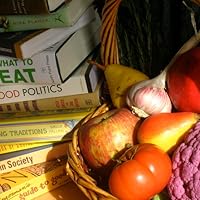
Say good-bye to flavorless tomatoes, mealy apples, and "mystery meats." Say hello to the way food used to taste-and still can. The Real Food Revival is a book of celebration and indulgence, an ode to culinary delight, and an indispensable reference guide for food lovers everywhere. It takes you through the delicious process of filling your pantries (and tummies) with Real Food. Simply put, Real Food delicious, produced as locally as possible, sustainable, affordable, and accessible. In The Real Food Revival , readers will learn how to find Real Food wherever they shop, and how to navigate the jargon-organic, eco-friendly, fresh, fresh-frozen, cage-free, GMO-free, fair-trade, grass-fed, grain-finished-in order to make meaningful choices. The book also informs readers about alternative Real Food sources such as CSAs (Community Supported Agriculture systems), direct-from-the-farm, and the Internet.
This book has some great references! I've used several of the websites listed throughout the book to find local food straight from the farm to my table (even during the middle of winter amazingly enough!).
The main focus of the book was this: Eat local whenever possible.
The benefit of eating local is that you know exactly where your food came from and, as an added benefit, it tastes like real food should! (Unlike the tomatoes you buy at the supermarket devoid of almost all flavor) Buying food directly from the farmer also builds relationships and trust. ....i.e.: Shake The Hand That Feeds You (one of the rules of eating that has stuck in my mind from the book In Defense of Food by Michael Pollan, whom the author quotes a few times in this book) I really like the feeling of helping someone else make a living while they are doing something they believe in by producing a quality product I can feel confident about.
The author talked a lot about the benefits of sustainable farming on the environment. While I have been more concerned with the nutrition and the health effects of the food I eat, I have learned that it all seems to be connected. What's better for the soil/environment is better for the produce/animals is better for the eaters/us.
The author described the problems with industrialized food (many of which I had heard about, but because I felt like I couldn't worry about something I had no control over or because I thought I didn't have any other options, I chose not to think about). Such as the treatment of animals on industrial feed lots (which will forever change the way you look at the meat on your plate) and the depletion of nutrients in the soil as a result of pesticide/herbicide use and the lack of biodiversity.
What I liked about this book is that it didn't just list the things that are wrong with the food system, it gave you information on what to look for in quality food and what to watch out for when purchasing any food item. It also gave you resources to help you support those who are farming produce and raising animals in a way that is sustainable, humane, and, in turn, more nutritious for you and...most importantly...better tasting!
If you want something different, there's a way to get it.
(.....Once again, my possibilities are only as big as my checkbook....hopefully I can do all this within a budget as well! We shall see.)
In recent years, our society has become more and more obsessed about food. Many people consciously count calories, limit fat intake, and cut carbohydrates hoping to become healthy. At the same time, however, our food has never before contained so many additives or had so many chemical and other unnatural processes occur before the product ever reaches the supermarket. Such things not only reduce the nutritional value and tastiness of our food but may even be detrimental to our health.
The authors propose a real food revival to counter these costly effects. This revival takes the form of understanding the processes that our food undergoes to get to us and determining the freshest, least processed food products on the market. At first, this task seems almost impossible given that many of us have very little time to research, seek out, and then prepare these products. However, this book sets out in an easy to understand way, various practices that reduce food nutrition and taste starting from the raising of animals and the growing of crops through the antibodies given to these animals and the pesticides used on these plants to the chemicals and freezing processes that keep foods looking flawless during transportation and storage. The authors then explain ways that consumers can reduce costs and increase potential nutritional value of the food they buy. The simplest of these plans is to buy local foods in season, limiting the amount of chemicals that are needed to keep the product looking perfect during long periods of transportation.
There's been a movement lately to try to get Americans back to the basics when it comes to food - plain food, done well, with local and organic ingredients, prepared simply. This book is another in that vein, but presented in a simple format. This one takes us 'aisle by aisle' through the basic food types and tells us first what's wrong with absolutely everything you like and then what you should do instead.
Perhaps you can tell from my grumpiness that I'm not completely converted to this way of thinking. As I sat last night at the dinner table, eating my Rice-a-Roni and frozen chicken prepackaged and preseasoned, plus my canned mandarin oranges (I got that one right, at least! I think.) I thought that I probably could make a few changes.
There is certainly some important stuff in here. I know buying local, organic ingredients is best. But my basic objections remain. This way of life is really only practical for those with the money to shop that way. People living on the edge of their income will not make these kinds of changes. I know; I've been there. When your grocery budget for the entire month is measured out by each careful dollar, you simply can't afford to buy these organic ingredients. It means going without.
But what I have decided to do is read my labels more carefully and see what exactly I am buying. My favorite quote from the book: "Good food should be valued on its quality, not its ability to turn your tongue purple."
Don't buy pre shredded cheese, has anti clumping agents in it, bad for us people to eat! Interesting! Where's that grater again?
So I do use the grater that I found now after reading this book. It was good information, much about what I already knew about evil high fructose corn syrup and white flour. Little hard to swallow alot of her negative comments about farming these days, being married to a crop farmer. It made us both think about bettering our eating, and about current crops and how farming has changed. A few good recipes and resources.
While it didn't always seem to make the soundest arguments when discussing the various ethical, environmental, and health issues surrounding industrialized food, this book nonetheless did a good job of at least introducing many of the issues. Its real strength was in its practical advice about how one can go about eating more local, naturally grown food and how one can avoid foods that have been genetically or chemically altered. Considering how much attention this subject has gotten in recent years, I imagine there might be other more recent and comprehensive books on the topic.
Another book that changes the way you think about food. I wished it went into greater detail in many parts, but sometimes to the point is good. It makes the book more easily accessible to the average person. It's a how-to on eating and grocery shopping. This is a super easy read and a really good book if you're just starting to think about eating local and supporting sustainability. It is a very practical guide for anyone wanting to get away from the highly processed foods.
Really I'd like to give this 3.5 stars. Its a good book, but there are so many out there now on food, and I felt this one was a little out of date. I do think its a good read for those not wanting a more in-depth treatment of foods. Its divided up into sections and has really good advice for people who want to make changes to eat more whole foods and support better practices, but don't know where to start, and has really great reasons why you should.
An excerpt from the preface; "...it doesn't take any special credentials to find Real Food. It just takes eaters who aren't afraid to ask questions. That's what we did and it's all you have to do to reclaim the pleasures of the table - to take charge of where your food comes from , how it was raised, and how it gets to you."
I'm lovin' this book....and it includes recipes. I heard an interview with the author on NPR but couldn't remember the name. I just got the book from the library and went, Oh, this is THAT book! I want to try the recipe for Gingerale. This one is going to come close to Real Food as my favorite foodie book.
Well-written and mostly helpful, especially for those who haven't read Omnivore's Dilemma, but the general message is "eat organic, eat local when you can." Not groundbreaking but an excellent synopsis of the reasons why to choose and where to find whole, seasonal foods that are not the product of Big Agriculture.
this is another great food book. lots of info about what we really eat here in america, even when we're trying to be good and eat healthily, a good pre-read to nourishing traditions, which has plenty more to say about real food.
This is the book I was hoping for when I read Michael Pollan's "An Eater's Manifesto." Excellent, brief, easy-to-read chapters, easy and delicious recipes, and good information about improving the state of our food. A must read for everyone who eats, in my opinion.
A great book with lots of recipes. Would recommend Omnivore's Dilemma to read first, then skip Pollan's most recent (In Defense of Food) and go directly to this one. Thought it was much more helpful in deciphering what foods to eat.
Really enjoyed this book. I thought it had a lot of great resources without making the information seem daunting or inaccessible. If you are interested in maintaing a whole foods, conscious kitchen this is a book to have on the shelf.
fun, approachable and fantastic resource of food information. you can't help but fall in love with sherri. her enthusiasm for food - real, good food - is contagious.
Read this book, it will stop any mindless shopping and make your life burst with flavor... your foods should always be delicious, sustainable and affordable. Eat mindfully and well.
This book was my first "introduction" into the real food vs gmo debate. Simple terms that were easy to understand. A good starting point for learning about the local food movements.