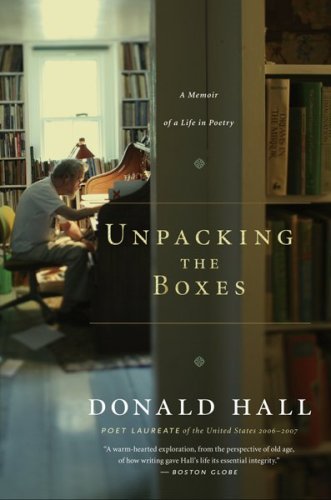
This book is so beautifully written and skillfully crafted, I read passages over and over again and took copious notes. Donald Hall's poetry has been a gift to me since I began to read his poetry in the early 1970's; he changed how I thought of poetry. To read how he came to be the writer he is...his love of reading and writing, his introduction to authors, his childhood, school and teaching experiences put an intimate face on his poetry for me.
“One’s life begins on so many occasions, constructing itself out of accident derived from coincidence compounded by character.” He writes of his Connecticut childhood in which dark times overshadowed his comfortable means, his privileged education at Exeter, the “feeble intelligence” at Harvard, his loneliness at Oxford where “rudeness was a mating call. If you responded to rudeness with rudeness, you might begin a friendship,” his views on the England of his youth, “the collapsing empire of power and art,” and teaching at Michigan.
His peers and colleagues read like a table of contents in an anthology: Frank O’Hara, Robert Bly, Kenneth Koch, Robert Lowell,and T.S.Eliot just to name a few. His love of his children, his wife, Jane Kenyon, and wonderful friends and the stories about them were personal revelations that resonated with me. His reflections about how poetry changed over his long life were thought-provoking as are most of his insights on reading and language. Reading his poetry aloud to audiences made him more mindful of the sound in writing, but he warned, “Performance can paper over bad writing, or substitute for the best language.”…”We never hear a line break and seldom a new metaphor.” Acknowledging he moved poetry to a larger audience, he thought he did so at a cost.
“To write as much as I have done, I have needed often to fail.”
“Young poets sometimes fear, as they begin a life in art, that personal history may become mere material, as if one lived one’s life in order to write about it.”
“Eventually, the writing is not only for the writer’s sake. A poem is nothing if it is not beautiful, a work of art that pleases the senses…Poems may comfort the afflicted – by their beauty of sound, by humor, by intelligence or wisdom, by the pleasures of resolution, by exact rendering of emotion, and by the embrace of common feeling.”
"Reading literature had destroyed my reading of junk," he wrote of his own experiences. Reading this memoir did this for me as well.
The death of his poet wife, Jane Kenyon, from leukemia at the age of 47 in 1995, was devastating, his grief captured in perhaps some of his best poetry…”I believe in the miracle of art but what prodigy will keep you safe beside me.”
And in the final pages, he writes, ”I left grief’s house and middle age for the thin air of antiquity’s planet…For many years impulse became mobility without the intervention of thought but now one lives the thoughtful life on antiquity’s planet.” May I be so graceful in my thinking when I am 80 years old.