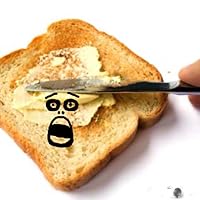
This charmingly illustrated book tells the story of Mary Frances, a little girl who wanted to help her mother. In the kitchen, Mary Frances discovered the Kitchen People, like Auntie Rolling Pin and Toaster Man, who became her teachers. They talked to her, helped her, and shared mysterious secrets she could have otherwise never understood. This nostalgic treasure includes 40 simple recipes kids can make. This classic is part of the Mary Frances Books for Children, a collection of children's instructional craft books, all of which were originally published in the early 1900s. For ages 9-12.
As a 36 year old school teacher from Merchantville, New Jersey, Jane Eayre Fryer wrote the first Mary Frances book---and left a lasting legacy. Combining fact and fancy for a complete course in home economics, her innovative concept was to teach useful things in an entertaining way. The Mary Frances books were not mere storybooks to be read and cast aside; these were instruction books, in story form, designed to teach valuable life skills to youthful readers in a playful manner. In 7 volumes, Jane Eayre Fryer leads Mary Frances through great adventures---and as Mary Frances learns cooking, sewing, housekeeping, gardening, first aid, knitting and crocheting from her fairy helpers, the reader learns right along with her.
Adorable! Sweetness spiced with humor (the odd pinch soured by being WAY past its expiration date). Positive pro-social points for the zero-tolerance stance on name-calling. And the author's name is Fryer? (And Mary Frances has nicknamed her male doll "Alfonso" as...."Fonsey", AAYYYYYY!)
I have an original edition of this hard cover book and cannot find the cover here. There were no ISBN numbers. Published in 1915. By June Eayre Fryer. It's full of stories and recipes for youngsters and lively illustrations. My grandmother gave me this book when I was a child; there's good in being the eldest in a family. Like all the kids before me, including my mother, who loved this book, I embellished it with my own drawings and a few words. (sigh) There is a story about a bum and marks he leaves so other bums know where to find a friendly meal. There are napkin folding instructions, and more. The original cover design is in color of a young lady and her cat in front of an old fashioned stove talking to the teakettles, because of course everything and everyone in the book talks. Oddly, the wall behind her has what appear to be subway tiles on it, and I now have those in my kitchen! I never noticed that before now.
This book will be passed along to my own granddaughters, maybe when they're old enough to know not to deface the book, although I don't think I left any blank pages unadorned, alas.
Over the course of some 160 pages, little Mary Frances teaches herself how to cook out of her mother's cookbook...with the help of all the magically talking kitchen implements. To be honest I started skimming the various poems and songs that populate this tale, because they're awful doggerel. But some of the illustrations are quite nice (it looks like two different illustrators to me), and this is a fascinating look into 1910s America. 99% of the recipes are some combination of rice, milk, flour, potatoes, or red meat. The very last meal Mary Frances cooks includes cabbage AND lettuce, bringing the number of non-starch vegetables in this book from zero all the way up to two. Fascinatingly, although this seems like a financially comfortable household to me, the cocoa recipe is half water, half milk, and the omelette recipe is also made with water. Culinary discoveries for me: "apple snow" (fold boiled&mashed apples into whipped egg whites) and "dream cake" which is flavored with mace--the first cake I've ever seen flavored like that.
A children's cookbook from 1912 - something that Bab a Sub Deb might have read. Part storybook, part recipe resource, this is fun read for mother-daughter teams who want to learn about history and cooking. Recipes range from buttered toast to Queen of Hearts Tarts.
Interesting and helpful for researching for my book, "The Secret Life of Anna Blanc," an homage to old Los Angeles inspired by Alice Stebin Wells, an LAPD police matron, who in 1910, became the first woman in the Western world to be granted police powers.
This is a fun concept that maybe didn't age as well as it could have. The story follows the adventure of Mary Frances, a young girl taught to cook by the kitchen people (aka pots, frying pans, rolling pins, etc.) following recipes left by her mother. The book has real recipes and tips for young cooks. It is creative but occasionally sexist with the 1912 gender roles.
This was one of the old books we had at the Farm. I read it before I started keeping my book list at the age of 12, so the year is estimate. Though it was a long time ago, I still remember lines from it!
I am bothered by the attitudes of the people in these books.
Father is not a nice man. There was no need for him to be that nasty to the tramp. Aunt whateverhernameis is not a nice woman. Billy is selfcentered, Bob is nasty - frankly, he shouldn't have gotten any more cake after that nasty little poem of his. He should have been send home without anything, and learn to behave. The kitchen people aren't that nice either. All the bickering and quarreling. :-( And the attitudes! A good little woman, of course, because there are no other values in females. Learn to do your womanly chores as soon as possible, that's all you'll ever be good for, and doing those things well is just the least that can be expected of you. Also, why didn't anyone tell her to mind the oven? That she can't leave the food on the stove? And why couldn't the pots and pans move when it was needed, while they were moving a lot when it wasn't needed? Good help that was.
So, no, I'm not too fond of these books.
I love the idea, though, of household implements teaching the girl to do all kinds of things. :-)
Oh, I forgot all about the Pickaninny fudge... until I read the Mary Frances Crocheting and Knitting book where they made a black nanny doll (Dinah Doll) "Well," said Mary Frances, "the first is 'Pickaninny Fudge!' Isn't that just like Mother!—to call Chocolate Fudge that cute name!" So... er... "cute".
This book was printed 100 years ago and seems perfectly wonderful as a starter lesson in the kitchen. When reading these books with children it would be wise to note technological changes that make many of the kitchen chores much more convenient ( we now have toasters for example). The variety of presentation keeps the reader interested... In "The Tramp" chapter the heroine prepares an omelet, or the one about the experiences dishes have when being washed! Delightful and copious illustrations! My book was missing the inserted pages... I know they are fantastic, but I am happy with this book as it is!
Okay! I read this on Gutenberg and while I did appreciate the illustrations, I did NOT enjoy the reading. For a start, this book is outdated (thus the language isn't a good learning material), and its pace is very slow and boring; nonetheless, I took it as a challenge and finished it to the end. To give it some credit, I did learn a few cooking tricks and got familiarized with some western recipes that I didn't know before. Here are my notes:
*I'm so glad I tried recipe No. 20.—Soft Custard: 1 cup milk 1 egg 2 tablespoons sugar dash of salt nutmeg The one I tried and saw on Youtube was: 2 cups of milk, 2 beated eggs, 1/4 sugar, and pinch of salt. All cooked in a pot (or u could cook them in a water bath in the oven)
*Rice Pudding, recipe No. 24, sounds like Mhalbi, my all-time favorite dessert. I tried it, here, but I didn't like it This recipe is a bit different from mom's: 3 tablespoons rice ¼ cup sugar 1/8 teaspoon salt sprinkling nutmeg 4 cups milk, or 3 cups milk and 1 cup water
*Recipe No. 37,Bread Pudding, sounds interesting. I want to try it. 1 pint milk (2 cups) 2 tablespoons sugar 2 eggs ¼ teaspoon vanilla -- 1. Cut slices of stale bread into squares of about one half inch. 2. For 2 cups bread, allow 3. Moisten bread with hot water. 4. Butter pudding dish. 5. Put into it the moistened bread. 6. Beat yolks of eggs; add sugar; add milk. 7. Pour this over the bread. 8. Beat whites of eggs. Add 2 tablespoons powdered sugar. Beat well. 9. Spread this over top of pudding. 10. Bake in moderate oven one half hour. 11. Serve with Hard Sauce or cream.
if you read this as a book from the beginning of the last century it is interesting, i mean it is kinda sad because Mary Frances is learning how to cook while her brother does not do anything and her dad is awful you know, and even her aunt is angry at her for no reason, but despite that it is really nostalgic idk maybe because of the images, and her relationship with her mom and the kitchen people, idk, it was so nice to read it- it was also interesting to compare the "easy" recipes for children in that time :)
This charming vintage children cookbook blends delightful storytelling with basic culinary lessons. Young readers will love the kitchen adventures while learning foundational cooking skills through engaging, imaginative, and highly entertaining.
Little Mary Frances is learning to cook, and The Kitchen People are the pots, pans, utensils, and appliances. Clever idea of a book from the olden days. The Kindle version has no illustrations.
Boo!☹️
🟣 Media form: Kindle version. 🟢 Media form: Project Gutenberg with illustrations.