

What do you think?

Čtyřnohá vrána a nové taškařice
Swedish / Svenska
- GenresRussiaShort Stories
284 pages, Hardcover
First published January 1, 1998
About the author
Daniil Kharms
243 books419 followersDaniil Ivanovich Yuvachev (Даниил Хармс) was born in St. Petersburg, into the family of Ivan Yuvachev, a well known member of the revolutionary group, The People's Will. By this time the elder Yuvachev had already been imprisoned for his involvement in subversive acts against the tsar Alexander III and had become a religious philosopher, acquaintance of Anton Chekhov during the latter's trip to Sakhalin.
Daniil invented the pseudonym Kharms while attending high school at the prestigious German "Peterschule". While at the Peterschule, he learned the rudiments of both English and German, and it may have been the English "harm" and "charm" that he incorporated into "Kharms". Throughout his career Kharms used variations on his name and the pseudonyms DanDan, Khorms, Charms, Shardam, and Kharms-Shardam, among others. It is rumored that he scribbled the name Kharms directly into his passport.
In 1924, he entered the Leningrad Electrotechnicum, from which he was expelled for "lack of activity in social activities". After his expulsion, he gave himself over entirely to literature. He joined the circle of Aleksandr Tufanov, a sound-poet, and follower of Velemir Khlebnikov's ideas of zaum (or trans-sense) poetry. He met the young poet Alexander Vvedensky at this time, and the two became close friends and inseparable collaborators.
In 1927, the Association of Writers of Children's Literature was formed, and Kharms was invited to be a member. From 1928 until 1941, Kharms continually produced children's works and had a great success.
In 1928, Daniil Kharms founded the avant-garde collective OBERIU, or Union of Real Art. He embraced the new movements of Russian Futurism laid out by his idols, Khlebnikov, Kazimir Malevich, and Igor Terentiev, among others. Their ideas served as a springboard. His aesthetic centered around a belief in the autonomy of art from real world rules and logic, and the intrinsic meaning to be found in objects and words outside of their practical function.
By the late 1920s, his antirational verse, nonlinear theatrical performances, and public displays of decadent and illogical behavior earned Kharms — who always dressed like an English dandy with a calabash pipe — the reputation of being a talented but highly eccentric “fool” or “crazy-man” in Leningrad cultural circles.
Even then, in the late 20s, despite rising criticism of the OBERIU performances and diatribes against the avant-garde in the press, Kharms nurtured a fantasy of uniting the progressive artists and writers of the time (Malevich, Filonov, Terentiev, Vladimir Mayakovsky, Kaverin, Zamyatin) with leading Russian Formalist critics (Tynianov, Shklovsky, Eikhenbaum, Ginzburg, etc.,) and a younger generation of writers (all from the OBERIU crowd—Alexander Vvedensky, Konstantin Vaginov, Nikolai Zabolotsky, Igor Bakhterev), to form a cohesive cultural movement of Left Art. Needless to say it didn't happen that way.
Kharms was arrested in 1931 together with Vvedensky, Tufanov and some other writers, and was in exile from his hometown (forced to live in the city of Kursk) for most of a year. He was arrested as a member of "a group of anti-Soviet children's writers", and some of his works were used as an evidence. Soviet authorities, having become increasingly hostile toward the avant-garde in general, deemed Kharms’ writing for children anti-Soviet because of its absurd logic and its refusal to instill materialist and social Soviet values.
He continued to write for children's magazines when he returned from exile, though his name would appear in the credits less often. His plans for more performances and plays were curtailed, the OBERIU disbanded, and Kharms receded into a very private writing life. He wrote for the desk drawer, for his wife, Marina Malich, and for a small group of friends, the “
Daniil invented the pseudonym Kharms while attending high school at the prestigious German "Peterschule". While at the Peterschule, he learned the rudiments of both English and German, and it may have been the English "harm" and "charm" that he incorporated into "Kharms". Throughout his career Kharms used variations on his name and the pseudonyms DanDan, Khorms, Charms, Shardam, and Kharms-Shardam, among others. It is rumored that he scribbled the name Kharms directly into his passport.
In 1924, he entered the Leningrad Electrotechnicum, from which he was expelled for "lack of activity in social activities". After his expulsion, he gave himself over entirely to literature. He joined the circle of Aleksandr Tufanov, a sound-poet, and follower of Velemir Khlebnikov's ideas of zaum (or trans-sense) poetry. He met the young poet Alexander Vvedensky at this time, and the two became close friends and inseparable collaborators.
In 1927, the Association of Writers of Children's Literature was formed, and Kharms was invited to be a member. From 1928 until 1941, Kharms continually produced children's works and had a great success.
In 1928, Daniil Kharms founded the avant-garde collective OBERIU, or Union of Real Art. He embraced the new movements of Russian Futurism laid out by his idols, Khlebnikov, Kazimir Malevich, and Igor Terentiev, among others. Their ideas served as a springboard. His aesthetic centered around a belief in the autonomy of art from real world rules and logic, and the intrinsic meaning to be found in objects and words outside of their practical function.
By the late 1920s, his antirational verse, nonlinear theatrical performances, and public displays of decadent and illogical behavior earned Kharms — who always dressed like an English dandy with a calabash pipe — the reputation of being a talented but highly eccentric “fool” or “crazy-man” in Leningrad cultural circles.
Even then, in the late 20s, despite rising criticism of the OBERIU performances and diatribes against the avant-garde in the press, Kharms nurtured a fantasy of uniting the progressive artists and writers of the time (Malevich, Filonov, Terentiev, Vladimir Mayakovsky, Kaverin, Zamyatin) with leading Russian Formalist critics (Tynianov, Shklovsky, Eikhenbaum, Ginzburg, etc.,) and a younger generation of writers (all from the OBERIU crowd—Alexander Vvedensky, Konstantin Vaginov, Nikolai Zabolotsky, Igor Bakhterev), to form a cohesive cultural movement of Left Art. Needless to say it didn't happen that way.
Kharms was arrested in 1931 together with Vvedensky, Tufanov and some other writers, and was in exile from his hometown (forced to live in the city of Kursk) for most of a year. He was arrested as a member of "a group of anti-Soviet children's writers", and some of his works were used as an evidence. Soviet authorities, having become increasingly hostile toward the avant-garde in general, deemed Kharms’ writing for children anti-Soviet because of its absurd logic and its refusal to instill materialist and social Soviet values.
He continued to write for children's magazines when he returned from exile, though his name would appear in the credits less often. His plans for more performances and plays were curtailed, the OBERIU disbanded, and Kharms receded into a very private writing life. He wrote for the desk drawer, for his wife, Marina Malich, and for a small group of friends, the “
Ratings & Reviews
Friends & Following
Create a free account to discover what your friends think of this book!
Community Reviews
Displaying 1 - 4 of 4 reviews

Read
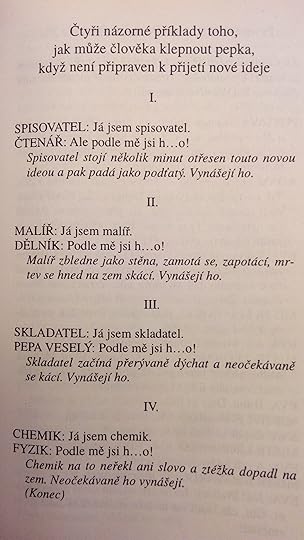
February 14, 2016Pár ukázek:
Čtyřnohá vrána
Bylo nebylo, dávno tomu, žila jednou jedna čtyřnohá vrána. Ona tedy ta vrána, když se to tak vezme, měla vlastně pět noh, ale to snad ani nestojí za řeč. No. A jednou si vám ta čtyřnohá vrána koupila kávu a přemýšlí: ,,No jo. No tak jsem si koupila kávu. To jo. Ale co s ní teď mám dělat, že jo?"
Vtom jako napotvoru běží kolem liška.
Uviděla liška vránu a hned na ni křičí: ,,Héj", křičí: ,,Týý! Vránó!"
A vrána křičí na lišku: ,,Kdo je u tebe vrána? Sama seš vrána!"
A liška křičí na vránu: ,,A ty si, vráno, svině!"
Vtom se vám vrána tak urazila, že kávu rozsypala.
A liška běžela pryč.
A vrána slezla dolů na zem a vykročila svýma čtyřma, nebo přesněji pěti nohama ke svému mizernému, prašivému domku.
Zrzek
Byl jednou jeden zrzavý člověk, který neměl ani oči ani uši. Neměl ani vlasy, takže ,,zrzek" mu říkali jen tak. Nemohl mluvit, protože neměl ústa. Nos také neměl. Neměl dokonce ani ruce a nohy. Ani břicho neměl, ani záda neměl, ani páteř neměl a ani žádné vnitřnosti neměl. Nic neměl. Takže vlastně ani není jasné, o kom je řeč. Tak už o něm radši nebudeme mluvit.
a ještě obrázkem:
Čtyřnohá vrána
Bylo nebylo, dávno tomu, žila jednou jedna čtyřnohá vrána. Ona tedy ta vrána, když se to tak vezme, měla vlastně pět noh, ale to snad ani nestojí za řeč. No. A jednou si vám ta čtyřnohá vrána koupila kávu a přemýšlí: ,,No jo. No tak jsem si koupila kávu. To jo. Ale co s ní teď mám dělat, že jo?"
Vtom jako napotvoru běží kolem liška.
Uviděla liška vránu a hned na ni křičí: ,,Héj", křičí: ,,Týý! Vránó!"
A vrána křičí na lišku: ,,Kdo je u tebe vrána? Sama seš vrána!"
A liška křičí na vránu: ,,A ty si, vráno, svině!"
Vtom se vám vrána tak urazila, že kávu rozsypala.
A liška běžela pryč.
A vrána slezla dolů na zem a vykročila svýma čtyřma, nebo přesněji pěti nohama ke svému mizernému, prašivému domku.
Zrzek
Byl jednou jeden zrzavý člověk, který neměl ani oči ani uši. Neměl ani vlasy, takže ,,zrzek" mu říkali jen tak. Nemohl mluvit, protože neměl ústa. Nos také neměl. Neměl dokonce ani ruce a nohy. Ani břicho neměl, ani záda neměl, ani páteř neměl a ani žádné vnitřnosti neměl. Nic neměl. Takže vlastně ani není jasné, o kom je řeč. Tak už o něm radši nebudeme mluvit.
a ještě obrázkem:


June 30, 2017
Tuhle knížku jsem četl ve vlaku do Českých Budějic, což zřejmě nemá na nic vliv.
Daniil Charms byl takovej ruskej Vian, stejně jako jsou české hranolky německý pommes frites. V této sbírce jsou divadelní hry, pohádky, mikropovídky, tedy naprosto všechno. Někdy je to slabší, někdy silnější, stejně jako jégr. Ten je taky jednou s red bullem a někdy zase bez. Po obojím se vám zatočí hlava, ovšem po přečtení této knihy vás nebudou budit policajti na ulici před bufetem v Českých Budějovicích, což se mi za celej život minulej týden rozhodně nikdy nestalo.
Daniil Charms byl takovej ruskej Vian, stejně jako jsou české hranolky německý pommes frites. V této sbírce jsou divadelní hry, pohádky, mikropovídky, tedy naprosto všechno. Někdy je to slabší, někdy silnější, stejně jako jégr. Ten je taky jednou s red bullem a někdy zase bez. Po obojím se vám zatočí hlava, ovšem po přečtení této knihy vás nebudou budit policajti na ulici před bufetem v Českých Budějovicích, což se mi za celej život minulej týden rozhodně nikdy nestalo.

May 5, 2022
"Det sägs att inom kort kommer man att skära bort rumporna på alla kärringar och låta dem spatsera längs Volodarskajagatan. // Det är inte sant! Man kommer inte att skära bort kärringarnas rumpor" (s. 20).
October 6, 2018
Charms nezklame. Něco už jsem četl, něco ne, ale jeho absurdně laděné povídky vždycky zaručeně pobaví
Displaying 1 - 4 of 4 reviews