When factory worker Pinquean Smallcreep, who has slotted a certain type of slot into a certain type of pulley for many years, packs his sandwiches and sets out on a journey to investigate what it is he is producing, his discoveries become increasingly more bizarre and disturbing.
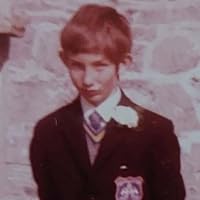
Peter Currell Brown went to Colchester Royal Grammar School, which he left at age fifteen. His first job working in a factory was the stimulus for his only novel, Smallcreep's Day. He married in 1962, and his first child was born later that year. The following year he moved to a small cottage in rural Gloucestershire, where he raised his 4 children. He worked at various jobs locally, including Dursley's main factory, Lister's and Peter Scott’s Wildfowl Trust in Slimbridge. The success of Smallcreep’s Day enabled him give up factory work.
In 1966 he set up a craft pottery he called The Snake Pottery. He later gave up employed work to concentrate on the pottery. In 1987 he separated from his wife and moved out of the cottage.
kind of enjoyed bits. This is a mix of Alice in Wonderland, Dante's Inferno and The Wizard of Oz, all set in a massive 60s factory where Smallcreep tries to find the Spare parts department but is lost amongst the massive machinery, sewage and fire. He meets various people along the way, and there is broad satire about Unions, suicide, sex, politics and religion. It's OK. It brought back factory life for me - I was brought up on a council estate attached to a massive factory like this on, and all my family worked there, our lives centred on it, not only work, but sport, drinking (social club) and Christmas dos, I did shift work for a year before going to Uni, and worked through various other stretches of time too, summer holidays, post Uni when I couldn't get a job etc. - with its grinders and polishers and cranes and characters. But towards the end (from about halfway even) I wondered why I was reading it.
Mike Rutherford (of Genesis fame) released a solo album in 1980 called Smallcreep's Day. One entire side of the record was a long-scale composition about the book. I have been wanting to read it ever since, but it wasn't until 2008 that it came back to print!
The book is as oddly surrealistic as Alice in Wonderland/Through the Looking Glass. It is filled with myriad of ingenious situations which keep the reader interested. Although dated and predictable at times it makes clever observations about society's irresistible urge to adapt the strangest ideas as dogma.
The story in its entirety is not a little depressing, yet interspersed with moments in which the reader is allowed a chuckle due to the witty observations by the main character, Pinquean Smallcreep. The writing is mostly brilliant, yet penetrated by bland and mundane descriptions here and there. I would say that it is a book of great contrasts, which suits the topic it tackles, and it is certainly a story that impinges itself on the reader's mind and leaves behind a sour taste and an urgent will to action (but what to do?)
I do not wish to go into detail at all, since this would only take away from the book, but I would stress two points. First, that if you decide to read this book, read it all the way through and preferably with few intermissions. Smallcreep needs to be followed, and the ending nails the story (and the reader) on the head. Secondly, you will take from the story to a large extent (perhaps more than with other novels) what you put into it, in the sense that you need to position yourself within the setting of the novel and extend Smallcreep's ordeal beyond its literal significance, to see it as a metaphor for society and politics at large. It is then that the book, in my opinion, reaches the height of its power.
This was straight up the weirdest book I have ever read.
While other reviews compare it to The Wizard of Oz and Alice in Wonderland (with good reason), it is more than that — this is the closest I have ever come to reading someone's dream. Really, that's the only way I can describe it — the random bizarre characters, the unexpected visions and creatures that relate to nothing else, the lack of any real plot, and the narrator's dreamlike ability to see all of this as normal — to accept the most bizarre events with at most a slight shrug. I've read some hippy-trippy stuff before — Lewis Carroll, Hunter Thompson, Clive Barker — but nothing like this.
And the absolutely weirdest thing of all is that in the mid-80's a British musician also read this book and thought, "hmm, this would be a great concept album for my debut solo recording!" That of course was Genesis' Mike Rutherford, and his album of the same name — while never a real hit — was WAY more famous than this book ever was. Just can NOT understand what he saw in this book that spoke to him musically — but guess that's why he's famous and I'm not. And of course, now that I think about it, Genesis is the group that gave us the even more bizarre (and far more famous) concept album "The Lamb Lies Down on Broadway."*
The book probably does lend itself to some semi-serious social evaluation in an Animal Farm "factory workers good, factory managers bad" sort of way, but this really only surfaces in the books overly-preachy final quarter. But up until then, this is just one wild psychedelic ride. Amazingly, for having been written over a quarter of a century ago, this book still has just 140+ ratings and 30+ reviews here on GR - weird and niche as it is, it certainly deserves a broader readership than that.
* If you're interested, you can learn more about the making of both the "Lamb Lies Down" and especially "Smallcreep's Day" albums in Rutherford's autobiography, The Living Years, reviewed here: https://www.goodreads.com/review/show.... IMHO, "Smallcreep" has stood the test of time much better and remains much more listenable today than "Broadway."
Smallcreep's Day is an odd mix of Gulliver's Travels, Monty Python, and a British-flavored Robert Coover. The events of this short book take place in a single day almost entirely within the walls of an enormous factory where the protagonist is employed as slotter. Day after day he feeds a piece of metal into a machine that carves a slot into it. He is aware that his finished piece is made into a pulley, but he has no idea what the finished machine looks like or what it does. On this particular day he has his wife pack him a lunch so that he might journey through the factory in search of the whole to which his part contributes.
The metaphor is obvious enough, but Currell Brown invests each episode with deadpan humor, political invective, and an avalanche of mostly compelling imagery and thoughts on the human condition. Smallcreep is that stock English character so familiar to watchers of British television, the upright man who is so bound by convention and propriety that he cannot appropriately react to the outrageous actions of those around him. One of the recurring lines in the book is Smallcreep's assertion that "I've always thought that there was a rational explanation for everything," which he tends to say after something completely surreal has transpired.
Initially, you wonder whether or not you are reading a post-apocalyptic novel because the factory seems strangely empty when he first leaves his familiar sector of it. Then abruptly Smallcreep finds himself in a room full of people behaving as if they are in a Samuel Beckett play. In every circumstance, no matter how outré, Smallcreep ends up going with the flow of the crowd. His efforts to assert his own will are largely confined to an interior monologue that leads to no independent action on his part. Instead, he finds himself having sex with a prostitute, delivering a baby, unable to stop a suicide, being accused of sexual perversion, joining a union negotiation team, moving a lot of dead bodies, and wading through sewage. At every turn he is harangued by characters representing all parts of the political spectrum and his responses are inevitably mild attempts to uphold the status quo and appeal to rationality.
Currell Brown is a former factory worker, turned potter, and his in depth knowledge of machinery and factory culture is plainly evident in Smallcreep's Day, which is packed with details about lathes, grinders, drills, and the dull routine of industrial employment. He makes a good case for the factory as a microcosm of modern society, but it is a very dystopian case and Currell Brown's debt to Orwell is large. This kind of dour perspective on politics dates back at least to Francis Bacon and Jonathan Swift, so Currell Brown's tone is familiar and yet his voice is his own. The novel was published in 1965, so the author's attitude toward West Indians now sounds rather racist and his depiction of the role of women in men's lives is quite sexist. But Smallcreep is a small-minded man—in the manner of satire, the names of all the people in the book reflect their character—and so Currell Brown's representation of his attitudes might still be just as accurate today.
The juxtaposition of the quotidian and the surreal is maintained in exquisite balance throughout the novel. Just when you think the whole thing will slide into supernatural chaos, Currell Brown pulls you (and Smallcreep) back into the realm of the credible. But the threats to normality and order crop up constantly and in startlingly grotesque form. Many elements of the plot are left entirely unexplained and in the end Currell Brown's message is not a hopeful one.
An interesting read but definitely a product of its time. Written back in the mid 60s it does well to capture the sense of foreboding and nervous excitement for the future of mechanisation that was prevalent at that time. More than that though, it's a discussion on humanity itself and their wants, needs, fears and hopes. The bulk of the story is fairly depressing as Smallcreep makes his way through the myriad departments of the factory, encountering everyone from preachy sales people, a duplicitous industrial negotiator, a philosophising managing director and a wizened sewer attendant. Overall the book conveys its message fairly well, but lacks excitement and (ironically) verges on the tedious at times. As a relic from the age it's fairly well written but sadly the writer never wrote another book as I would've been keen to read more of his work and see where he went next.
I came to this via Mike Rutherford's (Genesis) solo album of the same name. Billed as a classic and inspiring my musical heroes, I eagerly began this tale. Unfortunately this was very disappointing. A Pilgrims Progress like journey through a factory. Surreal adventures ensue. Lots happens but no real plot develops. I struggled to the end and apart from some clearly satirical slants on the nature of modern life and politics was left wondering what the point of it all was.
All I knew about this novel - something of a cult, I gather, in the 60s and 70s - was that it had inspired an album of the same title by Genesis bassist Mike Rutherford. Well, I like early Genesis, and I'm always up for joining a cult, so I was delighted to find it for 50p on my favourite second-hand market stall a few weeks ago.
It is a book very much of its period, The central plot conceit involves a factory worker, the eponymous Smallcreep, setting off through his workplace on a journey of exploration to find the purpose of his labours, which he believes lies with the mysterious and distant General Parts Store. Along the way he witnesses and participates in a series of surreal adventures which lead him to question the nature of work, of society, and of being human - particularly of being human, male, and living in an industrial society.
One can't help but be reminded of Kafka in places, with the labyrinthine bureaucracy of Austro-Hungarian Prague replaced as a backdrop by a ramshackle 1960s British engineering plant. There are some genuinely inspired and vivid moments of description, particularly of the material fabric of the factory itself, and moments of surreal business which recall stage directions in a Beckett play. Overall, the structure and theme resembles nothing so much as an urban "Gulliver's Travels", and I fear that this is where Peter Currell Brown's project comes unstuck - he is simply nowhere near as good a satirist as Swift.
OK, so not many people are, but as I said at the top of this review, this is clearly a book of its period, and its targets - the uniformity of factory life, the "wage slavery" of industrial workers, class, and the supposedly malign influence of mass-media - are commonplaces among the betes noires of 60s radicalism, and one has to have a particular take on the nature of the above issues in the first place to fully appreciate their treatment here. It's a brave attempt, though, and entertaining in places - just not particularly original in content or enlightening in impact.
Smallcreep's Day is the literary lovechild of Kafka, Freud and Swift's Gulliver's Travels as factory labourer Pinquean Smallcreep sets out to discover what use is made of the pulley he has faithfully been fitting into carefully worked slots for many years.
In a series of increasingly bizarre and disturbing encounters, Smallcreep plunges deeper into the factory's incomprehensible intricacies. There's an apocalyptic flavour to the descriptions of industrial machinery and processes; more than a whiff of Hades and its infernal devices. At the heart of the story is Smallcreep's strangely compelling personal quest. You can't help hoping for a successful conclusion, while being unable to escape the dreary certainty that all is not well, and will not end well. So it proves, although there is, in fact, a wild, exhilarating transcendence in Currell Brown's description of Smallcreep's final discovery.
Smallcreep's Day is also a bracing satire of industrial labour and alienation but so much more – a sly and surreal skewering of politics, cults of personality, as well as the suffocating conventions and distortions of patriarchy, nationalism and tradition.
Slightly dated in that I think modern readers might want more of narrative journey...but overall, what an imagaination. Alice Through Looking Glass for adults! I interviewed Peter Brown for my community radio programme Art Lot Slot [www.stroudfm.co.uk] - wow, what a man...Smallcreep was an international best-seller...he wrote that, and then nothing else!
I think it goes without saying that it's *super* weird. It gave very strong magical realism vibes and it makes me want to go and read some nice sensible Kafka.
But now I've finished it, I'm sitting here wondering how I'm going to process it. There was some real meaning-of-life stuff in there. Did I just experience a masterpiece? I think maybe I did.
Smallcreep is a factory worker who goes on a quest to find out what happens to the pulleys he makes in the slotting department. Lots of surreal things happen and it's somehow disturbing and unsettling but also amazing. The people he meets on the way contribute their wisdom, which you can choose to embrace or reject. And then it all goes nuclear. The last couple of chapters were unputdownable.
Drawn to it because it inspired the excellent first solo album by Mike Rutherford of Genesis. And like Smallcreep’s journey through the surrealistic factory, it was an arduous read for me. But the apocalyptic-spirited climax made the journey worthwhile. More interesting to have read it in light of the events in our world (and certainly my own country) in the past year or so. Certain passages had immediate relevance to our cultural and political realities today and the increasing blind nationalism and fear-based dehumanization we see in our public (and private) interactions and discourse. A worthwhile read as a creative warning/wake-up call for us all.
This entire review has been hidden because of spoilers.
Calls to mind elements of 'Modern Times', 'After Hours', and, of course, 'Alice in Wonderland'. Sure to be unlike anything you've read before, this surreal novel from '65 (and the only one from the author) traces the bizarre adventures and discoveries of a lone factory worker over the course of a single day. With the sole hope of learning more about what exactly he is working to produce in his corner of the building, he travels miles and meets a variety of strange, scary, and hilarious individuals. It likely won't have you laughing out loud, but the satire is on point, and the sheer unpredictability of the adventure makes it worth recommending.
I was keen to read this because I worked in the factory where the author worked too, albeit in the I.T. department, then called M.S. for Management Services. The colour green was mentioned in the book a few times, which may refer to the colour used for all the engines and generators produced in this factory. Anyway, I abandoned it after the first chapter. I’m sure it’s allegorical but of what? The men eating lunch in the Gents, the lady sitting on a chair by a telephone in a cubicle, who offers the man sex. What a weird read!
Self-indulgent in all the best ways; unapologetically weird, hilariously grim, and abounding in vivid, absurd imagery that will whisk you away with Mr. Smallcreep on a factory tour unlike any other. Lovers of Hieronymus Bosch and beautifully aged social commentary will rejoice. Lovers of supporting characters and plot points lasting more than four paragraphs will mourn. All will admit that Peter Currell Brown had an imagination too complex to replicate using even the most modern in slotted-pulley technology.
Oddly, this story brought back pleasant memories of factory work. There is an attraction in working together as parts of a larger whole, and Brown makes it clear that all those faceless workers are there voluntarily, however unfair their treatment. As "industrial lit," it is more realistic than Ayn Rand. The story arc builds smoothly, with a satisfying finale.
Possibly for fans of the Third Policeman. That said , it's much darker, didn't have the same charm, and is a densly written in parts. This is Currel Brown's only book so I wonder what else he had in him if he had kept publishing.
Smallcreep's Day is a dismal, nightmarish allegory for the monotony of life under the capitalist system and the alienation experienced as a unit of production.
Marx on acid, and it's a realy bad trip.
It's a bit of a slog at times and incredibly bleak. I would not recommend it if you're not feeling in the right headspace for it . I personally didn't manage to finish the last few chapters but might revisit it.
I imagine if you've worked in a factory it's more directly relatable but really it could translate to pretty much any job nowadays.
A lament for the working man? An ode to the industrial slave? Heartless bosses, inarticulate mates, purposeless roles. The opium of the people a cigarette and the daily rag. Hope springing eternally only from the football pools. Stultifying marriages, bickering kids. Dreams crushed by rent arrears and HP loans. Love gone old. Does anything ever change? I enjoyed it though!
Trip-tastic! Quite bonkers, dated and overlong but some amazing descriptions of factory 'life'. Not an easy read and maybe impossible for those unfamiliar with pyschedelics and/or factories. Possibly the highlight is that it paid for the author to leave the drudgery of factory life.
Kafkaesque satire of life amongst the industrial working class in the mid 60s. There is some joy and mischief amongst the grime and grind, see here for details: https://discontinuednotes.com/2021/01...
I read three or four pages. It's complete rubbish! I don't care how much of a cult following it has, Currell Brown is an interesting character but he isn't really an author and it shows - that's why he never published anything else.
I first read this book in the late sixties when there were many huge factories in my area. This surreal odyssey through such a factory is an excellent, if weird, evocation of late industrial era.
alternative title= 'sandwiches, machinery and marxism'
v good descriptive book, original plot, difficult to get into (i thought so anyway) but flows nicely. good but oddly predictable ending given its ideological direction.
overall, witty with a way of making mundane seem animalistic and almost alien.
Smallcreep's Day by Peter Currell Brown I was living and working in Colchester when I read this book.
I guess some of this may go over the heads of anyone who is not English as so much of it reflects the class system in England, especially in the post war years. It also mirrors the divide between workers and unions and management. I also thought that the rhythm of the book was a good expression of the reality of working in a large engineering factory and the sheer mindlessness of most of the work. As someone else remarked in their review about the mundanity of parts of it.The ending of the book where Smallcreep is back at his machine is a powerful allegory to the disappointment of postwar years where after all the struggle both in the war and after with the fight to get better wages and conditions and still at the end of the work was mindless repetition.The endemic futility of his quest is the most brutal truth of just about most factory workers lives.And yet, this dark depressing truth somehow lightens out spirit as we read it. A stark, surreal journey into the heart of darkness of capitalism. Don't miss it.