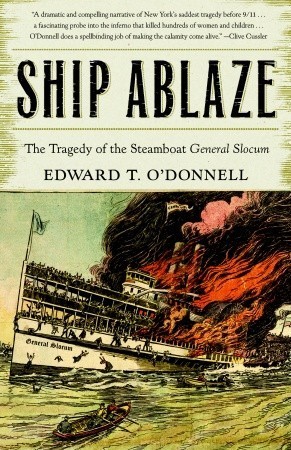
There were few experienced swimmers among over 1,300 Lower East Side residents who boarded the General Slocum on June 15, 1904. It shouldn’t have mattered, since the steamship was chartered only for alanguid excursion from Manhattan to Long Island Sound. But a fire erupted minutes into the trip, forcing hundreds of terrified passengers into the water. By the time the captain found a safe shore for landing, 1,021 had perished. Ship Ablaze draws on firsthand accounts to examine why the death toll was so high and how the city responded. Masterfully capturing both the horror of the event and the heroism of men, women, and children who faced crumbling life jackets and inaccessible lifeboats as the inferno quickly spread, historian Edward T. O’Donnell brings to life a bygone community while honoring the victims of that forgotten day.
Edward T. O’Donnell is an Associate Professor of History at Holy Cross College in Worcester, MA. He earned his bachelor’s degree from Holy Cross College and his Ph.D. in American History from Columbia University.
Imagine if your Circle Line cruise around Manhattan caught fire and over 1,000 people died because the life preservers were useless, the lifeboats were locked down and, instead of heading towards the nearest pier, the captain decided instead to go upwind (fanning the flames) to an East River Island minutes away. That is pretty much what happened to the unfortunate picnickers from St. Marks Lutheran church whose annual day of fellowship and fun in 1904 turned into a flaming nightmare.
The Circle Line had not yet been founded but there were plenty of steamships for hire around NYC at the turn of the 20th century. They were regulated, but corruption was rampant and some bribes to inspectors cost less than properly outfitting a tourist boat with safety equipment. Fire drills? Yes, we have them regularly (wink, wink). The General Slocum was no exception. Even though the captain had an excellent record of no fatalities, he was just as complicit with the other boat operators in ignoring the regulators in favor of his corporate masters.
Edward O'Donnell's well-researched history of the General Slocum tragedy and its aftermath shows how little things have changed in the century since then. It is a gripping tale, simply told and effective. The reason this particular disaster isn't better remembered today is that 7 years later the Triangle Shirtwaist Factory fire occurred. Even though far fewer people died in that inferno, there were photographs and lots of eyewitnesses watching people jump from the building. The owners of the General Slocum had already been lawyered out of any consequences by then, so the wrath of NYC was turned to the factory owners who locked the doors and made escape impossible. Still, "Ship Ablaze" shows how the city came together for the German immigrant neighborhood decimated by the Slocum fire in ways not seen again until 9-11. Over 100 years later there are still annual memorials for the victims of the Slocum. This book makes me want to attend the next one.
Titanic might be the most famous, but this comes close to being the most unbelievable.
This is an engrossing read about a tragedy overshadowed. While not in total scope and drama, it nears the loss of life of the most famous of all sinkings — The Titanic. In fact, given the drastically different setting, it is even more of a tragedy.
This recounting of the doomed ship General Slocum flies by like an action adventure disaster of the most epic proportions. Everything is in place, innocent victims, mustache-twirling villains, and the main character herself, the steamboat Slocum. One particular section prior to the sinking highlights certain individuals headed out for a day of fun. I winced the entire time, knowing some of these very real people wouldn't survive.
Ship Ablaze is informative, fascinating, enraging, and totally heartbreaking.
I have stopped and started this book multiple times in the past nine months, but I finally was able to focus on it over the past week and change and I'm glad I waited until I was able to process it.
This is a really excellent look at a major tragedy that has been largely forgotten, and yet until 9/11 was the largest death toll of any disaster in NYC history (significantly higher than the Triangle fire, a disaster that is well remembered for good reason). I wish this had been footnoted, but the afterward makes it clear how much the author relied on firsthand accounts and even videotaped interviews with the last two living survivors (who lived until 2002 and 2004 respectively). This doesn't just recount the details of the tragedy itself, but it touches on the real human elements of the story - entire families wiped out or mostly wiped out, the devastation to the German immigrant community that accelerated their exodus from Kleindeutschland to other areas of the city, the trauma endured by the survivors and the rescuers and coroners. The information on the investigations and trials that followed was also fascinating. I will have to swing by the memorial in honor of the victims in Tompkins Square Park the next time I'm in the area.
Also, I just wanted to shout out the multiple random people at Disney World who asked me what I was reading. Pretty sure none of you expected me to start talking about this book, but I hope you all enjoyed your mini history lesson!
A number of things conspired to make me intrigued with this story. Both the disaster, and the monument to the over 1,000 victims in Tompkins Square Park, are mentioned in NYPD: A City and its Police. Then, my in-laws told me that my husband's great uncle was born on June 15, 1904. I am thinking it must have been at Harlem Hospital as his mother was literally giving birth while watching the ship burn in the East River.
The author makes the inevitable comparisons to 9/11 and there are many similarities: The photo wall, the outpouring of charitable donations and concerts, the investigation etc. However, what makes the latter unlikely to be forgotten soon is the fact that it changed an entire country, not just one 40 block neighborhood (almost all those aboard the Slocum were parishoners of one church in "Little Germany"). And unlike the illustrious passengers on the Titanic, those killed on the Slocum were mostly poor nobodies.
Though it is still a very depressing story, there is a lot of "Old New York" detail included that makes it more than just an account of death and disaster. And one thing certainly hasn't changed: when it came to assigning blame, the steamship operator who did not upgrade any of the safety equipment (life preservers made of cork so old it was utterly useless) got off scot free. Only the hapless Captain did jail time.
Last night, I read a book, Ship Ablaze, that was everything Krakatoa wasn't--a book about an event that has long inspired my curiosity, which exhaustively describes and explains what happened and why.
The fire on the steamboat General Slocum was New York City's most fatal disaster prior to September 11th, but strangely almost no one has heard of it. It devastated the Lower East Side neighborhood once called Kleindeutschland, but the only reminder of it is a small and somewhat mysterious memorial plaque in Tompkins Square Park.
On June 15th, 1904, St. Mark's Lutheran Church, a block down Sixth Street from my old apartment, held its 17th annual Sunday school picnic. They chartered a steamboat to take them to a Long Island beach. Because it was a weekday, nearly all of the 1,300 people on board were women and children.
Partway up the East River, the boat caught on fire. The crew reacted badly, spreading the flames. Meanwhile, the passengers panicked. The boat had not been provisioned properly (not to mention inspected), and fifteen-year-old cork lifejackets were filled with useless dust. (Those who jumped into the river wearing them sank like stones, as the dust absorbed water.) The lifeboats were painted and wired onto the deck and could not be detached. As the fire spread, crowding the passengers to the front of the three decks, people began to fall or be thrown overboard. Most did not know how to swim, which meant that would-be rescuers--watching in horror from the nearby shores--had very little time to reach the victims before they drowned.
Despite many heroic rescues, within an hour, more than a thousand people had died. Many men had lost a wife and four or five children; some extended families were not reported missing for days because no one was left alive to report them. Some survivors committed suicide. Within a few years, the traumatized neighborhood that had seen so many funerals had emptied out; the German inhabitants were replaced with Eastern European newcomers.
O'Donnell tells the story at a perfect pace, giving the reader just the right amount of information to envision and understand the scene, while making the chronology clear. The psychology of panic, what it causes people to do, and why, is fascinatingly invoked. O'Donnell has also captured some of surprising differences between 2003 and 1904. Some of the orphaned survivors were simply sent back downtown in the El alongside commuters that evening, because "Americans in 1904 thought no more of 'grief counseling' than they did computer programming." There is a cautionary tale to be found here, too, about how the survivors were driven apart by disagreements related to a speedily-collected relief fund.
Many aspects of the disaster--aside from the fact that it was the result of criminal negligence rather than terrorism--are immediately relevant to September 11th and its aftermath. Yet I appreciated the fact that O'Donnell does not discuss this overtly, leaving you to make the connections yourself. Before September 11th, this might have been a solid study of a little-known event. Afterwards, it is an invaluable--if disturbingly familiar--look at an urban disaster that history has had time to analyze.
A few years prior to the Triangle Shirtwaist Factory fire, New York City suffered another tragedy by fire. One in which hundreds of people died. A summer excursion to the to beaches of Long Island never made it past the tip of lower Manhattan, as the Steamboat burst into flames. The life preservers and fire hoses were too old to function as they should, and the life boats had been wired to the sides of the boat. From the descriptive background of NYC in the early 20th century, to accounts at the scene and the trial that followed, O'Donnell presents a page-turning narrative that will tug at your heart.
This steamboat’s life preservers were so rotten that the inside of them were like sand… causing those who managed to get one on to literally sink to the bottom… And they were certified safe shortly before the fire. WILL WE EVER LEARN
It was a Wednesday morning, June 15, 1904, and families from St. Mark's Evangelic Lutheran Church were heading toward the piers where they would board the steamship General Slocum and travel to Long Island Sound for a picnic outing to celebrate the end of Sunday school. It was an annual event and many of the German immigrants who had moved out of the German enclave returned to enjoy a reunion of friends and relatives.
Admittedly, the author did a good job - in my opinion - of trying to touch on what life in New York City at the turn of the century was like. Tammany Hall. Mayor George McClellan, Jr who attempted to fight for his city. The corruption, lackadaisical inspections and bribery of the USSIS (U.S. Steamboat Inspection Service). The dangers of dealing with the Hellgate where the tides of the East River meets Long Island South in New York Harbor creating vicious riptides and crosscurrents. The rabid viciousness of newspaper reporters and the sensationalist writing in order to sell more newspapers. The development of ethnic enclaves and specifically the Little Germany where the passengers concentrated.
Back to June 15th. There was a limit of 1500 passengers but the counter would register 1 click per adult and 1 click for every two children so there is no true count of how many actually came aboard although the "official" account was 982 but city investigators said 1331.
The actual cause of the fire was also never determined - where it started, there were a myriad of flammable and combustible materials from the hay the picnic glasses was packed in, bags of charcoal, wood, kerosene for lanterns and polish for metal fixtures, used rags and oil based paint were only a few options. And all it might have taken was a spark from a match or cigarette.
Once the fire was discovered - one of the crew opened the door providing an inflow of oxygen to accelerate the flames that the crew did not know how to fight as the required fire drills had not been occurring. The Slocum would not have passed any inspection as the cork in the life preservers had crumbled with age and weather damage along with the canvas coatings. The woven linen constructed fire hoses were prone to leaking and the fibers had deteriorated. The life boats - in order to reduce noise - were permanently attached to the divots with wiring as well as multiple coats of paint. Those that put on the fire preservers and immediately jumped overboard, never resurfaced as the crumbed cork absorbed water and it was more like wearing a rock to add to the weight of the saturated clothes that dragged their owners down. The ability to swim was a talent that very few people possessed and unfortunately, when others panic, they lunge at any possible preservation and will often kill their prospective savior. Then there were those that were pulled under by the paddlewheel.
Captain von Schauck attempted to ground the General Slocum on North Brother Island in the hope that his passengers could jump into the shallower water but didn't get as close as he hoped. There were vessels trying to provide assistance but first had to catch the steamer. Many made the decision to merely stop chasing and pick up survivors or remove the bodies.
The saddest part arrived when survivors were searching through the bodies - the hundreds of bodies, many burned beyond recognition - hoping to find their loved ones and for every body that wasn't a spouse or child of theirs, that spark of hope that they were still alive if only they could be found and reunited.
Of course, the Knickerbocker Company - owner of the General Slocum - grabbed as many of the crew as they could to get the story 'correct', performing damage control. Accounting was ordered to change invoices that stated the life preservers had been replaced recently (they weren't). That the passengers all panicked - especially all the women as per the masculine culture of the time would state. But the coroner's office - having to deal with attempting to reunite hundreds of bodies with family - if any even survived - was going to make sure that someone paid for the disaster and carnage.
Even as the author is going through what the USSIS and the Knickerbocker Company was doing to protect themselves, there was a gathering of clergy from nearby congregations. A decision was made as the pastor of St Mark's was among the injured while 16 of the parish's 21 officers had died - to have the personal effects of those unidentified recorded and held at the coroner's office while they were the first to be buried. Overnight, hundreds of grave-diggers were hired to deal with the 100+ funerals that were held on the 18th, barely 3 days later. Morticians had more business than they could deal with as the law said that each coffin had to be placed in a separate hearse, even if their were multiple members of the same family.
Not surprising, none of the officers from the Knickerbocker Company were charged in the deaths although they eventually admitted to not getting new life preservers for the Slocum but they blamed the USSIS for not performing their inspections properly so they believed the government agency. The Captain was convicted of criminal neglect, failure to maintain proper fire drills and extinguishers and spent (eventually) 3 years, 6 months at Sing Sing prison before being pardoned.
As the author covered all the side-trips, it got a bit boring but once the disaster began to occur, the horrific catastrophe and profuse loss of life just inundates every sentence. for example, a child climbing the flagpole to evade the fire only to eventually fall back into flames. Children wondering why their mother's would not wake up. And it didn't stop with the court case or all the funerals. Many survivors or those who had not attended but the rest of their families had died in the disaster, left New York City for other parts of the country, returned to Germany or even committed suicide in the following years.
And this was the greatest loss of life in New York City until nearly 100 years until September 11, 2001.
Definitely interesting from the viewpoint of happenstance within New York City but also for those who enjoy reading about disasters.
I loved this book. I have read a lot of maritime history and this is one of the best books I've read. Great writing. The author did a fantastic job. This was truly a horrible event. This story will make you feel great sadness and intense anger. And display's the sad truth that greed destroys life, and will leave you with the realization that some things never change. I try not to give away details in my reviews, so I will just say this is a tragic event in history and I am kinda disappointed that hardly anyone is aware of this event. There was so many lessons to be learned from this tragedy. If you have any interest in non fiction, history, fires, maritime history..... if you have an interest in very good books.... read this. I will definitely be reading this book again.
I discovered this by accident at my favorite used book store a few years ago, and was surprised at how much I enjoyed it. I also had no idea that this relatively obscure disaster had been New York City's largest until 9/11--virtually wiping out an entire population of German immigrants. A horrific account, and very well-documented.
Amazing story about a horrific tragedy that took the lives of over 1,000 people, mostly women and children. On June 15, 1904, members of a church parish in Little Germany (lower east side of Manhattan), chartered the steamship General Slocum, for a one day excursion from the lower east side of Manhattan, to the Long Island Sound. They never made it to their destination when a fire erupted minutes into the trip. Over 1,000 people died either from burning to death, smoke inhalation, or drowning when so many jumped or were pushed overboard to avoid the flames. At that time, in New York City, very few people knew how to swim. There were life preservers on the ship, but unfortunately almost all of them were over a decade old, and very decayed. The cork inside the vests had rotted to dust, so basically anyone who put one on before entering the water was doomed when the vest go wet it acted like a rock and dragged the person to the bottom of the river. There were life boats on the ship, but they had been wired to the davits so they could not be cut loose to use. There were no fire drills ever done, and the crew was new and very inexperienced. So many lives could have been saved if the life preservers had been new and useful, if the life boats had been accessible, and if the crew had been trained properly in such emergency situations. The other thing that really surprised me was how few people at the time knew how to swim. The boat was only in the East River and the shore was not that far away. What a horrible waste of innocent lives. O'Donnell does an excellent job in detailing this tragedy and how it affected the lives of so many - those who perished, as well as those who survived, including the friends, relatives, and neighbors who did not even go on the journey.
A very well researched and thorough account of the General Slocum disaster that focuses on the lives and personalities of the victims and survivors both. The tragedy itself - in the brief 3-5 minutes it took to unfold - comes to vivid life in this retelling.
The author covers life in the neighborhood of Little Germany, New York, before detailing the cruise itself and its fiery demise, followed up by the recovery of the dead and the after effects of the tragedy on the living. As a shipwreck nerd, I hadn't heard of this one before. Just like the Eastland in Chicago in the early 1900s as well, there's a thousand lives lost in a horrible accident, but popular culture doesn't remember them as well as the Titanic (maybe because of the movie, maybe because of their immigrant vs. rich white American status). It's definitely a story worth learning if you're interested in the history of New York City, immigration to the US, shipwrecks, or trust busting, since of course there's an evil corporation involved as well.
Content Warning: This is one of the saddest books I've ever read, and I've read a lot of disasters and shipwrecks. The humanity and sorrow and rage are on full display here, and it hits you hard. I highly recommend this book, but maybe not if you've just lost a loved one or are going through a hard time emotionally.
I thought this was an absolutely fantastic book! It's a history book but it reads more like a novel. It's an amazing story about a terrible tragedy. The General Slocum was a passenger steamer out of New York City. On June 15, 1904 the ship was carrying German immigrants to a church picnic on Long Island. The ship caught fire on the East River and tragedy ensued. The book gives the reader a look into life in turn of the century New York City. I had never heard of the Slocum disaster before. Usually when people think of historic New York City fires, they think of the Triangle Shirtwaist factory fire mainly because it happened at a time when garment factory workers had been fighting to achieve organized labor. But the shirtwaist factory fire only took 55 lives. The General Slocum disaster claimed 1,021 lives. Only one of those was a crew member. The majority of the victims were women and children. Most people in New York in 1904 didn't know how to swim so the victims were caught in a horrible paradox; burn to death or drown. The fire started forward and was out of control on the wooden steamer in minutes. The captain kept the ship full speed into the wind trying to make it to land but the result was to feed and drive the fire aft where all of the passengers were trying to escape. The life jackets were useless because they were so old that the fabric was rotted and the cork inside them had literally turned to dust, making them as buoyant as dirt. The fire hoses were rotted and burst as soon as the crew tried to use them. People that couldn't swim who put on these life jackets and jumped into the water sank immediately. There are amazing stories of ordinary people committing selfless acts of heroism. There was rampant government and steamboat company corruption. The German immigrant community called "Little Germany" was decimated. Whole families were wiped out, and children left orphaned. There were days where there were so many funerals that horse drawn glass hearses were sometimes three abreast on the same street. And it's interesting to note so many of the differences between people's attitudes then and now. For example the people of New York were very generous establishing a relief fund for the victims but many people sold everything they had to pay for funerals rather than accept charity. It really is an amazing story. I'm going to read it again just to catch anything I might have missed
This book is extremely good from the start of the fire onwards. Unfortunately, O'Donnell begins with a very, very long, dull prologue in which he tries to include absolutely everything he came across in his research. I frankly don't need such a massive prologue, but his research pays off later. This is one of the most meticulously documented disaster books I've ever come across, and it's interesting to see what it did to one Lutheran German community, on the day a Sunday school class rented a steamboat for an outing.
After the fire started, the untrained crewmen failed to operate the boat's firehoses, and the passengers discovered the lifeboats were wired in place and could not be removed. All the life preservers were made of elderly cork which crumbled into dust. A terrible decision was made to head for a distant island in the teeth of the wind, which only fanned the flames higher, instead of heading immediately for shore. Women and children had to jump into the water to save their lives, and nearly all of them could not swim. A flotilla of other boats chased frantically after the burning ship, trying to rescue passengers, and even started to burn themselves when they came too close.
It was a tremendous shock to New York to witness a catastrophe in which had over thousand children and women as its victims, and story is a powerful read. It was one of the worst maritime disasters in history before the Titanic. But I recommend you do what I did and start with the day of the fire itself, or you may bog down from boredom in the beginning. I even went back and tried to read the first section after finishing the latter part, but nope, it was still dull.
Some disaster stories defy belief. First, you can’t believe they happened without ever hearing about them. Second, the details sound so alien to what we know today that it seems like fiction. The story of General Slocum fits the bill.
In 1904, a Lutheran Church from Little Germany in New York City chartered the General Slocum for an excursion. It was an annual trip which was now on its 17th year. As you may expect, whole families were planning on going. They boarded and the ship set off at 9:30 am. The fire was first noticed at 10 am.
Let me quickly list some of the safety features we now expect on ships like this and their condition at the time of the fire: fire hoses (rotted and couldn’t hold water), lifeboats (bolted in place), life preservers (weighted down with iron because the cheap cork used didn’t make minimum weight requirements). There were over 1,400 people on the boat. The estimated deaths were between 1,021 to 1,342.
O’Donnell doesn’t revel in the death. He takes the time to give backstory and make the reader feel the aftermath as a massive amount of a few city blocks were decimated by the deaths. Entire families died within Little Germany. O’Donnell tells the full story and doesn’t turn this story into disaster porn.
I have to admit one of the things I like to study is historical disasters. It can be very depressing but it's interesting to read about how they made medicine and safety better for us today. I picked this up prior to a trip to NYC and wanted to learn more about this little-remembered disaster. While I had known about things like the Triangle factory fire, the aircraft that crashed into the Empire State Building and of course 9/11, I had no clue about this disaster until a program on the History Channel a few years ago. I have no clue how this could have been forgotten, especially since most of those killed were women and children. A pleasure craft that was taking a church Sunday school to a picnic caught fire and due to multiple factors, including the crew saving themselves and not the passengers, caused over 1000 deaths. I plan on visiting the memorial to those lost on the ship during my trip.
This was a really good account of a little-talked about disaster. It's amazing to me that history seems to have forgotten this one considering over a thousand people died. I liked that O'Donnell included personal accounts as much as possible, although I wish there'd be an opportunity for more. I would have liked to know how specific people dealt with things in the aftermath in a bit more detail.
Some parts of the story are almost too crazy to believe, however, which made this book riveting. A lot of it reminded me of 9/11 and the comparisons are quite interesting. I highly recommend it to all history fans and all New Yorkers.
This book is halfway done. The research that went into it was great and the writing is competent, but the editor failed the enterprise. Details are repeated throughout as if they had not before been discussed, interesting tangents are left unresolved, and the organization is wobbly. A good editor could have improved this book in a big way. It's unfortunate because the story is very interesting and you can tell the author is talented. He was let down by the editor.
It was okay. It seemed kind of drawn out for the first half and then kind of rushed for the second half. Having read other historical accounts of major events in New York City that were more detailed and engaging, this book felt lacking. That being said, there is an almost criminal lack of remembrance of this tragic event, and it is certainly worth reading simply so more people will know the story.
On the History Channel, I watched a gripping show about the General Slocum disaster. I truly feel sorrowful that this tragedy has been overlooked and ignored; I know I'd never heard of it and I love history. So I had to read this book almost in tribute to those who lost their lives, that someone still remembered and cared. So sad.
Interesting account of a little-known tragedy that was, up until 9/11, the greatest loss of life in NYC. 1021 people died on a Sunday School excursion in the East River - because greed led to unsafe conditions and an untrained crew. The only person punished was, in my eyes, the least culpable. In 1904, as in 2016, money protects you.
An excellent read. Brings the half-forgotten 'Slocum' Disaster back to life in all its hideous details. This one will leave you in tears in places, and mad enough to spit bricks at others.
All the facts about the General Slocum. A steamship and its thousand or more passengers, many of whom burned alive or drowned on a supposed relaxing cruise.
On a bright June day in 1904, the steamboat General Slocum, carrying over 1,300 people from a single neighborhood, caught fire and sank in sight of Manhattan Island. The neighborhood outing, arranged by the local church, was a day of celebration. Yet in moments, years of negligence, greed, and corruption would lead to the horrific deaths of more than a thousand people, a tragedy on a scale that New York City wouldn't see again until the losses on 9/11.
Despite the era's turn towards reform and progressive politics, there were still many areas of government that were utterly corrupt, including the federal agency whose duty it was to inspect steamboats. Without that enforcement, owners of such steamboats were free to cut corners on safety equipment, and ship crews able to do away with practicing fire drills. All would lead to disaster.
As the fire began in a room below decks that was filled with flammable material illegally on board, the crew made an abysmal attempt at suppressing it, giving up when the completely rotted fire hoses disintegrated. They handed out 13 year old rotted life jackets, which acted like anchors, killing anyone who put one on. Lifeboats were found to be painted or wired in place so that they couldn't be used. The captain's decision to steer the boat into the wind hastened the growth of the fire, forcing people to abandon ship in blind panic. In an era where most Americans couldn't swim, a fire onboard ship meant almost certain death.
I have read many books on notable disasters. Why? To remember those lost, to reflect on humanity's inherent weakness and latent heroism, and to see if the painful lessons learned have made it to our time. I'm also interested in how the story is told. Edward O'Donnell's work in Ship Ablaze is one of the most searing, sensitive and affecting chronicles I've ever read. It is intensely real without being sensational, critical without being polemical. It is sober and sad, but replete with moments of bravery and grace.
The General Slocum tragedy claimed the lives of over 700 children, and wiped out scores of families. It became clear in the aftermath that widespread negligence was to blame, and a federal grand jury quickly identified multiple culprits. The newspapers demanded that an example be made of the company who skimped on its own ship. The federal government, under President Theodore Roosevelt, promised a full and complete reckoning, and ultimately published a damning report. Yet as with Chicago's Iroquois Theater fire which killed over six hundred people just months earlier, almost none of the principal figures in the disaster would be punished, despite overwhelming evidence of guilt.
O'Donnell reminds the reader that we need to remember those lost, and to not allow their denied justice to be perpetrated on the innocents of modern day. Yet one can quickly see the same patterns of corporate and governmental indifference and negligence in places like Flint, Michigan, Centralia, Pennsylvania, and Niagara Falls. Or in the inept responses to events like Hurricane Katrina, the 1906 San Francisco earthquake, or the Attica prison riots, which only increased the suffering of those affected.
Still, there is value in bearing witness. O'Donnell's account is of the highest caliber, alongside Stuart O'Nan's "The Circus Fire" and Kate Moore's "Radium Girls." Now more than ever, in a United States where corporate sleaze and wanton criminality lives alongside the tattered remnants of federal regulatory agencies, we must fight for accountability and remind those who have forgotten what prices previous generations have paid. The children are watching.
This entire review has been hidden because of spoilers.
Ship Ablaze: The Tragedy of the Steamboat General Slocom by Edward T. O’Donnell is eye opening. I saw a documentary about the ship that caught fire in the east river of NYC and burned and killed most of the passengers. In other reading, I learned that the neighborhood where I lived as a child was Little Germany, but people were starting to leave for Yorkville and Brooklyn. The fire that was an annual Lutheran celebration connected to St. Marks church did bring people back to the community for this boat ride and day of celebration outside the city, but this does not happen.
O’Donnell brings together all the elements in describing the Germany community, diverse in social class, with the strivers moving to new neighborhoods. The church and the commitment of the pastors. Fires and other urban tragedies were part of the landscape for people in 1904. We also have the press, that is working diligently to inform people with EXTRA sold by newsboys. The tragedy reflects the lack of enforcement of the few laws about public transport and the ways that big company leaders can avoid responsibilities.
We see lives of people who begin a day with high expectations and it ends if horror and loss. This was no accident but reflected the vulnerability of people in the stage of urban life. In the face of this “crime,” it was not clear who had jurisdiction and it meant the corporate wrong doers could avoid blame. The captain is scapegoated, but people also felt sorry for him.
O'Donnell does follow the people, their ways of coping with the tragedy over time. Many leave the neighborhood. Some sort out ways to keep the story alive and have an annual memorial in Queens, where the unidentified were buried. To many families members, whose loved ones were never found, this monument has significance.
This fire predates the Triangle Fire of 1911, where fewer people died, but it was another era and these working women had been trying to organize. The investigation of that industrial fire was more rigorous and did lead the way for legislation in the workplace. The Slocom fire killed more people and shattered the life of the survivors, people who did make it off of the ship with burns and other injuries. It shattered families, as father lost their wives and children, or most of their member, but a few did survive. But there was little change in the law.
The book is a nice treatment of a disaster that does show us how many factors come together, the public, the government, the press and the companies that jeopardize people’s lives for money.
The five stars for this book is all about the wealth of historical detail reported and research that went into it. The book was written using primary source material and is as comprehensive as possible and without speculating on the unknowable or undocumentable.
As far as a story-telling narrative, the book starts out strong. It weaves the stories of the Slocum's captain, the pastor of the church whose members were the passengers, and the Mayor of New York City. Their stories are woven together and along with the story of the most recent safety inspection of the ship and a number of members of the congregation of the church who would be on the ship, and the story of the Germantown neighborhood. Then the events of the fire are told in great detail, and told very well. However, the stories of the Mayor, the pastor, and the captain are not followed and paid-off in the days and months following the tragedy with the same sort of focus as in the beginning of the book.
In particular, the story of the Mayor is told in much detail prior to the fire. His expectations of using the Mayoral job as a springboard to a run for the US Presidency are detailed. How did his actions in the wake of the fire affect his possible run? What sort of leadership did he provide after the fire? Who knows; the build up of that story is never paid off in any way.
The stories of what happened to the captain and the pastor are told, but not with the same level of detail and focus as they were given in the pre-fire part of the book. Their lives are not followed in detail in the following days and months, but instead picked back up after a year (pastor) or almost two (captain), and not with the same feel or style as the pre-fire stories are told. As far the narrative story aspects are done, it is more of a 3 star effort.
The story and history of the victims, both the dead and the survivors, and story of how it happened are just superb and so well researched and documented. That is the part of a book of history such as this that really matters. The story is interesting, and is told in a way that evokes much emotion and empathy, and as deep an understanding of how it affected the people and the community as possible. Just so well done, and a wonderful read. For that, it is a 5 star book. Highly recommended.
General Slocum was a steamboat built by Brooklyn shipbuilder, Divine Burtis Jr. Construction was completed in 1891, with her maiden voyage being in June of the same year. The ship was a sidewheel steamboat, with a twenty two person crew. The ship's purpose was as a passenger vessel, carrying them to and fro on the East River. The ship had several accidents involving groundings before the final incident in 1904. The final voyage took place on June 15, 1904. There were 1,358 passengers and a larger crew of 30 on this voyage. While underway, a fire caught in one of the rooms toward the front of the ship, spreading rapidly due to many flammable materials scattered around and those used for construction. The captain ordered the ship to be beached, ultimately saving many lives. Unfortunately, safety aboard the ship was not maintained. Life jackets disintegrated and life boats were not accessible. Most of the passengers could not swim, or were weighed down by the heavy clothing of the time. There were other infuriating issues that I will not go into for those who are interested in the story. The end result was a massive loss of life, and one of the deadliest maritime disasters in the United States.
I really enjoyed this book. I had never even heard of this disaster, and I just accidentally ran across this book in my favorite used book store. I love that store for the prices, but sometimes I really do find some gems. The detail this book provided was immense, and I learned so much from it. I would love to go see the huge memorial that is dedicated to the people who lost their lives in this disaster. If you happen to be located in Queens, the memorial is at the Lutheran All Faiths Cemetery. The passengers who died were members of the St. Marks Lutheran Evangelical Church, who had chartered this vessel for a trip.