

What do you think?

Tours of the Black Clock
Cutting a terrifying path from a Pennsylvania farm to the Europe of the 1930s, Banning Jainlight becomes the private pornographer of the world's most evil man. In a Vienna window, he glimpses the face of a lost erotic dream, and from there travels to the Twentieth Century's darkest corner to confront its shocked and secret conscience. One of Steve Erickson's most acclaimed novels, Tours of the Black Clock crosses the intersections of passion and power and gazes into a clock with no face, where memory is the gravity of time and all the numbers fall like rain.
320 pages, Paperback
First published January 1, 1989
About the author
Steve Erickson
54 books487 followersSteve Erickson is a distinguished American novelist known for a visionary, dream-fueled style that blends European modernism with American pulp and postmodernism. Raised in Los Angeles, he studied film and political philosophy at UCLA, influences that permeate celebrated works such as Days Between Stations, Tours of the Black Clock, and Zeroville. Critics, including Greil Marcus, have labeled him "the only authentic American surrealist," placing him in the lineage of Pynchon and DeLillo. His most acclaimed novel, Shadowbahn, was hailed as a masterpiece even prior to its release and was later adapted for BBC Radio. A "writer’s writer," Erickson has published ten novels translated into over a dozen languages, consistently appearing on best-of-the-year lists for The New York Times and the Los Angeles Times. He is the recipient of the Lannan Lifetime Achievement Award, a Guggenheim Fellowship, and an American Academy of Arts and Letters award. Erickson served for fourteen years as the founding editor of the journal Black Clock and is currently a Distinguished Professor at the University of California, Riverside.
Ratings & Reviews
Friends & Following
Create a free account to discover what your friends think of this book!
Community Reviews
Displaying 1 - 30 of 101 reviews

November 12, 2014
I never fail to enjoy postmodern history... In the postmodernist’s hands history unavoidably turns into a farce – however dark but farce, anyhow.
All the personages of Tours of the Black Clock are refugees and pariahs of time and space...
Maybe we all are nothing but refugees and pariahs of time and space.
I also knew such a version of the Twentieth Century was utterly counterfeit. That neither the rule of evil nor its collapse could be anything but an aberration in such a century... in which the black clock of the century is stripped of hands and numbers. A time in which there’s no measure of time that God understands: in such a time memories mean nothing but the fever that invents them: before such memories and beyond such clocks, good views evil in the same way as the man on a passing train who stands still to himself but soars to the eyes of the passing countryside.
All the personages of Tours of the Black Clock are refugees and pariahs of time and space...
Maybe we all are nothing but refugees and pariahs of time and space.

March 2, 2014
I WAS A PORNOGRAPHER FOR HITLER!
My name is Banning Jainlight. I write fiction, specially tailored fiction: pulp sex American adventure stories. I write them for a very specific clientele. These clients, these monsters, they come into my life and I enter into theirs. Am I a monster, am I their fellow monster, their comrade-in-arms? My birth was monstrous, and I dealt with my monstrous family as they deserved - monstrously, as their own monster. I fled to New York; I fled to Europe. To Hitler's Europe. And there I found myself in a world of dreams, dark dire dreams that mass alongside a dire, dark concrete reality. I make my own reality! I change this world: I let evil make a nest of it. I reach out to new worlds, better worlds.
I live in a lusciously written, extravagantly hypnotic book called Tours of the Black Clock. My fiction creates worlds and my fiction recreates a woman. I punch through time and space to be with this woman; I leave my fluids upon her, a baby within her. She dreams me and I, her.

A PHANTOM RAVISHED ME NIGHT AFTER NIGHT!
My name is Dania. I lived in Africa, in Austria, on Davenhall Island. I am a dancer! I dance men to their deaths: they die when I fling myself about, spastic and free, they die and die again, they die grappling with each other, hurling themselves through windows. Men burn for me; men die at my feet.
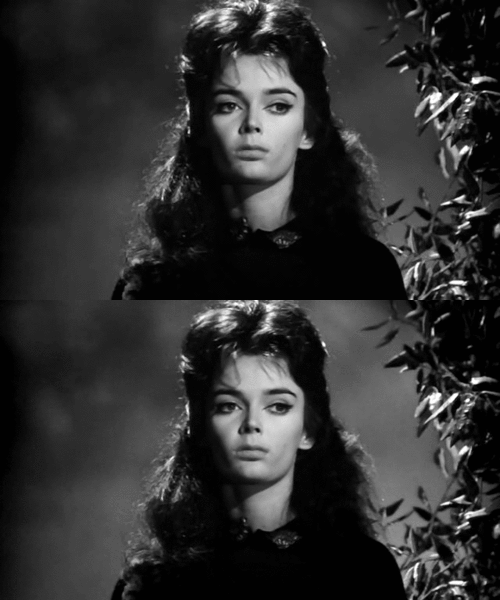
I have a special sort of face. Perhaps not a classic beauty - but this face launches its own sort of ships. One glance at me is enough to move men, to transport them to a sentimental past, to force open windows in space and time to be with me. One such monster ravishes me, a phantom, a phantom writer. He comes to me in the night, he comes to me throughout the years, he comes in me and upon me. And sometimes he brings a friend with him: a little tyrant who lurks in the corner of the room, looking at me as if upon his own past, as if looking upon what cannot be, such a longing for me. But I am not his woman.
THE BLACK CLOCK TOLLS!
But for whom do I toll? For Banning Jainlight? For Dania? For the white-haired boy Marc, that son of phantoms?
I toll for none of them and for all of them. This black clock tolls for an entire century! I move my characters in and out of history, I make a personal history a pulp story, I make the world's history a fever dream. A dream of a fever. A fever of love!
Hallucinatory prose and a circular narrative; time restarted and time disobeyed; murky motivations and characters as ciphers. A flow of strange words that progress clock-like, ever forward; a flood of words that submerges its banks; a river of words that moves backward, to its source. I am all of these things.
This black clock tolls for you, reader! I toll as you project your own desires onto the page, as you project those desires onto the faces and bodies of others. You remake history all the time, do you not? Your personal history, the history of the world with you in it; you remake history to allow yourself to survive within it. You project those dreams and they become your reality. You are both pimp and whore for those dreams. Banning Jainlight, Dania, Marc, even that sad and faithful detective Blaine, all my voices, all of my so-called protagonists... and you! You are all slaves to your dreams. Dream away! Dream it all away. Again.

My name is Banning Jainlight. I write fiction, specially tailored fiction: pulp sex American adventure stories. I write them for a very specific clientele. These clients, these monsters, they come into my life and I enter into theirs. Am I a monster, am I their fellow monster, their comrade-in-arms? My birth was monstrous, and I dealt with my monstrous family as they deserved - monstrously, as their own monster. I fled to New York; I fled to Europe. To Hitler's Europe. And there I found myself in a world of dreams, dark dire dreams that mass alongside a dire, dark concrete reality. I make my own reality! I change this world: I let evil make a nest of it. I reach out to new worlds, better worlds.
I live in a lusciously written, extravagantly hypnotic book called Tours of the Black Clock. My fiction creates worlds and my fiction recreates a woman. I punch through time and space to be with this woman; I leave my fluids upon her, a baby within her. She dreams me and I, her.

A PHANTOM RAVISHED ME NIGHT AFTER NIGHT!
My name is Dania. I lived in Africa, in Austria, on Davenhall Island. I am a dancer! I dance men to their deaths: they die when I fling myself about, spastic and free, they die and die again, they die grappling with each other, hurling themselves through windows. Men burn for me; men die at my feet.
I have a special sort of face. Perhaps not a classic beauty - but this face launches its own sort of ships. One glance at me is enough to move men, to transport them to a sentimental past, to force open windows in space and time to be with me. One such monster ravishes me, a phantom, a phantom writer. He comes to me in the night, he comes to me throughout the years, he comes in me and upon me. And sometimes he brings a friend with him: a little tyrant who lurks in the corner of the room, looking at me as if upon his own past, as if looking upon what cannot be, such a longing for me. But I am not his woman.

THE BLACK CLOCK TOLLS!
But for whom do I toll? For Banning Jainlight? For Dania? For the white-haired boy Marc, that son of phantoms?
I toll for none of them and for all of them. This black clock tolls for an entire century! I move my characters in and out of history, I make a personal history a pulp story, I make the world's history a fever dream. A dream of a fever. A fever of love!
Hallucinatory prose and a circular narrative; time restarted and time disobeyed; murky motivations and characters as ciphers. A flow of strange words that progress clock-like, ever forward; a flood of words that submerges its banks; a river of words that moves backward, to its source. I am all of these things.
This black clock tolls for you, reader! I toll as you project your own desires onto the page, as you project those desires onto the faces and bodies of others. You remake history all the time, do you not? Your personal history, the history of the world with you in it; you remake history to allow yourself to survive within it. You project those dreams and they become your reality. You are both pimp and whore for those dreams. Banning Jainlight, Dania, Marc, even that sad and faithful detective Blaine, all my voices, all of my so-called protagonists... and you! You are all slaves to your dreams. Dream away! Dream it all away. Again.


April 2, 2014
I've been thinking a lot about this book recently - two months after finishing it Banning Jainlight haunts me like an unscratchable itch on a phantom limb. I wouldn't be surprised to find that Steve Erickson is really a powerful warlock and his magics are threaded into the words of his novels. Bewitching, truly.
This isn't my favorite novel I've read all year, but it is the one to which my mind keeps returning. Erickson's protagonist struggles to understand what it means to be alive in a world that became untethered in the 20th century. We all serve at the pleasure of history Jainlight opines. In another aside he offers this beauty:
The author takes one of the worst participants in last century's 100 years of misery - Adolf Hitler - and makes an alternate history equally as absurd as the real one. It works on a level so visceral it makes for a reader's discomfort and reveals even more about our world than a fictional story told in a setting of true history. Not unlike an adult fairy tale.
I purchased two more Erickson novels after finishing this book, but now I'm almost afraid to start the next one. What dark magic will his other works contain?
This isn't my favorite novel I've read all year, but it is the one to which my mind keeps returning. Erickson's protagonist struggles to understand what it means to be alive in a world that became untethered in the 20th century. We all serve at the pleasure of history Jainlight opines. In another aside he offers this beauty:
In my time, I have no reason but to believe that whatever God exists is a God of revenge. A God of revenge in a century of revenge.
The author takes one of the worst participants in last century's 100 years of misery - Adolf Hitler - and makes an alternate history equally as absurd as the real one. It works on a level so visceral it makes for a reader's discomfort and reveals even more about our world than a fictional story told in a setting of true history. Not unlike an adult fairy tale.
I purchased two more Erickson novels after finishing this book, but now I'm almost afraid to start the next one. What dark magic will his other works contain?

December 11, 2020
Ma Erickson è così…
Col contagocce, arriva anche in Italia un altro dei romanzi che compongono la scarna bibliografia di Steve Erickson, particolarmente inatteso in questo caso poiché si tratta di un’opera del 1989, che in ordine cronologico rappresenta il terzo libro dell’autore.
Ancora una volta si tratta di un romanzo inclassificabile, con una collocazione che va oltre le categorie letterarie consuete, attraversandole più o meno tutte con spavalda nonchalance, dalla distopia al thriller, dall’ucronia al romanzo d’azione, dal romanzo storico alla fantascienza e al bildungsroman e potrei aggiungerne altri perché “I giri dell’orologio nero” riesce ad essere anche romantico, violento, avventuroso, grottesco, decisamente surreale.
A questo punto mi ero cimentato nell’abbozzare quanto meno una traccia delle vicende narrate, ma sono andato in confusione (fra scrittori di pulp pornografici nella New York degli anni ‘30, nazisti che risalgono la scala gerarchica fino a Hitler in persona o forse un suo avatar ossessionato da un amore giovanile, foreste sudanesi, suicidi e infanticidi nella Vienna dell’Anschluss, fughe da prigioni veneziane, fratricidi in Pennsylvania, invasioni dell’Inghilterra da parte dell’esercito tedesco, isole fluviali in località imprecisate degli Usa dove un ambiguo traghettatore attende per decenni l’oggetto del desiderio, ecc)...e ho cancellato!
Va da sé che durante una lettura come questa ci si trova spesso “spaesati”, per usare un eufemismo, e se ne esce abbastanza sfibrati, pur con la consapevolezza di aver attraversato un territorio inesplorato, a tratti magnifico, a volte incomprensibile e (vedi sopra) indescrivibile. Al punto di dover resistere al segreto impulso di mandare Erickson a quel paese, ma anche al desiderio audace di ricominciare da pagina 1, non certo nell’intento di riuscire a comprendere tutto, ma quanto meno per ricollegare una parte dei fili narrativi smarriti nel corso della narrazione.
Ma Erickson è così, si tende a dimenticarlo per le sue uscite a cadenza quinquennale, offre pagine ed anche intere “sezioni” di intensa suggestione, filtrate da una sorta di caleidoscopio virtuale ed inserite in un labirinto narrativo che sempre ci sbalordisce; l’originale introduzione e la scrittura in apparenza lineare dapprima seducono il lettore poi, quasi a tradimento, a un certo punto (un punto che varia secondo la concentrazione, la pazienza e le esperienze pregresse con lo stile dell’autore) gran parte delle traballanti coordinate acquisite vengono sovvertite.
Però resta un gran bel viaggio!
(aggiungo sempre un’avvertenza: non si confonda l’autore col quasi omonimo Steve Erikson senza la “c”, ennesimo scrittore di saghe high fantasy, ovviamente ben più popolare del nostro.)
Col contagocce, arriva anche in Italia un altro dei romanzi che compongono la scarna bibliografia di Steve Erickson, particolarmente inatteso in questo caso poiché si tratta di un’opera del 1989, che in ordine cronologico rappresenta il terzo libro dell’autore.
Ancora una volta si tratta di un romanzo inclassificabile, con una collocazione che va oltre le categorie letterarie consuete, attraversandole più o meno tutte con spavalda nonchalance, dalla distopia al thriller, dall’ucronia al romanzo d’azione, dal romanzo storico alla fantascienza e al bildungsroman e potrei aggiungerne altri perché “I giri dell’orologio nero” riesce ad essere anche romantico, violento, avventuroso, grottesco, decisamente surreale.
A questo punto mi ero cimentato nell’abbozzare quanto meno una traccia delle vicende narrate, ma sono andato in confusione (fra scrittori di pulp pornografici nella New York degli anni ‘30, nazisti che risalgono la scala gerarchica fino a Hitler in persona o forse un suo avatar ossessionato da un amore giovanile, foreste sudanesi, suicidi e infanticidi nella Vienna dell’Anschluss, fughe da prigioni veneziane, fratricidi in Pennsylvania, invasioni dell’Inghilterra da parte dell’esercito tedesco, isole fluviali in località imprecisate degli Usa dove un ambiguo traghettatore attende per decenni l’oggetto del desiderio, ecc)...e ho cancellato!
Va da sé che durante una lettura come questa ci si trova spesso “spaesati”, per usare un eufemismo, e se ne esce abbastanza sfibrati, pur con la consapevolezza di aver attraversato un territorio inesplorato, a tratti magnifico, a volte incomprensibile e (vedi sopra) indescrivibile. Al punto di dover resistere al segreto impulso di mandare Erickson a quel paese, ma anche al desiderio audace di ricominciare da pagina 1, non certo nell’intento di riuscire a comprendere tutto, ma quanto meno per ricollegare una parte dei fili narrativi smarriti nel corso della narrazione.
Ma Erickson è così, si tende a dimenticarlo per le sue uscite a cadenza quinquennale, offre pagine ed anche intere “sezioni” di intensa suggestione, filtrate da una sorta di caleidoscopio virtuale ed inserite in un labirinto narrativo che sempre ci sbalordisce; l’originale introduzione e la scrittura in apparenza lineare dapprima seducono il lettore poi, quasi a tradimento, a un certo punto (un punto che varia secondo la concentrazione, la pazienza e le esperienze pregresse con lo stile dell’autore) gran parte delle traballanti coordinate acquisite vengono sovvertite.
Però resta un gran bel viaggio!
(aggiungo sempre un’avvertenza: non si confonda l’autore col quasi omonimo Steve Erikson senza la “c”, ennesimo scrittore di saghe high fantasy, ovviamente ben più popolare del nostro.)

March 21, 2013
I discovered Steve Erickson thanks to a review of Zeroville in Rain Taxi. Zeroville was a minor revelation; I wanted to foist it upon every novel-reading person I came across for the next couple months. I found an author new to me with a substantial back catalog worth seeking out. A couple years later I bought Tours of the Black Clock at Myopic Bookstore in Chicago. If you ever find yourself in the middle of the country, check it out. It's a good used bookstore, and just down the street from Quimby's (if I remember correctly). I was in Chicago to see Throbbing Gristle, and this book seems to have that same dark, creepy, mind-bending quality that is found in the best Throbbing Gristle songs. Hitler, pornography, bloody icky death. Once upon a time I worked in a record store in downtown Minneapolis, and I accidentally made a little girl cry by playing Hamburger Lady. The weekend I bought this book (probably about 4 years ago), Myopic was flooded; a whole section of the store closed off because of possible water damage. This is pretty fitting for a Steve Erickson novel--there is a flood in this book, and rising waters play an even bigger part in a couple of the others. Anyway, if you already like Steve Erickson, read this book. If not, start somewhere else--Zeroville or Days Between Stations or Sea Came In At Midnight.
I'm a reader, not a writer. As such I have enjoyed Goodreads immensely, although I don't interact much. I love reading the reviews that my friends write, and I spend too much time every week reading the reviews of complete strangers. As a lifelong reader, I am bummed that Goodreads was bought by Amazon. They are a company with more than a few questionable practices, and in my opinion they have changed the book world for the worse. I think it's understandable that people are worried that any changes Amazon makes to Goodreads will benefit Amazon and won't improve the experience for the average user.
I don't think anyone is going to read this non-review but if you do, I urge you to check out books from your local libraries. Keep an eye out in laundry rooms, truck-stops, and stoops for free books. Borrow books from family and friends. Buy books at used bookstores, garage sales, estate sales, library sales, thrift stores, junk stores. If you must buy a new book, buy it from a locally-owned, independent bookstore. If you don't know where the nearest one is, this seems like a good resource for finding out: http://www.indiebound.org/.
Also, I don't believe in e-readers. I believe in printed matter. Fuck Kindle.
I'm a reader, not a writer. As such I have enjoyed Goodreads immensely, although I don't interact much. I love reading the reviews that my friends write, and I spend too much time every week reading the reviews of complete strangers. As a lifelong reader, I am bummed that Goodreads was bought by Amazon. They are a company with more than a few questionable practices, and in my opinion they have changed the book world for the worse. I think it's understandable that people are worried that any changes Amazon makes to Goodreads will benefit Amazon and won't improve the experience for the average user.
I don't think anyone is going to read this non-review but if you do, I urge you to check out books from your local libraries. Keep an eye out in laundry rooms, truck-stops, and stoops for free books. Borrow books from family and friends. Buy books at used bookstores, garage sales, estate sales, library sales, thrift stores, junk stores. If you must buy a new book, buy it from a locally-owned, independent bookstore. If you don't know where the nearest one is, this seems like a good resource for finding out: http://www.indiebound.org/.
Also, I don't believe in e-readers. I believe in printed matter. Fuck Kindle.

August 16, 2020
Il fardello del Novecento! Se alcuni eventi non si fossero verificati o si fossero verificati eventi diversi, la Storia avrebbe potuto avere un altro decorso?
Steve Erickson immagina, per il secolo breve, dei percorsi alternativi e costruisce una sorta di ucronia distopica. La narrazione si avvolge a spirale tra il 1901 e il 1989 senza seguire necessariamente la linearità temporale, né l’unità spaziale.
Pur cambiando il narratore, il protagonista principale è Banning Jainlight, un uomo non troppo sveglio, ma di dimensioni e forza eccezionali, quasi un Golem, sempre in fuga e la cui vita è intrisa di violenza che spesso può sembrare istintiva e gratuita; una violenza che lo stravolge dal di dentro e che Banning indica come devastazione, ma che è lo specchio della violenza che lo circonda, è la violenza del secolo e anche quella che da sempre è dell’Umanità, ”Sto attraversando la città a piedi. Potrei prendere il treno o un taxi, ma il fatto è che, be’, sento la devastazione nei piedi, la devastazione mi è tornata nel cuore. Nel giro di ventiquattro, quarantotto, settantadue ore ha iniziato a cambiare tutto, come a volte capita: Kronehelm se ne va, qualcuno mi cerca e io devo abituarmi alla devastazione dei tempi. Ma non ho ancora capito se la devastazione dei tempi è la stessa che ho dentro.”
Che racconti retrospettivamente la sua vita o che rifletta sul flusso della Storia, Banning è ben consapevole di attraversare il Novecento e le sue alternative ucroniche, ”Sto guardando il Novecento dalla finestra, ma non ho ancora modo di sapere se è il mio novecento o un altro, se il 1917 che vedo da quella finestra, il 1928 che vedo da questa e il 1989 che vedo dall’ultima sono gli stessi che conosco, ho conosciuto e conoscerò. […] A volte sono sicuro di vederlo tutto senza ostacoli, il Novecento dalla mia finestra. […] Quello che ho visto dalla finestra era l’altro Novecento che scorreva parallelo al mio, come il secondo ramo di un fiume tagliato in due da un’isola lunga e stretta: lo stesso fiume che bagna sponde diverse. Era il fiume del Novecento, tagliato in due nel momento in cui ti ho vista alla finestra di fronte al negozio di candele, mentre per strada infuriava il caos; il Novecento che ho visto oggi dalla mia finestra era quello in cui non ti vedevo.”
E con il Novecento la dimensione relativistica si adatta anche alle categorie morali del bene e del male e la figura di Einstein compare in due brevi e significativi passi: ”Quel secolo mi attirava mentre lo guardavo dalla finestra, perché in esso venivo assolto da parte della mia mostruosità; ma al tempo stesso sapevo che quella versione del Novecento era falsa. Che né il dominio del male né il suo tracollo potevano essere altro che un’aberrazione in quel secolo, perché si tratta del secolo in cui un altro tedesco, un ometto con i capelli bianchi arruffati, metteva per iscritto ogni Assoluto con la sua nuova poesia sfrenata; in cui l’orologio nero del secolo veniva privato di lancette e numeri. Un tempo in cui non esiste misura di tempo comprensibile a Dio. In un tempo simile i ricordi non significano altro che la frenesia che li inventa: prima di quei ricordi e al di là di quegli orologi, il bene vede il male come il passeggero di un treno che pur rimanendo immobile sembra filare via agli occhi della campagna. Era impossibile, tutto qui. È bello pensarlo, pensare che il male sia cedevole.
La devastazione che soggioga Banning alimenta anche le sue visioni e i suoi sogni e lo spinge a scrivere storie che virano dal pulp alla pornografia, storie che saranno oggetto di particolare attenzione da parte di Adolf Hitler, di cui diventa il pornografo personale.
La violenza, l’abuso e la colpa individuali si intersecano con quelle collettive, con la deificazione del capo, con l’orrore della persecuzione razziale e dei campi di sterminio; nella realtà storica alternativa Hitler resta in vita e raggiunge la vecchiaia con tutta la sua debolezza e fragilità e Banning, eludendo il controllo militare, riesce a trascinarlo con sé per la resa dei conti. È qui che si fa ardua la lotta tra la rivincita-vendetta e il riscatto-redenzione, tra il rendere evidente che un vecchio uomo, malato e indifeso è il responsabile dei peggiori e più aberranti crimini e che ucciderlo significherebbe sacrificare una parte di umanità e generare il feticcio, il simbolo del male, ”Steso ai miei piedi, il vecchio sanguina dal naso e dalle orecchie. Sono a un passo dal vuotare il sacco. Sono a un passo dal rivelare chi è, nell’improbabile eventualità che ci credano, è che ho bisogno di dirlo a qualcuno. Ma subito capisco che non lo farò. Non lo farò perché è meglio se si accaniscono contro di me, un uomo enorme e violento da una vita, e non contro un uomo vecchio, debole e malato. Perché esiste sempre l’atroce possibilità che mi credano, che guardandolo negli occhi si rendano conto che quella è la verità, e allora la pura e giusta ira che anima la loro lotta dovrebbe fare i conti con l’umanità del suo male. Combattono per un’età in cui il cuore e la coscienza non sono stati privati dei punti di riferimento che hanno finito per essere negati al tempo e allo spazio: osservando il sanguinoso test di Rorschach del Novecento vi hanno visto un fiore appena sbocciato. Non puoi, mi dico. Se nella tua vita farai soltanto una cosa buona, che sia questa, non distruggere le loro convinzioni, conferma con la tua forma mostruosa la loro idea di ciò che è mostruoso, e quindi di ciò che va difeso.”
I giri dell’orologio nero è senz’altro un libro dalla costruzione complessa ma nonostante ciò e le sue quattrocento pagine resta una lettura interessante, scorrevole e avvincente.
Steve Erickson immagina, per il secolo breve, dei percorsi alternativi e costruisce una sorta di ucronia distopica. La narrazione si avvolge a spirale tra il 1901 e il 1989 senza seguire necessariamente la linearità temporale, né l’unità spaziale.
Pur cambiando il narratore, il protagonista principale è Banning Jainlight, un uomo non troppo sveglio, ma di dimensioni e forza eccezionali, quasi un Golem, sempre in fuga e la cui vita è intrisa di violenza che spesso può sembrare istintiva e gratuita; una violenza che lo stravolge dal di dentro e che Banning indica come devastazione, ma che è lo specchio della violenza che lo circonda, è la violenza del secolo e anche quella che da sempre è dell’Umanità, ”Sto attraversando la città a piedi. Potrei prendere il treno o un taxi, ma il fatto è che, be’, sento la devastazione nei piedi, la devastazione mi è tornata nel cuore. Nel giro di ventiquattro, quarantotto, settantadue ore ha iniziato a cambiare tutto, come a volte capita: Kronehelm se ne va, qualcuno mi cerca e io devo abituarmi alla devastazione dei tempi. Ma non ho ancora capito se la devastazione dei tempi è la stessa che ho dentro.”
Che racconti retrospettivamente la sua vita o che rifletta sul flusso della Storia, Banning è ben consapevole di attraversare il Novecento e le sue alternative ucroniche, ”Sto guardando il Novecento dalla finestra, ma non ho ancora modo di sapere se è il mio novecento o un altro, se il 1917 che vedo da quella finestra, il 1928 che vedo da questa e il 1989 che vedo dall’ultima sono gli stessi che conosco, ho conosciuto e conoscerò. […] A volte sono sicuro di vederlo tutto senza ostacoli, il Novecento dalla mia finestra. […] Quello che ho visto dalla finestra era l’altro Novecento che scorreva parallelo al mio, come il secondo ramo di un fiume tagliato in due da un’isola lunga e stretta: lo stesso fiume che bagna sponde diverse. Era il fiume del Novecento, tagliato in due nel momento in cui ti ho vista alla finestra di fronte al negozio di candele, mentre per strada infuriava il caos; il Novecento che ho visto oggi dalla mia finestra era quello in cui non ti vedevo.”
E con il Novecento la dimensione relativistica si adatta anche alle categorie morali del bene e del male e la figura di Einstein compare in due brevi e significativi passi: ”Quel secolo mi attirava mentre lo guardavo dalla finestra, perché in esso venivo assolto da parte della mia mostruosità; ma al tempo stesso sapevo che quella versione del Novecento era falsa. Che né il dominio del male né il suo tracollo potevano essere altro che un’aberrazione in quel secolo, perché si tratta del secolo in cui un altro tedesco, un ometto con i capelli bianchi arruffati, metteva per iscritto ogni Assoluto con la sua nuova poesia sfrenata; in cui l’orologio nero del secolo veniva privato di lancette e numeri. Un tempo in cui non esiste misura di tempo comprensibile a Dio. In un tempo simile i ricordi non significano altro che la frenesia che li inventa: prima di quei ricordi e al di là di quegli orologi, il bene vede il male come il passeggero di un treno che pur rimanendo immobile sembra filare via agli occhi della campagna. Era impossibile, tutto qui. È bello pensarlo, pensare che il male sia cedevole.
La devastazione che soggioga Banning alimenta anche le sue visioni e i suoi sogni e lo spinge a scrivere storie che virano dal pulp alla pornografia, storie che saranno oggetto di particolare attenzione da parte di Adolf Hitler, di cui diventa il pornografo personale.
La violenza, l’abuso e la colpa individuali si intersecano con quelle collettive, con la deificazione del capo, con l’orrore della persecuzione razziale e dei campi di sterminio; nella realtà storica alternativa Hitler resta in vita e raggiunge la vecchiaia con tutta la sua debolezza e fragilità e Banning, eludendo il controllo militare, riesce a trascinarlo con sé per la resa dei conti. È qui che si fa ardua la lotta tra la rivincita-vendetta e il riscatto-redenzione, tra il rendere evidente che un vecchio uomo, malato e indifeso è il responsabile dei peggiori e più aberranti crimini e che ucciderlo significherebbe sacrificare una parte di umanità e generare il feticcio, il simbolo del male, ”Steso ai miei piedi, il vecchio sanguina dal naso e dalle orecchie. Sono a un passo dal vuotare il sacco. Sono a un passo dal rivelare chi è, nell’improbabile eventualità che ci credano, è che ho bisogno di dirlo a qualcuno. Ma subito capisco che non lo farò. Non lo farò perché è meglio se si accaniscono contro di me, un uomo enorme e violento da una vita, e non contro un uomo vecchio, debole e malato. Perché esiste sempre l’atroce possibilità che mi credano, che guardandolo negli occhi si rendano conto che quella è la verità, e allora la pura e giusta ira che anima la loro lotta dovrebbe fare i conti con l’umanità del suo male. Combattono per un’età in cui il cuore e la coscienza non sono stati privati dei punti di riferimento che hanno finito per essere negati al tempo e allo spazio: osservando il sanguinoso test di Rorschach del Novecento vi hanno visto un fiore appena sbocciato. Non puoi, mi dico. Se nella tua vita farai soltanto una cosa buona, che sia questa, non distruggere le loro convinzioni, conferma con la tua forma mostruosa la loro idea di ciò che è mostruoso, e quindi di ciò che va difeso.”
I giri dell’orologio nero è senz’altro un libro dalla costruzione complessa ma nonostante ciò e le sue quattrocento pagine resta una lettura interessante, scorrevole e avvincente.

October 17, 2013
Time shifts and contorts. Ripped open by a single artist, Banning Jainlight alters the regular course of time in his role as personal erotica-writer to Der Fuhrer when he somehow captures the specular image of his now-dead love obsession, niece Geli Raubal. As Jainlight’s writing reignites Hitler’s obsession, it changes the course of the war, causing unstable peace with Russia while England falls to the Germans.
It’s hard to write about Erickson’s works because the use dream-logic in ways that elude our ability to pin down specific meaning or total clarity on how the plot unfolds. And Erickson uses the rules of a dream to weave tales that are at once political without being prescriptive or pedantic—they cut to the human soul of the political to expose how the politics of lives, and people (and governments) are just an extension of humanity in general.
Like his most recent book, Shadowbahn, Tours of the Black Clock also shows us alternate timelines to the reality we know, re-writing history into a myth of The Real to expose the kernels of meaning behind all truths. He also de-mythologizes a figure like Hitler to expose how humanity builds myths to protect ourselves from The Real—things we divorce from reality, by creating monsters rather than reflecting on the deepest darkness of humanity. As Jainlight ushers the aging, decrepit body of Hitler out of Europe in the 1970s, and as the war still rages on, he hesitates telling some American soldiers who the old man really is when asked to provide identification papers:
“Because there’s always the one awful chance that they will believe me, that they’d look into his face and eyes and see that it’s true, at which point the pure righteous wrath of their fight would have to accommodate the humanity of his evil. They’re fighting for an age in which the heart and consciousness have not been stripped of the references points that have become denied to time and space: they’ve stared into the bloody Rorschach of the Twentieth Century and seen the budding of a flower”
Jainlight, responsible for undoing the threads of history, tries to correct his wrongs by not breaking the myth of the monster.
Erickson’s books stick in your mind for months, if not years after. They alter your mind, and the course of your history. The trajectory of your thinking is changed by his crepuscular dreamtales. You may find yourself darkened by them, deep inside yourself. But you are enlightened, too. Illumination often comes at the risk of making you cynical, but when one human is capable of such evil, and when time, like a black clock with no numbers, revolves around itself over and over, destined to repeat, is optimism really going to save us?
It’s hard to write about Erickson’s works because the use dream-logic in ways that elude our ability to pin down specific meaning or total clarity on how the plot unfolds. And Erickson uses the rules of a dream to weave tales that are at once political without being prescriptive or pedantic—they cut to the human soul of the political to expose how the politics of lives, and people (and governments) are just an extension of humanity in general.
Like his most recent book, Shadowbahn, Tours of the Black Clock also shows us alternate timelines to the reality we know, re-writing history into a myth of The Real to expose the kernels of meaning behind all truths. He also de-mythologizes a figure like Hitler to expose how humanity builds myths to protect ourselves from The Real—things we divorce from reality, by creating monsters rather than reflecting on the deepest darkness of humanity. As Jainlight ushers the aging, decrepit body of Hitler out of Europe in the 1970s, and as the war still rages on, he hesitates telling some American soldiers who the old man really is when asked to provide identification papers:
“Because there’s always the one awful chance that they will believe me, that they’d look into his face and eyes and see that it’s true, at which point the pure righteous wrath of their fight would have to accommodate the humanity of his evil. They’re fighting for an age in which the heart and consciousness have not been stripped of the references points that have become denied to time and space: they’ve stared into the bloody Rorschach of the Twentieth Century and seen the budding of a flower”
Jainlight, responsible for undoing the threads of history, tries to correct his wrongs by not breaking the myth of the monster.
Erickson’s books stick in your mind for months, if not years after. They alter your mind, and the course of your history. The trajectory of your thinking is changed by his crepuscular dreamtales. You may find yourself darkened by them, deep inside yourself. But you are enlightened, too. Illumination often comes at the risk of making you cynical, but when one human is capable of such evil, and when time, like a black clock with no numbers, revolves around itself over and over, destined to repeat, is optimism really going to save us?

January 23, 2017
Spanning an entire era and grappling with the pivotal crises and conscience of the 20th century, this is almost overwhelming in scope and ambition, an oblique secret history / remythololizing / psychiatric case history of a world in bedlam, spun with a pulp precision belying its beautifully formed turns of phrase and piercing images. However, Erickson's reach here may exceed core coherency. The actual primary narrative is a kind of conflation of The Man in the High Castle with The Entity: parallel histories decoupled in causality but linked by a supernatural invasive force. And also: a series of men animated seemingly only by the need to trail a women, endlessly, whose hidden intimations of symmetry only give way to a kind of moebius strip, leading us... where exactly? To a women isolated on an island, abandoning and abandoned by the world, until the slurred collapse of history. Impressive and perplexing in equal measures -- perhaps the rift at the core of the 20th century can only be approached through circling its incomprehensible center of gravity through imagines and nightmares where direct access fails. And of images and nightmares, questions over answers, this novel provides many.

August 15, 2021
"I have to make you the saddest man alive. A dead man caught in the body of a living one."
Es complicado escribir sobre Steve Erickson, independientemente de lo difícil que se me hace escribir sobre un autor que me interesa mucho, se hace raro porque es muy complejo describir la forma en que Erickson extrapola este mundo en el que vivimos al mundo de los sueños, porque terminada cualquiera de las novelas de las que he leído suyas, he tenido la sensación de que ha querido narrar todo un universo de acontecimientos bajo la premisa de un sueño. En el caso de las novela que me ocupa sus personajes aparecen y desaparecen entre las diferentes lineas temporales, presente, pasado y futuro, viajan en el tiempo en unos mundos que siempre andan derrumbándose, recorren mundos postapocalípticos, realidades distópicas o transformando el curso de la historia en historia alternativa, de alguna forma desafía los géneros marcados y llegado un punto no sabes si es ciencia ficción, realismo mágico o simplemente la historia de unos personajes reconvertidos en fantasmas cruzando mundos paralelos. Se le clasifica dentro de la literatura posmodernista porque estamos obsesionados en encasillarlo todo en compartimentos, pero este es un término en el cual Erickson no se siente cómodo y si buceamos en alguna entrevista suya, para nada le gusta que le encasillen en el posmodernismo y si nos fijamos bien, su esencia es clásica, sobre todo por la forma en que concibe las historias de amor: obsesivas, idealizadas y que perduran en la memoria del tiempo.
"You from the city? said the boatman. Which city? said Blaine after a moment. I've come from a lot of cities. I've come looking for a woman."
Podríamos considerar su estructura como circular porque el primer capítulo comienza en 3ª persona con Marc, y muy poco después nos adentramos en la historia de Banning Jainlight, su padre, contada en 1ª persona para finalmente concluir de nuevo con Marc, en una especie de bucle atemporal. Banning Jainlight nace en 1917 y se cría en una granja en Pensylvania y tiene la habilidad de visionar su tiempo a través de una ventana. Escapa de su familia muy jóven y se traslada Nueva York donde se convierte en escritor de historias pulp, más concretamente pornográficas. Las historias de Banning usan como modelo a Dania, una mujer misteriosa a la que ha idealizado y pronto llaman la atención del llamado Cliente X, que lo contrata para que siga escribiendo y enviarlas a Alemania donde están muy solicitadas. Pronto Banning se ve obligado a huir a Europa, donde el cliente X, se convierte en el cliente Z (Adolf Hitler), obsesionado porque siga escribiendo historias usando de modelo a Geli Raubal, su sobrina que se suicidó una década atrás en extrañas circunstancias. La historia de amor de Hitler con su sobrina es ya sobradamente conocida, pero Erickson la usa aquí como base para las historias que escribe Banning Jainlight porque sin que él lo sepa, a través de sus historias eróticas y bizarras, consigue cambiar el curso de la historia en la que está implicada Alemania en la 2ª Guerra Mundial. De pronto la novela se ha convertido en otra cosa, una especie de distopía o realidad alternativa muy a lo Philip K. Dick.
“I looked out my window onto the street, the same street, the same buildings I always see, the windows that stare back at my own; and it was different. The moment was a different moment, of a different now. What I saw from my window was the other Twentieth Century rolling on by my own, like the other branch of a river that's been forked by an island long and narrow and knifelike: the same river but flowing by different shorelines and banks.”
Condensar o intentar describir esta novela argumentalmente es casi una inutilidad porque realmente de lo que se trata es de dejarte embarcar en la mente de Banning Jainlight y seguirle, aunque su vida está repleta de saltos porque no está contada linealmente: memoria, recuerdos, sueños…, el lector nunca sabe realmente donde está en ese momento físicamente Banning, si es un sueño o es realidad puramente física. Hay una especie de angustia existencial por un mundo que se desmorona pero al mismo tiempo Erickson consigue recrear momentos atmosféricos a través de la sensualidad, del erotismo y de la búsqueda de una mujer obsesivamente. Porque en esta historia hay continúamente un hombre buscando, ansiando volver a revivir, a encontrar a una mujer idealizada, no sabemos si real o imaginada.
"I got tired of being men´s dreams. I got tired of being Paul’s, I got tired o being Joaquin´s. I was tired of being yours when I didn´t even know I was yours. I never meant to be anyone´s dream does it have to be my dream too? It was your dream.”
Steve Erickson está continuamente deconstruyendo los límites físicos, sexuales, históricos, temporales de este mundo, desmitifica cánones establecidos, deconstruye la historia y nos recuerda que ese pasado puede ser el presente. Al igual que Banning Jainlight es capaz de visionar la historia alternativa a través de una ventana, el estilo atmosférico y casi hipnótico de Erickson nos transporta a esos otros mundos como si el mismo lector fuera el voyeur obsesionado por reconstruir estas lineas temporales. Y al igual que en Dias Entre Estaciones de nuevo tenemos la simbologia del color azul, y de Wyndeaux y su estación de tren, esa ciudad que parece suspendida en el tiempo. ¡¡Erickson es lo más!!!
“We arrive at the Wyndeaux train station the morning of the next day. Wyndeaux is a medieval city as blue as the one we left sinking in the italian lagoon..."
https://kansasbooks.blogspot.com/2021...
Es complicado escribir sobre Steve Erickson, independientemente de lo difícil que se me hace escribir sobre un autor que me interesa mucho, se hace raro porque es muy complejo describir la forma en que Erickson extrapola este mundo en el que vivimos al mundo de los sueños, porque terminada cualquiera de las novelas de las que he leído suyas, he tenido la sensación de que ha querido narrar todo un universo de acontecimientos bajo la premisa de un sueño. En el caso de las novela que me ocupa sus personajes aparecen y desaparecen entre las diferentes lineas temporales, presente, pasado y futuro, viajan en el tiempo en unos mundos que siempre andan derrumbándose, recorren mundos postapocalípticos, realidades distópicas o transformando el curso de la historia en historia alternativa, de alguna forma desafía los géneros marcados y llegado un punto no sabes si es ciencia ficción, realismo mágico o simplemente la historia de unos personajes reconvertidos en fantasmas cruzando mundos paralelos. Se le clasifica dentro de la literatura posmodernista porque estamos obsesionados en encasillarlo todo en compartimentos, pero este es un término en el cual Erickson no se siente cómodo y si buceamos en alguna entrevista suya, para nada le gusta que le encasillen en el posmodernismo y si nos fijamos bien, su esencia es clásica, sobre todo por la forma en que concibe las historias de amor: obsesivas, idealizadas y que perduran en la memoria del tiempo.
"You from the city? said the boatman. Which city? said Blaine after a moment. I've come from a lot of cities. I've come looking for a woman."
Podríamos considerar su estructura como circular porque el primer capítulo comienza en 3ª persona con Marc, y muy poco después nos adentramos en la historia de Banning Jainlight, su padre, contada en 1ª persona para finalmente concluir de nuevo con Marc, en una especie de bucle atemporal. Banning Jainlight nace en 1917 y se cría en una granja en Pensylvania y tiene la habilidad de visionar su tiempo a través de una ventana. Escapa de su familia muy jóven y se traslada Nueva York donde se convierte en escritor de historias pulp, más concretamente pornográficas. Las historias de Banning usan como modelo a Dania, una mujer misteriosa a la que ha idealizado y pronto llaman la atención del llamado Cliente X, que lo contrata para que siga escribiendo y enviarlas a Alemania donde están muy solicitadas. Pronto Banning se ve obligado a huir a Europa, donde el cliente X, se convierte en el cliente Z (Adolf Hitler), obsesionado porque siga escribiendo historias usando de modelo a Geli Raubal, su sobrina que se suicidó una década atrás en extrañas circunstancias. La historia de amor de Hitler con su sobrina es ya sobradamente conocida, pero Erickson la usa aquí como base para las historias que escribe Banning Jainlight porque sin que él lo sepa, a través de sus historias eróticas y bizarras, consigue cambiar el curso de la historia en la que está implicada Alemania en la 2ª Guerra Mundial. De pronto la novela se ha convertido en otra cosa, una especie de distopía o realidad alternativa muy a lo Philip K. Dick.
“I looked out my window onto the street, the same street, the same buildings I always see, the windows that stare back at my own; and it was different. The moment was a different moment, of a different now. What I saw from my window was the other Twentieth Century rolling on by my own, like the other branch of a river that's been forked by an island long and narrow and knifelike: the same river but flowing by different shorelines and banks.”
Condensar o intentar describir esta novela argumentalmente es casi una inutilidad porque realmente de lo que se trata es de dejarte embarcar en la mente de Banning Jainlight y seguirle, aunque su vida está repleta de saltos porque no está contada linealmente: memoria, recuerdos, sueños…, el lector nunca sabe realmente donde está en ese momento físicamente Banning, si es un sueño o es realidad puramente física. Hay una especie de angustia existencial por un mundo que se desmorona pero al mismo tiempo Erickson consigue recrear momentos atmosféricos a través de la sensualidad, del erotismo y de la búsqueda de una mujer obsesivamente. Porque en esta historia hay continúamente un hombre buscando, ansiando volver a revivir, a encontrar a una mujer idealizada, no sabemos si real o imaginada.
"I got tired of being men´s dreams. I got tired of being Paul’s, I got tired o being Joaquin´s. I was tired of being yours when I didn´t even know I was yours. I never meant to be anyone´s dream does it have to be my dream too? It was your dream.”
Steve Erickson está continuamente deconstruyendo los límites físicos, sexuales, históricos, temporales de este mundo, desmitifica cánones establecidos, deconstruye la historia y nos recuerda que ese pasado puede ser el presente. Al igual que Banning Jainlight es capaz de visionar la historia alternativa a través de una ventana, el estilo atmosférico y casi hipnótico de Erickson nos transporta a esos otros mundos como si el mismo lector fuera el voyeur obsesionado por reconstruir estas lineas temporales. Y al igual que en Dias Entre Estaciones de nuevo tenemos la simbologia del color azul, y de Wyndeaux y su estación de tren, esa ciudad que parece suspendida en el tiempo. ¡¡Erickson es lo más!!!
“We arrive at the Wyndeaux train station the morning of the next day. Wyndeaux is a medieval city as blue as the one we left sinking in the italian lagoon..."
https://kansasbooks.blogspot.com/2021...

February 16, 2010
Marking the first appearance of Davenhall Island, a mysterious and isolated rock accessible to mainland America only by ferry, Tours of the Black Clock opens with the local town prostitute's son, Marc, yearning to become the next ferryman. As the island is lapped by the mystical waters of Erickson's phantom earth, the ferryman-aspirant conjures up the ghost of the improbably-named Banning Jainlight, formerly the chief pornographer of der Führer and subtle influencer of the course of Second World War history. As Jainlight relates his ethereal, creepy tale - his prewar Vienna is a cadaverous nightmare - Marc begins his circular journey through time; time that marks off the tickings of the spectral Black Clock.
Erickson's third novel - more disturbing than Rubicon Beach, if not quite as surreally inspired, and equally chaotic. Erickson has a real talent for writing fiction that propels the reader through its puzzling, tenebrous settings. Perfect reading material for snowed-in winter nights.
Erickson's third novel - more disturbing than Rubicon Beach, if not quite as surreally inspired, and equally chaotic. Erickson has a real talent for writing fiction that propels the reader through its puzzling, tenebrous settings. Perfect reading material for snowed-in winter nights.
February 1, 2019
"The hymen of feeling worn away like innocence."
An exemplary quote for this novel, not in meaning, of course, but in its excruciating, exhausting drive to become something it can't quite be.
The plot, which has confused far better readers than me, can be broken down like this, in a like, exemplary way:
A hick with an enormous penis writes porn for Hitler and creates an alternate timeline for the niece-obsessed Fuhrer.
Now, there's a lot to read into that and a few academic people have done so with often hilarious results (the fetishization of Hitler; the fetishization of the author). I don't want to read into it because frankly I don't care. This is my third attempt to re-read, or re-tackle Erickson's works and I was again disappointed. Style aside, and the quote above should do, the plot itself was wanting. I guess if you care about Hitler's love life, you might be drawn to this work. I'm not sure what to think of that. There's an awful lot of rape and the women here are basically there to be obsessed over and used for various sexual purposes. To put it crudely and in geometrical terms, women are essentially empty shapes that the man-shape must fill, in this case a covetous Hitler and various other male characters who may or may not be related.
Like all Erickson books there is a mysterious woman in a blue dress. Strange weather. And so on.
I'll keep plowing on, though.
An exemplary quote for this novel, not in meaning, of course, but in its excruciating, exhausting drive to become something it can't quite be.
The plot, which has confused far better readers than me, can be broken down like this, in a like, exemplary way:
A hick with an enormous penis writes porn for Hitler and creates an alternate timeline for the niece-obsessed Fuhrer.
Now, there's a lot to read into that and a few academic people have done so with often hilarious results (the fetishization of Hitler; the fetishization of the author). I don't want to read into it because frankly I don't care. This is my third attempt to re-read, or re-tackle Erickson's works and I was again disappointed. Style aside, and the quote above should do, the plot itself was wanting. I guess if you care about Hitler's love life, you might be drawn to this work. I'm not sure what to think of that. There's an awful lot of rape and the women here are basically there to be obsessed over and used for various sexual purposes. To put it crudely and in geometrical terms, women are essentially empty shapes that the man-shape must fill, in this case a covetous Hitler and various other male characters who may or may not be related.
Like all Erickson books there is a mysterious woman in a blue dress. Strange weather. And so on.
I'll keep plowing on, though.
February 27, 2013
Aside from Gravity's Rainbow, this has one of the most resonant opening lines I've read. There's a fable-like quality to all of Steve Erickson's books - really elegant sentences that follow elliptical paths - that makes the kinds of connections only accessible in altered states. Although his other novels do this to a greater extent, the post-apocalyptic worlds, he creates have a really heavy sense of atmosphere that remind me of even sadder versions of Bellona in Stephen Donaldson's Dhalgren. If you've ever seen Lars Von Trier's The Element Of Crime, that's pretty much exactly what I imagined a Steve Erickson-imagined city to look like, but it's so dreamlike I've tried to watch it twice, and passed out both times. Still, someone one wrote to Erickson to say they'd read three chapters of his novel and now couldn't find their own bathroom, so it's quite fitting I guess.

June 17, 2007
A twilight trip to an alternative version of the 20th Century Steve Erickson claims kinship with authors Philip K. Dick and Thomas Pynchon, and its easily to see why. Like those authors, he subtly twists the nature of reality and history until it resembles the inner (both philosophical and psychological) landscapes of his characters. This novel is about white-haired Marc and his mother, who live on a small island in the middle of a fog-shrouded river in the Pacific Northwest. They have an estranged relationship with each other, stemming from the fact that Marc doesn't know who his father is, and his mother will not speak to him about her past. One day, he comes home and finds her with a dead man at her feet. The image so disturbs him that he will not set foot on the island for about 20 years. He takes over the ferry that shuttles tourists back and forth. He finally goes back to the hotel where his mother lives, in search of a mysterious girl who has not stepped back onto the return ferry to the mainland, and runs into his mother. The ghost of the dead man is still at her feet, and he tells both mother and son of his strange history.
Banning Jainlight was the bastard son of a farmer and his Native American slave mistress in the earlier part of the century. He ends up burning down the farm, killing one of his half-brothers, and crippling both his father and his step-mother for the cruelty they inflicted on him. He runs away to New York City, and several years later, ends up in Vienna, Austria, where he writes pornography for a powerful client in the newly ascendant Nazi Regime. He bases his writings on the strange, surreal sexual encounters he has with a young woman who lives across the street from him. In his writings, he transforms her features and her name to resemble those of the client's -- who is, of course, Hitler -- long lost love. Bear in mind, that this is just a brief description of this novel.
Jainlight's story sparks off the no-less compelling story of Marc's mother, that moves from pre-Revolutionary Russia, sub-Saharan Africa, and Post-war New York City. Moving across dreams and reality, fantasy and history, this dense novel weaves together such unlikely themes as relationships between lovers and parents; the nature of good and evil; and the quest for identity. The images and instance in this novel are numerous and unforgettable: a woman who can kill men with the wild beauty of her dancing and menstruates flower petals; a city that's in the middle of a lagoon, and covered by blue tarps; a burial ceremony where the dead are hung upside-down on trees until they can speak their names; a herd of silver buffalo who run through the plains of Africa and North America. The writing is lovely and lyrical.
Banning Jainlight was the bastard son of a farmer and his Native American slave mistress in the earlier part of the century. He ends up burning down the farm, killing one of his half-brothers, and crippling both his father and his step-mother for the cruelty they inflicted on him. He runs away to New York City, and several years later, ends up in Vienna, Austria, where he writes pornography for a powerful client in the newly ascendant Nazi Regime. He bases his writings on the strange, surreal sexual encounters he has with a young woman who lives across the street from him. In his writings, he transforms her features and her name to resemble those of the client's -- who is, of course, Hitler -- long lost love. Bear in mind, that this is just a brief description of this novel.
Jainlight's story sparks off the no-less compelling story of Marc's mother, that moves from pre-Revolutionary Russia, sub-Saharan Africa, and Post-war New York City. Moving across dreams and reality, fantasy and history, this dense novel weaves together such unlikely themes as relationships between lovers and parents; the nature of good and evil; and the quest for identity. The images and instance in this novel are numerous and unforgettable: a woman who can kill men with the wild beauty of her dancing and menstruates flower petals; a city that's in the middle of a lagoon, and covered by blue tarps; a burial ceremony where the dead are hung upside-down on trees until they can speak their names; a herd of silver buffalo who run through the plains of Africa and North America. The writing is lovely and lyrical.

December 31, 2007
I didn't really like this the first time I read it. But there was just something about Erickson's writing, and I tried another book by him. Now he's one of my favorite writers. I liked this one a lot more my second time.

October 12, 2011
this summer i get to write about this book for 40 glorious pages.
i have no idea exactly what i'm gonna say yet but in effect it will amount to:
steve erickson i <3 you.
i have no idea exactly what i'm gonna say yet but in effect it will amount to:
steve erickson i <3 you.

October 30, 2016
A kind of Nazi fever dream. But in a good way.

April 7, 2011
For some unfathomable reason - and no doubt also to other devotees of his early novels - Erickson has gained only a small readership, although he has garnered some impressive reviews by a number of critics both in the US and Europe. Sadly, I just don't think Erickson has ever been marketed or promoted properly or with any real understanding of how amazing and original novelist he is.
`Tours of the Black Clock' is his third novel, and should have been the key to his literary stardom; his `breakout' fiction that should have, but didn't, take him to new and more popular heights, following his marvellous `Rubicon Beach' and equally wonderful `Days Between Stations'.
Sadly, this has not been the case, and his novels since, while still gaining some excellent reviews, have led him to a readership that is tiny by comparison to many other more popular `literary' novelists. For this fiction at least, there is no doubt that Erickson deserves more attention and celebration, and popularity. His fiction has a stark, poetic and haunting brilliance, reminiscent of Gabriel Garcia Marquez and Toni Morrison (at her most intense; i.e., with her novel, 'Beloved'). It is a fantastic, fantastical work that cannot - should not - be ignored and is a wonderful alternative modern history twist and take on key events/people in the 20th century.
The novel begins with Banning Jainlight, who is found dead in a boarding room, along with Dania, the obsession of his life, and Marc, their son - a product of surreality itself. Dania's and Marc's presence acts as a sort of catalyst, enabling Banning to narrate his story and, by doing so, reveals the myriad and complex memories that connect them and shape their histories.
Banning's life is experienced in a non-linear way; chronology and space become multi-dimensional as one memory merges with another. At the same time, his thoughts often assume a physicality, shaping the history of Dania's life, and extending and weaving the web of characters and stories that are being told.
Without his at first realising, Banning becomes a writer of erotic, strange stories for Adolf Hitler's consumption during WW2; stories which - unbeknownst to Banning - fuel Hitler's megalomaniac passions. History overturns itself, becoming a nightmarish Wonderland, and the world becomes bleak and decidedly Orwellian in this alternative reality.
The last few lines ending this tour de force are a match for (and an homage to) James Joyce's ending in his famous Dubliners' story, The Dead, when the main character Gabriel watches the snow fall. And are brilliantly, beautifully done.
This is truly mesmeric modern fiction at its best. It portrays an overwhelming knot of obsessions of voyeurism, erotic desire, of the licentious nature of power unchecked, and of the pain and anguish that make up the absurd time (black clock) that ticked away on the face of the 20th century. Amazing.
`Tours of the Black Clock' is his third novel, and should have been the key to his literary stardom; his `breakout' fiction that should have, but didn't, take him to new and more popular heights, following his marvellous `Rubicon Beach' and equally wonderful `Days Between Stations'.
Sadly, this has not been the case, and his novels since, while still gaining some excellent reviews, have led him to a readership that is tiny by comparison to many other more popular `literary' novelists. For this fiction at least, there is no doubt that Erickson deserves more attention and celebration, and popularity. His fiction has a stark, poetic and haunting brilliance, reminiscent of Gabriel Garcia Marquez and Toni Morrison (at her most intense; i.e., with her novel, 'Beloved'). It is a fantastic, fantastical work that cannot - should not - be ignored and is a wonderful alternative modern history twist and take on key events/people in the 20th century.
The novel begins with Banning Jainlight, who is found dead in a boarding room, along with Dania, the obsession of his life, and Marc, their son - a product of surreality itself. Dania's and Marc's presence acts as a sort of catalyst, enabling Banning to narrate his story and, by doing so, reveals the myriad and complex memories that connect them and shape their histories.
Banning's life is experienced in a non-linear way; chronology and space become multi-dimensional as one memory merges with another. At the same time, his thoughts often assume a physicality, shaping the history of Dania's life, and extending and weaving the web of characters and stories that are being told.
Without his at first realising, Banning becomes a writer of erotic, strange stories for Adolf Hitler's consumption during WW2; stories which - unbeknownst to Banning - fuel Hitler's megalomaniac passions. History overturns itself, becoming a nightmarish Wonderland, and the world becomes bleak and decidedly Orwellian in this alternative reality.
The last few lines ending this tour de force are a match for (and an homage to) James Joyce's ending in his famous Dubliners' story, The Dead, when the main character Gabriel watches the snow fall. And are brilliantly, beautifully done.
This is truly mesmeric modern fiction at its best. It portrays an overwhelming knot of obsessions of voyeurism, erotic desire, of the licentious nature of power unchecked, and of the pain and anguish that make up the absurd time (black clock) that ticked away on the face of the 20th century. Amazing.
October 12, 2008
Steve Erickson should be much more famous than he is, at least as famous as, say, Haruki Murakami, a writer he has a fair amount in common with, in particular Murakami's Wind Up Bird Chronicles or Kafka On The Shore. His stories are always unstuck in time and place, there is this theme that all history is happening at the same time. It's in this one, Zeroville, The Sea Came in At Midnight, Arc D'X... All his books put together in a row feel like a single epic in Erickson world, like the worlds of Gabriel Garcia Marquez or William Faulkner, or even Kurt Vonnegut. And yes, there is even some Pynchon in there. After recently slogging through the Complete Stories Of Kafka, I also appreciated what a page-turner this book is. It even works if you read it like a slightly off-kilter sci-fi alternate history novel a la Man In The High Castle. Sure, let's compare him to Philip K. Dick as well. He's good.

July 25, 2013
This was a beautiful read - Erickson's prose is like a mix of Philip K Dick and Toni Morrison. This is an excellent example of magical realism - the relationship between Banning Jainlight, Client Z, and Dania is gripping in its intensity, and it didn't particularly bother me as the reader that there was some sort of magic involved.
I have only two complains:
1.
2. I thought the end sort of sucked. I was really engrossed in the novel until about 2/3 of the way through it, and then it just sort of petered out.
I have only two complains:
1.
2. I thought the end sort of sucked. I was really engrossed in the novel until about 2/3 of the way through it, and then it just sort of petered out.

December 7, 2016
An extraordinary and audacious book about the nightmare of the twentieth century, a novel of stories within stories interlocked in shapes that cannot be adequately described. A meditation on the nature of fiction, history, time, and reality itself. At the center of it all is Banning Jainlight, one of the strangest, most fascinating characters in modern fiction. A hulking man capable of extreme violence, he is at times lucid, at times deranged, and narrates with a maniacal sense of humor. Central to his story are the rise of fascism and the meaning of selling out. And his story is but one in a book that contains multitudes. A daring and surreal novel, astounding despite its flaws, that goes to some incredibly dark places and lingers in the mind.

August 23, 2016
Stunning. Having just re-read this a decade on from the first time, I was blown away once again by the visceral reactions that I had to Erickson's prose. His writing is beautiful and sublime and thought-provoking in the very same moments that he is describing horrors and tragedies.
The novel is an intricate and tremendously woven story for which I think the reader must be prepared to be open to. The storytelling is beautiful and there are full pages which I could read over and over for their elegance. There's no reason not to enjoy this novel on its surface... But try to walk into this novel without expectations and allow it to wash over you.
The novel is an intricate and tremendously woven story for which I think the reader must be prepared to be open to. The storytelling is beautiful and there are full pages which I could read over and over for their elegance. There's no reason not to enjoy this novel on its surface... But try to walk into this novel without expectations and allow it to wash over you.

February 9, 2011
Let's be honest: the plot does not satisfy the hunger for a story. Somehow, the language holds you to the viscera of the text, igniting the hope in your mind that on the last page it will all make sense. It doesn't, as it should (rather shouldn't) if one is to read an intriguing and truly historical novel. Truly, meaning not in the least, and the point is just that, there is no point. Not a starting one and certainly not narratively speaking. Read this without an agenda, because it will destroy any you may have.

August 23, 2011
Probably one of the best books I've read this year or any year for that matter...

January 5, 2012
Phenomenal for its handling of pov alone. Also very funny (perhaps surprisingly).
June 4, 2018
Damnit, now I have to read Zeroville, though fortunately not as stylistic research for my next writing project, despite having little interest in its subject matter, on account of its seeming to be his passion project, though there's a lot of what I assume to be channeling of personal grief at and general wrestling with the 20th Century here. Parts of it are almost truly great, but there's also a great deal of pointless and lazy genrefuckery, stemming I, would assume, from what gave Zeroville life. Obviously a major influence on The Kindly Ones, which I love to bits, but, unlike that, this made me cry a lot, Russian Field of Experiments and whatnot, though the latter's more fun and has a stranglehold on tone, or, this being that period in history, tonality, haha...

September 2, 2018
All the stars

February 19, 2014
I liked this book, but I'm not at all sure that I understood it. The writing is compelling, almost hypnotic -- I found it difficult to put down -- but I always felt as if the actual meaning was hidden just around the next corner. Or as if the true meaning had trickled out of the sentences just before I got there, leaving only enough shape to hint (or misdirect?) as to what was going on. Mulholland Drive meets Borges, Jorge meets The Guns of the South?
This is a story about...well, I'm not just sure. It's about Geli Raubal (but not the real one). It's about Dania, a woman who isn't Geli Raubal (except sort of, in someone else's head). It's about Banning Jainlight, who is in love with Dania (or maybe he just invents her). It's about Jainlight's pornographic stories about Dania (or maybe they're true stories of his love affair with her). It's about "the most evil man in the world," i.e. Hitler, who is obsessed with Jainlight's porn about Dania because in his head it's about Geli Raubal, (and who ends up a sad, pathetic, senile old man). It's about Marc, the son of Hitler and Dania, or maybe Jainlight and Dania, or maybe just Dania herself (or maybe he's fictional too).
All these people cross back and forth between realities, or maybe between reality and unreality, in a weird braiding of time and space. Some of them seem to have doppelgangers, or alternate versions of themselves, like Jainlight/Blaine, or Dania/Geli; sometimes their worlds intersect or bleed into one another; sometimes one is the other's dream. It's never clear what's real and what isn't. The most extreme example may be the silver buffalo, which you'd think pretty much have to be a metaphor since they come perpetually pouring out of a black cave and some people can't even see them, but yet they're substantial enough to trample Dania's mother to death in Africa and rampage through the streets of Davenhall Island off the coast of Washington state. Are they the hours and minutes of one reality pouring out into another?
But the book is also about love and hate and cruelty and pity and obsession and fear and loneliness and forgiveness and good and evil. The main character, Jainlight, refers to Hitler as the most evil man in the world, and about himself and occasionally the entire twentieth century as irredeemably evil, but I ended up thinking that this book is much more about the redemptive power of love/forgiveness, although it's sort of tucked into the corners of the story as it were. I don't know what Erickson's intent was, but I ended up feeling desperately sad for every single person in this story, even crazy senile pathetic old man Hitler.
If all of this makes it sound like the book is strange and puzzling and perhaps unsettling, that's good because it is. Don't let that stop you from reading it. But don't expect a straightforward narrative: it's more like a spiral or a double helix or one of those complicated Spirograph patterns.
(NB: I have to admit the metaphor of the "black clock" was entirely lost on me -- no idea what that was meant to be about. Why black? Why a clock? What is this about numbers falling? Why is Marc listening for ticking icebergs at the end??)
This is a story about...well, I'm not just sure. It's about Geli Raubal (but not the real one). It's about Dania, a woman who isn't Geli Raubal (except sort of, in someone else's head). It's about Banning Jainlight, who is in love with Dania (or maybe he just invents her). It's about Jainlight's pornographic stories about Dania (or maybe they're true stories of his love affair with her). It's about "the most evil man in the world," i.e. Hitler, who is obsessed with Jainlight's porn about Dania because in his head it's about Geli Raubal, (and who ends up a sad, pathetic, senile old man). It's about Marc, the son of Hitler and Dania, or maybe Jainlight and Dania, or maybe just Dania herself (or maybe he's fictional too).
All these people cross back and forth between realities, or maybe between reality and unreality, in a weird braiding of time and space. Some of them seem to have doppelgangers, or alternate versions of themselves, like Jainlight/Blaine, or Dania/Geli; sometimes their worlds intersect or bleed into one another; sometimes one is the other's dream. It's never clear what's real and what isn't. The most extreme example may be the silver buffalo, which you'd think pretty much have to be a metaphor since they come perpetually pouring out of a black cave and some people can't even see them, but yet they're substantial enough to trample Dania's mother to death in Africa and rampage through the streets of Davenhall Island off the coast of Washington state. Are they the hours and minutes of one reality pouring out into another?
But the book is also about love and hate and cruelty and pity and obsession and fear and loneliness and forgiveness and good and evil. The main character, Jainlight, refers to Hitler as the most evil man in the world, and about himself and occasionally the entire twentieth century as irredeemably evil, but I ended up thinking that this book is much more about the redemptive power of love/forgiveness, although it's sort of tucked into the corners of the story as it were. I don't know what Erickson's intent was, but I ended up feeling desperately sad for every single person in this story, even crazy senile pathetic old man Hitler.
If all of this makes it sound like the book is strange and puzzling and perhaps unsettling, that's good because it is. Don't let that stop you from reading it. But don't expect a straightforward narrative: it's more like a spiral or a double helix or one of those complicated Spirograph patterns.
(NB: I have to admit the metaphor of the "black clock" was entirely lost on me -- no idea what that was meant to be about. Why black? Why a clock? What is this about numbers falling? Why is Marc listening for ticking icebergs at the end??)

July 11, 2012
It's not often that I say this, but I was fairly confused with this read.

The story begins with Marc, a man who has foresaken his village and mother upon discovering a dead body at her feet. He travels everyday to the village via boat, acting as a means of transportation for visitors to the island, never leaving the boat on these frequent trips. When he sees a beautiful young girl who travels on his boat to the island never to come back for the return trip, he is lured off the boat to visit his mother once again. Upon seeing her, the ghost of Banning Jainlight, the dead man at his mother's feet, returns to tell his tale.
Banning Jainlight served as a personal pornographer for Hitler during WWII, feeing the Fueher's fury and enabling his success. In his account, Hitler wins the war, partly due to Jainlight's motivation. Jainlight writes of a young girl he viewed through a window, envisioning a sorrid romance that develops between the two. At night, he has vivid erotic dreams that we find out are also shared by the young girl, Marc's mother, who lives in a reality that is more common to us, a reality where Hitler is not triumphant. These two lives and relaity operate independantly of one another, the two folding and meshing only in the coupling between Jainlight and Dania (Marc's mother). Marc is the result of this union.
It was extremely strange reading this book. It was very dreamlike and hard to pin down. Like I said before, I'm sure that I didn't get all of the meaning on my first read, but I'm not sure that I'll commit to a second reading. (AKA - I didn't like it enough to commit myself to another try).
The story begins with Marc, a man who has foresaken his village and mother upon discovering a dead body at her feet. He travels everyday to the village via boat, acting as a means of transportation for visitors to the island, never leaving the boat on these frequent trips. When he sees a beautiful young girl who travels on his boat to the island never to come back for the return trip, he is lured off the boat to visit his mother once again. Upon seeing her, the ghost of Banning Jainlight, the dead man at his mother's feet, returns to tell his tale.
Banning Jainlight served as a personal pornographer for Hitler during WWII, feeing the Fueher's fury and enabling his success. In his account, Hitler wins the war, partly due to Jainlight's motivation. Jainlight writes of a young girl he viewed through a window, envisioning a sorrid romance that develops between the two. At night, he has vivid erotic dreams that we find out are also shared by the young girl, Marc's mother, who lives in a reality that is more common to us, a reality where Hitler is not triumphant. These two lives and relaity operate independantly of one another, the two folding and meshing only in the coupling between Jainlight and Dania (Marc's mother). Marc is the result of this union.
It was extremely strange reading this book. It was very dreamlike and hard to pin down. Like I said before, I'm sure that I didn't get all of the meaning on my first read, but I'm not sure that I'll commit to a second reading. (AKA - I didn't like it enough to commit myself to another try).

June 29, 2012
Tours of the Black Clock kertoo pienen alkupohjustuksen jälkeen Banning Jainlightista. Hän syntyy vuonna 1917 perheeseen, johon ei oikein istu. Punapäinen Banning on jättiläinen mieheksi ja päätyy vauhdikkaiden käänteiden jälkeen New Yorkiin.
1930-luvun New Yorkissa Jainlight elättää itsensä ensin sekatyömiehenä, mutta päätyy sitten lehtikioskin myyjäksi, gangsterin juoksupojaksi ja lopulta kirjoittamaan tarinoita. Pian Jainlight erikoistuu pornografiaan ja löytää kiinnostuneita asiakkaita Euroopasta. Asiakkaina on saksalaisia suurmiehiä, joista ei käytetä nimiä: puhutaan vain asiakas X:stä ja asiakas Z:sta, joiden erikoistunutta pornografista makua Jainlight ruokkii.
Jainlightin kirjoittamat seksifantasiat eivät ole aivan merkityksettömiä: ne kiehtovat lukijoidensa mielikuvitusta niin, että historian kulku muuttuu. Saksalaiset toteavatkin operaatio Barbarossan huonoksi ideaksi ja mielenkiinto suuntautuukin länteen. Maailma muuttuu.
Tours of the Black Clock on omituinen kirja. Se kertoo 1900-luvusta ja pahuudesta, ja kun puhutaan 1900-luvusta ja pahuudesta, tiedätte varmasti, kuka Jainlightin asiakas on. Tarina vaeltelee vuosikymmeniltä toiselle, kuvaa elämää Wienissä ennen ja jälkeen natsien. Steve Erickson on uskollinen tyylilleen; kyllä tästä tekijänsä tuntee. Kiehtova, omituinen kirja, joka haastaa lukijaansa. (22.4.2014)
1930-luvun New Yorkissa Jainlight elättää itsensä ensin sekatyömiehenä, mutta päätyy sitten lehtikioskin myyjäksi, gangsterin juoksupojaksi ja lopulta kirjoittamaan tarinoita. Pian Jainlight erikoistuu pornografiaan ja löytää kiinnostuneita asiakkaita Euroopasta. Asiakkaina on saksalaisia suurmiehiä, joista ei käytetä nimiä: puhutaan vain asiakas X:stä ja asiakas Z:sta, joiden erikoistunutta pornografista makua Jainlight ruokkii.
Jainlightin kirjoittamat seksifantasiat eivät ole aivan merkityksettömiä: ne kiehtovat lukijoidensa mielikuvitusta niin, että historian kulku muuttuu. Saksalaiset toteavatkin operaatio Barbarossan huonoksi ideaksi ja mielenkiinto suuntautuukin länteen. Maailma muuttuu.
Tours of the Black Clock on omituinen kirja. Se kertoo 1900-luvusta ja pahuudesta, ja kun puhutaan 1900-luvusta ja pahuudesta, tiedätte varmasti, kuka Jainlightin asiakas on. Tarina vaeltelee vuosikymmeniltä toiselle, kuvaa elämää Wienissä ennen ja jälkeen natsien. Steve Erickson on uskollinen tyylilleen; kyllä tästä tekijänsä tuntee. Kiehtova, omituinen kirja, joka haastaa lukijaansa. (22.4.2014)

April 24, 2016
I'm a fan of Erickson's Zeroville and enjoy him much more when he's referencing film a little more directly. Here we get windows and war and large Third Man silhouettes on the streets of Vienna, but I found myself nodding off. Also, the ripple effect of men's boners on history and the fabric of space and time really doesn't interest me. If I'd read Gravity's Rainbow, I'd get all pretentious and say 'Pynchon does it better.' Bummer.
Displaying 1 - 30 of 101 reviews