BRIDE OF REVOLUTION...SLAVE OF SHATTERING DESIRE Desperate to escape the clutches of her mother, Eliza Hilliard trades the sumptuous false freedoms of Boston society for marriage to a royal stranger...
An innocent in a palace of dark intrigue, Eliza is helplessly captured in a bondage of raw desire -- swept on a sea of frightening sensual ecstasy. She swears to flee from the notorious Hungarian prince -- before she loses her very will to the ruthless hunger which possesses her body and soul.
But as the flames of war erupt, the lovers are torn by a scandal of loyalties divided, a private hell of dangerous betrayal. And in a last deadly game of power, they gamble the one thing they cannot live without...the radiant, forever promise of a love too long denied.
Christine Monson was born in 1946. Raised in a West Virginia coal camp, she read for escape, learning to coax the ordinary out of the extraordinary. She published her controversial debut novel, Stormfire, in 1984.
Lauded by some readers as lyrical and moving, and condemned by others as a violently immoral tale, Stormfire, a romance set during the Irish Rebellion of 1798, has gained a cult following since its release. After Stormfire’s publication, Monson continued combining high-angst historical romance with political conflict: Rangoon is set prior to the third Anglo-Burmese War, Surrender the Night breaks apart the main couple during the Hungarian Revolution of 1848, and A Flame Run Wild follows a weary Crusader. She published her last two novels, Golden Nights and This Fiery Splendor, in the early 90s.
Let there be sleep after death...Let me not be lonely for her. Let my desire be as ashes, my heart as a stone lost in a dark river.
Christine Monson's Surrender the Night may be a bodice-ripper but the author seriously researched the Hungarian Revolution of 1848 against the Austrian Empire, created an amazing, kick-ass heroine (and not a bad hero), and as bonus, inserted really poetic, lovely passages among all the purpletastic love scenes.
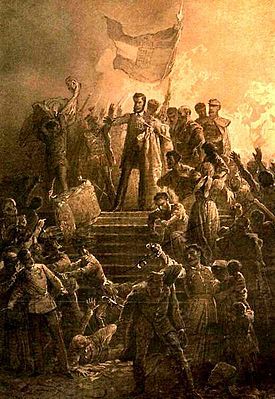
The scene above depicts Hungarian icon Sándor Petőfi reciting a nationalist poem to the Hungarian rebels in 1848. He and many real life historical figures such as Metternich, the Archduke Ferdinand, Czar Nicolas, and even Queen Victoria and her consort Albert make fun cameos throughout the book.
There is plenty here to sink your teeth in. Not only does the action move at a dizzying race from America to Italy, France, England, Austria and Hungary, but the protagonists have to deal with anarchists, serf rebellion, royal intrigue, political conspiracy, opera assassinations, snowbound trysts, cross-dressing soldiers, bloodcurdling battles, bombs, personal tragedy, betrayals, the Rebecca-like specter of a dead wife and the machinations of plenty of OM-OW. There is of course, much, much romance.
Normally, the much used trope of the Great, Big, Terrible, Misunderstanding that could have been solved, literally, by two lines of dialogue, would grate. However, this is one of those rare instances where it made sense. The hero is consumed by guilt and he wants to punish himself, which is why he drags out the secret for so long, much to the detriment of himself and the only woman he loves and has loved him back. You will rarely find a more compelling heroine than the outwardly shy and inwardly strong Eliza. The hero is more than worthy of her. Their love, as seriously dysfunctional as it grew at times, was what kept me reading and the true heart of the book.
I don't really agree with people who say that Stormfire is an outlier in Monson's work. It's not! There's not interpersonal violence in Surrender the Night like there is in Stormfire, but it's a book that is just as deeply concerned with political violence, oppression, and what we owe each other.
Eliza is an American heiress who feels saddled with her difficult mother, when a new acquaintance proposes a marriage of convenience to a Hungarian aristocrat she's never met. Eliza agrees, thinking that this man will be unhappy with her and ask for an annulment (in which she will, contractually, be well-provided for), leaving her a free woman who can chase her dreams in Paris. Eliza marries this man by proxy, and then travels all the way to Italy only to come face-to-face with Miklos, her charming and devastating husband who decidedly does not want her. But he also think she's up to something, so an easy annulment is off the table.
I have about a million highlights of dialogue from the first third of this book -- Eliza and Miklos are electric. They snap together like puzzle pieces but Eliza knows Miklos is withholding something from her. She (and I!) were expecting a traumatic backstory, but the extent of which Miklos was using Eliza for political gain was something I was caught off guard by.
Monson doesn't pull any punches in the historical setting: we're rapidly moving toward the Hungarian Revolution of 1848 and she is not going to spend any time overexplaining or coddling you. She also deliberately chose characters that are complicit in violent systems and forces you to watch them grapple with their mistakes. It's not an easy read, but it's extremely compelling.
It just feels like Monson was writing circles around her contemporaries. It sucks that she has such a salacious reputation when she's asking historical romance readers to engage with the genre on a level that most authors don't bother with.
Read: 7/23/24 3.5 stars Okay to good Setting: 1848 Hungarian Revolution, Italy, Switzerland, America
Plot: To say Eliza's had a hard life would be an understatement! She was crippled at 7, and the doctors tortured her tying to fix the problem. Because of this, she views life through very old eyes. Eliza is shocked when a princess offers her marriage to her nephew. Why would anyone want her? Desperate to escape her horrid mother, she agrees to marry the prince by proxy. She knows that once he sees her, he will want an annulment. Eliza will get a large settlement if the marriage is annulled, and then she can finally be free.
Eliza is shocked when she meets her husband in Italy. 1) Milo's is so handsome. 2) He can't decide if he wants the h or not. Eliza tries different methods to talk him out of the marriage, but the stubborn man won't budge. Miklos can relate to her loneliness and the walls she puts up to prevent more pain. He wants to show her how to live. Soon, they develop a friendship that eventually turns into love and a real marriage.
Unfortunately, the flames of war erupt and scandal and political upheaval threaten to tear the couple apart. Will their marriage survive? What was the real reason Miklos was exiled to Italy?
Dislike: 1. The h was hard to like sometimes. She had a quick mind but was scared to actually live. When she felt too vulnerable, Eliza had a habit of panicking and running off. Towards the middle of the book, I began to admire her loyalty and her dry sense of humor. I felt the same enjoyment as Miklos did when she was watching an opera for the first time. I rooted for this couple. That was until near the end of the book when she got involved with political rebels. This puts her husband and his entitled lands endanger. Miklos tells her that the revolution can't win because of Austria's alliance with Russia. What could he know? It's just HIS country.!
2. Eliza having her mother ship her guns for a revolution is idiotic. She wouldn't know how to secretly pull that off 🙄
3. The beginning of the book is very slow paced. 😴. The story doesn't pick up until the last 250 pages. Their late honeymoon was the best part of the story.
4. CM wasted a great premise! I would have liked to have learned more about Hungry and its culture. The story would have worked better if they were at court where all the political intrigue was taking place. Instead, in the last 100 pages, Eliza was stuck at Miklos' ruined estate while he was in Budapest after a terrible fight.
Liked: 1. I loved Miklos! This alpha male had a such kind heart, at least towards the h! He risks a lot to make Eliza happy.
2. What crime did Miklos commit that got him exiled? That question isn't answered until the end of the book, though it is obvious it involves his late wife. The mystery made the story more compelling.
3. The secondary characters were an interesting lot. Each character enhanced the story. Example: Miklos' aunt picked out his bride for him. Did she select Eliza because of love or malice? I never trust her completely.
4. I was also fascinated by Miklos' former lover! She was a political fanatic. Trying to bomb an Italian king to attempting to murder the czar of Russia. It seems for a while that everywhere the MC went, she was waiting in the background. Needless to say, the story was never dull when she was around. Then she disappears in the last of the book.😞
Conclusion: This book could have been better if not for the slow pacing. I can't believe this is the same author who wrote Stormfire!
congratulations to Chels for nailing the recommendation.
Stormfire has the reputation it does because of the interpersonal violence that makes it a hard read. Surrender the Night is not necessarily easier, but maybe the only way to put it is that it was less literally gross. But it still took me a long time to read because each chapter was so dense with violence.
Honestly the two books it reminded me of the most were A Room with a View and War and Peace. ARWAV for how well Monson integrated references to art and culture into the story. Usually I roll my eyes at this in romance--it almost always feels like authors did surface level research and the culture references sit on top of the romance like a projection. The way characters talk about and experience art feels so natural here.
And I say War and Peace just because of how integrated the history was here. I think the "reads like historical fiction and not historical romance" is a silly thing to say (why is it less romantic to have more history?), but Monson does something even beyond the peaks of that skill in this genre. I compare Monson to a historical novel like War and Peace, that had a smaller gap between its setting and its writing, because Monson writes like you are just supposed to know all these people, while simultaneously never letting the story slip. She just demands more of your mind, even compared to authors who take histrom as a chance to do a history lesson.
I think that is one thing that might turn readers off--I had Wikpedia open most of the time I was reading the book, in part because I was just so interested in this period of history that touched a few periods that I have read a lot about, but for which I knew none of the players. But! I really think people should give it a chance. I was delighted how often I would pause to read about a historical figure, come back to the book, and have Monson give me the character/personality details I just read.
Anyway, if you hate Eliza, you're wrong. She's great!
Понякога един старомоден бодис рипър си е чудесна отмора. Смешното е, че авторките явно са били по-образовани от сегашните си глупави посестрими в занаята, които са и страшно страхливи лицемерки или насилени смешни снобки с речник от точно 100 думи, състоящ се само от вулгаризми.
Езерото Комо, Виена, езерото Балатон и Будапеща осигуряват добра екскурзия. Мелодрамата е дяволски и непремерено много - тъкмо се успокоят малко нещата, и веднага избухва някоя трагедия да раздели гълъбчетата, страшно нелогично и накъсано. Не можа ли авторката да им даде поне малко дъх да си поемат?! Да не говорим за цялата идиотска история с купуването на оръжия, Метерних и неадекватните схващания на мацката за съдбата на унгарските селяни… А и тая балалайка е руска, дявол да го вземе, не унгарска. Но нейсе, активно търчане падна, че и война, супер, пък и това е любовен роман все пак.
Wonderful, Witty Romance & a Handsome, Hungarian Prince in Italy, Switzerland and Hungary!
Set in 1847, beginning in Rhode Island and New York but then going to Italy, Switzerland and Hungary, this is the story of Eliza Hilliard, the daughter of a wealthy merchant. Eliza is a talented artist who sees much, partly because she was left lame from a riding accident as a child and understands pain. When Princess Elizabeth (Bette) Von Schmerling comes to America seeking a wife for her nephew, Prince Miklos Sztarai of Hungary, Eliza’s mother leaps at the offer made to her daughter.
By proxy, Eliza is to marry a man she has never met, one she envisions as fat and blustering. She is willing to do it because the terms of the contract provide she can get out of the marriage if she wishes when she meets the prince and will get a large settlement—and the marriage can’t be consummated without mutual assent. Happy with her books and her art, Eliza jumps at the chance to be free from her controlling mother.
In Northern Italy, Eliza finally meets her new husband where he is staying at Lake Como. A handsome, golden-haired prince, he is also a former colonel in the Hungarian army and orders her about while holding her at arm’s distance.
Monson brings great humor and witticisms to the fore with Eliza’s musings about her husband. Eliza is only 16 but canny and wise. The dialog is witty, often brilliant. Neither Eliza nor Miklos wants the marriage. He is skeptical about Eliza’s reasons for entering the marriage and until he figures it out, he will not let her go, but he will not consummate the marriage either. Eliza is happy about that since she wants out.
Monson’s presentation of the budding respect and affection of these two prickly people is brilliant. I just loved it. And the secondary characters and historical figures are so well done, providing a rich tapestry of historical detail. I relish a romance where the author takes the time (and the pages) to slowly develop a believable relationship. The secondary characters are well drawn, including Miklos’ mistress, a great beauty who wonders at the appeal of the skinny American girl.
As they travel through Europe, Eliza discovers Miklos’ secrets and finally has to admit she loves him. And then revolution erupts and they are caught up in the fight for Hungary's independence. The story reflects great research into the history of Hungary. Historical figures join the fictional characters for some exciting scenes.
It's a wonderful read and highly recommended. Oh, and yes, it's a bodice ripper but they are married.
I give up. It's boring, I don't like the hero, I don't care about the heroine, & I don't like the weirdly-stylized prose. Monson has always impressed me with her writing, but this felt herky-jerky & forced with thin backdrop + endless witty banter. I DO NOT LIKE WITTY BANTER. A little is okay -- tolerable, or even funny. But unless you're PG Wodehouse, Agatha Christie, or a Guy Ritchie film, continual sparring, bickering, & verbal swordplay is so obnoxious. Have a normal conversation, ffs.
...Clearly I'm in the minority, because an overload of witty banter has become standard romance novel fare. Blech.
Another gripe: the blurb makes this sound exciting, but it isn't. It's dull & a waste of a great premise; indeed, I was expecting a gripping, fiery tale of Eastern Europe, something close to Drusilla Campbell's THE FROST & THE FLAME, but with Hungary instead of Russia. But this was no Campbell. It doesn't even feel like the same author as STORMFIRE or RANGOON. The setting is vague at best, with a forgettable, interchangeable cast of secondaries that wander in & out. Who cares? Overall, a big fat zzzzzzz.
1.5 stars, rounded up because the opening scene at the ballroom was actually good. The rest...meh.
I actually couldn't finish this book. I normally adore this author's writing but I just found the heroes devotion and love for the ex tedious and irritating. I open a romance novel to read about the heroes love for the heroine, not another woman! Zzzzz....
If you've never read this author's work, skip this and read something else.
This was my second Christine Monson book and, other than the revolutionary aspects, very different than the first I'd read, Stormfire. I knew that going in, so it wasn't a shock.
After getting through the annoyance of the hero still being in love with his first wife, the relationship between him and the heroine slowly progressed. Lots of emotional ups and downs. One minute they're happily married, the next depressed and emotionally estranged.
The ending was a bit odd, happier than I'd expected and a little out of place in the book.
This was really just that: a mediocre read that didn't unnerve me, but came close to it.
The rounded-up 3 stars are for the good and solid secondary characters and for the writing style, which was appropriate for the setting, considering how old this book is.
The main Characters, Katrina and Devin were okay, but both bothered me after about 70 pages. They were too stubborn and too emotional, they weren't exactly sensible or grown-up, no. For the most time both came across as childish and premature, and their constant arguments became tiring. I could have excused that one-dimensional angle with which the author draw them, but I didn't connect to them at any point. I can live with a lot of drama if it's done right and if I have a emotional bond with the main characters. But I wasn't as invested in the story as I should be, so it turned into a tiresome and rather boring read.
Regarding the story one cannot say that it was underdeveloped, but I wasn't prepared for a 400-pages book that focuses solemnly on the relationship between Kat and Devin, and more than that, solemnly on the aspect about herbeing his mistress and them being worlds-apart socially etc etc... Surprising here was the fact that the whole conflict on which the story is centered was introduced at the very beginning of the story, which lead me to question what else can come for the major part of the book.
Ambitious and packed with historical detail, "Surrender the Night" can be forgiven if its hero and heroine are kept apart by the kind of clichéd misunderstandings that drive far lesser books. After dealing with Napoleonic Europe and Colonial Myanmar in her two previous novels, Christine Monson dove into the Central European revolutions of 1848. Eliza Hilliard, the intelligent but unloved ugly duckling daughter of a nouveau riche, crass mother intent on storming society, takes the opportunity to flee her parvenu parents by agreeing to become the wife of an exiled Hungarian aristocrat. She finds in Prince Miklos Szatarai an opponent, a challenge and ultimately her soulmate. Their arranged marriage plays out against Hungary's struggles to find independence from Austria. Monson's research is impressive and the novel is full of political intrigue, battles, bloodshed and sparks between these well-matched lovers who misunderstand each other at every turn. With Miklos, Monson turns away from the sadistic alpha heroes of "Stormfire" and "Rangoon"; although powerful and virile, he is no rapist. As Eliza blossoms into a self-assured heroine, her political savviness and astuteness are delights. The afore-mentioned use of silly tropes to complicate the couple's lives is annoying; and the novel ultimately seems to run out of steam and end rather quickly because it seems the author herself became worn out by the historical drama. Nevertheless, "Surrender the Night," like its two previous siblings, is an example of an historical romance that doesn't stint on the history, written by a supremely talented author, one that puts lesser writers in the shade.






![Profile Image for [Aengell].](https://i.gr-assets.com/images/S/compressed.photo.goodreads.com/users/1431033477i/7221205._UX200_CR0,26,200,200_.jpg)