Jump to ratings and reviews
Rate this book

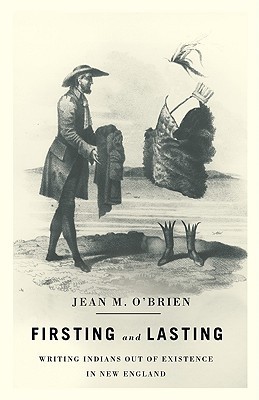
Firsting and Lasting: Writing Indians out of Existence in New England

Rate this book
Across nineteenth-century New England, antiquarians and community leaders wrote hundreds of local histories about the founding and growth of their cities and towns. Ranging from pamphlets to multivolume treatments, these narratives shared a preoccupation with establishing the region as the cradle of an Anglo-Saxon nation and the center of a modern American culture. They also insisted, often in mournful tones, that New England’s original inhabitants, the Indians, had become extinct, even though many Indians still lived in the very towns being chronicled.


In Firsting and Lasting , Jean M. O’Brien argues that local histories became a primary means by which European Americans asserted their own modernity while denying it to Indian peoples. Erasing and then memorializing Indian peoples also served a more pragmatic colonial refuting Indian claims to land and rights. Drawing on more than six hundred local histories from Massachusetts, Connecticut, and Rhode Island written between 1820 and 1880, as well as censuses, monuments, and accounts of historical pageants and commemorations, O’Brien explores how these narratives inculcated the myth of Indian extinction, a myth that has stubbornly remained in the American consciousness.


In order to convince themselves that the Indians had vanished despite their continued presence, O’Brien finds that local historians and their readers embraced notions of racial purity rooted in the century’s scientific racism and saw living Indians as “mixed” and therefore no longer truly Indian. Adaptation to modern life on the part of Indian peoples was used as further evidence of their demise. Indians did not—and have not—accepted this effacement, and O’Brien details how Indians have resisted their erasure through narratives of their own. These debates and the rich and surprising history uncovered in O’Brien’s work continue to have a profound influence on discourses about race and indigenous rights.

320 pages, Paperback

First published May 10, 2010

22 people are currently reading
681 people want to read

About the author

Jean M. O'Brien

29 books5 followers

Ratings & Reviews

What do you think?
Rate this book

Friends & Following

Create a free account to discover what your friends think of this book!

Community Reviews

5 stars
62 (36%)
4 stars
75 (43%)
3 stars
32 (18%)
2 stars
3 (1%)
1 star
0 (0%)
Displaying 1 - 19 of 19 reviews
Profile Image for Anjali.
57 reviews
July 22, 2023
so important and incredibly thorough- a must read for everyone.
Profile Image for Allison Horrocks.
217 reviews49 followers
June 12, 2025
A re-read for work - as important as ever. A total reframe of New England history.
Profile Image for Mallory Whiteduck.
58 reviews47 followers
December 16, 2018
So so so good. An absolute must read to understand the role that local histories play in perpetuating the vanishing Indian myth and how it impacts real people today.
204 reviews
July 16, 2025
Firsting and Lasting makes the case that the erasure of Indian history and Indians from modernity in New England was a deliberate act.  O'Brien's sources for this thesis are hundreds of New England town histories published in the 19th century.  These narratives are peppered with "firsts" - actions first performed by a white person in the present day town borders - as well as "lasts" that firmly place indigenous people in the past.  These actions are meant to show the progress of European-American settlers and their descendants towards civilization while making it clear that the Indians were the uncivilized past they were leaving behind.

In addition to an exhaustive reading of these town histories, O'Brien describes how monuments, place names, annual commemorations, and graves were used to create a fantasy narrative replacing the true history of indigenous people.  Despite the accounts referring to "the last Indian" of the respective towns, many of these places still had native people living in them at the time of publication and they could have descendants as opposed to being "the last."   The persistence of indigenous people in New England in their own communities as well as interacting with white Americans through labor and trade is covered by O'Brien as an act of resistance to their erasure.  Of particular interest is William Apess (1798-1839), a Pequot man who was also a Methodist minister who was an activist for Indian civil rights.

This was not an easy book to read due to its academic tone so I read it in bits and pieces over an extended time.  Nevertheless it's a fascinating work that explores how amateur histories meant to aggrandize white individuals and families in particular localities laid the groundwork for how Americans understand our history.  And that history - and our present day - was one that wouldn't include Indians.  And so we we will have to continue to seek out and make known the true stories of New England's indigenous people and their ancestors against the bureaucratic constructs that still deny their authenticity.

Favorite Passages:
"By taking up the narrative construction of Indian history in local accounts, this book aims to undermine its collective claim that modern New Englanders had replaced ancient Indians on the landscape.  I hope to show the ways in which non-Indians actively produced their own modernity by denying modernity to Indians.  I also want to expose the futility of these claims, as New England Indians continued to resist their effacement as tribal nations in the nineteenth century and beyond.  It is this long-term ideological construct, I would argue, that shapes contemporary debates and confusion over the 'authenticity' of New England Indians.  I hope that by exposing these constructions, I can shed light on larger issues about Indianness, 'authenticity,' recognition, and modernity in the United States." - p. xxiii

Recommended books:
Profile Image for Mary Figueroa.
10 reviews
Read
February 24, 2021
The aim of Jean O’Brien’s Firsting and Lasting: Writing Indians Out of Existence in New England is clearly addressed in the opening chapter — “to understand how non-Indians in southern New England convinced themselves that Indians there had become extinct even though they remained as Indian people—and do so to this day.” To explore these assertions of Native extinction, O’Brien utilizes a vast sampling of New England local history texts as a means of “getting at the mind-set of ordinary non-Indians.” By exposing the ways in which non-Indian “historians” rewrote themselves as the rightful, “first” permanent occupants of indigenous lands, Firsting and Lasting brings light to the falsity of Anglo-American mythology that claimed sole legitimacy to and supremacy over Native American lands and excluded Native people from “modernity.” Beyond outlining the “New England replacement narrative,” O’Brien simultaneously “aims to undermine [the] collective claim that modern New Englanders had replace ancient Indians on the landscape” and to “shed light on larger issues about Indianness, “authenticity,” recognition, and modernity in the United States.”

One of the most well-organized books I've ever read
Profile Image for Michelle Boyer.
1,877 reviews26 followers
December 18, 2016
This research begins with a simple premise: “Indians can never be modern” in a world in which they have continued to be written out of history (xi). It would seem that in many accounts of early New England, after having either given their land away or it having been taken, Indians have “so thoroughly vanished from the region that no physical trace of them survived in any living person” (xi). However, those of us working in American Indian Studies know that this type of assertion (from Harvard legal scholar Emory Washburn in 1856) is not true, but rather that there are many documents in America’s early history where American Indians were written out of the story. O’Brien suggests that the “vanishing Indian” has become a “generalized trope” and that it has appeared in “the form of the written word but also in a rich ceremonial cycle of pageants, commemorations, monument building, and lecture hall performances” (xiii). And of course, I would argue that today we also have film to help re-perpetuate the trope of the vanishing Indian.

In one sentence from the author, this study is the following: “My aim is to analyze the narrative strategies that New Englanders used regarding the Indian past and that attempted to put Indians themselves in the past by asserting their extinction in subtle and not so subtle ways” (xv).

Chapter 1 deals with the “Firsting” aspect of this work, and discusses ways in which small local texts claim Indian places as their own. Based on the belief that the written word (ie: documentation) tended to be “proof” of something, colonizers often began writing documents that claimed lands as their own. This way, they could claim that because no one else had any written document to claim the land, they indeed owned land that had been previously held communally by American Indians—who did not use the concept of private ownership regarding land until after colonization. But the concept of being the “first” went beyond land and included “first settlers, births of first white children (especially males), first marriages, first town meetings and town officers, first meetinghouses and ministers (numbered on into the present), first divisions of land, first newspapers, first schools, first bridges, mills, and other public works that symbolized modernity” (11). Indians were perhaps in the background—or were the “other” figure that modernity needed to be brought to—but they were not written into the texts as being the first of anything. After all, the “central story line of the colonial past for New Englanders involved the heroic overcoming of the ‘savage foe’ in a valiant struggle to make the wilderness ‘blossom as the rose,’ a phrase that is repeatedly invoked as the metaphor for subduing the land in English ways” (26).

Chapter 2 deals with “Replacing” Indians with other convoluted things: monuments, historical commemorations, excavations, etc. In all of the monuments and other events that deal with Indians, it is clear that “the overwhelming message about Indian history suggests that it is in the past” (103).

Chapter 3 deals with “Lasting” and discusses that Indians are often spoken of, or written of, as if they are the “last” of something. Think about the film The Last of the Mohicans or even Last of the Dogmen. In both cases, the American Indian group being viewed (or read) is always thought of as being the last—the race is going to vanish. Even Dances with Wolves has a similar thought, that the Indians will soon be gone, eradicated, erased, the last. But New England keeps many lists of famous Indians that were the “last” despite the fact that there is documentation about their children, the continued tribe, etc. As we know, the “last” is a romanticized version of history, because (despite what James Fenimore Cooper might have suggested, the Mohican are still thriving today).

Chapter 4 discusses “Resistance.” I argue this text is, in part, resistance itself.

Overall this is a good piece of scholarship that shows some of the ways certain tropes have been used to eradicate American Indians from history. I recommend it to those interested in working with the “vanishing Indian” motif, and also those thinking of looking at how to use primary sources to make a research claim.
Profile Image for Jeffrey Williams.
370 reviews6 followers
October 27, 2019
O'Brien conducted an exhaustive review of periodical literature in New England from 1820-1880 in which she examined how New Englanders saw themselves and Native Americans. She notes how the descendants of the early European settlers were inclined to perpetuate the "vanishing Indian" myth, even with Indian descendants living nearby or within the same community. She constrasts this in the later chapters with Indians living in the communities and their attempt at "resisting" the vanishing Indian myth and applying agency to their situation.

While this is well researched, even to the point of being mundane, it is interesting to see her choice for the timeframe of research, 1820-1880. There were a lot of national news stories that were occurring during this time which may very well have tainted the viewpoints of those writing the local narratives. In 1830, the Indian Removal Act was hotly debated in Congress and led to the Trail of Tears throughout the remainder of the decade (O'Brien at least mentions this). This was preceded by the War of 1812 which had a large Native American component to it that was newsworthy and still impactful on the early works. The U.S. Civil War took the stage in the early 1860s, but the hanging of the Dakota 38 in 1862 was a national story, as was Red Cloud's War, the Treaty of Fort Laramie (1868), and the Custer Campaign in the 1870s which led to his demise at the Little Bighorn. All of these national stories can easily conjure up images of the 1676-1676 King Philip's War, which was a huge deal for citizens of New England.

So on one hand, there was the myth of the vanishing Indian being perpetrated in the writings in which O'Brien examined, but because her timeframe of periodicals was limited to times when there were a lot of national news stories regarding Indians, I'm wondering how this tainted her study. (She at least acknowledges some of the local writer's biases from national news events, though probably not as frequently as it might have occurred.) Did that narrative change from the 18th century to the 20th century? We don't know because the study was specifically narrowed to the 19th century.

Also, O'Brien points out "racist" motivations of the various authors, but it is doubtful that most of the people who gave speeches about their town and their heritage in the mid-19th century were racist, but rather just looking through the viewpoint they were taught through THEIR heritage. By that I mean there was no intent to write the Indians out of the narrative, but with speeches that were not academic works from people who were not academics, to hold them to academic standards and attempt to assign motivations is disengenguous to those who lived through those times and wrote those speeches. I've been to many Memorial Day and July 4th addresses in the small town that I grew up in during the 1970s, and the people who were delivering the speeches mainly had high school diplomas and a few years of military service. They did not have college degrees nor research repositories at their disposal to determine if what they were saying was, indeed, correct. I cannot fault them (those in my town or those who were O'Brien's research subjects) for their naivete, but they certainly didn't have racist motivations.

Her last chapter and conclusion, where she discusses the role of William Apess, makes the most compelling argument to her thesis and the most rewarding part of the book.
Profile Image for Ben.
427 reviews44 followers
September 28, 2018
The narration of Indian extinction in local texts proceeded along two important avenues. Insistence on "blood purity" as a central criterion of "authentic" Indianness reflected the scientific racism that prevailed in the nineteenth century. New England Indians had intermarried, including with African Americans, for many decades, and their failure to comply with non-Indian ideas about Indian phenotype strained the credence for their Indianness in New English minds. Non-Indians thought about race and blood according to a colonial calculus in which the possession of even a single drop of African American "blood" relegated one to the status of "Black" and "slave," whereas it demanded of Indians evidence of just the opposite: purity of blood. This calculus operated within the colonial order, on the one hand securing a labor supply in hereditary bondage, and on the other justifying the seizure of Indian lands on the basis of Indian "disappearance." This penchant for Indian purity as authenticity also found essential expression in the idea of the ancient: non-Indians refused to regard culture change as normative for Indian peoples. Thus, while Indians adapted to the changes wrought by colonialism by selectively embracing new ways and ideas, such transformations stretched beyond the imaginations of New Englanders: Indians could only be ancients, and refusal to behave as such rendered Indians inauthentic in their minds. Indians, then, can never be modern. These ideas provided fertile round for the idea of extinction, a mythology that obliterated the fact of Indian survival and fostered the dominant ideology about racial formation in nineteenth century New England and informed a developing national ideology about Indians.

In the process of asserting their modernity, local writers worked mightily to root the New English social order deeply. In effect, they claimed to be the first people who established cultures and institutions worthy of notice, thereby subtly declaring the invalidity of Indian ways of life. Indians serve the larger story line of establishing the primacy of the New English social order. Collectively, the effect of their ideological labor is to appropriate the category "indigenous" away from Indians and for themselves. They subtly argue for the sole legitimacy of New English ways, as the institutions and practices of non-Indians are posited as the epitome of modernity.
Profile Image for Ai Miller.
581 reviews56 followers
January 15, 2019
Just a really solid work with a strong but still interesting and super useful framework; the citation you'll see of this really speaks to how useful it is. It's deeply thorough, and might strike some folks as repetitive, but I think O'Brien really just does an amazing job of showing how deeply pervasive these practices are, and really challenge the reader to consider how these practices might be used in their own local histories. Strongly recommend for everyone but especially people who live/have lived in the area currently known as New England, as a way to reconsider the spaces they occupy.
Profile Image for Rachel.
463 reviews
January 3, 2022
O’Brien unpacks how the telling of New England history first became mythologized. She painstakingly culls through local histories, commemorations, and historical pamphlets to piece together colonial moments of “firsting,” “replacing”, and “lasting.” These collective narratives developed the longstanding mythology of Indian extinction. Native resistance and survival shows these to be false narratives.
Profile Image for Matthew Rohn.
342 reviews10 followers
February 22, 2023
I'm always interested in books on the development of historical memory (Race and Reunion by David Blight is one of my favorites) and Firsting and Lasting provides a compelling and specific argument about the development of ideas of native American extinction in New England and American national identity. This book is tightly edited and always moving the argument forward. Anyone interested in the topic will appreciate it, although it is pretty regionally specific
Profile Image for Michelle.
147 reviews
February 25, 2021
I loved this book. It absolutely is just like being woken up to your own privilege and the narratives around you that you didn't realize were there. O'Brien makes everything accessible and presents the case clearly and convincingly. Truly enjoyed it and it changed me for the better.
Profile Image for Corinne.
41 reviews3 followers
October 9, 2019
A little dry sometimes but very insightful into 19th century New England writing natives out of history. It is very useful even today as these beliefs still survive and are taught.
Profile Image for T.
59 reviews
October 4, 2023
Field shifting book. Review forthcoming.
Profile Image for Bill.
517 reviews4 followers
February 5, 2022
During the 19th century, New England communities wrote town histories. To prove they were the legitimate successors to the indigenous population, they wrote about the deeded properties and the decline of these people and about the last living descendent of the tribes. At this point, no one could argue the occupation of the land. The author's intent is to prove these tribes continued hidden from the blind eye of the Europeans and are in fact still among us. The book is a revelation.
Profile Image for Beth.
28 reviews
January 12, 2011
Great study of the early county and town histories. At times, a bit repetitive.
Displaying 1 - 19 of 19 reviews

Can't find what you're looking for?

Get help and learn more about the design.