This magnificently illustrated volume explores Morris' fascinating life and astounding mastery of the arts, enabling him to create unforgettable textile designs and a revolutionary decorative arts business.
What does the name “William Morris” conjure up for you? Perhaps it is the intricate floral and leaf designs which tend to pop up in the more select gift shops, decorating a host of rather expensive knick knacks. Exactly, I fear, the sort of fripperies which William Morris himself would have despised. Yet his textile designs are undeniably beautiful, with their intertwining leafy patterns, the illusion of depth some of the later masterly ones have, and the subtle use of colour. William Morris went to great lengths to achieve the exact tones he required, researching ancient herbal recipes. He even created a new yellow dye, and in the later years of his life was experimenting with a particularly vibrant indigo, so much so that his hands were permanently stained blue.
Or perhaps it is his political work, as the founder of the “Socialist League” which you know. He was friends with Marx’s comrade, Friedrich Engels for a while, although he was later dismissed by the latter as “politically untalented”. Or possibly his translations of Icelandic sagas have drawn your attention. William Morris was best known in his own lifetime for his poetry, and he drew from a wide variety of classical, mediaeval and Norse myths and legends to rewrite his lyrical poems, which glorified the past. He formed his own printing firm the “Kelmscott Press” in order to produce books such as his Utopian novels, and those by authors he admired, to the standard he wished. Alongside all this frenetic activity, he was designing tapestries, wallpaper, fabrics, furniture, stained glass windows, and running his company “Morris & Co.” He worked himself to an early death at 62, and his doctor diagnosed the cause as: “simply being William Morris and having done more work than most ten men”.
William Morris’s early years proved to be a great influence on his life. He was the third of nine children born to a wealthy middle class family, living in Walthamstow, which is now a fairly densely populated suburb of London. (The author, John Burdick, did not seem to know this, but I attach no blame to him for this omission. He lives in New York, whereas I live in the Epping Forest area. When the Morris family lived there, Walthamstow was a rural community outside London.) When William was six, a fortunate investment by his father in the Devonshire copper mines resulted in a huge dividend, enough for the family to move to Woodford Hall, a Palladian mansion on fifty acres, surrounded by Epping Forest. William had a pleasant childhood, surrounded by natural beauty.
William’s father may have been a shrewd businessman, but he was also a deeply religious evangelical Protestant. The household was not extravagant, and old-fashioned values were maintained. The children were expected to perform everyday tasks such as butter churning and bread making, keep to rigid meal times and attend church. Strict discipline was observed, which took little account of the family’s sudden increase in wealth.
William Morris was not a robust child and was encouraged to take walks in Epping Forest. This is where he gained at first hand his impressions of the thickets and brambles, the curves of foliage, the flowers and birds which he loved. Having few friends, he exulted in these explorings. He loved the novels of Sir Walter Scott, and even had had his own suit of armour, which he donned to ride his pony through the wilds of Epping Forest. For this solitary and mentally absorbed boy, Nature was his tutor.
As well as enjoying fantasies of being a knight in the forest, William Morris also explored the local churches, enjoying the brass work. The local building which most impressed him was Queen Elizabeth’s hunting lodge (which incidentally, you can still visit today. Although small, it has a very wide, very worn, stone staircase. The person showing us round attributed this to the large, weighty Henry VIII, who often used the lodge for his deer hunting.) William Morris was very taken with what he called “a room hung with faded greenery” and this was his touchstone, when later he transformed the look of cluttered Victorian interiors. There are echoes of Epping Forest, and the room in Queen Elizabeth’s hunting lodge, in virtually every chintz, and every wallpaper design, he ever made.
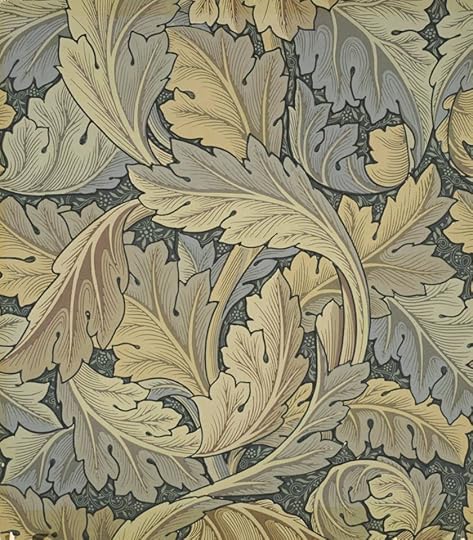
Acanthus
On his father’s death, William Morris went to a boarding school in Wiltshire. But the school was rather disorganised, and William was virtually allowed free rein to carry on with his own education. He left after a student riot, and unlikely as it may seem, was accepted at Exeter College, Oxford, with the intention of taking Holy Orders.
William Morris did not readily accept the idea that wisdom and power were the right of the privileged few, and despised the idea of the Oxford cultured man. He surrounded himself with like-minded students, and addressed them all with missionary zeal. At first he liked the idea of entering the church, imagining a pious life in the service of goodness, just as he had read about in his endless tales of chivalry and knights of old.
His closest ally in this; someone who was to remain his closest friend throughout his life, was the son of a picture framer in Birmingham. His name then was Ted Jones. We know him now as the great artist, Edward Burne-Jones. The group of peers often talked earnestly well into the night, setting the world right. Eventually their conversations developed from theological matters into other areas, such as Tennyson’s poetry, especially the Arthurian legends of Malory, and social theorists such as Thomas Carlyle and John Ruskin, who shared their mediaeval ideas. Ruskin commended the communal craftsman’s guilds, and talked about the joy in labour. This was to have far-reaching consequences throughout William Morris’s life. He was repelled by the cold perfection of mechanisation, and the changes which the Industrial Revolution had brought to Britain, and yearned for more pastoral times.
Such cliques of young idealistic intellectuals rarely come to anything, but William Morris had money, and was well able to follow his dreams. So began the paradox which he lived all his life. He believed in equality for all, worked phenomenally hard, teaching himself the trade skills which he needed for each of his crafts, yet he was roundly criticised throughout his life for liking the finer things. How could a committed Socialist in all conscience be the holder of such a fortune? At the age of 21, he had £900 a year from the copper mine shares. By comparison, the highest paid dons at Oxford, might at best have £250 salary per annum.
Fired by John Ruskin’s enthusiasm, William Morris and Edward Burne-Jones set out on on a tour around Northern France and Belgium, taking in the gothic cathedrals of Amiens, Rouen and Chartres, and Flemish painting. It became clear to both that their calling was not to to the Church, but to Art. John Ruskin became a frequent visitor, and the friends formed their own brotherhood, similar to the Pre-Raphaelites. Edward Burne-Jones was so caught up with the idea of being a painter, that he left Oxford without taking his degree. William Morris graduated, but found it difficult to explain to his parents that he would not after all be taking Holy Orders. Instead, he took a job in an architect’s office, working meticulously at architectural drawings, but soon becoming disenchanted by their limitations. He followed Edward Burne-Jones to London, to join the Pre-Raphaelites.
There they met the charismatic and immensely talented Dante Gabriel Rossetti, the most forceful member of the Brotherhood. Rossetti was probably bi-polar: had violently unpredictable mood swings, and was afflicted by melancholy. Eventually he was to alienate all his friends, but at this time he was at the height of his powers, charm, and artistic achievements. His influence on William Morris was vast, encouraging him to indulge all his creative ideas, and push aside any socio-political concerns. William Morris was soon developing his skills not only in painting, but also illuminated manuscripts, embroidery and furniture design, as well as producing an enormous amount of verse.
The group was exuberant and wildly creative, but did not always take the trouble to research the necessary skills. Rossetti had organised them to paint new frescoes on the walls of the debating chamber at Oxford Union library. They were in tremendous high spirits for most of the project, and one story tells how “Topsy” (as William Morris was known to his friends) got his head stuck in the visor of a suit of armour, and staggered around cursing! However they failed to prime the brick walls correctly, and the beautiful illustrations to the recently published “Morte d’Arthur” by Tennyson, began to fade and disappear almost immediately. There is little left of what might have been an historic collaboration between the two artists.
By now Rossetti was engaged to Elizabeth Siddal, but they had spotted what they called a “stunner” behind them in the theatre: someone who embodied all the Pre-Raphaelite ideas of beauty. Jane Burden was just seventeen, and was to feature in just about all the most famous Pre-Raphaelite paintings. “Topsy” Morris was goaded on to marry her, despite the fact that they were complete opposites. Jane, the quiet daughter of a stable-hand, was over-awed by this noisy, ebullient and wealthy man, and consented to marry him. They remained married for life, although at times it was not a happy one.
“La Belle Iseult” for which Jane modelled, is the only oil painting surviving by William Morris. Critics say that the figure drawing is clumsy, and William Morris seemed to think this himself, for on the back he scrawled, “I cannot paint you, but I love you.”
Wanting the perfect house to share with his new wife, rather than the messy bachelor rooms he shared with “Ted” Burne-Jones, he bought a plot of land outside London in Upton, and set about designing it. Upton is now called “Bexleyheath”, also now a suburb of Greater London. Unlikely as it may seem, I have also lived in this area, despite its being historically in Kent, south-east of London, and Epping Forest in Essex, north-east of London. I appear to be following the same location choices as William Morris!
William Morris asked his old friend from the architect’s office, Philip Webb, to help him with the designs. It was Philip Webb’s first big project, although he went on to be famous. The result is a striking house called “The Red House”, built from the local red brick rather than stone facades which were popular. It is a simple design, resembling a mediaeval monastery in its functionality. There are no Victorian embellishments, and this house, so different from what was being built in 1860, is considered one which was to herald modern architecture in its beauty and simplicity.
Visitors to the house in its early stages were handed a paintbrush and invited to decorate panels. This was to be a new venture, a showcase for the Pre-Raphaelite Brotherhood. William Morris concentrated on the areas he was so skilled at, the tapestries and carpets, and each friend brought their own talents to the enterprise, and developed new ones as well. The firm of “Morris, Marshall, Faulkner & Co.” was founded, presenting the world with a statement that the functional arts were just as worthy of consideration as the so-called “high” arts. Jane Morris and and Charles Faulkner’s two sisters were employed on pattern-copying and tile painting. As well as managing the firm (rather badly) William Morris was to work on stained-glass designs, and this is where the firm achieved its reputation, ironically enough, for ecclesiastical work. William Morris was well aware of his own deficiencies in representing the human form. Except for “La Belle Iseult”, he left people-shaped gaps in his works, to be filled in by Rossetti.
Everything was hand crafted, of course. There was no place for mass production in William Morris’s world, and some of the papers took many blocks to print, to achieve the depth, and variety of colour. Also paramount was comfort. The William Morris chair is still available, a rush-seated piece with an adjustable back. It is a timeless classic, and one of their best sellers as their customers did not need to be wealthy to purchase it. Chairs, they believed, should be comfortable, and tables and cabinets well-built and long-lasting. Simplicity was key.
However, it began to irk William Morris that most of his commissions were still for large houses of wealthy people, and that the money in his shares in the copper mining company had gone down. He felt for all his friends who were caught in this trap of a “profit-grinding society”, and contracted out a little of the menial work so that machines could be used. But the stained glass work was beginning to make a stir. Other artists working in the field were so impressed that they thought Rossetti and William Morris had secretly refurbished mediaeval originals.
William Morris provided much of the decorative borders and colourings for the stained glass windows, but his main passion was textiles. His designs for wallpapers, are also still available today. William Morris himself preferred wall hangings of fabric to papers, but he realised that wallpaper was more cost effective, and wanted to bring art to a wider audience. The designs grew increasingly more complex and flowing, the winding vines and thickets, the decorative birds and flowers all stemmed from the long meandering walks he had in Epping forest, so many years before. He taught himself to weave on a 18th century French manual and an old loom, which he took with him to his lectures. If the lecture was on something he deemed a “lesser art” he would sit with his back to the audience, industriously weaving on his loom whilst talking! William Morris considered embroidery and weaving to be the highest of all the decorative arts; the ones most closely allied with painting and sculpture.
Eventually the firm began to get into difficulties, as the price charged would not always cover the work which was done. Ford Maddox Brown was concentrating on his own painting and contributing little, and Rossetti’s health and mental acuities were deteriorating, perhaps because he had become addicted to laudanum. It was time for a change, and William Morris found himself thinking more and more about the social reform issues close to his heart. His conscience always troubled him, and he decided to involve himself more in the political arena.
Both John Ruskin, and William Morris believed that the current social conditions were deplorable, and that social and artistic changes were closely allied. But they diverged completely on the political stances they took to effect change. John Ruskin believed that what was needed was a move back to a mediaeval type of central authority, but William Morris had been heavily influenced by John Stuart Mill. He believed in the inherent goodness of humanity, and wished for true equality, however that could be achieved. Working on his Icelandic sagas with Eiriki Magnusson, he yearned to visit Iceland, to get away from the troubles at home. His children were ill, and Rossetti and Jane, like Lancelot and Guinevere, were having a passionate affair. Such irony, since he had painted his wife as Guinevere. William Morris knew of this, and despite his anguish, he did not confront either his friend or his wife. Instead, he fled to his beloved Iceland, leaving the lovers alone in his house for almost two years.
He began to search for a house further outside London, and settled on Kelmscott Manor which was built about 1570, in the village of Kelmscott, Oxfordshire. He and Rossetti became joint tenants. William Morris loved his new home, and began to spend much time in the local countryside. With his renewed vigour, he began to be involved in parliamentary politics. The young George Bernard Shaw was very impressed by William Morris’s directness, and regarded him as an astute socialist thinker. But he was plagued by the criticism that followed him everywhere, that his was a “soft” kind of socialism; he kept two servants, and did not sacrifice any of his wealth or comforts. Cartoons of him began to be published in the press, and one embarrassing incident was when he had been arrested at a political rally, but the magistrate recognised him, and let him off. When he was not accused of hypocrisy from one side, he was shunned by his artistic friends, who were mostly appalled at his politics. Edward-Burne Jones however stayed true to his friend, and William Morris visited there every Sunday, although they never shared beliefs.
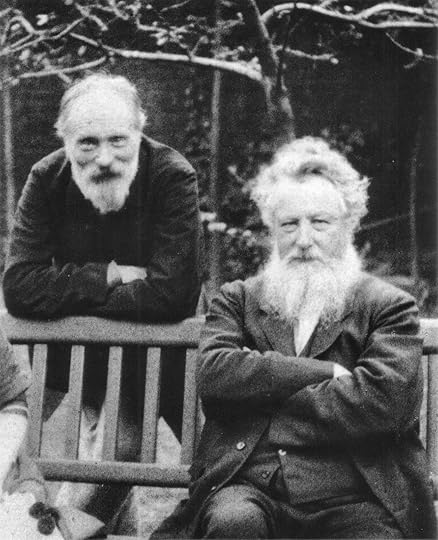
William Morris (right) and Edward Burne-Jones
William Morris joined the “Democratic Federation”, and went on to form his own “Socialist League” with himself at its helm. Their motto was “Education Towards Revolution”. He made new friends, but his wife Jane despaired of the very different sort of visitors who came to their home. He pursued his political work with his typical zeal, and later, his writings and theories gained considerable interest. But it affected his health badly.
Then within the last six years of his life William Morris took on yet another new project: book printing and publishing, with the founding of the “Kelmscott Press”. He even developed two new type faces for it, “Golden” and “Troy”. Books from the Kelmscott Press are instantly recognisable: fine editions which are works of art in themselves. Particularly highly regarded is an edition of Chaucer, which is heavily bordered with an intricate design. It was a true labour of love.
He threw himself into his work with tapestry and wallpaper designs, printing and writing poetry, retreating further into his imagination, to escape back to his first passion, and well away from the recent political turmoil. Yet he still attended Socialist meetings, and when roused by something he would speak to those attending with vigour and energy. One of his final addresses was against the tree-felling in Epping Forest, his childhood paradise. How I wish he were still here, with his commanding presence and fiery rhetoric, speaking out against the felling of ancient oaks, allowing the bracken to spread … but I digress. In September of 1896, William Morris finished off the poem he was writing, and retired to bed ill with congestion in the lungs, never to rise again. His close friends Edward Burne-Jones and Philip Webb came daily, until he died the next month. Whether or not they agreed with his politics, all his friends mourned him, knowing that this was for him a reasoned and sincerely compassionate extension of his art, and one which had ultimately drained his energy.
Perhaps we remember him best for this maxim: “Have nothing in your house that you do not know to be useful, or believe to be beautiful.”. It crystallises his thoughts, and is carefully phrased. Utility is essential, and not subject to fashion, but perceptions of beauty are.
In William Morris: Redesigning the World, John Burdick, has made a good attempt at providing an overview of William Morris’s life. It is not a scholarly study, of which there are many, but a good introduction for those who would like to know a little more. This is a large format book, printed on glossy Art paper and lavishly illustrated with over a hundred pictures. Many are of William Morris’s own designs, and others are photographs from the archives.
An interesting subject, and great illustrations/photos, but not really well written. A lot of referring to Morriss ideas about art and politics, without robustly stating what they were.
Morris himself is a very ambiguous figure -- a born-to-wealth socialsit who never gave up his comforts and servants, even while he grew more and more theoretically radical. As for his art, and design, it was supposedly based on the desire to beautify the lives of the masses, but was overwhelmingly marketed to the wealthy bourgeoisie. He articulated an abhorrence of Victorian fustiness and mindless worship of the past, but there is something precious and fake about his idolatry of romantic medievalism.
But, finally, he was a terrific designer -- the wallpaper, chintzes, typefaces -- and a prolific do-er, not just theorizing but producing a phenomenal amount and breadth of work.