

What do you think?

Every Crooked Pot
In her heart, Nina Goldman knows that beauty is only skin deep. But as a teenager growing up in Akron, Ohio – with her larger-than-life father Artie, a colorblind carpet salesman and frustrated musician – the only thing Nina wishes for is…to be beautiful. Or at least normal. As if having such an eccentric dad wasn't enough, Nina has another issue to face: the mirror. Born with a strawberry birthmark over her eye, Nina spends countless hours applying makeup and trying out ridiculous hairstyles designed to hide her eye. Convinced that her birthmark is the only reason she's not popular and can't find a boyfriend, Nina must find other ways to survive high school. With a string of crazy exploits that have her riding in dryers and appearing on TV, Nina proves she'll do just about anything to fit in, and even more in the hope of finding love.
227 pages, Paperback
First published June 1, 2007
About the author
Renée Rosen
10 books2,279 followersRenee Rosen is a USA Today bestselling author whose fiction focuses on pivotal moments in America and the complex, trailblazing women who shaped pop culture with iconic brands such as Barbie, Estee Lauder, and Cosmopolitan Magazine. Her novels span time periods from the Gilded Age to the 1960s and are richly researched. Her fiction is perfect for book clubs craving smart, nostalgic books about entrepreneurial women who changed the course of history.
She's the author of 8 historical fiction books, including: LET'S CALL HER BARBIE, FIFTH AVENUE GLAMOUR GIRL, THE SOCIAL GRACES, and PARK AVENUE SUMMER.
Renee now lives in Chicago where she is working on a new novel set at Woodstock.
. You can find her online at https://www.facebook.com/ReneeRosenAu..., https://twitter.com/ReneeRosen1 or visit her website at www.reneerosen.com
She's the author of 8 historical fiction books, including: LET'S CALL HER BARBIE, FIFTH AVENUE GLAMOUR GIRL, THE SOCIAL GRACES, and PARK AVENUE SUMMER.
Renee now lives in Chicago where she is working on a new novel set at Woodstock.
. You can find her online at https://www.facebook.com/ReneeRosenAu..., https://twitter.com/ReneeRosen1 or visit her website at www.reneerosen.com
Ratings & Reviews
Friends & Following
Create a free account to discover what your friends think of this book!
Community Reviews
Displaying 1 - 30 of 67 reviews

October 3, 2007
This book's packaging is a great injustice to the story inside. From the cover and jacket description, it seemed like silly teen chick lit. However, it is truly a wonderfully told coming-of-age story. Many times I forgot it was fiction and thought I was reading an actual memoir. I was so drawn into the story of Nina. I am actually surprised by it's YA classification (Baker and Taylor recommends it for 7-9 grades), as I believe its story would appeal much more to grown women.
January 30, 2018
“Every Crooked Pot,” is an amazing book made by Renee Rosen. Renee Rosen explained the life of a teenage girl, Nina Goldman, and the birthmark that stops her friendships, or as she thinks. Renee Rosen made me want to read more of her books, by making her story feel real. I recommend this book for 11+ because of its matureness.

June 24, 2007
Sounds like a good one -- I've read the first chapter. Can't wait to read the rest.
Update: I read this book in one sitting--disappeared for hours. Couldn't put it down. It's a beautiful and heartbreakingly real story about a girl with a facial birthmark. How she and her family deal with it, how it affects her personally as she comes of age and the effects of her "deformity" on the family dynamic is fascinating. Characters are well-developed. I feel like this family could be my next door neighbors -- you know, the eccentric ones.
Highly recommend to teens and to adults who grew up in the 70s and 80s. This book is real.
Update: I read this book in one sitting--disappeared for hours. Couldn't put it down. It's a beautiful and heartbreakingly real story about a girl with a facial birthmark. How she and her family deal with it, how it affects her personally as she comes of age and the effects of her "deformity" on the family dynamic is fascinating. Characters are well-developed. I feel like this family could be my next door neighbors -- you know, the eccentric ones.
Highly recommend to teens and to adults who grew up in the 70s and 80s. This book is real.

October 21, 2017
(Adult review of YA fiction):
This entire book can be summed up from a single sentence within (paraphrased):
This entire book can be summed up from a single sentence within (paraphrased):
January 10, 2022
Every Crooked Pot is a book set in the 60s and 70s revolving around the life of Nina Goldman, a teenage girl who not only has an eccentric home life - with her father, Artie, being an outspoken extrovert with a mean temper - but an eccentric face. I chose this book simply because I thought it looked interesting. Prior before seeing it in the library I had never heard about it before. Nina was born with a blood vessel abnormity that covers her left eye - a birthmark, if you will. This birthmark dominates her social status at school, making her upset that she can't attract popularity or a boyfriend. The story opens with Nina as a young child at the beach, desperately trying to rid of her birthmark by applying saltwater to it. She collects a jar of saltwater to bring home after the beach vacation, but gets in a fight with her Father and ends up pouring the water down the drain. At school, Nina is tormented by other kids at school. She has one friend - Patty - who she sticks with to look better next to, solely because of Patty's weight. Patty slowly becomes more popular at school and begins getting boyfriends and having parties, which confuses Nina. Nina even appears on television with her family for a musical performance, though she becomes distraught once she realizes her face was never actually broadcasted. Nina is devastated when she realizes she can't run away from her birthmark.
Throughout the book, Nina tries to escape the cruel children at school by spending time with her family - her grandparents, her cousin Ricky, her older sister Lissy - and her father. While Artie is her biggest supporter, he is also her biggest burden, as he is controlling towards Nina and her family. He's always the life of the party, always the center of attention, and while Nina adores him, she can't seem to break free from his spell to become her own person. Though there are many conflicts in the book, such as sleepovers, fights, surgery to lessen the birthmark, and even the death of her grandfather, Nina's biggest conflict throughout the book is finding a boyfriend. She goes through many failed attempts, including one of Patty's brothers, but never finds true love until she escapes from her home and finds a boyfriend on campus. Nina is at her happiest when she finally lands in a healthy relationship with her boyfriend, but unlucky for her, her father dislikes him. Artie begs Nina to break up with her new boyfriend, and even forbids Nina from seeing them once he catches them having sex in his house, but she ends up leaving him anyways after he leaves her for another woman. The story suddenly introduces a new conflict when Artie develops cancer. He survives, but it brings a new bond between Nina and Artie. The book ends with Nina, single, accepting her life.
This book had a lot to take in. I can't believe I'm saying this, but there were not a lot of things I liked about this book. I did not enjoy Nina, the main character, or her Father, Artie. My favourite characters were the side characters, such as Patty and her brothers, or Lissy, Nina's sister. Lissy was very caring towards Nina, and although she was not shown too much throughout the course of the book, I liked the sisterly relationship. Lissy even bought Patty a makeup kit when she was younger, something Nina had wanted for a long time but had never told anybody. Patty was another interesting character. She suffers the loss of her Father halfway throughout the story, which is certainly a shock. Unfortunately, other than those few things, nothing else stood out to me while reading this book.
While I understand how the book was supposed to showcase a father-daughter relationship, the relationship in question was extremely toxic. Artie has a god-complex and is controlling of his family. Throughout the book he gets in numerous fights over miniscule things, such as a microwave oven. Artie should have at least apologized to his daughter in the end, but I felt like we were just supposed to feel sorry for him once he got diagnosed with cancer. Yes, cancer is horrible, but it shouldn't be introduced just to show sympathy to such a problematic character. He should have gotten proper reprimands for his actions - Nina just forgave him for all the emotional turmoil he caused her once he got diagnosed. He was even flipped to be shown as a victim, with Nina actually apologizing to HIM. I also dislike how he turned out to be right about Nina's boyfriend in the end. Nina's boyfriend was extremely caring towards her - he was exactly what she needed. And then, suddenly, he cheated on her? And Artie got to say "I told you so"? For what? This made me extremely triggered. Another thing I disliked was the timeline of this book. It opened up seemingly as a flashback, but then cascaded into sort of a - chronological order of events? I expected it to open up into Nina's "present-day" life, as the beginning was worded as if it was a flashback. But, no, it just kept going. One more thing that really bothered me was the severity of Nina's birthmark. In the beginning, it is the biggest conflict - it prevents Nina from being happy. However, near the end, it just...disappears? She gets to college and it is suddenly gone. They mentioned Nina had undergone surgery to lessen the birthmark but they never said it had been fully removed.
Overall, this book just had a lot going on, and it was a little hard to keep up. It was not a bad book, just not exactly my cup of tea.
Throughout the book, Nina tries to escape the cruel children at school by spending time with her family - her grandparents, her cousin Ricky, her older sister Lissy - and her father. While Artie is her biggest supporter, he is also her biggest burden, as he is controlling towards Nina and her family. He's always the life of the party, always the center of attention, and while Nina adores him, she can't seem to break free from his spell to become her own person. Though there are many conflicts in the book, such as sleepovers, fights, surgery to lessen the birthmark, and even the death of her grandfather, Nina's biggest conflict throughout the book is finding a boyfriend. She goes through many failed attempts, including one of Patty's brothers, but never finds true love until she escapes from her home and finds a boyfriend on campus. Nina is at her happiest when she finally lands in a healthy relationship with her boyfriend, but unlucky for her, her father dislikes him. Artie begs Nina to break up with her new boyfriend, and even forbids Nina from seeing them once he catches them having sex in his house, but she ends up leaving him anyways after he leaves her for another woman. The story suddenly introduces a new conflict when Artie develops cancer. He survives, but it brings a new bond between Nina and Artie. The book ends with Nina, single, accepting her life.
This book had a lot to take in. I can't believe I'm saying this, but there were not a lot of things I liked about this book. I did not enjoy Nina, the main character, or her Father, Artie. My favourite characters were the side characters, such as Patty and her brothers, or Lissy, Nina's sister. Lissy was very caring towards Nina, and although she was not shown too much throughout the course of the book, I liked the sisterly relationship. Lissy even bought Patty a makeup kit when she was younger, something Nina had wanted for a long time but had never told anybody. Patty was another interesting character. She suffers the loss of her Father halfway throughout the story, which is certainly a shock. Unfortunately, other than those few things, nothing else stood out to me while reading this book.
While I understand how the book was supposed to showcase a father-daughter relationship, the relationship in question was extremely toxic. Artie has a god-complex and is controlling of his family. Throughout the book he gets in numerous fights over miniscule things, such as a microwave oven. Artie should have at least apologized to his daughter in the end, but I felt like we were just supposed to feel sorry for him once he got diagnosed with cancer. Yes, cancer is horrible, but it shouldn't be introduced just to show sympathy to such a problematic character. He should have gotten proper reprimands for his actions - Nina just forgave him for all the emotional turmoil he caused her once he got diagnosed. He was even flipped to be shown as a victim, with Nina actually apologizing to HIM. I also dislike how he turned out to be right about Nina's boyfriend in the end. Nina's boyfriend was extremely caring towards her - he was exactly what she needed. And then, suddenly, he cheated on her? And Artie got to say "I told you so"? For what? This made me extremely triggered. Another thing I disliked was the timeline of this book. It opened up seemingly as a flashback, but then cascaded into sort of a - chronological order of events? I expected it to open up into Nina's "present-day" life, as the beginning was worded as if it was a flashback. But, no, it just kept going. One more thing that really bothered me was the severity of Nina's birthmark. In the beginning, it is the biggest conflict - it prevents Nina from being happy. However, near the end, it just...disappears? She gets to college and it is suddenly gone. They mentioned Nina had undergone surgery to lessen the birthmark but they never said it had been fully removed.
Overall, this book just had a lot going on, and it was a little hard to keep up. It was not a bad book, just not exactly my cup of tea.

October 8, 2008
I was sucked into Nina Goldman’s life the minute I started to read this little gem of a book from Renée Rosen. Nina was born with a strawberry birthmark that covers one of her eyes, and early on she learned that it brings both good and bad attention to her. I agonized along with Nina as she struggled to fit in socially through middle school and high school, sure that her eye was the only thing keeping her from being popular. Nina’s story brought back memories from the mixed up social scene of my own school years, where everyone was trying to find who they were, and most of us were insecure about something.
Dominating Nina’s life outside of school is her father, Artie, whose larger-than-life character pulls in everyone around him as they try to live up to the high expectations he creates for himself and his family. There’s not much room for other memorable players in this story, but Rosen weaves other characters into the narrative seemlessly, and she makes it easy to get the dynamics between Nina and her friends, and Nina and the rest of her family.
Nina’s mother is a minor character, but readers will find lots to talk about in the family dynamics at play, the times described in the book (1960s and 70s), and Nina’s search to find what’s really important to her.
It’s hard to believe this was penned by a first-time author, but Rosen brings very complicated issues together well in a book that’s hard to put down once you start it. Something to note: the frank handling of drug use and teenage experimentation with sex probably makes Every Crooked Pot most appropriate for high school readers and their moms.
Dominating Nina’s life outside of school is her father, Artie, whose larger-than-life character pulls in everyone around him as they try to live up to the high expectations he creates for himself and his family. There’s not much room for other memorable players in this story, but Rosen weaves other characters into the narrative seemlessly, and she makes it easy to get the dynamics between Nina and her friends, and Nina and the rest of her family.
Nina’s mother is a minor character, but readers will find lots to talk about in the family dynamics at play, the times described in the book (1960s and 70s), and Nina’s search to find what’s really important to her.
It’s hard to believe this was penned by a first-time author, but Rosen brings very complicated issues together well in a book that’s hard to put down once you start it. Something to note: the frank handling of drug use and teenage experimentation with sex probably makes Every Crooked Pot most appropriate for high school readers and their moms.

July 25, 2009
Nina has a port-wine stain on her face. It's a bad one - the skin is bumpy, the white of her eye looks red all the time from the excess blood vessels, and the whole area is swollen so much that the kids at school called her "Big Eye-Little Eye" when they were young. It doesn't cause her any physical pain, but she spends a lot of time obsessing about her birthmark and thinking that it makes her unloveable.
Nina also has an incredibly manipulative and controlling father. He's always the life of the party, always the center of attention, and Nina adores him yet can't seem to break free from his spell to become her own person. It's largely because of her father's obsession with "fixing" the birthmark that Nina becomes fixated on the birthmark as the cause of all her problems.
The premise is good, and Nina's self-obsession is easy enough to relate to, but I never felt fully sucked into the story. Nina is just a little too self-absorbed, and her father's just a little too overwhelming, and the kids at school are a little too unilaterally mean - until suddenly they stop being mean and Nina realizes she never really had things that bad anyway. Wha? The ending bugged me more than anything else; I felt like the author let Nina get too old in the last few chapters, having experiences that felt tacked-on to the rest of the story, and older Nina is suddenly able to look back on her life and realize she was Just Like Everyone Else and that Everyone's Life Sucks In One Way Or Another. These are important things to realize, but I feel like it would have been more powerful to *see* Nina realize them rather than have older Nina *tell* us about how she realized them. Oh well.
Nina also has an incredibly manipulative and controlling father. He's always the life of the party, always the center of attention, and Nina adores him yet can't seem to break free from his spell to become her own person. It's largely because of her father's obsession with "fixing" the birthmark that Nina becomes fixated on the birthmark as the cause of all her problems.
The premise is good, and Nina's self-obsession is easy enough to relate to, but I never felt fully sucked into the story. Nina is just a little too self-absorbed, and her father's just a little too overwhelming, and the kids at school are a little too unilaterally mean - until suddenly they stop being mean and Nina realizes she never really had things that bad anyway. Wha? The ending bugged me more than anything else; I felt like the author let Nina get too old in the last few chapters, having experiences that felt tacked-on to the rest of the story, and older Nina is suddenly able to look back on her life and realize she was Just Like Everyone Else and that Everyone's Life Sucks In One Way Or Another. These are important things to realize, but I feel like it would have been more powerful to *see* Nina realize them rather than have older Nina *tell* us about how she realized them. Oh well.

June 3, 2020
In her heart, Nina Goldman knows that beauty is only skin deep. But throughout this book she wishes to be beautiful. Or at least normal. Her larger-than-life eccentric father is one thing but Nina's real issue to face is the mirror. Born with a strawberry birthmark over her eye, Nina spends countless hours applying makeup and flattening down her hair to the side of her face with aquanet over her disfigured eye. From getting picked on through middle school, going through injections at doctors offices. Nina goes through her life hoping that one day her face will be perfect but later learns she only needed it to be perfect for herself not for everyone else.
Problems I found in reading this book was Nina's father. He wanted everything his way or no way. He wasn't abusive or a drinker but was very manipulative and cunning. He would make you feel bad without actually coming out and saying something about it. It was in his demeanor or the way it says it. Know one could stand up to him in this book, he had this hold on his children that made this miss him and love him but also hate him at times. It was crazy. You'd truly have to read it to understand. But really I kinda just felt meh about this read.
Problems I found in reading this book was Nina's father. He wanted everything his way or no way. He wasn't abusive or a drinker but was very manipulative and cunning. He would make you feel bad without actually coming out and saying something about it. It was in his demeanor or the way it says it. Know one could stand up to him in this book, he had this hold on his children that made this miss him and love him but also hate him at times. It was crazy. You'd truly have to read it to understand. But really I kinda just felt meh about this read.
September 24, 2012
This is an awesome book about a family that becomes close. Nina, the daughter, has a hard time to find acceptance among her family. She has a birthmark located on her body that makes her very shy. Nina felt very unattractive to everyone because of birthmark that is located on her eye. During her family vacation, Nina somewhat, finds a cure to make it not so noticeable. For a reader who is self-conscious, this book would be a good one to read. It has a great storyline dealing with something you cannot fix. Nina tries makeup, and other ways to try and get the attention off her eye. Her father, who is color blind, tries to make it big in the music world, since he hates his job as a carpet salesman.
Great book!
I would recommend to any high school girl between the ages of 15-18 years old that likes family books or struggles through school!
Great book!
I would recommend to any high school girl between the ages of 15-18 years old that likes family books or struggles through school!
April 4, 2014
This is one of the best novels I've read in awhile. Was easy reading and written in a very uncomplicated way. A story of a young girl's journey into adulthood and the trials of carrying the stigma of having a birth mark on her eye. It was very well written and you could almost feel yourself getting pulled right into her character, feeling her pain and her challenges.
One of those novels that you were sorry to see end and hoped there would be a sequel written to it.
One of those novels that you were sorry to see end and hoped there would be a sequel written to it.
July 21, 2020
Every chapter a treasure, each page a gem. This book could easily become a play or Netflix series. Consider purchasing this book, as many of the character descriptions and insightful thoughts are so provoking, you will later want to reference. BTW, I rarely award a book with a rating of five. Immediately, I am tempted to reread this book to again to savor all of these nuanced characters, as I already miss their earnest imperfections...

March 26, 2011
At first,I wasn't looking forward to reading the book,because I chopped it up to being a boring book. I was wrong. I loved every minute of it, and although I don't have a birthmark holding me back I still felt like I could relate to Nina's wanting to fit in. The characters are memorable and I'd recommend it to everyone.
November 23, 2014
Wonderful story, could hardly put it down! I have a port wine stain, similar to what Nina has, so I could relate to her in some ways. But even with out the birthmark, her life is so interesting and relatable, I was truly upset when I finished. She is a wonderful character who has many strengths and weaknesses. I would most definitely recommend this book to anyone.
July 20, 2014
I really enjoyed reading this story. I love coming of age stories. Renée wrote realistic, complex characters, she took a unique approach on Nina's life and issues. It was a really funny and beautiful. The book is quotable. I recommend d reading it.

August 29, 2007
OMH Wheezy! Thankyou so much for suggesting this book. What a great book. Like you I picked it up started reading and it and couldn't put it down, I read it all last night.

January 31, 2015
The following review has been copied from http://behnamriahi.tumblr.com
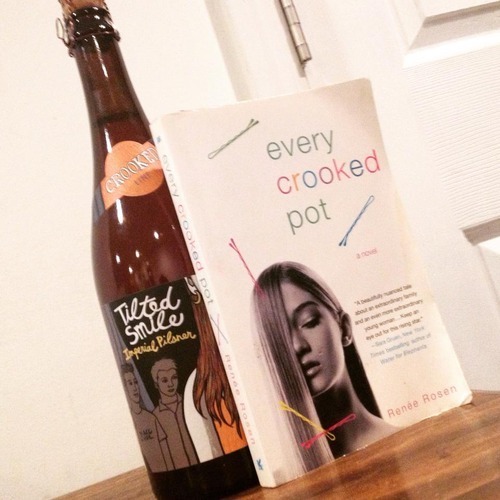
Every Crooked Pot, written by Renee Rosen and published by St. Martin’s Press, is the first-person, coming-of-age story of Nina Goldman, a girl born with a unique deformity: a strawberry-shaped and colored lump across one eyelid, running up to her eyebrow. Raised in Akron, Ohio, Nina doesn’t make many friends as a child because of her unique disfigurement. To escape the cruelty of other children, she spends the majority of her time with her family, like the most beautiful girl Nina knows, her big sister, Lissy. Or her older brother, Mitch, who can never stay in one place too long. Nina’s mother casts a comforting pall across the whole family, but it’s Nina’s father, Arthur, who becomes her biggest supporter—and her biggest burden. As a failed musician, Artie sells carpets—but he makes enough to get every treatment available for Nina’s unusual condition, to indulge in things like a pipe collection and early, residential-use microwaves. Only, Artie misses music, and most of all, he worries a great deal for his children. He’s a man of many regrets and many worries, but as Nina grows older, she begins to realize he’s a man of just as much wisdom too.
This book fell into my possession as a result of Reading Under the Influence. Before I started running Reading Under the Influence, I attended just about every month. It was my favorite local, literary reading series and the only one that habitually fit my budget and schedule, located relatively within reach off the Chicago red line. On Sheffield and School, for eleven months of the year (because who wants to go out in January anyway?), Sheffield’s Beer Garden hosts Reading Under the Influence on the first Wednesday of every month. Each reading has its own theme determined (at random, sometimes) by its small, motley crew of writers and literary enthusiasts, and usually has four readers, some with published novels while others are just starting out. Over the course of two rounds, each reader will take a shot of their preferred poison and read twice: once from their original works and once from works published by another author, accompanied by trivia questions that fit the theme. The trivia winners? Well, they get a book and a drink ticket. That’s just how I came about this book.
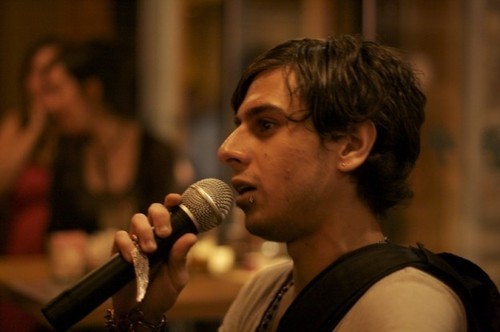
(Not the most flattering image of me at Reading Under the Influence, but I’ll take it.)
There’s something unique about this book that I find uncommon in coming-of-age stories: while this book has sexuality and strong language, the author is real goddamn slow to get into it. We know people are having sex—hell, we know people want to curse about all kinds of shit too. But the author eases into it as the novel progresses, almost as though Nina either can’t remember anything even mildly questionable in nature, or she purposefully forgot it. And it’s not like there aren’t times when this kind of thing wouldn’t happen: her father gets angry, her sister’s probably getting laid. But Nina simply doesn’t acknowledge that it occurs until her point-of-view transitions from a child to a teenager, when she’s cursing and fucking on her own. I found this technique effective because it’s more authentic to Nina’s childlike point-of-view, even if it isn’t necessarily realistic. Though it’s not something really plausible that people never learned to swear or fuck until Nina became a woman, it’s true to the character immersed in the innocent naivete of her childhood. After all, no one wants to believe that their youth was rife with the same dysfunction as their adulthood. Likewise, as Nina gets older, the author expects the audience to draw more adult conclusions than they would have when Nina was a child. For instance, during one Nina’s first sexual experiences, what a character perceives as urine is actually suggested to be vaginal lubrication. Maybe it’s because I’m a male, but if I was a teenager, I wouldn’t have jumped to that conclusion. I didn’t learn that vaginas self-lubricate until I, figuratively, looked into it—but Nina doesn’t know that any better than I did as a teenager. So Rosen doesn’t spell it out. To add another layer of authenticity, the swearing that does occur throughout the collective novel is when Artie exclaims, “Jesus Christ, Nina!” But the thing is is that Artie, his family included, is Jewish. It was one of those things that never occurred to me until I read this book—non-Christians using Jesus Christ to denote surprise or anger never made sense to me. I sat down with my friend, Nick, who was raised Atheist but is Jewish in ancestry, and he described all the times his family used the name of Christ in moments of anxiety. Whether you’re Jewish or not, there’s a lot to this novel that is real, and that’s what makes it fun.
Now we’re jumping from the 1970s of Ohio to the new millennium in Illinois. In 2005, a group of MFA students from Columbia College Chicago, including Rob Duffer, Julia Borcherts, Amanda Snyder, Joe Tower, and Carly Huegelmann, probably intended a little vaginal lubrication talk themselves when they stepped up to the plate to start Reading Under the Influence. They set up shop permanently at Sheffield’s, with the help of its owner and fellow writer, Ric Hess, may he rest in peace. And for almost eight years, they ran the show with a number of additional hosts and staff members, including Naomi Huffman (Curbside Splendor staff and host of The Marrow) and Amy Guth (operational manager for the Redeye and Metromix). And in their eighth year? Well, the old guard, led by Julia Borcherts, entrusted their show to a new crew. Erin Nederbo, for instance, was one of their former interns. Bronwyn Mead and Jon Natzke were some of the most highly sought-after authors in Columbia College Chicago’s undergraduate program. And Frankie Migacz and Behnam Riahi? Well, those two kids have their own story. They struggled to put together couple of their own reading shows, but never maintained one for more than a year after running into too many snags at too many bars. That dynamic duo, however, certainly made their impact on the Chicago literary scene in displays of vulgar antics and senseless chaos. At least I think we did?
![]()
(Rob Duffer certainly used to put the “under the influence” part in Reading Under the Influence.)
This book is broken down into instances generally involving Nina’s eye and the way people treat her because of it, or in instances examining her relationship with her father. In most cases, the instances accomplish both—Nina and Artie go back and forth. As things get better for her eye, things get worse for her father, and vice-versa. The two are almost symbiotic in that capacity, Nina’s eye requiring her father just as much as her father requires Nina’s eye. The give-and-pull of this strange relationship, illustrated through these instances devoted to milestones in Nina’s childhood, compels us through the narrative as we wait to find out if her father ever really does fix her eye, or if she overcomes the social anxiety that accompanies it. It’s because of this ongoing theme conveyed through instances that this almost feels like a novel-in-stories instead of a novel, like a coming-of-age, teen-angst version of Trainspotting. However, that’s about where these two books end in similarities. After all, in spite of some very careful thematic techniques, the biggest flaw in Every Crooked Pot is its theme. Perhaps it’s because it’s a teen lit novel and I’m still very unfamiliar with this particular genre, but the theme of a girl struggling to accept herself while quibbling with her overprotective father just didn’t appeal to me. The solution in the end would have very easily been the same solution in the beginning, and though that doesn’t sound extremely different than an action story where the bad guy should have just been killed from the start, it does lack a layer of self-discovery we come to anticipate with literature, and I surmise that a lot of that is actually because it’s broken up into instances. Had it been one, succinct narrative, the revelation would have felt like a revelation—as it was though, it felt more like “too little, too late.” Like we watched this character fail time and time again under the same, repetitive pressures of daughterhood and vanity that encompass this novel as a whole. Sometimes, a novel-in-stories isn’t the best way to get your point across, especially when each instance fails to drive their own individual theme home. And while many of the themes illustrated in each chapter are given some finality, their mundane subject matter isn’t enough to bolster the overall theme of this novel.
Speaking of conflicts, Frankie and I started out as rivals before we ran literary readings together. We were both trying to fetch the same grant money for opposing projects—and we both lost. It’s not that our ideas weren’t good—Frankie had a notion of starting a literary magazine that turned reviews of local hot-spots into stories themselves. I wanted to put together a collection of stories about experiences being a nerd of a particular fandom. Not fan fiction though, I have to keep telling people that. In either case, neither of us actually got the grant. As it turned out, they weren’t looking for short story anthologies. With our combined tragedy at the loss of our grant, we put together a literary reading at the Hidden Shamrock in Lincoln Park, only we barely knew what we were getting into. Unfortunately, within the few of us that put this idea together, just Frankie and I shared a unique vision—other people on our staff saw only what they wanted to see. One of our staff readers in particular spent fifteen to twenty minutes on stage, reading from an experimental, Dali-inspired piece that lacked both meaning and literary foundation, and also drove our audience really fucking bored. In addition to that, there was trouble with the band we encouraged to play for us, who forgot to bring their own sound equipment, and inevitably did an acoustic set after much begging and pleading. These were all problems that we didn’t necessarily anticipate, but we dealt with them as we could. It was one of the longest nights of my life and when I look back, I smile internally at all the stupid struggles we went through to put our own show on that evening, to start my own literary reading series. In the end, Frankie and I decided we’d do better the next time around. We streamlined our hodgepodge reading into a literary game called the Gamble and ran it at a couple of other bars for quite a few months more, but we gave it up when we couldn’t find a permanent home. And that’s when RUI found us. Funny thing about that first reading though, some good came out of it after all—that was the first time that the Chicago Center for Literature and Photography heard about me.
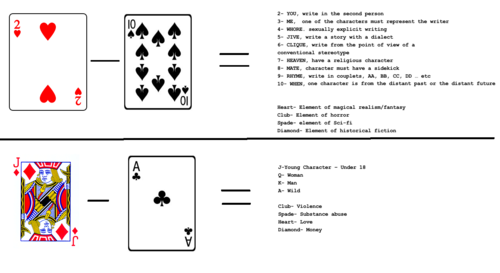
(The rules of the Gamble. I’d really like to do this again.)
Though theme is a pretty big weakness in this piece, it’s not so big that it overshadows the whole novel. However, what took me out of the story were some of the challenges presented by the text itself on the page. My biggest pet peeve in literature is when authors use capitalization of a full statement to depict a character’s angry tone or loud volume. It’s like saying, “Because I can’t describe how loud this is, let me show it to you.” If I wanted to read a story with pictures though, I’d spend more money on comics. Although Rosen doesn’t do it as much as previous authors I’ve read, it comes early on in the book and sticks with you throughout the rest of the novel. Other funny text issues include a moment when describing a hospital tray, Rosen uses the phrase “L-shaped” to describe a table. I’m perfectly okay with this—only in the actual printing of the book, the font is changed so that the L is sans-serif, as opposed to the rest of the text. This only happens once in the entire piece, but it stands out like a sore thumb, much like sentences composed of capital letters. Or like a disfigured eye? I’m not sure it’s supposed to be that meta, but maybe even I missed the point.
What really ironed down RUI for Frankie and myself wasn’t that we ran our own lit readings or that I was Criminal Class Press’s publicist at the time. It related directly to the fact that we attended RUI 11 months out of the year. If you want to be appreciated for the work you do, you need only throw yourself into the mix to get there. After all, let’s face it—I’m still not an established author yet. I’ve only published a few short stories, I’ve only read about a hundred and some books over the course of my life, and I’ve only got one degree in writing. But I’ve made an impact because I’ve been there, because I’ve promoted good work, and because I’ve taken a conscious effort to study and understand what makes a story good. Now I edit, and this year, there’ll be two books coming out with my name on it—and at least two more next year too. Most notable of all, I’ll still be hosting RUI any given Wednesday night. Ten years running—I wager I have another ten left in me. One thing I will say in my defense about not having more work though: it’s just because I have more novel material than short stories. Hope that’s something worth looking forward to.

(Reading Under the Influence, me and the foreground with Rob in the back. Awesome haircut though, really.)
Every Crooked Pot isn’t as bad as I made it sound either. There’s really some multi-faceted characters here, each with their own unique talents or attributes that bring everyone together. As Nina goes through the story, she begins to see how imperfect everyone is—and how those imperfections make her bad eye look superficial. That’s what this story is about—how not everyone will accept you the way you are, but your family will still love you unconditionally. It’s another theme that’s hard for me to grasp, but it’s there—like Rosen’s insinuations, you need to dissect the other ideas presented here to find it. And though I didn’t relate to this family’s struggle, I was moved by it—in some moments, I was even moved to tears while watching Nina and Artie struggle through a dysfunctional father-daughter relationship. I guess we’re all looking for a family—some of us are lucky enough to have one, some of us find one in a small literary reading series that they unexpectedly adopt. Either way, I’m open to reading more from Rosen in the future. And though my review was harsh, I hope to see you at RUI soon.
Every Crooked Pot, written by Renee Rosen and published by St. Martin’s Press, is the first-person, coming-of-age story of Nina Goldman, a girl born with a unique deformity: a strawberry-shaped and colored lump across one eyelid, running up to her eyebrow. Raised in Akron, Ohio, Nina doesn’t make many friends as a child because of her unique disfigurement. To escape the cruelty of other children, she spends the majority of her time with her family, like the most beautiful girl Nina knows, her big sister, Lissy. Or her older brother, Mitch, who can never stay in one place too long. Nina’s mother casts a comforting pall across the whole family, but it’s Nina’s father, Arthur, who becomes her biggest supporter—and her biggest burden. As a failed musician, Artie sells carpets—but he makes enough to get every treatment available for Nina’s unusual condition, to indulge in things like a pipe collection and early, residential-use microwaves. Only, Artie misses music, and most of all, he worries a great deal for his children. He’s a man of many regrets and many worries, but as Nina grows older, she begins to realize he’s a man of just as much wisdom too.
This book fell into my possession as a result of Reading Under the Influence. Before I started running Reading Under the Influence, I attended just about every month. It was my favorite local, literary reading series and the only one that habitually fit my budget and schedule, located relatively within reach off the Chicago red line. On Sheffield and School, for eleven months of the year (because who wants to go out in January anyway?), Sheffield’s Beer Garden hosts Reading Under the Influence on the first Wednesday of every month. Each reading has its own theme determined (at random, sometimes) by its small, motley crew of writers and literary enthusiasts, and usually has four readers, some with published novels while others are just starting out. Over the course of two rounds, each reader will take a shot of their preferred poison and read twice: once from their original works and once from works published by another author, accompanied by trivia questions that fit the theme. The trivia winners? Well, they get a book and a drink ticket. That’s just how I came about this book.
(Not the most flattering image of me at Reading Under the Influence, but I’ll take it.)
There’s something unique about this book that I find uncommon in coming-of-age stories: while this book has sexuality and strong language, the author is real goddamn slow to get into it. We know people are having sex—hell, we know people want to curse about all kinds of shit too. But the author eases into it as the novel progresses, almost as though Nina either can’t remember anything even mildly questionable in nature, or she purposefully forgot it. And it’s not like there aren’t times when this kind of thing wouldn’t happen: her father gets angry, her sister’s probably getting laid. But Nina simply doesn’t acknowledge that it occurs until her point-of-view transitions from a child to a teenager, when she’s cursing and fucking on her own. I found this technique effective because it’s more authentic to Nina’s childlike point-of-view, even if it isn’t necessarily realistic. Though it’s not something really plausible that people never learned to swear or fuck until Nina became a woman, it’s true to the character immersed in the innocent naivete of her childhood. After all, no one wants to believe that their youth was rife with the same dysfunction as their adulthood. Likewise, as Nina gets older, the author expects the audience to draw more adult conclusions than they would have when Nina was a child. For instance, during one Nina’s first sexual experiences, what a character perceives as urine is actually suggested to be vaginal lubrication. Maybe it’s because I’m a male, but if I was a teenager, I wouldn’t have jumped to that conclusion. I didn’t learn that vaginas self-lubricate until I, figuratively, looked into it—but Nina doesn’t know that any better than I did as a teenager. So Rosen doesn’t spell it out. To add another layer of authenticity, the swearing that does occur throughout the collective novel is when Artie exclaims, “Jesus Christ, Nina!” But the thing is is that Artie, his family included, is Jewish. It was one of those things that never occurred to me until I read this book—non-Christians using Jesus Christ to denote surprise or anger never made sense to me. I sat down with my friend, Nick, who was raised Atheist but is Jewish in ancestry, and he described all the times his family used the name of Christ in moments of anxiety. Whether you’re Jewish or not, there’s a lot to this novel that is real, and that’s what makes it fun.
Now we’re jumping from the 1970s of Ohio to the new millennium in Illinois. In 2005, a group of MFA students from Columbia College Chicago, including Rob Duffer, Julia Borcherts, Amanda Snyder, Joe Tower, and Carly Huegelmann, probably intended a little vaginal lubrication talk themselves when they stepped up to the plate to start Reading Under the Influence. They set up shop permanently at Sheffield’s, with the help of its owner and fellow writer, Ric Hess, may he rest in peace. And for almost eight years, they ran the show with a number of additional hosts and staff members, including Naomi Huffman (Curbside Splendor staff and host of The Marrow) and Amy Guth (operational manager for the Redeye and Metromix). And in their eighth year? Well, the old guard, led by Julia Borcherts, entrusted their show to a new crew. Erin Nederbo, for instance, was one of their former interns. Bronwyn Mead and Jon Natzke were some of the most highly sought-after authors in Columbia College Chicago’s undergraduate program. And Frankie Migacz and Behnam Riahi? Well, those two kids have their own story. They struggled to put together couple of their own reading shows, but never maintained one for more than a year after running into too many snags at too many bars. That dynamic duo, however, certainly made their impact on the Chicago literary scene in displays of vulgar antics and senseless chaos. At least I think we did?
(Rob Duffer certainly used to put the “under the influence” part in Reading Under the Influence.)
This book is broken down into instances generally involving Nina’s eye and the way people treat her because of it, or in instances examining her relationship with her father. In most cases, the instances accomplish both—Nina and Artie go back and forth. As things get better for her eye, things get worse for her father, and vice-versa. The two are almost symbiotic in that capacity, Nina’s eye requiring her father just as much as her father requires Nina’s eye. The give-and-pull of this strange relationship, illustrated through these instances devoted to milestones in Nina’s childhood, compels us through the narrative as we wait to find out if her father ever really does fix her eye, or if she overcomes the social anxiety that accompanies it. It’s because of this ongoing theme conveyed through instances that this almost feels like a novel-in-stories instead of a novel, like a coming-of-age, teen-angst version of Trainspotting. However, that’s about where these two books end in similarities. After all, in spite of some very careful thematic techniques, the biggest flaw in Every Crooked Pot is its theme. Perhaps it’s because it’s a teen lit novel and I’m still very unfamiliar with this particular genre, but the theme of a girl struggling to accept herself while quibbling with her overprotective father just didn’t appeal to me. The solution in the end would have very easily been the same solution in the beginning, and though that doesn’t sound extremely different than an action story where the bad guy should have just been killed from the start, it does lack a layer of self-discovery we come to anticipate with literature, and I surmise that a lot of that is actually because it’s broken up into instances. Had it been one, succinct narrative, the revelation would have felt like a revelation—as it was though, it felt more like “too little, too late.” Like we watched this character fail time and time again under the same, repetitive pressures of daughterhood and vanity that encompass this novel as a whole. Sometimes, a novel-in-stories isn’t the best way to get your point across, especially when each instance fails to drive their own individual theme home. And while many of the themes illustrated in each chapter are given some finality, their mundane subject matter isn’t enough to bolster the overall theme of this novel.
Speaking of conflicts, Frankie and I started out as rivals before we ran literary readings together. We were both trying to fetch the same grant money for opposing projects—and we both lost. It’s not that our ideas weren’t good—Frankie had a notion of starting a literary magazine that turned reviews of local hot-spots into stories themselves. I wanted to put together a collection of stories about experiences being a nerd of a particular fandom. Not fan fiction though, I have to keep telling people that. In either case, neither of us actually got the grant. As it turned out, they weren’t looking for short story anthologies. With our combined tragedy at the loss of our grant, we put together a literary reading at the Hidden Shamrock in Lincoln Park, only we barely knew what we were getting into. Unfortunately, within the few of us that put this idea together, just Frankie and I shared a unique vision—other people on our staff saw only what they wanted to see. One of our staff readers in particular spent fifteen to twenty minutes on stage, reading from an experimental, Dali-inspired piece that lacked both meaning and literary foundation, and also drove our audience really fucking bored. In addition to that, there was trouble with the band we encouraged to play for us, who forgot to bring their own sound equipment, and inevitably did an acoustic set after much begging and pleading. These were all problems that we didn’t necessarily anticipate, but we dealt with them as we could. It was one of the longest nights of my life and when I look back, I smile internally at all the stupid struggles we went through to put our own show on that evening, to start my own literary reading series. In the end, Frankie and I decided we’d do better the next time around. We streamlined our hodgepodge reading into a literary game called the Gamble and ran it at a couple of other bars for quite a few months more, but we gave it up when we couldn’t find a permanent home. And that’s when RUI found us. Funny thing about that first reading though, some good came out of it after all—that was the first time that the Chicago Center for Literature and Photography heard about me.
(The rules of the Gamble. I’d really like to do this again.)
Though theme is a pretty big weakness in this piece, it’s not so big that it overshadows the whole novel. However, what took me out of the story were some of the challenges presented by the text itself on the page. My biggest pet peeve in literature is when authors use capitalization of a full statement to depict a character’s angry tone or loud volume. It’s like saying, “Because I can’t describe how loud this is, let me show it to you.” If I wanted to read a story with pictures though, I’d spend more money on comics. Although Rosen doesn’t do it as much as previous authors I’ve read, it comes early on in the book and sticks with you throughout the rest of the novel. Other funny text issues include a moment when describing a hospital tray, Rosen uses the phrase “L-shaped” to describe a table. I’m perfectly okay with this—only in the actual printing of the book, the font is changed so that the L is sans-serif, as opposed to the rest of the text. This only happens once in the entire piece, but it stands out like a sore thumb, much like sentences composed of capital letters. Or like a disfigured eye? I’m not sure it’s supposed to be that meta, but maybe even I missed the point.
What really ironed down RUI for Frankie and myself wasn’t that we ran our own lit readings or that I was Criminal Class Press’s publicist at the time. It related directly to the fact that we attended RUI 11 months out of the year. If you want to be appreciated for the work you do, you need only throw yourself into the mix to get there. After all, let’s face it—I’m still not an established author yet. I’ve only published a few short stories, I’ve only read about a hundred and some books over the course of my life, and I’ve only got one degree in writing. But I’ve made an impact because I’ve been there, because I’ve promoted good work, and because I’ve taken a conscious effort to study and understand what makes a story good. Now I edit, and this year, there’ll be two books coming out with my name on it—and at least two more next year too. Most notable of all, I’ll still be hosting RUI any given Wednesday night. Ten years running—I wager I have another ten left in me. One thing I will say in my defense about not having more work though: it’s just because I have more novel material than short stories. Hope that’s something worth looking forward to.
(Reading Under the Influence, me and the foreground with Rob in the back. Awesome haircut though, really.)
Every Crooked Pot isn’t as bad as I made it sound either. There’s really some multi-faceted characters here, each with their own unique talents or attributes that bring everyone together. As Nina goes through the story, she begins to see how imperfect everyone is—and how those imperfections make her bad eye look superficial. That’s what this story is about—how not everyone will accept you the way you are, but your family will still love you unconditionally. It’s another theme that’s hard for me to grasp, but it’s there—like Rosen’s insinuations, you need to dissect the other ideas presented here to find it. And though I didn’t relate to this family’s struggle, I was moved by it—in some moments, I was even moved to tears while watching Nina and Artie struggle through a dysfunctional father-daughter relationship. I guess we’re all looking for a family—some of us are lucky enough to have one, some of us find one in a small literary reading series that they unexpectedly adopt. Either way, I’m open to reading more from Rosen in the future. And though my review was harsh, I hope to see you at RUI soon.
August 18, 2019
This is a cutie of a book. It’s a good read for adults and young adults. The story tells us all about the dynamics in a family centered around Nina, who has an obvious deformity of one eye. It really delves into being a teen and all that growing through the teen years involves. Warm- hearted and loving read. Totally different from other Renée Risen books I have read, but full of her wit and charm.
November 4, 2020
I remember reading this book in middle school and really liking it; it had mature themes that I had never been exposed to so it was really interesting. Overall I think it is a great book of a coming-of-age story plus the way the story is told and the timeline makes it so it does not bore you at least in my opinion. By the end of the story, I wanted to know more about the characters and what would happen in the future.

May 19, 2020
2.5 out of 5 rating
June 1, 2024
I feel like I should have liked this book but it was just so boring to me. Idk bro.
March 24, 2016
“Every Crooked Pot”
Renée Rosen
Rating: 4 out of 5
In the book “Every Crooked Pot” tells a story about a girl with a skin/eye disorder. Nina the main character was born with a birthmark covering her eye. The book goes through parts of her life and the struggle she has faced because of her eye. In the book it shows all aspects of Nina’s life, whether it’s doctor visits, family time, fun and bad times with friends, etc. Nina is often times looked down upon because of the discoloration of her eye, and it really gets to her. Nina has to stay strong and try not to always let certain things hurt her. This book is very inspiring, and I definitely recommend other read it.
I personally think this book is a great read. Some reasons I found it so great are, it has a lot of life lessons to offer. The book teaches you a lot on how to be you and not be afraid to show who you are. It’s important to not change who you are, and the book really emphasizes this. I also like this book because, it takes place in the 70’s and 80’s, so it is much different. Reading some of the events are really exciting because of the things teenagers did back then. It really is intriguing reading about certain activities, especially since they are not so heard of nowadays, like many of the ‘parties’. Another reason I like this book is because it is so relatable. The book talks a lot about the struggle Nina faces with people making fun of her. A lot of people know what it’s like to be picked on. They also show the hardships between Nina and her family. There is a lot of fighting and all together typical family issues. Many of these issues are common in many households. Overall Rosen wrote a wonderful book filled with so many exciting, and sad moments making the read worthwhile.

August 4, 2013
I must admit, I almost lost hope for this book halfway through. But I'm glad I braved my way until the end, for that's when it all became worth it.
Nina Goldman was born with a hemangioma around her eye, the result of having way too many blood vessels around the affected area. Since childhood, she has always been convinced that the only reason she isn't popular is because of her birthmark. In an attempt to fit in, and finally be accepted despite her abnormality, Nina does anything and everything to prove that she is normal.
In the beginning, I really didn't like Nina's character. Whiny and self-absorbed, it seemed all that mattered was her eye and how horrible it looked. When it came to the point that she used it to get out of things, I was ready to hurl the book away in disgust. But I kept on going, hoping it would get better.
And it did. As the book progressed, and Nina got older, I really loved the character development that was taking place in all the main characters, including Nina herself. Serious issues were being taken apart, and the novel finally took meaning. There were hints of homosexuality, of depression, and of course the complex dynamics of relationships. Now there was a theme and a message to be seen.
In other words, Every Crooked Pot does disappoint a little, with its content being almost nothing like the summary leads the reader to believe. But that doesn't mean it's not worth an afternoon's reading, provided of course, you can be tolerant and patient of the characters and plot.
Nina Goldman was born with a hemangioma around her eye, the result of having way too many blood vessels around the affected area. Since childhood, she has always been convinced that the only reason she isn't popular is because of her birthmark. In an attempt to fit in, and finally be accepted despite her abnormality, Nina does anything and everything to prove that she is normal.
In the beginning, I really didn't like Nina's character. Whiny and self-absorbed, it seemed all that mattered was her eye and how horrible it looked. When it came to the point that she used it to get out of things, I was ready to hurl the book away in disgust. But I kept on going, hoping it would get better.
And it did. As the book progressed, and Nina got older, I really loved the character development that was taking place in all the main characters, including Nina herself. Serious issues were being taken apart, and the novel finally took meaning. There were hints of homosexuality, of depression, and of course the complex dynamics of relationships. Now there was a theme and a message to be seen.
In other words, Every Crooked Pot does disappoint a little, with its content being almost nothing like the summary leads the reader to believe. But that doesn't mean it's not worth an afternoon's reading, provided of course, you can be tolerant and patient of the characters and plot.
September 21, 2010
The novel Every Crooked Pot by Renee Rosen is a fiction which I enjoy reading. Even though the novel is a fiction, the story is very realistic that many girls can relate to. I would recommend the book for girls but I’m not sure about the boys. Because the story includes how girls view about guys and how girls want to look pretty for guys and the novel has many girls talk involved. The main character in the story, Nina is not confident about how she looks because she has a red, bumpy birthmark on one of her eye. So she always try to cover it up by putting the hair all over on half of her face and put very thick make up to cover the red color of her eyelid. And she believes that she is not famous and can not find a boyfriend just because of the way she looks. She thinks that beauty comes from the appearance. But towards the end of the story, she finds a boyfriend and realized that her life is not as bad as she thought. She learned that she could be loved even thought she has a birthmark and she looks different from normal people. Nina faces many conflict such as her appearance, complication with her father and friends. These conflicts are very common within teenager so I could relate to myself. The reading level was not hard, and the page number was 227pages which are good length. I usually get bored in the middle of the novel, but this novel was very special that I could enjoy reading through out the whole book.
August 22, 2007
3 1/2 stars...recommended by one of my "goodreads friends"...This is a coming-of-age story about a teenage girl who has a hemangioma across one eye. I really liked it, especially the second half, and thought the author had a good understanding of the psychological makeup of many teenagers, including the body image issues, insecurities, attention-seeking behaviors, and complex desires surrounding family (proud one minute, embarrased the next, and a desire to make everything okay for the more needy members of the family). I loved the insights that she had by the end of the book both about being different and about her relationship with her father. I think I would have enjoyed this book as a teenager, actually, and think some of my teenage patients (especially the ones with eating disorders) would connect with it. This book also reminded me of "Autobiography of a Face", by Lucy Grealy, a memior of Grealy's own years growing up after cancer left her face disfigured. Strangely, though, I think this fictional story felt more like every teen's story in a way, and Grealy's set her teen years apart as very unique.
July 29, 2011
Ugh. This book is ostensibly about Nina, her portwine stain and how she overcomes her disability, if you will. While that's not something that appeals to me -- I was primarily reading it because of its Akron setting -- the author could have won me over by writing a lively, interesting story.
Instead, you have a whiny main character who's never happy, even when things are going right, and a plotline that's really centered on the character's -- and author's -- relationship with her father. Because what it is is really a collection of vignettes about dad that never amount to an actual story.
There's a certain amount of write-what-you-know that allows for creativity within the confines of familiarity, and then there's the feeling that you're simply reading a collection of family stories because too many people over the years said, "Man, your dad is such a character! Why don't you write a book about him!"
This is most assuredly the latter, and as a reader, I was just waiting for it to end.
Instead, you have a whiny main character who's never happy, even when things are going right, and a plotline that's really centered on the character's -- and author's -- relationship with her father. Because what it is is really a collection of vignettes about dad that never amount to an actual story.
There's a certain amount of write-what-you-know that allows for creativity within the confines of familiarity, and then there's the feeling that you're simply reading a collection of family stories because too many people over the years said, "Man, your dad is such a character! Why don't you write a book about him!"
This is most assuredly the latter, and as a reader, I was just waiting for it to end.

July 19, 2007
I loved this book! I haven't enjoyed a book this much in awhile. It's the coming of age story of Nina, a young girl with with a hemangioma on her eye (it follows her from about ages 13 to 20 or so). Of course, reading the book it become apparent that all the things she worries about are universal to most teens, hemangioma or no. Whereas most teens might think "why doesn't this boy like me?" she was thinking "it's because of my eye." She had a "reason." I found myself wondering many times whether this made it better or worse for her. Anyway, I loved the character and I loved her relationship with her father. I was *bawling* by the end, their relationship was so charming and so complicated. It's a shortish book (220 pages) but I felt like I really knew the characters. Highly, highly recommended!

July 26, 2011
It was an okay book. I wouldn't tell a friend to not read it if they picked it up, but I don't know that I'd recommend it either. I feel like it took a little while to get into the book and the characters don't grow or develop until the last chapter or two of the book. You hate the protagonist's father, you feel bad for the protagonist and then just feel like she's whiny, you don't learn much about the rest of the characters--such as the protagonist's mother, sister, brother or friends--and just when the book starts to pick up and the characters begin to become three dimensional, the book ends.
All of that being said, I still did enjoy the book. At the end, I definitely teared up as the characters grew and changed, but, like I said, there were many times throughout the book where I just wanted to slap some of the characters.
Not an A, not an F...probably a C/C+/B-.
All of that being said, I still did enjoy the book. At the end, I definitely teared up as the characters grew and changed, but, like I said, there were many times throughout the book where I just wanted to slap some of the characters.
Not an A, not an F...probably a C/C+/B-.

June 10, 2013
Every Crooked Pot by Renee Rosen tells the story of a almost larger than life family, with the main focus on Nina. She is the youngest child. She was born with a birth mark on her right eye and lid. The story starts in 1968 and continues. I grew up during the time frame that the story is placed. Talking about bell bottom jeans and tie dye shirts.
At times the story would seem to drag a bit but it was to help build the story line. Nina felt that if she could be without the birth mark then her life would be perfect. She tried salt water treatments, injections and laser treatments. She wanted to be part of the in crowd but only seemed to be able to hang onto the edge.
I haven’t looked to see if Ms. Rosen has written any more books but if she has I would give them a try.
I received this book for free from Goodreads First Read.
At times the story would seem to drag a bit but it was to help build the story line. Nina felt that if she could be without the birth mark then her life would be perfect. She tried salt water treatments, injections and laser treatments. She wanted to be part of the in crowd but only seemed to be able to hang onto the edge.
I haven’t looked to see if Ms. Rosen has written any more books but if she has I would give them a try.
I received this book for free from Goodreads First Read.

October 23, 2008
This book is a timeline of Nina Goldman's life, from a youngster to and adult. Ninna Goldman has a big pink strawberry birth mark on her eye. Nina thinks that she will never find true love, and everybody will make fun of her. When she goes back to school everybody makes fun of her except for a fat girl named Patty, who turns out to be Nina's best friend. Nina is having trouble understanding life as she matures. Nina's and Patty's friendship loosen and soon Nina is asking Patty why so many boys like patty and not her, she says that Patty is fat. Patty is upset by this and doesn't speak to Nina for a long time. Will Patty be the only friend that Nina has? Will the birth mark that is enclosing her in a bubble go away? Will nina finally find what she is looking for, true love?
September 30, 2013
In my opinion, this book was not the best. There was no drama or suspence. The book was very predictable. There should have been different things that went on instead of everything repeating.
Every Crooked Pot is about a girl named Nina who was born with a swoolen eye. It is all purple and black. She is bullied and does not fit in with the people at school. New neighbors move in and Patty, a girl her age becomes good friends with Nina. As Nina gets older she sees different eye specialists for seven years and nothing was able to cure her eye.
This book shows how insecure Nina was about her eye and how she was never invited to the highschool partys and never had a boyfriend. This book can be relatiable to girls who have insecurities.
Every Crooked Pot is about a girl named Nina who was born with a swoolen eye. It is all purple and black. She is bullied and does not fit in with the people at school. New neighbors move in and Patty, a girl her age becomes good friends with Nina. As Nina gets older she sees different eye specialists for seven years and nothing was able to cure her eye.
This book shows how insecure Nina was about her eye and how she was never invited to the highschool partys and never had a boyfriend. This book can be relatiable to girls who have insecurities.
Displaying 1 - 30 of 67 reviews