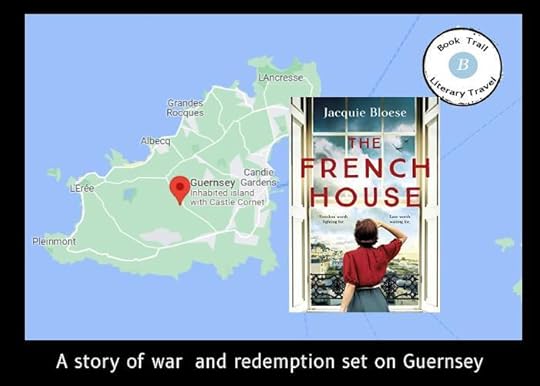
'A raw and honest love story, filled with a wealth of historical detail. The French House is a powerful depiction of the brutal intricacies of island relationships and loyalties in a time of war' FIONA VALPY, bestselling author of The Dressmaker's Gift
Freedom worth fighting for. Love worth waiting for.
In Nazi-occupied Guernsey, the consequences of making the wrong decision can be deadly...
Left profoundly deaf after an accident, Émile is no stranger to isolation - or heartbreak. Now, as Nazi planes loom over Guernsey, he senses life is about to change forever.
Trapped in a tense, fearful marriage, Isabelle doesn't know what has become of Émile and the future she hoped for. But when she glimpses him from the window of the French House, their lives collide once more.
Leutnant Schreiber is more comfortable wielding a paintbrush than a pistol. But he has little choice in the role he is forced to play in the occupying forces - or in his own forbidden desires.
As their paths entwine, loyalties are blurred and dangerous secrets forged. But on an island under occupation, courage can have deadly consequences...
Lyrical, moving and compelling, this is a novel about wanting to hear and learning to listen - to the truths of our own hearts. Perfect for lovers of The Nightingale, The Guernsey Literary and Potato Peel Pie Society and All the Light We Cannot See.
'A brilliantly moving historical novel' - 2020 Caledonian Novel Award panel
The French House is an unhurried and thought provoking historical fiction story set in Guernsey during the German occupation. Emile Quenneville is taking a load of tomatoes to the port, when German planes start dropping bombs and he knows life on the tranquil island will never be the same.
Isabelle Larch is married to Ronald and Emile was her first love. Years ago he returned to Guernsey, deafened by an accident and discovers she’s wed another. Emile marries Letty, they have two daughters Maud and Stella.
Emile starts working as a gardener at The French House, growing vegetables for the Germans and where Isabelle is the housekeeper.
Lieutenant Peter Schreiber is billeted with the Larch’s, forced to serve in the German army, the former Oxford student, is a talented painter and artist. Peter has a forbidden longing, it wouldn’t be tolerated by his comrades and he has to keep it a secret.
Emile struggles due to being deaf, he’s troubled and frustrated and spends the odd night sleeping in the potting shed. Soon the locals are gossiping about Isabelle and Emile and it’s only a matter of time before their spouses find out.
The narratives about life in Guernsey during the Second World War, how hard it was for the islanders being completely cut off from the mainland, you get a real insight into the restrictions, challenges, shortages, suffering and deportations. A story about complex relationships, loss, love, secrets, courage, consequences, lessons learnt and redemption.
I received a copy of The French House by Jacquie Bloese from NetGalley and Hodder & Stoughton in exchange for an honest review. My favorite character is Emile, his demeanor changes over the course of the story and he becomes a hero. It was interesting to read the author’s notes at the end, the house was originally called Hauteville and belonged to French novelist Victor Hugo from 1856 to 1870 and five stars from me. https://karrenreadsbooks.blogspot.com/ https://www.facebook.com/KarrenReadsH...
The quality of the writing drew me in from the first paragraph of this glorious novel, and Émile’s random, life-changing accident on page four had me rooting for him. He had travelled to Vancouver to seek his fortune but returned to Guernsey profoundly deaf and penniless, to find that Isabelle, love of his life, had married another man. His proud and stoic acceptance of his lot, along with his compassion for others, make him a compelling, very likeable character, whose fate provides the main narrative drive.
The backdrop for most of the story is the occupation of Guernsey during World War Two. A German soldier is billeted in Isabelle’s spare room – but he is not the goose-stepping, vicious Nazi of caricature but a sensitive, artistic man with secrets. There are edge-of-the-seat moments but at first the occupiers do not impinge too much on everyday life. Then, as supplies of food dwindle, the claustrophobia of island life increases, and loyalties are tested.
The tangled relationships in the novel get under your skin and make it hard to put down. Émile still loves Isabelle but both are married to other people. Émile’s daughter Maud is on a mission to uncover hidden family truths. Letty takes drastic action to earn money. The tensions in Émile’s marriage are portrayed with great insight and originality. There is never a clichéd moment.
Jacquie Boese has a real knack for concise, vivid descriptions and characters that spring from the pages. I thought I’d read enough World War Two love stories to last a while, but this one is refreshingly different. It’s hard to believe it’s a debut novel, because it feels incredibly accomplished. I urge you to read it.
With thanks for Hodder & Stoughton for sending a proof copy.
In Nazi=occupied Guernsey, the consequences of making the wrong decision can be deadly. Left profoundly deaf after an accident, Emile is no stranger to isolation - or heartbreak. Now, as Nazi planes loom over Guernsey, he senses life is about to change forever.
Trapped in a tense fearful marriage, Isabelle doesn't know what has become of Emile and the future she hoped for.
Lieutenant Schreiber is more comfortable wielding a paintbrush than a pistol. But he has little choice in the role he is forced to play in the occupying forces.
I did like the authors writing style but this is a slow burner. It's basically a love story set around the time the Nazis had occupied Guernsey. It is interesting though, learning about Hauteville House where novelist Victor Hugo lived during his exile from France. The characters were well drawn out. This is a heartwrenching story. I really liked Emile's character from when we first met him. If the pace had been a littler quicker, this would have been a five star read for me.
I would like to thank #NetGalley #HodderStoughton and the author #JacquieBloese for my ARC of #TheFrenchHouse in exchange for an honest review.
The French House is set in Nazi-Occupied Guernsey and follows the lives of several inhabitants during these years, focusing in particular on Emile and his family, as well as Isabelle Larch and her husband, and the German solider, Peter Schreiber, who is billeted with them. Emile and Isabelle were engaged to be married many years before, however, that was before Emile had the accident that left him deaf. Now though as both work at the French House, their paths cross once more, and indeed the lives of all these characters will intertwine in sometimes unexpected ways.
This was a gently paced story, more character driven, but one that paints a vivid picture of life in Guernsey during the Occupation. At its heart it is a love story, and I liked that the main romance was between maturer characters. Given both Emile and Isabelle are married to other people, things between them are complicated, and whilst Isabelle's husband is vile, Emile's situation was a little less black and white. He is married to Letty, and whilst their marriage is far from a contented one and Letty has not always been the perfect wife, there were times when I did feel sorry for her, and I liked that the author made her a sympathetic character. I also thought she captured the tensions in their marriage well, portraying it in a very realistic way, and still managing to show small moments of affection and warmth between them too.
Furthermore, there are many relationship dynamics at play within the story, such as a complex father-daughter relationship between Emile and Maud, as well as Isabelle's connection to Peter, who she treats almost as a surrogate son, having lost her own son.
I liked that not all the German characters were villainously portrayed, with Peter a very likable character, and harbouring secrets of his own.
I thought Blouse did a good job of showing the daily struggles and hardships of the Island's occupants during this time, be it the restrictions and shortages, as well as the brutalities endured and the claustrophobic feeling of always being under such close scrutiny. The sense of tension and the stakes rise as the story goes on and loyalties are tested, with acts of courage and compassion shown.
I also thought that the author handled Emile's hearing impairment well, the daily struggles and frustrations he endures, and his sense of isolation.
Furthermore, I found Blouse's writing style very engaging, and overall thought this an absorbing and evocative read, with an array of interesting and well drawn characters. Incidentally the French House of the title, refers to Hauteville House, where Victor Hugo lived during his exile.
The French House is an exquisitely written novel set on the island of Guernsey during the German occupation in WWII. A heart wrenching story, told with great empathy about how love is complicated and untidy; how life can be brutal, but how strength and courage are found through acts of kindness and compassion. Émile, rendered profoundly deaf as a young man in a terrible accident and who captured my heart from the first pages, is a quiet, tormented hero and his story, wound up with that of Isabelle, Letty and the gentle Lieutenant Schreiber, is told with great sympathy. A truly special debut historical novel.
I loved visiting Guernsey during the 1940s through The French House. It’s a beautifully written love story in a unique setting. The author has drawn the characters so well that it’s a delight to enter their lives and experience their struggles. What a treat! I won a copy of the novel as part of a Twitter giveaway. Thank you, Jacquie Bloese.
If you thought you had read enough stories about Guernsey and the German occupation then think again. This is unique and utterly beguiling which you might not think given the subject matter but the writing elevates it to another level and its clever research and author’s deft of hand really makes a difficult subject shine through.
You might not think this is going to be a positive novel as in the early chapters, lead character Emilie suffers hearing loss. He ends up in Guernsey at the same time as his childhood sweetheart Isabelle.
They end up meeting at Hauteville house which was actually the real life home of Victor Hugo. So, queue the literary links from the start! He finds out that isabelle is now married and eventually he marries someone else. But neither of the childhood sweethearts are happy and there is a fair amount of longing regret and tension. Before anything can happen, the war erupts and the Germans invade changing life for ever.
It was very interesting to read about the German invasion of Guernsey as this is not a setting that I often read about in ww2. The people of Guernsey are a small community and there is a lot of suspicion and fear when the Germans bring so much danger and uncertainty, bringing the war right on their island doorstep.
What I really appreciate learning about too was Emile and his deafness. How was a deaf person treated at this time and what did the Germans make of him? There is a great deal of loneliness and claustrophobia om the island to begin with and add deafness to that and you have some seriously grave issues to deal with. I was shocked and moved in equal measure. Impossible to put yourself in his shoes but you do get a keen sense of what this poor man and deaf people at the time faced. He was lonely and solitary and my heart went out to him.
Oh, what a shame this turned out to be. I was blindsided by the cover art because this is exactly my favourite type of historical fiction genre, but I was disappointed in this one.
The writing itself is okay, if a little jilted at times, but I just couldn’t get to grasp with the characters and their motivations. There was no single character to focus on in detail, more a hodge podge of events and conversations without any real story progression.
This is the authors debut so I just hope she continues to write and excels in her craft. The potential is there, but this book was one hard slog for me.
The French House begins in Vancouver in 1911 where Émile has travelled for work in the hope of securing a better life. He desperately misses his fiancé Isabelle, whom he hasn’t heard from for several months but still keeps writing to her. When an accident leaves him badly injured and deaf, he returns to Guernsey, to find Isabelle married to someone else. The book then moves back to Guernsey in 1940 and Émile is unhappily married to Letty with two teenage daughters, Maud and Stella. With the occupation of Guernsey by the Germans, Émile finds himself working in the gardens of the French House, the previous home of Víctor Hugo, where Isabelle works as a housekeeper, and things are understandably difficult between them given their history. Isabelle herself is unhappily married to controlling and abusive Ron and as part of the occupation, they are made to take in Lieutenant Schrieber which adds tension to the household. Isabelle herself can’t help but feel maternal to Schrieber, who is kind to her and when Émile discovers a secret about Schrieber, Isabelle and Émile find themselves thrown together again, in their attempts to help the German. It was interesting to read about the occupation of Guernsey during the Second World War which I previously read about in The Guernsey Literary and Potato Peal Society. Although the German occupation, meant the island residents were spared the bombings of mainland Britain, food was still scarce and the islanders still lived in fear, as every move was scrutinised. I have to say in the beginning I didn’t find either Émile or Isabelle very sympathetic characters. I felt Émile treated Letty badly, but as the book progressed and we find out more about what happened over the time they were apart, I warmed to both of them, but I still felt sorry for Letty. It was interesting also to read about a disabled character. I found it difficult to recall many other books that have characters with physical disabilities and Émile’s deafness is a source of frustration in his marriage. He is able to lip read to some extent but often conversations pass him by. I really enjoyed The French House, being completely transported back to 1940s Guernsey, and being able to picture the French House and the island perfectly – it is somewhere I would love to visit. It is a well paced story and a great piece of historical fiction.
A wartime love story on the island of Guernsey. A story of two people Emile and Isabelle, a lost love and a new beginning amongst the German occupation of the island. One Man Emil, two women Isabelle and Lily. How can Emile choose between his wife and his lost love.
On the island of Guernsey against the backdrop of the French House the former home of Hugo a story of the people living under the German's and living dysfunctional lives trying to survive until the island is liberated and the war ends.
Emil and Isabelle has once been engaged and Emile goes away to Canada to find his fortune in order to come back and marry Isabelle. He has a horrible accident and loses his hearing. Meanwhile his letters are hidden from Isabelle by her parents and she marries someone else.
Emil is devastated when he returns home to find she is married. He marries Lily, a pregnant housemaid he feels sorry for , raises her daughter Maude and has a daughter Stella. They live a good life growing tomatoes until the Germans come.
When his greenhouses are destroyed by the Germans he must find another job to support his family. He takes a job as gardener at the French House where Isabelle is working as a housekeeper. when they meet again he finds she is in a loveless marriage as is he and although they fight the feeling they know they are still meant to be with each other.
Then he helps Isabelle's boarder a German soldier hide from the authorities and escape from the island when he is in trouble for being a gay man which in intolerable by the Germans. Then tragedy happens and he is arrested by the Germans.
What will become of Emile and his family, of Isabelle. Will they ever find their way back to each other? Will the German soldier escape or be caught and punished? You will want to read every word of this historical love story. It was a good read and I recommend it.
Thanks to Jacquie Bloese for writing a great story, to Bookouture for publishing it and to NetGalley for making it available to me to read and review.
I loved this historical novel, following the lives of Isabelle and Emile in Guernsey during the Second World War. Isabelle and Emile were in love but due to family pressures and events outside of their control by 1941 they are both in unhappy marriages.
I was really drawn into this story from the first page. I hadn't realised before reading this that Guernsey was occupied by Nazis during the war. It was fascinating to read the impact of the Nazis occupying their small island (including the billeting, food shortages, interrogators, arrests and deportations.) The characters are so well written and the horrors of the war are shockingly portrayed. I was willing the love story between Emile and Isabelle to have a happy ending but equally by the end I emphasised for Letty who had also had a difficult life. A beautifully written and captivating story that I would recommend.
Having lived in Guernsey for many years this book came over as an authentic interpretation of the German Occupation and its effects on the community more so than the Potato Peel Society Book. With a few tweaks it could make a film as well.
Fantastic plot line, excellent story telling. My only issue is that it felt slightly cheesy, and the language wasn’t at all times my cup of tea. I think the story may better suit a dramatic movie than a book. However, as a lover of romance, I swallowed the story whole nonetheless. My objections are merely out of preference. Well done, Bloese.
Left profoundly deaf after an accident, Émile is no stranger to isolation - or heartbreak. Now, as Nazi planes loom over Guernsey, he senses life is about to change forever.
Trapped in a tense, fearful marriage, Isabelle doesn't know what has become of Émile and the future she hoped for. But when she glimpses him from the window of the French House, their lives collide once more.
Leutnant Schreiber is more comfortable wielding a paintbrush than a pistol. But he has little choice in the role he is forced to play in the occupying forces - or in his own forbidden desires. I really enjoy any novel set on Guernsey during WW2 . The history of it fascinates me and it is unimaginable how the islanders coped with occupation on their small island. Books such as this one give an insight on how the communities may have made the best of a bad situation. Great characters in Emile and Isabelle and Lieutenant Schreiber and the interactions they had. Brilliant story.
As an avid reader of historical fiction, I’m always looking for the jackpot: a book that fully immerses you in the past (without burying you in historical detail!) but populates the landscape with characters and plot lines that catch at your soul. This debut novel was simply extraordinary - an old world brought vividly to life and characters that were a masterful blend of ordinary and original. Emile epitomises the author’s delicate and compelling approach - a deaf, difficult character to begin with whose isolation and frustrated love draws you in and makes you really invested in his story. I dedicated four of my baby’s daytime naps to the delicate and beautiful world that Jacquie Bloese creates here - the highest of accolades these days! Loved The French House and can’t wait for the next Bloese novel.
What made this novel so engrossing for me was the refusal of the writer to play cheap tricks on the reader. Respect. Jacquie Bloese seems to know that by observing her characters carefully, never missing the telling detail - she does that with the novel's landscape too and the wartime setting - she can create a world much more real and ultimately moving than novels that peddle familiar types (feisty heroines, reckless heroes, devilish villains etc). Her style is the same: elegant and restraint, she never uses two words where one will do, neither does she subject you to attention-seeking imagery that only gets in the way. She has created a world that is fully realised and there wasn't a sentence that didn't give me pleasure.
Exquisite! So quietly evocative, emotional, and poignant. A beautiful dive into historical fiction set in Nazi-occupied Guernsey. A slow, quiet story until its heart is revealed & little droplets of tears appear everywhere. Each and every one of the multi-faceted characters in this story has a story to tell, & their personal detail is vital - vital that the reader listen to everyone. I lost myself in Emile's life, his hardships, his losses, his striving to continue. Letty, Maud, Stella, Peter, Isabelle - they are all little books in themselves - their stories begging to be released. Jacquie Bloese has executed this story perfectly from start to finish.
A well-written WW2 story with interesting, three-dimensional characters, most of whom you really want the best for. Lots of pain and anguish but this is balanced well with the happier theme of love.
I’m a sucker for historical novels, particularly those set in the British Channel Islands during the Nazi occupation. It is an almost incredible period of history and anything that sheds light on this is, to my mind, worthwhile. And so, a well-researched and well-written, even lyrical novel set in this location, at this time is likely to be a winner for me.
However, romance novels are not really my thing… and the pre-publication reviews do make The French House appear to be a romance novel with an almost incidental Channel Island backdrop (and to be fair, it could be argued that is not too far from the case). Indeed, based on the promotion and reviews you might be let to believe that this is simply historical ‘chick lit’ but that could hardly be further from the truth. The research and period detail included feels so vibrant and real that I was happy to go with the romantic basis of the narrative and actually quite enjoyed it, although I am still not sure I am the ‘target’ audience…
But really, the book is about isolation: British Channel Islanders cut off from, and to an extent, abandoned by, the rest of their country; the good Germans trapped in Hitler’s obsession with invading and holding onto British territory; the individuals who make up a family being pushed away from each other by trauma; but not least, the isolation is exemplified by Émile, the lead character being profoundly deaf. This obviously affects all of his relationships and perceptions of the world but it does not detract from the fact that he is the ‘hero’. This is not a box-ticking exercise nor does it make him someone to be pitied, it is just part of his makeup. Bravo to the author for including someone with a disability in a key role in an entirely natural way and without feeling the need to find a ‘miracle’ cure before the end of the book.
Of course, no novel is without flaws and on occasion The French House can tend towards being both mawkish and a touch fanciful but all in all, it is a beautifully written account of a very dark period of recent history and gives it a very human face.
The French House can of course be read simply as a ‘romance’, but it is a shame to purely promote it as such: it may be picked up by those looking for historical romance and will probably sell very well, but it is very likely to be missed by another large readership who are looking for something more but will have no inkling they will find it here.
The French House is a most moving and absorbing novel set in Guernsey during the German Occupation. At its heart is a love story between Emile, who is profoundly deaf after an accident while seeking a better life in Canada, and his childhood sweetheart Isabelle.
The French House that plays a large part in Emile and Isabelle's story is Hauteville House, once the home of Victor Hugo, and it is here that Isabelle first sees Emile again when he returns from Canada. When he discovers Isabelle has married someone else Emile settles down with Letty. Neither marriage is happy but the characters are all so beautifully drawn that the reader can only sympathise with the predicament Emile and Isabelle find themselves, particularly when the island is invaded and they take risks to help a German artist escape the Nazis.
Typical of its time, with a small and suspicious community, local people gossip about Isabelle and also treat Emile as someone to be avoided because of his deafness. As a deaf person myself I found Jacquie Bloese's portrayal of Emile to be a truthful and evocative one. His loneliness and frustration at being on the outside are perfectly envisaged here.
The assured writing of The French House ensures that we are cast into the characters' lives and experiences, Readers who enjoyed The Forgotten by Mary Chamberlain, The Child on Platform One by Gill Thompson, People Like Us by Lousie Fein, A Single Thread by Tracey Chevalier and Mussolini's Island by Sarah Day will enjoy The French House. On my list of favourite books of 2022, I highly recommend it with many thanks to NetGalley and Hodder & Stoughton for the opportunity to read and review it.
Set in the 1940s German occupied Guernsey, The French House is a achingly beautiful story about love, loss, family, sorrow and hope. Jacquie Bloese writes passionately and evocatively with a unique rawness which really took me on a journey through all sorts of emotions and feelings. The atmosphere is often tense and haunting which is compounded with a slow and deliberate pace. However, it was a fast read and anxious as I was to get to the end, it came too quickly.
The characters are all trapped in one way or the other. Emile became deaf in an accident and his marriage to Letty is indifferent. Their two daughters are dissimilar yet would move heaven and earth for each other. Isabelle is married to Ron, successful yet cruel. Emile and Isabelle have a past together but meet years later. German Billet Schreiber is far better at painting than fighting. And they (plus other minor characters) are all connected.
My favourite aspects are the gorgeous writing and the historical inclusions such as Victor Hugo as well as the effects of war. Watching the characters navigate their pain and circumstances was incredible!
Historical Fiction readers who enjoy snippets of romance and "real" life (aka not fluff), do read this. Just know there are occasional adult situations.
My sincere thank you to Hodder & Stoughton and NetGalley for the privilege of reading this riveting book.
Set in the island of Guernsey the story of two people whose lives were entwined innocently enough, who got separated due to the war and parental pressure and then who lived miserable lives during the course of the war under untold hardship.
Nazi occupied Guernsey was no fun. Emile returned from the war stone deaf - his hearing impaired by an accident. Isabelle is now the housekeeper of The French House and married to a bully who watches her every move, with the intention of hurting her either mentally or physically. Emile is married to Letty who is bitter and angry because she knows her husband has never loved her and despite him taking over and being a father to another man's daughter - she is not charitable enough to overlook that for his other failing of not caring for her.
Loyalties are tested, old enmities surface and lives are at risk with the all seeing Nazi always trying to find a spy in their midst.
The story was intense, plenty of very good history in the story and very vivid descriptions.
A heart-breaking love story set in Jersey in WWII Set during the German occupation of Jersey, this is a multi-layered story of love, courage and disappointment. The titular French House belongs to the local gentry and its garden has been requisitioned to provide food for the troops. You really get a sense of the severe restrictions and turmoil endured by the locals during this time. There's a great cast of well-drawn characters, from often-drunk deaf gardener Emile to his former girlfriend Isabelle, now house-keeper at the French House. Then there's Leutnant Schreiber, a man with a secret. A powerful page-turner.
A beautifully written and insightful debut. I was immediately gripped by Emile's situation. Left profoundly deaf after falling down a lift shaft and now trapped in a loveless marriage, Emile finds himself hoping to reclaim the relationship he once had with Isabelle before his accident. Set on the island of Guernsey during German occupation, this is a tense and subtle love story that draws on the closeness of island life and reveals so much about the time as well as the characters around them. A very absorbing and atmospheric read. I was hooked throughout!
I enjoy historical fiction and occasionally read books that are set during WW2 mostly when they concern the people who aren’t on the war front. This is the second book that I have read that takes place in Guernsey and I found it fascinating.
Émile is living in Guernsey at the start of WW2 after his dreams of a happier life in Canada was destroyed by a tragic accident that left him deaf. He has a family but not with Isabelle the woman he wanted to spend his life with. Instead he is married to Letty and they have two daughters Maud and Stella. It’s not a happy life but it is a lot better than what Isabelle has. A dream ruined by her parents and she is now married to Ron who is controlling and manipulative. When they have to take in a German lodger life changes for everybody.
I loved this novel, mainly because of how real if felt. Not just the relationships and the storyline but the way life changed for all of the islanders when their were under occupation. I’ve read about the struggles for food, evacuation and fear of bombing many times but never about having to give accommodation to the enemy forces, having to provide food or not being able to sing the anthem. What is also shown is the fear shown by the German officers who had their own secrets and what they could face if they were revealed.
A fantastic storyline which showed many believable if not always likeable characters.
This beautifully written novel is so closely observed that you feel totally immersed in the world of Emile and Isabelle who find each other in occupied Guernsey after they both marry the wrong person. I was lucky enough to receive an early copy of this novel and couldn’t put it down. The writing is so evocative of the time, the characters so real, the story heart wrenching. I was totally captivated. Jacquie Bloese is a fresh voice and rising talent. I’m already waiting for her next novel!
Its not my usual read, but I'm an occasional visitor to Gurnsey so I gave it a go and was impressed in terms of the style and content. It plays with some interesting themes in terms of the moral dilemmas people face as life puts them in situations and roles they never anticipated or wanted. It was also interesting and very current in terms of what it means on a personal level when war and occupation becomes part of day to day life and decisions that once seemed abstract might be life or death. I wont offer spoilers, give it a read.
Set in Nazi occupied Guernsey this book is a very moving read. It is brought to life by the characters and the discriptions of the events taking place. The underlying love story is moving as is the loyalty and bravery of the people. A brilliant read that I can highly recommend 5* doesn't seem enough.