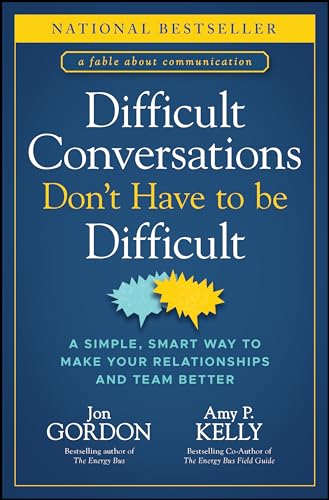
Help your team maximize their full potential by mastering tough conversations In Difficult Conversations Don’t Have to be A Simple, Smart Way to Make Your Relationships and Team Better , bestselling author Jon Gordon and veteran human resources professional and executive coach Amy P. Kelly deliver an engaging and inspiring new take on how to make tough workplace conversations an asset in building a stronger team and organization. The book, written as a business fable, follows Ruth, the CEO of a successful multinational company who has been instructed by her board to prepare her company for sale. Along the way, she must lead an underperforming and dysfunctional team to set aside their differences and work together toward a common goal. This includes growing herself while elevating her team’s performance. As Ruth discovers the secret to unlocking extraordinary growth and productivity, you’ll learn Perfect for managers, executives, directors, and business leaders and their teams, Difficult Conversations Don’t Have to be Difficult is also a must-read for coaches, trainers, teachers, consultants, and other professionals doing their best to help others realize their full potential. Teams who read the book together will be equipped with a proven strategy and process to enhance communication performance and unity.
Jon Gordon is an American business consultant and author on the topics of leadership, culture, sales, and teamwork.
Jon Gordon's best-selling books and talks have inspired readers and audiences around the world. His principles have been put to the test by numerous NFL, NBA, and college coaches and teams, Fortune 500 companies, school districts, hospitals and non-profits. He is the author of The Wall Street Journal bestseller The Energy Bus, The No Complaining Rule, Training Camp, The Shark and The Goldfish, Soup, The Seed and his latest The Positive Dog. Jon and his tips have been featured on The Today Show, CNN, Fox and Friends and in numerous magazines and newspapers. His clients include The Atlanta Falcons, Campbell Soup, Wells Fargo, State Farm, Novartis, Bayer and more.
Jon is a graduate of Cornell University and holds a Masters in Teaching from Emory University. He and his training/consulting company are passionate about developing positive leaders, organizations and teams.
When he's not running through airports or speaking, you can find him playing tennis or lacrosse with his wife and two "high energy" children.
“Ruth’s mother always told her that everyone is a teacher, and if you’re willing to learn from everyone, they will teach you something valuable.”
This book is a short tale about fictional characters that are dealing with a workplace issue that snowballed out of control because of bad communication practices. It isn’t the worst, but it isn’t the best either.
Deal with the Elephants
It is a thing I try to do in all aspects of my life. Emphasis on the word try.It is damn near impossible to accomplish when it involves people who prefer to ignore the multiple ginormous elephants rolled up under the collective rugs. This is why I love to hate advice like this. Perfect world scenarios only exist in fiction.
Three stars to a book that made me think about how I can try to take a different approach to my current work stuff.
I enjoyed this book. Easy read and It was a good reminder of the simplicity of being straight forward and direct when having conversations. In my line of work, this is so important and helpful.
The entire book is about 85 pages long. You can read everything you need to know on pages 83-85.
I gave it a 1 out of 5 stars because I don’t feel it added any value. The principles were all kept at 30,000ft and the whole concept was told through story telling. Too much fluff, too big of a font. I feel like they tried to make 3 pages into 85…and that’s what they did.
Should I have read this before I had a difficult conversation today? Yes. Did I know I was going to have that difficult conversation? No. It was meant to be next week. I did well though considering what tips and intentions the book discussed. Could have been worse.
Notes: - The longer you wait to have crucial conversations, the more difficult they become, and the greater the potential for harm. - When it comes to guiding hard talks and conflicts in teams, you can employ the STARRR method. STARRR stands for: situation (describe the issue); task (explain what was “supposed” to happen); action (describe what was or wasn’t done); result (describe the outcome); relationship (consider how it affected others); reaction (acknowledge the emotions of others); and response (decide on next actions and follow-ups). - Intentional steps: setting the stage; telling her truth; actively listening; reflecting and responding; resolving and resetting; and reinforcing and following up.
Examples: - What Priya should have done: Priya finds a quiet, private space, and schedules a time that works well for both of them. Before the meeting, she takes a moment to clarify her intentions, and reminds herself that the goal is to find a solution that benefits both Jae and the team. Priya opens the talk by telling her truth calmly and clearly. She explains how Jae's actions have been impacting the team and the project, using specific examples to illustrate her points. She focuses on the consequences of his behavior rather than voicing accusations. Together, they brainstorm potential solutions, such as adjusting workloads or providing additional support. - Another e.g. Marcus starts by setting the stage; he creates an environment conducive to open and honest communication by choosing a private, neutral location for the meeting. He schedules it at a time when both he and Lisa are likely to be at their best — not rushed or stressed. Marcus takes a few moments to collect his thoughts and set his intentions. Then he focuses on finding a solution that benefits both the team and the whole company. - other idea: You choose a time when your son is likely to be receptive — perhaps after dinner, when he's had a chance to unwind. You find a quiet, comfortable space where you can talk without distractions. - e.g. on active listening: When Michael pauses, Jenna asks clarifying questions to better understand his perspective. She encourages him to elaborate on situations where he felt unsupported. - Other e.g. To resolve and reset, Jenna works with Michael to brainstorm potential solutions to the issues he's facing. They agree on adjusting the project timeline, redistributing tasks, and providing additional resources. This is a collaborative plan of action that addresses Michael's concerns and sets him up for success.
"Difficult Conversations Don't Have to Be Difficult" provides a framework for navigating challenging discussions effectively. By mastering a few key strategies, individuals can transform difficult conversations into opportunities for growth, understanding, and positive change.
Avoiding difficult conversations can lead to a host of negative outcomes, both in the workplace and at home. The story of Priya, a marketing manager, illustrates how avoiding a crucial conversation can lead to project failure, decreased team morale, and a toxic environment. Addressing issues early on is crucial to prevent escalation and harm.
Priya's story also shows how a structured approach can lead to positive outcomes. By setting the stage, telling her truth, actively listening, reflecting and responding, resolving and resetting, and reinforcing and following up, Priya was able to address the challenge and improve her team's dynamics.
1. Setting the Stage and Telling Your Truth: - Choose a private, neutral location for the conversation. - Schedule it at a time when both parties are at their best. - Clarify your intentions and focus on finding a solution. - Speak calmly and clearly, focusing on specific actions and consequences.
2. Active Listening and Reflecting and Responding: - Give your full attention, maintain eye contact, and avoid interruptions. - Ask clarifying questions and encourage the other person to elaborate. - Paraphrase their concerns and acknowledge their feelings. - Reflect on what you've heard and respond with empathy.
3. Resolving, Resetting, Reinforcing, and Following Up: - Work together to brainstorm potential solutions and agree on a plan of action. - Establish clear expectations and set up regular check-ins. - Follow up regularly to offer support and acknowledge progress.
The STARRR method (Situation, Task, Action, Result, Relationship, Reaction, Response) helps guide team discussions. Emphasize the bigger mission, encourage constructive truth-telling, assume positive intent, avoid personal attacks, and manage emotional energy. Establish clear rules for consistency and fairness, and respect the conversation process.
The main takeaway from "Difficult Conversations Don’t Have To Be Difficult" is that difficult conversations can lead to positive outcomes when approached with a structured method. By setting the stage, telling your truth, listening actively, reflecting and responding, resolving and resetting, and reinforcing and following up, you can navigate challenging discussions with confidence and grace, building stronger relationships and achieving better results.
Quick read with a few simple ideas about increasing the transparency and positive communication in an organization.
It was a pamphlet, in reality. I always appreciate decent ideas organized or a problem clearly addressed in a book.
I need to develop a system of reviewing these books:
Usefulness right now: 3 - as far as the types of conversations and issues that the models in this book suggest. Simplicity and clarity: 4.5 - The STAR3 model is simple. The T4 idea is also simple. They aren't super memorable, sort of forcing words to make up the acronyms, but the ideas are clear enough and if I have some of these issues, I will go back to it. Practicality for Implementation: 3.5 It feels a little forced and possibly awkward, but all things like this are. I do think that learning to have regular, transparent, trust-building difficult conversations is absolutely vital.
In the end, I think it's a decent tool - the models in this little book. It should take you about 45 minutes to read the whole thing, so there's that. Difficult Conversations - the fear of them - is probably the downfall of so many families and organizations and friendships, that the topic is absolutely relevant at all times. Not sure if this is the best compendium for it, but it's a good, easy practical start.
I have a statement that I write most mornings in my journaling: Make a decision, take swift action, and iterate as new information comes to light through the action.
This is the kind of book that will help you get started with having difficult conversations - so you can decide to deal with this and take action using this book.
As you take action, additional hurdles to good communication might reveal themselves. This book helps you get started, but I would imagine other resources will be needed as you move forward.
The book had some good principles and helpful approaches to systems and challenges within a team or organization.
However, most of it was common sense. The table approach wasn’t as effective as stats and data would’ve been with different approaches or systems to handle difficult conversations.
Of course it’s important to remember the mission or put your team first and to always speak the truth but it’s different when you actually have to navigate friendships and people going on corrective action plans and how to best navigate transformation or growth. It all seemed more like common sense rather than actionable suggestions.
I always enjoy Jon Gordon and his leadership principles, this book just didn’t happen to be my favorite. I love the fact that he tackled the issue. It’s something everyone has to navigate.
Once Jon Gordon's/Amy P. Kelly's fable "Difficult COnversations Don't have to be Difficult". takes a difficult occurance that happens daily in both life and business and gives the reader two tools to navigate the environament presented. The two the four T's and Starrr process. The story line is business CEO stress to advance a product line and basically destroyed the team through her own personal stress from things she can't really control. In a number of Jon's fables there comes a point where the crisis is either boiliing oveer or about too and someone outside the group provides input that assist in righting the ship. It's a very quick read that provides the reader to several things that can be applied to ALL aspects of life. Be it business, educaiton, sports or life in general.
This book just makes me angry. My takeaway is if you are a security guard talk to as many people as you can and give advice to whoever will listen cause maybe someday some dumbass CEO will give you a high paying job. And by some miracle, everyone else who has worked countless hours at their job and will now earn less than you, are totally ok with that.
What a stupid book. But I guess this is the kind of trach CEOs read and follow . Anything's better than taking a pay cut and giving your employees a raise, right ?
This entire review has been hidden because of spoilers.
I’ll always read and love a Jon Gordon book, but the reason I didn’t give it five stars is there were parts I wish were developed more. Sometimes, I’d actually like to see more conflict in the books to see how a real conversation could be addressed with STARRR, and I think it would have been great to see a T4 action plan in use in the book itself since that is one of the central ideas here.
Just kind of (or very cheesy). Feels like reading a children’s bedtime story or watching a hallmark movie. The title and overall presentation led me to believe it was a nonfiction book but the “allegorical” set up didn’t really work here. Still valuable lessons in it but was not a fan of delivery. That’s on me, my expectations were completely misaligned and I didn’t really like the product.
I wish my company wouldn’t keep making these fables our ‘team read’ - they feel like they’re written in an hour and serve mainly to get you to sign-up to an ongoing consulting program or keynote speaker session. Jon Gordon has clearly found a money-making formula, but these parables do next-to-nothing for me.
Jon Gordon creates another memorable business parable in this book. While the narrative at times seems short and tends to oversimplify the complexities of challenging communications, the STAR3 concept is on point for successful teams.
I enjoy Gordon’s books and would recommend this as another good addition to a business executive’s library.
My rating could go from 2 to 4 stars, depending on what I focus on...
They followed the path of "The goal", hypersimplified. There some good reminders and advices, nothing really new (if you're already versed in the topic). I didn't like much the marketing part of that Star3 method...but I understand we all need to have dinner at the end of the day XD
I love how Jon and Amy impart simple, yet practical ways to approach conversations, that can been deemed as difficult. The STAR3 model provides a pragmatic framework to help teams and organizations grow.
Great quick read giving people leaders great ideas on how to address the elephants in the room. If they are not addressed, the issues will destroy the businesses they have worked so hard at to become successful
Good readability and I like Jon Gordon style of writing. He has stories built within the book that make it simple to follow. If you like to follow things by steps or directions or procedures then you will like this book.
A positive spin on a fable on how communication is key!
This felt like an episode of Touched by an Angel to me - something that could be good for high schoolers to read - but not something I expected to have been asked to read as a professional. I may be spoiled after reading books like Dare to Lead and Radical Candor. 🤷🏼♀️
Quick, easy read that offers good inspiration and a simple STAR3 model to follow. The storyline is kinda cheesy, and rael-life situations rarely work out in such a utopian way as described in this book. But it's a quick read (1 hour?) and is inpirational.
It was a quick, easy read. A nice book for those leading and building teams in organizations. Would be a good book study that is not overwhelming in the content - but would bring great discussion to the team.
Jon Gordon always comes through with an excellent message in his books! Simple steps to follow to improve communication and teamwork. This can be helpful in all areas.