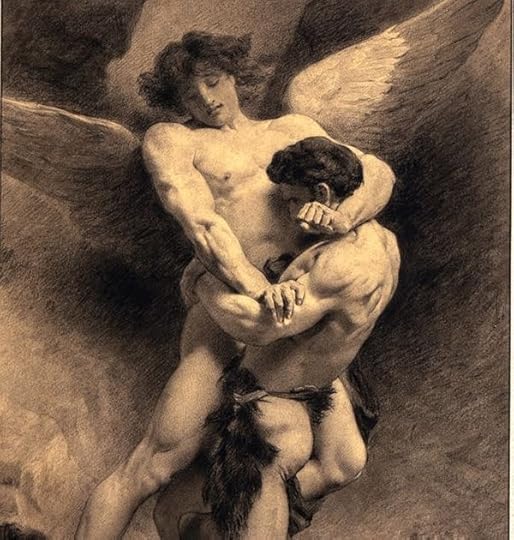
From the author of Interview with the Vampire , this national bestseller begins a divinely thrilling new series about an assassin with the choice to turn from darkness to light.
It’s the present day. Toby O’Dare—aka Lucky the Fox—is a contract killer on assignment once again. He’s a soulless soul, a dead man walking. His nightmarish world of lone and lethal missions is disrupted when a mysterious stranger, a seraph, offers him a chance to save rather than destroy lives. O’Dare, who long ago dreamt of being a priest, seizes his chance. Now he is carried back through the ages to thirteenth-century England, to dark realms where children suddenly die or disappear, and accusations of ritual murder have been made against Jews. Here O’Dare begins his perilous quest for salvation, a journey of danger and flight, loyalty and betrayal, selflessness and love.
Anne Rice (born Howard Allen Frances O'Brien) was a best-selling American author of gothic, supernatural, historical, erotica, and later religious themed books. Best known for The Vampire Chronicles, her prevailing thematic focus is on love, death, immortality, existentialism, and the human condition. She was married to poet Stan Rice for 41 years until his death in 2002. Her books have sold nearly 100 million copies, making her one of the most widely read authors in modern history.
Anne Rice passed on December 11, 2021 due to complications from a stroke. She was eighty years old at the time of her death.
She uses the pseudonym Anne Rampling for adult-themed fiction (i.e., erotica) and A.N. Roquelaure for fiction featuring sexually explicit sado-masochism.
It's probably been more than a decade since I last read Anne Rice. After the masterful fifth volume of Vampire Chronicles "Memnoch the Devil", the last one I delved into was, I guess, "Pandora." So I met "Angel Time" with its due enthusiasm. The plot was particularly odd, but engaging. There are nods to interviews with other-beings, with creatures of light. The tan colored tone is bothersome though, as her deep purples and crimson-blacks and erotic violence are what cemented Rice as the Literary Mistress of the Dark in the first place.
But angels? (And, what's worse, no demons?!) And time-travel? Well, the plot that involves a peek at the 13th century IS insightful, educational, at least. But what else? Nuh-thing. This is a minor novel; but at least its not a tremendous disaster follow-up, such as "Dr. Sleep," or "Imperial Bedrooms," or "Saturday," or "Freedom," or "The Goldfinch," or "The Snow Queen," or "Bridget Jones III."
There are salvageable parts here, which makes the fact that its pretty mediocre(ish) all the sadder.
Edit As it has been two years and I have not been struck down by lightning yet, I feel safe enough to lower my rating to the 1 star I originally wanted to give.
The back cover of Angel Time sounded quite exciting, but once I started reading I was harshly reminded of the fact that "you shouldn't judge a book by its cover". The main character wishes salvation (as he likes to remind you every fifteen seconds or so) and after a hit (as he is a hired assassin) he meets an angel who has been watching over him. After the longest chapter I have ever read that recounts his sad past, the angel gives him a "mission" which is to stop a town in medieval England of condemning two innocent people of their child's murder. So he goes to pose as a friar with the angel by his side. All that really matters in this book is the main character's wish for salvation. I felt like the main purpose was to convert me to christianity, which is not why I want to read. The plot could have been very interesting if it weren't written like a religious document. I was really looking forward to the part in historical London, but unfortunately that only comprised about 15% of the book as Rice appeared to favour telling the reader about salvation and goodwilled angels. It took sheer determination to finish it and that doesn't make reading fun. The reason I give it an extra second star, is because I fear divine retribution if I don't. I would recommend this to people who would like to read a modern tale about their faith. But people-like-me (who are openminded enough but not religious): this book is definitely not for you.
Considero a Anne una de mis autoras favoritas, amo la forma en que escribe y como crea ambientes tan oscuros, y que sus personajes tengan esa esencia de melancolía y decadencia. Pero con todo el asunto del cambio de religión sacó esta trilogía, ( de la que todavía nos debe la tercera parte).
Me animé a leerlo, por que ella es fantástica y seguro logra interesarme en este universo con cosas mas encaminadas a dios.
No me equivoqué, Anne lo hizo. Una historia tierna, lúgubre y con la aparición de personajes tan deliciosos de leer que lamente llegar al final. Toby me cautivó, su pasado, su presente y todas sus aventuras, nos acercan incluso sin querer a acercarnos más a ese lado espiritual que todos tenemos, y junto a él, comenzar nuestra propia redención.
This is my 2nd novel to read of 2019. I start this in December in my car and had to stop in the middle for holiday. It didn't bother me a bit to put this down. It was difficult to keep going and there were several times I almost stopped and gave it up.
I have read 20 novels by Anne Rice and she is an author I appreciate. I have always enjoyed her stories (accept for Violin which is probably the worst story I have ever read). I read the second one in this series first and I thought it was ok. So, I got around to reading the first one.
I can't explain how much I loathe this book and I hate it. I still think Violin is worse than this, but this is Anne's second worst book in my reading opinion.
This is a religious dirge that plods and ponders on. Our main character loves beauty, yet he kills people for a living. After listening to his inner dialogue, I can't see him being a killer, it didn't make sense to me and the dots weren't there.
Then we have to hear his back story. I was enjoying the story until we went into the never ending back story - please save us. It was all self-loathing and I could hardly find an interest. Finally, the story goes back to the present where he meets an angel that helps him and gives him purpose.
So the angel takes him back in time, because of course, there isn't anyone in the present to help and the angel couldn't possibly find someone from that time to help someone in that time. Now we are set down in the middle of a christian and Jewish debate over the death of a girl, a twin.
The big ending set-piece is a legal battle to prove the twin is the dead girl so the Jews won't be punished. It could not be more boring. This whole setting was pure agony to listen to. The characters go on and on about their feelings and how much they loathe themselves and religion and spirit and on and on and on. It plodded and we had to listen to people say the same things over and over again.
Well, I did finish this book and I should have put it down. It was not worth finishing. I still love most of Anne's work and her catalog, but this was not a novel for me. I'm sure people will love this, but she was not playing my tune here. I hope the next one I try of hers is back to form.
We make our own angels, create our own demons, and forge our own destinies. Angel Time ~~~ Anne Rice
Anne Rice's passing was terribly upsetting to me ~~ this made me incredibly sad. I first read Anne Rice at 13 ~~ soon I devoured everything of hers she had written. Rice shaped me not only as a reader, but as a person. She unlocked an entirely new world for me as I traveled with Lestat and Amadeo. Rice put into words how I secretly felt.
I read the Vampire Chronicles in order ~~ Lives of the Mayfair Witches too. Interspersed among these reads, I read Rice’s stand alone novels. The best of these was Cry to Heaven, now a lesser known work of Rice’s. In fact, it may be Rice’s best work.
Later, when she turned her back on horror and made her highly publicized return to Catholicism, I tried to read Rice’sThe Songs of the Seraphim series, but they were terrible. The magic was gone. The writing had become preachy. And just like that she abandoned Christianity and returned to horror. I read Prince Lestat but sadly, Rice was simply repeating herself.
Then, Rice began to harass her critics, encouraging her fans to publicly attack those who poorly reviewed her books. Her fans terrorized her detractors ~~ in fact, it was Kayleigh Herbertson's review of Pandora that first sent Rice and her fans into a tailspin. Herbertson's review received over 300 comments from Rice's followers; she was called a hag, a bitch and one commenter event threatened to infect her with herpes. Rice refused to take responsibility for the attack and instead used her followers to unleash her anger on other reviewers.
Lastly, she began to focus more and more on promoting her son's inferior work as she slowly withdrew from the world. I had now outgrown Anne Rice. Despite all this, I feel like a part of my youth has been taken from me with her passing.
I have to admit the last paragraph blew me away. But this is my least favorite of all Rice's books. It was a challenge to get thru it. Nothing more need be said.
Being a long time Anne Rice Fan, I had looked forward to reading this book. Her religious journey, like mine, had been bumpy at best. So, I was very curious after the Christ the Lord series what she may do next...and I wasn't disappointed.
Angel Time is an exceptional novel dealing in the story of an assassin who is contacted by an angel and walked back through time through the err of his ways and how it was he became an assassin. Then, through Anne Rice's skilled writing, she takes the reader back in time with this character to right a historical wrong.
I would say the first few chapters of this book were brilliantly written and I really felt as if we were intwined with Toby O'Dare's character. However, when we arrive back in reality and the character asks for forgiveness from his wrongs, I felt cheated as his requests for forgiveness seemed a bit cheesy and insincere.
Once the character is introduced into the past, again, Anne Rice delves directly into her amazing storytelling abilities and we're off to the races until the very end.
So, all in all, I enjoyed the book and really liked her discussion of how God, Heaven and the Angels exist out of time and how she used that to tell this story. I can say that the chapter on forgiveness seemed pressed and I'm not sure why the character came across that way to me. I know in my personal struggles, it's difficult to simply ask for forgiveness and then automatically become the person I believe God expects me to be, so for this character to flip a switch was difficult for me to comprehend. I know that I've seen this miraculous transformations occur in others, it just seemed that this character would have thought more in depth about this automatic change.
However, all in all, I enjoyed the book and believe others will as well, Anne Rice fans and those that haven't enjoyed her reading alike.
I knew there was going to be trouble with this book as soon as I read the main character, an assassin, is a great lute player. Uh, yeah, right. Maybe it's just that I love the old style Anne Rice, but this book found me shaking my head and saying "oh, Anne, Anne, Anne". I think her recent return to the Church made her incredible writing talent go running out the vestibule door. So sad. There wasn't anything in this story that was really believable. Characters were just so trite and so out of touch with who they were supposed to be that I couldn't get into them. On one good note, she does end the book in a sort of cliff hanger way to lead the series on, but other than that, I think Anne's lost touched with herself as a thrilling author. She, I believe, says it best herself in the book "It was almost as if he had become, in his inveterate goodness, a little bit of a simpleton as is bound to happen, I think, if and when one gives oneself absolutely to God."
Esta novela deja bastante que desear porque en el esfuerzo de unir diferentes componentes con el fin, supongo, de alcanzar un libro más impactante, sólo se logran pegar historias que ni unidas ni separadas convencen al lector.
Así, se comienza con la historia de vida del asesino... larga, cansadora y con sólo algunos pasajes que logran despertar un poco de interés. Luego, el encuentro con el ángel... lo peor logrado de la novela; un capítulo así y de la forma que lo presenta la autora, debiera ser sublime, sin embargo, a mi me pareció que rayaba en lo ridículo por su simplicidad, casi de cuento infantil. Finalmente el pasaje en la Edad Media, quizá lo más interesante de todo el libro, de no ser por lo superficial de la historia, que además, se lee casi completamente como el recuerdo de uno de los personajes.
Quedan muchos cabos sueltos que, imagino, se irán develando en la continuación de esta saga, de la cual humildemente prescindiré.
Pompous, yet boring and forgettable. This is a huge disappointment from the woman you made Egyptian queens into vampires, and vampires into rock stars.
I finally finished this book and I am not sure that it was worth the time or effort. This was my first Anne Rice book and I was honestly surprised at how badly written it was. The dialogue was extremely simplistic and the prose was so didactic that it read more like a plot outline than a fully fleshed out novel. The story itself was repetetive and un original. I have read other similar stories many times, but those were well written. One question I have, Toby's skills were apparently the reason he was chosen to be the instrument of God on earth. My understanding is that these skills included the ability to be unnoticed, be an efficient killer and a master of disguise, not to mention an expert lute player. None of these skills were used to any extent in his "mission". So glad this one is over and behind me.
I was pleasantly surprised with this book. I was interested, entertained, and at the same time expecting some of the more homoerotic and/or gruesome detail that her old books used to contain but this book had none of it.
The book is lovely and written perfectly. Anne Rice always has a tendency to over-describe different things and dive into memories for more time than needed but I feel she worked out exactly as much 'time' as needed in this story. Each memory was presented to the degree of information we needed and each description was perfectly executed.
Although Anne Rice might not be writing vampire literature anymore (and believe me, I wish I could get another story about Lestat and Louis one of these days!) I think that her strength in writing has returned. Her tales are interesting with an edge of education added to it. They might not be as dark as they once were, but there is still that edge of darkness, that eternal struggle for what is right from wrong.
Set in two very different worlds and written with a fluency that testifies to long hours of research on the part of the author, Angel Time is certainly not your average supernatural novel. The characters are unique, the plot engaging, and the words spun together flawlessly and effortlessly in typical Anne Rice style. The story is chopped up in two places where inserted are the background stories of Toby's life and that of the 13th-century Jewish woman he is attempting to help. In most books I would object to such a fragmentation of the plot; in most books it would seem tedious to work through such long narratives, but not so in this book thanks to Rice's colorful writing.
I did not like the first half of this book as much as the second half, the first half detailing Toby's life before Malchiah's arrival. It was too dark, depressed, and morbid for my taste. I don't condemn the book for this, but simply didn't enjoy the first half as much on that account. The second half was much more interesting and engaging to me. Rice did a fine job of expressing the turmoil of the European Jews in the Middle Ages and weaved a believable tale around that critical setting. Perhaps my only moral complaint about this book was the fact that Toby uses deception to solve the problem he was sent to resolve and this method of resolution seemed to be endorsed by the angel Malchiah, and hence, heaven itself. This didn't sit quite right within the context of the story, which was Toby seeking redemption for the evil he had committed. Overall, a good book with some minor flaws.
First off, I'm not an Anne Rice fan. I am reading this book because of my book club. I can't believe how repetitive she is. Her first chapter was about twenty pages stating that the main character was a hit man. I could have summed it up much quicker.
Plus the whole lute player angle, I just envision a LARPer as an assassin and laugh. I mean I just literally thought of someone dressed up as a renaissance festival nerd just did not seem plausible in my head.
Only at around page 100 did it start moving faster, it's a shame that that is almost halfway through the book.
This is not my kind of literature but once I got into it it wasn't that hard to read. Definitely took me way too long and I wasn't motivated to read it. A 265 page book can be read in a matter of hours by me, whereas I have had this book for nearly two weeks and am only just over halfway through it.
----update, i finally finished it and it wasn't AS bad as the first third of the book. very interesting plot although i am still not fond of her repetitiveness. Can't say I would read the series of this though.
(2.5 stars) Anne Rice’s body of work plays a huge role in my history as a reader, and in fact was one of the “gateway drugs” that led me to fantasy. I discovered her books the summer before I left for college and spent the next several years procrastinating my studies all too often in favor of devouring her backlist. And a hefty backlist it was; her old books kept me busy for several years. The first one I read “new” was Pandora. Then, in the late nineties and early 2000s, Rice began to change her style and her portrayals of favorite characters, and I didn’t like her new books as much. I’d heard that her new Songs of the Seraphim series marked a return to her old writing style. Curiosity and nostalgia convinced me to give Angel Time a shot.
Angel Time’s protagonist is Toby O’Dare, a skilled hitman who has just been assigned to make a kill in his favorite hotel. He loves this hotel and hates the idea of sullying it with his unpleasant profession. The beginning of the novel moves at a snail’s pace as Rice lingers over the description of the hotel.
Eventually, though, the hit occurs, and shortly thereafter an angel appears to Toby. This angel, Malchiah, wants to recruit Toby for an important task. Toby doesn’t believe at first, but Malchiah shows Toby a vision of his life and how it’s led him to this point. This backstory is compelling at first, but soon begins to sound really familiar. This is the backstory of Michael Curry from The Witching Hour. Obviously, the details are different, but the rhythms of its telling are the same, and the highlights are all here: the childhood among Irish alcoholics, the saving power of music, the first girlfriend, the family tragedy that precipitates a departure from New Orleans... Instead of restoring old houses, though, Toby takes a very different path.
Toby never quite coalesced as a character for me. Part of this is because I kept thinking of Michael during the backstory. Even beyond that, though, he feels “all over the place.” He’s an assassin, and he plays the lute, and he kind of wants to be a monk, and in one of Rice’s better books all these traits would add up to a complex character. Here, they seem like several different characters crammed into one, and this isn’t helped by his sudden moment of conversion. Just when he almost comes into focus, he changes drastically and instantly as a result of his salvation.
The second half of the book, in which Toby is sent back in time to medieval England to save a Jewish couple accused of murdering their daughter, is better. Rice gives a well-researched portrayal of the anti-Semitism of the period and introduces several interesting characters. Rice’s writing has some recurring flaws and quirks, though, and the usual suspects are in evidence; namely, a high talk-to-plot ratio and backstory-to-plot ratio. I did find the end of the time-travel sequence interesting. It seems like an intentional inversion of Lasher’s first death scene, in which he looked for the divine but found only emptiness in that moment. What happens here is very different and almost certainly reflects Rice’s own shift in beliefs.
The writing style does indeed come close to that which she employed in her early novels. Using heavy description and deliberate repetition, Rice creates a languid, hypnotic mood. The prose is especially beautiful when Malchiah takes Toby through the eponymous “Angel Time,” a time-out-of-time through which the characters travel from the present to the past.
So, what did I think of Angel Time? It displays some of the chronic flaws of Rice’s work while lacking that intangible spark in character or plot that would overcome these flaws. It’s also a little preachy in places. On the other hand, it was intriguing enough that I went on to read book two, Of Love and Evil, which was better and which I'll review soon.
This was my first Anne Rice read, and in all honestly I was disappointed.
For as long as I can remember, her Vampire Chronicles have been books I wanted to read. I entered the teenage vampire loving stage and my mother suggested them. It turns out she’d tried to read them earlier, but had never really managed to work her way through them. She enjoyed them but the writing style was not for her (overly descriptive, she called it). I did not let this deter me, and promised myself I would read them. Still, years later I have yet to read them. In part it is because I’m super cheap and I’m waiting for my mother to find out her old copies for me so we don’t have doubles of books sitting in dark corners of the house, but it’s also because other books have interested me more. When I found Angel Time going for a pound – you have to love bargain bins – I decided to jump on it. I thought I would give this book a try to see whether or not her writing style was for me before I entered her Vampire Chronicles.
Don’t get me wrong, I like her writing but it was not for me. It was not badly written yet it was missing out a number of things that I like. Mostly, it was lacking on the emotional front. Oh, we were told about characters and sad histories were given yet we didn’t get much in the way of emotional responses from characters. We were given paragraph upon paragraph describing surroundings but whenever an emotional response was necessary, a mere sentence – a short sentence, at that – was given. Such a thing prevented me from growing to like any of the characters all that much. They never really developed into more than storytellers who had the same voice.
Not that the story was what I was expecting.
I thought we would be given lots of action. Everyone loves a good angel book… yet in this, the angel theme is rather drab. Our angel exists solely to shift our character from one point of time to another whilst wearing a stupid facial expression as he whispered sweet nothings in ears. Such a thing almost sounds like what fandoms go for – the quick glances and the touches – but there is no chance for such an underground fandom to appear. Things simply are. We cannot add our own little versions of the truth.
History and settings play a much larger part than characters and storyline, in my opinion, which made the story much harder to enjoy. I like such things in a story, but I want everything to be equal. It was as though she wanted to throw in as much of her research as possible, and in doing so she forgot she was telling a story. Then, out of the blue, her memory would return and she would throw in what we were waiting for – except without the action we’re longing for.
Honestly, it wasn’t what I was expecting. Where was the character development? Where was our chance to second guess what was coming? Where was the action? Where were all the angels? Character development – I use that term very loosely, you should know – comes in the world’s longest chapter of the angel informing us of our main character’s life. It isn’t development as much as it is fact telling, a way to explain why our main character seems to only have the same thought (although the wording varies) in his head. The second-guessing is non-existent. The action is almost as non-existent, with just a little bit of drama but not in the form you would expect of such a story. The angels… well, they stick to whispering and the occasional appearance. They take the mystique to a whole new level whilst making you wish we could simply be given some kind of information about the world building.
I could rant and rave for a very long time about my disappointment, but I won’t bore you. Just know that after the first two chapters I considered putting it down yet I persisted because I’m a sucker for torture, only to realise things got better for the shortest of time periods only to return to the drab state.
In Angel Time, Anne Rice tells the story of a present-day hit man, a former parochial school student. The narrator is his guardian angel. After learning about his depressing descent from down on his luck school boy to a life of crime, we meet said angel. And together they time travel to 13th-century England and Paris to save the lives of a Jewish family. That’s a pretty succinct version of the story, which clearly bends strongly towards the religious and philosophical. Or preachy and plodding, depending on how generous you are feeling.
In the midst of the story, Rice discusses the intersection of Catholicism, Judaism, and sin. If that sounds daunting, it was. Truthfully, she lectures about these topics and the story is secondary to the author unpacking her own beliefs all over the book.
The reviews for this book aren’t great. But I bought it ages ago, back when Anne Rice was an auto-buy author for me. And then I never listened. I’ve been trying to “clean up” my Audible shelves, so here we are. And I regret every minute of this book. Plus, the second book is on my audio shelf too. Argh.
My conclusions If this was your first Anne Rice, it’s not hard to imagine it being your last. She takes a mediocre plot, mixes it with less-then-stellar writing, and tops it all off with a listless main character. He’s not even interesting enough to consider him unlikable.
Reading this book was like attending a wake for someone you don’t like, where everyone drones endlessly about their religious philosophy. Avoid it like the plague.
A ver, la historicidad... la angeología... pues un poquito mal. Lo normal en Rice. La repetitividad, alta. ¿Cómo puede ser que varios capitulos consecutivos sean simplemente una señora contándole su vida al protagonista?
Angel Time is the first book in Songs of the Seraphim series by Anne Rice. Interview with the Vampire introduced me to Anne Rice many, many years ago now, and I have been a fan of her work ever since. I think I have now read everything she has ever written, some several times over. Every so often I work my way through her books again and as a friend of mine who loves the TV series, but had never read any of Ms. Rice’s work asked me to ‘buddy read’ them with her, so I again took the opportunity to dive in. I love introducing people to her work, especially when they end up loving them as much as I do. Buddy Reading was a fun way to read this great series, because I had someone to discuss each book with as we finished. We have decided not to stop at just this series, but to read everything she’s written, together. I can’t believe I had never left a review for any of these books before, but sometimes I get so caught up in reading that I forget that I have yet to post a review. My reading challenge reviews were down about 150 or so last year because I would get so caught up in the books, that I would forget to leave a review, especially when reading a whole series back-to-back. So, this year I am determined to leave a review for every book I read. I adore Ms. Rice’s work, she writes so passionately and has a rich, vividly descriptive and detailed style that really lends itself to her Gothic fantasies. The stories are woven so well, I am not merely reading them, but experiencing them in exquisite detail. The historical elements that are sprinkled through her books are so cleverly done, and given her own unique twist. If you have never read any of her work before, I really recommend that you do, as Ms. Rice limitless imagination and spellbinding storytelling abilities ensure a spellbinding read. Happy Reading...
I'd managed never to read an Anne Rice novel before Angel Time. Now, I wish I'd kept up that streak. Angel Time graces us with completely black and white morality, poor storytelling, and an eye-rolling plot. I was anything but impressed.
Spoilers towards the end of the review, but I saw them coming from a mile away... so they may not even be spoilery.
Let me tell you all about how the protagonistis a really, really good person. No, you don't understand. He's so good. The only reason he's a contract killer is because his life was so hard. But he's a good person! Now let's help him find God again.
That's the plot of Angel Time.
See, we know how good he is because after we spend a few chapters on how he's a contract killer and an angel comes to save him, the angel tells us (in a single chapter that takes up a quarter of the book) his entire history. Because that's good storytelling. Trigger warnings in this section include, but are not limited to: suicide, alcoholism, abuse, and violence. We also know that he's really, really truly good because an angel said so.
There's a lot that could be done here, with shades of morality. I mean, we have a contract killer trying to redeem himself in the eyes of god. But nope. Everyone who is good is good and everyone who is bad is awful. Even when they go time travelling to save Jews in the 13th Century.
Oh yes. See, the angel takes him time traveling in... Angel Time. That's what the angel literally calls it. Angel Time.
"From Natural time to Natural Time you'll go. But I exist in Angel Time and you'll travel with me through that as well."
Talk about the type of corny dialogue that can throw you right out of a book. Actually, all the dialogue is awful. Anne Rice seems to believe that Medieval Jews talk like Victorian translation of their writing. (Protip: people generally don't talk like they write, especially in times writing was highly formalized.) Even worse, Anne Rice thinks everyone, even in modern times, talks in a weirdly stilted, completely unnatural way.
So half the book is the setup.. contract killer. Time traveling angels. Then the other half of the book is him saving some Jews from being killed and riots starting because their daughter died of appendicitis. This isn't even a thinly veiled reference to the Jewish girl he was in love with when he was a kid... it's so completely obvious and it feels like over and over Anne Rice is trying to smack me in the face with it.
"I GET IT," I would say. And Anne Rice would try to be teasing again. "NO REALLY, IT'S QUITE OBVIOUS. I CAN READ BETWEEN THE LINES."
Well, apparently the protagonist can't because his angel buddy has to spell it out for him after it's all over and he's written his memoir. (Which is called... Angel Time. Who saw that coming???)
Oh, and we also find out that the protag has actually been doing contract killing for the government, so he was one of the good guys all along! Yayyyyy! Now that he's found God (and dear God, I swear half of this book is him talking about God or talking to God or whining about not having a relationship with God anymore...) and he knows that he was killing people as a good guy, it's all good! Good, good, good, good. No need to think about complicated morality here.
Anne Rice is starting off a new series entitled Songs of the Seraphim with her newest title. As you can probably guess, they will be focusing on angels. This first volume tells the table of a man called Lucky. It is not his true name, but it is the name that he goes by to protect himself since he is a hired assassin. He is visited by his guardian angel, who offers up the name Malchiah when Lucky wants to know his name. Like Lucky, angels are not supposed to share their true names, so this will just have to do.
After their introduction to each other immediately following a hit, Malchiah tells how he has seen Lucky grow and develop into the person he is rather than living up to his one-time asperations of becoming a priest. Lucky, who was born Toby O'Dare, is offered an opportunity at redemption. It is an offer he takes up quickly.
As a result, Toby is brought back in time to the 13th century. He takes on the guise of a friar who will protect a Jewish couple being hunted down because the people in their English community believe they killed their daughter for converting to Christianity.
Rice became famous with her vampire novels largely because of interesting characters and rich descriptions of their environs, and she continues to try to do that now that she has given up the occult to focus on novels that better express her new-found faith. Her first two works in this new vein shared the tale of the early years of Jesus Christ.
While she continues to work with the same writing style, she seems to struggle a bit. Rather than just using the florid detail to place her readers in the setting, she seems to get bogged down in the detail, letting scenes (and chapters) drag on longer than they should. In fact, it takes almost the first half of the book for Toby to get Malchiah's offer.
With that said, Rice has created an interesting look at the way Jews were cheated in the Middle Ages. It is a part of history that not many may be familiar with, and the story of the Jewish family nicely parallels the journey Toby is making as he works his way back to his faith.
For me, experiencing an Anne Rice novel is like visiting an eccentric but beloved old friend. I’ve been reading her work since my college days, which were long enough ago that anyone who read the adventures of the Vampire Lestat and his companions on the Devil’s Road was considered freaky and a bit outré. These days, of course, vampires are like breakfast cereal.
In any event, Angel Time is not a Vampire Chronicle, although the hero displays shades of Lestat and The Witching Hour’s proletarian crusader Michael Curry.) It’s the launch book for Songs of the Seraphim, a new series about reformed hit man Toby O’Dare, who’s transported by his guardian angel Malchiah from the scene of his latest hit to thirteenth century England, where the good Christians of Norwich are threatening to burn out the Jews in retaliation for a fabricated outrage. It’s up to Toby, disguised as a wandering Dominican friar, to answer the Jews’ prayers and deliver them from ruin. By saving an innocent and appealing young Jewish couple from destruction, Toby takes the first steps on the long road toward finding his own redemption.
Although I wouldn’t call this vintage Rice in the grand tradition of The Vampire Lestat and The Witching Hour, there’s plenty here for a fan to savor. As mentioned, Toby betrays hints of both working class Irishman-turned-billionaire Michael Curry and the spiritual, contemplative Lestat who emerges in Tale of the Body Thief and especially Memnoch the Devil. Rice explores similar spiritual themes in Angel Time, and her trademark style infuses the work—opulent and sensual, although in this case nearly innocent of sex itself (which could hardly be said of her previous work. The infamous Sleeping Beauty books she wrote long ago as A.N. Roquelaure spring to mind.)
If I felt any sense of unmet need as a reader, it was a hunger to plunge deeper into angelology and the angel mythos. But I imagine that’s still to come as the Songs of the Seraphim series continues!
I have read every book Anne has published and have enjoyed them all, some a very great deal (Cry to Heaven, most of the Vampire Chronicles - esp. Memnoch, The Mummy, Feast of All Saints, Christ the Lord series) and some not as much (Mayfair Witches saga, Violin, the last Beauty book, East of Eden).
I know when her name is on the cover, I'm going to get vivid characters, evocative prose, solid scholarship, and an entertaining if not completely engrossing plot. She hit all the notes with this one and yet I wasn't drawn in and held like I usually am and I really wanted to be. I've long been interested in the subject of Angels (warrior of G'd type vs. the greeting card, New Age type) and was intrigued by Malchiah and by the insight into the lives of medieval Jews in England. And I'm always interested in philosophical and theological insight and debate.
I'm not sure if it was the jarring of being inside assassin Toby's modern head for the first half of the book and then shifting so rapidly into the spiritually changed Toby sent back into medieval time to right a wrong that threw me off. Because I had no problem with the two Toby's taken separately, but they just didn't flow into each other as smoothly for me as they could or should have and I can't say why.
This appears to be the first in a series and I think she was laying the groundwork for Toby's character and that's why the whole first half of the book is taken up establishing his background before she shifted the characters and the story into Toby's 'new' life and into the whole premise of the book - a reformed sinner, rededicated to G'd and working to help right or prevent injustices. I just can't put my finger on why the transition threw me out of the story. I'm still looking forward to the next book in this series and hoping it will grab me like so many of her other books have in the past. I just wish this had been one of them.
I loved the old style Anne Rice. I was hoping that she was back and she is in some ways. Her descriptive style is back and her ability to make you see and feel what she is writing is back. However, her plot in this book leaves a lot to be desired. The description on Amazon, the title and the back of the book make a reader think that this book is about assassins and angels. It's not really. It's about a man who is finding himself. I was confused throughout the book about where it was going and where it really wanted to go. I felt like Ms. Rice was struggling in getting her true meaning across. I'm very conflicted about recommending this book. In some ways, I definitely want to recommend it because Toby is a fascinating character and I hope that Ms. Rice explores his life further. However, the book doesn't really make complete sense until the final two pages. It was frustrating to say the least. Of course the last couple books by Anne Rice have been frustrating to most of her fans. I would love her to continue the series to see what she has in mind.
This novel is about an assassin who has lost his faith in God. His guardian angel comes to visit him and needs his assistance in helping others.
I did not care for this novel or should I say novella as it was a quick read. The writing is simplistic and I felt like I was reading a YA novel. Usually this author's writings contain fantastic imagery that the reader cannot help but picture the scene and surroundings. That was not the case in this novel. As for the story itself I did not buy into it. The author recently had a religious transformation and this novel read like an allegory of her change in beliefs. I have no problem with that but at times it was too blatant. Also, I never felt any connection to the main character as his story fell flat and his guardian angel's story was never explored.
If you are looking for something to read from this author may I suggest trying a different novel. There is a sequel for this and I probably won't even bother.(That never happens since I ALWAYS complete a series if I start one)
I was never able to get into or like Ms. Rice's vampire books. I have tried to read one other book by her since her change of perspective and found it a bit...elaborate for my taste. Lots of "flowery description" and so on. This has much the same problem (for me). Some will of course enjoy what I don't care for here.
The story is of a hit man who has an awakening and is then sent on a mission to help others rather than to take life. Not a bad story. i found my mind wandering off a lot and had to "draw my attention" back to the story sometimes. As i said...not a bad read. I won't be searching out other works (it ends in a way that might lend it to sequels)but I didn't dislike it.
Reiterativa en algunas descripciones, extrañamente sucinta en otras, detalles que no cuadran... Con el típico ambiente depresivo de las novelas de Rice, pero inundado por el reciente fervor religioso que posee a la autora. En este libro veremos como un asesino a sueldo que por sus características destacaría en cualquier parte, se le da bien pasar desapercibido con un par de detalles al disfrazarse (?). Luego lo visita un ángel (??) para que deje ese camino y para darle una nueva misión (???) la cual consiste en... bueno, no voy a seguir con los spoilers, pero lo que sigue merece un "(???????)" xD
Esperaba algo diferente a lo que Anne Rice me dio en este libro, aunque no estoy diciendo que sea malo. Fue un poco extraña en que la autora me planteó todo el asunto pero era entendible. En momentos lo sentí un poco lento y no creo que tengo mucha continuación pero ya veremos que pasa.