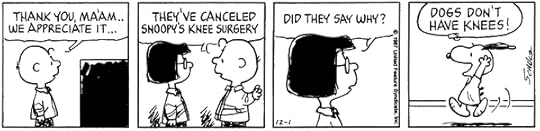
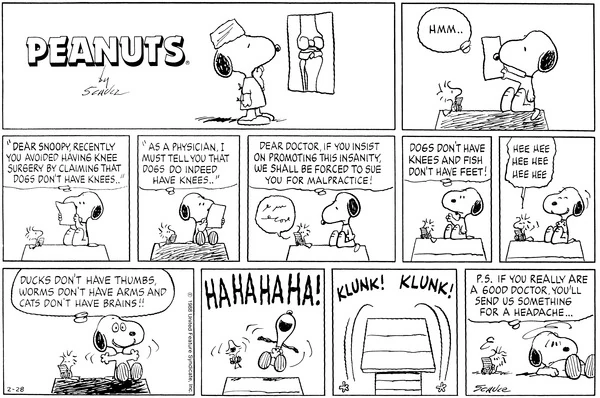
In the 19th volume of The Complete Peanuts, uproariously inept flirtations abound! In this latest paperback volume of Peanuts , romance is in the Charlie Brown’s flirtatious winking in class sends him to the school nurse, Linus’s attempts to woo “Lydia” of the many names are met with mockery ― and Peppermint Patty and Marcie’s fierce quarrel over which one of them “Charles” likes the best. Other storylines include Snoopy’s stay in the hospital for a hockey-related knee injury ― until everyone realizes that dogs don’t have knees, Patty’s campaign to be her school’s “May Queen,” Sally’s rocky career as a playwright, and Snoopy’s “kiss-and-tell” book. Plus, fan-favorites Lucy, Rerun, Spike... and Snoopy’s feathered Beagle Scouts! The Complete Peanuts is the publishing project that launched a renaissance in comic strip publishing and the only place Charles M. Schulz’s classic has ever been collected in its entirety. Featuring impeccable production values, each volume of this series features two successive years of newspaper strips (dailies and Sundays), plus bonus material such as celebrity introductions, interviews, and a brief biography of Schulz himself. Black-and-white illustrations throughout
Charles Monroe Schulz was an American cartoonist, whose comic strip Peanuts proved one of the most popular and influential in the history of the medium, and is still widely reprinted on a daily basis. Schulz's first regular cartoons, Li'l Folks, were published from 1947 to 1950 by the St. Paul Pioneer Press; he first used the name Charlie Brown for a character there, although he applied the name in four gags to three different boys and one buried in sand. The series also had a dog that looked much like Snoopy. In 1948, Schulz sold a cartoon to The Saturday Evening Post; the first of 17 single-panel cartoons by Schulz that would be published there. In 1948, Schulz tried to have Li'l Folks syndicated through the Newspaper Enterprise Association. Schulz would have been an independent contractor for the syndicate, unheard of in the 1940s, but the deal fell through. Li'l Folks was dropped from the Pioneer Press in January, 1950. Later that year, Schulz approached the United Feature Syndicate with his best strips from Li'l Folks, and Peanuts made its first appearance on October 2, 1950. The strip became one of the most popular comic strips of all time. He also had a short-lived sports-oriented comic strip called It's Only a Game (1957–1959), but he abandoned it due to the demands of the successful Peanuts. From 1956 to 1965 he contributed a single-panel strip ("Young Pillars") featuring teenagers to Youth, a publication associated with the Church of God. Peanuts ran for nearly 50 years, almost without interruption; during the life of the strip, Schulz took only one vacation, a five-week break in late 1997. At its peak, Peanuts appeared in more than 2,600 newspapers in 75 countries. Schulz stated that his routine every morning consisted of eating a jelly donut and sitting down to write the day's strip. After coming up with an idea (which he said could take anywhere from a few minutes to a few hours), he began drawing it, which took about an hour for dailies and three hours for Sunday strips. He stubbornly refused to hire an inker or letterer, saying that "it would be equivalent to a golfer hiring a man to make his putts for him." In November 1999 Schulz suffered a stroke, and later it was discovered that he had colon cancer that had metastasized. Because of the chemotherapy and the fact he could not read or see clearly, he announced his retirement on December 14, 1999. Schulz often touched on religious themes in his work, including the classic television cartoon, A Charlie Brown Christmas (1965), which features the character Linus van Pelt quoting the King James Version of the Bible Luke 2:8-14 to explain "what Christmas is all about." In personal interviews Schulz mentioned that Linus represented his spiritual side. Schulz, reared in the Lutheran faith, had been active in the Church of God as a young adult and then later taught Sunday school at a United Methodist Church. In the 1960s, Robert L. Short interpreted certain themes and conversations in Peanuts as being consistent with parts of Christian theology, and used them as illustrations during his lectures about the gospel, as he explained in his bestselling paperback book, The Gospel According to Peanuts, the first of several books he wrote on religion and Peanuts, and other popular culture items. From the late 1980s, however, Schulz described himself in interviews as a "secular humanist": “I do not go to church anymore... I guess you might say I've come around to secular humanism, an obligation I believe all humans have to others and the world we live in.”
In 1988, after 38 years, we saw the traditional 4 frame comic strip cut to 3, and sometimes even 2 in or 1. Luckily the Sunday strip remained true. I had to take off a star due to a couple of things. I almost did this on a couple of previous 80’s volumes. Schultz keeps the ridiculous Spike in the desert thing going way too long. Keeping characters like this while losing Shermy, Violet,the original Patty, Pigpen, Frieda, etc. makes little sense. There is also too much focus on Peppermint Patty in school. Her best stuff is away from school. Marcie is excellent in this volume, as is the ongoing relationship between Linus and Lydia. Overall 4 stars because Scultz, even not at his best, is still very good.
Not the very best of Charles M Schulz but still worth reading. Some experimentation from the cartoonist with a few of the regular four frames in a strip cut down to three or two. Snoopy is, as ever, top entertainment. We all feel Charlie Brown's trials and tribulations. The combination of Patty and Marcie is top notch in this volume. However the Spike stories from Needles are a bit hit or miss.
Best things about this collection: The introduction of Linus’ cute and oh, so frustrating schoolmate (and sort of crush), Lydia (“Today my name is ...”), and perhaps my all-time favorite Peanuts strip (from 2/29/88): Patty (staring in dismay at her test paper): Rats! Another “D-minus”! Marcie: Life has its sunshine and its rain, sir..its days and its nights..its peaks and its valleys... Patty (appearing even more despondent): It’s raining tonight in my valley!
Monday, February 29th, 1988: that was the day the daily strips went from 4 panels to three, and occasionally two. Discombobulating at first.
It also contains one of my all-time favorite panels, which I used to have cut out and saved on my refrigerator for many years: Lucy, saying to Linus, as he sits in the beanbag chair, "How would you like to have someone like myself remind you of all your faults?"
Amazing that Schulz just kept better and better. And I have to say - after reading every single comic he did up to this point, Marcie has to be one of the best characters Schulz created.
As before, the highs are less frequent and I was very surprised at the sudden move to 3 panel stories midway through. I would be interested to understand why that happened and so abruptly. But when Schulz is on form, there is no one better. The skit about Snoopy's knee surgery is laugh out loud funny. And Lydia, who we met in 1986 is central to many of my favourite sections in this collection. It's amazing the level one man has managed to achieve over 40 years. Will be interesting to see how his final decade pans out.
Peppermint Patty: "Who're you writing to Marcie?" Marcie: "I'm writing to Charles... I just kind of want to know if he misses us..." Peppermint Patty: "Don't get too involved, Marcie... They say that every broken love takes a year off your life..." Marcie: "I wonder if that's true..." Peppermint Patty: "I don't know... I just made it up!"
So before I get to my usual way of "reviewing" these Peanuts collections by sharing my favorite strip from this collection (because there's no reason to tell you that Peanuts is so great--you already know) I wanted to mention two things about this volume.
First, to me the gold standard of the introductions to these volumes is the one that Robert Smigel did for the 1975-1976 edition but the introduction by Doonesbury's Gary Trudeau is a close second, if not for the reverence someone who is fairly established cartoonist has for Schulz, then for the explanation of who Snoopy's Veteran's Day root beer drinking buddy Bill Mauldin, was. It turns out that Mauldin was one of Schulz's mentors and in my further researches, found out that he collaborated with Schulz on the 1998 Veterans' Day strip (we'll come back to that in that volume's review.) Something for us to look forward to to be sure.
The other thing I wanted to note was as of the February 29, 1988 strip, the strip went from a base four panel strip to a base three panel strip. The change is jarring, as the book's pages are formatted to allow for the four panel and Sunday strips to rest comfortably on the page, which means the three panel strips have a lot of white space on either side. Schulz makes due with this change, sometimes running long, one panel strips across the space of three, but I have a sneaky suspicion that this change was forced on Schulz by the syndicate which seems blasphemous to me. (Especially given that I recently read How to Read Nancy and its revealing how the sausage is made gives some credence to this view.)
Now to my favorite strip from this collection. There were many excellent strips to choose from, but I picked one that spoke to me simply because Schulz was a master at taking strange little details about life and weaving a clever bit around it. This one requires a bit of a setup both personally and for the strip itself. I have a dog named Rigby. Rigby has many soft areas to pet on him, including his head, his ears and weirdly enough on the spot on his back legs that would correspond to knees on a human. This is where the Peanuts strip comes in. At the end of November, Snoopy ends up in the hospital because he gets hurt playing hockey. It ends up being a case of mistaken identity as the hospital staff thinks Snoopy is "a big nosed kid" (early Peppermint Patty strips often had her making this mistake about Snoopy.) In the end, Snoopy avoids knee surgery. Why?
One cartoon stopped me in my tracks... December 17, 1988. It is the final of a series of comics where Charlie Brown has been trying to secure a dog license for Snoopy. CB says to the (out of panel) adult, "Yes, ma'am. We got the dog license..we also got a driver's license and a fishing license." Then he turns to Snoopy and says, "No, she says you don't need a license for that." And he walks out with Snoopy following him, and Snoopy is carrying an assault rifle. That was 1988, and it could not be more relevant or poignant today.
An up and down collection. I don't know if the panel reduction was a request from newspapers or if Schulz just couldn't keep up with doing 4 panels a day anymore. It also occasionally drops to 2 or even 1 panel strips that come off as lazy. Peppermint Patty is starting to get too much focus and is losing her effectiveness as a result. At the same time, Marcie gets better and better through her increased use. Spike also shows up more, but his jokes are so dumb they're some of my favorites.
February 29, 1988 the daily strips went from 4 panels to 3 panels. There are even some that are two panels, and a couple that are only one panel. It is almost exactly at this time that the humor seemed to really come down. It almost seemed forced. There are many notable moments, but I really found it to be disappointing.
On February 29, 1988, the daily strips (excluding Sundays) went from an average of four frames to three frames. Somehow it doesn’t seem fair. Best quote from Lucy: “Nothing that’s going on in the world today is my fault!”
There is something comforting about reading these strips were initially run after I had stopped actively following Peanuts. Schulz's gentle touch is fully evident, and he still has the ability to make me laugh out loud a few times, for example the strip with Peppermint Patty as a sheep in a play forgetting her line. This volume also featured the transition from 4 panels to 3 panels (with occasional variances), which was probably due to the shrinking space made available by the newspapers to cartoonists. Also interesting was Schulz's first use of screentone for shading things like Snoopy's doghouse, and some furniture.
I hope to find as many of the volumes as I can. My love for the Peanuts kiddos hasn't changed in years. They are oldies but goodies. RiP Sparky.. and thanks for leaving these for us to read and pass to future generations..
J’ai trop aimé découvrir l’univers des Peanuts ! J’avoue avant ça j’avais juste vu le film et lu quelques strips Merci Alix :))
Les persos sont iconic, et présentent parfois des thématiques très adultes, c’est super cool Par contre, comment ça Schulz a détesté l’appellation « peanuts » jusqu’à sa mort ?? 😧
“Lydia” appears for the first time, I really enjoy her frustrating relationship with Linus. The strip changes format and Schulz begins experimenting with it... A good volume. It’s not the best, but it’s really good.
I think this is the first time that the author uses different formats for his daily comic strips, going from 4 panels to a variable number (1, 2 or 3, excluding the Sunday panels). It’s interesting to see the evolution.
I read this a long time ago but it made me laugh out loud. This book contains comics that inspired the peanut films. It is overall a funny book that quickly passes time.
Nice collection of Schulz's late 80's material, with just a few mis-steps (too many Spike strips with the same punchline). Very thoughtful intro by Garry Trudeau.
Imagine doing the same thing for 38 years, and then being told you have to make a significant change. I don’t know about you, but I’d be pretty upset. Well, on February 29, 1988, Charles Schulz suddenly had to draw his daily strips in a much smaller size, as did all other comic strips. The exception was Gary Trudeau’s Doonesbury, which Trudeau successfully argued needed more space because it was political.
No doubt Schulz was upset and complained about the shrinkage of space. But a remarkable thing happened – his strips suddenly became a lot better. They don’t come anywhere close to the pinnacle of the seventies’ strips. But the change in size seems to have sparked Schulz’s creativity.
The most obvious change on 2/29/88 strip is that the number of panels has gone from four squares to three. But then on 3/11 he decided to squeeze in four squares, each of uneven size. On 4/2 he does something quite remarkable for him, and makes the strip a single panel. Did he do this before the size change? If so, I don’t remember it. On 4/16 he tries out a two-square strip.
The size of the squares has a dramatic effect on his artwork. I’m no artist, but even I can see that the bigger squares allow Schulz to play around with perspective. Some of the strips lose their flat two-dimensional looks and actually look somewhat three-dimensional. This seems most evident when he has his characters sit in oversized chairs.
None of this would matter if the strips themselves weren’t funny. My theory is that the shake-up in the art inspired him to shake up his gags. We’re still stuck with lots of un-funny Spike strips, but there are some real gems in between. My favorite are the strips with Linus and Lydia, a girl who completely messes with his head. When she’s not coming up with creative ways of telling him that he’s too old for him, she’s constantly changing her name. “Tomorrow my name will be Ophelia..As my character grows and my beauty increases, so will my names change…” Pretty meta thing to say for a Peanuts character. Lucy asks Linus, “Why do you bother with her.” Linus replies “She fascinates me.” (In a four-panel strip – so much for my theory. Although, to be fair, it happens a couple of months before the change, so maybe Schulz was already inspired to shake things up.)
Anyway, it’s unfair to say Schulz wasn’t funny after the seventies. The fact is that he’s always had dry spells in his humor. In the eighties, these dry spells can last over a year. But what the 1988-89 edition proves is that those dry spells weren’t permanent, and he still had a few good gags up his sleeve.
One last note – Gary Trudeau is an asshole. The prefaces to the Complete Peanuts series have been uniformly abysmal, with the exception of Robert Smigel’s entry in 75-76. Why did they give Trudeau the 88-89 slot? Did Trudeau ask for it or was it randomly assigned. Trudeau is a fellow cartoonist closely associated with the size change. Does he bring it up at all? No. Because he’s an asshole. Instead he writes some tripe about how famous Schulz is. Well, no kidding. Nobody’s clamoring for “The Complete Doonesbury.” Why on earth did they give Trudeau a preface slot when Schulz was on record that he thought Doonesbury sucked. Trudeau’s lame preface was probably his way of sticking it back at Schulz. He doesn’t deign to talk about Schulz’s craft, doesn’t analyze how he tackled the change. That would force Trudeau to come to terms with how Schulz’s craft completely obliterates his own.
I understand that Tom Tomorrow is doing the preface for 91-92 book. I can’t wait.
With this volume, Schulz is heading for the final lap of his fourth decade with one more decade to go after. This volume boasts the best introduction of the series to date, by Garry Trudeau, and has some great strips among others that are just so-so. Trudeau: “Peanuts was the first post-modern comic strip. Everything about it was different. The drawing was graphically austere but beautifully nuanced. It was populated with complicated, neurotic characters speaking smart, haiku-perfect dialogue. The stories were interwoven with allusions from religion, classical music, psychiatry, and philosophy.”
In Peanuts there was nothing unusual about Peppermint Patty doing (poorly) a book report on War and Peace. Or a bilingual text as Snoopy, downed World War I ace, wandering the French countryside, consulting his phrase book as Marcie speaks abundantly in French. Or this Beckett-like exchange between Sally Brown and Linus: “What are you doing here?” asks Linus. “I’m practicing waiting for the school bus,” replies Sally. “Is that something you have to practice?” “It is if you want to be good at it.”
Familiar tropes abound but work freshly: Nearly forty years in and Snoopy, writing his tell-all book, can’t remember the little round headed kid’s name; Charlie Brown’s baseball team (Peppermint Patty trades Marcie for Lucy and both managers regret the trade); Snoopy’s fantasy life (he’s a surgeon as well as the usual cast of characters, including sand trap violating leader of the French Foreign Legion); Lucy is a shrink, football holder, and know it all (Linus volunteers to bring the world together so Lucy can improve it with her wisdom—try to get them all in one room, says Lucy, I hate to say things twice).
Peppermint Patty and Marcie call Charlie Brown from camp to ask if she misses them. He turns to his baby sister for advice. “I think Peppermint Patty and Marcie like me but I don’t know why…I wish I could ask them.” Sally nixes the idea, “It’s all right to ask somebody why they hate you, but you should never ask somebody why they like you.” “Why is that?” Says Sally, “It’s a harder question.”
Charlie Brown takes Snoopy to city hall to get him a dog license but first he comes away with a driving and fishing license for his dog. After securing the dog license, they go up to one more counter but Charlie Brown turns back to Snoopy. “No, she says you don’t need a license for that.” He and Snoopy leave city hall with Snoopy shouldering an assault rifle.
A lot happening in these two years of Peanuts, and the volume starts with a very cool intro by Garry Trudeau. Mr Trudeau compares Schultz to Bill Mauldin a famous cartoonist from WW II, and one of Charles heroes, and then "blamed" his own career on his love of Charles Schultz. A fun way to start the volume off. 1087 starts off with Charlie Brown winking at the little red haired girl and ends up with him in the eye doctors office having it checked out. Romance is in the air as Linus is having his first problems with Lydia who doesnt know who he is,even tho he sat in front of her all year in school. Snoopy is prominent all thru the volume as a surgeon, a member of the foreign legion,the flyin ace and a patient with knee surgery. Peppermint Patty trys for May Queen again and falls far short. Rerun learns the finger snap. Marcie tells Charlie Brown that her and Peppermint Patty "love him" and PP worries about it the whole time they're at camp,as swim instructors.In fact the PP/Marcie/"Chuck" triangle keeps coming up thru the whole volume. There's a new character that wants to be part of a non-existant football team,Leland, who is a helmet with feet. On the holiday gets out Christmassed and the problem continues on Valentines Day. I also found PP's wig to be a fun little run. It was during this period that Charles Schultz started to experiment with the format of the dailies. Sometimes using just three panels, sometimes just using one long panel. Very creative and interesting lesson for anyone interesting in cartooning. This is a great series for fans and a lot of fun for anyone who happens upon it. I recommend it but I am that a huge fan of Schulz and Maudlin too.