Jump to ratings and reviews
Rate this book

Nuclear Ethics

Rate this book
Discusses the methods of moral reasoning, the evaluation of moral arguments, nuclear war theory, the policy of nuclear deterrence, and the effect of nuclear weapons on nonnuclear powers

162 pages, Hardcover

First published April 7, 1986

2 people are currently reading
68 people want to read

About the author

Joseph S. Nye Jr.

77 books298 followers
Joseph Samuel Nye Jr. was an American political scientist. He and Robert Keohane co-founded the international relations theory of neoliberalism, which they developed in their 1977 book Power and Interdependence. Together with Keohane, he developed the concepts of asymmetrical and complex interdependence. They also explored transnational relations and world politics in an edited volume in the 1970s. More recently, he pioneered the theory of soft power. His notion of "smart power" ("the ability to combine hard and soft power into a successful strategy") became popular with the use of this phrase by members of the Clinton Administration and the Obama Administration. These theories from Nye are very commonly seen in courses across the U.S., such as I.B. D.P. Global Politics.
Nye was the Dean of the John F. Kennedy School of Government at Harvard University, where he later held the position of University Distinguished Service Professor, Emeritus. In October 2014, Secretary of State John Kerry appointed Nye to the Foreign Affairs Policy Board. He was also a member of the Defense Policy Board. He was a Harvard faculty member since 1964. He was a fellow of the American Academy of Arts & Sciences, a foreign fellow of the British Academy, and a member of the American Academy of Diplomacy.
The 2011 Teaching, Research, and International Policy (TRIP) survey of over 1,700 international relations scholars ranked Nye as the sixth most influential scholar in the field of international relations in the past 20 years. He was also ranked as one of the most influential figures in American foreign policy. In 2011, Foreign Policy magazine included him on its list of top global thinkers. In September 2014, Foreign Policy reported that international relations scholars and policymakers ranked Nye as one of the field's most influential scholars.

Ratings & Reviews

What do you think?
Rate this book

Friends & Following

Create a free account to discover what your friends think of this book!

Community Reviews

5 stars
8 (22%)
4 stars
11 (31%)
3 stars
12 (34%)
2 stars
3 (8%)
1 star
1 (2%)
Displaying 1 - 3 of 3 reviews
Profile Image for Mike.
575 reviews452 followers
February 22, 2016
While I usually read fantasy, sci-fi, or history books, every so often I get a hankering to dig into some philosophy and get back to some of my college roots (not surprisingly I have yet to fully utilize that minor in philosophy I picked up at University). So here I am, reviewing a mid-1980's book about the ethics of nuclear policy.

The first half or so of the book was pretty basic for me. It was a review of various ways of to assess a moral decision. This basically devolves into a consequential argument (the morality of an action is determined by its consequences) and more rules based argument. Nye does a good job explaining these positions with examples that illustrate their strengths and drawbacks as a way to establish a firm moral philosophy foundation for a reader not familiar with the subject. Since I was already quite familiar with them this part was a bit of a drag but important for later in the book.

Nye was writing in a time where the world was very much facing the chance that human civilization could be utterly obliterated.
We may be, in the words of the American Catholic Bishpos, "the first generation since Genesis with the capacity to destroy God's Creation."
On one side was the Western Alliance led by America and on the other was the Eastern Bloc states led by the Soviet Union. Both sides had the capacity to destroy the world many times over but, thus far, had yet to turn the Cold War into a hot war. One of the main contributors to this balance was the policy of Deterrence. Basically if both sides had the capacity to destroy the other side even after suffering a sneak attack the other side would be less likely to risk such retaliation. Think War Games, but with less Matthew Broderick.
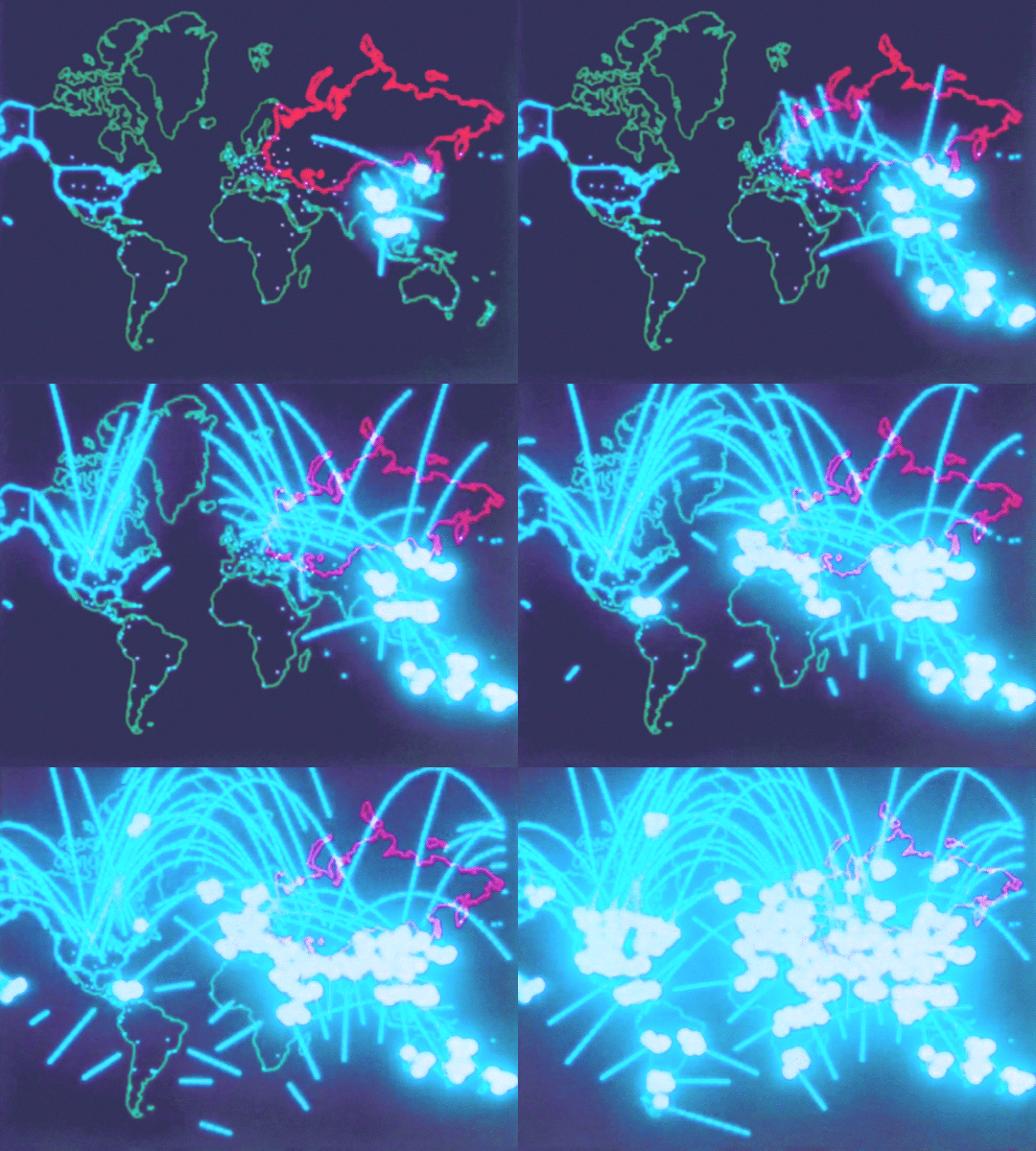
description

Naturally the immolation of billions of people (not to mention countless animals and civilization as we know it) ought to require some sort of moral assessment. Is it moral to have our weapons on a hair trigger? Should we be building more weapons to further increase deterrence even if it is at the expense of civilian needs? What about other countries? Do we owe them any part in our moral calculus when making these sorts of decisions?

All in all I would say Nye does a very good job laying out many facets of the nuclear question and very methodically assess their moral qualities, both pro- and anti-deterance. While the paradigm he comes up with isn't the most exciting or earth shattering it can still serve in modern times:
1. Self defense is just but limited cause.
2. Never treat nuclear weapons as a normal weapon
3. Minimize harm to innocent people
4. Reduce risks of nuclear war in the near term
5. Reduce reliance on nuclear weapons over time
Boring, but still a very useful guide to work from. As much as I would like to relegate this need to the dustbin of history, we still have assholes of some significance that don't seem to have the same moral introspection that Nye demonstrates throughout this book.

Much of what Nye writes about is a bit dated. He completely missed the whole "Soviet Union collapsing within five years", assuming they would be a fixture on the international scene for the foreseeable future. Some of it, however, is not. I found he reasoning on the matter of allowing (or in his case NOT allowing) other nations to develop nuclear weapons very compelling. Effectively they could lead to less secure nuclear materials, more resources being diverted away from civilian use, and more regional rivalry. Further I think he makes a very strong case against a comprehensive nuclear missile defense given the reaction such a system would cause other nuclear nations before it was fully installed. Finally, I wonder how Nye's views on the morality of deterrence (where he places much faith in American and Soviet control systems) in light of the 1983 Soviet Nuclear False Alarm Incident. Seriously scary stuff.

Everyday I wake up glad I don't live under the perpetual fear of nuclear annihilation. There is still the danger out there and it is incumbent upon our leaders to ensure that the risk is diminished with every new generation. Nye's work, while dated, still serves as a very well reasoned and methodical basis for leaders to refer to while assessing nuclear matters.
Profile Image for Mihai Zodian.
160 reviews54 followers
June 12, 2025
The title is an apparent paradox. These weapons are so terrible that a Nuclear Ethics seems inconsistent. For the late Joseph Nye Jr. it was not always the case, and he tried to offer an accessible argumentation. Premised on his teaching, this short book is useful for anyone interested in nuclear debates.

The volume searches an alternative to skeptics and absolutists, an option called rule utilitarianism. There is a room in international politics for ethics, even if this domain lacks a common authority and culture. Nye thought that this could be found in the just war tradition, which tried to reconcile morality with power and in the works of Max Weber. Nuclear Ethics is mostly a framework for ethical debate.

Nye pleaded for a judgment balancing motives, means, and consequences. Nuclear Ethics offers five criteria to guide the reader in concrete situations. Some are logical, others are about a J. Rawls-inspired impartiality, an emphasis on rules or prudence. He used them to evaluate several topics like deterrence and disarmament.

Nuclear Ethics took a nuanced stance about controversial issues at its publishing in 1986, which are still debated today. Both a generalized proliferation and disarmament are rejected as unstable options. Only a highly restricted form of deterrence intended for defense was acceptable for Nye because it worked like a crystal ball before the start of a possible war. While a controlled form of proliferation was tolerable, the dependence on nuclear weapons should decrease in the long run.

Nuclear Ethics has many virtues. It invites the reader to take a reasonable stance and share a healthy distrust of abstract models who can't be tested. The arguments can be criticized from both extremes as naive or propagandistical. Years after, writing in 2023, Joseph Nye Jr. maintained that the major points of the book are still valuable.

Additional sources
Nye, Joseph Jr., "Nuclear Ethics Revisited", Ethics and International Affairs, 37:1, pp. 5-17.
Profile Image for Vincent Vo.
8 reviews1 follower
March 14, 2016
As a high school student a lot of the stuff that I read was pretty confusing, and i had to look up certain things just to understand a couple sentences. It was pretty interesting otherwise, and will most likely re-read it when I'm older.
Displaying 1 - 3 of 3 reviews

Can't find what you're looking for?

Get help and learn more about the design.