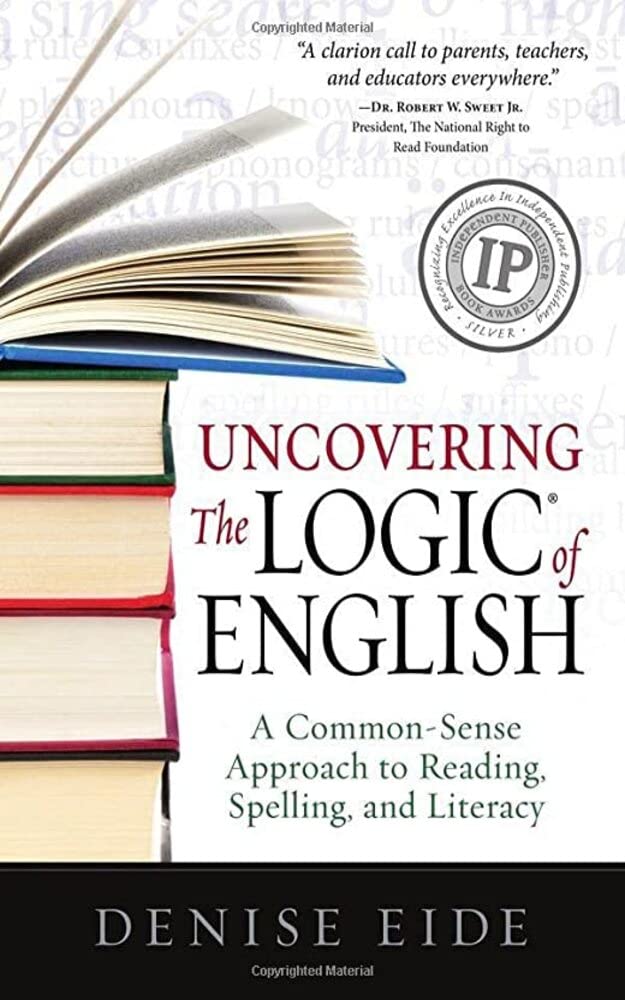
Multiple award-winning book on reading and spelling education that will transform how you think about English! Do you know a student who is good at math or science but struggles with reading or spelling? Has a student ever asked you a question about English spelling to which you replied, "That's an exception"? Have you ever abandoned a word while writing because spell check didn't recognize it? Discover this revolutionary method that Dr. Temple Grandin called "really helpful for teaching reading to children who are mathematical pattern thinkers..." Predominant reading methods require students to break the complex code of English without help. This has resulted in low literacy rates and explains why many highly educated professionals cannot spell. By revealing the logical patterns underlying 98% of English words, Uncovering the Logic of English eliminates the need to guess and provides a logical solution to English spelling.
This is one of the stupidest books I have ever read. Why? It reads like one of those dietary books that tells you all other dietary methods are useless and only the author’s teaching processes will achieve literary success.
I first entered the classroom as a student teacher in 1972. I started my career as an English as a Second Language teacher. I worked in numerous positions in the field of education. Gained a bachelor’s and master’s degrees in education, became a principal and the after my retirement returned to the role of an ESL teacher, teaching Afghan refugees. I did casual teaching in classes K – 12 for two and a half years during COVID. I now live in Asia and tutor students in English.
The absurdity of this book is the idea that if you teach students her thirty-five rules there will be immediate success in literary achievement: It doesn’t happen.
Denise Eide makes claims about a literacy crisis exists (She is relating this data to USA but many believe it exists throughout the English speaking world) then quotes unsourced figures, “34% of fourth graders cannot read.” “69% of our eighth graders are below grade average” (I ask how can you have 69% below average, wouldn’t 50% be below and 50% above) I always wonder where these expected performance figures came from? Was there a golden age when all children read, wrote and spelt brilliantly? There wasn’t. For over 50 years I have heard this tired mantra about falling literacy standards.
There are 35 rules she says that young readers must follow. Some young readers have difficulty remember 35 words!
I argue that the greatest inhibitor to learning literary skills is engagement, the willingness and the sustainability of a student to want to learn and the continued engagement in the learning process. The most successful learner is the one who actively engages with the teacher and the resource materials to acquire the skills and knowledge being presented.
Why there is such a disparity in engagement should be the focus of study, not some list of grammar and spelling rules.
The teacher’s role is to create the most engaging environment so that a maximum number of students are participating in the learning process. Good teachers are those who engage with their students.
You would not find a teacher in any K – 2 faculty that doesn’t see the need to teach phonics, the issue is for how long does a teacher’s teaching program focus purely on phonics and how does the teacher meet the various needs of their students? For many readers phonics is the key to starting the learning of reading. For most students the use of phonics in the skill of reading evaporates as they develop a wide range of sight words and then as they gain meaning they start to read groups of words. I have taught Year 1 students who are capable of writing several paragraphs of syntax sensible sentences.
This author never discusses the essence of reading, gaining meaning.
Like swimming, running, cycling once you have acquired the basics you improve by training by applying different strategies to the basic movements. It is much the same in reading.
If you want to be a good reader, then choose your parents carefully. If you come from a literate family where there are much reading material available, where the child has adult readers who act as models, where speaking and listening are valued, then the chances are you will develop the skill, and maybe more importantly, the love of reading.
Eide addresses none of these, rather she devotes page after page of rules and examples.
Acquiring the ability to read is not the same as acquiring the ability to speak. There are neurological disorders that can prohibit the development of speech; Childhood Apraxia of Speech (CAS) and Cri Du Chat syndrome. Some autistic children are mute. Generally, the vast majority of humans learn to speak without the need for specific instruction. Speaking has been part of human ability for tens of thousands of years. Reading for the majority has been around for a few centuries.
Reading appears to be a far more complex learning process than speaking. Very few children learn to read without pedological assistance.
The author argues that English is a logical language, yet she states that it is an extremely complex language. If it is so logical, why does it have so many rules with exceptions. I wonder if she knows any other language. There is no proof that acquiring a first language is more difficult no matter what language.
Unfortunately, there are too many language messiahs claiming that they have the answer to reading acquisition. Sadly, there are too many governments, usually right-wing governments who see teachers as being incapable of designing appropriate learning programs and phonic based programs as the panacea for improved literacy outcomes. Eide’s book adds little to the discussion of how to teach children the literary skills necessary to survive and thrive in our changing world.
Highly recommended to me and I do the same for anyone who is frustrated with what they were taught about the patterns of the English language. There are reasons for the madness. Most I inherently knew as a kid and s further supported with wonderful teachers who built those reading and spelling skills for me.
If you teach reading or spelling - in the classroom, as a parent, etc - or want to know some reason why this is a great resource. It goes hand in hand with the resource book ABCs and All Their Tricks. Next up - Speech to Print.
After having a curious child ask me “why” about a bunch of English spelling idiosyncrasies, this was a fun book to read. Not earthshaking but interesting and my son enjoyed having a more knowledgeable mother 😂 I skimmed over at parts when it didn’t feel applicable.
This book has provided me invaluable insight into the rules of the English language and EVERYTHING makes so much sense. I’ve been a literacy coach for a few years and I have a daughter with dyslexia, so I understand phonics, phonemic awareness and morphology, but this provided me with extra insight. I loved it and I’ve been referencing it almost everyday!
I think it’s also a valuable resource for elementary school teachers. We need to get away from some of the “incorrect” ways we’ve been teaching phonics, morphology and spelling and move to this more logical approach.
Highly recommend for my teacher buddies and linguists!
Follow along on Instagram // @lisawiththegoodbooks
Very interesting book about improving language skills and language acquisition through an understanding of the true rules of reading. It is a great starting place for educators or parents trying to help new readers and would even be useful for anyone wanting to improve their reading or spelling. I had hoped it would include more information on why words are the way they are (where they came from), but that wasn't what this book was trying to be. I do agree that English is more logical than I believed before reading this, but I feel like there is still more grey than is being presumed in these pages. Interesting, worthwhile read.
If you’re an educator READ THIS BOOK!!! English IS logical, we just never learned the rules to why things are spelled or said the way they are - but our students deserve this.
There’s phoneme patterns. There’s morphology. There’s word origin. If we can just teach these to our students, their reading and spelling of words would increase tremendously. We’re already seeing the results.
If you’re just a word nerd or poor speller - this would also be a perfect fit for you.
An excellent resource that explains the "why" behind the seemingly many exceptions in the English language.
Why do the words have, puzzle, and house have a silent E on the end? Why is /u/ spelled with an O in love and mother? Why is S doubled in fuss but not in bus?
My literal, logical-thinking students ask these questions and it is so satisfying to have answers for them!
This changes everything about English literacy for me. I wish I'd read it earlier. I'm glad to have read it now rather than later. I'll refer to it again and again. Great book. You should read it, especially if you're an educator.
This was a required read for one of my classes, but I ended up actually enjoying the book. It breaks down a lot of spelling and reading rules into digestible chunks. I’ll definitely be holding on to this book to reference as needed in my teaching.
Had to read this for class, but I’m a nerd and loved it. So many phonics rules we don’t know about! We would all be better readers and writers if we knew these.
This book amazingly eye-opening. Did I agree with everything, of course not. But I did start this book saying how the English language was so illogical and ridiculous. And now most of it makes sense and I can grasp the concept behind words better due to understanding the rules and phonograms better. As a homeschool mom, I think this book is a hidden gem. I learned so much. As she stated “English is a complex code, though in this complexity lie powerful tools of expression, nuance, creativity, and meaning. By learning then phonograms and rules that control their sounds, students acquire a strategy to sound out unknown words.” I’m not saying I’ll use everything I learned from her book, but I will implement some and I left with so many “Aha!” and “Now that makes sense!” moments that I can’t go back. I can’t wait to implement these rules, strategies, phonograms and morphemes when my children start to read and spell. A book I’ll send have readily available on the shelf to read again and refer to.